China's Seafood Wholesale Markets: What a First-Time Buyer Needs to Know
A pier at three in the morning, a chilled hall that only opens in the late afternoon, foam boxes stacked waist high — China's seafood wholesale market is not simply "a place that sells fish." It is a supply network where fishing ports, landing quays, border inspection points, processing plants and cold stores sit within a few dozen kilometers of one another. This guide is written for two readers: the overseas buyer sourcing seafood from China for the first time, and the newcomer who walks into one of these markets without yet knowing the difference between a trading agent and a stall.
200+Species from more than 20 countries traded at Huangsha, Guangzhou
320,000 tAnnual traded volume at Huangsha, per public reporting in 2025
350,000 m²Site area of Xingcheng Aquatic Products Center, Mawei, Fuzhou
1,000+Domestic and overseas merchants operating at Mawei
Note: this article is a factual introduction to market structure and buying practice. It does not represent any merchant, and it is not a quotation or a sales recommendation. Trading hours, tenancy and market layout change; confirm details with the market operator before you travel.
What Makes These Markets Different
Many buyers picture a Chinese seafood wholesale market as one large wet market. Walk into one and you find something closer to an exchange with a pier attached: upstream are trawlers and aquaculture ponds, downstream are processing plants, restaurants and export containers.
The operating model differs from Toyosu in Tokyo, Garak Market in Seoul and Rungis outside Paris. The difference is not scale but structure — and that structure determines what you can buy, how you buy it, and which steps you have to control.
Farms, quays, ports and the market sit in one chain
Live product comes off a pond or a boat and reaches a holding tank within hours. Imported cargo clears at Nansha, Yantian or Mawei and is drayed straight into the market. The "market price" you hear is three things moving at once: ex-farm price, landed import price, and today's arrivals.
Live is the hard metric, and holding tanks are the storefront
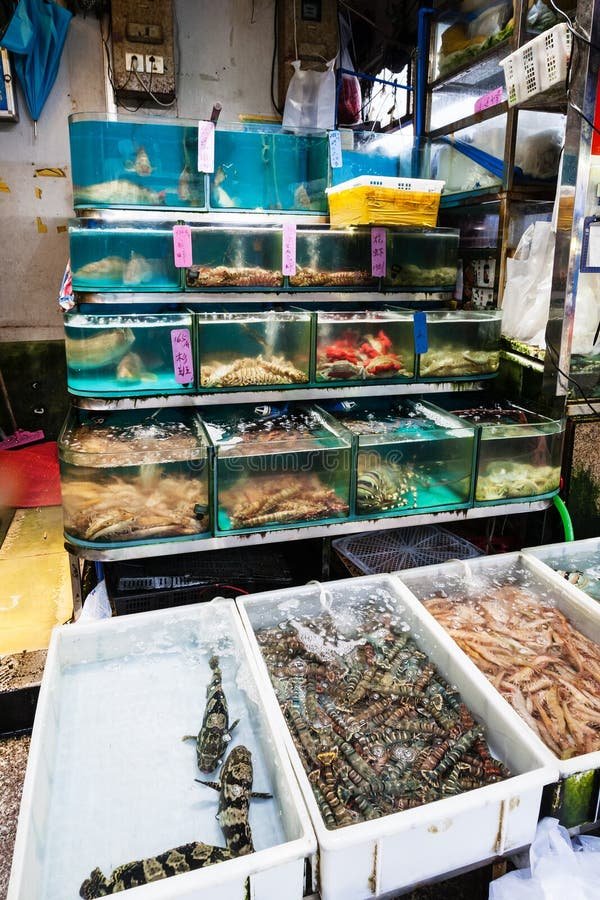
Chinese consumers place a premium on live freshness, so mainstream markets are built around recirculating tanks rather than ice beds. One building may hold coral trout, mud crab, king crab and giant freshwater prawn at the same time. That live-holding and tank-separation capability is uncommon in many markets.
There are two openings a day — miss one and you wait for tomorrow
The live peak runs from the small hours to early morning. Chilled product moves in the late afternoon and early evening, when boats land, sort and ship the same day. Frozen stalls trade normal daytime hours. The most common first-visit mistake is arriving at ten in the morning and finding only pack-down and hose-down.
The range is wide enough to fill a container in one market
East China Sea small yellow croaker, South China Sea grouper, Ecuadorian white shrimp, Norwegian salmon, Russian king crab and Fujian abalone can be bought on the same street. For buyers consolidating mixed loads or testing small orders, that one-stop density is the main value.
Trading agents broker deals — they are not just stalls
Many units in a Chinese market are hang (trading houses): they sell on commission, buy on your behalf, pack and book cold chain. They hold the production relationships and sailing schedules, but earn from spread and commission. Understanding that role matters more than memorizing shop names, because price levels, payment terms and supply stability all come through them.
Prices are day prices, not list prices
There is no stable price list. The same product can carry two prices on the same day, and holidays, typhoons or a delayed sailing will move it again. When you quote your own customer, state a validity period — otherwise currency or landing volume alone can eat the margin.
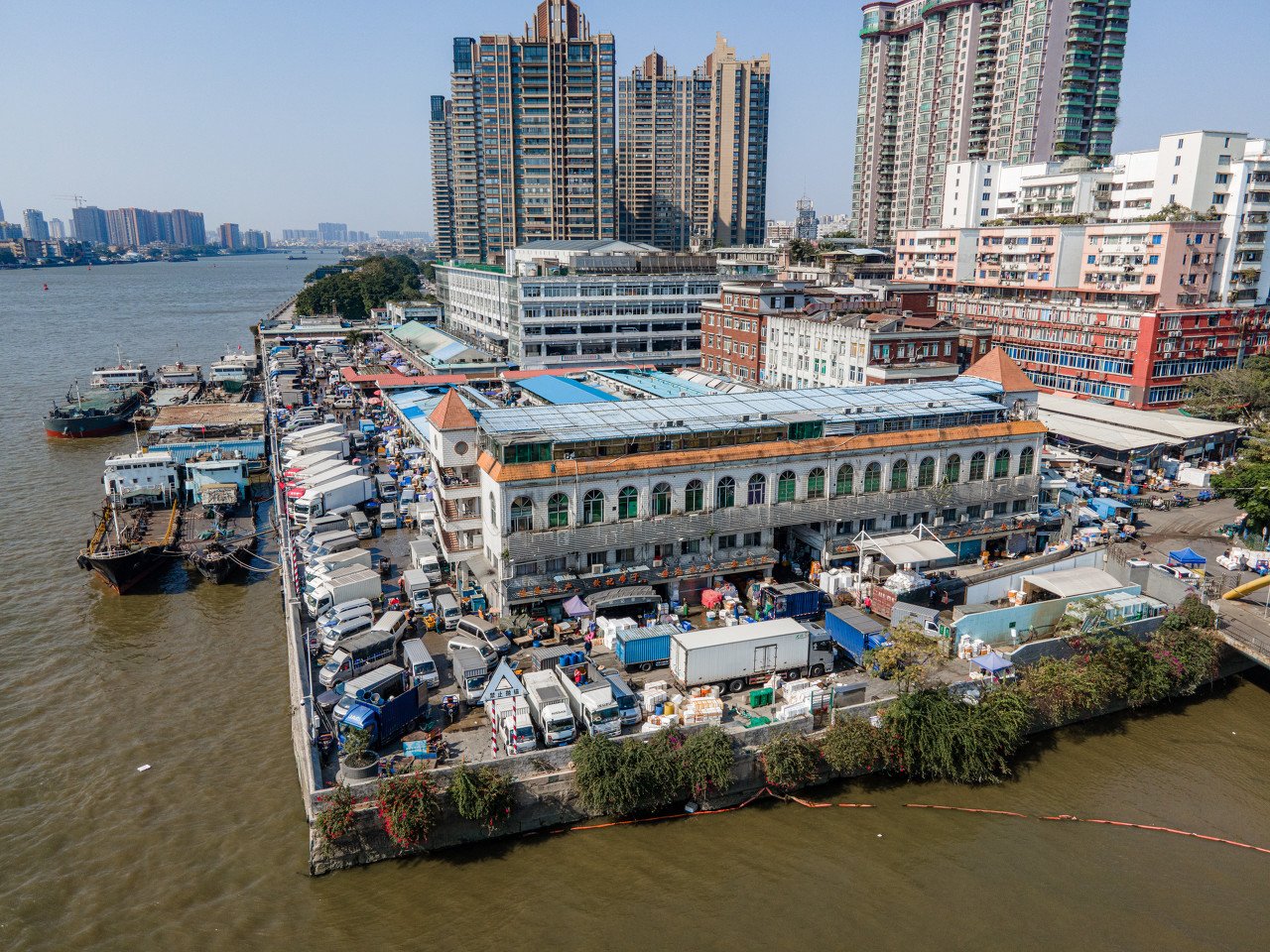
Typical southern China layout: quay, fishing boats and wholesale halls in one footprint. Live product can reach a stall's holding tanks within a few hundred meters of landing.
Compared with Toyosu, Rungis and Southeast Asian landing markets, the gap is structural rather than a matter of size. Toyosu is built on standardized grading and auction; Rungis on licensed wholesalers and contract distribution. Chinese seafood markets rely far more on flexible matchmaking between stalls: you can find product today, change the spec today, pack and ship today — at the cost of uneven standardization, which means inspection, net weight and paperwork stay your responsibility.
Table 1 — Structural differences between China's mainstream seafood markets and other models (qualitative comparison)
Dimension
China mainstream seafood market
Toyosu-type market (Japan)
Rungis-type market (Europe)
Southeast Asia landing market
Trading method
Stall-level negotiation, agent matchmaking, cash or mobile payment
Auction plus registered brokers, standardized process
Licensed wholesalers, contracts and credit terms
Spot trading on the floor, price follows landings
Share of live product
High; holding tanks are core infrastructure
Medium-high; chilled and frozen both significant
Medium; cold chain and pre-packing more developed
High, but preservation infrastructure is uneven
Category breadth
Very wide; domestic and imported in the same market
Wide, with a large imported share
Wide; European waters plus imports
Narrow; mostly local catch
Standardization
Weak to moderate: size grade, net weight and glaze must be confirmed line by line
Strong: grading, labeling, traceability
Strong: packing, temperature control, documents
Weak; experience and eye judgment dominate
Export support
Packing, cold storage, customs brokerage and forwarders around the market
Mature but costly
Mature, with high compliance cost
Limited; often routed via a third country
Barrier for a newcomer
Low barrier to enter, high barrier to buy correctly
Barrier is licensing and cost
Barrier is compliance and contracts
Barrier is consistency of quality
This table is a qualitative structural comparison, intended to set expectations for first-time buyers rather than to rank markets. Actual trading rules are set by each market operator.
China's Main Seafood Hubs — and What Each Is Good At
There is no "best market," only the market that fits this particular shipment. Before choosing one, answer three questions: live or frozen, south China or east/north, and do you need the market to handle processing and export support?
Table 2 — Main consolidation hubs (listed by city; scale and merchant counts come from public reporting and may have changed)
Opened 1994; one of the largest live seafood wholesale markets in China, with 200-plus species from more than 20 countries. The Huangsha Aquatic Center (about 110,000 m², roughly 800 merchants) opened in September 2025.
Live product, imported mid-to-high-end seafood, south China distribution and export
The legacy market and the new center coexist — confirm which site you are going to. Busiest before dawn.
Xingcheng Aquatic Products Trading Center (Mawei) 名成海峡水产品交易中心 ChilledDistant-water
Mawei, Fuzhou
Over 350,000 m², more than 1,000 merchants, 150,000 t of cold storage and a dedicated fisheries wharf; a key consolidation point for distant-water catch and an import gateway for aquatic products.
Chilled product, distant-water catch, imported frozen goods, Southeast Asia re-export
The chilled hall mostly opens in the afternoon and evening; a morning visit shows only leftovers.
Dongfang International Aquatic Center东方国际水产中心 DistributionFrozen
Yangpu, Shanghai
Comprehensive aquatic wholesale market established in 2006, serving distribution across the Yangtze River Delta city cluster.
East China secondary wholesale, restaurant supply chains, frozen LCL consolidation
Distribution-led; origin pricing is weaker than at production-area markets.
Jingshen Seafood Market京深海鲜市场 North ChinaLive
Fengtai, Beijing
One of the larger seafood consolidation and retail-wholesale mixed markets in north China.
North China distribution, direct restaurant supply, small trial orders
Strong retail character; for volume, negotiate the wholesale basis and minimum order quantity.
Zhoushan International Aquatic City舟山国际水产城 OriginCoastal
Zhoushan, Zhejiang
Built on the Zhoushan fishing grounds; consolidates coastal and distant-water catch with strong origin characteristics.
Chasing origin pricing; East China Sea species such as hairtail, pomfret and swimming crab
Heavily exposed to weather and sailing schedules — allow waiting time.
Zhanjiang seafood market湛江水产市场 ShrimpFarmed
Zhanjiang, Guangdong
A concentrated shrimp-farming and processing-export area with stable farmed supply.
Long-term orders for white shrimp, tilapia and other farmed species
Processing-plant access matters more than stall access — schedule plant visits too.
Chengyang Aquatic Products Wholesale Market城阳水产品批发市场 North ChinaFrozen
Qingdao, Shandong
A significant frozen and chilled consolidation point in the north, close to processing and export clusters.
North China frozen goods; exports to Japan, Korea, Europe and the US
For frozen product, check net weight and glaze — not carton weight.
Luohu / Luofang seafood area and the Pinghu new park 罗湖 / 罗芳水产片区 BorderHK supply
Shenzhen, Guangdong
Adjacent to Wenjindu and Liantang border crossings, with a mature Hong Kong and cross-border fresh chain. Merchants from the former Luohu, Luofang and Buji clusters are consolidating into the Pinghu Haijixing International Aquatic Products Logistics Park.
Hong Kong supply, cross-border e-commerce fresh, small high-frequency replenishment
The border area is mid-transition; confirm which side your target merchants have moved to.
A second layer: large regional farm-produce and seafood markets, in four types
Beyond the well-known hubs above, China has a group of very large regional markets. They often do not specialize in seafood: they combine fruit and vegetables, seafood, frozen goods and dried goods in one site, or they lead on freshwater fish and frozen product. For an overseas buyer, sorting the type before deciding whether to visit saves a lot of time.
Production-area type (fishing port or farm zone)
Zhoushan, Zhanjiang and Mawei depend on boats and ponds. Prices sit closer to cost, but weather and sailing schedules make waiting normal. Good for single-species long-term contracts, not for assembling twenty species in three days.
Gateway type (import consolidation)
Huangsha, Shanghai Jiangyang and Jiangyang North Road sit next to airports and ports, so imports distribute on landing. Widest range, fastest information, but the price carries gateway and distribution cost.
Destination type (city distribution)
Beijing Jingshen, Wuhan Baishazhou and Changsha Mawangdui serve local restaurants and supermarkets. Short delivery radius, fast response — best if you already have a channel there and need steady replenishment.
Integrated farm-produce type (full-category, one-stop)
Shenzhen Haijixing and Zhengzhou Wanbang are farm-produce flagships where seafood is one section. The advantage is fruit, vegetables, frozen goods, dried goods and seasonings in one trip — suited to mixed container loads or setting up a local sourcing office.
Table 2A — Large regional farm-produce and seafood markets (figures from public reporting and market websites; may have changed)
Market
City
Type
Scale and characteristics
Best for
Shenzhen Haijixing International Agricultural Products Logistics Park深圳海吉星国际农产品物流园 IntegratedSZ–HK
Pinghu Bainikeng, Longgang, Shenzhen
Integrated farm produce (tier 1)
Opened autumn 2011, fully operational 2012; about 300,000 m² with close to 3,000 permanent merchants. Shenzhen's only national-level tier-1 agricultural wholesale market; media reports say roughly 80% of the city's food passes through it, with daily vegetable volume peaking in the thousands of tonnes.
Assembling fruit, vegetables, seafood and dried goods in one Shenzhen stop; understanding the Shenzhen–Hong Kong supply system
Shenzhen Haijixing International Aquatic Products Logistics Park深圳海吉星国际水产品物流园 SeafoodLeasing
Pinghu, Longgang, Shenzhen
Seafood tier 1 (new build)
RMB 3.65 billion investment by Shenzhen Agricultural Products Group; total floor area about 439,200 m²; planned zones for large live product, shellfish, shrimp and crab, small aquatic species and premium imported seafood, with professional holding tanks and multi-temperature cold storage and centralized seawater, ice and oxygen supply. 15 minutes to Wenjindu crossing, 30 minutes to Yantian port. Public reporting says it is intended to carry more than 90% of Shenzhen's seafood wholesale supply once complete.
Tracking Shenzhen's future main seafood channel; confirm it is actually open before travelling
Established around 2006 on more than 200 mu (about 13 ha) with over 1,700 shop units. After Tongchuan Road market closed in 2016, more than a thousand merchants moved here. Daily wholesale volume exceeds 1,000 t; a key imported seafood hub for Shanghai and the Yangtze Delta.
East China imported seafood and frozen distribution; restaurant supply chains
Shanghai Jiangyang North Road Aquatic Products Wholesale Market上海江杨水产品批发市场 ScaleFrozen
Jiangyang North Road, Baoshan, Shanghai
Destination
One of Shanghai's largest aquatic wholesale markets, with over a thousand shop units, cold storage and ice/oxygen supply; full range of frozen, chilled and shellfish lines.
East China volume distribution; easily confused with the Taihe Road market — check the street address before navigating
Wuhan Baishazhou Agricultural Products Market武汉白沙洲农副产品大市场 FreshwaterCentral China
Hongshan, Wuhan
Integrated farm produce (freshwater strength)
470 mu (about 31 ha); the seafood zone covers about 33,000 m² with its own access gate. Around 80% of supply is local to Hubei. Full range of the four major freshwater carp, eel, crayfish, bullfrog and soft-shell turtle, with holdings reaching thousands of tonnes. Buying peaks in the afternoon.
Freshwater fish and crayfish from central China; a freshwater hub that buys and sells nationally
Zhengzhou Wanbang International Agricultural Products Logistics City郑州万邦国际农产品物流城 FrozenInland
Zhongmou, Zhengzhou
Integrated farm produce (frozen strength)
The aquatic frozen zone opened November 2013 with more than 2,800 permanent merchants, zoned for frozen goods, seafood and freshwater fish, plus large low-temperature cold storage. A key frozen seafood cold-chain hub for the central plains.
Inland replenishment, north China frozen distribution, mixed container assembly
One of the larger seafood wholesale markets in south-central China, with a full range of shrimp, crab, shellfish and fish, fast turnover of imported seafood, and both wholesale and restaurant functions.
Central China seafood distribution, direct restaurant supply, small high-frequency replenishment
!
Two outdated guides that still circulate
1. Buji Seafood Wholesale Market in Shenzhen closed permanently in July 2020 — more than 500 businesses relocated because of high-speed rail construction. Plenty of online guides still recommend it, and following them wastes a day; the former merchants moved mainly to the newer markets around Pinghu. 2. Shanghai's "Jiangyang" and "Jiangyang North Road" are two different markets, on Taihe Road and Jiangyang North Road respectively, with different scale, range and customer base. Many Chinese guides conflate them. Copy the street address into your map app and check the door number before booking a car.
Which market fits which need:
Live product and premium imports: start with Huangsha in Guangzhou — widest range, densest flight and sailing information.
Chilled product and distant-water catch: start with Mawei in Fuzhou, where the chilled hall and cold storage sit on one chain.
Origin pricing, and you can wait for sailings: go to production-area markets such as Zhoushan and Zhanjiang — lower prices, higher uncertainty.
Regional distribution only, steady replenishment: destination markets in Shanghai, Beijing or Qingdao — short logistics radius, fast response.
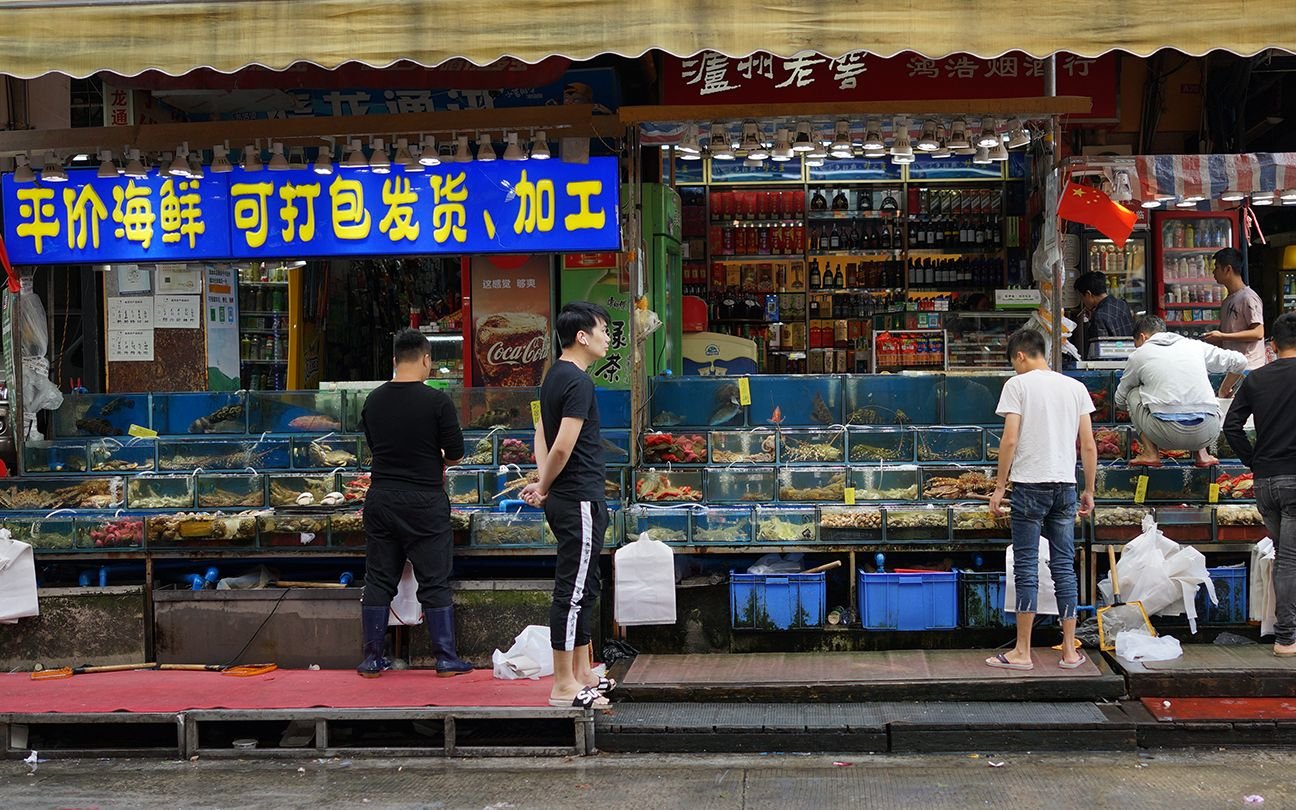
A typical street-front stall. The signage usually advertises three things at once — live product, packing and shipping, and toll processing — which are precisely the services a buyer needs most.
Your First Buying Trip, Step by Step
The beginner's usual failure is not weak bargaining — it is arriving without having settled market access, specification basis and settlement terms beforehand. The sequence below follows the real rhythm of a buying trip and doubles as a working checklist for the first visit.
The rhythm on site is roughly: price discovery in the morning, chilled product in the afternoon, live product before dawn. Agree the specification basis before you discuss price, and buy a small sample of anything you are unsure about.
2–4 weeks before departure
Settle whether the product can enter your country at all
This matters more than picking product. Confirm four things: whether the destination country permits the species (some crabs, abalone and sturgeon lines fall under endangered-species permits), whether the processing plant or vessel is on the destination's registered list, which certificates are required (health certificate, certificate of origin, inspection and quarantine certificate), and labeling and language rules. If any of these is unresolved, the best cargo still will not clear.
1 week before departure
Fix the market and the time window — don't "decide when you get there"
Choose the market by category (see the previous section), then match the window: live product peaks from the small hours to early morning, chilled halls mostly open in the late afternoon, frozen stalls run normal daytime hours. Check whether a typhoon, the fishing moratorium or a public holiday falls in your window — all three distort both price and arrivals at the same time.
First 30 minutes on site
Walk the floor once without speaking or asking prices
Spend half an hour building a price baseline: visit five to eight sellers in the same category and look at who is actually shipping, who is sorting, whose door has a reefer truck parked outside. Stalls moving volume usually have steadier supply and prices closer to the real market. Those displaying samples without shipping are often second-hand resellers.
Choosing a counterparty
Separate an owner-operator from a commission agent
Owner-operated stalls hold their own production or vessel allocation: less price flexibility, steadier supply. Trading agents broker on commission, can assemble multiple species and handle packing and dispatch, but add a layer of margin. On a first purchase, go with the party willing to take you into the cold store and show you the whole lot.
Inspection, 20–40 minutes
Inspect the bottom layer and the whole batch
Do not judge from the top layer. Ask them to open cartons, pull the bottom, and sample three random spots. For live product, read the water color and the animals' movement in the holding tank. For chilled product, check that ice covers evenly and that no blood water has pooled in the carton base. If the batch does not match the sample, say so on the spot — not after loading.
Negotiation, 10 minutes
Five bases to settle, or the price means nothing
(1) Unit of pricing — jin, kilogram, piece or carton. (2) Net or gross weight.(3) With or without glaze — the glazing percentage. (4) Packing included or not — foam box, gel pack, oxygen bag. (5) Minimum order quantity and whether LCL consolidation is allowed. The same sentence — "this price" — can differ sharply across those five bases.
Weighing
Tare, zero, re-weigh — all three steps
Ask for the empty carton to be tared to zero, then re-weigh yourself after the goods are on the scale, or verify on the market's public scale. For loose product, watch whether basket, ice and water weight are being counted. This is not distrust; it is the routine the trade itself expects.
Settlement
Pay on the spot if you like — but take the paper on the spot
The receipt (or handwritten note) must state: date, stall number, product name, specification, quantity, unit price, total, whether glaze or packing is included, and payment method, signed or stamped. For larger amounts, use a bank transfer so there is a record. Ask in advance whether a formal invoice (fapiao) can be issued.
Packing and pre-chilling
Packing decides the condition on arrival
Live: oxygen bags or moisture-retaining boxes chosen by species, never packed too dense. Chilled: layer ice, layer fish, roughly 1:1, with drainage at the carton base. Frozen: insulated box with dry ice or gel packs, and no repeated thawing. Require the goods to be brought down to temperature before packing; sealing warm product is the main cause of arrival loss.
Drayage and export
Market to cold store, cold store to port — two different bills
Around the market you will normally find cold storage, reefer drayage, customs brokers and forwarders. Ask for door-to-door and port-to-port quotes separately: does it include customs declaration, port surcharges, destination charges? If not, the gap shows up as unbudgeted cost at the end. Our FCL sea freight and consolidated shipment pages set out what each basis covers.
Before container loading
Keep the evidence: photos, batch, temperature log
Photograph the whole lot, the sealed cartons, the labels and the thermometer reading before loading, and record batch number and production date. If a quality dispute arises at destination, this is the only evidence that speaks. For high-value cargo, add a temperature data logger.
After you get home
Post-trip review: calculate real cost and real loss
Work out actual yield (net weight after thawing against gross weight landed), loss rate and true landed cost. Keep one reliable contact each for stall, cold store and customs broker. Your second trip will run at twice the speed.
First-visit checklist (tick as you go — saved in this browser)
Trade vocabulary: if you cannot follow these, you will pay for it
Table 3 — Market terms and pricing bases (regional usage varies; confirm once more before you close)
Term
Meaning
Why you must confirm it
jin (斤)
Chinese market catty: 1 jin = 500 g = 0.5 kg
Quote in jin, contract in kilograms — the most common conversion error in the trade
piece / carton / pallet (件 / 箱 / 板)
A unit of one carton or one pallet; carton spec differs by stall
"How many jin in a carton" varies widely — always ask for net weight
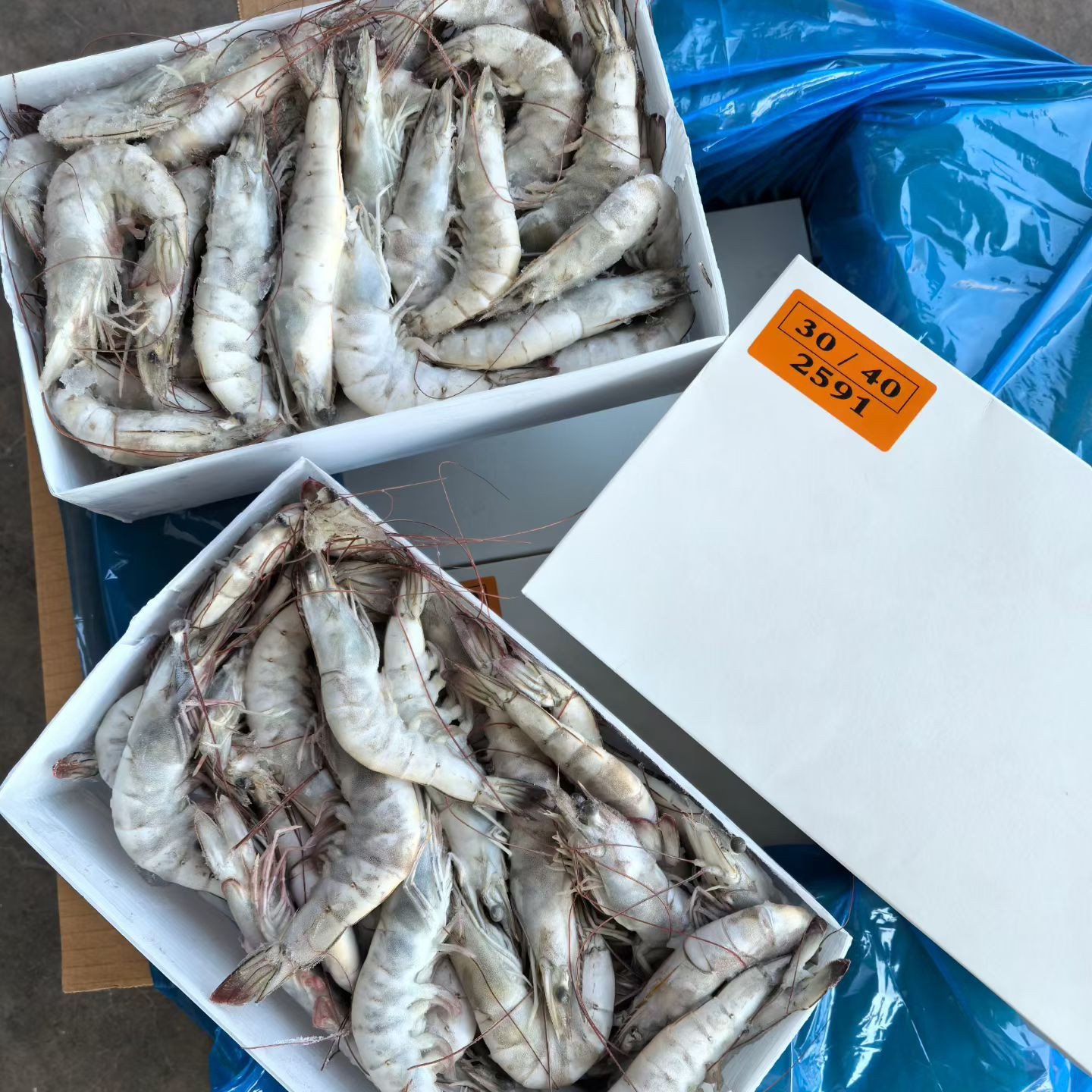
size grade 30/40
Count per pound (or per kilogram); the lower the number, the larger the individual
Mislabeled grade is the most common trick on frozen shrimp
glaze / ice glaze (冰衣 / 包冰)
The protective ice layer on frozen product, priced as a percentage
10% versus 30% glaze on the same carton weight is a tenth of the cargo
net / gross weight (净重 / 毛重)
Net is the product alone; gross includes ice, water and carton
If the quote is silent, the seller defines the basis at settlement
yield (出成率)
Usable share after thawing, heading and peeling
Yield sets your real cost, not the headline unit price
holding / oxygenation (暂养 / 打氧)
Keeping live product in recirculating tanks; oxygen packing at dispatch
Over-long holding loses condition and cuts survival rate
drayage (短驳)
Short haul from market to cold store or port
Often buried inside "freight" — ask for it as its own line
credit terms (账期)
Ship now, settle later
Newcomers rarely get terms — don't get caught by "we'll square up next time"
How to Inspect: Live, Chilled, Frozen and Dried
Inspection is not a vague judgment about "how fresh it looks." It is a set of actions you can complete on the spot. The standards below are what buyers actually use on the floor.
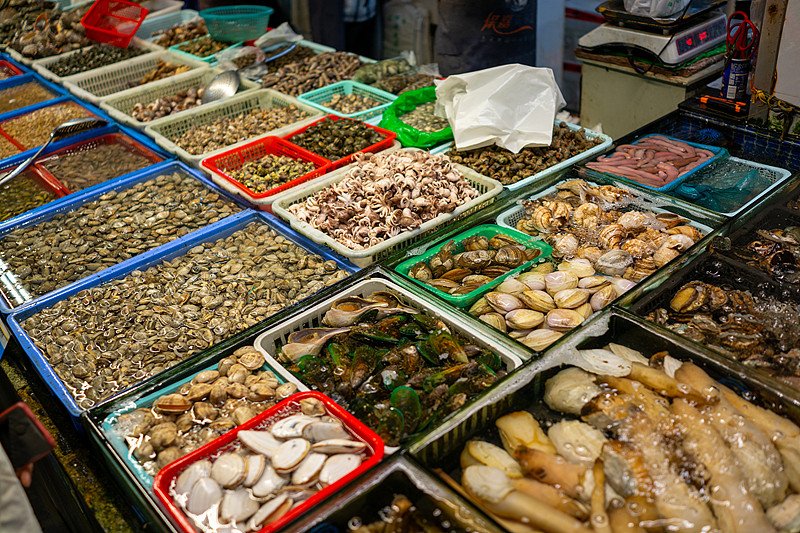
Tiered recirculating tanks hold live product above; foam boxes with chilled fish and shellfish sit below. Many stalls carry both.Shellfish separated by species. Check shell-closing response and whether the product has been purged of sand — not just size.
Live product: four actions, thirty seconds
Movement: fish should hold upright and turn with force; shrimp should flick; crabs should stand and grip. Anything floating on its side, lying flat or slow to respond goes back.
Body surface: scales intact and lustrous, mucus clean and clear. Heavy scale loss, whitening or torn skin does not travel well.
Gills and eyes: gill filaments bright red with no slime or off-odor; eyes full and clear. Dark gills and sunken eyes signal long holding or a dying animal.
Water and density: holding water should be clear with circulation running and stock not packed too dense. Cloudy water, heavy foaming or a foul smell means water changes and tank separation are not being managed — that stock survives poorly after packing.
One extra check for crab: press the base of the second-to-last leg. Hard and full means the crab is well filled; soft or hollow means it has not been fed up. For shellfish: tap the shell — closing means alive; open shells that stay open, or any off-odor, means dead or damaged product.
Chilled product: five points, one pass
Chilled seafood is the category that most tests the eye, and where newcomers lose the most money. Look at five points: eyes (full and clear, not sunken or milky), gills (bright red, no dark brown), surface mucus (clear and thin, not cloudy or stringy), flesh elasticity (springs back when pressed), and belly and vent (not swollen, no leaking). Then one more: whether the ice bed covers the product evenly and whether blood water has pooled at the carton base — pooled blood usually means the cargo has thawed at least once.
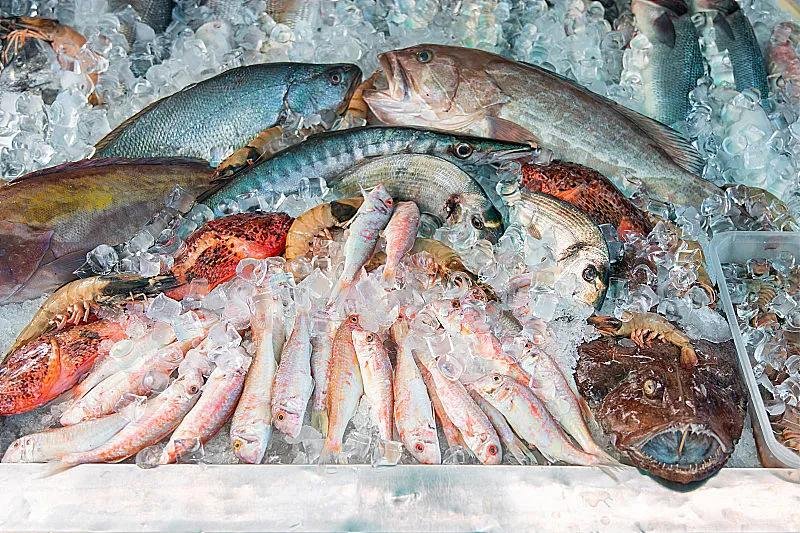
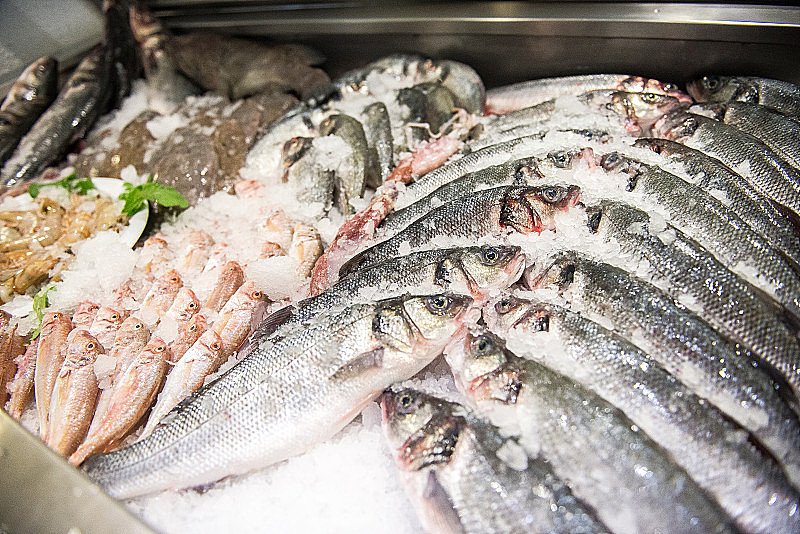
What acceptable chilled product looks like on the floor: crushed ice covering evenly, fish not exposed, no extensive blood water in the box.
Frozen product: four data points, not carton weight
Core temperature: insert a probe thermometer into the center of the carton. −18 °C or colder is the usual requirement; frost on the outside with a soft center means it has thawed and been refrozen.
Glaze percentage: ask for the glazing figure (commonly anywhere from 5% to 20%) and put "net weight" in the contract.
Freezer burn and block freezing: pieces stuck together in a block, or repeated surface frost, usually means second freezing.
Labels and batch: production date, size grade, plant registration number and traceable batch — the precondition for clearing export customs.
Table 4 — What to check on the floor, by category, and the disguises to expect
Category
Key indicators
Pass state
Common disguise
Live fish
Movement, gill color, body surface
Holds upright, bright gills, intact scales
Recently dead but not yet rigid, sold as live; weight loss from long holding
Live crab
Fullness, movement
Hard leg base, can right itself
Hollow "water crab"; inferior grade substituted; weight added by binding
Live shrimp
Flick response, body color
Strong flick, translucent shell
Chilled in ice water to "look alive"
Chilled fish
Eyes, gills, elasticity, ice bed
Clear eyes, red gills, springs back
Re-iced after thawing; old stock mixed with new
Frozen shrimp
Grade, glaze, core temperature
Consistent grade, thin clear glaze
Grade overstated; heavy glaze displacing net weight
Shellfish
Shell-closing response, purging
Closes when tapped, no off-odor
Dead shellfish mixed in; weighed before purging
Cephalopods
Flesh elasticity, color
White, springy, no ammonia smell
Soaked in solution to add weight; repeated thawing
Dried seafood
Dryness, aroma, color
Dry to touch, natural color, clean smell
Weight added with sugar or salt; sulfur bleaching; rehydrated stock
What These Markets Actually Sell
The product range is extremely wide, and for a buyer the bigger risk is usually specification basis and seasonal window rather than species selection: one grade up or one month earlier changes both the price and the end use.
Live crab & lobster 活鲜甲壳类
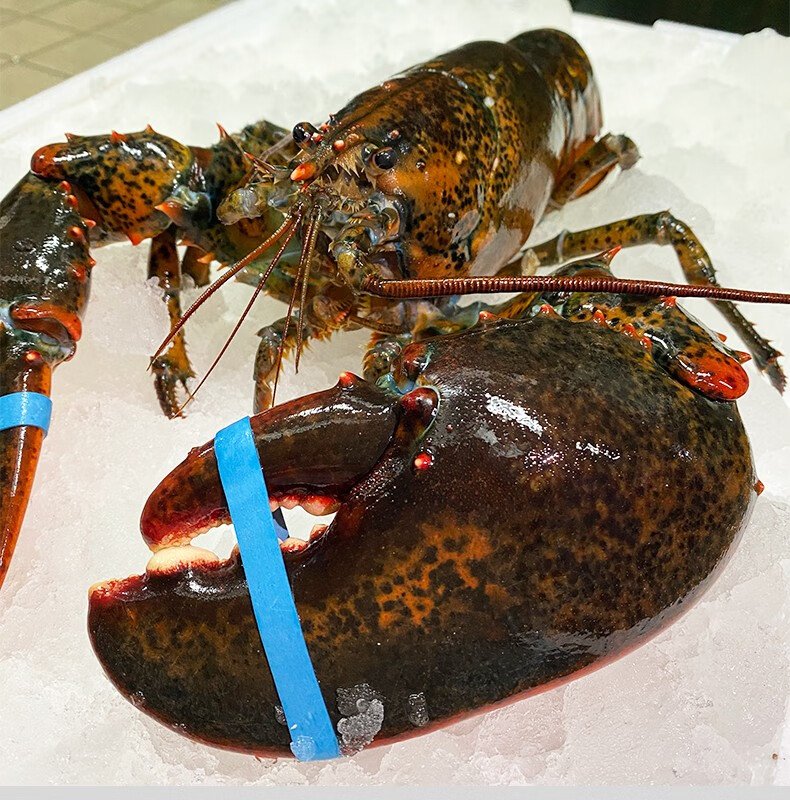
King crab, Boston lobster, mud crab, swimming crab and brown crab are the highest-value lines in the market. Trading runs on both "per piece" and "per jin," with size bands set by individual weight (for example 1–1.5 kg, 1.5–2 kg). The two core risks are fullness, which sets meat yield, and survival rate, which sets how much freight each surviving animal has to carry.
Buying note: per-piece pricing is more common — ask for individual weights to be taken on the spot. Live crab exports require confirming destination rules on live crustaceans and packaging.
Imported lobster & crab 进口龙虾与蟹
This cargo usually lands at Guangzhou, Shanghai or Fuzhou, holds briefly in market tanks and then distributes. What matters on inspection is vigor and completeness — claws, legs and antennae all present — plus time in holding: the longer the holding, the more condition is lost.
Buying note: ask for landing date and days in holding. Exports may require endangered-species permits and related compliance.
Marine fish (chilled or live) 海水鱼
Grouper, large yellow croaker, pomfret, hairtail, mackerel and sea bass dominate. Chilled product is graded by fish weight (for example 300–500 g, 500–800 g); live product is priced per fish. East China Sea species have a clear seasonal window, and the fishing moratorium — generally around May to August, subject to the current year's official notice — drives the widest swings in supply and price.
Buying note: weight bands belong in the contract. Chilled exports carry the strictest temperature-chain and packing requirements.
Shrimp & prawn (live, chilled, frozen) 虾类
White shrimp, black tiger shrimp, giant freshwater prawn and Arctic sweet shrimp are among the highest-volume categories. Frozen shrimp is graded by count per pound (30/40, 40/50, 50/60), where a lower number means a larger individual. Glaze percentage, net weight, and whether heads and shells are on are the three variables that must be written down.
Buying note: grade + glaze + net weight — all three or none. Ask for the plant registration number and batch code.
Shellfish & abalone 贝类与鲍鱼
Oysters, scallops, clams, razor clams, mussels and abalone. Shellfish is low-value and heavy, so freight takes a large share — best bought near the market or consolidated with other cargo. For live shellfish the key checks are shell-closing response and purging; for abalone, also the count per unit weight and whether the mantle edge is intact.
Buying note: price by count per jin or per piece. Exports must meet the destination's growing-water and purification requirements.
Imported chilled fish 进口冰鲜鱼类
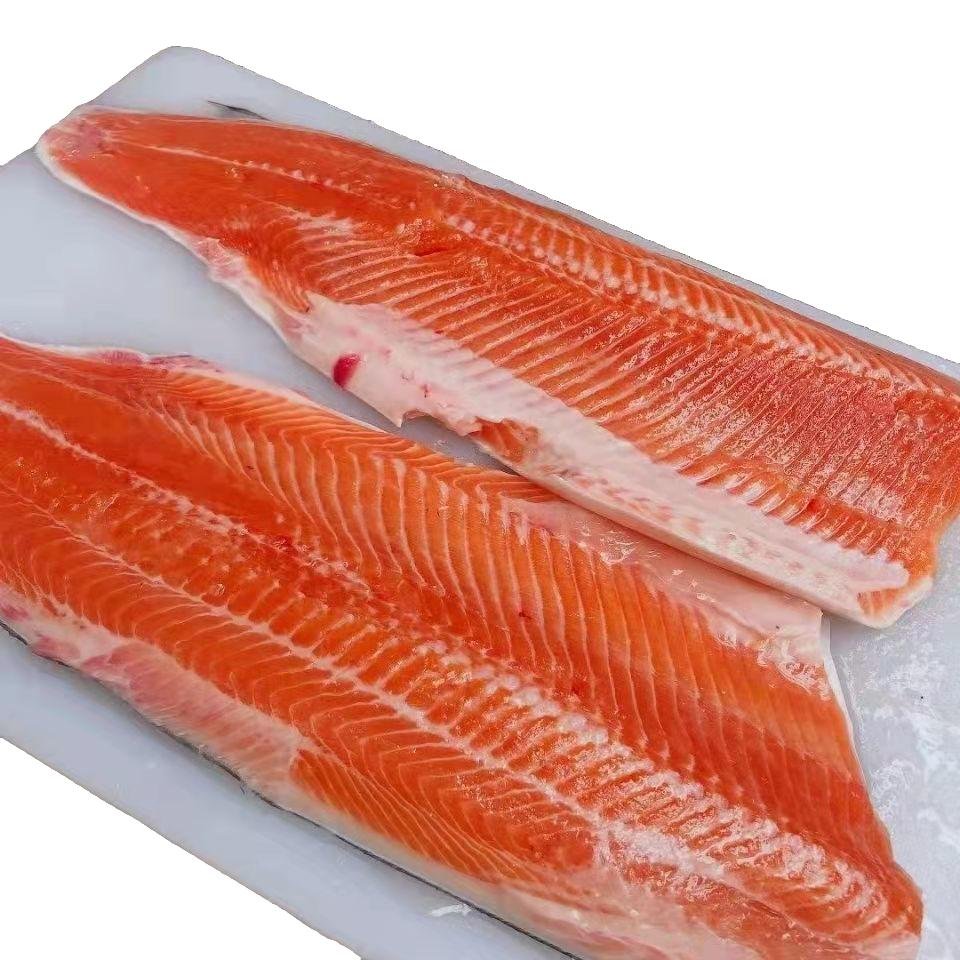
Salmon, cod, sablefish and tuna enter the market chilled or as ultra-low-temperature frozen, mostly whole, headed and gutted, or as portioned fillets. Inspection focuses on core temperature, clarity of the fat lines, cut-face color and days in transit.
Buying note: ask for catch or processing date and days on ice. Air-freighted and sea-freighted lots differ sharply in cost.
Two more categories that matter: frozen prepared lines and dried seafood
Frozen and prepared seafood
Frozen shrimp meat, fish portions, marinated fish and breaded shrimp are more standardized than live product and suit long-term contracts and supermarket channels. What matters is net weight, glaze, additive compliance and plant approval — not whether the piece looks big.
Dried seafood
Dried scallop, dried squid, dried shrimp, fish maw, sea cucumber and swim bladder. High value, small volume, low freight share — the easiest category for a first trial order, and also where sugar/salt weight-loading and sulfur bleaching concentrate.
Where Buyers Get Burned — and How to Avoid It
These are not horror stories; they are routine mechanisms in the trade. Almost every first-time loss traces back to one of them, and nearly all can be avoided with one sentence written down before payment.
!
Basket, ice and water weight
The basket, the ice and the water are all on the scale. On low-value product that can be a tenth of what you pay. What to do: specify net weight; ask for the empty basket to be tared; stand at the scale while it is weighed.
!
Thick glaze on frozen product
Two cartons of the same quoted weight can differ by 15–20% in actual product. The glaze is legal and necessary; the problem is when it is priced as fish. What to do: write the glazing percentage and net weight into the contract, and check one carton by thawing a sample.
!
Water-injected or gel-soaked product
Some shrimp, shellfish and cephalopods are soaked to gain weight; the giveaway is a puddle in the bag, a spongy texture and rapid drip loss after thawing. What to do: weigh a sample, wait twenty minutes, weigh again. If it loses a lot of liquid, the price is not the price.
!
The lot you inspect is not the lot you load
Sampling from a good tank and loading from a different one is the most common substitution, and it is invisible unless you are present. What to do: mark the cartons, photograph the lot, and do not leave the loading area while the goods are being moved.
!
Dead sold as live, farmed sold as wild
Chilled-down animals that still look alive, and farmed product priced as wild-caught, are both routine. What to do: check reflex and rigidity, ask for landing or pond records, and treat origin claims as unverified unless a certificate supports them.
!
Grade overstated
30/40 sold as 20/30 is a price difference with no visible change in the carton. What to do: count ten pieces from a random carton and weigh them; grade is arithmetic, not opinion.
!
Conflicting units
One seller quotes per jin, another per kilogram, a third per carton, and a fourth per piece. Converted to the same basis, the "cheapest" quote is often not. What to do: put every quote on a single basis — net kilogram, delivered to the cold store — before comparing.
!
Packing that shrinks on the way
Cheap foam boxes, thin ice, no drainage, warm product sealed in — the carton arrives lighter and wetter, and the loss is yours. What to do: agree the packing spec in writing (box type, ice ratio, gel pack count) and pay for it as a separate line.
!
Consignment selling and credit terms
"Leave it with me, I'll sell it and settle later" gives the seller your cargo and all the discretion, with no price floor. What to do: avoid consignment on a first deal; if you accept credit, cap the exposure and put the settlement date in writing.
!
Cold-chain quotes on different bases
One forwarder quotes port-to-port, another door-to-door, a third excludes destination charges or plug-in fees. What to do: compare only on the same basis, and ask explicitly what is excluded: drayage, plug-in, inspection, storage, destination THC.
!
Processing fees and yield kept opaque
Heading, gutting and peeling are priced by weight in, weight out, or a flat fee — three very different economics. A 60% yield at a low unit price can cost more than 70% at a higher one. What to do: request yield by species, in writing, and price the finished kilogram.
!
Enthusiastic brokers and deposits
An agent who promises everything, asks for a deposit before any lot is shown, and cannot name the stall he works with, is a risk. What to do: meet at the stall, see the goods, pay against goods — not against a promise. Deposits go to a company account, never to a personal one.
!
Documentation blind spots
Species not permitted at destination, plant not registered, health certificate missing, label not in the required language — the container stops at the border and the cargo becomes a storage bill. What to do: settle market access before you buy, and get the document list from your broker in writing.
If a dispute cannot be settled at the stall, the next stop is the market management office, which keeps merchant records and handles complaints on site. Consumer disputes can go to 12315; commercial disputes between companies usually end in negotiation or arbitration rather than a consumer channel. Neither route recovers the freight you have already paid, which is why the evidence matters more than the argument.
What a Container Really Costs
Buyers usually budget for goods value and freight, and forget the middle. On seafood the middle is where the margin lives — cold chain, packing, loss and the cost of money.
Relative shares below are indicative, based on typical reefer and air shipments of chilled or frozen seafood from south China; they are not a quotation. Actual shares move with species, value density, season and routing — confirm with your carrier and forwarder.
Goods value at market the dominant line
Packing, ice and consumables bought by the carton
Processing and shrinkage yield-dependent
Drayage and cold storage market to port
Customs, inspection and documents fixed per shipment
Sea or air freight reefer or air pallet
Insurance and cost of capital often the invisible line
Bar length shows relative share, not absolute cost. On a low-value, heavy cargo such as shellfish, freight can exceed goods value; on high-value live crab and dried seafood, freight is a small fraction and loss control dominates. Ask for a reefer quote with plug-in, drayage and inspection broken out — see warehouse and cold storage.
Three items almost nobody books:
Loss not booked as cost. A 5%–15% live loss rate, or a 3%–5% chilled shrink, is a real cost per kilogram sold. If it is not in the price, the margin is fictional.
Ice and water weight not booked. Paying for 20% glaze at the market price means the product kilogram costs 25% more than the invoice suggests.
Cost of capital not booked. Payment at the market, cash tied up for 20–45 days at sea, then 30–60 days of customer credit. That financing cost is usually the difference between a good year and a flat one.
Export Documentation and Compliance
Seafood is one of the most document-intensive categories in international trade. Compliance is not paperwork added at the end — it decides whether the cargo can be bought at all.
Exporter qualification and registration
The seller or trading company needs export rights and, for aquatic products, registration with the customs authority; processing plants and vessels must be on the destination country's approved list for many markets. Licensing is the market, not the stall.
Inspection, quarantine and health certificate
Chilled and frozen seafood normally requires inspection and quarantine, and the destination usually demands a health certificate issued in the exporting country, matching the consignment lot by lot.
Species control and CITES permits
Some species — certain abalone, sturgeon caviar, some sharks and corals — fall under CITES or national protection rules. A permit is required before departure, not after arrival; a missing permit means the cargo is seized.
Labeling and traceability
Labels must carry species name, net weight, production date, batch, plant registration number and storage conditions — in the language the destination requires. Traceability from lot to plant is now the norm in the EU, US and Japan.
Temperature chain records
A reefer set point is easy to promise and hard to prove. Ask for the container's temperature log at destination and use a data logger on high-value lots; a single break in the chain can void the insurance claim.
Tariffs and rules of origin
Duty depends on species, product form (live, fresh, chilled, frozen, prepared) and HS code, not on the invoice description. A certificate of origin can reduce or eliminate duty under an applicable agreement — confirm the code before booking.
Cold store behind the trading floor. The temperature chain between stall, cold store, container and vessel is what the certificates actually certify.
Document requirements are set by the destination country and change. Confirm the current list with your customs broker and with the destination's import authority before the container is booked; nothing in this article substitutes for that confirmation.
A Walk Through the Market
Five frames in the order a buying trip actually moves: the quay, the frontage, the chilled hall, the cold store, the frozen line.
The quay, first lightLandings arrive at the water's edge; the halls are a few hundred meters away. This is when the live market sets its price.
The frontageOne unit can hold live tanks, pack and dispatch, and toll processing — three businesses behind one sign.
The chilled hallIce beds, grading and same-day dispatch. The hall fills in the late afternoon, not at dawn.
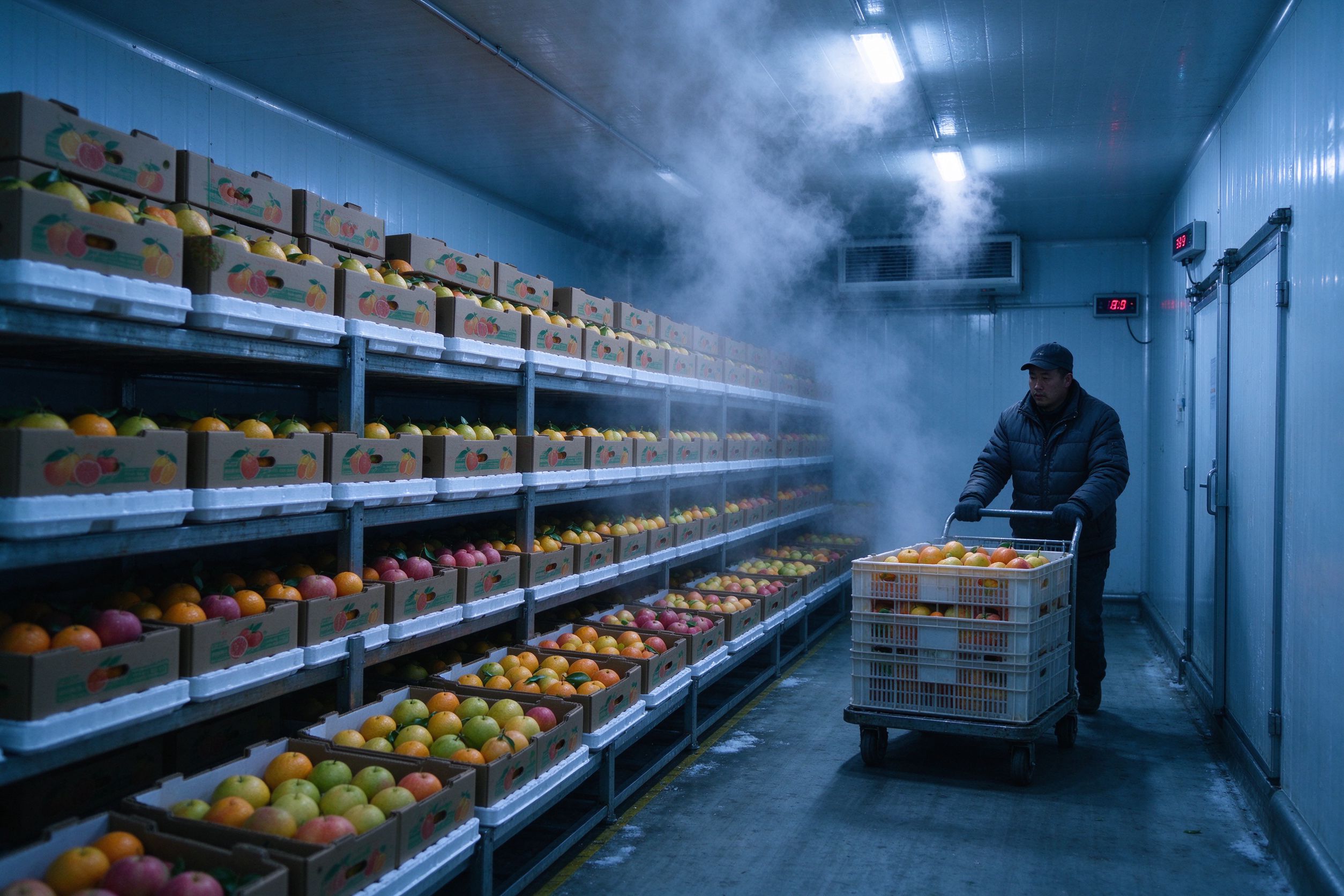
The cold storeThe temperature chain that stands behind the stall, and the part your certificate actually certifies.
The frozen lineGrade, glaze and net weight are printed on the carton. Read all three, then weigh a sample.
1 / 5
These are still photographs arranged as a motion sequence along the actual buying route, not footage shot inside the market. Interior shooting conditions are difficult, and most halls restrict filming; a sequence of frames is the honest way to show the layout.
Questions First-Time Buyers Actually Ask
Seventeen answers, written for someone who has never bought seafood in China and needs to know what to expect on the first trip.
Can I buy on my own if I don't speak Chinese?
You can, but not efficiently on the first trip. Stall holders rarely speak English, and quotes are given in jin, on the floor, in cash terms. What works: hire a local buying agent or ask your forwarder for an interpreter for one to two days; keep every price and specification in writing or photographed on a phone; and use a translation app for species names only, never for numbers or weights. Practical: half a day of interpreting costs far less than one misread net-weight figure.
Do I need an appointment or an introduction to get in?
Most wholesale markets are open to the public: walk in, no appointment needed. What you do need is correct timing and permission to inspect stock. Some buildings restrict vehicle entry or require registration at the gate to remove samples. If you are buying a container, ask a stall or agent to meet you at the gate — an introduction shortens price discovery by a day or two.
Can I buy just one or two cartons — what is the minimum order?
Most stalls will sell one or two cartons, but at retail-level pricing. Live product is often sold by the jin with a minimum of a few jin; frozen product has a minimum of one carton. What moves the price is less the quantity than whether the cargo can be consolidated: several buyers in one reefer or one air pallet. If your volume is small, ask for LCL consolidation instead of pushing for a wholesale price on two cartons.
What time of day should I go?
Live product: 3 a.m. to 6 a.m. is the busiest window, when trucks arrive and the best stock moves first. Chilled halls: mostly 4 p.m. to 7 p.m., after boats land and sort. Frozen and dried goods: normal daytime hours. Sundays and public holidays are quieter. The most common beginner mistake is arriving at ten in the morning and finding only clean-down.
Cash or bank transfer — can I get an invoice?
Both work. Cash and mobile payment are normal at stall level; bank transfer is used for larger amounts and leaves a record. A formal invoice (fapiao) is not automatic — ask before you pay, and expect that some stalls cannot issue one. For export you also need a commercial invoice and packing list, issued by the seller or by the trading company you buy through.
Can I taste the product or watch it being processed?
Tasting on the floor is uncommon. What you can ask for is a cut sample or a look at the processing room. Many stalls advertise toll processing — heading, gutting, filleting, peeling, vacuum packing — and asking to see the room is a reasonable test of whether you are dealing with an operator or a reseller.
Can you ship it to my market and handle customs for me?
Yes, and this is normal in China. Forwarders and trading companies provide pickup at the market, cold storage, export declaration, booking and shipping. What you must separate: door-to-door versus port-to-port pricing, whether destination charges and import clearance are included, and who carries the risk if the reefer fails. Get every item on one written quotation.
Can live seafood go by air, and what is the survival rate?
Live seafood ships by air far more often than by sea. Air transit is usually 1 to 3 days; survival depends on species, packing density, oxygen supply and ground handling time. Sea freight takes 20 to 45 days, and live survival over that window is poor for most species — live crab and lobster go by air, chilled and frozen go by reefer. Budget a live loss rate of roughly 5% to 15%; anything lower needs proof from the seller's past shipments.
Chilled or frozen — which should I choose?
Choose by end use, not by price. Chilled gives better texture and higher unit value, but the temperature chain has to hold from the market to your customer, and one break ruins the lot. Frozen is more stable and cheaper to move, and suits retail and food service. If your market cannot maintain a cold chain at destination, buy frozen.
How can I tell wild-caught from farmed?
Ask for the catching or landing record rather than accepting a claim. Wild product usually shows mixed sizes in one lot and uneven color, sometimes net marks or hook damage; farmed product is more uniform in size and color and often carries a pond or plant code. For species controlled by CITES or by destination rules, the permit is the proof, not the seller's word.
What if the weight is short or the goods don't match the sample?
Raise it before you pay, and photograph the scale and the carton. Ask for the lot to be re-weighed with the carton tared, and for the shortfall to be settled on the spot — deducted or made up with goods. If the seller refuses, the market management office is the next step; consumer complaints can go to 12315, though that channel handles consumer transactions rather than commercial disputes between companies.
What documents or visa do I need?
For entry into China, check your visa category and whether your passport needs a visa at all for a short business trip. For the cargo, the documents are set by the destination: health certificate, certificate of origin, inspection and quarantine certificate, and permits for controlled species. Your forwarder and the seller's export department normally assemble them; confirm the full list before the container is booked.
Can I put my own brand on it — OEM?
Yes, OEM is common, especially on frozen and dried product. Settle four things: minimum quantity per SKU, who owns the artwork and the printing plates, whether the plant is registered for your market, and the label content rules in the destination language. OEM on live product is unusual; on frozen shrimp, fillets and dried goods it is routine.
How long does one buying trip take?
Plan three to five days: one to two days for inspection and sampling, one day for price comparison and negotiation, one day for packing, weighing and paperwork. Add time if you visit a processing plant or an off-market cold store. A single-day trip only works when you already know the seller and the specification.
Any food-safety or hygiene precautions?
Wear closed shoes that can get wet, and expect standing water, ice and hose-down. Keep cuts covered and do not eat product on the floor. Buy from stalls where the ice is clean and the water is circulating, not from the cheapest tank. For export cargo, hygiene is the plant's responsibility — ask for its registration number and its most recent inspection record.
Integrated farm-produce markets or specialist seafood markets — which one?
Specialist markets go deeper: more species, more origin supply, better holding and cold storage. Integrated farm-produce markets go broader: seafood sits beside fruit, vegetables and frozen goods, which suits mixed containers and setting up a local sourcing office. If your cargo is seafood only, go specialist; if you are assembling a mixed load, start at an integrated market.
How do I avoid the markets that online guides say have moved or closed?
Check three things before you travel: the market's official site or account for a relocation notice, the street address in a map app rather than the market name, and one phone call to the management office. Two cases still circulate widely online: Shenzhen's Buji seafood market closed in July 2020, and Shanghai's Jiangyang and Jiangyang North Road are two different markets. Guides copied from one another rarely correct either.
Shipping seafood out of China? Start with the cold chain, not the rate.
Tell us the species, the temperature regime, the volume and the destination. You get a reefer or air plan with drayage, documentation and destination charges written out line by line — before you commit to the cargo.