
Home / Shipping to Anguilla / How to Ship from China to Anguilla: CIF Duty, the Administrative Charge and Road Bay
How to Ship from China to Anguilla: CIF Duty, the Administrative Charge & Road Bay
Anguilla is a small British Overseas Territory with its own government, its own Comptroller of Customs and its own tariff — and, like most small import-dependent economies, it funds a meaningful part of itself at the dock. There is no VAT and no income tax here, which is precisely why the border charge is where it is, and why the basis on which it is calculated matters so much.
That basis is CIF: duty is assessed on the cost of the goods, plus insurance, plus freight — not on the invoice value. On a lane where almost everything arrives on an indirect routing through somebody else's port, freight is a large share of the total. So the freight you have already paid becomes part of the figure the duty is charged on. Ask your supplier to break freight and insurance out separately so both halves of the number are visible.
The second thing that makes Anguilla unusual is how relief works. Exemptions are not simply sitting in a schedule waiting to be claimed — they are granted by resolution of the House of Assembly for specified goods, subject to conditions that include a five-year restriction on selling or repurposing the goods and a certification to the Comptroller every six months. That is a real mechanism with real obligations attached, and it is worth understanding before anyone assumes a shipment is duty-free.
At a glance
Status: British Overseas Territory; own government, own Comptroller of Customs · Duty basis: assessed on the CIF value — cost, insurance and freight — not the invoice value · Alongside the duty: a customs administrative charge under the Customs Administrative Costs Recovery Act · Exemptions: granted by resolution of the House of Assembly under the Customs Act, subject to conditions including a five-year restriction and six-monthly certification · No VAT and no income tax · Sea ports: Blowing Point (ferry terminal to Marigot) and Road Bay at Sandy Ground · Airport: Clayton J. Lloyd International, AXA · Currency: Eastern Caribbean dollar, XCD · Storm season: June to November
How your cargo moves: China to Anguilla
Eight steps from your supplier's door to yours. The last four are the ones shaped by local rules.
- Pickup from your supplierWe collect the goods anywhere in China and bring them to our consolidation point.
- Export clearanceChina customs declaration filed and released before the goods move to the port.
- Loading and departureContainer loaded, sealed and handed to the carrier at the Chinese port.
- Main carriageOcean, air or rail movement booked on the route agreed for your cargo.
- Arrival at the gatewayDischarge at the port or airport of entry, recorded on the carrier's manifest.
- Import clearanceCustoms declaration filed locally, with duty and tax assessed on the declared value.
- Customs releaseGoods released into free circulation once duty and tax are settled.
- Final deliveryOnward movement to your delivery address, warehouse or nominated depot.
Duty rates, VAT rates and clearance times move, and the figure that applies to your goods is the one set for your commodity code on the day of clearance. We check the current position against your code before your goods sail and confirm it to you in writing — ask for that check when you request a quote.
Anguilla assesses duty on the CIF value rather than the invoice
Get this wrong and the duty bill comes back higher than the buyer modelled. CIF means the customs value includes the goods, the insurance and the freight to the point of entry. It is not the figure on the commercial invoice, and it is not the FOB value.
Why it bites harder here than on a large-market lane. Anguilla has no deep-water container terminal handling direct mainline calls; cargo comes in on an indirect routing, and the freight and handling on that routing are expensive. Those costs are then folded into the base the duty rate is applied to. Model the landed cost including freight before you promise a number.
The customs administrative charge that sits alongside the duty
Alongside the duty itself, Anguilla levies a customs administrative charge under the Customs Administrative Costs Recovery Act, including on goods that have been exempted from duty by resolution. That is the detail most first shipments miss: an exemption from duty is not necessarily an exemption from everything.
How to handle it in a quotation. Treat the administrative charge as a separate line that survives a duty exemption. Confirm the current rate with the Comptroller of Customs or with a licensed Anguillan broker rather than assuming it away.
Exemptions here are granted by resolution, not found in a schedule
This is the most distinctive thing about importing into Anguilla, and it is worth setting out plainly because the obligations are real. Under the Customs Act, the House of Assembly may by resolution exempt specified goods from duty. Published examples of the attached conditions include:
- The goods must not be sold, exchanged, given away or put to another use within five years of the date of importation.
- The importer must certify to the Comptroller every six months that the conditions are being met, for the duration of that five-year period.
- The goods must be produced or accounted for on demand by a customs officer.
- The customs administrative charge is still payable at import.
- Breach carries consequences — published resolutions provide for payment of the duty relieved, a fine of twenty thousand dollars or three times the duty relieved, whichever is greater, and forfeiture of the goods.
What this means for a supplier. If your buyer says the goods are duty-exempt, ask to see the resolution and ask whether they are set up to meet the certification obligations. An exemption that is breached becomes a duty bill plus a penalty, and it is the importer who carries it.
Which categories carry the heaviest rates
Published rate tables for Anguilla vary considerably between sources, and we are not going to present one as authoritative. What is consistent across them is the shape of the tariff, and the shape is what tells you how to plan: books and documents at or near zero at the bottom, consumer goods at the top, and food, clothing, electronics and household goods in the upper range.
| Category | What published sources commonly show | How to use it |
|---|---|---|
| Documents and books | 0% to 1% | At the bottom of the schedule |
| Jewellery and gaming | Around 6% | Low, but confirm |
| Dry food and supplements | Around 14% | Upper-middle |
| Electronics, fashion, appliances, toys, sports | Commonly shown at or near 20% | The top of the schedule — get the code right |
Two practical conclusions. Get the HS code right, because the distance between the top and the bottom of that table is most of twenty points. And write the description properly, because the officer classifies from what is on the invoice.
Blowing Point, Road Bay and the ferry from Marigot
Blowing Point
The seaport and ferry terminal on the south coast, with a scheduled public ferry to Marigot on the French side of Saint Martin. This is the passenger and light-freight link that connects Anguilla to a bigger island with a real port and a real airport.
Road Bay, Sandy Ground
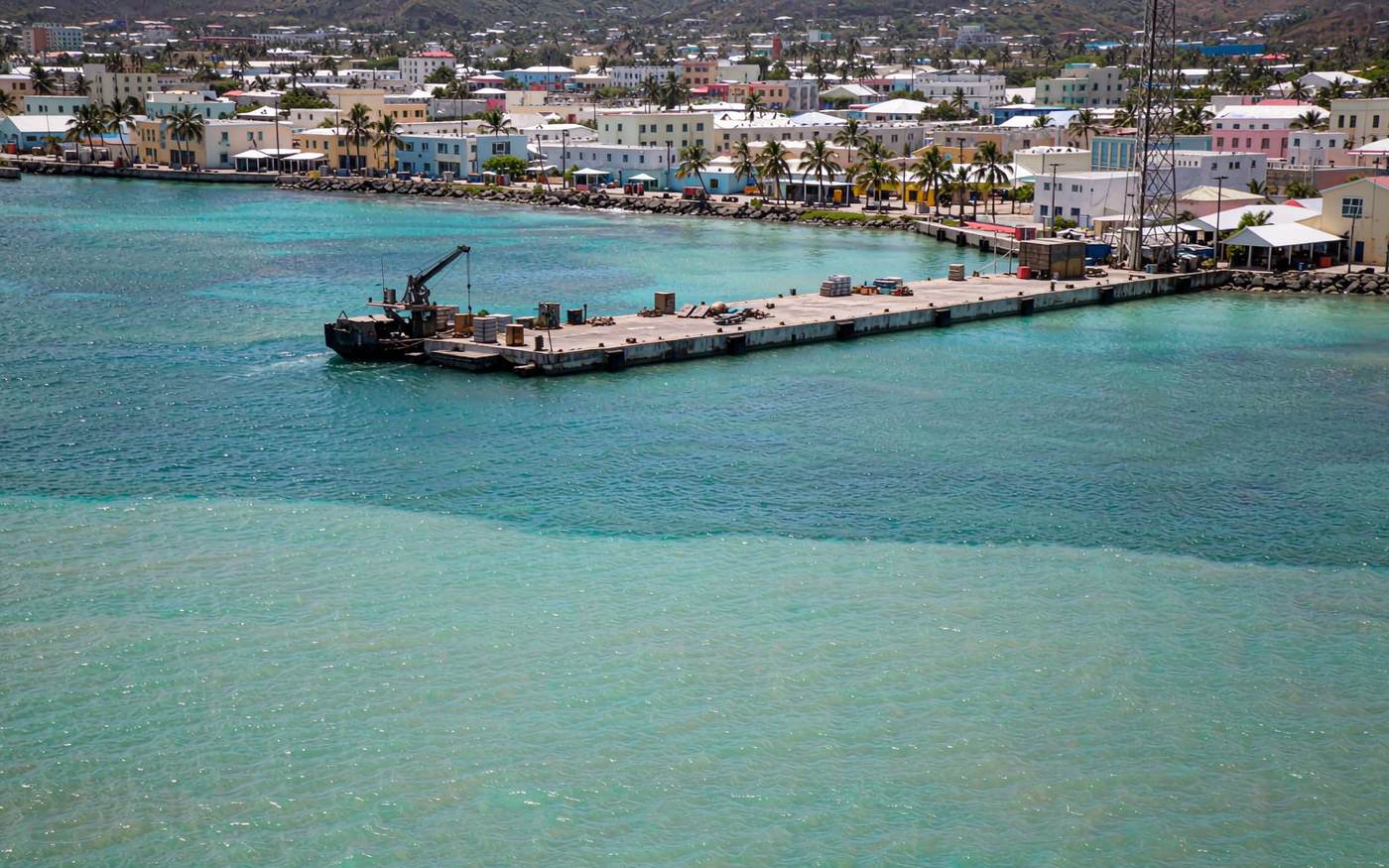
The harbour where private boats and yachts must clear customs and immigration, and the working anchorage on the north-west coast. Heavier and project cargo is landed here rather than through the ferry terminal.
Most cargo arrives through somebody else's port
This is the operational reality of the lane, and it is the thing most likely to disappoint a buyer who has read a transit time off a map. There is no direct container service from China to Anguilla. Freight is consolidated and moved to a regional gateway — most often Saint Martin, with the Marigot ferry crossing as the final link for lighter cargo, or Puerto Rico — and then brought across.
Quote the legs separately. Name the gateway, name the crossing, and say who is responsible for each. A buyer who understands that the cargo touches Saint Martin before Anguilla will not panic when tracking goes quiet for two days. A buyer who was promised a single through movement will.
Clayton J. Lloyd, AXA, and why air is often the answer
Air freight arrives at Clayton J. Lloyd International Airport, AXA, with services connecting through the region rather than direct from China. For a market this size, air is frequently the sensible answer: consolidation volumes are small, sea frequencies are thin, and the value of certainty is high.
Air suits spares, samples, documents, hotel and restaurant supplies, and anything where a missed connection costs more than the freight premium. Sea suits building material, vehicles and bulk consumables where the schedule is being planned months out.
The storm season and the resort calendar
Anguilla sits in the hurricane belt, with the season running June to November. It is also a high-end tourism market whose project and refurbishment work tends to be scheduled outside the peak visitor season, which means booking pressure and freight demand both rise at the same time of year.
The practical rule: plan critical arrivals outside the storm window where the schedule allows, and book earlier than the project plan suggests, because every other supplier on the island is working to the same calendar.
From a Chinese factory to an Anguilla address
| Stage | What happens | What decides it |
|---|---|---|
| Code and rate | HS code fixed, duty rate identified, administrative charge allowed for | Doing it before quoting rather than after landing |
| Exemption check | Confirm whether a resolution covers the goods, and on what conditions | Whether the buyer can meet the certification obligations |
| Routing | Consolidated to a regional gateway, then crossed — commonly via Saint Martin | The gateway connection, not the ocean leg |
| Packing | Export packing, ISPM 15 timber, units sized for a small landing craft | Whether the spec was set at order time |
| China export clearance | Declaration filed, goods released | Documents complete before the truck is booked |
| Arrival and entry | Declaration filed, duty assessed on CIF, administrative charge applied | Classification accuracy and complete paperwork |
| Release | Charges paid, cargo released and moved | Funds and transport arranged in advance |
Answer the exemption question before you quote an Anguilla buyer
- What is the HS code, and what rate attaches to it? Sources disagree; confirm with the Comptroller.
- Is there a duty exemption, and can the buyer meet its conditions? Five-year restriction, six-monthly certification.
- Has the customs administrative charge been allowed for? It survives a duty exemption.
- Which gateway, and which crossing? Name both in the quotation.
- Is the cargo sized for a landing craft? Small, liftable units.
- Is the wooden packaging ISPM 15 marked? Check before sealing.
- Is the arrival inside the storm season? Plan accordingly.
Why importers use Goodhope on this lane
Six things that are different about working with us on China to Anguilla shipments.
True stories into Anguilla
Five shipments bought in China and delivered into Anguilla, told end to end — where the order came from, how it moved, where it nearly went wrong, and how it finished. Client names are withheld at their request; the situations and the handling are what we deal with on this lane.
Invoice value mistake · CIF assessment · Shenzhen to Anguilla
The purchase. A buyer quoted his customer using the supplier's invoice value and discovered the duty was assessed on something else entirely.
The move. Consolidated in Shenzhen, relayed through a neighbouring hub, then sea freight into Anguilla with local entry.
Where it nearly went wrong. Duty here is assessed on the CIF value — cost, insurance and freight — not on the invoice value. On a route with a long relay leg, freight is a large share of the assessed base, so the gap between the two numbers is not small.
How it finished. We worked the assessment basis out before he quoted his customer, and his price went in correct the first time.
Exemption assumption · granted by resolution · Ningbo to Anguilla
The purchase. A buyer importing equipment for a resort project assumed his category appeared on an exemption list.
The move. Checked the exemption position before booking, then shipped and cleared on the actual basis.
Where it nearly went wrong. Exemptions here are granted by resolution rather than sitting in a published schedule. Assuming one exists because a similar island offers one leaves you arguing at the counter.
How it finished. We told him to settle the exemption question before the cargo was sealed, which is the only point at which it is still cheap to change plans.
Air instead of sea · urgent fit-out · Guangzhou to Anguilla
The purchase. A hotel fit-out had a hard opening date and the relay routing could not guarantee it.
The move. Air freight into Clayton J. Lloyd rather than sea freight through the relay port, priced against the sea alternative.
Where it nearly went wrong. For small consignments into Anguilla, air is frequently the answer rather than the expensive exception, because the relay leg adds both time and handling.
How it finished. He took air for the fit-out items and kept sea for the bulk that had no deadline.
Storm season · resort calendar · Shanghai to Anguilla
The purchase. A buyer scheduled a delivery without knowing that both the storm season and the resort refurbishment calendar affect capacity into the island.
The move. Booking moved forward to clear the storm window, with delivery timed before the seasonal rush.
Where it nearly went wrong. Vessel and aircraft capacity into Anguilla tightens around the resort calendar and can be disrupted entirely in storm season. A date that looks generous on a mainland route is not generous here.
How it finished. He now books against the island calendar rather than the mainland one.
Heavy rates · alcohol for a venue · Yiwu to Anguilla
The purchase. A buyer importing bar supplies and glassware for a venue did not realise the two categories behaved very differently.
The move. Consolidated in Yiwu, then relayed and cleared with the heavier-rated lines identified up front.
Where it nearly went wrong. Certain categories carry the heaviest rates on this island, and alcohol is among them. Mixed consignments hide the problem until assessment, when it is far too late to restructure the order.
How it finished. We split the declaration lines so the exposure was visible before he committed, and he rebalanced the order.
Why importers use Goodhope on this lane
Six things that are different about working with us on China to Anguilla shipments.
Get the exemption question answered before the cargo is sealed
Tell us what you are shipping, the packed dimensions and gross weight, the pickup city in China and the delivery address. We will confirm the consolidation and the gateway, quote the sea and air options separately, flag whether the cargo is sized for a landing craft at Road Bay or a ferry crossing from Marigot, and check the wood packaging requirement with you. Where the question belongs to the Comptroller of Customs or to a licensed Anguillan broker — the rate on your code, whether a resolution covers the goods, the current administrative charge — we will say so plainly rather than guess.
Get a quote Talk to usRelated pages
Frequently asked questions
Is Anguilla part of the UK customs territory?
No. Anguilla is a British Overseas Territory with its own government, its own Comptroller of Customs and its own tariff. Goods arriving from the United Kingdom are imports like any other, and there is no VAT and no income tax on the island, which is why the border charge carries as much weight as it does.
How is duty calculated in Anguilla?
On the CIF value — the cost of the goods, plus insurance, plus freight — rather than on the invoice value alone. Because freight into Anguilla is expensive and arrives on an indirect routing, that freight becomes part of the figure the duty rate is applied to. Declare freight and insurance separately.
What is the customs administrative charge?
A charge levied alongside duty under the Customs Administrative Costs Recovery Act, including on goods that have been exempted from duty by resolution. An exemption from duty is not an exemption from everything; confirm the current rate with the Comptroller.
How do duty exemptions work in Anguilla?
They are granted by resolution of the House of Assembly under the Customs Act for specified goods, subject to conditions: the goods must not be sold or repurposed within five years, the importer must certify compliance to the Comptroller every six months, and the goods must be produced on demand. Breach can bring the duty back, a fine, and forfeiture.
Which ports handle cargo in Anguilla?
Blowing Point is the seaport and ferry terminal with the scheduled public ferry to Marigot on the French side of Saint Martin. Road Bay at Sandy Ground is the harbour where private vessels clear customs and where heavier and project cargo is landed. There is no direct container service from China.
What is the airport called?
Clayton J. Lloyd International Airport, AXA. Services connect through the region rather than direct from China, and for a market this size air freight is frequently the more sensible answer for anything where a missed sea connection costs more than the freight premium.
Which goods need a permit or are prohibited?
Published lists name alcohol, animals, chemicals, currency, drugs, explosives, firearms, fresh food, plants, seeds and tobacco among the controlled or prohibited categories. Wood packaging should meet ISPM 15. Check the current list with the Comptroller before packing, not after arrival.
What currency is used?
The Eastern Caribbean dollar, XCD, which is pegged to the US dollar. US dollars are widely accepted in practice on the island, but agree the settlement currency with the buyer in advance.
When is hurricane season?
June to November. Anguilla sits in the hurricane belt, and because the island's project and refurbishment work clusters outside the peak visitor season, freight demand and booking pressure tend to rise at the same time of year.
Should the first shipment be FCL or LCL?
LCL is almost always right for a first consignment, because there is no direct container service and committing a full container to an indirect routing with a thin crossing schedule is unnecessary risk. Move to FCL only when volume and timing are genuinely predictable.