
Home / Shipping to Bangladesh / How to Ship from China to Bangladesh
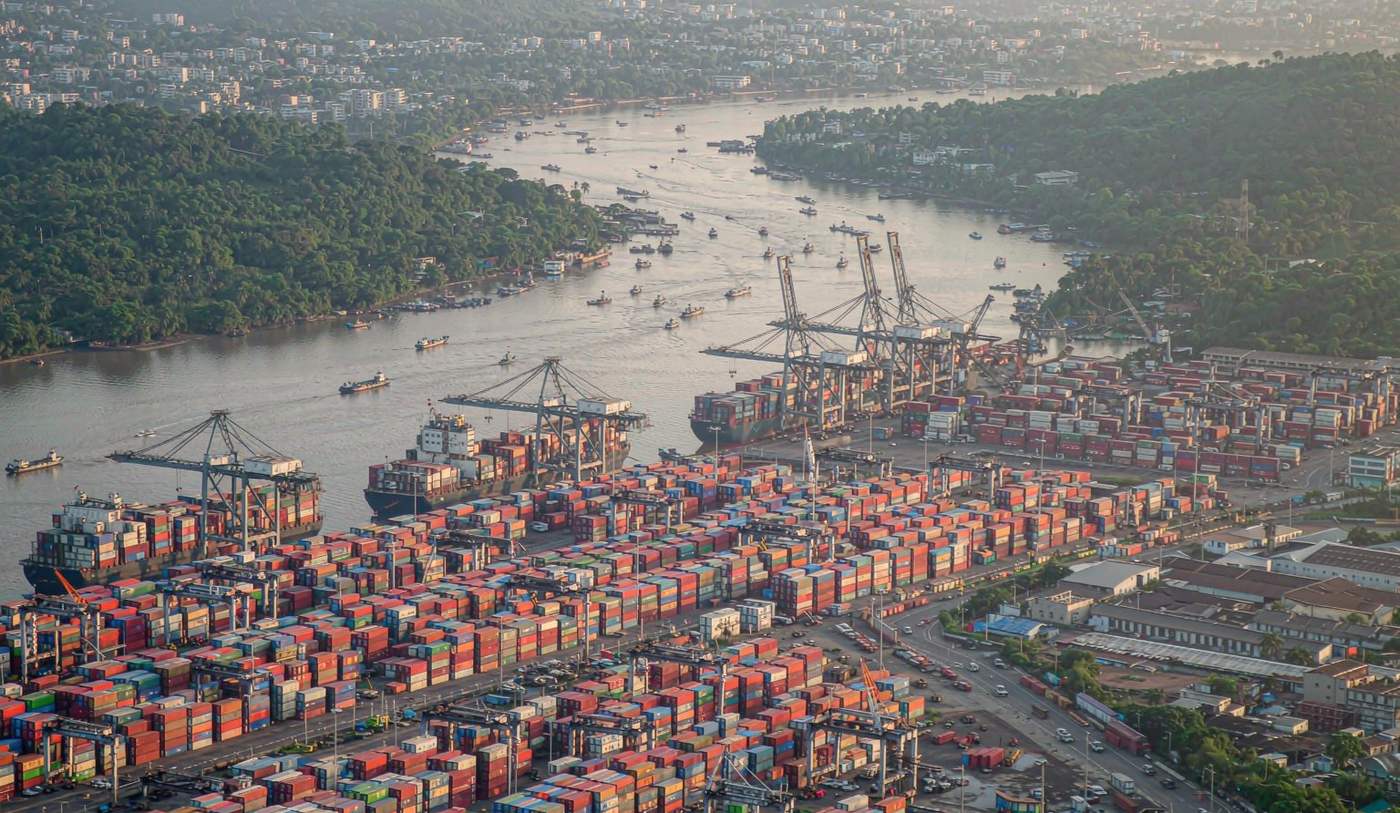
How to Ship from China to Bangladesh: the Five-Tax Stack, Chittagong & the Bill of Entry
Bangladesh does not have one import tax. It has five, and each one is calculated on a base that already includes the ones before it. Customs duty, regulatory duty, supplementary duty, VAT and advance income tax all appear on the same bill of entry, and the compounding is the reason a shipment that looked like a fifteen percent duty turns out to carry a tax burden approaching half the CIF value.
This is the single most important thing to understand before you order, and it is the thing first-time importers get wrong. Model the stack, not the rate.
The second thing is procedural. Chittagong handles the bulk of container traffic and is regularly congested, and clearance is gated on three registrations — an Import Registration Certificate, a Business Identification Number and a Taxpayer's Identification Number — all of which must be active at the moment the bill of entry is filed. An expired certificate is a rejected declaration and a container that is not going anywhere.
At a glance
Country: in South Asia on the Bay of Bengal, bordered by India and Myanmar; capital Dhaka; a WTO member and a party to the Asia-Pacific Trade Agreement. · Currency: the Bangladeshi taka. · Customs duty: 0, 1, 5, 10, 15 or 25 percent of CIF value; average applied MFN rate published at 14.0 percent, maximum 25. · Regulatory duty: 3, 5, 10, 20 or 35 percent of CIF on selected goods. · Supplementary duty: 0 to as high as 500 percent on luxury and socially sensitive goods, on CIF plus duty plus regulatory duty. · VAT: 15 percent on CIF plus customs duty plus regulatory duty plus supplementary duty. · Advance income tax: 3–10 percent, creditable against annual corporate income tax. · Advance trade VAT: 4 percent, for traders rather than manufacturers. · Filing: bill of entry through ASYCUDA World under the National Board of Revenue. · Registrations: IRC from the Chief Controller of Imports and Exports, BIN for VAT, TIN for income tax; a letter of credit through an authorised dealer bank for most commercial imports. · Ports: Chittagong principal, with Mongla and Payra and inland container depots; Dhaka for air. · Clearance: green 1–3 days, yellow 3–5, red 5–10.
How your cargo moves: China to Bangladesh
Eight steps from your supplier's door to yours. The last four are the ones shaped by local rules.
- Pickup from your supplierWe collect the goods anywhere in China and bring them to our consolidation point.
- Export clearanceChina customs declaration filed and released before the goods move to the port.
- Loading and departureContainer loaded, sealed and handed to the carrier at the Chinese port.
- Main carriageOcean, air or rail movement booked on the route agreed for your cargo.
- Arrival at the gatewayDischarge at the port or airport of entry, recorded on the carrier's manifest.
- Import clearanceCustoms declaration filed locally, with duty and tax assessed on the declared value.
- Customs releaseGoods released into free circulation once duty and tax are settled.
- Final deliveryOnward movement to your delivery address, warehouse or nominated depot.
Duty rates, VAT rates and clearance times move, and the figure that applies to your goods is the one set for your commodity code on the day of clearance. We check the current position against your code before your goods sail and confirm it to you in writing — ask for that check when you request a quote.
Five taxes, stacked on one another
Customs duty
0, 1, 5, 10, 15 or 25 percent of the CIF value, set by HS code. Average applied MFN rate published at 14.0 percent.
Regulatory duty
3, 5, 10, 20 or 35 percent of the CIF value, on selected goods where the revenue authority wants to moderate trade.
Supplementary duty
0 to as high as 500 percent on luxury, non-essential or socially sensitive goods, calculated on CIF plus the two duties above.
VAT
15 percent, on CIF plus customs duty plus regulatory duty plus supplementary duty.
Advance income tax
3 to 10 percent of the assessable value. Not a loss — it is credited against your annual corporate income tax.
There is also advance trade VAT at four percent, which applies to traders rather than manufacturers. And depending on the goods, an advance tax line at around seven and a half percent may appear as well.
The one that is not really a cost: advance income tax looks alarming on the assessment, but it is creditable against your annual corporate income tax liability. Treat it as a prepayment and a cashflow item, not as a charge. Customs duty and supplementary duty are not recoverable through that mechanism — VAT is, for a registered business making taxable supplies.
A worked stack, and why the total surprises people
Published worked examples run like this on a CIF value of US$10,000 at fifteen percent customs duty and three percent regulatory duty:
| Line | Base | Rate | Amount |
|---|---|---|---|
| Customs duty | CIF US$10,000 | 15% | US$1,500 |
| Regulatory duty | CIF US$10,000 | 3% | US$300 |
| VAT | US$11,800 | 15% | US$1,770 |
| Advance income tax | Assessable value | 5% | US$500 |
| Advance tax | Assessable value | 7.5% | US$750 |
| Total tax and duty | ≈ US$4,820 |
That is roughly 48 percent on top of the CIF value, on a shipment whose headline duty rate was fifteen percent. On goods carrying supplementary duty the cumulative burden is materially higher still.
The lesson is simple and worth repeating: on this lane you cannot quote from the duty rate. You have to model the stack.
The Import Policy Order, and where exemptions hide
The Import Policy Order is the primary legislative tool governing customs tariffs in Bangladesh, and it is where the exemptions and concessions live. Published guidance lists exemptions for:
- Generators and information technology equipment
- Raw cotton and textile machinery
- Certain machinery used in irrigation and agriculture
- Animal feed for the poultry industry
- Certain drugs and medical equipment
- Raw materials imported for use in specific industries
Concessions also exist for capital machinery and equipment and for specified inputs and parts. Published commentary is candid that this makes determining the tariff rate a complex and non-transparent process — which is precisely why it is worth doing with a local agent before you commit to a price, rather than after the assessment arrives.
Chittagong, Mongla and the ICDs
Chittagong
The principal seaport and the one most container traffic uses. It is also the constraint: congestion at Chittagong and the completeness of your documents are consistently cited as the two variables that determine clearance time.
Mongla, Payra and the ICDs
Mongla and Payra serve as alternatives, used both to relieve Chittagong and for cargo destined for the west of the country. Inland container depots allow clearance away from the port itself, which can be the difference between a container that moves and one that waits.
The Bill of Entry, and how it is filed
The bill of entry — also called the goods declaration — is filed with the National Board of Revenue through ASYCUDA World. It carries the importer's IRC, the HS codes, the CIF value and all the tax lines.
- Timing: filed before or at the time the goods arrive. Filing can begin as soon as the bill of lading and other documents are available from the supplier, usually two to five days after departure.
- Registrations must be live: an expired IRC or inactive BIN at the moment of filing causes rejection.
- Classification is scrutinised: published guidance describes Bangladesh Customs scrutiny as active, particularly given the supplementary duty and regulatory duty complexity.
- The number matters downstream: on onward sales, the bill of entry number is referenced on the tax invoice and links customs records to VAT records.
IRC, BIN and TIN — the three registrations
| Registration | Issued by | What it is for |
|---|---|---|
| Import Registration Certificate (IRC) | Chief Controller of Imports and Exports | Proof of registered importer status |
| Business Identification Number (BIN) | National Board of Revenue | VAT registration and filing |
| Taxpayer's Identification Number (TIN) | National Board of Revenue | Income tax compliance |
| Letter of credit | An authorised dealer bank | Required for most commercial imports |
All three must be active at the moment of filing. They renew, and an expired certificate is one of the most avoidable causes of a stalled first shipment.
Why a C&F agent is effectively mandatory
Legally an importer can file directly if they have ASYCUDA World access. In practice, published guidance is blunt: the complexity of the system and of port procedures means almost all importers — including large corporations — use a C&F agent. What the agent does:
- Lodges the bill of entry with the complete document set.
- Handles the assessment, which on a five-line stack is where errors get caught or created.
- Coordinates examination if the declaration is selected for physical inspection.
- Arranges release and trucking out of the port to your warehouse.
What each channel costs you in calendar days
| Channel | Published time |
|---|---|
| Green — no examination | 1–3 days |
| Yellow — documentary review | 3–5 days |
| Red — physical examination | 5–10 days |
| Routine shipment, clean documents | 3–7 working days |
The two variables are Chittagong congestion and document completeness, and the second is the one you control. Inconsistencies between the commercial invoice, packing list, bill of lading and certificate of origin are consistently described as the number one cause of customs delays at Chittagong.
APTA, and the preference available from China
Bangladesh and China are both parties to the Asia-Pacific Trade Agreement, and published guidance describes using an APTA certificate of origin to claim preferential tariff benefits between the two. Whether it improves on the standard rate for your HS code is a schedule question, and one worth asking before you file rather than after.
China receives MFN treatment from Bangladesh, with the average applied rate published at 14.0 percent and a maximum of 25 percent. Confirm your code against the current schedule with your agent.
Get the documents consistent before the vessel sails. On most lanes a mismatch between the invoice and the packing list costs a day or two. At Chittagong, with five tax lines riding on the declared value and classification, it costs the assessment to be reopened. Have your forwarder or agent review the full set in China, before departure — fixing it from Bangladesh is slow and expensive.
The dossier for the bill of entry
| Document | Who provides it | Note |
|---|---|---|
| Commercial invoice | Supplier in China | Basis for customs value; must show HS code, unit price, total and Incoterm |
| Packing list | Supplier in China | Carton count, gross and net weight, CBM |
| Bill of lading or airway bill | Carrier | The title document |
| Certificate of origin | Chamber of commerce in China | APTA form for preferential benefit |
| Import Registration Certificate | Importer | Must be active at filing |
| TIN and BIN | Importer | Must be active at filing |
| Letter of credit or proof of payment | Importer's bank | Through an authorised dealer |
| Pre-shipment inspection report | PSI agency | Required for specific product categories |
| Permits | Importer | Product-specific — telecoms, food safety, drug administration |
Why importers use Goodhope on this lane
Six things that are different about working with us on China to Bangladesh shipments.
Working examples into Bangladesh
Five shipments bought in China and delivered into Bangladesh, told end to end — where the order came from, how it moved, where it nearly went wrong, and how it finished. Client names are withheld at their request; the situations and the handling are what we deal with on this lane.
Five taxes · the stack nobody modelled · Shenzhen to Chittagong
The purchase. A buyer priced his landed cost on the customs duty rate alone and found his margin gone.
The move. The full stack modelled before his second order, then shipped on the real numbers.
Where it nearly went wrong. Duty here is the first of several layers. Supplementary duty, VAT, advance income tax and further charges sit on top, each calculated on a running total, which is why duty-only estimates fall so far short.
How it finished. We walked him through the whole stack in advance. He repriced his range and stopped losing money on every container.
APTA preference · available from China · Ningbo to Chittagong
The purchase. A buyer had been importing for two years without ever claiming the preference his Chinese-origin goods qualified for.
The move. Certificate of origin arranged in China and the preference claimed on entry.
Where it nearly went wrong. Bangladesh is a party to the Asia-Pacific Trade Agreement, and goods originating in China can qualify. Unlike most lanes we handle, there is a real preference here — but it has to be claimed with the right certificate.
How it finished. He claimed it on the next shipment and has claimed it ever since.
Agent requirement · C&F · Guangzhou to Chittagong
The purchase. A buyer assumed he could handle clearance himself to save the fee.
The move. C&F agent appointed before arrival, with the bill of entry prepared in advance.
Where it nearly went wrong. A C&F agent is effectively mandatory on this lane. Going without one does not remove the requirement, it just means discovering it while the container is accruing demurrage.
How it finished. Appointed early, and the container cleared on schedule.
Registrations · IRC, BIN, TIN · Foshan to Mongla
The purchase. A first-time buyer had goods ready and none of the three registrations his entry depended on.
The move. Registration sequence set out, then goods shipped once they were in place.
Where it nearly went wrong. IRC, BIN and TIN are separate registrations and all three sit behind a bill of entry. Missing one is not a paperwork delay, it is a stop.
How it finished. We flagged all three at enquiry. His first import cleared without a registration problem.
Port choice · Chittagong against Mongla · Shanghai to Bangladesh
The purchase. A buyer had always used Chittagong because that was what he had been quoted.
The move. Compared Chittagong against Mongla and the inland container depots against his actual delivery point.
Where it nearly went wrong. Chittagong handles the majority of containers and takes the pressure. Depending where the goods are going, Mongla or an inland depot can shorten the door-to-door time considerably.
How it finished. He split his volumes and cut several days off his inland leg.
Why importers use Goodhope on this lane
Six things that are different about working with us on China to Bangladesh shipments.
Model the full stack before you place the order
Tell us what you are shipping, the HS codes if you have them, the packed dimensions and gross weight, the pickup city in China and the delivery address in Bangladesh. We will model the complete five-line stack for your code before you commit, check whether your product appears on the Import Policy Order exemption list or qualifies under APTA, route through Chittagong or Mongla as appropriate, review the full document set in China before the vessel sails, and work with a C and F agent at your port so the assessment is right the first time.
Get a quote Talk to usRelated pages
Frequently asked questions
How many taxes are charged?
Up to five, and they stack: customs duty, regulatory duty, supplementary duty, VAT at 15 percent, and advance income tax. Advance trade VAT at 4 percent applies to traders.
Why is the total so much higher than the duty rate?
Each tax is calculated on a base that includes the ones before it. A published worked example at US$10,000 CIF with 15 percent duty and 3 percent regulatory duty produces roughly US$4,820 in total tax — about 48 percent on top of CIF.
Which port does cargo arrive at?
Chittagong is the principal seaport, with Mongla and Payra as alternatives and inland container depots for clearance away from the port. Dhaka handles air.
What is the Bill of Entry?
The import declaration, filed with the National Board of Revenue through ASYCUDA World. It should be filed before or at the time the goods arrive, and can be prepared two to five days after departure.
What registrations do I need?
An Import Registration Certificate, a BIN for VAT and a TIN for income tax — all active at the moment of filing — plus a letter of credit through an authorised dealer bank for most commercial imports.
Do I need a C and F agent?
Legally you can file directly with ASYCUDA access, but in practice almost all importers including large corporations use one. The system and the port procedures are the reason.
How long does clearance take?
Green 1–3 days, yellow 3–5, red 5–10. Routine shipments with clean documents are often 3–7 working days. Congestion and document completeness are the variables.
Is there a preferential rate for Chinese goods?
Both countries are parties to the Asia-Pacific Trade Agreement, and an APTA certificate of origin is used to claim preference. China also receives MFN treatment, with the average applied rate published at 14.0 percent.
Are there exemptions worth claiming?
Yes — generators, IT equipment, raw cotton, textile machinery, certain agricultural and irrigation machinery, poultry feed, some drugs and medical equipment, and raw materials for specific industries. Check the Import Policy Order with your agent.
What happens if the declaration is wrong?
Under the Customs Act 1969, mis-declaration can mean confiscation, fines and in serious cases prosecution, with penalties that can equal or exceed the value of the goods. Classification scrutiny is active.