
Home / Shipping to Bhutan / How to Ship from China to Bhutan
How to Ship from China to Bhutan: Kolkata, Phuentsholing & the Road In
Bhutan is landlocked, and that means sea freight does not reach it. A container from China sails to Kolkata, in India, and then travels roughly 830 kilometres overland to the Phuentsholing border crossing. The ocean leg is the predictable part. The road is where schedules slip.
The second thing to understand is the tariff shape, because it is the opposite of what most importers expect. Machinery sits around 5 to 10 percent; clothing and footwear sit around 20 to 30 percent. Bhutan is not a low-duty destination for consumer goods, and a costing built on the assumption that a small Himalayan market means light duties will be wrong by a wide margin.
The third thing is that Bhutan has exactly one international airport, at Paro, and one realistic land border for freight. Optionality is limited by design here, which makes planning ahead more valuable than negotiating hard.
At a glance
Country: a landlocked Himalayan kingdom of under a million people; capital Thimphu; borders India and China. · Currency: the Bhutanese ngultrum, pegged to the Indian rupee. · No seaport: ocean freight ends at Kolkata Port in India. · Main crossing: Phuentsholing, reached via Jaigaon on the Indian side, about 830 km from Kolkata; the dry port there handles the freight. Alternatives: the Jogighopa inland waterways terminal in Assam, about 91 km from Gelephu, and a Chattogram routing through Bangladesh. · Airport: Paro International (PBH), the sole international gateway, served by the national carrier. · Customs: the Department of Revenue and Customs under the Ministry of Finance, processing through RAMIS; a National Single Window is reported in pilot for 2026. · Duty: 0–50 percent by HS code; machinery 5–10 percent, electronics 10–20 percent, clothing and footwear 20–30 percent, food 5–30 percent, cosmetics 20–30 percent, books 0 percent, vehicles 25–50 percent. · Sales tax: sources differ — one set gives a 5 percent sales tax applied at point of sale rather than at customs, another gives 7 percent on the CIF value plus duty. · Licensing: an import licence is required for most goods except those from India. · Transit: ocean to Kolkata 15–25 days, plus 3–5 days overland. · Clearance: published at 3–10 days.
How your cargo moves: China to Bhutan
Eight steps from your supplier's door to yours. The last four are the ones shaped by local rules.
- Pickup from your supplierWe collect the goods anywhere in China and bring them to our consolidation point.
- Export clearanceChina customs declaration filed and released before the goods move to the port.
- Loading and departureContainer loaded, sealed and handed to the carrier at the Chinese port.
- Main carriageOcean, air or rail movement booked on the route agreed for your cargo.
- Arrival at the gatewayDischarge at the port or airport of entry, recorded on the carrier's manifest.
- Import clearanceCustoms declaration filed locally, with duty and tax assessed on the declared value.
- Customs releaseGoods released into free circulation once duty and tax are settled.
- Final deliveryOnward movement to your delivery address, warehouse or nominated depot.
Duty rates, VAT rates and clearance times move, and the figure that applies to your goods is the one set for your commodity code on the day of clearance. We check the current position against your code before your goods sail and confirm it to you in writing — ask for that check when you request a quote.
Landlocked, and the road in runs through India
There is no version of this lane that avoids a neighbour. Bhutan has no coastline, no seaport and one realistic land border for freight, so every sea shipment is really a sea shipment to India followed by an Indian road movement and a Bhutanese import.
That produces three practical consequences:
- Two sets of formalities, not one. Indian transit formalities at Kolkata, then Bhutanese import clearance at Phuentsholing.
- Two sets of handling. The container is discharged in Kolkata and the goods then move overland, which is where damage and pilferage risk concentrate.
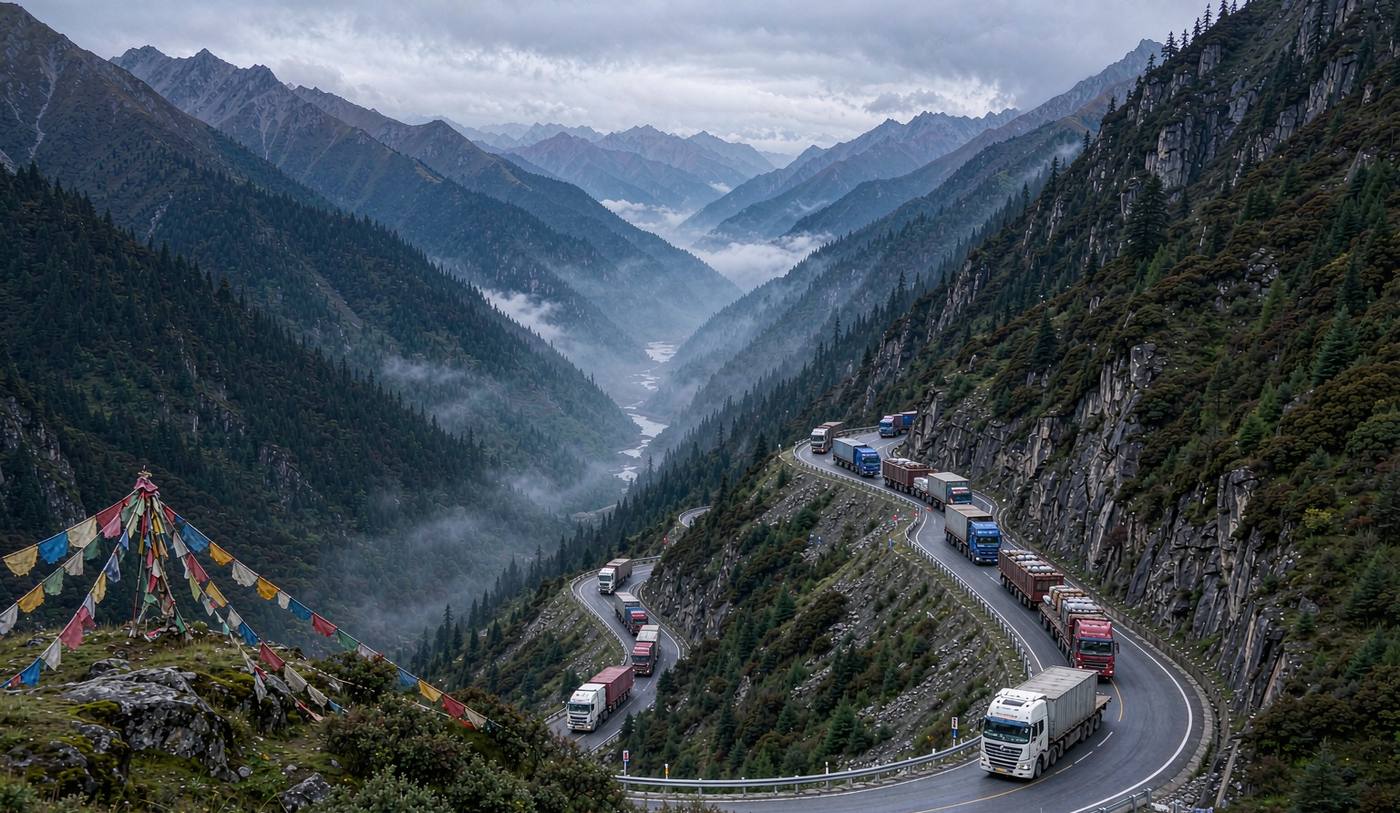
- Two clocks. The ocean schedule is a carrier schedule; the road leg is a mountain road subject to weather, landslides and holiday closures.
This is the reason we quote the two legs separately as well as together. A shipper who knows the ocean leg is 18 days and the road leg is 4 plans correctly. A shipper who hears "about three weeks" does not.
Kolkata, Phuentsholing and the eight hundred kilometres
Kolkata Port
The primary maritime gateway for Bhutanese cargo, and where ocean freight ends. Bhutan maintains a customs office in Kolkata specifically to facilitate inbound cargo arriving through the port, which is a useful thing to know when something needs answering on the ground.
Phuentsholing
The primary trade and transit entry point, on the Bhutan-India border. The dry port is reached through the town of Jaigaon on the Indian side. It is where the Bhutanese import is cleared, and it is the crossing published reporting describes as backing up during the monsoon.
Two newer alternatives are worth asking about because they can shorten the road leg materially. The Jogighopa inland waterways terminal in Assam sits about 91 kilometres from Gelephu, which is a fraction of the distance from Kolkata. A Chattogram routing through Bangladesh is also reported as a faster option in some cases. Both depend on service availability, so ask rather than assume.
What the transit through India actually requires
The goods are not being imported into India, so the movement is a transit rather than an Indian import — but a transit still has to be documented and closed out.
Discharge at Kolkata
The container is discharged and the transit paperwork begins.
Transit documentation
Documents establishing that the cargo is in transit to Bhutan rather than being imported into India. Confirm the current requirements before the vessel sails.
Overland movement
Roughly 830 km to the Phuentsholing crossing, subject to road conditions and season.
Bhutanese import clearance
Filed with the Department of Revenue and Customs at the crossing, with duty and any sales tax assessed.
The practical advice: for a first shipment, ask for a delivered-duty-paid quotation. The alternative is asking a consignee who has never imported to manage a transit through a foreign port and a border crossing on their own, which is where Bhutan shipments go wrong.
Duty bands, and why clothing costs more than machinery
Duty is assessed by HS code, and the bands are wide enough that classification is the single biggest lever on cost:
| Category | Published duty band |
|---|---|
| Machinery | 5–10% |
| Electronics | 10–20% |
| Clothing | 20–30% |
| Footwear | 20–30% |
| Cosmetics | 20–30% |
| Food and beverages | 5–30% |
| Vehicles | 25–50% |
| Books | 0% |
Read that table against what Bhutan actually buys from China — machinery and mechanical appliances, electrical machinery and equipment, base metals, textiles and consumer goods, with bilateral trade reported at around US$203 million in 2025. The machinery and electronics bands matter more in practice than they might on a consumer-goods lane, and the textile bands are the ones that hurt.
One structural point: under the India-Bhutan Trade, Commerce and Transit Agreement, many goods of Indian origin enter at zero duty. Chinese-origin goods do not have that advantage, so there is no regional preference to claim here — just an accurate HS code.
Sales tax at the border versus sales tax at the shop
This is the part of Bhutan's system that published sources disagree about, and it is worth stating plainly rather than picking a number.
- One view: Bhutan has no VAT. A Bhutan Sales Tax of 5 percent applies to some goods, but at the point of sale rather than at customs — so an importer does not pay it at the border.
- Another view: a 7 percent charge on the CIF value plus duty at import, alongside fixed processing and handling fees.
On a container the difference between zero and seven percent at the border is real money, and this is exactly the kind of figure that should be confirmed in writing rather than assumed from a website.
Either way, two other charges are worth budgeting for: fixed clearance and processing fees, published in a band of roughly BTN 500 to 2,000, and a green tax reported at 1 to 5 percent of value on electronics as an environmental levy.
Paro, and the only international airport
Paro International Airport is Bhutan's sole international gateway, served by the national carrier. There is no second option, which shapes how air freight is used here.
- It is fast and it is the whole answer for urgent cargo. Published air rates start from around US$4.55 per kilogram for larger weights.
- Capacity and schedule are limited by definition. One airport, one international carrier, mountain approaches that are weather-sensitive. Book early.
- It bypasses the transit problem entirely. An aircraft lands in Bhutan, which removes the Indian transit formalities and the 830 km road leg from the shipment altogether.
When air wins: high value-to-weight goods, urgent spares, samples, anything seasonal, and any shipment where the monsoon makes the road leg unreliable. For bulky, low-value cargo the road still wins on cost and always will.
Import licences and the restricted list
Published guidance states that an import licence is required for most goods except those from India. That is a broad statement and it should be checked against your product, not assumed.
| Status | Categories |
|---|---|
| Restricted | Arms and ammunition; explosives; endangered species and their parts; industrial and toxic waste; wireless and remote-sensing telecommunications and broadcasting equipment; certain notified chemicals; used or second-hand goods, vehicles, machinery and equipment |
| Prohibited | Narcotics and psychotropic substances; pornographic materials; anything prohibited by other law or international convention |
| Heavily taxed | Alcohol and tobacco; published figures note alcohol duty from third countries reduced from 100 percent to 40 percent in 2026, and e-cigarettes carrying a combined 115 percent from January 2026 |
| High duty | Vehicles, at 25 to 50 percent |
The one that catches commercial shippers is the second-hand goods and used machinery restriction. If your shipment is used equipment — which is common for project cargo — confirm its admissibility before it sails, not after it reaches the crossing.
Transit times, and the season that slows them
| Leg | Published time | Note |
|---|---|---|
| Ocean, China to Kolkata | 15–25 days | The predictable part |
| Overland, Kolkata to Bhutan via Phuentsholing | 3–5 days | About 830 km; the variable part |
| Air freight to Paro | A few days | Fastest and least seasonal |
| Express courier | Door to door | The only genuinely door-to-door option |
| Bhutanese customs clearance | 3–10 days | Longer where documents are incomplete |
The monsoon belongs in your plan. Published guidance describes the Phuentsholing crossing backing up in the monsoon season, and mountain roads in the region are subject to landslides. If your delivery date is fixed, build in weeks rather than days around the wet months.
What we assemble before the truck leaves Kolkata
| Document | What it has to do |
|---|---|
| Commercial invoice | Complete description, value and HS code; the code sets the duty band and the description drives it |
| Packing list | Contents, weight and dimensions, matching the invoice |
| Bill of lading or air waybill | Consignee consistent with the licence-holding importer |
| Transit documents | Establishing that the cargo is moving through India to Bhutan |
| Import licence | Required for most goods; confirm for your product before shipping |
| Certificate of origin | Issued in China; supports origin. There is no preference to claim, but origin still matters |
| Sector permits | Health and phytosanitary certificates where the product requires them |
| Insurance certificate | Not less than 110 percent of CIF, with cover running through the road leg |
| ISPM 15 evidence | Stamp on every wooden pallet or crate |
Why a local agent matters more than the freight
On a lane built out of two countries' formalities, a single mountain crossing and one airport, the freight rate is the least interesting number in the file.
What a Bhutanese agent does that matters: holds or obtains the import licence, files through RAMIS with the right HS code, coordinates with the Bhutanese customs office in Kolkata while the container is still in India, and knows what the crossing is doing this week rather than last quarter. Add the transit formalities on the Indian side and you have four parties that have to move in sequence.
Why importers use Goodhope on this lane
Six things that are different about working with us on China to Bhutan shipments.
Case notes to Bhutan
Five shipments bought in China and delivered into Bhutan, told end to end — where the order came from, how it moved, where it nearly went wrong, and how it finished. Client names are withheld at their request; the situations and the handling are what we deal with on this lane.
Two legs quoted as one · Kolkata to Phuentsholing · Shenzhen to Thimphu
The purchase. A buyer had one quote for the sea leg to Kolkata and a vague promise about getting the goods across India afterwards.
The move. Both legs quoted and booked as one shipment, with the Indian transit arranged before the vessel berthed.
Where it nearly went wrong. The road in runs through India and the transit has its own requirements. Treating the two legs separately is where Bhutan-bound cargo disappears for weeks.
How it finished. One booking, one accountable party, and the consignment moved continuously from Kolkata to the border.
Licence missed · restricted list · Guangzhou to Bhutan
The purchase. A buyer imported goods that required an import licence and only found out at the crossing.
The move. Licence requirement identified and resolved, then the consignment completed its journey.
Where it nearly went wrong. Import licences and the restricted list gate certain categories. Freight routing cannot substitute for them, and discovering the requirement at the border is the most expensive possible moment.
How it finished. We check the licence position before the truck leaves Kolkata now. Nothing has been turned back since.
Duty bands · clothing against machinery · Ningbo to Bhutan
The purchase. A buyer was costing two different product lines using a single average rate.
The move. Duty checked by line before he committed, with the difference between the categories made explicit.
Where it nearly went wrong. Duty bands differ sharply here, and clothing costs materially more than machinery. Averaging across a range is how a viable line turns into an unviable one.
How it finished. He priced each line on its own band and dropped the one that no longer worked.
Season · monsoon slowdown · Shanghai to Bhutan
The purchase. A buyer scheduled a delivery without knowing which season slows the mountain road.
The move. Booking moved forward so the transit happened outside the season that slows it.
Where it nearly went wrong. The mountain road and the border both slow in the wet season. A schedule that works in the dry months does not survive the monsoon unchanged.
How it finished. He now books against the season, and his delivery dates hold.
Air to Paro · urgent · Guangzhou to Paro
The purchase. A buyer had urgent items and assumed the mountain road was the only option.
The move. Air uplift into Paro, the country's only international airport, for the urgent part of the order.
Where it nearly went wrong. Air into Paro is a genuinely different option rather than an expensive curiosity, and for urgent items it removes the entire overland leg.
How it finished. He split the order: urgent by air, bulk overland. Both arrived when he needed them.
Why importers use Goodhope on this lane
Six things that are different about working with us on China to Bhutan shipments.
Get both legs quoted as one shipment
Tell us what you are shipping, the HS codes if you have them, the packed dimensions and gross weight, the pickup city in China and the delivery address in Bhutan. We will quote the ocean leg and the road leg so you can see both, confirm whether the Jogighopa or Chattogram routing is running for your cargo, tell you whether your product needs an import licence and whether it is admissible at all, and set out the duty band before you commit.
Get a quote Talk to usRelated pages
Frequently asked questions
Does Bhutan have a port?
No. Ocean freight ends at Kolkata Port in India, then travels about 830 km overland to Phuentsholing, reached via Jaigaon. Alternatives include the Jogighopa inland terminal in Assam, about 91 km from Gelephu, and a Chattogram routing.
How long does shipping take?
Ocean to Kolkata is typically 15–25 days, plus 3–5 days overland. Air into Paro is faster and express delivers door to door. Monsoon and landslides are the main cause of slippage on the road.
What duty will I pay?
Published bands run 0–50 percent by HS code: machinery 5–10 percent, electronics 10–20 percent, clothing and footwear 20–30 percent, food 5–30 percent, cosmetics 20–30 percent, books 0 percent, vehicles 25–50 percent.
Is there VAT?
Sources differ. One set says no VAT, with a 5 percent sales tax at the point of sale rather than at customs; another gives 7 percent on the CIF value plus duty at import.
Which crossing is used?
Phuentsholing is the primary trade and transit entry point, with the dry port reached through Jaigaon. Bhutan also keeps a customs office in Kolkata to facilitate cargo arriving through the port.
Do I need an import licence?
Published guidance says yes for most goods except those from India. Alcohol and tobacco are heavily taxed and regulated, and vehicles carry 25–50 percent duty. Confirm for your product.
What is restricted?
Arms and ammunition, explosives, endangered species, industrial and toxic waste, wireless telecoms equipment, certain chemicals, and used or second-hand goods, vehicles, machinery and equipment. Narcotics are prohibited.
Can I ship by air?
Yes — Paro International is the sole international gateway, served by the national carrier, with published rates from around US$4.55 per kilogram. It removes the Indian transit and the road leg entirely.
Do you deliver door to door?
Express courier does. For sea and air we can arrange a DDP quotation, which is usually right for a first shipment because the alternative is asking a first-time consignee to manage Indian transit and a border crossing alone.
How big is Bhutan's trade with China?
Published figures put bilateral trade at roughly US$203 million in 2025. Main imports from China are machinery, electrical equipment, base metals, textiles and consumer goods.