
Home / Shipping to Bolivia / How to Ship from China to Bolivia
How to Ship from China to Bolivia: Arica, the Andes & IBNORCA
Bolivia has no coast, and the last leg of the journey climbs a mountain. Every container from China lands in another country — Chile, Peru or Brazil — and then travels overland, crossing the Andes or crossing the eastern lowlands, to reach a Bolivian customs warehouse. Which port it lands at is decided by which Bolivian city the goods are going to, and that is the first question to answer, not the freight rate. Arica in Chile is the default and handles more than seventy percent of the country's maritime imports, but it is the right answer only for La Paz and the altiplano.
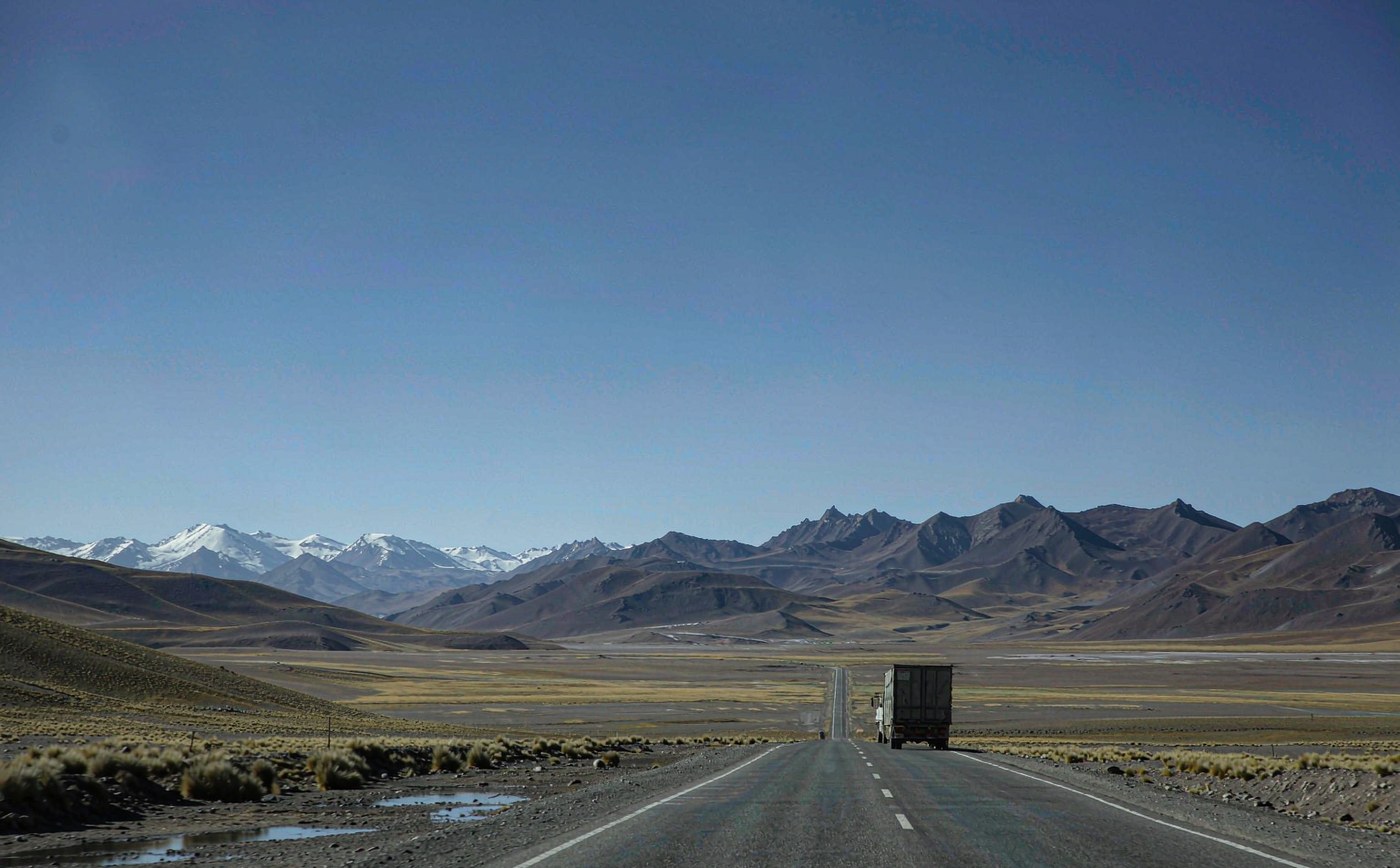
The second thing is that the mountain changes what a container can carry. Andean road regulations and gradients cap truck payloads at roughly twenty-one to twenty-two tonnes, well below what a forty-foot box can physically hold. A heavy container that would be routine on a coastal lane gets force-transloaded into two trucks at the port, at real cost, and the crossing it has to make sits at roughly 4,600 metres. Winter snow and the summer rainy season both stop trucks on that road.
The third thing is that the tax is arithmetic and the certificate is the obstacle. Duty and IVA at an effective rate near fifteen percent can be calculated on a spreadsheet. What stops containers is conformity certification: IBNORCA, under Bolivia's products and safety law, described as voluntary and required in practice, supported by a laboratory report from an accredited laboratory and a product description in Spanish. It takes weeks, and it has to start before the goods ship.
At a glance
Corridors: Arica (Chile) for La Paz and the altiplano, 34–48 days; Matarani or Callao (Peru) as backup and for Santa Cruz, 32–50 days; Santos (Brazil) for eastern Bolivia, 40–55 days; Iquique for the southern altiplano, 37–48 days. · In bond: MIC/DTA transit documents are mandatory, and carriers commonly require a refundable guarantee deposit of US$1,000–2,000 per container before release at Arica or Iquique. · Payload: Andean road limits cap trucks at roughly 21–22 tonnes, so load to the road limit rather than the container limit. · Border: Tambo Quemado at about 4,600 metres; snow from June to August, rain and queues from December to March. · Duty: Gravamen Arancelario 0–40% by HS code. · IVA: 13% headline on CIF plus duty, grossed up to an effective rate near 15%. · Entry: a Bolivian NIT and a licensed despachante filing through SIDUNEA++. · Certification: IBNORCA under the products and safety law, plus SENASAG, AGEMED and VUCE permits where the product is regulated.
How your cargo moves: China to Bolivia
Eight steps from your supplier's door to yours. The last four are the ones shaped by local rules.
- Pickup from your supplierWe collect the goods anywhere in China and bring them to our consolidation point.
- Export clearanceChina customs declaration filed and released before the goods move to the port.
- Loading and departureContainer loaded, sealed and handed to the carrier at the Chinese port.
- Main carriageOcean, air or rail movement booked on the route agreed for your cargo.
- Arrival at the gatewayDischarge at the port or airport of entry, recorded on the carrier's manifest.
- Import clearanceCustoms declaration filed locally, with duty and tax assessed on the declared value.
- Customs releaseGoods released into free circulation once duty and tax are settled.
- Final deliveryOnward movement to your delivery address, warehouse or nominated depot.
Duty rates, VAT rates and clearance times move, and the figure that applies to your goods is the one set for your commodity code on the day of clearance. We check the current position against your code before your goods sail and confirm it to you in writing — ask for that check when you request a quote.
What this guide covers, and the city that decides everything
This is written for a buyer bringing goods out of China for the first time and landing them in Bolivia. It follows the shipment in the order the problems arrive: which port, what the mountain does to the load and the schedule, how the goods cross two countries without being imported into either, what the charges are, which certificate gates the release, and how long it all takes.
It does not quote freight rates. Those move with the market, and on a lane with an ocean leg, a transshipment and an overland leg there are more of them than usual. What it does instead is show where the money goes and which decisions change the total.
The first question is the delivery city, and it is worth stating plainly because everything else follows from it. La Paz and El Alto, Oruro and Cochabamba belong to the Chilean and southern Peruvian corridors. Santa Cruz and the eastern lowlands belong to Callao, Ilo or Santos. A quotation that says only "Bolivia" has not answered the question that determines its own price.
Three neighbours' ports: Arica, Iquique and the Peruvian south
| Gateway | Route and border | Serves | Door to door |
|---|---|---|---|
| Arica, Chile | About 440 km over the Andes to La Paz, crossing at Tambo Quemado. | La Paz, El Alto, Oruro, Cochabamba. The default, and the shortest combined distance. | 34–48 days |
| Iquique, Chile | Truck via Colchane and Pisiga to Oruro or La Paz. | The southern altiplano. Competitive when Arica is congested. Also the home of the ZOFRI free zone, which some importers use for staging. | 37–48 days |
| Matarani / Ilo / Callao, Peru | Matarani is the short run to La Paz; Callao serves the centre and east via Desaguadero or the interoceanic route. | La Paz as a backup when Arica is slow; Santa Cruz and central Bolivia as a primary route. | 32–50 days |
| Santos, Brazil | Ocean to Santos, then road, or river to Puerto Suárez and onward to Santa Cruz. | Santa Cruz and eastern Bolivia. | 40–55 days |
The rule is short: the altiplano goes through Chile, the east goes through Peru or Brazil. Sending Santa Cruz cargo over the Andes, or La Paz cargo round by Santos, adds hundreds of dollars of overland cost and days of transit for no benefit.
Arica's dominance is worth understanding rather than just accepting. It is not simply the nearest port; the road from it is the one built for Bolivian volume, the operators on it know the transit procedure, and the border post is set up for it. That is also why it congests, and why Matarani exists as the release valve when it does.
The Andes, and the trucks that cannot carry what the container holds
This is the part of the lane that surprises importers who have shipped to coastal South America before.
Bolivian road regulations, and the gradients themselves, cap what a truck may carry at roughly twenty-one to twenty-two tonnes. A forty-foot container can physically hold twenty-eight to twenty-nine tonnes. The difference is not absorbed by a stronger truck: a box loaded above the road limit faces a forced transload at the port, split across two vehicles, at a cost that typically exceeds any saving from choosing the larger container.
Load to the road limit, not to the container limit. Tell your supplier the payload ceiling before the container is stuffed, and ask your forwarder to confirm the truck limit on your specific corridor. It is one instruction, given early, and it removes a cost that otherwise appears at the port as a surprise.
Then the crossing itself. The Tambo Quemado post sits at roughly 4,600 metres, and the road to it is exposed to two seasonal problems. Snow and ice between June and August can close trucking for two to four days at a time. The altiplano rainy season, from December to March, backs the border up with truck queues — at Tambo Quemado and equally at Desaguadero on the Peruvian side.
There is a quieter cost worth knowing about: high-cube containers into Chilean and Peruvian ports can carry a repositioning premium, because equipment does not flow back evenly on this trade. A 40HC that costs less per cubic metre on paper can end up costing more once that premium is applied.
In bond: MIC/DTA, and the deposit before the box is released
Cargo from China arrives at a port in Chile, Peru or Brazil and then crosses that country without being imported into it. The documents that make that possible are the Manifiesto Internacional de Carga and the Declaración de Tránsito Aduanero — MIC/DTA — and they are mandatory. There is no route around them.
The procedure is physical as well as documentary. The goods are unloaded into a bonded terminal, the transit documents are filed showing Bolivia as the final destination, and the truck moves under seal with documents that are validated at the exit point and again at the Bolivian entry point. No local import duty is paid at the port, which is the entire point.
Two things go wrong, and both are timing failures rather than paperwork failures. The first is a transit declaration filed late: cargo that arrives at Arica before the MIC/DTA is ready waits in bond, and once free time expires the detention clock is running, with charges reported in the region of a hundred to two hundred US dollars per container per day. The second is the container guarantee deposit, which carriers commonly require before releasing boxes at Arica or Iquique — reported between one and two thousand US dollars per container, refundable, but a real working-capital item while it is held. Some forwarders arrange container insurance through their carrier contracts to remove that upfront outlay; ask whether yours can.
The question to put to your forwarder in writing is simple: who files the MIC/DTA, when, and is the deposit inside the quotation?
What you pay: the GA, thirteen percent, and the grossed-up IVA
| Charge | Basis and rate |
|---|---|
| Gravamen Arancelario | 0–40% of CIF by HS code. Capital goods and machinery often 0–5%; electronics around 5–10%, with smartphones and laptops near 5%; textiles and footwear 20–35%; food 5–40%; cosmetics 10–20%; toys 10–20%; books 0%. Many finished consumer goods are reported at 15% under a decree described as running to the end of 2027, down from 20% . |
| IVA | 13% headline on CIF plus duty. It is applied por dentro — computed on a base that already includes the tax — which produces an effective rate nearer 14.94%. |
| Verification charge | Around 1% of the FOB value. |
| Customs service fee | Around 0.5%. |
| Statistical charge | Around 0.8%. |
| ICE excise | Alcohol, tobacco, vehicles, fuels and some luxury goods. |
Two structural points. There is no agreement with China, and Bolivia's preferences as a member of the Andean Community apply to goods from within the bloc rather than to Chinese goods — so there is no certificate that removes the duty here, in the way a preferential certificate does on the Chile, Peru and Ecuador lanes. And no de minimis relief is reported, which means even a small shipment is assessed rather than waved through.
One warning, stated once and worth heeding: the customs authority maintains valuation databases by product, and a declared value far below the published reference triggers inspection, fines and days of storage. The cheap declaration is the expensive one.
IBNORCA, and the certificate that is voluntary in name only
Bolivia's products and safety law requires that goods placed on the Bolivian market conform to Bolivian technical standards, the normas NB. The body that certifies that conformity is IBNORCA, the Bolivian institute for normalisation and quality.
The certification is described in law as voluntary. In practice it functions as a requirement for goods subject to import control, because Bolivian customs and the health authorities can ask for it as a condition of release, and goods without it can be held at the border, fined or returned. That gap between the description and the reality is where first-time importers lose weeks.
What the file needs
A test report from a laboratory accredited to ISO/IEC 17025, with the test items matched one-for-one to the applicable Bolivian standard for your product. The IBNORCA certificate or registration itself. And a product description in Spanish carrying the technical parameters — material, finish, dimensions, intended use.
What else may gate the release
SENASAG covers agricultural and animal products, AGEMED covers medicines, and permits for regulated goods are filed through the VUCE single window before the shipment departs. Food-contact materials — plastic containers, tableware, kitchen utensils, food packaging — are explicitly inside the controlled perimeter.
The pattern is the same one this series has found in Ecuador, Uruguay and Paraguay: the duty is a number you can calculate, and the certification is a process you have to start. Start it with the production order.
Who can import: the NIT and the despachante
Customs is run by the Aduana Nacional de Bolivia through the SIDUNEA++ electronic system. The consignee needs a Bolivian NIT, the national tax identification number, and a licensed despachante de aduana files the import declaration.
Use your own NIT. Importing under a broker's or a trader's tax number can look convenient, but the invoice has to match the NIT holder and clearing under someone else's number costs you the IVA credit on your own tax position. Appoint the broker with a power of attorney and import under your own number.
Clearance of a clean, well-documented shipment takes two to five working days; published ranges stretch to five to fourteen days where documents, permits or valuation are not in order. Valuation is on a CIF basis.
Following a box from Xiamen up the Andes to El Alto
Here is the default western corridor end to end.
Corridor set by the destination
The warehouse is in La Paz, so the container will land at Arica. The overland trucking and the transit documents are booked with the ocean leg, not after it.
Stuffed to the road limit
The supplier loads to the payload ceiling the Andean road allows rather than to what the container physically holds, which avoids a forced transload at the port.
Export clearance and loading in China
Collection, loading at Xiamen, Chinese export declaration, verified gross mass before the carrier's deadline. The certificate and permit work is already in progress at this point, because it takes longer than the voyage.
Ocean leg to Arica, roughly twenty-eight to thirty-five days
Most services transship once — commonly at Busan, Hong Kong or Singapore — before the west coast South America leg. Sailings are weekly from the main Chinese ports.
Released in bond
MIC/DTA filed, guarantee deposit arranged, container released under seal. It has not been imported into Chile and no Chilean duty has been paid.
Over the Andes, two to three days
The truck climbs to the Tambo Quemado crossing at roughly 4,600 metres and descends to La Paz, where the transit documents are validated on entry.
Declaration and payment in Bolivia
The despachante files through SIDUNEA++ under the importer's NIT. Duty, IVA at the effective rate, and the fixed charges are assessed and paid, and the goods are released to the warehouse in La Paz or El Alto.
Transit times, and what the mountain adds
| Leg | Days | Applies to |
|---|---|---|
| Origin consolidation | 5–10 | LCL only |
| Ocean leg to the Pacific gateway | 26–35 | All sea freight, usually with one transshipment |
| Port handling and transit formalities | 3–7 | All sea freight |
| Overland leg into Bolivia | 2–5 | All sea freight |
| Customs clearance | 2–5 working days | Longer where documents or permits are imperfect |
| Air freight, door to door | 5–10 | Plus courier at 4–8 |
Published door-to-door totals: thirty-four to forty-eight days via Arica to La Paz, thirty-two to thirty-eight via Matarani, forty to fifty via the Peruvian gateways to Santa Cruz, forty to forty-five to Cochabamba, and forty to fifty-five via Santos. Consolidated cargo typically runs forty to fifty-five days, because consolidation and break-bulk at the gateway each add five to ten days.
The things that stretch those numbers are all seasonal or procedural. A missed transshipment connection adds five to ten days. Winter snow at the border adds two to four. The rainy season adds whatever the queue is. A transit declaration filed late adds the entire wait, at a daily rate.
Air freight, and two airports at very different heights
Bolivia's two main airports are not interchangeable, and the difference is altitude.
El Alto, above La Paz, is one of the highest international airports in the world at around four thousand metres. Thin air affects aircraft performance and payload, which matters for heavy cargo and for how airlines price it. Viru Viru, serving Santa Cruz, sits at low altitude and is the principal cargo gateway for eastern Bolivia and, in practice, for a good deal of freight that is trucked onward from there.
Air runs five to ten days door to door and courier four to eight. It is more expensive per kilogram than sea freight by a wide margin, and it is worth costing anyway, because it sidesteps three things at once: the border crossing, the transit regime and the Andean weight limit. For high-value electronics, spare parts and anything seasonal, that is often the right trade.
Consolidation, and the fifteen cubic metre line
The break-even sits around fifteen cubic metres on this lane, and it shifts further towards a full container than on coastal lanes for a simple reason: the overland leg is priced per container for full loads and per cubic metre for consolidated ones, and the consolidated cargo is handled more times — at origin, at the transshipment hub, at the gateway, and again at the Bolivian warehouse.
Full containers run roughly thirty-five to forty-five days door to door against forty to fifty-five for consolidated cargo, and arrive with fewer touches on a route where every touch is a border or a handover. Below about fifteen cubic metres, consolidation is still the right answer; above it, and certainly above twenty, a full container usually wins on both cost and risk.
Packing for altitude, rain and a border crossing
Solid wood packaging has to meet ISPM 15 and carry the stamp, and the certificate belongs with the documents. Processed wood falls outside the rule and is the simplest way to remove the risk.
Then the handling count. A container on this lane is loaded in China, transshipped once, discharged, moved to a bonded terminal, loaded onto a truck, possibly transloaded, examined at a border, and unloaded again in Bolivia. Packaging specified for a single-handling shipment will not survive that. Add the seasonal conditions — altiplano rain from December to March, hard sun and cold on the plateau — and specify accordingly.
Weight distribution matters more than usual too, because a container that is heavy at one end is the one that gets pulled for a transload.
Labels, Spanish and 220 volts
Retail goods are labelled in Spanish, with the product name, country of origin, dates and ingredients for consumables. As on the other lanes in this series, that is a production decision: customs will release unlabelled goods and the problem appears later, at the point of sale.
The mains supply is 220 volts at 50 hertz, with socket types that vary by building, so adapters and, where relevant, transformers are worth planning for. A Spanish-language technical description is also what the certification file needs, so the two requirements are worth satisfying together.
Business cargo, and the goods Bolivia will not take
Commercial stock follows the full path: corridor, transit, declaration, duty, IVA and the fixed charges. Because no de minimis relief is reported, the small first order is assessed like a large one, which is worth knowing before you budget a trial shipment.
Used clothing is banned or heavily restricted, and this catches importers who assume second-hand goods are merely a low-value trade. Narcotics, explosives and counterfeit goods are prohibited outright. Firearms, pharmaceuticals, agrochemicals and certain food products need permits filed through VUCE before departure, with SENASAG covering agricultural goods and AGEMED covering medicines.
The calendar: winter snow, the rainy season and the border queues
Three seasonal effects and one commercial one.
June to August is the altiplano winter. Snow and ice at the high crossings can stop trucking for two to four days at a time, and it is the most predictable source of schedule slippage on the western corridor.
December to March is the rainy season, when Tambo Quemado and Desaguadero back up with truck queues. Combine it with Chinese New Year at the origin end and you have the worst window on the lane.
August to December is when capacity tightens on the China–South America trade, with peak season surcharges reported in the range of fifteen to thirty percent on the ocean rate. Book three to four weeks ahead, with a rate validity window, and treat that as the cheapest insurance available.
Practical version: avoid scheduling arrivals into the February New Year window, into the wettest weeks on the altiplano, or into the deep winter if your cargo must cross the high passes.
The paperwork, and the file that has to be complete at Arica
| Document | What it has to do |
|---|---|
| Commercial invoice | The true transaction value, full description and HS code, with the consignee matching the holder of the NIT. Valuation databases are used to check it. |
| Packing list | Carton count, dimensions and weights, matching the invoice and the verified gross mass. |
| Bill of lading | Consignee and description consistent with the transit documents, because all three are read at the border. |
| Certificate of origin | Evidence of origin. It does not reduce the duty, because no agreement with China is in force. |
| MIC/DTA transit documents | What moves the cargo in bond across Chile or Peru. Ready before the vessel arrives. |
| ISPM 15 fumigation certificate | Any shipment with wood packaging. |
| IBNORCA certification and laboratory report | Where the product is controlled. The report from an ISO/IEC 17025 laboratory, matched to the applicable standard. |
| SENASAG, AGEMED and VUCE permits | For regulated goods, filed before departure. |
| Import declaration | Filed through SIDUNEA++ by a licensed despachante. |
| Insurance certificate | Evidence of cover across two countries and two very different risk profiles. |
Two checks worth running over the whole file yourself, and both are free. One HS code, used identically, on the invoice, the packing list, the certificate and the declaration. And one consignee name, matching the NIT holder, because a mismatch costs the IVA credit as well as the time to correct it.
Why importers use Goodhope on this lane
Six things that are different about working with us on China to Bolivia shipments.
Real stories to Bolivia
Five shipments bought in China and delivered into Bolivia, told end to end — where the order came from, how it moved, where it nearly went wrong, and how it finished. Client names are withheld at their request; the situations and the handling are what we deal with on this lane.
Port choice by city · La Paz against Santa Cruz · Xiamen to Bolivia
The purchase. A buyer was quoted Arica for everything because that was the port his previous forwarder used.
The move. Compared Arica, Iquique, the Peruvian south and Santos against which city the goods were actually going to.
Where it nearly went wrong. The right port is decided by the delivery city, not by habit. Arica suits the altiplano and La Paz; Santa Cruz and the east are better served from Peru or Brazil.
How it finished. He split his routings by destination and cut days off the inland leg.
In bond documents · MIC/DTA · Shenzhen to El Alto
The purchase. A buyer assumed his container would simply be trucked across the border once it landed.
The move. Transit documents and the deposit arranged before the box was released from the port.
Where it nearly went wrong. The in-bond movement is mandatory and carriers commonly require a deposit before release. Without both in place, the container does not move at all.
How it finished. We arranged the documents and the deposit ahead of discharge, and the box moved on arrival.
IBNORCA · voluntary in name only · Guangzhou to Bolivia
The purchase. A buyer read that the conformity certificate was voluntary and decided to skip it.
The move. Told him what actually happens in practice, then arranged the certificate before shipping.
Where it nearly went wrong. The certificate is voluntary on paper and effectively required in practice. Cargo arriving without it faces exactly the delay the 'voluntary' label led him to expect would not happen.
How it finished. He has arranged it on every shipment since and cleared without difficulty.
Andes transfer · trucks cannot take the full box · Ningbo to La Paz
The purchase. A buyer assumed a full container could be trucked up to El Alto as one load.
The move. Planned the transfer at the border, with the cargo carried onward in vehicles suited to the mountain route.
Where it nearly went wrong. The Andes leg cannot always be done with the same vehicle or the same load. Planning it as a straightforward trucking job produces a stuck container and a very expensive second attempt.
How it finished. We planned the transfer in advance. The goods reached El Alto without incident.
Fifteen cubic metre line · consolidation · Yiwu to Bolivia
The purchase. A buyer with a part load was quoted full-container pricing on a route where that made no sense.
The move. Consolidated his cargo with other Bolivia-bound shipments, below the volume line where consolidation clearly wins.
Where it nearly went wrong. Below roughly fifteen cubic metres, consolidation is the cheaper answer on this corridor, and paying for a whole box is money spent on air.
How it finished. He consolidated, and now uses consolidation for anything under that line and full containers above it.
Why importers use Goodhope on this lane
Six things that are different about working with us on China to Bolivia shipments.
Request a quote on your Bolivia shipment
Tell us the delivery city in Bolivia, the commodity and its description, and the volume in cubic metres or the container type. We will recommend the corridor, confirm the payload ceiling and the transit documents, and quote the deposit separately rather than leaving it to appear at the port.
Get a quote Talk to usRelated pages
Frequently asked questions
Which port should my Bolivia-bound cargo go through?
Arica in Chile for La Paz, Oruro and the altiplano — it handles more than seventy percent of Bolivia's maritime imports. Matarani in Peru is the backup when Arica is congested. Callao, Ilo or Santos serve Santa Cruz and the east. Give your forwarder the delivery city, not just the country.
How long does shipping from China to Bolivia take?
Published door-to-door figures run 34–48 days via Arica to La Paz, 32–38 via Matarani, 40–50 via the Peruvian gateways to Santa Cruz and 40–55 via Santos. Air runs 5–10 days, courier 4–8. Most services transship once on the way to the Pacific.
What taxes will I pay importing into Bolivia?
The Gravamen Arancelario at 0–40% by HS code, IVA at 13% on CIF plus duty — effectively nearer 15% once the grossed-up basis is applied — a verification charge around 1% of FOB, a service fee around 0.5%, a statistical charge, and ICE excise on alcohol, tobacco, vehicles and some luxury goods. No de minimis relief is reported.
Is there a free trade agreement between China and Bolivia?
No. Andean Community preferences apply to goods from within the bloc, not to Chinese goods, and no certificate removes the duty on this lane.
What is IBNORCA and do I need it?
The institute that certifies conformity with Bolivian technical standards under the products and safety law. Voluntary in law, required in practice for controlled goods, and backed by a laboratory report from an ISO/IEC 17025 accredited laboratory plus a Spanish technical description.
Do I need a tax number and a broker?
Yes. A Bolivian NIT for the consignee and a licensed despachante filing through SIDUNEA++. Import under your own NIT — clearing under someone else's costs the IVA credit.
What is MIC/DTA and why does it matter?
The transit documents that move cargo in bond across Chile or Peru without importing it there. Mandatory, and needed before the vessel arrives: cargo that lands first waits in bond with the detention clock running.
Why does a forty-foot container cost more than expected?
Andean road limits cap truck payloads near 21–22 tonnes, so a heavy 40ft can be force-transloaded into two trucks. Carriers also commonly require a refundable guarantee deposit of US$1,000–2,000 per container before release at Arica or Iquique.
Which airport should air freight use?
El Alto above La Paz sits at around 4,000 metres, which affects aircraft performance and payload. Viru Viru in Santa Cruz is at low altitude and is the main cargo gateway for eastern Bolivia. Air runs 5–10 days door to door.
What cannot be imported into Bolivia?
Used clothing is banned or heavily restricted; narcotics, explosives and counterfeit goods are prohibited. Firearms, pharmaceuticals, agrochemicals and certain foods need permits filed through VUCE before departure.