
Home / Shipping to the British Virgin Islands / How to Ship from China to the British Virgin Islands
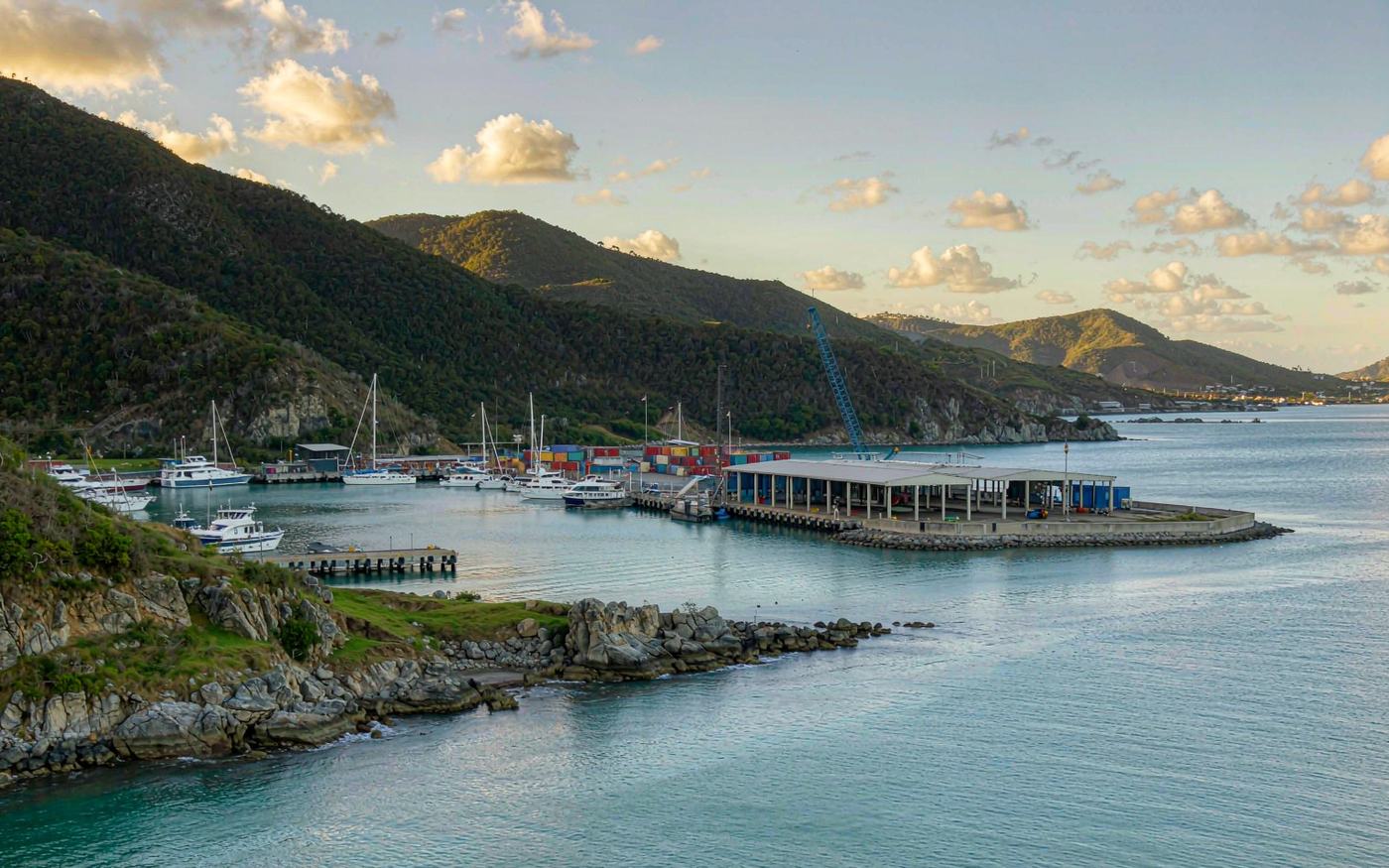
How to Ship from China to the British Virgin Islands: Duty on CIF, the 2022 Rate Cut & Port Purcell
The British Virgin Islands have a reputation for being a tax-free place, and for a company that is broadly true. For a shipment, it is not. There is no income tax, no corporate tax, no capital gains tax and no VAT in the BVI. What there is instead is import duty at the dock, because a government that collects no income tax and no sales tax has to fund itself somewhere, and on an island where almost everything arrives by sea, the customs house is where it happens.
For a first-time importer this produces a specific and predictable mistake. The buyer reads that the BVI is tax-free, assumes the landed cost is close to the invoice value, and is then surprised by a duty assessment calculated not on the invoice but on the CIF value — the goods, plus insurance, plus the freight that was expensive precisely because the cargo went to a small island on an indirect routing.
The second thing worth knowing before you quote is that the published rates disagree with each other, and that is not sloppy research. In April 2022 the territory reduced duty rates above five percent to five percent. Whether that reduction is permanent, and how it interacts with the tariff schedule written into law, is not settled in the sources a shipper can read. Any honest page about BVI duty has to say that out loud and send you to the customs authority for the number.
At a glance
Status: British Overseas Territory; own government, own customs administration · Customs authority: HM Customs, Virgin Islands — Richard Stoutt Building, Road Town, Tortola · Law: Customs Management and Duties Act 2010, with rates in Schedule 4 · Basis: HS classification first, then duty on the CIF value · 2022 change: rates above 5% reduced to 5% from 15 April 2022, described as temporary · No VAT, no income tax, no corporate tax, no capital gains tax · Main port: Port Purcell, Tortola · Airport: Terrance B. Lettsome International, EIS, on Beef Island · Currency: US dollar · Hurricane season: June to November, August to October worst
How your cargo moves: China to the British Virgin Islands
Eight steps from your supplier's door to yours. The last four are the ones shaped by local rules.
- Pickup from your supplierWe collect the goods anywhere in China and bring them to our consolidation point.
- Export clearanceChina customs declaration filed and released before the goods move to the port.
- Loading and departureContainer loaded, sealed and handed to the carrier at the Chinese port.
- Main carriageOcean, air or rail movement booked on the route agreed for your cargo.
- Arrival at the gatewayDischarge at the port or airport of entry, recorded on the carrier's manifest.
- Import clearanceCustoms declaration filed locally, with duty and tax assessed on the declared value.
- Customs releaseGoods released into free circulation once duty and tax are settled.
- Final deliveryOnward movement to your delivery address, warehouse or nominated depot.
Duty rates, VAT rates and clearance times move, and the figure that applies to your goods is the one set for your commodity code on the day of clearance. We check the current position against your code before your goods sail and confirm it to you in writing — ask for that check when you request a quote.
A British Overseas Territory that writes its own tariff
The BVI is internally self-governing, with its own elected government, its own courts and its own customs service. Being British does not make it part of the United Kingdom customs territory. Goods arriving from the UK are imports, declared and assessed in exactly the same way as goods arriving from China.
The framework is the Customs Management and Duties Act 2010. It is the statute that establishes the administration, the powers of officers, the obligations of importers and the tariff itself, with the duty rates carried in Schedule 4. That structure matters practically: when you want to know the rate on a product, you are not looking for a policy statement or a press release, you are looking for a classification and the rate attached to it in the schedule.
One consequence of the status is easy to miss. As a UK Overseas Territory, United Kingdom sanctions measures can be extended to the BVI by Order in Council. For a freight forwarder and a buyer, that means sanctions screening is part of the job on this lane even though the goods never touch the United Kingdom. Check counterparties, not just commodities.
Classification first, then CIF: how the duty is worked out
Two steps, in this order, and getting them in the wrong order is the most common reason a BVI duty bill comes back higher than expected.
Classify the goods
The product is placed under the Harmonized System. The classification is what determines which rate in Schedule 4 applies. If the description on the invoice is vague — "machine parts", "accessories", "gifts" — the classification is being guessed, and the guess is unlikely to be the favourable one.
Establish the customs value
The BVI assesses duty on the CIF value: the cost of the goods, plus insurance, plus freight to the port of entry. It is not the invoice value and it is not the FOB value. Both the insurance and the freight are inside the number the rate is applied to.
Apply the rate
The Schedule 4 rate for that classification is applied to the CIF figure. Where the goods qualify for relief — a documented exemption, a returned-goods claim, a temporary importation — the relief has to be claimed with evidence, not assumed.
Pay and release
Duty is paid and the entry is released. Held cargo attracts storage, and on a small island with limited yard space, storage is a real cost rather than a nominal one.
Why CIF matters more here than on a large market lane. Freight into Tortola is expensive because almost nothing goes direct and the island volumes are small. That expensive freight is then included in the base on which duty is charged. Ask your supplier to state the freight and insurance components separately on the invoice so the calculation is visible, and so a dispute about one number does not hold the whole entry.
The 2022 order that flattened every rate above five percent
This is the part of the BVI tariff that no published table agrees on, and it is worth understanding why.
Published trade guidance records that with effect from 15 April 2022 the BVI reduced customs duty rates that were above five percent down to five percent. The same sources describe the measure as temporary, and do not give a confirmed end date. That leaves the territory in a position where:
- The rate written into Schedule 4 for a given classification may be well above five percent.
- The rate actually being collected at the counter may be five percent, because of the reduction.
- Two published rate tables — one drawn from the statute, one drawn from the current administrative practice — can both be correct and still disagree with each other.
| Category, as commonly published | Rate cited in the Schedule 4 style tables | What to do with it |
|---|---|---|
| Electronics, apparel and toys | Around 20% | Treat as a pre-2022 statutory figure; confirm the rate now being charged |
| Dry goods and packaged food | Around 14% | Same — confirm with HM Customs before pricing |
| Pet supplies | Around 12% | Same |
| Jewellery | Around 6% | Same |
| Books | Around 1% | Below the 2022 ceiling, so unaffected by the reduction |
| Documents | 0% | Unaffected |
How to handle this with a buyer. Do not quote a duty rate as though it were settled. Say what the published figures are, say that a reduction has been in force since April 2022 that lowers everything above five percent, and say that the number being charged at the counter has to be confirmed with HM Customs for the specific classification. That is both accurate and, on a large consignment, worth a great deal more than a confident wrong number.
Where the published category rates sit
Even allowing for the 2022 reduction, the shape of the schedule tells you something useful about how the territory thinks about imports. Books and documents sit at or near zero. Food, clothing, electronics and consumer goods sit at the top. That is not an accident: it is a tariff designed to raise revenue from consumption while keeping inputs and printed matter cheap.
For a Chinese exporter it means the single most valuable piece of preparation is an accurate product description and a defensible HS code, supplied before the quotation. A buyer who receives an invoice that says "electronic accessories" will be assessed on whatever the officer decides that means. A buyer who receives an invoice that says "LED strip light fittings, 24V, aluminium profile, complete with driver", with the code, has a much shorter conversation at the counter.
How freight from China reaches Tortola
Almost nothing from China goes direct to the BVI, and the routing is the part of this lane that most often disappoints a first-time importer who has read a transit time off a map.
Sea, the usual answer
Containerised cargo is consolidated and transhipped. Puerto Rico and San Juan are the most commonly used consolidation points for BVI-bound freight, with Miami and other regional hubs also in play. From the hub the cargo moves on a feeder service to Port Purcell. The connection decides the arrival date more than the ocean leg does, and a missed feeder is usually more expensive in time than a slow main leg.
Air, when it is worth it
Air freight arrives at Terrance B. Lettsome International Airport, EIS, on Beef Island, linked to Tortola by the Queen Elizabeth II Bridge. The runway limits the aircraft types that can operate, so heavy or outsize pieces are not straightforward. Air is the right answer for spares, samples, documents and anything where a missed sailing costs more than the freight premium.
What this means for your quotation. Quote the ocean leg and the feeder separately if you can, and say which hub the consolidation happens at. A buyer who understands that the cargo touches San Juan before Tortola will not be surprised when tracking appears to stall, and will not blame the factory.
Port Purcell, Beef Island and the outer islands
The BVI is not one delivery point. It is an archipelago of around sixty islands and cays, four of which matter commercially for freight, and each of which is a different job.
| Place | What it is | What that means for delivery |
|---|---|---|
| Tortola | The main island, about twenty kilometres long; Road Town is the capital and Port Purcell the main cargo port | Where customs clearance happens and where almost all freight lands |
| Beef Island | Connected to Tortola by the Queen Elizabeth II Bridge; home to EIS airport | Air freight arrives here, then a short road move to Tortola |
| Virgin Gorda | The third largest island, reached by ferry from Tortola | A separate inter-island leg with its own schedule and its own handling |
| Anegada | The northernmost island, flat and coral, with a small airport and a harbour | The hardest delivery in the territory; plan it as a project, not a line item |
| Jost Van Dyke | Small, west of Tortola, served by ferry | Inter-island boat from Tortola; limited handling capacity |
Say which island. "Delivered to the BVI" is not a delivery address. Tortola is a truck move from the port. Virgin Gorda is a ferry. Anegada is a ferry or a small aircraft, and can be weather-dependent. Quote the inter-island leg separately and name the operator if you can.
Boats are dutiable too, and rated on value
The BVI is one of the world's significant yacht charter jurisdictions, and the tariff reflects it. Published guidance treats boats as dutiable at a single rate of five percent of value, and applies that to both commercial vessels and non-commercial pleasure craft.
Two practical notes follow. First, a single rate on value means the question is which value — and on a vessel, the difference between an invoice value, a market valuation and a declared value is not a rounding error. Second, a boat being delivered under its own power or on a deck carrier is a different logistics problem from a boat in a container, and it needs to be planned as such.
The lines that need a permit, and who issues it
Standard consumer goods generally clear on the invoice and the declaration. A specific set of lines does not, and on these the permit has to exist before the goods are packed, because a permit applied for after arrival is a storage bill.
- Firearms and ammunition. Require permission from the police. Assume prohibited unless documented.
- Food, plants, animals and agricultural products. Fall to the Department of Agriculture and the fisheries authorities, with phytosanitary documentation where plants or plant products are involved.
- Pharmaceuticals and medical products. Require the relevant health authorisation; do not assume a Chinese export licence is sufficient on the import side.
- Radio and telecommunications equipment. May require licensing before it can be used, and in some cases before it can be imported.
- Wood packaging. All wood packaging material should meet ISPM 15 and bear the mark. This is not a permit, but it is the single most common cause of a hold on a Caribbean consignment, and it is entirely preventable at the packing stage.
Hurricane season sets the calendar, not the schedule
The BVI hurricane season runs June to November, with August to October the most active period. The territory was hit severely in 2017, and rebuilding has been a sustained driver of demand for building material, fixtures, generators and marine equipment ever since.
For a shipper the practical rules are simple. Avoid planning critical arrivals into the peak where the schedule allows. Expect ports and airports to close at short notice when a storm tracks through, and expect the closure to affect the hub as well as the island, because a feeder out of San Juan stops running when San Juan is the one being hit. And if you are shipping building material for a rebuild, book the space earlier than the project plan suggests, because everyone else is doing the same thing.
From a Chinese factory to a Tortola warehouse, step by step
| Stage | What happens | What decides it |
|---|---|---|
| Product and code | Description fixed, HS code agreed, Schedule 4 rate identified | Doing this before quoting, not after landing |
| Permit check | Confirm whether the line needs a licence and who issues it | Whether it was checked before packing |
| Routing | Space booked, transhipment hub named, feeder connection confirmed | The feeder schedule, not the ocean transit |
| Packing and marking | Export packing, ISPM 15 timber, marked for the receiving island | Whether the spec was set at order time |
| China export clearance | Declaration filed, goods released | Documents complete before the truck is booked |
| Transhipment | Consolidated or transhipped, commonly through San Juan | The hub connection |
| Arrival and entry | Declaration filed with HM Customs, duty assessed on CIF | Classification accuracy and the completeness of the invoice |
| Payment and release | Duty paid, cargo released | Having the funds arranged in advance |
| Inter-island leg | Onward movement where the delivery is not Tortola | A separate schedule, independent of the ocean carrier |
What to settle before quoting a Tortola buyer
- What is the HS code, and what rate does Schedule 4 attach to it? Get this before you price, not after.
- Is the 2022 five percent reduction being applied to this classification? Confirm with HM Customs.
- Are freight and insurance shown separately on the invoice? They are inside the CIF base.
- Which island is the delivery address? Tortola, Virgin Gorda, Anegada and Jost Van Dyke are different jobs.
- Which hub does the cargo tranship through? Usually San Juan. Name it.
- Does the product need a permit? Firearms, food, plants, pharmaceuticals, telecoms.
- Is the wood packaging ISPM 15 marked? Check before the container is sealed.
- Is the arrival inside hurricane season? July to October arrivals need a plan B.
- Has the buyer arranged the duty funds? Release follows payment.
Why importers use Goodhope on this lane
Six things that are different about working with us on China to the British Virgin Islands shipments.
Field notes to British Virgin Islands
Five shipments bought in China and delivered into British Virgin Islands, told end to end — where the order came from, how it moved, where it nearly went wrong, and how it finished. Client names are withheld at their request; the situations and the handling are what we deal with on this lane.
2022 change missed · rates flattened · Shenzhen to Tortola
The purchase. A buyer was pricing against rate tables published before the 2022 order took effect.
The move. Rate position confirmed against the current schedule before he quoted, then shipped and cleared.
Where it nearly went wrong. Rates above five per cent were reduced to five per cent in 2022. Working from older tables overstates the duty materially, and the error lands on his customer's price.
How it finished. Confirmed before quoting, and his price was competitive rather than padded with a rate that no longer applies.
Classification first · CIF then duty · Ningbo to Road Town
The purchase. A buyer wanted a duty figure before he could say what his products were.
The move. Classification settled first, then duty worked out on the CIF value against that code.
Where it nearly went wrong. The order matters here: classification comes first and duty follows on the CIF value. Asking for a rate before you have a code is asking for a guess, and a guess is what you will be quoted.
How it finished. He gave us the commodity and got a real figure, which he could then price against.
Vessel rating · boats are dutiable · Guangzhou to BVI
The purchase. A buyer importing a boat treated it as cargo rather than as a dutiable line in its own right.
The move. Value rating explained and the assessment modelled before the purchase completed.
Where it nearly went wrong. Boats are dutiable here and rated on value. Treating one as an ordinary shipment produces a bill that the buyer had not remotely budgeted for.
How it finished. He knew the exposure before he completed the purchase.
Hurricane season · calendar, not schedule · Shanghai to BVI
The purchase. A buyer planned a project delivery on a calendar that ignored hurricane season entirely.
The move. Booking moved so the connection and the discharge fell outside the worst of the season.
Where it nearly went wrong. Hurricane season sets the calendar in this territory. Connections that exist in the quiet months do not reliably exist in the storm months, and a missed connection here costs weeks.
How it finished. Planned around the season, and the delivery date held.
Outer island · onward leg forgotten · Yiwu to Virgin Gorda
The purchase. A buyer quoted to Tortola was delivering to an outer island and had no onward leg arranged.
The move. Onward movement from Tortola to the outer island arranged as part of the original booking.
Where it nearly went wrong. Port Purcell and Beef Island are the entry points; the outer islands are served from there. Quoting to Tortola for a Virgin Gorda delivery is quoting to the wrong address.
How it finished. Booked the onward leg from the start, and the goods arrived at the actual destination rather than waiting on a dock.
Why importers use Goodhope on this lane
Six things that are different about working with us on China to British Virgin Islands shipments.
Classify the goods and check the rate before you fix the booking
Tell us what you are shipping, the HS codes if you have them, the packed dimensions and gross weight, the pickup city in China and the delivery island. We will confirm the transhipment routing and the feeder connection to Port Purcell, quote the sea leg and the air alternative to EIS separately, flag any permit the product needs, check the wood packaging requirement with you, and tell you where the arrival sits against hurricane season. Where the question is one for HM Customs rather than for us — the rate now being charged on your classification, the current status of the 2022 reduction — we will say so plainly rather than guess.
Get a quote Talk to usRelated pages
Frequently asked questions
Is the British Virgin Islands part of the UK customs territory?
No. The BVI is a British Overseas Territory with its own government and its own customs administration, HM Customs, based in the Richard Stoutt Building in Road Town. Goods from the UK are imports like any other. UK sanctions measures may be extended to the territory by Order in Council, so screening still applies.
Is there VAT or income tax in the British Virgin Islands?
No VAT, no income tax, no corporate tax and no capital gains tax. Import duty is therefore a principal source of government revenue rather than a supplement to a domestic tax system, which is why the border charge is where it is.
How is BVI import duty calculated?
Classification under the Harmonized System determines the rate in Schedule 4 of the Customs Management and Duties Act 2010. Duty is then applied to the CIF value — cost, insurance and freight — not the invoice value alone. Freight into Tortola is expensive and becomes part of the assessed base.
What did the 2022 rate reduction do?
From 15 April 2022, duty rates above five percent were reduced to five percent, and published sources describe the measure as temporary with no confirmed end date. That is why two published BVI rate tables can disagree and both be defensible. Confirm the rate now charged with HM Customs.
Which port does cargo from China arrive at?
Port Purcell on Tortola, near Road Town, is the main cargo port. Air freight arrives at Terrance B. Lettsome International, EIS, on Beef Island. Cargo for Virgin Gorda, Anegada and Jost Van Dyke moves on from Tortola by inter-island boat.
Does cargo from China ship direct to the BVI?
Rarely. Most freight tranships, with Puerto Rico and San Juan the most commonly used consolidation points and Miami also in play. The feeder connection usually decides the arrival date rather than the ocean leg.
What duty applies to importing a boat?
Published guidance treats boats as dutiable at five percent of value, applied to both commercial vessels and non-commercial pleasure craft. Confirm how a specific vessel will be classified and valued before it sails.
Which goods need a permit in the BVI?
Firearms and ammunition need police permission; food, plants and animals fall to the Department of Agriculture; pharmaceuticals need health authorisation; radio and telecoms equipment may need licensing. Wood packaging should be ISPM 15 marked.
When is hurricane season?
June to November, with August to October the most active months. Ports and airports can close at short notice, and a closure at the transhipment hub affects the feeder as much as a closure on the island does.
Should the first shipment be FCL or LCL?
LCL is usually right for a first consignment, because it avoids committing a full container to an indirectly routed lane with a thin sailing schedule. Move to FCL once volume and timing are predictable. A licensed broker is strongly advisable.