
Home / Shipping to Cambodia / How to Ship from China to Cambodia
How to Ship from China to Cambodia: Sihanoukville, Form E & the Four Duty Bands
Cambodia is a four-band tariff, and there is no threshold below which duty stops applying. Customs duty falls at zero, seven, fifteen or thirty-five percent of the CIF value depending on the HS code — broadly primary goods and raw materials at seven, capital goods at fifteen, and finished goods, alcohol, petroleum, vehicles and precious metals at thirty-five. Published figures put the de minimis threshold at zero, which means a sample parcel is assessed just like a container.
Then comes VAT at ten percent, charged on the CIF value plus the duty. On a mid-band import the VAT is usually the larger number, and it is the number first-time importers under-model. A worked example at a CIF value of US$10,000 with duty at seven percent: duty is US$700, the VAT base is US$10,700, VAT at ten percent is US$1,070, and the total tax is US$1,770 — roughly 17.7 percent of CIF, not the seven percent people expect.
The third thing worth knowing before you book is Form E. It is the certificate of origin used under the ASEAN-China Free Trade Area, and where your product qualifies it is what turns a seven or fifteen percent duty into zero. It is a piece of paper obtained in China before the goods sail, and it does nothing at all if it arrives after the declaration.
At a glance
Country: in mainland South-East Asia on the Gulf of Thailand, bordered by Thailand, Laos and Vietnam; capital Phnom Penh; an ASEAN and WTO member. · Currency: the Cambodian riel, with the US dollar widely used in trade. · Duty: four bands by HS code — 0, 7, 15 and 35 percent of CIF value; some published schedules go higher on specific lines. · Exempt: agricultural equipment, school supplies, medicines and sports equipment are published as duty-free. · VAT: 10 percent on CIF plus duty; a special tax applies to certain categories. · De minimis: none — duty is assessed from the first dollar. · FTA: ASEAN-China Free Trade Area, claimed with a Form E certificate of origin; RCEP certificates also accepted. · Customs: General Department of Customs and Excise, filing through ASYCUDA World with green, yellow and red channels. · Ports: Sihanoukville (deep sea) and Phnom Penh (inland, on the Mekong). Airport: Phnom Penh International. · Payment: duties and taxes within 7 working days of the customs notice. · Clearance: 2 to 7 days typical; 2 to 3 days for express air. · Transit: sea roughly 8 to 15 days from South China, overland 6 to 9, air 2 to 5.
How your cargo moves: China to Cambodia
Eight steps from your supplier's door to yours. The last four are the ones shaped by local rules.
- Pickup from your supplierWe collect the goods anywhere in China and bring them to our consolidation point.
- Export clearanceChina customs declaration filed and released before the goods move to the port.
- Loading and departureContainer loaded, sealed and handed to the carrier at the Chinese port.
- Main carriageOcean, air or rail movement booked on the route agreed for your cargo.
- Arrival at the gatewayDischarge at the port or airport of entry, recorded on the carrier's manifest.
- Import clearanceCustoms declaration filed locally, with duty and tax assessed on the declared value.
- Customs releaseGoods released into free circulation once duty and tax are settled.
- Final deliveryOnward movement to your delivery address, warehouse or nominated depot.
Duty rates, VAT rates and clearance times move, and the figure that applies to your goods is the one set for your commodity code on the day of clearance. We check the current position against your code before your goods sail and confirm it to you in writing — ask for that check when you request a quote.
Four duty bands, and where your product lands
| Band | What typically sits here | Note |
|---|---|---|
| 0% | Agricultural equipment, school supplies, medicines, sports equipment | Published as duty-free categories |
| 7% | Primary goods and raw materials | The band many industrial inputs fall into |
| 15% | Capital goods, and raw materials available domestically | Machinery often lands here without Form E |
| 35% | Finished goods, alcohol, petroleum, vehicles, precious metals | The band that makes a costing uneconomic if misclassified |
Duty is assessed on the CIF value, not the factory invoice, and Cambodia uses ten-digit HS codes. Classification is therefore not a formality: the difference between the seven and the thirty-five band is the difference between a viable product and an unviable one.
Where the surprises come from: a product described loosely on the invoice as "equipment" can be classified as a finished good at thirty-five percent when the paperwork would have supported a capital-goods classification at fifteen. Get the HS code settled, in writing, before the vessel sails — not when the assessment comes back.
What Form E actually does on this lane
Form E is the certificate of origin under the ASEAN-China Free Trade Area. Cambodia is a party, so it is the instrument that applies to Chinese goods here — not the generic certificate of origin, and not the Form D used for intra-ASEAN trade.
- It reduces or removes duty. Where the product qualifies under the rules of origin, the rate drops to the preferential level, often zero.
- It does not touch VAT. The ten percent applies whether duty is zero by preference or zero by band. This is the most common misconception on this lane.
- It must match the declaration. Product description, HS code and shipper details have to agree with what is filed. A Form E that contradicts the classification unlocks nothing.
- It has to exist before shipment. Obtaining one after the goods have sailed is a correction exercise, not a preference claim.
- RCEP certificates are also accepted. Where your product fares better under RCEP rules, that route is available too — worth comparing for high-value lines.
Sihanoukville, Phnom Penh and the Mekong leg
Sihanoukville Autonomous Port
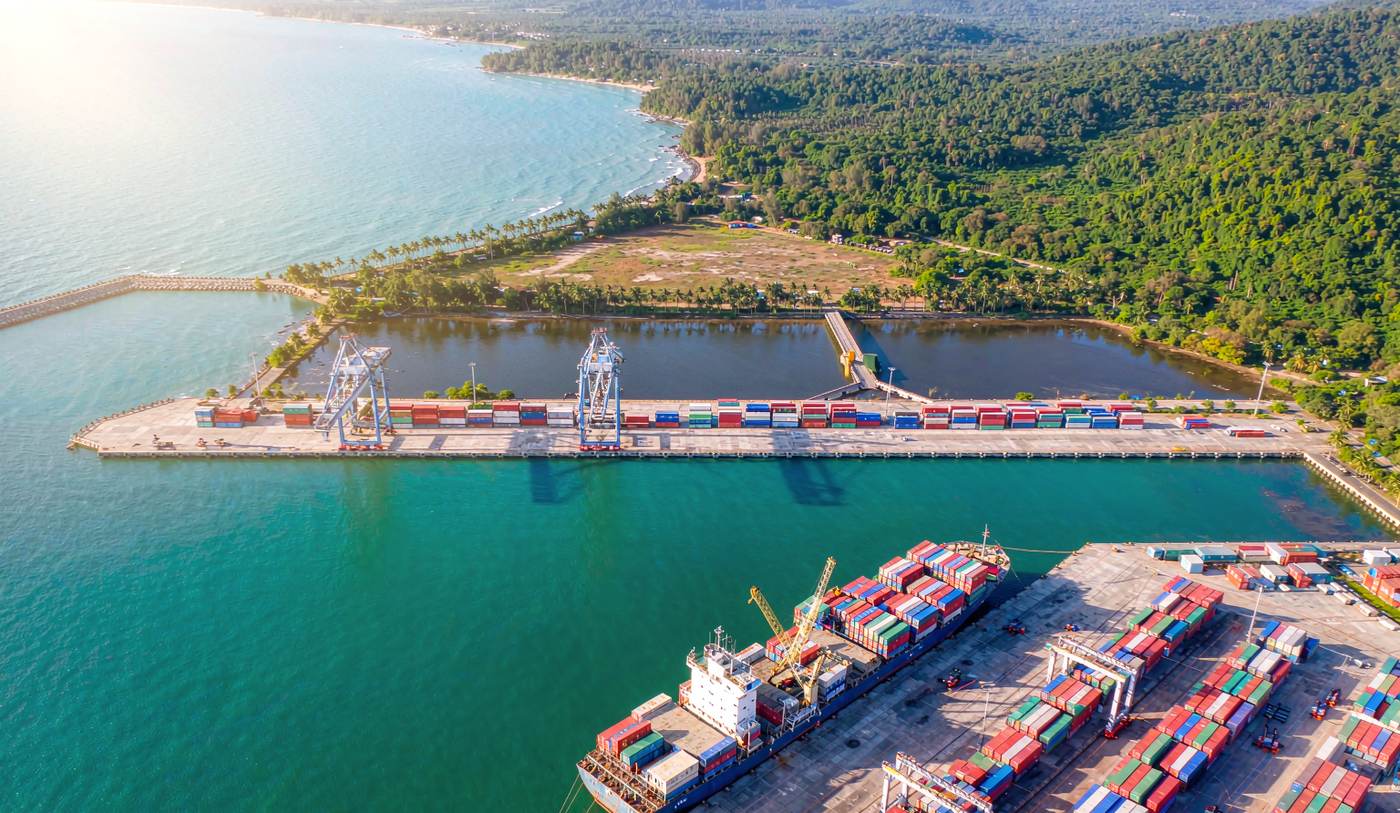
The deep-sea container gateway on the Gulf of Thailand and the port most sea freight uses. It handles the container vessels directly, and road haulage from there to Phnom Penh is the standard inland leg. It is also the site of one of the country's special economic zones.
Phnom Penh Autonomous Port
An inland river port on the Mekong, reached by barge from the Vietnamese delta or by road from Sihanoukville. It is the right choice when the cargo belongs in the capital and the inland haul would otherwise be the longer leg.
Air goes through Phnom Penh International, typically two to five days from Guangzhou or Shenzhen including consolidation, and it is the fastest route to release — express air clearance is often quoted at two to three days. There is also an overland option through the China-Laos corridor and south into Cambodia, which suits smaller consignments out of Yunnan and can beat sea on door-to-door time.
The electronic filing, and the single window behind it
Cambodia's General Department of Customs and Excise has required brokers to file through ASYCUDA World since 2018. The platform handles the declaration, the document upload, the assessment and the payment, and it auto-routes each filing to a channel:
| Channel | What happens | Planning implication |
|---|---|---|
| Green | Automatic release on the declaration | The fastest outcome, and the one a complete file earns |
| Yellow | Documentary review before release | Adds days; usually triggered by inconsistencies between documents |
| Red | Physical inspection at a designated examination site | Adds the most time and examination and handling charges |
Which channel you get is largely determined by the risk profile and by whether the invoice, packing list and transport document agree with each other. Inconsistency is the cheapest problem to avoid and the most common cause of delay.
The seven-working-day payment clock
Once customs issues its notice, duties and taxes are payable within seven working days. Late payment attracts additional charges, and while the goods sit unpaid they are also sitting in the port or terminal accruing storage.
Two practical consequences. First, arrange the payment mechanism before the vessel arrives rather than discovering at assessment that the money cannot move that quickly. Second, understand that this clock runs in parallel with terminal free time, so a slow payment costs twice — once in penalties and once in storage.
When an SEZ changes the arithmetic
Cambodia has designated special economic zones, including one at Sihanoukville. For a qualifying enterprise inside one, published guidance describes raw materials and production equipment entering without import duty, and import and export VAT relieved as well.
That is a genuinely different cost model, and it is worth asking about if you are manufacturing rather than trading. It is not a shortcut for a one-off import: it requires zone admission, approval and its own documentation chain, and the goods are subject to the zone's controls. For a trader importing finished goods to sell domestically, it changes nothing.
The dossier the GDCE expects
| Document | What it has to do |
|---|---|
| Commercial invoice | Product description, quantity, unit and total value, currency and terms of sale |
| Packing list | Contents per package, weights and dimensions, agreeing with the invoice |
| Bill of lading or airway bill | Original transport document from the carrier |
| Customs declaration | Filed electronically through ASYCUDA World by a licensed broker |
| Form E certificate of origin | Issued in China before shipment; required to claim preferential duty |
| Import licence or permit | For controlled goods — vehicles, pharmaceuticals, alcohol, tobacco, precious metals, some electronics |
| Health or phytosanitary certificate | For food, plants, seeds and agricultural products |
| Importer registration and tax number | A Cambodian-registered importer with the right activity and a tax identification number |
| ISPM 15 evidence | Stamp on every wooden pallet or crate |
A packing point for this lane: Cambodia enforces wood packaging rules, and published trade guidance describes fumigation failures as leading directly to detention and, in the worst case, re-export — at roughly US$200 per container per day in port charges. Use stamped ISPM 15 timber or switch to plastic pallets before you have the problem.
What a Phnom Penh broker is for
- Classification. Settling the ten-digit HS code so the duty band is right the first time and not reopened later.
- Form E handling. Getting the certificate, checking it matches the declaration, and lodging it with the filing.
- Permits. Knowing which authority your product needs and starting the process before the goods move.
- Channel management. Presenting a consistent file so the declaration goes green rather than yellow or red.
- Payment and release. Meeting the seven-working-day clock and getting the cargo out before free time expires.
Why importers use Goodhope on this lane
Six things that are different about working with us on China to Cambodia shipments.
Real shipments to Cambodia
Five shipments bought in China and delivered into Cambodia, told end to end — where the order came from, how it moved, where it nearly went wrong, and how it finished. Client names are withheld at their request; the situations and the handling are what we deal with on this lane.
Form E · preference lost · Guangzhou to Sihanoukville
The purchase. A buyer new to importing assumed the preference certificate could be sorted out once the container had landed.
The move. Full container into Sihanoukville, with the Form E issued and checked before the vessel sailed.
Where it nearly went wrong. The preference is claimed on a certificate issued in China before departure. Arriving without it means paying the standard band, which on a fifteen per cent line is the difference between a profitable first order and a loss.
How it finished. We made the certificate a booking condition. He has claimed preference on every shipment since.
No de minimis · small parcel · Yiwu to Phnom Penh
The purchase. A buyer sending a small sample order by air assumed there would be a value threshold below which nothing was charged.
The move. Air consignment to Phnom Penh, declared in full.
Where it nearly went wrong. Cambodia has no de minimis. Duty is assessed from the first dollar of CIF value, so a low-value parcel still produces a duty and VAT assessment and still needs an entry.
How it finished. We told him before he quoted his customer. He consolidated the samples into one entry and saved the handling on four separate ones.
The payment clock · storage bill · Shanghai to Phnom Penh
The purchase. A first-time buyer did not know duty had to be paid within a counted number of working days of assessment.
The move. Container moved up the Mekong leg, with the duty and VAT funds arranged before assessment.
Where it nearly went wrong. The payment window is measured in working days, and it runs even while your goods sit at the port. Missing it converts a routine clearance into a storage bill that grows daily.
How it finished. We flagged the assessment date as soon as it was issued. He now pre-funds and clears inside two days.
Inside an SEZ · duty position changed · Shenzhen to Cambodia
The purchase. A buyer whose factory sits inside a special economic zone assumed the zone removed customs obligations altogether.
The move. Full container, with the zone status documented and the duty position worked out before shipment.
Where it nearly went wrong. An SEZ changes the arithmetic rather than removing the process. The goods still enter, still get declared, and the exemption depends on the zone status being documented correctly at entry.
How it finished. We got the zone documentation into the dossier up front. His entries clear on the zone basis without argument.
The dossier · broker relationship · Ningbo to Cambodia
The purchase. A buyer filing on his own discovered that the customs authority expects a specific set of supporting documents, not just a commercial invoice.
The move. Sea freight with the full dossier assembled and a Phnom Penh broker appointed before arrival.
Where it nearly went wrong. The authority works from a fixed dossier. A missing document does not produce a query you can answer later; it produces an entry that does not progress while the clock and the storage run.
How it finished. He now sends the dossier to the broker before the vessel sails. Clearance is a formality.
Why importers use Goodhope on this lane
Six things that are different about working with us on China to Cambodia shipments.
Get the Form E right while the goods are still in China
Tell us what you are shipping, the HS codes if you have them, the packed dimensions and gross weight, the pickup city in China and the delivery address in Cambodia. We will confirm the duty band before anything is filed, arrange the Form E certificate of origin in China before the goods sail, tell you whether your product needs a permit, route through Sihanoukville or Phnom Penh as appropriate, and set out the duty and the ten percent VAT so you can see the landed cost before you commit.
Get a quote Talk to usRelated pages
Frequently asked questions
What duty and tax will I pay?
Four duty bands by HS code — 0, 7, 15 and 35 percent of CIF — then VAT at 10 percent on CIF plus duty. A special tax applies to some categories. There is no de minimis threshold, so duty is assessed from the first dollar.
What does Form E do?
It is the certificate of origin under the ASEAN-China Free Trade Area. Where the product qualifies and the certificate matches the declared HS code, duty can drop to zero or to a reduced rate. It does not remove the 10 percent VAT, and it must be obtained before shipment.
Which port does cargo arrive at?
Sihanoukville Autonomous Port is the deep-sea container gateway; Phnom Penh Autonomous Port is the inland river port on the Mekong; Phnom Penh International handles air and clears fastest.
How long does clearance take?
Typically 2 to 7 days, with express air at 2 to 3. Delays come from documentation and channel routing rather than the goods. Duties are payable within 7 working days of the notice.
What is ASYCUDA World?
The UNCTAD electronic customs platform Cambodia has required brokers to use since 2018. It handles the declaration, documents, assessment and payment, and routes each filing to a green, yellow or red channel.
Is there a duty-free threshold?
No. Published guidance sets it at zero. Samples and small parcels are assessed like any other import.
What does a special economic zone change?
Qualifying enterprises inside a designated SEZ can import raw materials and production equipment without import duty, with import and export VAT also relieved. It suits manufacturers with volume, not one-off imports.
How long does shipping take?
Sea to Sihanoukville roughly 8 to 15 days from South China, overland 6 to 9 days door to door, and air 2 to 5 days including consolidation. Add 2 to 7 days for clearance.
What documents are required?
Commercial invoice, packing list, bill of lading or airway bill, the ASYCUDA World declaration, Form E for preferential duty, permits for controlled goods, phytosanitary certificates where applicable, and the importer's registration and tax number. HS codes are ten digits.
Do I need a Cambodian importer?
Yes. A Cambodian-registered entity with the right activity and a tax identification number, filing through a licensed customs broker. Sort it before the first shipment rather than at the port.