
Home / Shipping to the Cocos (Keeling) Islands / How to ship from China to the Cocos (Keeling) Islands
How to ship from China to the Cocos (Keeling) Islands
The Cocos (Keeling) Islands are an Australian external territory in the Indian Ocean, roughly halfway between Australia and Sri Lanka. Twenty-seven coral islands make up the group, and only two are inhabited: Home Island, where the Cocos Malay community lives, and West Island, which holds the airport and most of the administration. The whole population is under a thousand.
Two things catch first-time importers out. The first is tax: customs duty applies here, but Australia's GST does not, because the territory sits outside Australia's indirect tax zone. The second is physical: there is no deep-water harbour, so cargo is brought ashore by barge. Both are manageable once you know about them, and both are expensive if you plan the shipment as though this were a mainland Australian destination.
At a glance
Australian external territory, two inhabited islands out of twenty-seven. Customs duty applies under the Customs Act 1901; the 10 per cent GST does not. No deep-water harbour, so cargo is lightered. Sea freight runs from Fremantle roughly every four to six weeks. Air freight arrives at Cocos Islands Airport (CCK) on West Island. Biosecurity is strict. Currency is the Australian dollar. Wet season December to April.
How your cargo moves: China to the Cocos (Keeling) Islands
Eight steps from your supplier's door to yours. The last four are the ones shaped by local rules.
- Pickup from your supplierWe collect the goods anywhere in China and bring them to our consolidation point.
- Export clearanceChina customs declaration filed and released before the goods move to the port.
- Loading and departureContainer loaded, sealed and handed to the carrier at the Chinese port.
- Main carriageOcean, air or rail movement booked on the route agreed for your cargo.
- Arrival at the gatewayDischarge at the port or airport of entry, recorded on the carrier's manifest.
- Import clearanceCustoms declaration filed locally, with duty and tax assessed on the declared value.
- Customs releaseGoods released into free circulation once duty and tax are settled.
- Final deliveryOnward movement to your delivery address, warehouse or nominated depot.
Duty rates, VAT rates and clearance times move, and the figure that applies to your goods is the one set for your commodity code on the day of clearance. We check the current position against your code before your goods sail and confirm it to you in writing — ask for that check when you request a quote.
Two inhabited islands out of twenty-seven, and one supply route
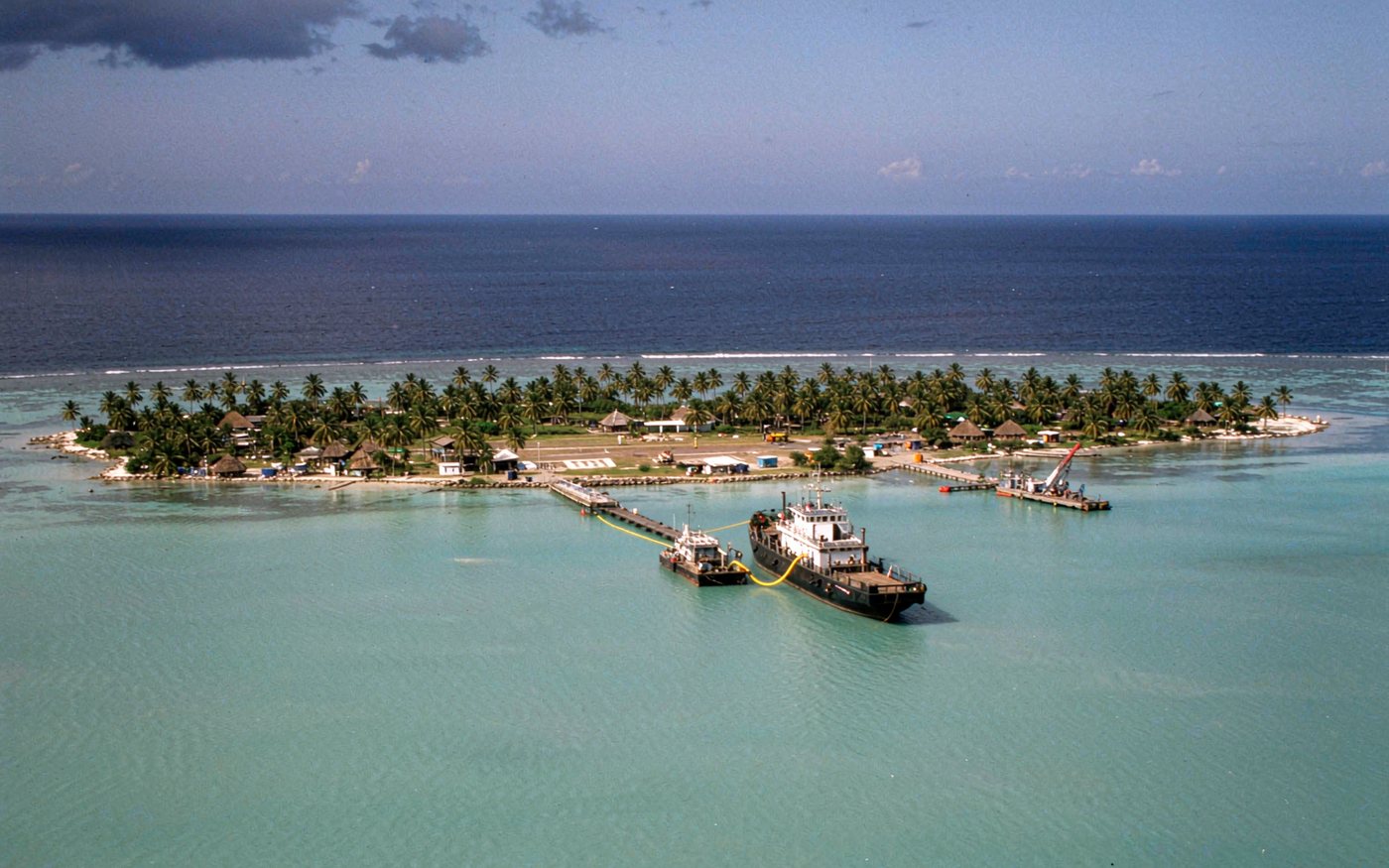
The group is a classic coral atoll: a ring of islands around a lagoon, low, sandy and covered in coconut palms. Home Island holds the larger settlement and West Island holds the airport, the administration and much of the tourism infrastructure. They are separate islands in the same lagoon system, and moving between them is a sea crossing.
Everything the islands consume arrives from outside. There is no manufacturing, limited local agriculture, and no road network in the sense a mainland planner would recognise. That means your shipment is not competing with local production but competing for space on a service that runs to a very small market.
The territory is administered from the Australian mainland, and Australian law applies, including Australian customs law, biosecurity law, sanctions and export controls. For a Chinese supplier the practical point is that the receiving end is Australian in every respect that matters legally, even though the tax treatment differs from the mainland in one important way.
Duty is charged on this group; GST is not
Australia's GST is levied in what the tax law calls the indirect tax zone, and the external territories are outside it. Christmas Island and the Cocos (Keeling) Islands are therefore not subject to the 10 per cent GST, and goods arriving from the Australian mainland are treated as exports for GST purposes. That part is well established.
Customs duty is a separate question, and here the answer is different. The Customs Act 1901 applies to the territory, so goods imported from a third country are classified and duty is assessed against the Australian tariff. Relief and preferential treatment exist for certain goods, and goods already in free circulation from the mainland are in a different position again.
A note on conflicting information. Some commercial shipping references, including material on our own site, describe a 10 per cent GST and an AUD 1,000 duty-free threshold for this territory. The tax position set out above is the one we believe is correct, but the two do not agree, and you should not build a landed-cost model on either without confirmation. Ask the broker, in writing, against your HS codes.
For a first-time importer the takeaway is straightforward: budget for duty, do not budget for GST without confirmation, and get the answer in writing before you commit. The difference on a mid-sized order is material.
Goods from mainland Australia enter duty-free; Chinese goods do not
Goods moving from the Australian mainland to the territory are treated differently from goods arriving from a third country, and goods originating in the external territories receive preferential treatment under the Customs Act. A Chinese shipment is a third-country import and is assessed against the tariff in the normal way.
What that means commercially is that your landed cost will include a duty component that a mainland Australian competitor supplying the same buyer would not pay. If your customer on the islands is comparing your quote against an Australian wholesaler's, that difference needs to be visible in the comparison rather than discovered at clearance.
Classification is where the money is. Two similar products can sit in different tariff lines with different rates, and the rate that applies is the one attached to the code you declare. Get the HS codes right before the goods ship, and if you are unsure, ask us or the broker rather than guessing on the invoice.
Biosecurity is the strictest checkpoint on this route
The territory is a designated biosecurity first point of entry, and the Department of Agriculture, Fisheries and Forestry controls food, plants, animals and soil arriving there. On a small island ecosystem with limited agriculture, this is enforced seriously, and it is the checkpoint most likely to delay a shipment that is otherwise perfect.
A biosecurity declaration is required, and permits are needed for the categories that carry risk: soil and growing media, seeds and plant material, fresh food, meat and dairy, animal products, and untreated wood. Wooden packaging must meet the ISPM 15 standard and carry the mark, and this should be specified to the Chinese supplier in writing rather than assumed.
Apply for permits before the goods ship, not after they arrive. On a route where the vessel runs every four to six weeks, a permit applied for on arrival costs you a full cycle. Our quarantine inspection page covers the export-side process in China.
No deep-water harbour, so cargo is lightered at Port Refuge
There is no deep-water harbour here. Cargo vessels anchor in the sheltered water at Port Refuge and cargo is brought ashore by barge and lighter. That adds a handling step that does not exist on a conventional container route, and it changes how goods should be packed.
Lighterage means cargo is lifted twice, moved over water, and often set down in the open. Pieces should be manageable by the equipment available, sealed against water, and packed to survive being outdoors. Long or awkward pieces are a problem, and anything that cannot tolerate spray or a delay on the landing is a problem.
It also means the discharge is weather dependent. Swell and wind can stop lightering, and a stoppage is not measured in hours. Build that into the schedule and make sure the consignee knows that arrival of the vessel is not the same as arrival of the goods.
Sea freight leaves Fremantle every four to six weeks
The supply service runs from Fremantle, the port for Perth in Western Australia, roughly every four to six weeks. Your container travels from a Chinese port to Fremantle, or to another Australian port and then by coastal service, and then waits for the Cocos sailing.
The waiting is the variable. A four-to-six-week service means that a container arriving in Fremantle the week after a departure can sit for over a month before it moves. Any transit time you are given should be understood as a range with the connection risk sitting at the Fremantle end, not at the Chinese end.
Because the service is infrequent and the market is small, consolidation matters. Group what you can into one shipment, and give the forwarder the full dimensions and weights early so space can be requested against a specific sailing rather than in general terms.
Freight pricing, port efficiency and food security for the Indian Ocean territories have been the subject of a government supply chain review, with recommendations on airfreight and sea freight subsidy models being implemented. Service patterns may change as those measures take effect.
Flying cargo in: Cocos Islands Airport on West Island
Cocos Islands Airport, code CCK, is on West Island and has a runway long enough for jet aircraft. Air freight from Perth runs on a passenger and freight combination service roughly fortnightly, with charter capacity available on demand.
Air suits the same narrow set of goods it does everywhere else: urgent spare parts, medical supplies, documents, and small high-value items where the cost of waiting exceeds the cost of flying. It does not suit bulk, and it does not suit anything heavy, because the handling at the CCK end is limited.
Remember that landing at West Island is not the same as arriving at Home Island. If the consignee is on Home Island, there is a further crossing, and it needs to be arranged. See air freight from China for how the long-haul leg is built.
Moving cargo from West Island across to Home Island
The two inhabited islands sit in the same lagoon system but are separate pieces of land. Cargo discharged at the airport or the landing point on West Island still has to reach Home Island, and that is a local arrangement rather than something a Chinese forwarder can book end to end.
Make the inter-island leg explicit. Name the final island on the documents and on the packages, confirm with the consignee who is arranging the crossing, and treat it as a separate leg with its own timing and its own cost. A shipment that arrives on West Island and sits there is a shipment that has not arrived.
This is also where the packing standard shows its value. Goods that cross between islands by small boat get handled again, outdoors, in salt air. Seal them accordingly.
The wet season runs December to April
The tropical wet season covers roughly December to April. Cyclones are not common in this part of the Indian Ocean compared with some other regions, but when one occurs it can disrupt both the shipping and the air service, and it can stop lightering entirely for a period.
Plan key shipments outside the window where the timing allows, keep the cargo insured, and accept that the calendar is indicative during those months. Because the service is already infrequent, a weather disruption is not absorbed by a following sailing in the way it would be on a weekly route.
Insurance deserves a specific mention on this route. Cargo is lightered, stored outdoors and moved by small craft, and none of those are covered by a standard assumption about how freight is handled. See cargo insurance and tell the insurer how the last leg works.
Documents and the Integrated Cargo System entry
The Australian Border Force handles clearance, and cargo is reported through the Integrated Cargo System. The broker or the importer of record needs a complete set before the entry can be lodged.
- Commercial invoice with a specific description, quantity, unit and total value in Australian dollars or with the currency named, HS code, country of origin and Incoterm.
- Packing list with piece count, net and gross weights and dimensions, matching the invoice.
- Bill of lading or air waybill, with consignee and notify party correctly named.
- Biosecurity declaration, and permits where the goods require them.
- Certificate of origin where it supports the classification or a preference claim.
- Import permit or licence for regulated goods.
- Insurance certificate.
Vague descriptions are the most common cause of a hold here, because a biosecurity officer and a customs officer both need to know what is actually in the box. "General goods" will be opened; "stainless steel cooking pots, 60 pieces" will not. See shipping documents.
What gets shipped here, and in what volume
The market is small, so be realistic about what is worth sending and how much.
- Consolidated restocking for the local store or a business, sized to a full cycle
- Durable, non-perishable goods that tolerate outdoor storage
- Building and maintenance materials for known projects
- Urgent small items sent by air where waiting costs more than flying
- Anything needed by a fixed date, given the four-to-six-week service
- Perishables or temperature-controlled goods
- Goods that need to be returned or exchanged
- Anything that will not survive lighterage and outdoor handling
Above all, consolidate. On a route this infrequent, the fixed costs and the handling risk both favour one well-planned shipment over several small ones, and they favour a buyer who has thought about the schedule months ahead rather than weeks.
Why importers use Goodhope on this lane
Six things that are different about working with us on China to the Cocos (Keeling) Islands shipments.
Five shipments on the China to the Cocos (Keeling) Islands lane
Five shipments bought in China and delivered into the Cocos (Keeling) Islands, told end to end — where the order came from, how it moved, where it nearly went wrong, and how it finished. Client names are withheld at their request; the situations and the handling are what we deal with on this lane.
The sailing window · first shipment · Shenzhen to Cocos
The purchase. A buyer new to importing booked on the assumption that cargo to the Cocos group sailed weekly.
The move. Consolidated to Fremantle, then forwarded on the four-to-six-week island service.
Where it nearly went wrong. The service out of Fremantle runs roughly every four to six weeks. A booking made a week late does not slip a week; it slips a full interval, and a buyer who has promised his customer four weeks finds out after the goods are already packed.
How it finished. We gave him the sailing dates before he ordered. He buys against the schedule now, not against hope.
Mainland-sourced versus Chinese · sourcing · Cocos buyer
The purchase. A buyer on the islands was comparing a Chinese supplier against an Australian distributor and assumed the duty treatment was the same.
The move. Chinese-origin cargo declared in full, with the duty position set out against the mainland-sourced alternative.
Where it nearly went wrong. Goods arriving from mainland Australia enter duty-free, while goods of Chinese origin are assessed under the Customs Act in the ordinary way. It is a real difference in landed cost, and it belongs in the sourcing comparison rather than in the freight quote.
How it finished. We put both figures side by side. He kept the Chinese supplier on the lines where the difference was small and moved the rest.
Lightering limit · heavy item · Shanghai to West Island
The purchase. A first-time buyer ordered a heavy unit without asking how it would get from the ship to the shore.
The move. Sea freight, with the piece weight and dimensions checked against the lightering method before booking.
Where it nearly went wrong. There is no deep-water harbour here, so cargo is lightered. Heavy or awkward pieces are constrained by the method rather than by the vessel, and the limit is discovered at the anchorage where your options are at their thinnest.
How it finished. We confirmed the limit during quoting. He split the unit and both halves came ashore.
Wet season · December to April · Ningbo to Cocos
The purchase. A buyer scheduled a delivery for January without knowing what the wet season does to the island leg.
The move. Sea freight scheduled outside the wet season, with the December-to-April window marked on his planning calendar.
Where it nearly went wrong. The wet season runs December to April and it affects the lightering and the last leg more than the ocean transit. Planning a delivery into that window without contingency is planning to be late.
How it finished. We moved his order to November. It landed dry and on time.
West Island to Home Island · internal transfer · Guangzhou to Home Island
The purchase. A buyer shipping to Home Island assumed cargo landed at Cocos Islands Airport was at its destination.
The move. Air freight into Cocos Islands Airport on West Island, with the crossing to Home Island arranged as a separate leg.
Where it nearly went wrong. Cargo lands on West Island and the inhabited islands are not the same place. The transfer across is a leg with its own availability, and it is the part that buyers leave out of a delivery promise.
How it finished. We booked the transfer with the freight. His customer received the goods without a second arrangement.
Why importers use Goodhope on this lane
Six things that are different about working with us on China to the Cocos (Keeling) Islands shipments.
Getting a quote for the Cocos (Keeling) Islands
Send us the commodity, HS codes if you have them, weights and dimensions, and which island the goods are going to. We will confirm the Fremantle connection, flag the tax points that need written confirmation, and advise on packing for lighterage.
Get a quote Talk to usRelated pages
Frequently asked questions
Are the Cocos Islands part of Australia for customs purposes?
Australian customs law applies and the Australian Border Force handles clearance through the Integrated Cargo System, so goods are classified against the Australian tariff and duty is assessed. The GST position is different, because the territory sits outside Australia's indirect tax zone.
Is GST charged on imports to the Cocos Islands?
No, on the established position that the external territories are outside Australia's indirect tax zone, so the 10 per cent GST does not apply. Some commercial references, including material on our own site, say otherwise. Do not budget on either figure without written confirmation from the broker.
Is customs duty charged on goods from China?
Yes. Chinese goods are third-country imports and are assessed against the Australian tariff. Goods from the Australian mainland and goods originating in the external territories are treated more favourably under the Customs Act.
Is there a duty-free threshold?
Do not assume one. Some references give an AUD 1,000 threshold, but that figure is associated with the conflicting sources mentioned above rather than with a primary ruling we can point to. Confirm the current treatment of your commodity and value in writing.
Is there a deep-water port?
No. Cargo vessels anchor at Port Refuge and goods are brought ashore by barge and lighter. That means an extra handling step, weather-dependent discharge, and a packing standard that assumes the cargo will be outdoors and exposed to spray.
How often does the sea service run?
Roughly every four to six weeks from Fremantle in Western Australia. A container that arrives in Fremantle just after a departure can wait over a month, which is why transit estimates on this route should be given as a range.
Can I ship by air?
Yes, to Cocos Islands Airport (CCK) on West Island, with a passenger and freight combination service from Perth roughly fortnightly and charter capacity on demand. It suits urgent, small, high-value goods rather than bulk.
Which island should I address the shipment to?
Whichever one the consignee is on: Home Island or West Island. They are separate islands, and cargo landing on West Island still has to be moved across by local arrangement. Name the final island on the documents and on the packages.
How strict is biosecurity?
Very. The territory is a designated biosecurity first point of entry and the Department of Agriculture, Fisheries and Forestry controls food, plants, animals and soil. A biosecurity declaration is required and permits are needed for higher-risk goods. Apply for permits before the goods leave China.
When is the worst time to ship?
December to April, the wet season. Cyclones are not frequent here but they can stop both the sea and the air service, and they stop lighterage. Ship key goods outside that window where you can, and keep the cargo insured.