
Home / Shipping to Costa Rica / How to Ship from China to Costa Rica
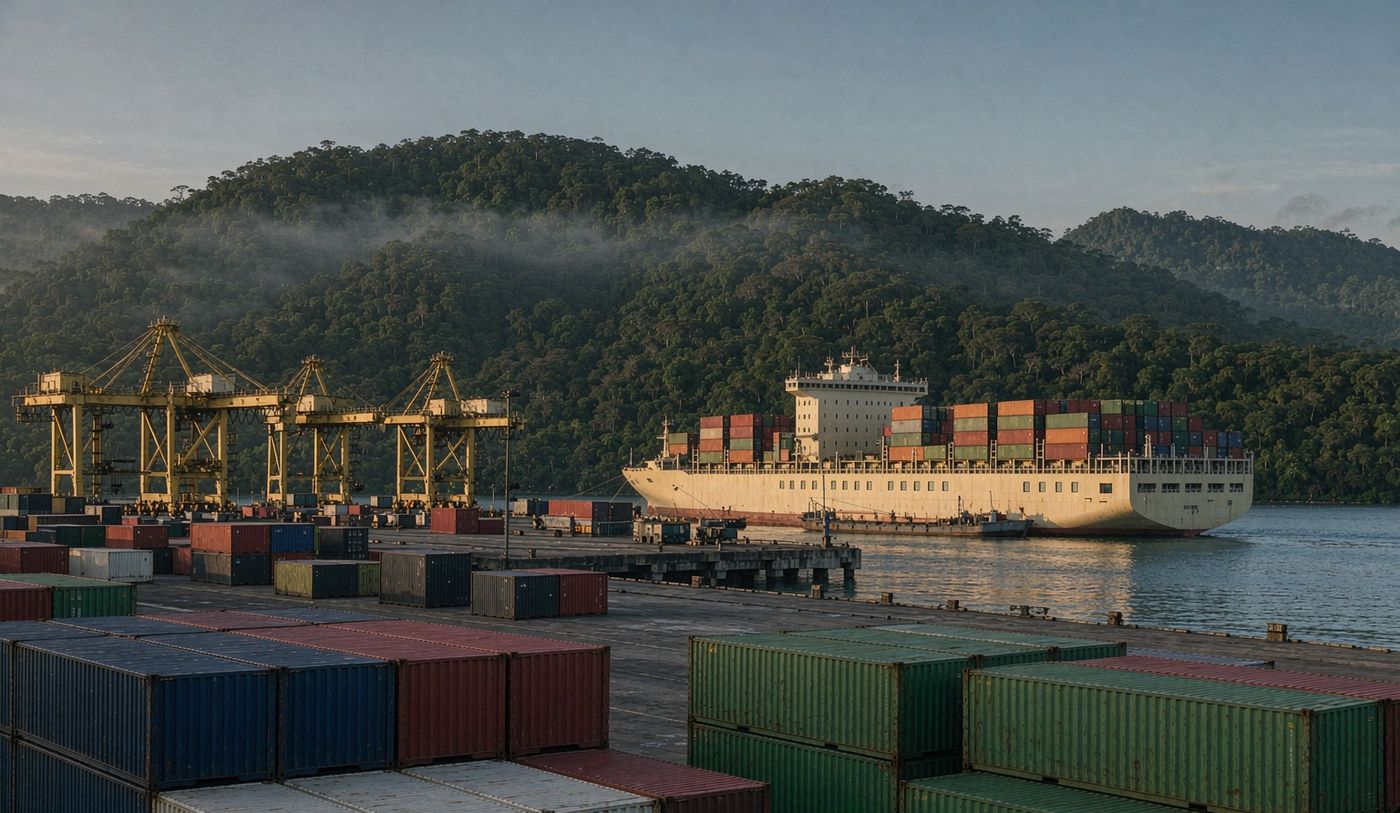
How to Ship from China to Costa Rica: Moin, Caldera & the RTN You Need First
Costa Rica is the one country in Central America with a free trade agreement with China. It was signed in April 2010 and has been in force since 1 August 2011 — the first agreement of its kind China concluded with a Central American country. On paper that makes this the most favourable lane in the region. In practice, the preference is claimed, not given: it applies to the tariff line you declare, and only when a valid preferential certificate of origin travels with the goods. Importers who assume the discount arrives automatically are the ones who end up paying the standard rate and wondering why.
The second thing to understand is that Costa Rica faces two oceans, and the choice between them is a real decision. Moin sits on the Caribbean side near Limón and is operated by APM Terminals; Caldera sits on the Pacific side near Puntarenas and is operated by DP World. They are not interchangeable. Which one you use should be decided by where your warehouse is and by how the box actually gets there — Caldera is a Pacific crossing, Moin involves the Panama Canal or a transhipment.
The third thing is the one that catches first-time importers, and it is not a customs form at all. If you are bringing in anything electrical or electronic, it has to be registered before it arrives, under a national technical registration administered by the Ministry of Economy, Industry and Commerce. That registration takes weeks, not days, and it is the single most common reason a first shipment to Costa Rica sits at the port. Start it before your goods are even manufactured.
At a glance
Preference: China–Costa Rica FTA, in force since 1 August 2011; claim it with a preferential certificate of origin issued in China. · Ports: Moin (Caribbean, Limón, APM Terminals) and Caldera (Pacific, Puntarenas, DP World). · Airports: Juan Santamaría (SJO, Alajuela, about 20 km from San José) and Daniel Oduber Quirós (LIR, Liberia). · System: TICA; declaration is the DUA, filed by a licensed customs agent. · Registrations: RTN with MEIC for electrical and electronic goods; SUTEL for wireless and radio devices; Ministry of Health for food, cosmetics, medical devices and pharmaceuticals; SENASA for goods of plant or animal origin. · Duty: commonly quoted at 0–15 percent on CIF; some sources give 1–15 percent with an average near 5.6 percent for non-preferential goods. · IVA: 13 percent, charged on CIF plus duty plus any selective consumption tax. · De minimis: two figures circulate — US$50 FOB for commercial shipments, US$500 for personal parcels and the traveller allowance. Confirm which applies to you. · Clearance: 1–2 days standard, 6–12 hours expedited, plus 2–5 days if the red channel opens. · Transit: FCL 30–45 days, LCL 35–55 days, air 5–10 days, courier 3–7 days. · Supply: 120 V at 60 Hz.
How your cargo moves: China to Costa Rica
Eight steps from your supplier's door to yours. The last four are the ones shaped by local rules.
- Pickup from your supplierWe collect the goods anywhere in China and bring them to our consolidation point.
- Export clearanceChina customs declaration filed and released before the goods move to the port.
- Loading and departureContainer loaded, sealed and handed to the carrier at the Chinese port.
- Main carriageOcean, air or rail movement booked on the route agreed for your cargo.
- Arrival at the gatewayDischarge at the port or airport of entry, recorded on the carrier's manifest.
- Import clearanceCustoms declaration filed locally, with duty and tax assessed on the declared value.
- Customs releaseGoods released into free circulation once duty and tax are settled.
- Final deliveryOnward movement to your delivery address, warehouse or nominated depot.
Duty rates, VAT rates and clearance times move, and the figure that applies to your goods is the one set for your commodity code on the day of clearance. We check the current position against your code before your goods sail and confirm it to you in writing — ask for that check when you request a quote.
What this guide covers, and the two decisions that shape the bill
This is written for a buyer bringing goods out of China into Costa Rica for the first time. It follows the shipment in the order the problems actually arrive: which coast, which port, what the free trade agreement does and does not do for you, the product registrations that have to exist before anything ships, the paperwork that gets filed at the border, how the tax is calculated, and how long it all takes.
It does not quote freight rates. Those move with the market and any number printed here would be wrong within weeks. What it does instead is show where the money goes and which decisions move the total, so that when you do get a quotation you can read it for what it leaves out as well as what it contains.
Costa Rica is a country of roughly five million people with a stable democracy, no standing army, and an economy built on medical device manufacturing, agriculture — coffee, bananas, pineapples — tourism, and business services. It is one of the strongest logistics markets in Central America precisely because it is a manufacturing exporter: customs brokers, bonded warehouses and cold chain at SJO are all well developed, and the paperwork is professional. That is good news for a first importer. The currency is the Costa Rican colón, but commercial invoices in US dollars are normal and widely accepted in trade. Mains power is 120 V at 60 Hz with US-style plugs, which matters if you are importing anything that plugs into a wall.
Bilateral trade with China has grown steadily. Published figures for 2025 put total two-way trade at about US$4.45 billion, with Chinese exports around US$2.65 billion, making China Costa Rica's second-largest trading partner after the United States. Chinese goods are already thoroughly embedded in the retail and industrial mix here.
Two coasts, two ports: choosing between Moin and Caldera
New importers often ask which port is "the main one", as though there is a single answer. There is not. There are two, they are on opposite sides of the country, and the right one is a function of your inland address.
Moin — Caribbean, Limón province
Operated by APM Terminals, with a quay reported at about 650 metres, a depth of about 16 metres and capacity in the order of 1.5 million TEU a year. A container scanner reported at US$2.8 million was installed in April 2026 to speed up physical inspections. Moin serves the Caribbean corridor and the northern and eastern parts of the country, and it is the natural gateway if your consignee is in Limón, or if your onward distribution runs north toward Nicaragua and the Caribbean coast.
Caldera — Pacific, Puntarenas province
Operated by DP World under a long concession signed in 2021. Caldera is the nearer of the two to the Central Valley, where San José, Alajuela, Heredia and Cartago sit and where most of the population, warehousing and light industry are concentrated — roughly 80 km, against something in the order of 150–170 km for Moin. For a first importer delivering to San José, this difference usually decides the question before anything else does.
The second factor is the shape of the voyage. Cargo from China crossing the Pacific reaches Caldera without a canal transit. Reaching Moin means either a Panama Canal transit or a transhipment on the isthmus, and both add handling and time. That is not a reason to avoid Moin — it is a reason to read two quotations side by side rather than accepting the first one.
The third factor is the road. The Central Valley to Moin runs on Route 32 through the Braulio Carrillo national park, a mountain road that carries heavy rain and is prone to landslides and closures during the wet season. If your delivery schedule cannot absorb a day of uncertainty, that is worth knowing before you commit to the Caribbean port for a Central Valley warehouse.
| Port | Coast | Operator | Best for | Watch out for |
|---|---|---|---|---|
| Moin | Caribbean (Limón) | APM Terminals | Caribbean corridor, Limón, northern and eastern distribution | Canal transit or isthmus transhipment; Route 32 landslides in the wet season |
| Caldera | Pacific (Puntarenas) | DP World | San José and the Central Valley, western and Pacific distribution | Peak-season yard congestion; inland leg still needs a reliable carrier |
What the China-Costa Rica trade pact does to your duty bill
Negotiations opened in January 2009, the agreement was signed in April 2010, and it entered into force on 1 August 2011. Both sides committed to staged tariff elimination: roughly 60 percent of tariff lines went to zero immediately, with around another 30 percent phasing down over five to fifteen years. Costa Rica's schedule was written to remove tariffs on more than 90 percent of Chinese-origin goods over fifteen years; China's schedule covers more than 95 percent of Costa Rican goods on a similar horizon.
What that means in 2026: the staging that began on 1 August 2011 was written to run for up to fifteen years, which puts the final steps of the schedule in 2026. A great many lines will now be at zero — but not every line, and not every product was covered. Check the current-year rate for your specific tariff line rather than assuming zero. The duty figures commonly quoted for Costa Rica, in the range of 0 to 15 percent, are the post-FTA outcome, not the starting point.
There is a useful contrast here. Costa Rica is also a party to CAFTA-DR with the United States, under which most US-origin consumer and industrial goods have entered duty-free since January 2015. Chinese-origin goods get nothing from CAFTA-DR. If you are comparing a US quote with a Chinese one, the tariff treatment is not the same, and the difference comes from this agreement, not from the freight.
The practical consequence is simple. The duty you pay is set by three things: the HS code you declare, the origin you can prove, and whether anyone actually claims the preference on the entry. Get any one of those wrong and you pay the standard rate on the full value.
Origin rules: the certificate that turns a tariff line into zero
A preferential certificate of origin under the China–Costa Rica agreement is issued in China — through the China Council for the Promotion of International Trade or China Customs, both of which have been issuing them since the agreement took effect in August 2011. Ask your supplier for it before production finishes, not after the goods have sailed. Retrospective certificates are difficult and sometimes impossible, and the cost of not having one is the whole duty line.
Three things make a certificate fail at the border, and all three are avoidable:
- The description does not match. The origin certificate, the commercial invoice and the bill of lading should describe the same goods to the same consignee. Mismatched consignee names are a common cause of a rejected claim.
- The HS code is inconsistent. The code on the certificate should be the code on the entry. If your broker classifies differently from your supplier, resolve it before the vessel sails, not at the counter.
- The routing breaks the direct-consignment rule. If the cargo transits a third country, expect to show the through bill of lading and the transit documents. Transhipment alone does not kill a claim; undocumented transhipment does.
The certificate costs very little. The tariff it removes can be the entire margin on a first order. It is the cheapest document in the whole file and the one most often missing.
RTN: the electronics registration that stops first shipments
This is the section to read twice if you are importing anything with a plug, a circuit board or a battery.
RTN — Registro Técnico Nacional — is a national technical registration administered by the Ministry of Economy, Industry and Commerce (MEIC). Electrical and electronic products entering Costa Rica need it, and it is routinely described as the most commonly overlooked requirement on this lane and the leading cause of customs holds for first-time shippers. Registration is reported to take two to four weeks. That is longer than most manufacturing lead times people assume, which is why the advice is to begin the process before the goods are made.
RTN is not the only product gate. Depending on what you are shipping, one or more of these may apply as well:
| Authority | What it covers | When it bites |
|---|---|---|
| MEIC — RTN | Electrical and electronic products | Before import; allow 2–4 weeks |
| SUTEL | Wireless and radio-frequency devices; unregistered radio equipment is restricted | Before import; homologation of the specific model |
| Ministry of Health | Food, cosmetics, pharmaceuticals, medical devices | Registration of product or establishment before import |
| SENASA | Anything of plant or animal origin, including wooden packaging and some food | Phytosanitary or zoosanitary permit with the shipment |
| MINAE | Environment, CITES-listed species, certain chemicals and pesticides | Permit before import |
If you are unsure which of these applies to your product, that question should be answered before you place the order, not after the container lands. A shipment that arrives without its registration does not clear faster because it is urgent — it waits, and it accrues storage while it does.
Spanish labels and Spanish paperwork, not English-only documents
Costa Rica requires product labels, instruction manuals and packaging to be in Spanish. This is a consumer-protection requirement, not a customs formality, and it is enforced at the border: officers at SJO routinely flag shipments with English-only labelling for secondary inspection. A carton printed in English and Chinese but not Spanish is one of the cheapest problems to prevent and one of the more expensive to fix after arrival, because the cost lands as storage and demurrage rather than as a reprint.
Build a Spanish labelling check into your pre-shipment routine. It costs a fraction of a percent of the order value and it removes an entire category of delay.
The same logic applies to the commercial invoice. It should show the goods description in Spanish where practical, unit and total values, the HS code, and the Incoterm — and it helps to break out FOB value, freight and insurance separately, because Costa Rica assesses duty on the CIF value and the officer needs to see how that number was built.
One more thing on the invoice: do not under-declare. TICA compares declared values against reference data for comparable goods and flags discrepancies automatically. Penalties for undervaluation routinely exceed the duty saved, and a flagged importer tends to get flagged again. Declare the real transaction value.
Getting the HS code right before TICA accepts the declaration
TICA is Costa Rica's customs information system, and the DUA — Documento Único Aduanero — is the single import declaration filed through it, electronically, by a licensed customs agent. Permits that sit outside customs are handled through VUCE, the foreign trade single window.
HS classification is where a lot of avoidable trouble starts. TICA cross-references declared codes against trade data, and a misclassification — even an innocent one — can trigger an automatic audit, penalties, and weeks of delay. It also silently changes your duty: the same product under two codes can sit at zero under the FTA schedule and at 15 percent outside it.
The fix is boring and effective: agree the code in writing with your broker before you book. Give them the product specification, the material composition, the intended use and photographs if the description is ambiguous. A code confirmed before sailing is worth more than any amount of argument after arrival.
IVA at 13%, plus the selective consumption tax that follows
Three separate things can land on an import entry, and they stack.
Import duty (DAI)
Charged on the CIF value — goods, insurance and freight to the Costa Rican port. Commonly quoted in the 0–15 percent range for goods covered by the FTA schedule, with higher rates outside it. One published survey of non-preferential imports gives 1–15 percent with an average near 5.6 percent.
Selective consumption tax
A separate excise on a defined list of goods — alcohol, tobacco, fuels, vehicles and certain appliances among them. Rates vary widely by tariff line and some are steep. Where it applies it is part of the base for the next line, not a footnote to it.
IVA at 13 percent
The value added tax, charged not on the CIF value alone but on CIF plus duty plus any selective consumption tax. This is the step people get wrong when they budget.
A worked illustration, using round numbers and no freight figures: goods with a CIF value of US$10,000, a duty rate of 8 percent. Duty is US$800. The base for IVA is US$10,800, so IVA at 13 percent is US$1,404. Total tax before any broker fee, port charge or inland haulage is US$2,204 — about 22 percent of the CIF value, on a duty rate that looked like 8 percent. That gap is the whole point of this section.
On top of the three lines above expect small statutory stamps and administrative charges, plus the customs agent's fee and, if the box waits, storage and demurrage. None of those are in the duty rate.
Where de minimis really sits, and why two figures circulate
If you search for Costa Rica's de minimis threshold you will find two numbers, and they are not describing the same thing.
- US$50 FOB. This figure appears in commercial shipping references and in our own Costa Rica hub page: shipments at or below it are described as exempt from duty and taxes. It is the conservative number and the one to plan around.
- US$500. This figure appears in parcel and traveller references, describing the duty-free allowance for personal parcels and for goods carried by arriving travellers.
For a commercial import of any real size the threshold is not going to save you, and a landed-cost model built on the assumption that it might will be wrong.
Sea transit from Chinese ports to Costa Rica, realistically
Published transit ranges for this lane are roughly 30–45 days for a full container and 35–55 days for LCL, port to port. Air runs about 5–10 days and courier roughly 3–7 days door to door.
Those ranges are wide for reasons that have nothing to do with the ocean leg:
- Which coast. Caldera is a Pacific crossing; Moin adds a canal transit or an isthmus transhipment.
- Direct or transhipped. A service that calls Costa Rica directly will beat one that relays through Panama, Manzanillo or a US gateway, sometimes by a week.
- Season. Chinese New Year shuts production and empties sailings for weeks. The pre-Christmas push tightens space from roughly August onward.
- The wet season at the receiving end. May to November brings heavy rain, and with it the landslide risk on the Moin road and slower inland turnaround.
| Mode | Typical transit | Minimum we work with | Notes |
|---|---|---|---|
| Sea FCL | 30–45 days | 1 container | Port to port, Moin or Caldera; inland and clearance arranged by consignee |
| Sea LCL | 35–55 days | 1 CBM | Longer because consolidation and deconsolidation sit at both ends |
| Air freight | 5–10 days | 45 kg | Into SJO; no nonstop freighter from China |
| Express courier | 3–7 days | 1 kg | Door to door; best for samples and urgent spares |
Note the shape of our sea service: it ends at the port. We deliver to Moin or Caldera; import clearance and final delivery inside Costa Rica are handled by the consignee with their customs agent. If you want a door-to-door price, say so and we will quote it as DDP with those destination elements built in.
Air freight into SJO: there is no nonstop freighter from China
Juan Santamaría International Airport (SJO) in Alajuela, about 20 km from San José, is the main gateway and the one that handles the bulk of air cargo. Daniel Oduber Quirós (LIR) in Liberia serves Guanacaste and the Pacific north.
The thing to know about this lane is that there is no scheduled nonstop freighter from China to Costa Rica. Air cargo almost always moves via a US gateway — Miami, Los Angeles, Houston are the common ones — with Panama and European hubs appearing in some routings. That is why the transit estimate is 5–10 days rather than the two or three a direct flight would give, and it is why a routing that looks odd on paper can be the fastest one available.
Costa Rica is a serious air-freight market, and not by accident: medical device manufacturing is one of its largest export industries, so SJO has mature cold-chain, pharma handling and bonded storage. If you are shipping temperature-sensitive or high-value goods, that infrastructure is a genuine advantage over most of Central America.
On batteries: goods with batteries installed can usually move with an MSDS and proper declaration. Standalone lithium batteries are dangerous goods and need to be declared and handled as such. Tell us before booking, not after.
LCL or FCL when your monthly volume is still modest
Most first orders are LCL, and that is fine. The trade-off is straightforward.
LCL has a low entry point — we work from 1 CBM — and lets you test a market without filling a box. What you give up is time and handling: consolidated cargo waits for a full container at origin, gets stripped at destination, and passes through more hands, which means more chance of a dented carton and more exposure to inspection. There are also deconsolidation charges at the receiving end that do not appear in an FCL quote.
FCL is faster end to end, is handled less, and gives you a door you control. As a rough rule of thumb many forwarders treat somewhere around 15–18 CBM as the point where a 20-foot box starts to make commercial sense, but that is a starting point for a conversation, not a rule — dense cargo crosses over earlier, bulky cargo later, and the destination charges on LCL can move the line substantially.
If you expect to ship monthly, ask us to price a single 20-foot box against the same volume as LCL. The answer is often closer than people expect, and the time saved is usually worth more than the difference.
The free zone regime under Ley 7210, in plain terms
A large share of Costa Rican manufacturing — medical devices especially — operates inside the free zone regime (Régimen de Zonas Francas) created by Ley 7210 and administered by PROCOMER. Companies admitted to the regime import raw materials, components and capital goods under duty and IVA exemption, on the condition that the finished output is produced under the regime.
If your company is a free-zone operator, say so at the quoting stage. The documentation differs, the entry is filed differently, and the goods move under a different control regime than a normal commercial import. Getting that wrong means filing the wrong kind of entry and unpicking it afterwards.
There is also an inward processing arrangement (perfeccionamiento activo) for goods brought in to be transformed and re-exported, which suspends rather than eliminates the taxes. If your business model is import–process–re-export, ask whether that fits better than a standard entry; your customs agent will know which of the two applies to your flows.
What a customs agent handles, and when the red channel opens
The DUA is filed electronically through TICA, and it is filed by a licensed customs agent (agente aduanero). Before any of that can happen, the importing company needs to be properly registered with the customs and tax authorities as an importer. That registration is your first administrative task and it is not optional.
Once the entry is filed, one of three things happens. Standard clearance is commonly 1–2 days. Expedited clearance can run 6–12 hours for urgent, perishable or medical cargo. If the entry is selected for physical examination — the red channel — add 2–5 days, plus whatever the inspection itself finds.
The agent's fee covers classification, filing, liaison with the authorities and representation during inspection. Published ranges for broker fees on this lane run from a few hundred to around a thousand US dollars depending on value and complexity. Ask what is inside the number: some quotes include the permits handling, some bill it separately, and some do not include storage if the entry is held.
Selection for the red channel is not an accusation, but it is not random either. New importers, new products, unusual values, and RTN or labelling problems all make it more likely. Getting the paperwork right the first time is the cheapest way to stay in the green channel.
Packing for a humid climate and a long inland leg
A box leaving Shenzhen or Ningbo in a cool month and opening in the tropics five or six weeks later has been through a lot. The temperature swing alone will condense water inside the container — "container rain" — and it drips onto the top layer of cartons. Add a humid port, a wet season that runs from May into November, and an inland leg over mountain roads, and packing becomes a cost-control measure rather than a formality.
- Moisture. Desiccant in the container, a moisture barrier or stretch wrap on pallets, and cartons that are not already damp when they are loaded.
- Wood packaging. Pallets and crates must meet ISPM 15 — heat treated or fumigated, and stamped. Unstamped wood is a classic cause of a hold at the border, and it is not fixable at the port.
- Load security. If you are routing via Moin, assume the truck will climb and descend a wet mountain road. Strap, block and brace accordingly.
- Carton strength. transhipment means your boxes are handled more than once, by more than one set of equipment. Single-wall cartons that survive a factory floor do not always survive that.
Insurance, and what to do when cartons arrive wet
Cargo insurance is normally written on an all-risks basis at around 110 percent of the CIF value — the extra ten percent standing in for the profit you expected to make. It is inexpensive relative to the value at risk and it is the difference between a bad day and a bad year.
What it does not cover is worth knowing: inadequate packing is a standard exclusion. Cartons that collapse because they were never fit for the voyage are your problem, not the underwriter's. That is the other reason the previous section matters.
If cartons do arrive wet or crushed, the sequence protects the claim:
Photograph before unloading
Pictures of the container as it opens, the seal intact, and the damage in place. Once the cartons move, the evidence goes with them.
Note it on the delivery document
Get the exception written onto the delivery receipt or interchange before signing clean. A clean signature is very hard to argue against later.
Notify and survey
Tell the carrier in writing within the period stated on the bill of lading, tell your insurer, and ask for a survey. Keep the damaged cartons and the packing material until the surveyor has seen them.
The document set we assemble before your cargo sails
Nothing here is exotic; the failures are almost always omissions rather than errors. Before a shipment leaves China, this is the file we want to see closed:
| Document | What it has to do |
|---|---|
| Commercial invoice | Description, quantity, unit and total value, HS code, Incoterm, with FOB, freight and insurance shown separately so the CIF base is visible |
| Packing list | Line-by-line contents, net and gross weight, dimensions, carton count, matching the invoice |
| Bill of lading or air waybill | Consignee and notify party matching the rest of the file |
| Preferential certificate of origin | China–Costa Rica FTA form, issued in China, consistent with the invoice and the entry |
| Insurance certificate | Evidence of cover, usually at 110 percent of CIF |
| Product registrations and permits | RTN for electrical goods, SUTEL for wireless, Ministry of Health where applicable, SENASA for plant or animal origin, filed through VUCE as required |
| ISPM 15 evidence | Stamp on any wooden pallet or crate |
| MSDS and DG declaration | For anything with a battery or a chemical content; standalone lithium batteries as declared dangerous goods |
| Importer registration | The consignee registered and able to appear on a DUA |
A forwarder who files the DUA, not just books the vessel
There is a meaningful difference between a forwarder who sells you space on a ship and one who understands what happens when the ship arrives. On this lane the second kind is worth having, because the expensive failures are administrative: a registration that was never applied for, a certificate of origin that was never requested, an HS code nobody checked, a label printed in the wrong language.
None of those are freight problems. All of them cost more than freight.
What we do is check the administrative path before we quote, tell you which coast and which port fits your delivery address, flag any registration your product needs, and hand you the duty plus IVA arithmetic so you can see the landed cost rather than just the freight line.
Why importers use Goodhope on this lane
Six things that are different about working with us on China to Costa Rica shipments.
Sending us the commodity so we can map the whole route
Tell us what you are shipping, the HS codes if you have them, the packed dimensions and gross weight, the pickup city in China and the delivery address in Costa Rica. We will tell you whether your product needs an RTN or any other registration before it ships, quote Moin and Caldera side by side with the routings we would actually use, lay out the duty plus IVA so you can see the landed cost before you commit, and give you a transit time we would stand behind — including what happens when a connection is missed.
Get a quote Talk to usRelated pages
Frequently asked questions
Do I need a certificate of origin to get the FTA rate?
Yes. The China–Costa Rica agreement has been in force since 1 August 2011, but the preferential rate is claimed on the entry with a preferential certificate of origin issued in China. Ask your supplier for it before production ends. Without it you pay the standard rate on the full value.
What is the RTN, and who needs one?
RTN — Registro Técnico Nacional — is a product registration with the Ministry of Economy, Industry and Commerce (MEIC) required for electrical and electronic products. It is reported to take two to four weeks, so start it before the goods are manufactured. It is the most commonly missed requirement on this lane and the leading cause of holds for first-time shippers.
Which port should I use, Moin or Caldera?
Decide by delivery address, not by size. Caldera on the Pacific is roughly 80 km from the Central Valley and is a direct Pacific crossing. Moin on the Caribbean involves a Panama Canal transit or a transhipment, and the road to San José runs through a mountain route prone to wet-season landslides. For a San José warehouse, Caldera usually wins.
How long does shipping from China to Costa Rica take?
Full containers run about 30–45 days port to port, LCL about 35–55 days. Air into SJO is roughly 5–10 days, and express courier about 3–7 days door to door. There is no nonstop freighter from China, so air cargo routes through a US or Panama gateway.
What taxes will I pay on an import?
Import duty on the CIF value, commonly 0–15 percent for lines covered by the FTA schedule; selective consumption tax where the product is on the excise list; then IVA at 13 percent charged on the CIF value plus duty plus that excise. Plus broker fees, port charges and inland haulage.
Is there a de minimis threshold?
Two figures circulate and they describe different things: US$50 FOB appears in commercial shipping references, while US$500 is cited for personal parcels and the traveller allowance. Confirm with your customs agent which applies to your shipment type — a commercial import will normally be above either.
Do labels really have to be in Spanish?
Yes. Product labels, manuals and packaging must be in Spanish, and customs officers at SJO routinely flag English-only labelling for secondary inspection. Check it before the goods leave China; fixing it after arrival costs storage and demurrage rather than a reprint.
Can you ship batteries or dangerous goods?
Goods with batteries installed can move with an MSDS and correct declaration. Standalone lithium batteries are dangerous goods and must be declared and handled as such — tell us at the booking stage so the routing and paperwork are arranged properly.
Do you deliver door to door?
Sea freight is quoted port to port, to Moin or Caldera; import clearance and inland delivery are handled by the consignee with their customs agent. Express courier is door to door. If you want a door-to-door sea or air price, ask for a DDP quote and we will build the destination elements in.
Do I need an import licence or permit?
It depends on the product. Electrical and electronic goods need RTN with MEIC; wireless and radio devices need SUTEL homologation; food, cosmetics, medical devices and pharmaceuticals come under the Ministry of Health; anything of plant or animal origin needs SENASA. Tell us what you are shipping and we will tell you which of these applies before you order.