It sets your duty rate
With a CO, your entry is assessed at the normal most-favored-nation rate. If origin cannot be documented, the same goods can be pushed to the general rate — on plenty of HS lines that is a multiple, not a percentage point.

A CO is the one page that tells your customs authority where the goods were made. This guide covers the two offices that issue it, who is allowed to file, the deadline that actually matters, what the fee really is, and the small mistakes that turn a certificate into an origin verification at destination.

A CO (Certificate of Origin) is the non-preferential origin certificate for goods exported from China. It is issued by China Customs at the port of export, or by CCPIT — the China Council for the Promotion of International Trade — and its local branches. Its only job is to certify that the goods were produced in China.
It does not reduce duty on its own. What it does is tell the destination customs which rate column applies, supply the evidence in anti-dumping and countervailing cases, back up quota and origin-marking controls, and feed the trade statistics. If you want a reduced or zero rate, you need the preferential certificate that matches a specific trade agreement — Form E for ASEAN, Form K for Korea, RCEP, and so on.
Who files: the shipper or the manufacturer, or an agent holding a signed power of attorney. When: before or at shipment — and if that window is missed, a retroactive certificate is still possible within one year of the shipment date. Cost: the issuing authority charges nothing; what you pay is the agent's service fee.
An origin certificate is the official statement of a product's economic nationality — the trade calls it the goods' passport. The CO is the plain, everyday version: no tariff preference attached, one question answered — was this made in China?
Under China's Measures for the Administration of Certificate of Origin Visa for Export Goods (GACC Order No. 270, in force since September 1, 2024), origin certificates fall into three groups: non-preferential certificates — the CO; GSP certificates — Form A; and regional preferential certificates — Form E, Form K, RCEP and the rest. The same offices issue all three. What differs is what they can do for your duty bill.
Origin itself is tested one of two ways. Wholly obtained: grown, mined, raised, caught or produced entirely in China. Substantial transformation: imported materials were used, but the finished goods changed tariff classification in China, hit the required value-added threshold, or went through a specified manufacturing process. Simple assembly, repacking or relabeling of imported parts normally does not earn Chinese origin — those goods can only be covered by a processing and assembly certificate or a re-export certificate.
Your contract or letter of credit will normally name which one is wanted. If it does not, ask before booking.
You are the importer of record. When your broker files entry, the origin document decides which duty column your goods land in, whether a trade case applies, and whether the shipment counts against a quota. Without it, release can stall — or the entry gets liquidated at the general rate, which on many products is several times the normal rate.
With a CO, your entry is assessed at the normal most-favored-nation rate. If origin cannot be documented, the same goods can be pushed to the general rate — on plenty of HS lines that is a multiple, not a percentage point.
Anti-dumping, countervailing duties, safeguards, country quotas and tariff-rate quotas are all decided on origin. The CO is the document your broker hands over when the case file is opened or the entry is audited later.
Across the Middle East, South America, Africa and parts of Southeast Asia, the CO sits on the mandatory entry document list. Missing or inconsistent, and the container goes to an exam, sits in the terminal, and the entry gets amended.
Letters of credit routinely call for a certificate of origin in one original. A discrepancy in the shipper name, the date or the value is a documentary discrepancy, and payment can be held. The CO has to read exactly the way the credit reads.
Marking rules at destination, government procurement and official tenders all require the country of origin to be provable. A CO keeps a neutral-packed shipment from turning into a compliance argument.
Import statistics are compiled by origin, and the certificate is the record behind the number. For a Chinese supplier, a properly issued CO is also the formal backing for a Made in China label.
Only two kinds of office in China can issue an origin certificate — China Customs, and CCPIT with its local branches. Both are legally valid, both are accepted at destination, and both produce the same document. Which one you use is normally decided by the contract, the letter of credit or your buyer.
| Channel | What it is | Where you file | Choose it when |
|---|---|---|---|
| China Customs | Government issuing authority — the customs house at the port of export | Internet + Customs at online.customs.gov.cn (tax and fee services → origin management → certificate issuance), or the Single Window at singlewindow.cn → customs origin certificate | Your buyer or the letter of credit wants a government-issued certificate, or you want the CO tied to the declaration data and to electronic origin data exchange |
| CCPIT | Chamber-of-commerce issuer — the China Council for the Promotion of International Trade and its local branches | CCPIT origin certificate system at co.ccpit.org, or declare.ecoccpit.net | Your buyer asks for a chamber certificate or a chamber stamp, or your company already files everything through the CCPIT system |
Issuance is fully electronic. You file in one of the systems above, the authority reviews it online, and once it clears you print it yourself — A4, color, double-sided, with the electronic seal and signature. That printout carries the same legal effect as a pre-printed certificate. You can also collect a paper original at the counter. In practice the number of counter visits is zero.
There is no residency requirement. Any customs house and any local CCPIT branch will accept an online filing. Cargo shipped out of Shenzhen and the Pearl River Delta is usually filed with Shenzhen Customs or CCPIT Shenzhen, which keeps review and follow-up simple. Cargo moving through Guangzhou, Ningbo, Shanghai, Qingdao, Tianjin or Xiamen can be filed with the office that matches the port of export.
The rule is short. The shipper or the manufacturer may apply directly, or appoint an agent with a signed power of attorney filed with the issuing office. In daily practice that produces three arrangements.
The manufacturer registers, maintains its own profile and files its own certificates. Best control, and it works well when the product range is narrow and the documentation desk is staffed.
The exporter applies in its own name, so the certificate name matches the invoice and the bill of lading it issued. Sensible for high-volume exporters with a dedicated documents team.
We file on your behalf. The certificate still carries your name or your supplier's name — never ours. This is the usual route for companies with no registration yet, a thin documents desk, or shipments spread across several ports.
Before the first filing, the company profile has to exist in the system: unified social credit code, Chinese and English name and address, contact details. A company already registered with customs as an importer or exporter of goods can sync that record instead of re-entering it. If you want to self-print, the company seal and the declarant's signature are uploaded and authorized in the system. When an agent files, the entrustment relationship is also maintained in the e-port system and the power of attorney is uploaded there.
The regulation says the application is made before or at the time of shipment. That is not a formality. The certificate carries a box for means of transport and route — departure date, vessel and voyage or flight number, port of discharge. None of that is fixed until the booking is confirmed.
Departure date, vessel or flight, discharge port are locked. Pull the invoice, packing list, HS code and the origin support for the goods.
Filed in the Customs or CCPIT system, description taken from the commercial invoice. If an inspection or a pre-check of origin is needed, move this earlier.
The authority finishes within two business days. Self-print, check the seal, the number and the signature, then send PDF and original.
Original goes out with the shipping documents or by courier. The PDF goes ahead so your broker can pre-file at destination.
It can still be done. Within one year of the shipment date you can apply for retroactive issuance, submitting the bill of lading or air waybill as proof of the shipment date. If it passes review, the certificate is issued and marked as issued retrospectively. Note the limits: some letters of credit explicitly refuse a retroactive CO, and some destination banks and customs question a certificate dated after the bill of lading. If it can be filed on time, file on time.
Self-filing and agent filing walk the same official path. What changes is who fills the form, who checks it, and who does the rework when something is wrong.
Check the destination, the contract and the letter of credit first. A CO if you only need origin proof; the matching FTA certificate if the goods are meant to enter at a reduced rate.
Commercial invoice, packing list, and bill of lading or air waybill. Reconcile invoice number, date, value, package count, gross and net weight, and shipping marks.
Map where the materials came from and what was done in China, then decide whether wholly obtained or substantial transformation applies. A bill of materials helps.
Enter company and goods details. The description follows the invoice line by line — specification, quantity, HS code. Never a catch-all word.
Send it to Customs or CCPIT. A response comes back within two business days, and any correction needed is usually listed in one pass.
Self-print on A4 in color, double-sided, or collect at the counter. Check the seal, the certificate number and the signature before the paper leaves the office.
PDF goes out immediately, the original follows with the documents or by courier. Ask the consignee to check the certificate number against the entry filing.
The certificate copy and the application file are kept for three years from issue — that is the file you produce if an origin verification arrives.
The list is short. Every item on it has to survive being read twice — once by the issuing office in China, once by the customs authority at destination.
Two separate numbers. The official fee charged by the issuing office, and the service fee charged by whoever prepares and files the certificate. They are accounted for separately because they are paid to different people.
China Customs publishes a zero charge for origin certificate issuance, and the CCPIT system publishes the same. The certificate stock, the review and the electronic seal are not billed to the applicant.
What we charge covers labor: checking the three document sets, filing in the system, chasing the review result, printing, delivery and rework. One certificate, one price — quoted per certificate, not bundled into freight.
They are all called certificates of origin. Whether one saves duty depends entirely on which agreement it belongs to. Below is the range of regional preferential certificates issued by China Customs as of October 2025, next to the plain CO.
| Certificate | Code | Countries / regions covered | Duty relief |
|---|---|---|---|
| General certificate of origin (CO) | CO | Worldwide, no country restriction | No — origin proof only |
| Asia-Pacific Trade Agreement | B | Bangladesh, India, Korea, Sri Lanka, Laos, Mongolia | Yes |
| ASEAN–China FTA | E | Thailand, Malaysia, Myanmar, Singapore, Indonesia, Brunei, Philippines, Vietnam, Laos, Cambodia | Yes |
| China–Pakistan FTA | P | Pakistan | Yes |
| China–Chile FTA | F | Chile | Yes |
| China–New Zealand FTA | N | New Zealand | Yes |
| China–Singapore FTA | X | Singapore | Yes |
| China–Peru FTA | R | Peru | Yes |
| China–Costa Rica FTA | L | Costa Rica | Yes |
| China–Iceland FTA | I | Iceland | Yes |
| China–Switzerland FTA | S | Switzerland, Liechtenstein | Yes |
| China–Australia FTA | A | Australia | Yes |
| China–Korea FTA | K | Korea | Yes |
| China–Georgia FTA | GE | Georgia | Yes |
| China–Mauritius FTA | MU | Mauritius | Yes |
| Cross-strait ECFA | H | Taiwan region | Yes |
| RCEP | RC | The ten ASEAN states plus China, Japan, Korea, Australia and New Zealand | Yes |
| China–Cambodia FTA | CA | Cambodia | Yes |
| China–Nicaragua FTA | NI | Nicaragua | Yes |
| China–Ecuador FTA | EC | Ecuador | Yes |
| China–Serbia FTA | SE | Serbia | Yes |
| China–Honduras early harvest | HD | Honduras | Yes |
| China–Maldives FTA | MV | Maldives | Yes |
| GSP Form A | A | Historically dozens of preference-giving countries | On paper yes, but the EU and Japan have withdrawn GSP treatment for China; rarely usable today |
Korea is the standard example: APTA (Form B), the China–Korea FTA (Form K) and RCEP all apply at once. There are only three tests — is the product on that agreement's tariff schedule, does it meet that agreement's origin rule, and which one produces the lower rate. Picking the certificate you know best is not the safe choice; it is usually the expensive one.
ASEAN works the same way: ACFTA's Form E and RCEP run in parallel, and on some products RCEP is cheaper while on others Form E wins. That comparison belongs before the shipment, not after your buyer's broker has already filed at destination.
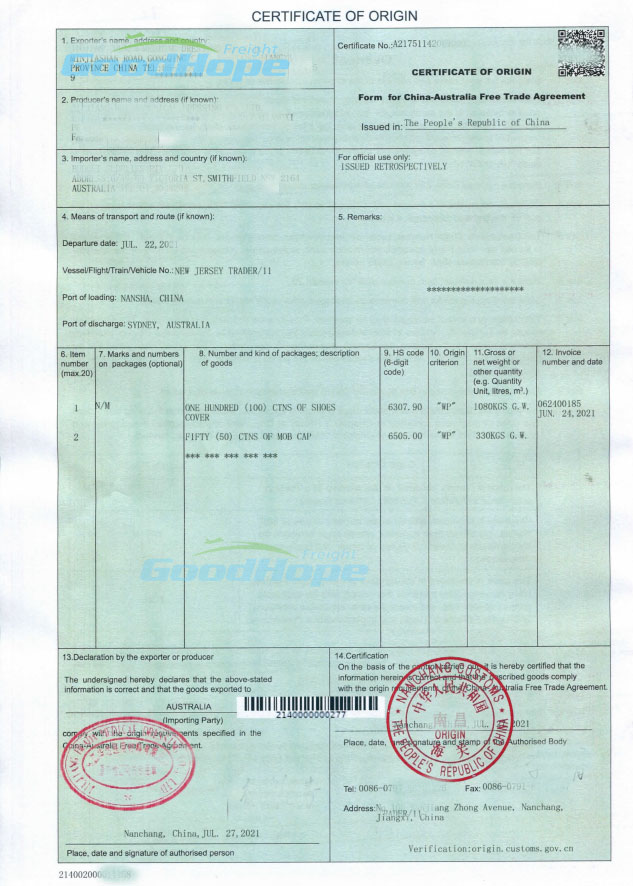
Issuing the certificate is the easy part. When a destination customs authority opens an origin verification, the question is rarely whether a certificate exists — it is whether the certificate holds up.
Machine. Garment. Goods. Those words describe nothing. The description has to follow the invoice: product name, specification, model, quantity and HS code, with the manufacturer named where required.
Invoice number, date, value, package count, gross and net weight, marks — any mismatch against the packing list, the bill of lading or the export declaration is the way in. Amending a filed entry always costs more than preparing it properly.
Goods routed through Hong Kong or another third place need a non-manipulation certificate where the destination asks for one. Direct or transshipped is a booking decision, so decide it when you book.
If the outer packaging or the shipping marks state a country of manufacture other than China, or carry Hong Kong, Macao or Taiwan origin wording, the certificate no longer matches the goods in the container.
Under-declaring the invoice to save duty detaches the certificate from the payment record and the export declaration. When the destination checks, the duty and penalties dwarf what was saved.
Declaring wholly obtained when imported materials were used, or claiming a value-added threshold the factory never reached. The issuing office can inspect equipment, processes and materials, and the declarant carries the liability.
Among the ASEAN destinations, Indonesian customs examines origin certificates most closely: a broad description, an HS code that does not match, a transshipment without a non-manipulation certificate, or an invoice that looks inconsistent can all trigger a verification request. A flagged certificate means preference suspended, cargo held, a security deposit demanded, or duty assessed outright — and if the answer still does not satisfy the authority, the deposit is forfeited and some cases end in a penalty.
For an exporter there is only one effective defense: align the three document sets before the certificate is filed, not after a verification arrives. That is why our filing routine starts with a cross-check and only then touches the system.
The twelve questions that come up most often from buyers and their brokers, answered with the rule rather than the sales pitch.
No. It depends on what your contract, your letter of credit and the destination customs authority require. Many countries ask for proof of origin to set the duty rate and to record the entry; some buyers never request one. Confirm it with your broker before the cargo leaves China, not after it arrives.
Not by itself. A CO is a non-preferential certificate: it proves the goods were produced in China and supports the normal most-favored-nation rate. A reduced or zero rate needs the preferential certificate that matches a trade agreement, for example Form E for ASEAN, Form K for Korea, Form FTA for Pakistan, the China-Australia certificate, or an RCEP certificate.
The issuing authority completes its review within two business days of accepting the filing. With clean documents most certificates are issued in one working day, and a same-day request depends on that day's review queue.
The authority charges no visa fee, and both China Customs and CCPIT publish a zero charge. What you pay is the agent's service fee, quoted per certificate and itemized by certificate type, rush handling, amendments, chamber stamps or embassy legalization.
The exporter or shipper named on the export declaration, or the manufacturer of the goods. Either can appoint an agent with a signed power of attorney. When we file on your behalf the certificate stays in your name or your supplier's name; we never issue one in our own name.
Yes. The company profile has to exist in the filing system: unified social credit code, Chinese and English name, address and contact. Companies already registered with customs as importers or exporters can sync that record. Self-printing also requires uploading the company seal and the declarant's signature.
Yes, within one year of the shipment date. File with the bill of lading or air waybill as proof of the shipment date and the certificate is issued retrospectively, marked as such. Some letters of credit refuse a retroactively issued CO, so file before departure whenever you can.
One year from the date of issue. Amendments and duplicates have to be requested inside that window; once it expires you file a new application.
There is no free trade agreement between China and either destination, so no preferential certificate applies. A CO is still the standard proof of origin: US brokers ask for it in anti-dumping and countervailing cases, and letters of credit routinely list it. Whether your entry needs one depends on the product and your broker's instructions.
The certificate can be filed on a third-party invoice basis with the corresponding remark on the form, declared to the issuing authority at the time of application. The invoice number, date and value on the CO must match the invoice your broker files at destination.
More destinations every year verify certificates through electronic origin data exchange, but plenty of brokers and ports still want the original. We deliver the PDF as soon as it is issued and send the original with the shipping documents or by courier.
Usually not because a certificate is missing, but because the content does not hold up: goods described too broadly, an HS code that differs from the invoice or the declaration, a transshipment without a non-manipulation certificate, or an invoice value that does not match the payment. Indonesia is the strictest checker in ASEAN, and a flagged certificate can mean suspended preference, held cargo, a security deposit or duty assessed.
We are a freight forwarder and documentation desk in Shenzhen, working out of Futian. Export declarations, origin certificates, fumigation, commodity inspection and embassy legalization for one order are delivered through one window wherever the rules allow it.
Invoice, packing list, bill of lading and export declaration are cross-read line by line — description to specification, marks to net weight. The verification triggers we can see in advance get fixed in advance.
Where several agreements cover the destination, we compare tariff schedules and origin rules first and file whichever produces the lower rate, not whichever we file most often.
Cargo out of Shenzhen, Guangzhou, Nansha, Huangpu, Ningbo, Shanghai, Qingdao, Tianjin or Xiamen is filed with the office that matches the port of export, so the certificate and the routing agree.
The PDF goes out the moment the certificate clears so your broker can pre-file. The original travels with the bill of lading or by courier, and the file is archived for the three-year retention period.
Tell us the destination, the Incoterms and what your broker has asked for. You get a certificate recommendation, the document checklist, and an itemized quote for the filing — from Shenzhen, for cargo out of any China port.
