
Home / Shipping to Czech Republic / How to Ship from China to Czechia
How to Ship from China to Czechia: Gateway Ports, T1 Transit & 21% DPH
Czechia has no coastline. That single fact shapes a Chinese import more than any other, and it is the reason this guide is arranged differently from the ones for coastal countries. There is no Czech seaport to choose, no Czech vessel schedule to watch, and no Czech container terminal where your goods are discharged. Instead there are two decisions that matter more than the freight rate: which foreign gateway port you route through, and where you clear customs.
Get the first one wrong and you add days and inland cost for no reason. Get the second one wrong and you tie up a large sum in import VAT that you did not need to pay in cash at all. Both are avoidable, and both are invisible to a buyer who has only ever been quoted a single "China to Prague" number.
The good news is that Czechia is an efficient place to import into. It sits in the middle of the EU single market with a strong manufacturing economy, customs clearance is typically measured in one to three days, and the inland terminal network is dense. What trips up new importers is almost always documentation rather than distance.
This guide is written for buyers importing from China for the first time. It covers what landlocked routing actually involves, the gateway choice and why it has been changing, moving cargo under T1 transit so clearance happens inland, transit times by sea, rail and air, trade terms, the documents Czech customs asks for, duty and the 21% DPH, product compliance, and how to judge whether a forwarder really knows this lane.
Czechia at a glance
- Landlocked. Every container arrives at a port in Germany, the Netherlands, Belgium, Slovenia, Italy or Poland, then continues inland by rail.
- Gateway ports: Hamburg carries the largest share of Czech container volume; Bremerhaven, Rotterdam, Antwerp, Koper, Trieste and Gdańsk are all live options depending on routing and delivery address.
- Inland terminals: Praha-Uhříněves is the largest, with Ostrava-Paskov, Česká Třebová, Plzeň, Brno and the river port at Mělník.
- Clear inland under T1 where you can. Duty and VAT stay suspended until release for free circulation in Czechia.
- EU member since 2004. EU customs union and single market. Duty from the TARIC code. No EU–China free trade agreement.
- DPH 21% standard, 12% reduced, 0% on books. Postponed accounting means registered importers usually never pay import VAT in cash.
- Celní správa runs customs; Finanční správa runs tax. Import data is retained for ten years.
- Czech-language administration. Forms and correspondence are in Czech, which is why most foreign importers work with a local broker or fiscal representative.
How your cargo moves: China to Czechia
Eight steps from your supplier's door to yours. The last four are the ones shaped by local rules.
- Pickup from your supplierWe collect the goods anywhere in China and bring them to our consolidation point.
- Export clearanceChina customs declaration filed and released before the goods move to the port.
- Loading and departureContainer loaded, sealed and handed to the carrier at the Chinese port.
- Main carriageOcean, air or rail movement booked on the route agreed for your cargo.
- Arrival at the gatewayDischarge at the port or airport of entry, recorded on the carrier's manifest.
- Import clearanceCustoms declaration filed locally, with duty and tax assessed on the declared value.
- Customs releaseGoods released into free circulation once duty and tax are settled.
- Final deliveryOnward movement to your delivery address, warehouse or nominated depot.
Duty rates, VAT rates and clearance times move, and the figure that applies to your goods is the one set for your commodity code on the day of clearance. We check the current position against your code before your goods sail and confirm it to you in writing — ask for that check when you request a quote.
What being landlocked really means for a Czech shipment
The practical consequence is that your shipment has two clearly separate halves, and they are priced and managed differently. The first half is the ocean leg from a Chinese port to a European gateway. The second is the inland leg from that gateway to a Czech terminal, and that leg is rail, not river.
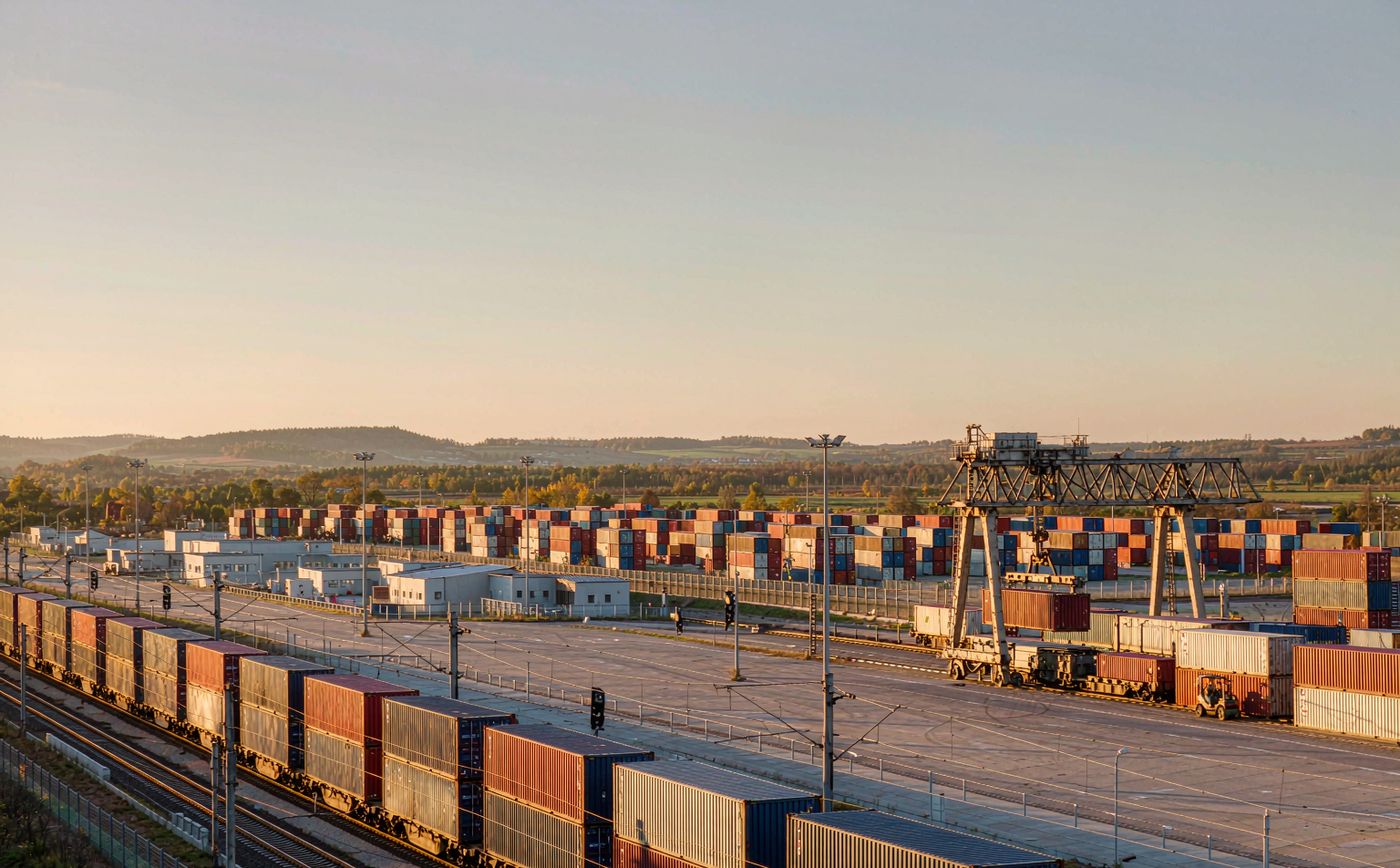
The inland network runs on standard-gauge rail operated by companies such as Metrans, ČD Cargo and Rail Cargo Group, feeding terminals at Praha-Uhříněves for Prague and Central Bohemia, Ostrava-Paskov for Moravia-Silesia, Česká Třebová as a central hub, Plzeň for West Bohemia, Brno for South Moravia, and Mělník on the Elbe. Barge service up the Elbe to Mělník technically exists but is unreliable because of low water levels, so if a quotation describes "inland waterway" it is probably describing a mode you will not use.
The inland rail leg from any of the main gateways is typically three to six days, and then clearance and final trucking to your door on top. So the honest way to read a Czech quotation is in three parts: ocean transit to a named port, rail transit to a named terminal, and clearance plus final delivery. A single door-to-door number hides all three, and hides the fact that any one of them can be optimised.
Ask for the three numbers separately. If a forwarder will not tell you which gateway port and which Czech terminal your container is going to, you cannot tell whether the price is good or the schedule is real.
Choosing a gateway port when your country has no coastline
The gateway decision is a balance of rail distance, rail service density and the ocean routing of the service you are actually booking. Here is how the main options compare:
| Gateway | Rail distance to Prague | Where it suits | Trade-off |
|---|---|---|---|
| Hamburg | About 700 km | The default for most of Czechia; carries the largest share of Czech container volume | Densest rail service to Prague and Brno, but the North Sea approach is long when services route via Suez. |
| Bremerhaven | About 750 km | A working alternative when Hamburg is congested | Similar routing, sometimes better terminal fluidity; slightly longer rail leg. |
| Rotterdam / Antwerp | About 900 km | When the service or the price makes the extra rail leg worthwhile | Europe's largest ports with extensive barge and rail connections, but the longest inland run to Czechia. |
| Koper / Trieste | About 800–850 km | Brno and South Moravia; the Adriatic corridor | Closer to Asia by sea on Suez routing, which can save five to seven days; further when services use the Cape. |
| Gdańsk / Gdynia | About 700–720 km | Northern Moravia and Silesia; eastern Czechia | Shorter inland distance to the Ostrava region, and useful when Baltic services have capacity. |
Two things are worth noting about that table. First, rail is generally cheaper than trucking over these distances, so a container moving by rail from Hamburg to Prague is not the expensive option people assume. Second, the last column is the one that matters: the ocean routing of the service changes which of these gateways is genuinely faster, and that has been moving around.
Hamburg or Koper: why the right gateway flips with the routing
This is the part that catches out importers who chose a gateway two years ago and have never revisited it.
On Suez routing, Koper is typically the faster gateway from Asia by roughly five to seven days. The reason is simple geometry: a vessel discharges in the Mediterranean instead of sailing on around Iberia and up to the North Sea, and from there the rail run to Brno is short.
On Cape of Good Hope routing, the position reverses. A vessel coming around Africa sails north through the Atlantic, and Hamburg, Rotterdam and Antwerp are directly on that path. Reaching Koper means re-entering the Mediterranean through Gibraltar and crossing its full length, which adds days rather than saving them.
Since late 2023, most carriers have avoided the Red Sea and used the Cape, and while some services returned to Suez during 2026, the Cape remains the default on most Asia–North Europe strings. That means the gateway that was the right answer in 2023 may be the wrong answer today, and may switch back again.
The practical instruction: ask your forwarder to check the actual service routing for your cargo-ready date and to name the gateway that routing implies. Do not accept "we always use Hamburg" as an answer. This is the single cheapest optimisation available on a Czech lane, and it costs nothing but a question.
Clearing customs inside Czechia instead of at the seaport
The second decision is where your goods are released for free circulation, and it has a direct effect on your bank balance.
Option A — clear at the gateway port
Duty and import VAT are assessed and paid in Germany, the Netherlands or Slovenia. The goods then travel to Czechia as an intra-EU movement, already in free circulation. This is simple to arrange and is what happens by default if nobody decides otherwise. The cost is that you pay import VAT in a country where you may not be VAT-registered, and recovering it means either reclaiming it later or registering for VAT there.
Option B — T1 transit, clear inland
The container travels sealed from the seaport to a Czech inland terminal under a T1 transit procedure with duty and VAT suspended. Release for free circulation and the import declaration happen in Czechia. This works cleanly for FCL because the container moves as a sealed unit, and it puts the import into your own VAT return.
Option B usually wins, and the reason is VAT rather than duty. Czechia uses postponed VAT accounting as the standard treatment for importers registered for Czech VAT. Instead of paying import VAT at clearance, you self-assess it on your VAT return, declaring output VAT and claiming input VAT in the same period. For a fully taxable business the cash effect is close to neutral — the money effectively never leaves your account.
The conditions are straightforward but real: the importer must be registered for Czech VAT, the goods must be released for free circulation in Czechia, and the transit documentation must be correct. Businesses that breach customs rules or fail compliance requirements can be excluded from postponed accounting and required to pay upfront.
There is a second, quieter point. Whoever is the importer of record at the seaport carries the legal responsibility for that declaration. If your supplier's agent clears a DDP shipment in Hamburg, the classification, the valuation and the VAT are all being declared under someone else's name — and if it is wrong, it is not your mistake to fix later, but it is your supply chain that stops. Knowing where clearance happens is worth the question.
Rail and air into Czechia, and where the cargo actually arrives
Czechia has a genuine rail option, which is unusual for a country with no port. Trains from Chinese inland hubs run the northern corridor into the EU at Małaszewicze and continue into Czechia, with Prague as the main rail gateway and onward delivery to Brno, Ostrava, Plzeň and Pardubice. Station-to-station times commonly run 18 to 25 days, with some scheduled services below that; door-to-door is typically 25 to 35 days once clearance and final delivery are included.
It is worth comparing against the sea route honestly. Rail roughly halves the ocean transit but costs more per container, and the same restrictions apply as on every northern-corridor service: dangerous goods are not carried, loose lithium batteries and most battery-powered products are excluded, and chemicals need a non-hazardous safety appraisal before booking. If your product is in one of those groups, the rail option disappears and you are back to sea or air. See our dangerous goods to Czech Republic and non-DG chemicals to Czech Republic pages.
Air freight lands at Prague Václav Havel Airport (PRG), and where the schedule or capacity does not fit, cargo is often flown into Vienna, Munich or Leipzig and trucked across the border. Airport-to-airport is about three to seven days. Express courier delivers door to door in roughly one to five days and handles clearance for you, which is convenient for samples but leaves you with less control over how your goods are classified.
A useful reference point: Czech customs clearance is typically one to three days, among the more efficient in the EU. When a Czech shipment runs late, the cause is far more often documentation at origin than anything happening after arrival.
Incoterms on a Czech order from China, without the jargon
The trade term on your supplier's quotation decides who is responsible at each stage, and for a landlocked destination it also decides something else: who chooses the gateway port and who acts as importer of record.
| Term | What the supplier handles | What you handle | Note for a Czech delivery |
|---|---|---|---|
| EXW | Makes goods available at their factory. | Everything from pickup onward. | Only sensible if you have your own agent in China. |
| FOB | Delivers goods on board at the Chinese port with export clearance done. | Main carriage, insurance, Czech import clearance, duty and VAT. | The usual recommendation. You choose the gateway and the inland routing. |
| CIF | Pays carriage and insurance to a named port. | Clearance, duty, VAT, inland leg, all destination charges. | CIF requires a named port of destination. "CIF Prague" is not a valid term — ask which port is named and who pays the inland leg. |
| DAP | Delivers to your Czech address. | Unloads, clears customs, pays duty and VAT. | Works well if you are VAT-registered and want to self-assess the VAT yourself. |
| DDP | Handles everything including duty and VAT. | Unloads. | Simple to receive. Ask where they clear: if it is Hamburg rather than Czechia, you lose the postponed-accounting benefit and visibility of classification. |
The landlocked twist in that table is worth restating. On a shipment to a coastal country, "CIF Rotterdam" is unambiguous. On a shipment to Prague, the term must name a port somewhere else, and the inland leg to Czechia is an additional cost that the term does not cover unless you have agreed it. New importers regularly discover this at the point where the container is sitting at a terminal waiting for someone to pay for the rail move.
For a first import, FOB plus your own forwarder remains the structure that gives you the most control. Full detail on the service side sits on our DDU and DDP and local charges pages.
The documents Czech customs will ask you for
Czech customs is the Celní správa České republiky, operating under the Union Customs Code with electronic import declarations through its own systems and advance security data through ICS2. Tax is administered separately by the Finanční správa. The split matters because the same movement generates obligations to two different authorities.
The document set is the standard EU one:
- Commercial invoice with buyer and seller, a product description that matches the declared commodity code, quantities, unit and total prices, the trade term, country of origin and payment terms.
- Packing list with carton counts and the gross and net weight and dimensions of every package. Customs weighs and measures, and mismatches trigger inspections.
- Transport document — bill of lading for sea, air waybill for air, CIM or CMR consignment note for rail and road. If you are moving under T1, the transit documentation must be correct or the suspension of duty and VAT fails.
- EORI number of the importer of record.
- Certificate of origin where a preference is claimed, and product certificates for regulated goods.
- CE declaration of conformity and the technical file behind it, for anything in scope.
Two practical points. First, advance cargo data must be consistent across invoice, packing list and declaration; vague descriptions like "parts", "samples" or "accessories" are no longer adequate for customs risk analysis. Second, Czech customs retains import data for ten years. A classification decision made in a hurry is reviewable a decade later, which is an argument for getting the commodity code right the first time rather than fixing it later.
One more thing that is easy to underestimate: the administration runs in Czech. Forms, correspondence and corrective requests arrive in Czech, and response deadlines on control statements can be as short as five working days. Most foreign importers therefore work with a Czech broker or appoint a fiscal representative, and the cost of that is small compared with the cost of missing a deadline you did not understand.
More detail on our import clearance documents page.
Czech VAT at 21 percent, and why you may never pay it in cash
The Czech standard VAT rate, DPH, is 21%. A reduced rate of 12% was created at the start of 2024 by consolidating the previous 10% and 15% rates, and covers food, non-alcoholic drinks, water, medicines, books and hotel accommodation. Books and certain newspapers are zero-rated, as are exports and intra-EU supplies. Import VAT is calculated on the customs value plus duty plus the costs of getting the goods to their first destination in the EU, not on the invoice value alone.
Here is the part worth understanding before your first container. For importers registered for Czech VAT, postponed VAT accounting is the standard treatment, not an optional extra you have to apply for. The import VAT is self-assessed on the VAT return for the period, where output VAT is declared and input VAT claimed at the same time. For a business making fully taxable supplies, the cash effect is neutral. The exception is taxpayers who breach customs rules or fail compliance requirements: they can be excluded and required to pay upfront.
To get there you need Czech VAT registration, which means a DIČ number, and the EORI application is generally based on it. Registration thresholds differ depending on where your business is established: a Czech-established business registers once turnover exceeds CZK 2,000,000 in any twelve consecutive months, while a non-resident business has no threshold at all — the first taxable supply triggers registration. That catches people out, because it means the obligation can arise before you feel ready for it.
Once registered, the reporting rhythm is real. Czech VAT returns are filed monthly by default for new registrants, due on the 25th of the month following the period, and the KH DPH control statement is a mandatory monthly transactional report. If you dispatch goods onward from Czechia to other member states, check the Intrastat threshold before your first outbound movement.
What your HS code decides about duty in Czechia
Duty is EU duty. Czechia applies the common customs tariff, and the rate for your product comes from TARIC along with any trade-remedy or restriction measures attached to that code. There is no EU–China free trade agreement, and China has largely graduated out of the EU's preferences scheme, so most Chinese goods pay the standard rate for their code. Budget on that basis.
The code does more than set the rate, though, and this is where new importers get caught:
| What the code determines | Why it matters |
|---|---|
| The duty rate | From zero to double digits depending on the product. A wrong code means a wrong bill, in either direction. |
| Whether a certificate or licence is needed | Some codes trigger requirements for health certificates, type approval, REACH registration or dual-use screening that the rate alone would never reveal. |
| Whether anti-dumping or safeguard duty applies | Certain steel, aluminium, ceramic and bicycle categories carry additional measures that appear only at code level. |
| Whether the reduced VAT rate applies | 12% rather than 21% where the goods genuinely qualify — but only if the classification supports it. |
| How long the decision stays on file | Czech customs retains import data for ten years, so a code chosen now remains reviewable long after. |
For Czechia specifically, two categories deserve a second look because the country's manufacturing base makes them common imports. Automotive parts and accessories are frequently misclassified, because the same physical item can fall under different headings depending on whether it is for a specific vehicle or generic. LED lighting, e-bikes and small electric vehicles attract both product-safety documentation and, in some categories, trade-remedy measures.
On small consignments: the EU relief for goods valued at €150 or less was removed from 1 July 2026 and replaced with a flat charge of €3 per tariff line for consignments up to that value. Import VAT never depended on a threshold and is charged regardless of value.
CE marking and GPSR: what a Czech distributor will demand first
Customs clearance is not permission to sell. Czech market surveillance and, before that, any serious Czech distributor will ask for product documentation, and the questions come early.
- CE marking with a declaration of conformity behind it. The mark on its own is not evidence. For machinery, electrical equipment, toys, PPE, medical devices and construction products, expect to produce the technical file and test reports.
- GPSR, the General Product Safety Regulation. Most consumer products need an identifiable responsible person established in the EU. If you are the importer into Czechia, that may be you, and it is a role with real obligations.
- Czech-language documentation. Instructions, safety information and labelling generally need to be in Czech for the Czech market. Customs will not check this; your customer will, and non-compliant instructions are a common reason a distributor rejects a delivery.
- WEEE, batteries and packaging. Electrical goods, batteries and packaged products carry separate registration and reporting obligations. Recovery is usually handled through a collective compliance scheme, and your distributor will often expect you to be registered before they list the product.
- REACH and CLP for chemicals and mixtures, plus separate rules for cosmetics and food-contact articles.
The most useful thing you can do before a first container ships is to ask the factory for the declaration of conformity, the test reports behind it, and Czech-language artwork for the packaging. If those three cannot be produced, the problem is not logistics.
Buying as a private person or as a Czech company with a DIČ
As a private individual
You can import personal goods and pay duty plus 21% VAT, and customs will ask for the same documents as for a commercial shipment. You cannot reclaim the VAT, postponed accounting is not available to you, and you will need to show that the goods are for personal use rather than resale. For a one-off personal purchase this is fine. For anything you intend to sell, it is an expensive way to do it.
As a registered business
A Czech company — a limited company, s.r.o., or a sole trader operating under a trade licence — needs a DIČ VAT number and an EORI number, and registers for VAT once turnover passes CZK 2,000,000 in any twelve consecutive months. A business established outside the EU has no threshold: registration is triggered by the first taxable supply, and a fiscal representative is normally appointed because the administration runs in Czech.
The deciding question is the same as everywhere: are you going to resell? If yes, register before the first shipment arrives, because retrofitting VAT registration onto goods already in the country is slow and expensive. If you are importing a single personal purchase, accept the VAT as a cost.
Sourcing on a marketplace or meeting the factory in person
Many Czech buyers reach China through a marketplace first. It is fast, prices are visible, and there is no travel cost. What a listing does not tell you is whether the seller is the manufacturer, whether the product has ever been tested for EU conformity, or whether the specification on the page is the specification that will ship.
There is also a pattern worth naming in this market: a lot of Czech businesses buy through a German or EU distributor before they ever import directly. Going direct to China is the step that changes your margin, and it is also the step that moves full importer responsibility onto you — classification, product compliance, VAT, and the record-keeping that follows for ten years. That is a good trade for a business with volume, and a poor one for someone testing a single product line.
The questions to ask any marketplace seller are the same two: can you provide a CE declaration of conformity and test report for this exact model, and will the commercial invoice describe the goods the way customs requires? A seller who cannot answer the first is selling you something you may not be able to sell in Czechia.
On consolidation: if you are buying from several suppliers, consolidating into one container at a warehouse in China is usually faster and cheaper per cubic metre than several LCL shipments, and it gives you one set of documents and one clearance. See our warehouse and consolidation and consolidated shipment pages.
What to ask a forwarder before you trust them with Czech cargo
Every item below is something you can test with one question before you pay anything, and each one separates a forwarder who runs this lane from one who is reselling generic space.
- Will you name the gateway port and the Czech terminal? If the answer is only "Czech Republic", the quote is generic.
- Will you show me the actual service routing? Suez or Cape changes which gateway is genuinely faster. A forwarder who checks is worth more than one who quotes from habit.
- Do you understand T1 transit? Getting the container sealed to a Czech terminal with duty and VAT suspended is the mechanism that protects your cash.
- Do you quote ocean, inland and destination separately? Three numbers you can challenge beat one number you cannot.
- Do you know that Czech import VAT is normally self-assessed? A forwarder who tells you to budget for paying 21% in cash at the port is describing a different country's rules.
- Who is the importer of record, and where does clearance happen? If the answer is "our agent in Hamburg", you have lost control of classification and of the VAT treatment.
- Do you hold a Chinese NVOCC registration and operate your own consolidation warehouse? Both are checkable.
- Will you confirm the commodity code before booking? Czech customs keeps import data for ten years. This is not a clerical detail.
- Do you offer cargo insurance and explain what it excludes? See our cargo insurance page — carrier liability limits sit far below cargo value.
- Do they tell you what they do not do? Czech VAT returns, KH DPH control statements and product registration belong to the importer, and a forwarder who claims otherwise is overstating.
From the factory gate to a Czech warehouse, in order
Confirm the commodity code and the product paperwork
Before ordering, settle the code and check the duty rate, any certificate requirement, and whether CE and GPSR apply. Ask the factory for the declaration of conformity and test reports at this stage, not later.
Agree the trade term and name the gateway
FOB for most first imports. Make the forwarder name the gateway port and the Czech inland terminal, and confirm the service routing for your cargo-ready date.
Register on the Czech side
DIČ and EORI first, VAT registration before the goods arrive if you intend to self-assess import VAT and use T1 clearance inland. Appoint a Czech broker or fiscal representative.
Collection, consolidation and export clearance in China
Goods are collected from one or several factories, consolidated if needed, and cleared for export.
Ocean leg to the gateway port
Track the vessel and watch for routing changes. ICS2 advance data must match your commercial documents.
T1 transit to a Czech inland terminal
The container moves sealed from the seaport to Praha-Uhříněves, Ostrava-Paskov, Brno or another terminal with duty and VAT suspended. Transit documentation must be correct or the suspension fails.
Release for free circulation and VAT self-assessment
The import declaration is filed in Czechia, duty is paid, and import VAT is self-assessed on your VAT return rather than paid at the border. Clearance typically takes one to three days.
Final delivery and the ten-year file
Trucking from the terminal to your address. Keep the declaration, invoice, packing list and conformity documents — Czech customs retains import data for ten years and audits happen.
A first container into Prague, and the two decisions that mattered
A Brno-based seller of LED lighting and small kitchen appliances came to us with a first consolidated order from two suppliers in Ningbo, around 18 CBM. Both had been found on a marketplace, neither had been asked for a declaration of conformity, and the buyer had been quoted a single "China to Czechia, door to door" number by another forwarder.
The first decision was the gateway. The incumbent quotation routed through Hamburg because that is what the forwarder always did. When we checked the actual service for the cargo-ready date, that string was still running via the Cape, which put Hamburg on the natural path and Koper at a disadvantage — so on that particular booking Hamburg was right, and we said so. Three months later the same service had shifted and Koper was the faster option for the Brno address. Neither answer is permanent, which is exactly the point.
The second decision was where to clear. The buyer assumed VAT would be paid at the port, as it had been on the small parcels they had received before. Because the business was already registered for Czech VAT, we arranged the container to move under T1 from the seaport to Praha-Uhříněves and cleared it there. Import VAT was self-assessed on the VAT return and claimed in the same period, so the 21% never left the business's account. On a container of this value that was the difference between financing a tax payment for a quarter and not doing so.
The one thing that did go wrong was not logistics at all. One of the six SKUs had no CE declaration of conformity, and the factory could not produce one. That carton stayed in the bonded area while the rest was delivered, and the buyer ended up writing off a small order line. What decided it: the two decisions that mattered most were made before the vessel left China, and the one that cost money was a question nobody had asked the supplier.
Where Goodhope fits on a China to Czechia shipment
Goodhope Freight has been moving cargo out of China since 2012, operating as a licensed NVOCC (registration GD20230925153335) from Shenzhen. On a Czech shipment our job is to make the two decisions above visible to you, and to handle the China end properly.
- Ocean freight port to port — FCL and LCL to the gateway port that the actual service routing favours, not the one we used last year.
- We name the gateway and show the routing — Hamburg, Bremerhaven, Rotterdam, Antwerp, Koper or Gdańsk, with the reason for the choice written down.
- Rail through Małaszewicze into Czechia — and an honest answer on whether your commodity is accepted on the corridor.
- Air freight to Prague Václav Havel — airport to airport, with chargeable weight worked out before you book.
- Consolidation in China — several suppliers, one container, one set of documents, one clearance.
- Documents checked before the vessel sails — commodity codes, descriptions and certificates, because that is where Czech clearance problems start.
- Plain answers on what we do not do — the T1 transit leg, Czech import clearance, VAT self-assessment and KH DPH reporting belong to the importer of record or their Czech representative. We coordinate with them and we do not pretend otherwise.
Why importers use Goodhope on this lane
Six things that are different about working with us on China to Czechia shipments.
Straight cases on the China to Czechia lane
Five shipments bought in China and delivered into Czechia, told end to end — where the order came from, how it moved, where it nearly went wrong, and how it finished. Client names are withheld at their request; the situations and the handling are what we deal with on this lane.
Landlocked · first container · Shenzhen to Prague
The purchase. A buyer new to importing asked for a rate to Prague and was confused that the quote named a port in another country.
The move. Full container into Hamburg, then inland by rail, cleared at an inland point inside Czechia.
Where it nearly went wrong. Being landlocked means the ocean leg ends in another country and the inland leg is half the journey. A quote that stops at the port is not a quote to Czechia.
How it finished. We quoted door to door with both legs named. He understood the routing and stopped comparing ocean-only rates.
Hamburg or Koper · routing flips · Ningbo to Brno
The purchase. A first-time buyer was told Hamburg was the gateway for Central Europe and never revisited it.
The move. Full container compared across both gateways against the actual sailing and the inland run to Brno.
Where it nearly went wrong. Which gateway is right depends on the routing the carrier is running, not on geography alone. Koper is often the better call for Adriatic routings and Hamburg for North Sea ones, and the answer changes during the year.
How it finished. We re-check both on every Czech quote. Koper won on his sailing by five days.
Clearing inland · not at the port · Shanghai to Czechia
The purchase. A buyer assumed customs clearance had to finish at the seaport before the container could move inland.
The move. Full container moving inland under customs control, with the entry filed at an inland point in Czechia.
Where it nearly went wrong. Clearing inside Czechia rather than at the seaport keeps the container moving instead of waiting for an entry to be processed at a terminal that is not its destination. It is the difference between a container in transit and a container in storage.
How it finished. We filed inland. His container arrived at the warehouse without a terminal stay.
CE and GPSR · distributor demand · Yiwu to a Czech distributor
The purchase. A buyer importing consumer goods assumed the factory's test report would satisfy his Czech distributor.
The move. Consolidated sea freight with CE conformity and the general product safety documentation prepared before shipment.
Where it nearly went wrong. A Czech distributor asks for CE marking and the general product safety documentation before he asks about freight, and the technical file behind the mark is what he wants to see. Without it the goods clear customs and still cannot be sold.
How it finished. We flagged it at quote stage. His distributor accepted the file on first submission.
VAT in cash · budgeting · Guangzhou to Czechia
The purchase. A buyer budgeted the twenty-one per cent as a cash payment due at the border.
The move. Full container with the VAT treatment confirmed against his registration before arrival.
Where it nearly went wrong. Registered businesses here generally account for the VAT rather than paying it in cash at the frontier, and the treatment depends on how the importer is registered. Budgeting it as a cash outlay at the border overstates the money he needs on the day.
How it finished. We confirmed the treatment with his accountant. He released the cash he had been holding against it.
Why importers use Goodhope on this lane
Six things that are different about working with us on China to Czechia shipments.
Ask us to quote Czech cargo out of China
Send us the product and its commodity code if you have it, the carton count and total weight or volume, the supplier's city, and your delivery address in Czechia. We will check the current service routing, name the gateway port and the inland terminal, price the ocean and inland legs separately, and tell you whether clearing inland under T1 is available to you.
Frequently asked questions
Which port should I use for shipping from China to the Czech Republic?
Czechia is landlocked, so you are really choosing a gateway port in another country plus an inland leg. Hamburg carries the largest share of Czech container volume and has the densest rail service to Prague, roughly 700 km. Bremerhaven is close behind. Rotterdam and Antwerp are around 900 km out. Koper and Trieste on the Adriatic sit about 800 to 850 km away and suit Brno and South Moravia. Gdansk suits northern Moravia and Silesia. The right answer depends on the actual service routing at the time you ship, not on habit.
How long does shipping from China to Czechia take?
Sea freight runs about 30 to 45 days door to door, made up of an ocean leg to a European gateway plus three to six days by rail to a Czech inland terminal, plus clearance and final delivery. LCL usually adds another three to seven days for consolidation and deconsolidation. Rail from Chinese inland hubs into Czechia is commonly 18 to 25 days station to station, with some faster scheduled services below that. Air freight into Prague Vaclav Havel is about 3 to 7 days airport to airport, and express courier 1 to 5 days door to door.
Should I clear customs at the seaport or in the Czech Republic?
For most importers, clearing in Czechia is better. The container moves under a T1 transit procedure, sealed, from the seaport to a Czech inland terminal with duty and VAT suspended, and is released for free circulation there. Because Czechia uses postponed VAT accounting for VAT-registered importers, the import VAT is self-assessed on your VAT return, where you declare output VAT and claim input VAT in the same period, so the cash effect is close to neutral. Clearing at a foreign seaport usually means paying VAT there and reclaiming it later, or registering for VAT in that country.
Do I need an EORI number to import into Czechia?
Yes. Any business importing into the European Union needs an EORI number, and one issued by any member state is valid throughout the EU. Businesses established in Czechia apply through the Czech Customs Administration, the Celni sprava, and the application is generally based on the DIC VAT number. Non-EU companies usually appoint a fiscal representative, partly because the administration's forms and correspondence are in Czech.
What VAT rate applies to imports into the Czech Republic?
The standard Czech VAT rate, DPH, is 21%, with a reduced rate of 12% that was consolidated from the previous 10% and 15% rates at the start of 2024 and covers food, non-alcoholic drinks, water, medicines, books and hotel accommodation. Books and certain newspapers are zero-rated. Import VAT is calculated on the customs value plus duty plus costs up to the first destination in the EU, not on the invoice value alone.
Is Hamburg or Koper the better gateway from Asia?
It depends on the routing, and the answer has changed. When services use the Suez Canal, Koper is typically five to seven days faster from Asia because vessels discharge in the Mediterranean instead of sailing around Iberia to the North Sea. When services route around the Cape of Good Hope, which has been the default on most Asia to North Europe strings since late 2023, the position reverses: vessels come north through the Atlantic past Hamburg, Rotterdam and Antwerp, while reaching Koper means re-entering the Mediterranean through Gibraltar. Some services returned to Suez during 2026. Ask your forwarder to check the actual routing for your cargo ready date rather than quoting from habit.
What documents does Czech customs require?
A commercial invoice with a description that matches the declared commodity code, a packing list with weights and dimensions, the transport document being a bill of lading, air waybill or CIM or CMR consignment note, the importer's EORI number, a certificate of origin where a preference is claimed, and product certificates such as the CE declaration of conformity for regulated goods. Advance cargo data for the EU Import Control System must be consistent across all documents, and vague descriptions such as parts or samples are no longer adequate.
Is there a duty-free threshold for small parcels into Czechia?
The EU relief that exempted consignments valued at 150 euro or less from customs duty was removed from 1 July 2026 and replaced with a flat charge of three euro per tariff line for consignments up to that value. Import VAT has never depended on a threshold and is charged regardless of value, at 21% or the reduced rate if the goods qualify.
Can I import into Czechia as a private individual?
Yes, but you will pay duty and 21% VAT and you cannot reclaim the VAT, and postponed VAT accounting is not available to you. Anyone planning to resell should register a business, obtain a DIC VAT number and register for VAT. Non-resident businesses have no turnover threshold: the first taxable supply triggers registration, which is worth knowing before you commit to a delivery schedule.
What does a Chinese freight forwarder handle on a Czech shipment?
On the China side a forwarder collects goods from the factory or factories, consolidates them if needed, clears them for export, books space and issues the bill of lading, air waybill or rail consignment note, and provides tracking. Goodhope works port to port on ocean freight and airport to airport on air freight, names the gateway port and shows you the actual service routing, and coordinates with your Czech broker for the T1 transit leg and inland release. Czech import clearance, VAT self-assessment and any product registration belong to the importer of record or their Czech representative.