
Home / Shipping to Denmark / How to Ship from China to Denmark
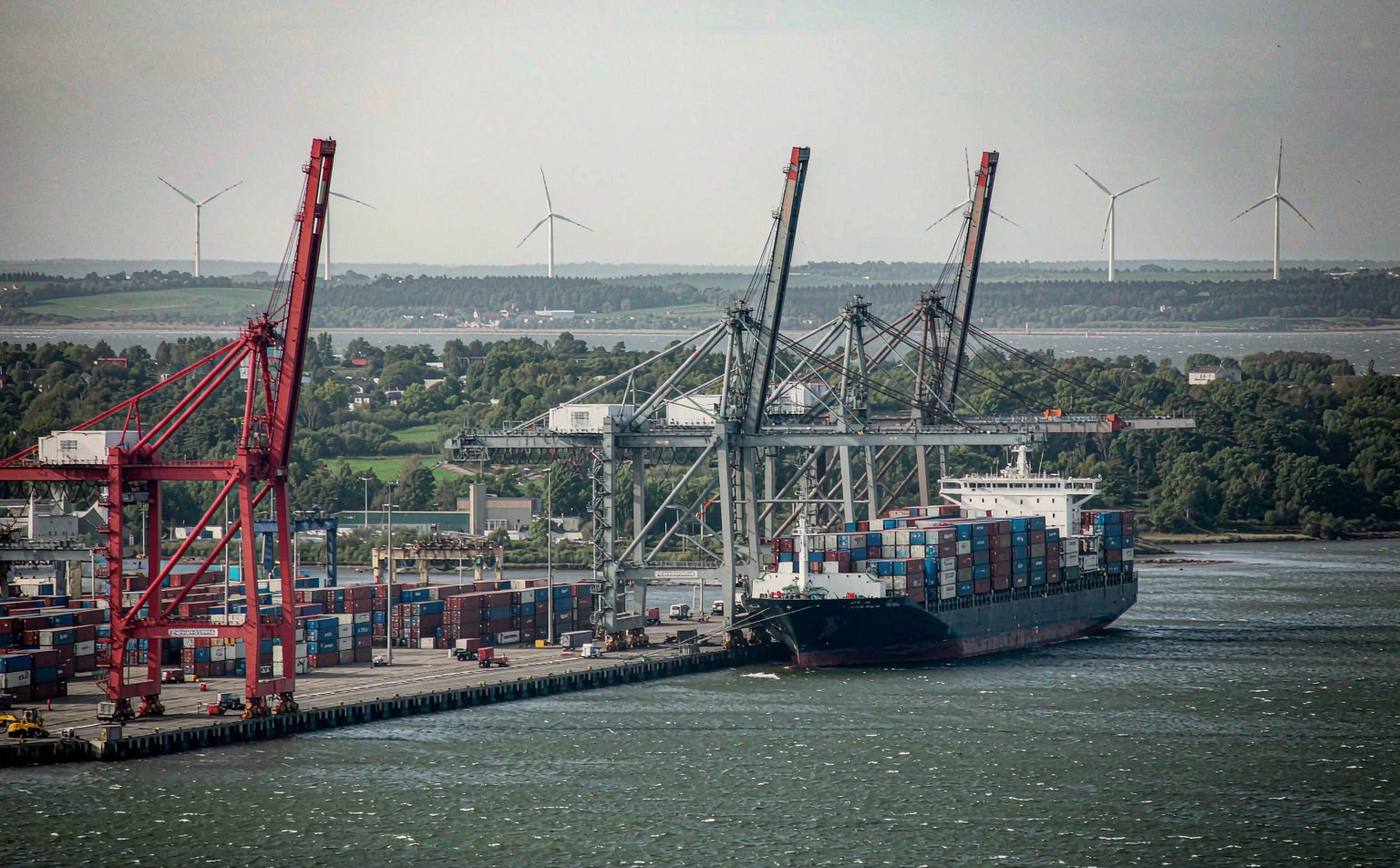
How to Ship from China to Denmark: Aarhus, DMS Import & 25% Moms
Denmark is a small market with a very efficient logistics system, and that combination misleads first-time importers into thinking the whole thing will look after itself. Two things actually decide whether a Danish import goes smoothly. The first is that Aarhus is the only Danish port with a direct connection to the Far East, so unless your container is on one of those calls it arrives on a feeder from Rotterdam, Hamburg, Antwerp or Bremerhaven — or it is cleared in Germany and crosses the border by truck. The second is that Danish customs changed its import declaration system in March 2026, which means that on a Danish shipment this year the delay is more likely to come from the paperwork than from the vessel.
Almost everything else is ordinary European Union. Denmark has been in the customs union and the single market since 1973, duty comes from the TARIC commodity code, and VAT — Danish moms — is a flat 25% with no reduced rate to plan around. That flat rate sounds harsh until you learn the second half of the story: since 2022 a VAT-registered Danish business can move import moms onto its own VAT return instead of paying it at the border, which removes the cash-flow problem almost entirely.
This is written for buyers importing from China for the first time. It covers which port your cargo should land at, realistic transit times, the 2026 customs change, duty and moms, the registration numbers you need, Danish producer responsibility, and how to tell whether a forwarder genuinely works the Danish lane or is quoting you a number copied off a website.
Denmark at a glance
- Aarhus is Denmark's largest commercial port and the only Danish port with direct connections to Far East ports. It handled a record 843,665 TEU in 2025.
- Scale matters. Aarhus moves roughly 0.8 million TEU a year against about 13.5 million at Rotterdam and Antwerp and up to 7.8 million at Hamburg. Direct calls exist, but they are limited in number.
- Everything else arrives by feeder from a North European hub, or is cleared in Germany and trucked in across the border.
- Moms is a flat 25% with no general reduced rate. Postponed accounting (udskudt betaling, marked UD on the declaration) has been available since 1 January 2022.
- Toldstyrelsen handles customs and Skattestyrelsen handles tax — they are separate authorities. Since 14 March 2026 import declarations go through DMS Import.
- Your EORI number is DK plus your eight-digit CVR number, issued automatically when you register for customs on Virk.dk.
- Producer responsibility runs through one register, DPA-System, covering electronics, batteries and packaging — with no minimum threshold for packaging.
How your cargo moves: China to Denmark
Eight steps from your supplier's door to yours. The last four are the ones shaped by local rules.
- Pickup from your supplierWe collect the goods anywhere in China and bring them to our consolidation point.
- Export clearanceChina customs declaration filed and released before the goods move to the port.
- Loading and departureContainer loaded, sealed and handed to the carrier at the Chinese port.
- Main carriageOcean, air or rail movement booked on the route agreed for your cargo.
- Arrival at the gatewayDischarge at the port or airport of entry, recorded on the carrier's manifest.
- Import clearanceCustoms declaration filed locally, with duty and tax assessed on the declared value.
- Customs releaseGoods released into free circulation once duty and tax are settled.
- Final deliveryOnward movement to your delivery address, warehouse or nominated depot.
Duty rates, VAT rates and clearance times move, and the figure that applies to your goods is the one set for your commodity code on the day of clearance. We check the current position against your code before your goods sail and confirm it to you in writing — ask for that check when you request a quote.
Aarhus is the only Danish port with a direct link to Asia
If you remember one thing about Danish routing, make it this. The Port of Aarhus states plainly that it is the only Danish port with direct container connections to ports in the Far East, and the mainline calls it receives are operated by Maersk, MSC and Hapag-Lloyd. Capacity tracked at the port in early 2026 put Maersk at roughly half of the named capacity and MSC at around forty per cent, with Hapag-Lloyd, Unifeeder, OPDR, Samskip and CMA CGM making up the rest. A weekly Hapag-Lloyd call connecting Aarhus with Rotterdam and Shanghai was added under the Gemini network the two carriers run together.
The port has also been growing quickly. Container throughput reached a record 843,665 TEU in 2025, around 28% more than the 659,886 TEU of 2024, and the first quarter of 2026 came in 13% ahead of the same quarter the year before. APM Terminals operates the container terminal, a railway track runs right into it, and the E45 motorway is a short distance away — which is why Aarhus works as a national distribution point and not just a Jutland one. A new Omniterminal leased to MSC is being finished with a 430 metre quay dredged to 14 metres.
Now the part that matters for planning: Aarhus is large by Danish standards and small by European ones. Rotterdam and Antwerp each handle around 13.5 million TEU a year and Hamburg up to 7.8 million. Danish volumes are a rounding error on an Asia–Europe mainline vessel, which is exactly why so many services prefer to drop Danish cargo at a hub and feed it north. A direct call is worth asking for, but you should ask how often it actually runs before you build a production schedule around it.
The question to ask your forwarder is not "is it direct?" It is: which vessel, which hub, which feeder operator, and what is the fallback if the connection is missed. A forwarder who works the lane can answer all four. A forwarder who says "about 35 days" has usually not looked at the rotation.
Copenhagen, Fredericia and when a feeder makes more sense
Denmark is a country of peninsulas and islands, and the sensible port is the one closest to the delivery address rather than the one with the biggest ship.
| Port | Where it serves | How Chinese cargo usually reaches it | When to choose it |
|---|---|---|---|
| Aarhus | Jutland, and national distribution via the E45 and the terminal railway | Direct Asia call where available, otherwise feeder from a North European hub | The default for containerised imports into western and central Denmark, and the only option with a direct Far East link |
| Fredericia | Central and southern Jutland, close to the Little Belt crossings | Feeder, or road and rail from a hub | When the consignee is in the Triangle region and trucking from Aarhus adds cost and a day |
| Copenhagen (Copenhagen Malmö Port) | Zealand, the capital region, and southern Sweden across the Öresund | Feeder from Rotterdam, Hamburg, Antwerp or Bremerhaven; sometimes trucked from Hamburg | When you deliver around Copenhagen or distribute into Skåne; the Öresund Fixed Link puts Copenhagen and Malmö about half an hour apart |
| Esbjerg | West coast, North Sea and offshore wind supply chain | Feeder and short-sea, plus project and out-of-gauge handling | For energy, wind and heavy project cargo, where the port's North Sea role matters more than container frequency |
| Aalborg, Kalundborg, Køge | Regional and niche flows | Feeder or road from a larger Danish port | Only when a specific service or consignee requirement makes them worthwhile |
There is a second decision hiding inside this one: which country clears the goods. Because Denmark is in the EU customs union, a container released for free circulation in Hamburg can be trucked into Denmark with no second customs entry. That option is genuinely used. But import VAT is due in the member state where the goods are released, so clearing in Hamburg means owing German import VAT and needing a German VAT position to defer it. For a business that is registered in Denmark, clearing in Denmark is almost always the cleaner route, and the feeder leg is a smaller price to pay than a second tax footprint.
How many days a Danish shipment really takes, end to end
Quoted transit times on the China–Denmark lane vary more than most buyers expect, and the spread is real rather than salesmanship. A service that calls Aarhus directly is a different journey from one that discharges in Rotterdam and waits for a feeder, and both exist on the same trade.
| Mode | Typical door-to-door | What the clock actually includes |
|---|---|---|
| Sea FCL (20ft / 40ft / 40HQ) | 38–50 days | A mainline leg from China of roughly 30–42 days depending on the service and the Suez routing, plus a feeder of two to six days when the container tranships, plus clearance and final delivery. |
| Sea LCL | 48–60 days | The same sea legs plus consolidation at a Chinese warehouse and deconsolidation at the destination, which together commonly add one to two weeks. |
| Rail from China | 22–32 days | China–Europe rail to a terminal such as Hamburg, Duisburg, Warsaw or Malmö, then one to three days by truck into Denmark. Some forwarders quote faster figures for the rail leg itself; treat the low end as optimistic. [To be verified] |
| Air freight | 5–9 days airport to airport | Into Copenhagen Kastrup, sometimes with a European stop. Add a day or two for collection, clearance and delivery. |
| Express courier | 3–6 days door to door | Samples and small parcels, with the carrier acting as broker and billing the recipient for duty and moms. |
Add a buffer to your first shipment. In 2026 add a little more, for the reason in the next section.
Air and rail into Denmark, and when each one earns its cost
Air. Copenhagen Kastrup is the main air cargo gateway and the one most consolidators build around. Billund also has dedicated freighter capacity and is genuinely useful if your consignee is in Jutland — it sits in the middle of Denmark's manufacturing belt and can save a full day of road transit compared with trucking from Kastrup. Air earns its cost when the cargo is high-value relative to its weight, when a line is stopped waiting for a part, or when a seasonal window would close. It rarely earns it for furniture, bulky consumer goods or anything sold on thin margins.
Rail. There is no direct China–Denmark container train. Rail gets your container to a European terminal and a truck finishes the job, which puts it between sea and air on both time and cost. It makes most sense when the supplier is inland — Chengdu, Chongqing, Xi'an, Zhengzhou — because the road leg to a Chinese seaport is removed from the equation. It makes least sense when your delivery date is fixed to the day, because the European leg is where the slippage happens.
The honest comparison. Ask for all three side by side, priced to the same door, with the destination charges itemised. A sea quote that excludes terminal handling, the delivery order and inland delivery is not comparable to an air quote that includes them. Our local charges page lists the destination items most often left out.
The sequence behind a Chinese order arriving at a Danish address
Fix the commodity code, weights and origin
Before production ends. The ten-digit TARIC code sets the duty rate and reveals any anti-dumping exposure. Gross and net weight matter separately, and the consignee details must match the party who will appear on the Danish declaration.
Check product obligations while they are still cheap
If you will be the first party to place the goods or their packaging on the Danish market, producer responsibility starts with the first item, not with a threshold. Registration belongs here rather than after the vessel sails. See dangerous goods and non-DG chemicals to Denmark for the freight side.
Choose the port and the service, and name the fallback
Aarhus direct where it exists, feeder where it does not, and a written answer to "what happens if we miss the connection."
Collect from the factory or consolidate
A full container loaded at the supplier, or cartons into a consolidation warehouse alongside other shippers' cargo. See pick up and warehouse and consolidation.
Chinese export declaration
Filed through China's single window. Anything needing inspection, a licence or a certificate is cleared here, which is why those requirements must be identified when you book rather than a week later.
Mainline leg, then the feeder north
China to the European hub, then a short-sea service to Aarhus, Fredericia or Copenhagen. This is where most of the variance in your transit time is created.
Danish import declaration
Your broker files electronically with Toldstyrelsen, now through DMS Import. Duty from the TARIC code, import moms at 25% on the duty-inclusive value, and postponed accounting applied if you are registered and have asked for it.
Release, then inland delivery
Once released for free circulation the goods move to your address with no further customs formality, whether they cross Jutland by rail or the Great Belt by truck.
Danish customs moved to a new system, and 2026 is the switchover year
Denmark split its old combined tax and customs administration in 2021. Today Toldstyrelsen (the Danish Customs Agency) handles customs and Skattestyrelsen (the Danish Tax Agency) handles VAT and other taxes. If you read older guidance referring to SKAT, it predates that split.
What changed for importers is the declaration platform. On 14 March 2026 Denmark implemented DMS Import, and the previous system, Import Classic, stopped accepting new declarations on that date. Ahead of the change, freight forwarders operating in Denmark warned customers that the new system was going live while not yet fully functional, that customs office opening hours would be reduced from 1 March 2026, and that staffing reductions had already lengthened waiting times. The reasonable reading is that clearance during the transition period may be slower than importers were used to. [To be verified — confirm the current processing situation with your broker before setting a delivery date.]
Three practical responses follow from that:
- Get declaration data ready early. TARIC code, customs value, origin, EORI number, VAT number and invoice references. A declaration held up for a missing number is a self-inflicted delay on top of a system one.
- File before arrival where the rules allow. Danish import declarations can be lodged ahead of the goods arriving rather than waiting for them to land.
- Do not cut the documentation timing. If your normal habit is to send the invoice pack when the vessel is a week out, send it when it sails.
Separately, the EU's Import Control System 2 requires advance cargo information before goods reach the EU border on all modes. That is filed by the carrier, but it is why your booking data has to be accurate at origin — corrections after departure cost days, not minutes.
TARIC fixes the duty as soon as the goods load
Denmark applies the EU Common Customs Tariff. The rate is set by the ten-digit TARIC commodity code for your product, not by the country you are shipping from and not by the product's marketing name. There is no free trade agreement between the EU and China, so Chinese-origin goods are assessed at the standard rate for their code with no preferential treatment.
Customs value is built from the transaction value plus the costs of getting the goods to the EU border — freight, insurance, and commissions or brokerage. It is not the invoice price alone, and understating it is one of the fastest routes to an audit. Anti-dumping and countervailing duties apply to a defined list of Chinese product lines and can be many times the ordinary duty, which is why the commodity code belongs in your purchase contract rather than in a conversation after the goods land.
Worked example, using round numbers in Danish kroner and a 5% duty rate purely for illustration:
| Element | Amount (DKK) | Note |
|---|---|---|
| Goods value | 100,000 | Commercial invoice |
| Freight to the EU border | 5,000 | Included in customs value |
| Insurance | 1,000 | Included in customs value |
| Customs value | 106,000 | The base duty and moms are calculated on |
| Customs duty at 5% | 5,300 | A real cost — not recoverable |
| Import moms at 25% | 27,825 | 25% of 111,300 (value plus duty) |
| Total duty and moms | 33,125 | Of which the moms is recoverable if you are registered |
Two things to take from that table. The duty is a genuine cost that nobody refunds. The moms is not, provided you are VAT-registered and have the declaration in your own name — which is the entire argument for the next section.
Import moms at a flat 25% and how to stop paying it upfront
Denmark's VAT system is unusual in its simplicity. There is one standard rate, 25%, and no general reduced rate at all. The only true zero rate applies to newspapers published at least monthly; the proposal that would have zero-rated books lapsed when the 2026 general election was called, so books remain taxed at 25%. For an importer this removes a whole category of planning — you never need to work out whether your product falls into a reduced band — and adds one urgent question: how do you avoid paying a quarter of the shipment's value in cash at the border?
Postponed accounting — udskudt betaling
Available since 1 January 2022 to businesses registered for Danish VAT. Instead of paying import moms to release the goods, you declare it on your VAT return as both output VAT due and input VAT deductible in the same period. For a fully taxable business the effect is cash-flow neutral. The declaration shows postponed accounting, or UD, and the amount is pre-filled on your return from customs data. You must have your VAT number on the declaration and report in the period the import falls in.
Toldkredit — a customs credit account
A deferment arrangement that covers duty as well as import moms, with payment taken from the account on a set date in the following month rather than at release. It requires you to provide security to Toldstyrelsen, so it suits importers with regular volume rather than a one-off shipment. A toldoplag (customs warehouse) is the other option: goods are stored without duty or moms becoming payable until they are released for free circulation or re-exported.
If you are not registered, none of this applies and you pay at the border with no route to reclaim. That is the whole argument for registering before the goods ship rather than after the first container arrives.
Registration, numbers and deadlines
A business established in Denmark registers for VAT once taxable sales exceed DKK 50,000 in a calendar year, and the application must be submitted no later than eight days before the activity that takes it over the line begins. A business established outside the EU generally has no threshold at all: it may have to register from the first taxable supply, and where Denmark has no mutual-assistance arrangement with the country of establishment it must register through a representative resident or established in Denmark, with the representative and the foreign business jointly and severally liable for the tax.
Your Danish VAT number is the CVR number for a Danish entity, or an SE number for a foreign business without a Danish establishment — eight digits in both cases, prefixed DK for EU VAT identification purposes, so DK12345678. Filing frequency is assigned by turnover: half-yearly below DKK 5 million, quarterly between DKK 5 million and DKK 50 million and for every newly registered business regardless of size, monthly above DKK 50 million. A return that is not filed on time can trigger an estimated assessment, a fee per period, and interest on the tax account.
One Danish detail that surprises foreign suppliers: the Danish Bookkeeping Act requires businesses to keep records in a registered or approved digital bookkeeping system, and from 1 July 2026 businesses on registered systems are enrolled in NemHandel by default and prompted to issue e-invoices. If your Danish customer asks for a structured invoice rather than a PDF, that is why. Agree the invoicing route before the first order, not after the first rejection.
The EORI number, the CVR number and the SE number
Three numbers get confused on Danish shipments, and they are not interchangeable.
| Number | What it identifies | How you get it |
|---|---|---|
| EORI (DK + 8 digits) | Your business to every customs authority in the EU, for trade with non-EU countries | Issued automatically when you register for customs (toldregistrering) on Virk.dk using MitID. Free. You can only hold one EORI number in the whole EU, so a branch in another member state still uses the Danish one. |
| CVR (8 digits) | Your company in the Danish central business register — the general company identifier | Issued when the business is registered with the Danish Business Authority. Needed before you can register for customs or VAT as a Danish entity. |
| SE number (8 digits) | A foreign business without a Danish establishment, for VAT and payroll purposes | Issued by Skattestyrelsen on registration of a non-Danish company. |
One more distinction catches people out: who is the declarant, and in what capacity. Under the EU customs code the declarant generally has to be established in the EU, with narrow exceptions. A direct representative files in your name and on your behalf; an indirect representative files in its own name on your behalf, which can change who carries the customs debt. A freight forwarder preparing your declaration is not automatically your importer, your buyer or your product-law importer — those are separate roles, and on a Danish shipment they frequently sit with three different parties.
One Danish register, three product obligations
Denmark has chosen a tidy approach to producer responsibility. Instead of a separate register for each waste stream, DPA-System (Dansk Producentansvar) operates a single national producer register covering electronics, batteries and packaging. The Danish Environmental Protection Agency oversees the regime and the Danish Energy Agency enforces it and handles appeals. The regime has been rolled out stream by stream: electronics since 2005, single-use plastics phased in from 2023, and packaging, batteries and fishing gear added in 2025, with full financial responsibility for packaging from 1 October 2025.
The part that catches importers is the threshold, or rather the absence of one. Denmark applies no minimum turnover and no minimum weight for packaging. The duty starts with the first packaged item you place on the Danish market. It applies to manufacturers, importers and distance sellers, including online shops based outside Denmark, regardless of company size.
| Stream | What triggers it | What to know |
|---|---|---|
| Packaging | Placing any packaged product on the Danish market — primary, secondary and tertiary packaging all count | No threshold. Materials are split into paper and cardboard, glass, plastics (since 2025 subdivided into rigid, flexible, rigid PET and foamed), wood, and metal. Fees are eco-modulated red/yellow/green by recyclability, with a surcharge of around 35% on the red band and a discount on the green. |
| Electronics (WEEE) | Placing electrical or electronic equipment on the market | Registration plus membership of a collective take-back scheme. Reported alongside the other streams through the same register. |
| Batteries | Loose cells or products with batteries built in | Since the EU Batteries Regulation obligations took effect on 18 August 2025, portable and light-transport batteries require membership of a mandatory collective scheme in Denmark — you cannot self-organise around it. Non-EU businesses must use a representative for this stream. |
A single product can trigger all three at once. A cordless drill imported from China carries packaging responsibility for the box and the plastic, battery responsibility for the cell inside it, and electronics responsibility for the machine. Importers who register for one stream and assume it covers the others are the ones who get caught.
On representation: a business established in another EU country needs an authorised representative for producer responsibility in Denmark. A business established outside the EU can currently register itself, with batteries the exception where a representative is required. From 12 August 2026, the EU Packaging and Packaging Waste Regulation requires a producer that first makes packaging available in a member state where it is not established to appoint an authorised representative by written mandate, and that representative holds the DPA registration and takes on local reporting liability. Registration is expected before products are placed on the market, so this belongs before launch rather than after the first sale.
Packaging, batteries and electronics: the deadlines people miss
Registration is the setup. Compliance then becomes a calendar, and the calendar is where new importers slip.
- 31 March — annual quantity reports for electronics, end-of-life vehicles and fishing gear.
- 31 March — the annual battery quantity report.
- After 31 May — packaging data for the previous calendar year filed with DPA.
- 30 June — a second, separate battery obligation: the collection-rate report.
The battery trap is worth spelling out. A seller who reads "batteries are reported once a year" and diaries one date will miss half the duty, because the quantity report and the collection-rate report fall three months apart. Some compliance providers describe reporting as quarterly for most streams with an annual authority deadline, so confirm your own cadence with your PRO rather than assuming. [To be verified.]
Enforcement is not theoretical. Businesses that place products on the market unregistered are treated as free riders, the Danish Energy Agency supervises actively, and the major online marketplaces suspend listings for sellers who cannot show a valid registration — which means a missed filing can stop sales before any formal penalty arrives. Because packaging only reached full financial responsibility on 1 October 2025, registering promptly also limits retroactive exposure for volumes already shipped.
The pant system, tyres and what sits outside the Danish register
Not everything green is on the DPA register, and two of the things Danish consumers touch most are deliberately run elsewhere.
Pant is Denmark's deposit-return system for beverage bottles and cans, operated by Dansk Retursystem. A refundable deposit is charged when a covered drink container is sold and repaid when the empty is returned. It is a deposit system, not packaging EPR, and it runs independently of the DPA register — a beverage seller can face both at once, pant for the drink container itself and DPA for the shipping materials used to deliver it.
Tyres are the other exception. Rather than register-and-report, tyres run on a producer fee that funds collection through an industry take-back arrangement, and they stay off the DPA register entirely.
Two further distinctions save arguments later. Producer responsibility is about the waste an item becomes, sits with DPA and the Danish Energy Agency, and is billed on the volumes you report. Excise duties are about the item itself, sit with Skattestyrelsen, and are billed separately. The same product can generate both — two bills, to two authorities, under two laws. And clearing customs does not discharge your product obligations at all: CE marking, a declaration of conformity, a technical file, Danish-language instructions and labelling where required, and the correct producer-role mapping are all separate checks. The authorities involved include Miljøstyrelsen for the environment, Sikkerhedsstyrelsen for electrical and gas safety, Lægemiddelstyrelsen for medicines, Fødevarestyrelsen for food, and Trafikstyrelsen for vehicles and transport equipment.
A private buyer and a limited company face different Danish rules
A private individual can be named as importer of record on a Danish entry. The customs mechanics are identical: same declaration, same duty, same 25% moms on the same customs value. What differs is what happens next.
Importing as an individual
You pay duty and 25% moms and there is no mechanism to reclaim the moms, because you have no VAT return to put it on. Postponed accounting is unavailable. This is acceptable for a one-off personal purchase and expensive for anything else. Note too that the moment you resell, you are no longer importing privately — you have become the party placing goods on the Danish market, with the producer-responsibility consequences that follow.
Importing through a registered business
A Danish-registered company reclaims the import moms as input VAT, or never pays it at all if postponed accounting is applied. It can hold a toldkredit account, use a customs warehouse, and re-export without having sunk cash into VAT that has to be chased back. For a business established outside the EU the position needs checking case by case: there may be no registration threshold, and a jointly liable representative may be required.
The practical rule is simple: if you are importing to resell, register before the goods ship. Registration done before departure turns a 25% cash outflow into a bookkeeping entry. Registration done three months later means paying the moms on the first container and recovering it, at best, in a later return.
Where Danish buyers actually find their Chinese suppliers
Most Danish importers meet their first Chinese supplier in one of two ways, and the two produce very different risk profiles.
Through a B2B platform. Fast, searchable, and the default for a first purchase. The weakness is that the listing describes a product the factory can make rather than the one it will make for you, and photographs, certifications and lead times are all quoted loosely. Trade assurance covers a slice of the risk — delivery and a basic quality window — and does not cover a product that fails a Danish compliance check after arrival. Danish buyers can also source through 1688 and Alibaba, where the prices are domestic-Chinese and the export paperwork is usually not included in the quote at all.
Through a trade fair or a factory visit. Slower and more expensive, but you see the production line, the packing method and the QC process, and you can ask whether the factory has exported before — which tells you whether it understands export packing, palletisation and documentation. For a first container this is usually worth the airfare.
Either way, three documents should exist before you pay a deposit: a test report from an accredited laboratory if your product needs one, the commodity code in writing, and a written answer to who handles Chinese export clearance. Our page on shipping documents covers what the shipment itself will need.
Two partners on one Danish shipment: the China side and the border side
A Danish import has two distinct halves, and the failures almost always happen in the gap between them.
| Stage | Handled by your Chinese forwarder | Handled by your Danish broker or declarant |
|---|---|---|
| Origin | Factory collection, consolidation, export declaration, booking, bill of lading or air waybill | — |
| Documents pack | Invoice, packing list, transport document, certificate of origin if applicable, certificates and test reports | Same pack, plus EORI and VAT number, plus power of attorney for representation |
| Pre-arrival | Accurate booking data for EU advance cargo information | Declaration lodged in DMS Import, ideally before the goods land |
| Assessment | — | TARIC classification, customs value, origin, duty, import moms, postponed accounting flag |
| Product side | Flags anything needing special handling before booking | Confirms the importer also holds the producer-responsibility roles the product triggers |
| Release | — | Release for free circulation, then inland delivery |
We are a Chinese freight forwarder, not a Danish customs broker. We make sure everything on the China side is correct before the container leaves, and we coordinate with your broker on documents, weights, commodity codes and timing. That division is deliberate: the party who can walk into a factory in Guangdong is rarely the party who should be arguing with Toldstyrelsen about a classification.
Eight questions worth asking before Danish cargo is booked
Is the Aarhus call direct, and what is the fallback?
If the answer is a hub and a feeder, ask which hub and which feeder operator, and what happens if the connection is missed.
Have you checked the TARIC code for anti-dumping exposure?
A code that carries an anti-dumping duty changes the entire economics of the order, and it must be known before you sign the contract.
Who is the declarant, direct or indirect?
Direct representation files in your name; indirect representation files in the broker's own name and can shift who carries the customs debt. Get it in writing.
Is my data DMS-ready?
EORI number, VAT number, customs value, origin, invoice references — complete before the vessel sails, not when it berths.
Will you file for postponed accounting (UD)?
And will I receive the declaration in my own name? Without a declaration in your name you have no evidence of import moms and nothing to reclaim.
Which destination charges are excluded from this price?
Terminal handling, delivery order, demurrage and detention windows, storage, and inland delivery. Compare quotes only once all of them are in.
Who checks my packaging, battery and WEEE position?
If the answer is nobody until the goods arrive, your first sale in Denmark may already be non-compliant.
What is the real transit range, not the best case?
A forwarder working the lane will give you a range with the reasons. A forwarder quoting a single number has not looked at the rotation.
Three Danish shipments and the trade-off behind each
The examples below are composites drawn from the kinds of decisions this lane forces. The figures are illustrative, not quotations.
Flat-pack furniture, 40HQ, Foshan to Jutland
The buyer had a shop opening date and chose a direct Aarhus call over a Rotterdam transhipment, paying a premium for roughly five to seven fewer days and one less terminal handling. The trade-off was real money against a fixed launch date; the deciding factor was that a missed feeder would have cost more than the premium. Wooden packaging had to comply with ISPM-15, and the importer registered for packaging producer responsibility before the container shipped because Danish packaging duty starts with the first item.
Consumer electronics, 6 pallets LCL, to a Copenhagen warehouse
The tempting option was to clear in Hamburg, where the container was already being discharged. The importer held Danish VAT registration and no German one, so clearing in Hamburg would have meant paying 19% German import VAT with no route to defer it. Clearing in Aarhus with postponed accounting kept the moms on the Danish return and out of the cash account. The cost of that choice was a feeder leg; the cost of the alternative was a second tax registration.
Machine spare parts, 400 kg, production line down
Sea was quoted at around forty days and air at under a week into Kastrup. At 400 kg the air freight bill was smaller than the cost of a stopped line, so air won on arithmetic rather than impatience. The parts were cleared the same week and the consignee in Jutland later switched part of the volume to Billund to save the road leg from Kastrup.
Where the pattern points
In all three the deciding factor was not the freight rate. It was a fixed date, a tax registration, or the cost of downtime. Danish imports reward importers who work out which of those three applies to them before asking for a price.
Picking the port and the clearance point for a first Danish shipment
Work through it in this order.
- Where does the cargo actually go? Jutland points to Aarhus or Fredericia. Zealand and Copenhagen point to Copenhagen Malmö Port, or to Hamburg plus a truck if the service into Copenhagen is slow. North Sea, wind and project cargo point to Esbjerg.
- Where is your VAT registration? Clear in the country where you can defer or reclaim the import VAT. For a Danish-registered business that is Denmark. Clearing elsewhere because the ship happens to call there creates a tax bill in a country where you have no way to handle it.
- Do you have the numbers yet? EORI from customs registration, VAT number from Skattestyrelsen, and a DPA producer number if you are the first party placing the goods or packaging on the Danish market. All three are obtainable before the vessel sails and painful to chase afterwards.
- Which trade term? For a first shipment, FOB with your own nominated forwarder gives you control of the main carriage and the routing. DAP works if you are a registered Danish business that wants door delivery while remaining importer of record. EXW puts Chinese export clearance and inland pickup on you, which you cannot manage from Denmark, and DDP should only be accepted once you know who is named as importer and whether you will receive a declaration in your own name.
If you take one action before booking: register for Danish VAT and get your EORI number before the goods leave China. It converts a 25% cash payment at the border into an entry on a VAT return, and on a full container it is the single largest cash-flow decision in the whole import.
Frequently asked questions
Is there a direct container service from China to Denmark?
There is, but only into one port. The Port of Aarhus describes itself as the only Danish port with direct connections to ports in the Far East, and its mainline calls are operated by Maersk, MSC and Hapag-Lloyd. Every other Danish port receives Chinese cargo by feeder from a European hub such as Rotterdam, Hamburg, Antwerp or Bremerhaven, or by truck after the container has been cleared somewhere else. Ask your forwarder whether the Aarhus call is direct on your specific rotation and what the fallback is if the connection is missed.
Which Danish port should my first container go to?
It depends on the delivery address rather than on the ship. Aarhus suits Jutland and anything moving along the E45 corridor, and it is the only port with direct Asia calls. Fredericia also serves central and western Denmark and sits close to the motorway and rail crossings. Copenhagen, run jointly with Malmö as Copenhagen Malmö Port, suits Zealand and the Öresund region and works well if you also distribute into southern Sweden. Esbjerg is the North Sea gateway and the usual choice for energy, wind and project cargo.
What is DMS Import and does it affect my shipment?
DMS Import is the Danish Customs Agency's new import declaration system. It replaced the previous system, Import Classic, which stopped accepting new declarations on 14 March 2026. Industry notices ahead of the change warned that the system went live before it was fully functional, that customs office opening hours were reduced from 1 March 2026, and that processing times could lengthen during the transition. The practical response is to give your broker complete declaration data early and to confirm the current processing situation before you set a delivery date. [To be verified]
Is there a reduced VAT rate in Denmark?
No. Denmark applies a flat 25% moms to almost everything and has no general reduced rate, which is unusual in the EU. The only true zero rate is for newspapers published at least monthly. A frequently repeated claim that books are zero-rated is wrong: the bill that would have done so lapsed when the 2026 general election was called, so books remain at 25%. This is one reason postponed accounting matters so much to Danish importers.
Can I avoid paying import moms at the border?
If your business is registered for Danish VAT, usually yes. Since 1 January 2022 Denmark has allowed postponed accounting, known as udskudt betaling and shown on the declaration as UD. Instead of paying import moms to clear the goods, you declare it on your VAT return as both output and input VAT in the same period, which is cash-flow neutral for a fully taxable business. The amount is pre-filled from customs data. There is also a customs credit arrangement, toldkredit, which defers duty and import moms but requires you to provide security to the Danish Customs Agency.
Do I need an EORI number, and how do I get one?
Yes, for any import from outside the EU. A Danish EORI number is the letters DK followed by your eight-digit CVR number, and it is issued automatically when you register your business for customs through Virk.dk using MitID. You can only hold one EORI number in the whole EU, so a branch in another member state still uses the Danish one. Registration itself is free.
Can I import into Denmark without a Danish company?
A private individual can be named as importer of record, but the difference is recoverability: without VAT registration you pay duty and 25% moms and cannot reclaim the moms. A business established in Denmark registers for VAT once taxable sales exceed DKK 50,000 in a calendar year, and must apply no later than eight days before the activity starts. A business established outside the EU generally has no threshold at all and may have to register from the first taxable supply, in some cases through a Danish-resident representative who is jointly liable for the tax.
What is DPA-System and do I have to register with it?
DPA-System, or Dansk Producentansvar, runs Denmark's national producer register and covers electronics, batteries and packaging in one place. Registration is required of whoever first makes a product or its packaging available on the Danish market, which includes importers and distance sellers, and there is no minimum turnover or weight threshold for packaging — the duty starts with the first packaged item. If you are established outside the EU you can generally register yourself, except for batteries, where a representative is required. From 12 August 2026 the EU Packaging Regulation also requires a written-mandate authorised representative for producers not established in the member state.
Can I clear my goods in Hamburg or Rotterdam instead of in Denmark?
Legally yes, because Denmark is in the EU customs union and goods released for free circulation in one member state can move to another without a second customs entry. In practice it is usually the wrong choice for a Danish-registered importer, because import VAT is due in the country where the goods are released. Clear in Hamburg and you owe German import VAT and need a German VAT position to defer it, which adds a second tax footprint to save nothing. Clear in Denmark if you hold Danish VAT registration, and use postponed accounting there.
Do Greenland and the Faroe Islands follow the same import rules?
No. Greenland and the Faroe Islands run their own indirect-tax systems outside the EU VAT area, and shipments to them need to be planned separately from shipments to mainland Denmark. If your delivery address is in either territory, tell your forwarder at quotation stage, because the declaration route, the tax treatment and in some cases the transport pattern are all different.
The work Goodhope does on the China leg of a Danish shipment
The routing is named before you book
Aarhus direct where it exists, otherwise the hub and the feeder operator, with the fallback sailing identified in writing. See our Denmark freight rates and updates.
Compliance flagged while it is still cheap to fix
Batteries, chemicals, electronics commodity codes and certification identified at quotation stage. See dangerous goods to Denmark and non-DG chemicals to Denmark.
Since 2012, NVOCC licensed
NVOCC licence GD20230925153335. One named contact from factory collection in China through to Danish delivery, with the destination charges itemised before you commit.
We coordinate with your Danish broker, we do not replace them
We are not a Danish customs broker. We make sure everything on the China side is correct before the cargo leaves, and hand your broker a complete pack — commodity codes, weights, invoice references and timing — so the declaration is not held up for something we could have fixed in Shenzhen.
Goodhope Freight handles sea, rail, air and express from China to Denmark, including consolidation, export clearance and cargo insurance. Duty rates, VAT treatment, DMS Import processing times and producer-responsibility obligations should always be confirmed with Toldstyrelsen, Skattestyrelsen, DPA or your Danish broker — we give you the shipping side accurately and tell you where to check the rest.
Why importers use Goodhope on this lane
Six things that are different about working with us on China to Denmark shipments.
Getting a Danish shipment quoted properly
Send us the commodity, HS codes if you have them, gross and net weight, dimensions, the supplier's city and your delivery postcode — and tell us whether you already hold Danish VAT registration and an EORI number. We will price the modes side by side, name the port and the routing in writing, flag anything that needs certification, and itemise the destination charges.