
Home / Shipping to Djibouti / How to Ship from China to Djibouti
How to Ship from China to Djibouti
Djibouti sits on the Bab el-Mandeb strait at the southern mouth of the Red Sea. It is a small market of around a million people, but it is one of the most important ports in East Africa, because roughly nine in ten containers discharged there are not staying: they are going on to landlocked Ethiopia.
If your goods are for Ethiopia, read this as the first half of a longer route. If they are for Djibouti itself, or for the free trade zone, the rules are different and simpler. Either way, one certificate has to be sorted out before the vessel sails, and that is the part first-time importers most often miss.
At a glance
Main port: Port of Djibouti, including the Doraleh container terminal. Roughly 90 per cent of cargo is transit trade for Ethiopia. Addis Ababa–Djibouti railway: 752 km, commercial freight since 2018. ECTN mandatory for all cargo discharged in Djibouti since mid-June 2023; apply at least five days before departure. Declaration types: ordinary import, IM2 for transit, IM4 for the free trade zone. Duty: roughly 2 to 33 per cent by HS code. Domestic consumption tax (TIC): 8 / 20 / 33 per cent by category. Sales tax: 10 per cent on CIF plus duty.
How your cargo moves: China to Djibouti
Eight steps from your supplier's door to yours. The last four are the ones shaped by local rules.
- Pickup from your supplierWe collect the goods anywhere in China and bring them to our consolidation point.
- Export clearanceChina customs declaration filed and released before the goods move to the port.
- Loading and departureContainer loaded, sealed and handed to the carrier at the Chinese port.
- Main carriageOcean, air or rail movement booked on the route agreed for your cargo.
- Arrival at the gatewayDischarge at the port or airport of entry, recorded on the carrier's manifest.
- Import clearanceCustoms declaration filed locally, with duty and tax assessed on the declared value.
- Customs releaseGoods released into free circulation once duty and tax are settled.
- Final deliveryOnward movement to your delivery address, warehouse or nominated depot.
Duty rates, VAT rates and clearance times move, and the figure that applies to your goods is the one set for your commodity code on the day of clearance. We check the current position against your code before your goods sail and confirm it to you in writing — ask for that check when you request a quote.
A port that mostly serves somebody else's country
The first thing to understand about Djibouti is that the port is far bigger than the market. Its position on the strait, its modern terminals and the rail and road corridors running west make it the natural maritime outlet for Ethiopia, and the overwhelming majority of what it handles is in transit.
That is good news for importers: it means frequent services, modern handling equipment and an administration that processes transit files every day. It is also why the paperwork distinguishes carefully between goods that stay and goods that move on, and why getting that distinction wrong on the shipping documents causes trouble.
Decide at the quotation stage which of the three you are: a domestic import, a transit shipment to Ethiopia or beyond, or cargo going into the free trade zone. Each has its own declaration type and its own tax treatment.
Doraleh, and why nine in ten boxes are bound for Ethiopia
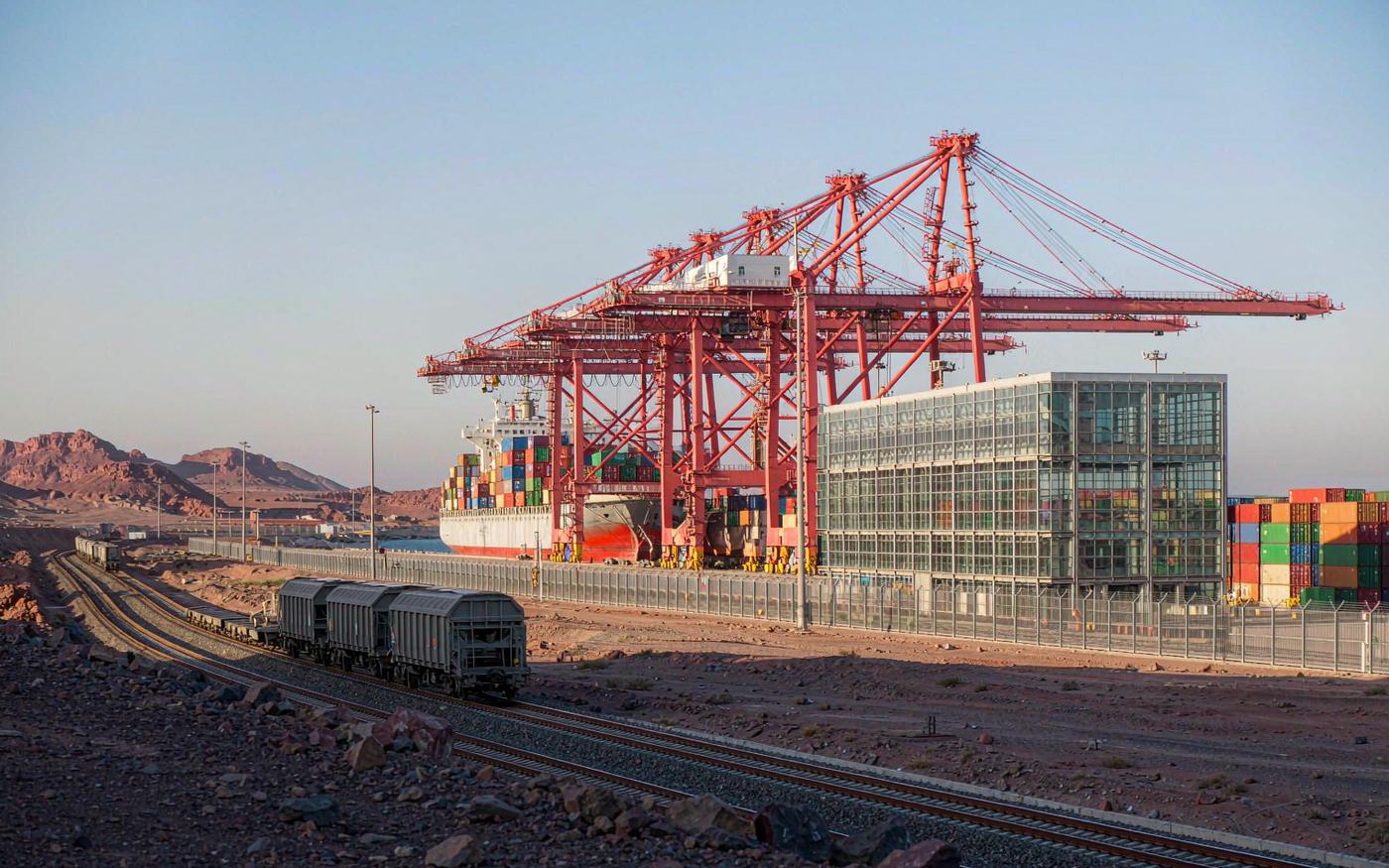
The Port of Djibouti complex includes Doraleh, a modern container terminal with deep berths and ship-to-shore gantries. It handles the bulk of containerised cargo, supported by a road corridor and, since 2018, by the standard-gauge railway running to the Ethiopian highlands.
The port authority puts the transit share at roughly 90 per cent, which tells you how the administration is organised. Transit cargo moves under a declaration and a guarantee rather than an ordinary import entry, and the corridors — road to the border, or rail to the dry ports inland — are set up for it.
If your goods really are going to Addis Ababa, say so. A transit declaration is cheaper and simpler than an import entry, and it is the normal way this corridor works.
The Addis Ababa to Djibouti railway and when it makes sense
The 752-kilometre Addis Ababa–Djibouti railway has been carrying commercial freight since 2018. For transit cargo it offers an alternative to the road corridor that is generally steadier in transit time and less exposed to road congestion, though it is less flexible for irregular or part-loads.
Road remains the default for most shippers because it can be arranged per container and delivers to a specific address. Rail tends to suit regular, predictable volumes moving to a dry port or an industrial zone.
Ask your forwarder which one they are pricing, and whether the quote covers the inland leg at all. A port-to-port quote for Djibouti is not a quote to Addis Ababa.
ECTN: applied for five days before the ship sails
Since 15 June 2023 every shipment discharged in Djibouti must carry an Electronic Cargo Tracking Note. It applies to all cargo, including goods destined for the free trade zone and goods in transit, and shipping lines are required to show the ECTN reference number on the bill of lading.
You apply at the port of loading before departure — the usual guidance is at least five days ahead, and processing can be same-day or take several working days. Supporting documents are a draft bill of lading, the commercial invoice and the freight invoice. Goods in transit to another country are exempt only when the transit destination is stated on the bill of lading.
Without a valid ECTN, clearance is refused, and the published penalties on this route run to figures around USD 2,500 per shipment, with the risk of the cargo being held or returned. Put the application on the pre-loading checklist alongside export clearance in China.
IM2, IM4 and the ordinary import declaration
Three declaration types cover most of what moves through Djibouti. An ordinary import declaration is for goods entering the domestic market, and it is the one that attracts duty, domestic consumption tax and sales tax.
The IM2 declaration is for transit goods bound for Ethiopia, Somalia or elsewhere. They move under a bond, remaining sealed and going directly to the border, and they are generally exempt from Djiboutian import duties provided that condition holds.
The IM4 declaration is for goods entering the Djibouti International Free Trade Zone. Goods can be held in the zone without paying duty; if they later leave the zone for the local market they go through an import declaration at that point, and if they leave for re-export they move under an export declaration backed by a deposit.
Domestic consumption tax, alongside a 10% sales tax
For goods cleared for domestic use there are three layers. Customs duty is assessed by HS code, with rates commonly quoted from about 2 per cent at the bottom to around 33 per cent at the top; manufactured goods and petroleum sit at the higher end of the applied range.
On top of duty sits the domestic consumption tax, the Taxe Intérieure de Consommation, which is banded by category: roughly 8 per cent on basic necessities, 20 per cent on intermediate products and 33 per cent on luxury goods. Businesses approved under the investment code, diplomatic entities and some government-agreement imports are exempt.
Then a sales tax of 10 per cent, functionally the equivalent of a VAT, applies on the CIF value plus duty, and a statistical tax of about 2 per cent is also quoted. The combined effect on a luxury-classified item is substantial, so classify before you quote.
Inspection only applies above a set invoice value
Djibouti operates a pre-shipment inspection regime for goods above a value threshold, commonly quoted at USD 2,500, with inspection carried out by a contracted inspection company. The output is a certificate of validation that forms part of the clearance file.
Like the ECTN, this has to be arranged before or during loading in China, not after arrival. If your shipment exceeds the threshold, tell your forwarder at booking so the inspection is booked in time and the certificate is issued with the rest of the documents.
Threshold and scope change, so confirm the current position rather than relying on a figure from a previous shipment.
The free trade zone, and what happens if goods leave it
The Djibouti International Free Trade Zone operates under separate rules from the domestic market. Goods enter under an IM4 declaration and can be stored, processed or re-exported without paying import duty. That is attractive for anyone using Djibouti as a regional distribution base.
The important point is what happens at the boundary. Goods leaving the zone for the Djiboutian market go through an import declaration and pay duty and taxes at that moment. Goods leaving for re-export are cleared under an export declaration supported by a deposit against potential duty and tax.
The zone prohibits certain categories outright, including flammable goods other than authorised fuels, radioactive materials, arms and ammunition, goods infringing intellectual property rights and illicit drugs. Businesses handling dangerous goods inside the zone need certified risk prevention measures in place.
Personal imports versus a Djiboutian company file
Commercial importing expects a registered Djiboutian entity and a licensed customs broker. The consignee named on the bill of lading needs to be the entity clearing the goods — a mismatch between the two is one of the most common causes of delay on this route.
An import licence from the relevant ministry is required for controlled categories: pharmaceuticals, food products, chemicals and telecommunications equipment among them. Pharmaceuticals need health ministry authorisation.
Documentation is prepared in French, with Arabic also in use. Certificates of origin are issued through the Chamber of Commerce of Djibouti and regional COMESA and IGAD arrangements may apply depending on the goods.
Three shipments: local sale, Ethiopia transit, free zone stock
Consumer goods for the Djiboutian market. Ordinary import declaration, ECTN obtained before sailing, duty by HS code plus domestic consumption tax and the 10 per cent sales tax. Cleared by a local broker and delivered within Djibouti. This is the simplest of the three.
Machinery bound for Addis Ababa. IM2 transit declaration, moving under bond by road or by rail along the 752 km corridor, with duty and tax assessed in Ethiopia rather than in Djibouti. The ECTN requirement still applies unless the transit destination is stated on the bill of lading.
Stock held in the free trade zone. IM4 declaration on entry, no duty while the goods stay in the zone, and a separate import declaration with duty and tax if any of it is later sold into the local market. Useful for regional distribution, but the zone boundary has to be accounted for properly.
Where clearance stalls, and the mismatches that cause it
- Consignee name mismatch. The entity named on the bill of lading is not the entity clearing the goods. The most frequent single cause of delay here.
- HS code misclassification. Djibouti inspects documents closely, and a code chosen to lower the duty is regularly caught.
- Invoice values that do not stand up. Under-declaring triggers inspection plus penalties quoted at 1 to 3 per cent of declared value.
- Missing or inconsistent certificate of origin. Mandatory as a customs document here even though no preferential tariff treatment attaches to Chinese origin.
- ECTN filed late or not at all. Applied for at the loading port, at least five days before departure.
Timescales and the checks worth doing before booking
Before you book: confirm whether the goods are domestic, transit or free zone; get the HS codes right; confirm whether the shipment crosses the pre-shipment inspection threshold; and line up the Djiboutian consignee and broker. Then book space and start the ECTN at least five days before departure.
Transit times from Chinese ports to Djibouti are among the shorter Africa routes, with modern terminals keeping discharge efficient. Clearance is a matter of days when the file is clean. The variables are the document checks, not the port.
Build the plan around those checks rather than around the sailing, and the route will behave predictably.
Why importers use Goodhope on this lane
Six things that are different about working with us on China to Djibouti shipments.
Djibouti as gateway and destination: planning for both
Tell us whether the goods are for Djibouti, for Ethiopia in transit, or for the free trade zone. We will confirm the declaration type, arrange the ECTN before sailing, and price the inland leg if you need one.
Get a quote Talk to usRelated pages
Frequently asked questions
Is an ECTN required for Djibouti?
Yes. Since 15 June 2023 every shipment discharged in Djibouti must carry an Electronic Cargo Tracking Note, including free zone and transit cargo. Shipping lines must show the ECTN number on the bill of lading. Apply at the port of loading at least five days before departure.
Are transit goods exempt from the ECTN?
Only when the transit destination is stated on the bill of lading. Otherwise the requirement applies to all cargo discharged in Djibouti, including cargo moving on to Ethiopia.
What are the declaration types?
An ordinary import declaration for goods entering the domestic market; IM2 for transit goods moving under bond to Ethiopia or elsewhere; and IM4 for goods entering the Djibouti International Free Trade Zone.
How much of Djibouti's cargo is transit?
The port authority puts it at roughly 90 per cent, almost all of it bound for landlocked Ethiopia. That is why the transit regime is well established and why the corridors west are road and rail rather than local delivery.
What are the duty and tax rates?
Customs duty is assessed by HS code, commonly quoted from about 2 to 33 per cent. The domestic consumption tax (TIC) is banded at roughly 8 per cent for basic necessities, 20 per cent for intermediate products and 33 per cent for luxury goods. A sales tax of 10 per cent applies on CIF plus duty, and a statistical tax of about 2 per cent is also quoted.
Is pre-shipment inspection required?
Yes above a value threshold commonly quoted at USD 2,500, with the inspection carried out by a contracted inspection company and a certificate of validation forming part of the clearance file. Confirm the current threshold before shipping.
How does the free trade zone work?
Goods enter under an IM4 declaration and no duty is payable while they remain in the zone. If they leave for the local market, a standard import declaration applies and duty and tax are payable at that point. Re-exports move under an export declaration backed by a deposit.
Can I ship to Addis Ababa through Djibouti?
Yes, and it is the normal route. The 752 km Addis Ababa–Djibouti railway has carried commercial freight since 2018 and the road corridor runs alongside it. Make sure your quote covers the inland leg rather than stopping at the port.
What documents do I need?
Commercial invoice with HS codes, packing list, bill of lading, certificate of origin issued through the Chamber of Commerce of Djibouti, a valid ECTN, the certificate of validation if inspection applies, and any import licence for controlled goods such as pharmaceuticals, food, chemicals and telecoms equipment.
What most often delays clearance?
A mismatch between the consignee named on the bill of lading and the entity clearing the goods, followed by HS code misclassification, invoice values that do not stand up to review, a missing certificate of origin, and an ECTN filed late.