
Home / Shipping to Dominican Republic / How to Ship from China to Dominican Republic
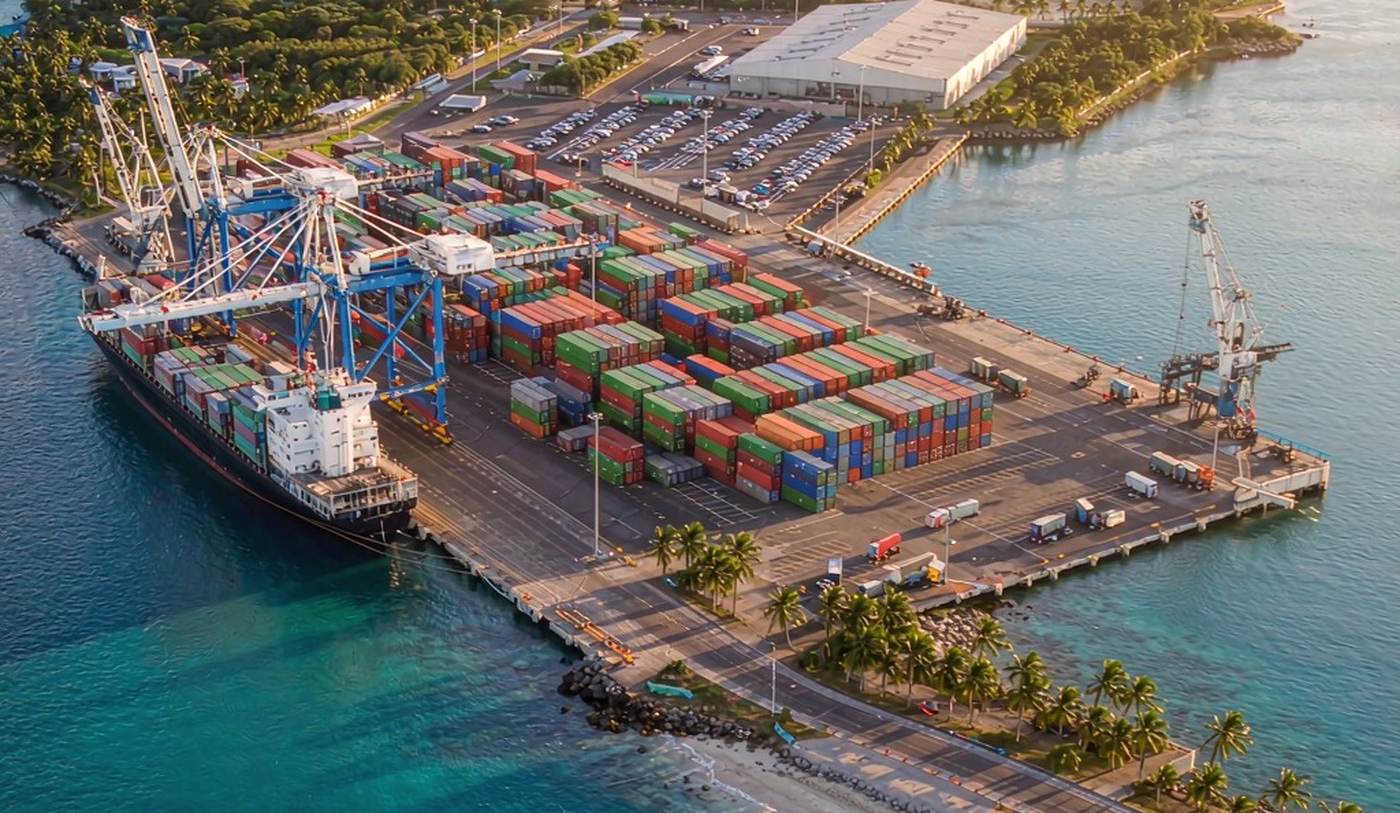
How to Ship from China to the Dominican Republic: Caucedo, ITBIS & the Transhipment Week
The Dominican Republic is the largest economy in the Caribbean, and nothing sails to it direct from China. That single fact shapes every other decision on this lane. Your container does not go from Shenzhen to Santo Domingo; it goes from Shenzhen to a regional hub — Colón or Balboa in Panama, Cartagena in Colombia, Kingston in Jamaica — and then onward on a feeder vessel. The feeder is typically weekly. Which means that when a container misses its connection, the penalty is not a day. It is a week.
The second thing that catches new importers is tax arithmetic. ITBIS is eighteen percent, and it is charged on the customs value plus the duty plus the selective consumption tax — a tax on a tax on a tax. On top of that, the base is CIF, so your freight and insurance are inside the number being taxed. A buyer who has done this before with a European or United States supplier and simply reuses the old duty rate will under-budget, because DR-CAFTA's preferential rates are United States origin rates and do nothing at all for goods made in China.
The third thing is a registration, not a shipment problem. Without an RNC number from the tax authority, there is no import in your name, and it is reported as the most common reason a first shipment from China into the Dominican Republic stalls. It has to be in hand before the goods leave China, not chased while they are on the water.
At a glance
Ports: Caucedo (deep-water container terminal, ~25 km east of Santo Domingo, the default) · Río Haina (older, near the capital, breakbulk / project / vehicles) · Puerto Plata (north coast, serves Santiago and the Cibao). · Routing: no direct service; transhipped via Panama, Cartagena or Kingston; the feeder is weekly. · Transit: FCL reported ~28–40 days port to port, LCL ~32–45 door to door; air into Las Américas (SDQ) 3–7 days. · Duty: by HS code, commonly 0–20%, up to 40% at the top of the schedule. · ITBIS: 18% on customs value + duty + ISC. · ISC: alcohol, tobacco, vehicles, fuels — charged before ITBIS, so it also enters the ITBIS base. · Registration: RNC with DGII before the goods ship. · Declaration: Declaración Única Aduanera in the DGA's SIGA system, filed by a licensed broker. · Clearance: commonly 2–5 days routine; weeks if valuation is challenged. · Low value: US$200 widely cited, but do not plan a commercial programme around it. · Supply: 120 V at 60 Hz. · Weather: hurricane season June to November, peak August to October.
How your cargo moves: China to the Dominican Republic
Eight steps from your supplier's door to yours. The last four are the ones shaped by local rules.
- Pickup from your supplierWe collect the goods anywhere in China and bring them to our consolidation point.
- Export clearanceChina customs declaration filed and released before the goods move to the port.
- Loading and departureContainer loaded, sealed and handed to the carrier at the Chinese port.
- Main carriageOcean, air or rail movement booked on the route agreed for your cargo.
- Arrival at the gatewayDischarge at the port or airport of entry, recorded on the carrier's manifest.
- Import clearanceCustoms declaration filed locally, with duty and tax assessed on the declared value.
- Customs releaseGoods released into free circulation once duty and tax are settled.
- Final deliveryOnward movement to your delivery address, warehouse or nominated depot.
Duty rates, VAT rates and clearance times move, and the figure that applies to your goods is the one set for your commodity code on the day of clearance. We check the current position against your code before your goods sail and confirm it to you in writing — ask for that check when you request a quote.
What this guide covers, and the schedule question underneath it
This is written for a buyer bringing goods out of China for the first time and landing them in the Dominican Republic. It follows the shipment in the order the problems arrive: which port, what route it actually takes, what the freight is billed on, what the tax office will charge, who is allowed to sign, how long it takes, and what the calendar does to all of it between June and November.
It does not quote freight rates. Those move with the market and any number printed here would be wrong within weeks. What it does instead is show where the money goes and which decisions change the total, so that a quotation can be read for what it leaves out as well as what it contains.
The Dominican Republic is worth the effort. It has around eleven million people, the largest economy in the Caribbean, a large and long-established free zone manufacturing sector, and a consumer market supplied overwhelmingly by imports. Chinese goods are everywhere in its retail mix. The lane is busy and well served by global carriers through the Panama and Colombia hubs. It is not a difficult country to import into — but it is a country where the schedule is set by a connection you do not control, and where the tax is higher than a first-timer usually expects.
The three seaports, and the coast your cargo should land on
The Dominican Republic has two coasts and three working commercial ports that matter to an importer. Choosing between them is mostly about where the goods are going after they land, because the island's interior is mountainous and the inland leg is not free.
| Terminal | Coast | Position | What it suits |
|---|---|---|---|
| Caucedo DP World Caucedo | South (Caribbean) | About 25 km east of Santo Domingo, next to Las Américas international airport. The country's main deep-water container terminal and a regional transhipment hub in its own right. | Almost all containerised imports into Santo Domingo. Best berth depth, best equipment, the widest choice of feeder services. The default, and for most buyers the right answer. |
| Río Haina | South (Caribbean) | On the western edge of the Santo Domingo urban area, closer to the capital than Caucedo but older and more constrained. | Breakbulk, project cargo, steel and bulk, and vehicles. Useful when the cargo does not fit a container or when a specific carrier calls there. Congestion is reported more often than at Caucedo. |
| Puerto Plata | North (Atlantic) | On the north coast, roughly 70 km from Santiago de los Caballeros. | Cargo destined for Santiago and the Cibao valley. Choosing it removes a long haul over the central mountains from Caucedo. Fewer services, so schedules are less flexible. |
The practical test is a simple one. If your warehouse is in Santo Domingo, or anywhere in the south and east including the hotel corridor around Punta Cana and La Romana, use Caucedo. If the goods are genuinely oversized or you are shipping vehicles, ask whether Río Haina is the better berth. If your customer is in Santiago, the country's second city, price a Puerto Plata routing alongside the Caucedo one and compare the inland trucking as well as the ocean leg — the saving is often in the road, not the water.
Ask for both routings. On this lane more than most, the cheapest ocean freight is not always the cheapest total. A Caucedo routing that saves money on the feeder and then adds a mountain crossing to Santiago can easily lose to a Puerto Plata routing with a slightly higher freight component. Make the forwarder quote both, with inland delivery included.
Why no vessel sails direct from China, and what that means for your calendar
There is no scheduled direct container service from China to the Dominican Republic for general cargo. The volumes are healthy but they do not justify a dedicated transpacific string, so carriers serve the island the way the Caribbean is served generally: a large mother vessel runs Asia to a hub, and a smaller feeder distributes from there.
The hubs used for Dominican cargo are Colón and Balboa in Panama, Cartagena in Colombia, and Kingston in Jamaica. Which one your carrier uses depends on the alliance and the service, and it is not a detail worth ignoring: the dwell time at the hub is the most variable number in the whole transit.
Here is the point that new importers underestimate. A direct service that misses a sailing waits for the next one, which might be three days later. A transhipped service that misses its feeder waits for the next feeder — and feeders in the Caribbean are commonly weekly. One missed connection is one week. Two is fifteen days of a customer relationship.
Origin consolidation
For a full container, this is the factory stuffing and the truck to the Chinese port. For a consolidated shipment, it is the warehouse receiving, measuring and loading — commonly three to seven days before the vessel sails, and the cut-off is a hard cut-off.
The main ocean leg
China to the hub. Commonly reported at twenty-five to thirty-two days from South China to Panama or Cartagena depending on the service and the port of loading.
Hub dwell — the elastic part
Discharge, yard handling, and waiting for the onward feeder. Reported at roughly three to ten days. This is where schedules are won and lost, and it is why two forwarders quoting the same main-line service can quote materially different total transit times.
The feeder leg
Hub to Caucedo or Puerto Plata, commonly two to five days. Weekly frequency is normal.
Deconsolidation, where it applies
For consolidated cargo, two to five days to strip the container and make the cargo available. This is also where damage caused by poor packing gets discovered.
Customs clearance
Routine commercial clearance is commonly reported at one to five days with complete documents. A valuation challenge, a missing permit or an inspection extends it — in the worst reported cases for postal and informal channels, by weeks.
Adding it up: full containers are commonly reported at twenty-eight to forty days port to port, and consolidated shipments at thirty-two to forty-five days door to door. Treat both as planning numbers with a week of slack on either side, and tell your own customer the upper end. Nobody has ever been thanked for quoting thirty days and arriving on day thirty-eight.
Charged by weight rather than by space: the W/M rule
Consolidated freight is quoted per cubic metre or per tonne, whichever is greater. This is the weight-or-measurement rule, and it is the reason a quote for LCL can come back higher than the buyer expected from a small-looking shipment.
The conversion used across the industry is that one cubic metre is treated as equivalent to one tonne. Anything denser than that — and a surprising amount of what China exports to the Caribbean is denser than that — is billed on weight, not on volume.
Billed on volume
Furniture, textiles, apparel on hangers, lighting, empty packaging, plastic goods, toys in boxes, footwear in cartons. Light for the space they occupy, so the cubic metre is the larger number and that is what you pay on.
Billed on weight
Ceramic tiles, hardware and fasteners, metal components, liquids in drums, batteries, paper, stone, and machine parts. Five cubic metres of tile can weigh ten tonnes, and you will be invoiced for ten.
The same trap catches full containers in a different way. A twenty-foot container holds roughly thirty-three cubic metres, but its payload is limited — commonly cited around twenty-eight tonnes, and in practice often lower once road weight limits at the destination are taken into account. Dense cargo frequently reaches the weight limit at around half the available volume. A buyer who orders a twenty-foot container of tiles because "the tiles only fill half of it" has not ordered a half-full container; they have ordered an overweight one, and the overweight part has to be solved before it can be loaded.
Practically: get the actual packed dimensions and the actual gross weight from the factory before you book, not the estimate in the proforma invoice. On this lane, where a booking error costs a week rather than a day, that one habit is worth more than any negotiation on the rate.
ITBIS, and the taxes that treat every origin the same way
Three separate charges stack on an import into the Dominican Republic, and they stack in a specific order. Getting the order right matters because each one becomes part of the base for the next.
| Charge | Rate | Charged on | Notes |
|---|---|---|---|
| Import duty arancel | By HS code. Commonly 0–20% for most goods, with the schedule reaching 40% at the top. | The customs value, which is CIF — goods, insurance and freight. | Industrial machinery is often at 0–3%. Apparel and footwear are commonly reported around 20%. Electronics vary widely within 0–20%. |
| ISC Impuesto Selectivo al Consumo | By product, ad valorem or specific. | Alcohol, tobacco, vehicles, fuels and a short list of other goods. | It is assessed before ITBIS, and it goes into the ITBIS base. This is the detail that catches people. |
| ITBIS Impuesto a la Transferencia de Bienes Industrializados y Servicios | 18% standard. A reduced 16% rate is reported for some goods, and items in the basic food basket are reported exempt. | Customs value + import duty + ISC. | It applies to imports regardless of origin. There is no origin-based relief on this line for Chinese goods. |
Read that middle column again. The tax base is CIF, so your freight is taxed. On a consolidated shipment where the freight is a large share of the goods value — which is exactly the case for small first orders — the tax is being charged on the transport as well as the product. It is one more reason the cheapest-looking small shipment is rarely the cheapest landed cost, and one more reason to consolidate properly rather than shipping three small lots separately.
Do not under-declare. Customs in the Dominican Republic is reported to compare declared values against market price, and a valuation challenge does not just produce a reassessment — it produces a hold. The goods sit in the terminal while it is argued about, and storage charges accrue at a port where yard space is not cheap. Declare what you paid.
Registering as an importer before you place the first order
Before anything else happens, the importer needs an RNC — Registro Nacional del Contribuyente, the taxpayer registration issued by the tax authority, DGII. Companies register with their incorporation documents; individuals can also register for import activity.
Without it, there is no customs declaration in your name, and this is reported as the most common single reason a first shipment from China to the Dominican Republic fails to clear on time. It is not a document that can be produced quickly at the port. Obtain it before the goods ship.
Alongside it, decide the structure you are importing under. A company importing for resale, an individual bringing in goods for personal use, and a free zone operator importing raw materials are three different situations with three different sets of consequences. If you are importing stock you intend to sell, register as a business and keep the paperwork consistent across every shipment — the tax authority will look at the pattern over time, not at one consignment in isolation.
The single customs declaration, and the system it is filed in
Customs is run by the Dirección General de Aduanas (DGA), and the declaration is the Declaración Única Aduanera (DUA), filed electronically in the DGA's SIGA system. The declaration is filed by a licensed customs broker, not by the importer directly.
What the broker needs from you is unglamorous and completely standard:
- Commercial invoice — in the name of the registered importer, with a real description of the goods, quantities, unit prices and the total, and with the terms of sale stated (FOB, CIF or EXW).
- Packing list — matching the invoice line for line, with weights and dimensions.
- Bill of lading — original or telex release, with the consignee and notify party matching the registered importer.
- Certificate of origin where it is required, and a copy of the RNC.
- Permits and registrations for any regulated product line, obtained before arrival rather than on arrival.
Note the emphasis on before arrival. The documents are the clearance. When the invoice description does not match the packing list, or the bill of lading consignee does not match the RNC holder, the file stops moving — and it stops moving at a port where the next feeder is a week away.
Routine commercial clearance is commonly reported at two to five days with a complete file. Courier and express consignments often clear faster, sometimes within one to two days. The slow cases are the ones where value is challenged, a permit is missing, or the goods are selected for physical inspection.
Duties by product line, and where the 0% band actually sits
Duty is set by HS code, and the spread across the schedule is wide: the top of the schedule is reported at around forty percent, while industrial machinery and many capital goods sit at or near zero. What matters for a first-time importer is the band their own products fall into, because that number belongs in the pricing spreadsheet before the order is placed, not after.
| Product group | Commonly reported duty band | Comment for a first importer |
|---|---|---|
| Industrial and agricultural machinery | 0–3% | The lowest band on the schedule. Capital equipment is generally treated favourably. |
| Electronics and electrical goods | 0–20% | Wide spread. Confirm the exact code; the difference between two neighbouring headings can be large. Check the 120 V / 60 Hz supply as well. |
| Apparel and footwear | Around 20% | One of the higher bands. Significant for anyone importing for a retail clothing business. |
| Food and drink | 5–25% | Health registration applies as well, and it takes time. Alcohol and tobacco also carry ISC. |
| Cosmetics and sanitary products | High single digits to mid teens | Registration or permit from the health authority before the goods ship. |
| Toys | High single digits to mid teens | Seasonal. Do not let a December deadline meet a June booking. |
| Vehicles | High, plus ISC | Used vehicles are restricted, commonly reported at five years of age or older. A specialist job — do not treat it as general cargo. |
These bands are indicative and drawn from published summaries of the Dominican tariff. Duty rates are amended, and the rate that applies is the one attached to your HS code on the date of import.
DR-CAFTA, and the preference that does not reach Chinese goods
This is worth its own section because it costs buyers real money.
The Dominican Republic is a party to DR-CAFTA, the free trade agreement with the United States and Central America. Under it, a large share of United States origin goods enter at zero duty. Those zero rates are quoted constantly in trade material about the country, and they are quoted without the word "United States" attached often enough that buyers absorb them as the general rate.
They are not. The preference runs to United States and qualifying Central American origin. Chinese origin is assessed at the standard MFN rate. A certificate of origin issued in China documents where the goods were made; it does not reduce the duty.
Who this hits hardest. A buyer who previously sourced from the United States — or from a Miami distributor — and has moved to direct purchasing from China. The unit price improves, the freight is longer but manageable, and then the duty line is nothing like the one in the old spreadsheet. Budget the duty at the MFN rate from the start, and the switch still usually makes sense. Discover it at the port, and it does not.
The same caution applies in reverse. Do not assume that because a competitor is selling cheaply into the Dominican market, they are paying the same duty you will be. If they are operating inside a free zone, or importing under a regime you have not looked at, their landed cost is not your landed cost.
Why the zone regime matters even to buyers who never join one
The Dominican free zone regime, run under Ley 8-90 and administered by the national free zones council, is one of the largest and longest-established in the Caribbean: dozens of parks, and a manufacturing and export-services sector built on it.
The incentives reported for qualifying operators include exemption from import duty on raw materials, equipment and inputs, exemption from ITBIS on those imports, and a long-term exemption from income tax, with a limited share of output permitted for sale into the domestic market subject to the normal taxes. That last part matters: it means a free zone operator can compete with you in your own market while not having paid the duty you paid on the same goods.
Most readers of this guide will never join a free zone, and that is fine. Two things about the regime are still useful to them:
- Bonded storage defers tax. Holding stock in a bonded facility rather than clearing it all at once means the duty and ITBIS are paid when the goods are withdrawn for sale, not when the ship arrives. For a business working out what actually sells, that is worth real money — it converts an upfront tax bill into a cash-flow line.
- It explains the competition. Understanding that a domestic competitor may be operating with duty and ITBIS deferred or exempt changes how you read their pricing. It is not a reason to match it; it is a reason not to be surprised by it.
Hurricane season, and the months when the schedule slips
The Atlantic hurricane season runs from 1 June to 30 November, with the peak commonly from August through October. For an importer that means three things beyond the obvious one.
First, ports close. A named storm approaching the island suspends terminal operations, and a suspension is not a delay of hours: it pushes cargo onto the next feeder, which is a week away. Build the season into delivery promises rather than discovering it in September.
Second, connections are missed upstream. A storm anywhere along the route — in the Caribbean approaches, at the Panama or Colombia hub, or in the South China Sea during typhoon season — produces the same result. Your container did not get damaged; it simply missed the boat.
Third, the domestic peak runs the other way. December to April is the high tourist season, and import volumes rise into it: hotel fit-outs, restaurant and retail restocking, construction. Port and inland capacity tighten in the quarter before Christmas, at the same time as Chinese New Year shuts factories. The worst booking window on this lane is roughly November to February: holiday demand at one end, factory closure at the other.
Practical calendar: for stock needed in country by December, book to arrive by early November. For anything crossing Chinese New Year, either ship before the shutdown or accept that nothing moves for two to three weeks. And treat any promise of a fixed arrival date inside hurricane season as an estimate, not a commitment.
The paperwork set: invoices, packing lists and the bills of lading
Most clearance failures are document failures, and most document failures are boring. The invoice says "machine parts"; the packing list says "hardware"; the bill of lading shows a different piece count from both. Nobody is alleging fraud — the file simply stops while someone reconciles it, and storage accrues.
A clean file has these properties:
- One description of the goods, used consistently across invoice, packing list, bill of lading and any permit application. Not "accessories" in one place and "phone cases" in another.
- Quantities and weights that reconcile — the number of cartons on the packing list equals the number on the bill of lading, and the gross weight matches within tolerance.
- Terms of sale stated on the invoice, so the customs value can be established without correspondence. If it says CIF, the freight figure is on the invoice and part of the base.
- The consignee matching the RNC holder. This is the one that catches buyers who use a trading company or an agent's details on the bill of lading.
- HS codes stated on the invoice where the supplier can provide them. Not mandatory everywhere, and the broker will confirm the classification anyway — but a mismatch between a supplier's code and the broker's code is a conversation you would rather have before arrival.
Keep a copy of every set. The tax authority looks at patterns across shipments, and a business that can produce the same standard file for every import is a business that clears faster on average.
Permits for food, electrical goods and used vehicles
Three categories carry extra steps, and all three need to be started before the goods ship.
Food, drink and sanitary products
Health registration or a permit from the health authority applies to food, drink, pharmaceutical and sanitary products. The registration is applied for by the importer in the Dominican Republic, and it is reported to take weeks rather than days. This is the single most common reason a first food shipment from China sits at Caucedo — the container is fine, the paperwork is fine, and the product registration does not exist yet. Register first, ship second.
Electrical goods
Electrical products are checked against national quality standards, and the mains supply is 120 volts at 60 hertz with United States pattern plugs. Equipment built for a 230 volt market will not run without a transformer. For anything sold to consumers, confirm the standards position for that product category before the order, not after the container lands.
Vehicles, and other restricted categories
Used vehicles are restricted by age, commonly reported at five years or older. Importing one commercially is a specialist job with its own tax treatment, and it should not be treated as general cargo. Import licences and permits are also reported for firearms, pharmaceuticals, chemicals and some agricultural products, with environmental permits for chemicals.
Air freight into Las Américas, and when paying more makes sense
Air cargo into the Dominican Republic principally arrives at Las Américas International Airport (SDQ), serving Santo Domingo. Punta Cana (PUJ) and Cibao (STI) near Santiago also handle cargo, but SDQ is where the scheduled freighter and widebody belly capacity concentrates.
Air is commonly reported at three to seven days including handling, with express courier often faster door to door. Courier clearance is frequently one to two days. That is a genuine saving of about a month against sea freight, and on some cargo it is worth far more than the difference in cost.
The decision is arithmetic. Air freight is charged on chargeable weight — the greater of actual and volumetric, with the standard divisor — so light bulky goods are expensive to fly and dense goods are less so. Rough working guidance:
- Fly it when the value per kilogram is high, when a stock-out costs more than the freight, when the goods are seasonal and the window is closing, or when it is a sample or a first order you need to validate before committing to a container.
- Ship it when the value per kilogram is low, when the volume justifies a container, or when the goods are heavy and dense — because density is exactly what makes air expensive and sea cheap.
- Courier it when it is genuinely small. A few cartons under the low-value threshold clear faster than any other channel. Do not use the postal service for anything you care about; postal delivery through the national service is reported to take weeks and to be unreliable.
For many first-time importers the sensible shape is: fly or courier the first order, learn what actually sells, then consolidate the second order into a container. That costs more per unit on the first lot and far less over the year.
Following a shipment from Nansha to a warehouse in Santo Domingo
Concretely, here is what a consolidated shipment out of South China looks like end to end, with the numbers that are reported for this lane.
Day 0 — booking and cut-off
You book with the factory's packed dimensions and gross weight. The forwarder gives a cargo cut-off at the consolidation warehouse, typically three to seven days before the vessel sails. Miss it and the booking moves to the next sailing, which on this lane can move everything by a week.
Days 1–7 — consolidation and export
The warehouse receives, measures and loads. Your measurement here is the one that gets billed. Export customs clearance in China runs in parallel, and the container is loaded.
Days 8–38 — the main leg
Nansha or Yantian to the hub. Commonly reported at twenty-five to thirty-two days to Panama or Cartagena. This is the part of the schedule that is most predictable.
Days 38–48 — hub dwell and feeder
Discharge and wait for the feeder: reported at three to ten days. Then the feeder leg to Caucedo: two to five days. This is the part that is least predictable, and where a weekly frequency turns a slip into a week.
Days 48–53 — deconsolidation and clearance
The container is stripped, the cargo is made available, and the DUA is filed in SIGA by your broker against your RNC. Routine clearance two to five days with a complete file.
Day 53–55 — the inland leg
Caucedo to a warehouse in Santo Domingo is a short run of tens of kilometres, provided the truck is booked and the terminal gate slot is held. Book the truck when you book the shipment, not when you get the arrival notice.
Total: roughly seven to eight weeks door to door, with a week of slack either side. If your own customer expects five, either change the expectation or ship by air.
Commercial stock, and the parcels that clear under the US$200 line
A figure of US$200 is widely cited as the low-value threshold for imports into the Dominican Republic, and low-value personal parcels are commonly reported to clear without duty.
Do not build a commercial plan on it. Commercial consignments are generally assessed regardless of value, the treatment of personal parcels and commercial imports is not the same, and the threshold is applied by customs officers who compare declared value against market price. Splitting one order into five parcels to stay under a line is the kind of thing that works twice and then defines your importer record.
What the threshold is genuinely useful for is samples and one-off small items: a replacement part, a prototype, a set of samples from a new supplier. Those arrive by courier, clear in a day or two, and cost less in admin than they would as a formal import. For anything you are buying repeatedly and selling on, import it properly and build the real tax into the price.
The inland leg from the port to Santiago and the Cibao valley
The Dominican Republic is not flat. The Cordillera Central runs east to west through the middle of the island, and the road from Santo Domingo to Santiago crosses it. That crossing is the reason the port choice matters so much if your customer is in the north.
Practical points for the inland leg:
- Book the truck with the shipment. Trucking capacity around Caucedo tightens at the same times the port does, and a container that has cleared but has no truck is still paying storage.
- Check the delivery address properly. Street addressing in Dominican cities is inconsistent, and a driver waiting for a confirmed address is costing someone money. Give a landmark, a contact name and a phone number that answers.
- Know the weight limits. Road weight limits apply, and they can be lower than the container's own payload limit. A twenty-foot container loaded to twenty-eight tonnes may simply not be legally deliverable — which is a loading decision, not a driving one.
- Consider Puerto Plata for the north. If the goods are going to Santiago or anywhere in the Cibao, a north-coast discharge removes the mountain crossing entirely. Compare it on a landed basis.
- Allow for the wet season. Heavy rain between May and November affects inland transit in the mountainous interior, and landslides are not unknown on the mountain roads.
Insurance, packing and the claims that get rejected
Cargo insurance on this lane is not expensive relative to the value at risk, and the reason to buy it is specific: a transhipped container is handled more times than a direct one. Every lift is an opportunity for damage, and the hub yard is where a lot of it happens.
The claims that get rejected are predictable, and all of them are prevented at the factory rather than at the port:
- Moisture damage with no desiccant and no barrier. A container crossing the tropics generates condensation — "container rain" — and cartons stacked against the container walls wick it up. Use a liner or a barrier, use desiccant, and do not load wet cartons.
- Poor lashing and poor dunnage. Heavy goods on a wooden pallet that is not blocked and braced will move in the yard and on the feeder. Movement is damage, and damage from inadequate packing is the classic exclusion.
- Cartons too weak for the stack. Consolidated cargo gets stacked. A carton rated for a single tier will fail under three.
- Undeclared or misdeclared dangerous goods. Batteries, aerosols, some chemicals and some adhesives are regulated. Declaring them costs a surcharge; not declaring them costs far more, and it puts the whole container at risk.
- Photographs taken at the wrong time. Photograph the goods at stuffing and at stripping. Without both, a claim becomes an argument about when the damage happened.
Specify the packing in the purchase order, not in a message. "Export cartons, double-wall, palletised, shrink-wrapped, with desiccant" is a specification a factory can be held to. "Please pack well" is not.
Working with a customs broker, and what the fee covers
You need one. The DUA is filed in SIGA by a licensed broker, and the broker is the party that deals with the DGA on classification, valuation and inspection.
What a good broker does that is worth paying for: confirms the HS codes before the goods ship rather than after, tells you which permits apply to your product lines, files the declaration against a complete file, and answers the valuation question when customs asks it. What a broker cannot do is obtain an RNC for you retroactively or conjure a health registration that was never applied for.
Choose one before the first shipment, give them the product list while it is still a plan, and hold the same broker across shipments. On a lane where the schedule is set by a weekly feeder, the broker who already knows your file is the difference between a two-day clearance and a two-week one.
Why importers use Goodhope on this lane
Six things that are different about working with us on China to the Dominican Republic shipments.
Real moves for first-time the Dominican Republic buyers
Five shipments bought in China and delivered into the Dominican Republic, told end to end — where the order came from, how it moved, where it nearly went wrong, and how it finished. Client names are withheld at their request; the situations and the handling are what we deal with on this lane.
No direct vessel · first shipment · Nansha to Santo Domingo
The purchase. A buyer new to importing asked for the fastest direct sailing from China and was given a transit figure that assumed one.
The move. Full container relayed through Panama onto the weekly feeder into Caucedo, with the relay shown as its own leg.
Where it nearly went wrong. There is no direct service on this lane, and pretending otherwise produces a transit estimate that is wrong by the whole relay. The feeder runs weekly, which is the rhythm your stock planning has to follow.
How it finished. We quoted both legs separately. He now plans against the feeder schedule rather than against a direct figure that does not exist.
DR-CAFTA · preference that does not apply · Shenzhen to the Dominican Republic
The purchase. A first-time buyer had read that the country's trade agreement zeroed duty and asked us to claim it.
The move. Full container declared at the standard rate, with the preference position confirmed before he quoted his customer.
Where it nearly went wrong. The trade agreement here does not extend to goods of Chinese origin. Claiming it does not just fail; it prices your order at zero duty and invoices it at up to twenty per cent, which is the difference between winning and losing the customer.
How it finished. We set the duty position before he quoted. He priced it correctly and kept the account.
Weight versus space · the W/M rule · Yiwu to Caucedo
The purchase. A buyer shipping dense goods was quoted on volume because that was all he gave us.
The move. Consolidated sea freight rated on whichever produces the greater figure, weight or measurement.
Where it nearly went wrong. Freight on this lane is charged by weight rather than by space. A dense consignment that looks cheap on cube is billed on kilos, and the quote you get from a volume-only enquiry is not the invoice you receive.
How it finished. We asked for both dimensions and weight up front. His freight lines have matched his quotes since.
The tax cascade · alcohol and vehicles · Shanghai to Santo Domingo
The purchase. A buyer importing a consignment carrying selective tax budgeted the eighteen per cent on the cargo value alone.
The move. Full container with the selective tax worked into the base before the eighteen per cent was calculated.
Where it nearly went wrong. The selective tax on categories such as alcohol, tobacco, vehicles and fuels is charged before the eighteen per cent, which means it enters the base that the eighteen per cent then applies to. It is a tax on a tax, and it is the line first-time importers leave out.
How it finished. We modelled both together. His landed cost came within a few pesos of the assessment.
The registration · before anything ships · Guangzhou to Puerto Plata
The purchase. A buyer placed his first order and only asked about registration once the goods were on the water.
The move. Full container into Puerto Plata, with the RNC completed during production rather than during transit.
Where it nearly went wrong. Registration with the tax authority has to exist before the goods ship, because the declaration is filed against it. A shipment whose importer is not yet registered sits at the terminal instead of clearing.
How it finished. We made registration step one of his first order. Every shipment since has cleared on arrival.
Why importers use Goodhope on this lane
Six things that are different about working with us on China to the Dominican Republic shipments.
Tell us what you are shipping, and we will price both coasts
Send us the commodity, the packed dimensions and gross weight, the HS codes if you have them, the pickup city in China and the delivery city in the Dominican Republic. We will come back with a Caucedo routing and a Puerto Plata one, an LCL and an FCL option where both apply, the hub and feeder we would use, and the transit time we would actually commit to — including the week it takes when a connection is missed.
Get a quote Talk to usRelated pages
Frequently asked questions
Is there a direct service from China to the Dominican Republic?
Not a scheduled one for general cargo. Everything tranships: Panama, Cartagena or Kingston. The feeder is typically weekly, so a missed connection costs about a week. That is the most important thing to know before promising a delivery date.
How long does shipping from China to the Dominican Republic take?
Full containers are commonly reported at 28–40 days port to port, LCL at 32–45 door to door. The variable part is the hub wait, reported at 3–10 days. Air into Las Américas runs 3–7 days; courier clearance is often 1–2.
Caucedo, Río Haina or Puerto Plata?
Caucedo is the deep-water container terminal 25 km east of Santo Domingo and the default. Río Haina suits breakbulk, project cargo and vehicles. Puerto Plata serves Santiago and the Cibao and saves the mountain crossing. Ask for both a Caucedo and a Puerto Plata routing.
What taxes will I pay?
Duty by HS code, commonly 0–20% and up to 40% at the top of the schedule. ISC on alcohol, tobacco, vehicles and fuels, assessed before ITBIS. Then ITBIS at 18%, charged on customs value plus duty plus ISC — and the customs value is CIF, so freight is taxed too.
Does DR-CAFTA reduce my duty on Chinese goods?
No. DR-CAFTA preferences are United States and Central American origin rates. Chinese origin is assessed at the standard MFN rate. Buyers switching from a United States supplier to China most often get this wrong.
What is an RNC, and do I need one?
The Registro Nacional del Contribuyente from DGII. Without it there is no import in your name, and it is the most commonly reported reason a first shipment stalls. Get it before the goods leave China.
Is the US$200 threshold real?
It is widely cited, and low-value personal parcels are commonly reported to clear without duty. Do not plan a commercial programme around it — commercial consignments are generally assessed, and customs compares declared value against market price.
Do I need a customs broker?
Yes. The DUA is filed in the DGA's SIGA system by a licensed broker. Give them the invoice, packing list, bill of lading and RNC before the vessel arrives, not after. Routine clearance is commonly 2–5 days.
What about free zones?
Ley 8-90 runs one of the Caribbean's largest free zone regimes, with duty and ITBIS exemption on inputs and long-term income tax relief for qualifying operators. Even if you never join one, bonded storage can defer tax you would otherwise pay on entry.
What extra permits apply?
Food, drink and sanitary products need health registration, which takes weeks — apply before you ship. Electrical goods face national quality standards and a 120 V / 60 Hz supply. Used vehicles are commonly restricted at five years of age or older.