
Home / Shipping to Estonia / How to Ship from China to Estonia
How to Ship from China to Estonia
Estonia is a market of roughly 1.4 million people, and almost everything it buys from Asia arrives through a single deep-water cargo port. Getting to grips with that port, the customs system behind it and the two taxes you pay at the border covers most of what a first shipment needs.
Because Estonia is an EU member state, the framework is the EU framework: an EORI number, an entry summary declaration before the vessel arrives, a declaration for release into free circulation, and the EU common customs tariff. What is local is the port itself, the customs IT system, the language that must appear on your labels, and the way boxes move inland from the quay.
The notes below follow one container from a Chinese factory to a warehouse in Estonia. Nothing here is a rate quote — freight pricing moves weekly. What is described is the procedure, because the procedure is what causes delays when it is wrong.
At a glance
Main seaport: Muuga, the cargo harbour of Port of Tallinn, about 17 km north-east of the city centre. Main airport: Tallinn (TLL). Customs authority: the Estonian Tax and Customs Board. Standard VAT: 22 per cent. Duty: the EU common customs tariff, set by HS code. EORI number required before the first declaration. Product information in Estonian.
How your cargo moves: China to Estonia
Eight steps from your supplier's door to yours. The last four are the ones shaped by local rules.
- Pickup from your supplierWe collect the goods anywhere in China and bring them to our consolidation point.
- Export clearanceChina customs declaration filed and released before the goods move to the port.
- Loading and departureContainer loaded, sealed and handed to the carrier at the Chinese port.
- Main carriageOcean, air or rail movement booked on the route agreed for your cargo.
- Arrival at the gatewayDischarge at the port or airport of entry, recorded on the carrier's manifest.
- Import clearanceCustoms declaration filed locally, with duty and tax assessed on the declared value.
- Customs releaseGoods released into free circulation once duty and tax are settled.
- Final deliveryOnward movement to your delivery address, warehouse or nominated depot.
Duty rates, VAT rates and clearance times move, and the figure that applies to your goods is the one set for your commodity code on the day of clearance. We check the current position against your code before your goods sail and confirm it to you in writing — ask for that check when you request a quote.
Where Estonian imports actually land
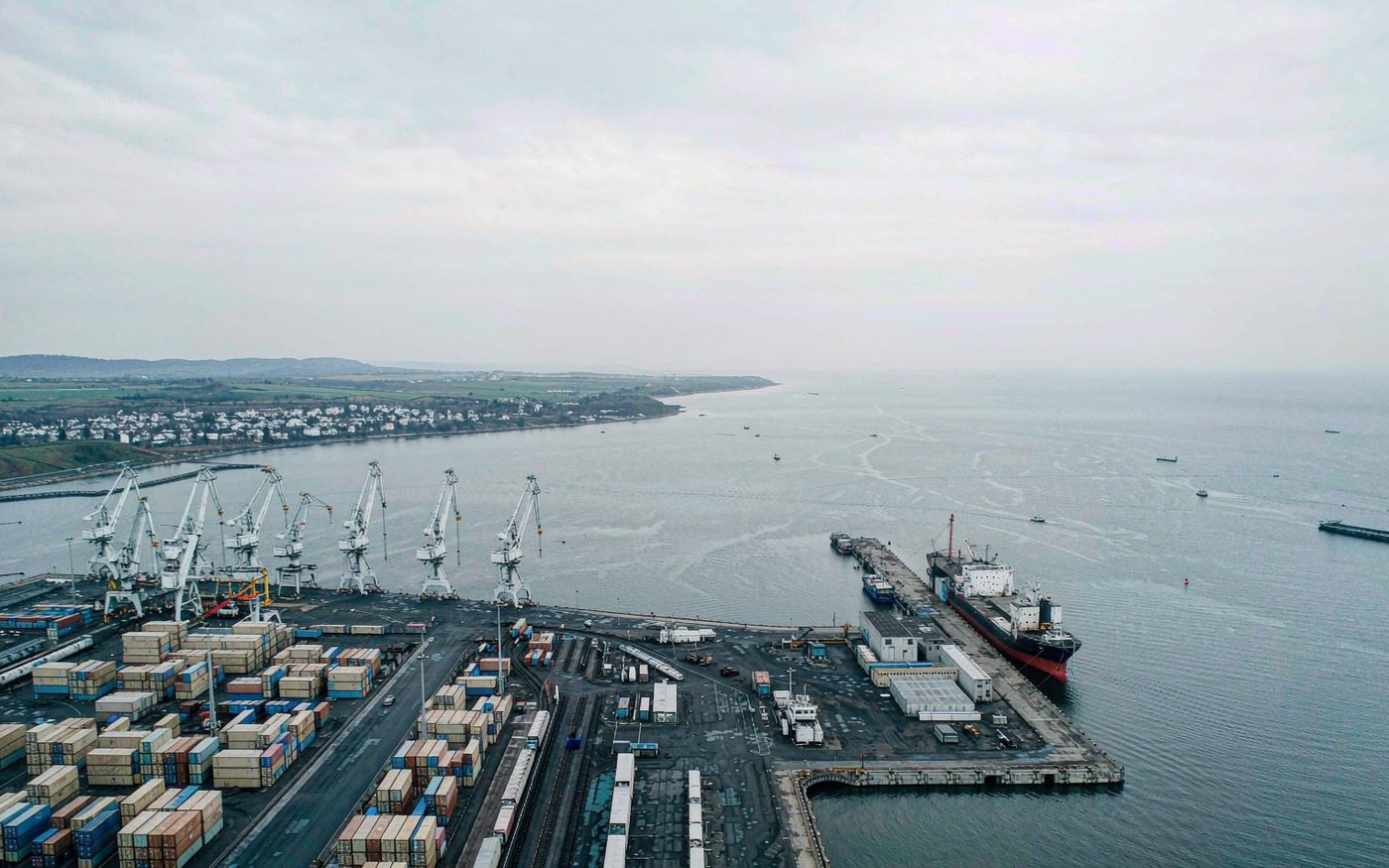
Muuga is the deep-water cargo harbour of Port of Tallinn and handles the great majority of Estonia's container and roll-on volume. The Old City Harbour in central Tallinn is geared to passengers and cruise calls, not to boxes. If your freight forwarder names "Tallinn" as the discharge port, the container will almost always be worked at Muuga, and the haul from there into the city is about 17 km.
Very little from China arrives direct. The common pattern is a mainline vessel into a North European hub — Rotterdam, Hamburg, Bremerhaven or Gdansk — then a feeder service up the Baltic to Muuga. Some lines route through Helsinki and truck or feed across the Gulf of Finland. Build the feeder leg into your planning: it adds days, and in winter it can add more.
Air cargo into Tallinn (TLL) is thin. Small consignments usually fly into Helsinki, Riga, Stockholm or a German hub and continue by truck, which is often faster door to door than waiting for a direct air uplift. For urgent samples and spare parts this is the normal route; for anything above a few hundred kilos, sea freight plus a feeder is usually cheaper by a wide margin.
How the declaration is filed in Estonia
Before anything is filed you need an EORI number. It is issued once and used across the EU, and without it a customs declaration cannot be accepted. Applications go to the Estonian Tax and Customs Board, and the practical advice is to apply while the goods are still being manufactured rather than when the ship is three days out.
Then comes the entry summary declaration, or ENS. This is a security filing made before the goods physically arrive in the customs territory of the Union, and for sea cargo it is generally expected before loading or at latest a short window before arrival at the first EU port. Your carrier or forwarder normally files it, but the data it contains — shipper, consignee, HS codes, container numbers — has to come from you, and a late or wrong ENS is one of the fastest ways to hold a box at the terminal.
The import declaration itself is lodged electronically into the Estonian customs information system. Release for free circulation is the standard procedure; simplified and local clearance arrangements exist for repeat importers with a clean record, but a first-time importer should expect to file a full declaration. The declarant must be established in the EU, which is the single most important structural point for a buyer sitting outside Europe: you cannot simply name yourself as importer of record from abroad. Either you use an EU entity you control, or the broker acts as your indirect representative, and the liability that follows differs between the two.
Transit, bonded storage and what each one does
Two documents do most of the work here. A T1 transit document covers non-Union goods moving under customs control from one point in the EU to another. So if your box is discharged at Rotterdam and driven to Estonia, it travels under a T1 and is declared for import in Estonia, not in the Netherlands. That is usually what you want: it lets you clear where your business and your VAT registration are, rather than where the vessel happened to call.
Customs warehousing is the second tool. Goods placed in a customs warehouse have not entered free circulation, so import duty and VAT are not due while they sit there. This is genuinely useful when you are importing a seasonal line, splitting a container across several buyers, or waiting on a permit. How long goods may remain is governed by the warehouse authorisation rather than by a single EU-wide number, so confirm the limit with the operator before you build a plan around it.
Estonia also operates bonded and logistics parks around Muuga, and inward processing is available if goods are going to be worked and re-exported. For a straightforward first import none of this is needed, but it is worth knowing the options exist before you commit to paying duty on stock you may not sell for months.
Estonian duty rates and how they are set
Duty is set by the EU common customs tariff, applied through a ten-digit TARIC code: the eight-digit CN code plus two further digits covering EU measures. Getting that code right is the single highest-value piece of preparation you can do, because the same physical product can sit at zero per cent or at double digits depending on how it is classified.
There is no free trade agreement between China and the EU, so the rates you get are the standard MFN rates rather than a preferential band. Many manufactured goods land somewhere between zero and six per cent; apparel and footwear sit noticeably higher; and a number of Chinese industrial lines — certain steel products, aluminium, ceramics, glass fibre, bicycles and e-bikes — carry anti-dumping or countervailing duty on top. Before you quote a landed cost to your own customer, have the ten-digit code checked against the current measures rather than against last year's invoice.
The value duty is charged on is the customs value, which in practice is the transaction value plus the cost of getting the goods to the EU frontier — freight and insurance included. That is why a CIF China–Estonia figure, not the ex-works price, is what duty is assessed against.
Small consignments valued at EUR 150 or less are currently relieved of customs duty, although VAT still applies from the first euro. The EU has agreed to remove that EUR 150 relief, so confirm the current position instead of assuming it.
VAT on imports into Estonia
Estonia's standard VAT rate is 22 per cent on most goods, with reduced rates for a short list of categories. The rate has moved more than once in recent years and a further increase was announced and then withdrawn, so treat the current figure as something to verify at the time you price your goods rather than as a permanent constant.
Import VAT is calculated on the customs value plus duty plus the cost of transport to the first destination inside the EU. It is charged at import, which means it leaves your account at the border rather than at the point of sale. If your Estonian company is VAT registered, that amount is deductible as input tax, so it is a cash-flow item rather than a true cost — but only if you are in the VAT system. Buyers who import through a third party's registration often discover too late that they cannot recover it.
The old relief for very small consignments was abolished EU-wide in 2021, so VAT applies from zero value on ordinary commercial imports. For business-to-consumer e-commerce below EUR 150 there is a separate simplified scheme, which matters only if you are selling direct to Estonian consumers rather than importing into your own stock.
Compliance traps waiting for a first Estonian order
The first trap is conformity. Where an EU directive or regulation applies — electrical equipment, machinery, toys, PPE, medical devices, radio equipment, construction products — the goods need CE marking backed by an EU declaration of conformity and a technical file. A test report from a Chinese laboratory is not by itself sufficient; the manufacturer has to have actually done the conformity assessment, and where the manufacturer sits outside the EU, an authorised representative inside the Union is required for most product categories.
The second is the general product safety regime. Since the end of 2024, consumer products placed on the EU market need a responsible person established in the Union, and instructions and safety information have to reach the consumer in a language they understand. For Estonia that means Estonian, and this is the requirement that catches people who have successfully shipped the same product to larger markets.
The third is producer responsibility. Packaging, electrical and electronic equipment, and batteries each carry extended producer responsibility obligations, and in Estonia those obligations attach to whoever first places the goods on the market — usually the importer. Registration and reporting come with real deadlines and real fees, and they are not something a freight forwarder can discharge on your behalf.
Food, feed, plants and animal-origin products sit behind a separate wall: prior notification, health certificates and controls by the Veterinary and Food Board. And because Estonia is an EU external border adjoining Russia, screening of dual-use and sanctioned goods is tighter here than in western Europe. A product that clears without comment in Rotterdam may be looked at more closely at Muuga.
Packaging, labelling and language
Estonian is the official language, and consumer-facing information — instructions, safety warnings, warranty terms — should be in Estonian. Additional languages are fine alongside it. Relying on English-only manuals is the most common labelling failure for first shipments, and because it is a consumer-protection matter rather than a customs matter, goods can clear the border and still be unsaleable.
Certain categories carry their own specific content: fibre composition for textiles, material composition for footwear, energy labels for appliances, and origin and allergen declarations for food. Check the specific regulation for your product rather than assuming a generic label will do.
Wooden packaging is separately regulated. Pallets, crates and dunnage made of solid wood must be treated to the ISPM-15 standard and carry the stamp. Untreated wood is a real risk of the whole consignment being refused or re-exported, and it is entirely avoidable if you tell the factory at the time of packing. Estonian packaging rules also require recyclable packaging to be marked; confirm the current marking requirement with your local partner.
Documents you must have ready
The set is short, and every delay we see traces back to one of these being missing or inconsistent.
The commercial invoice is the core document. It needs the seller and buyer, a clear description, the HS codes, unit and total prices, the currency, the Incoterm, and the country of origin. Under-valuing on the invoice to save duty is a mistake: customs sees freight and insurance data independently, and an inconsistent value leads to a request for a guarantee and a valuation review that costs far more than the duty saved.
Alongside it: the packing list, the bill of lading or air waybill, a certificate of origin, the insurance certificate, and any conformity documentation the product requires. Note that China no longer receives EU generalised preference, so a certificate of origin proves origin rather than unlocking a lower rate — useful for marking and for anti-dumping purposes, but not a discount.
Finally, a power of attorney to the customs broker and your EORI number. Without the first, nobody can file for you; without the second, nothing can be filed at all.
How clearance actually runs day to day
The sequence is: entry summary declaration filed, vessel arrives, container discharged, import declaration lodged, risk assessment returns either a release or a request for documents or an examination, duty and VAT assessed and paid, release granted.
Estonia's administration is heavily automated and clearance for a clean, correctly documented consignment is commonly quick — same or next working day. Risk assessment selects which consignments get looked at, and a first-time importer with an unfamiliar HS code is more likely to be selected than an established one. That is not a problem in itself; it just means your first shipment should not be timed to the day.
When things do go wrong, they go wrong in two places far more often than anywhere else: the classification and the declared value. Both are fixable before the goods ship. Neither is cheap to fix afterwards.
Getting cargo from the port to inland Estonia
Muuga to central Tallinn is about 17 km. Tartu, the second city, is roughly 190 km south-east; Pärnu about 130 km south-west; Narva about 210 km east. For most importers the inland leg is a single truck move and not a complicated matter.
Rail exists from Muuga but runs on 1,520 mm broad gauge, the same gauge as the Russian network. The standard-gauge Rail Baltica corridor through the Baltics is under construction, so intermodal options into Estonia are more limited today than they will be. In practice, road haulage is the default for containerised imports.
Winter deserves a line of its own. The Gulf of Finland ices over in a hard winter, and while Muuga is kept open, feeder schedules slip and inland moves slow between roughly December and March. If you have a seasonal deadline, ship earlier than the calendar suggests.
Before you book, confirm the free time at destination. Free days, demurrage and detention rates differ by carrier and by terminal, and a container that sits because a permit was late can cost more than the ocean leg.
Costs that are easy to overlook
Import VAT is the big one. It is not a cost if you can recover it and it is a serious one if you cannot, so decide who imports before the goods move rather than after.
Then terminal handling, security and documentation fees at destination, which are charged regardless of how smoothly clearance goes. Demurrage and detention if the box sits. Customs warehouse rent if you choose to defer. Broker fees, and a guarantee if customs asks for one.
On the compliance side: producer responsibility registration and its annual fees, translation of instructions and labelling into Estonian, and testing or conformity work if the product turns out to need it. And on certain lines, anti-dumping duty, which can be large enough to change whether the import makes sense at all.
Why importers use Goodhope on this lane
Six things that are different about working with us on China to Estonia shipments.
True stories for first-time Estonia buyers
Five shipments bought in China and delivered into Estonia, told end to end — where the order came from, how it moved, where it nearly went wrong, and how it finished. Client names are withheld at their request; the situations and the handling are what we deal with on this lane.
Muuga, not the city port · first container · Shanghai to Estonia
The purchase. A buyer new to importing arranged collection from the Tallinn passenger terminal because that was the address on the quotation.
The move. Full container discharged at Muuga with collection planned from there.
Where it nearly went wrong. Cargo lands at Muuga, which is a separate harbour some distance from the city. Collection planned against the wrong terminal is a wasted journey and a day lost on the free time.
How it finished. We put the terminal name on the arrival notice. His haulier has gone to the right gate every time since.
EORI · before the goods sail · Ningbo to Muuga
The purchase. A first-time buyer assumed the number could be applied for while the container crossed the Baltic.
The move. Full container with the EORI obtained during production.
Where it nearly went wrong. The EORI number is required before the first declaration, and it is the kind of registration that has to be granted rather than requested. A container whose importer has no number cannot be entered, and storage runs while everyone waits.
How it finished. We made registration the first item on his checklist. Nothing has waited on it since.
Language · Estonian product information · Guangzhou to Estonia
The purchase. A buyer shipping consumer goods supplied instructions and labelling in English only.
The move. Consolidated sea freight with product information prepared in Estonian before shipment.
Where it nearly went wrong. Product information has to be in Estonian here, and the requirement attaches to the item rather than to the invoice. Correcting labelling after arrival costs more than producing it correctly at the factory, and blocks sale in the meantime.
How it finished. We flagged it at quotation. His distributor accepted the goods without relabelling.
Bonded storage · cash flow · Shenzhen to Estonia
The purchase. A buyer budgeted the import VAT as a payment due at the border on every container.
The move. Full container moved into bonded storage, with duty and VAT accounted for as stock was withdrawn.
Where it nearly went wrong. Transit and bonded storage defer the assessment instead of demanding it on arrival. For an importer whose goods sell over months rather than days, that difference is working capital rather than a technicality.
How it finished. He now bonds inbound stock and withdraws against orders. The cash he used to hold against VAT went back into inventory.
Twenty-two per cent · budgeting · Yiwu to Estonia
The purchase. A buyer worked his landed cost on a VAT figure he had used for another European destination.
The move. Consolidated sea freight with the current Estonian rate confirmed before quoting.
Where it nearly went wrong. The standard rate here is twenty-two per cent and it changes by legislation, not by practice. Reusing a figure from another country is how a landed cost ends up short.
How it finished. We confirm the rate on every Estonian quote. His costs have matched the assessment since.
Why importers use Goodhope on this lane
Six things that are different about working with us on China to Estonia shipments.
Getting your first shipment to Estonia moving
Send us your HS codes, weights and dimensions and we will tell you which gateway suits the cargo, which duty and VAT treatment to expect, and which certificates you still need before the goods leave China.
Get a quote Talk to usRelated pages
Frequently asked questions
Do I need an Estonian company to import from China?
You need an importer of record established inside the EU. A buyer outside the EU normally either uses an EU entity it controls or appoints a broker to act as indirect representative. The two arrangements put liability in different places, so choose deliberately rather than by default.
What is an EORI number and when should I apply?
It is the identification number used for all customs formalities in the EU, issued once and valid across member states. Apply as soon as you know you will be importing — waiting until the vessel is close is the usual reason a first consignment misses its clearance window.
Which Estonian port should I ship to?
Muuga, for almost all containerised cargo. It is Port of Tallinn's deep-water cargo harbour and has the container handling, rail and bonded facilities. 'Tallinn' on a booking note normally means Muuga.
How much duty will I pay?
It depends entirely on the ten-digit TARIC classification of the goods, not on the value alone. Have the code checked before you quote a landed cost, and check it against current anti-dumping measures if the product is steel, aluminium, ceramics or a bicycle-related line.
Is VAT charged on top of duty?
Yes. Import VAT is calculated on the customs value plus the duty plus transport to the first destination in the EU, and it is payable at the border rather than at the point of sale.
Can I recover the import VAT?
Yes, if the importing entity is registered for VAT in Estonia and the goods are used for taxable supplies. If you import through someone else's registration, assume you cannot recover it and price accordingly.
Does my packaging have to be in Estonian?
Consumer-facing information such as instructions, safety warnings and warranty terms should be in Estonian. English-only documentation is the most common reason an otherwise cleared shipment cannot be sold.
How long does customs clearance take?
For a clean, correctly documented consignment, commonly the same or the next working day. First-time importers and unfamiliar HS codes are more likely to be selected for a documentary or physical check, so avoid timing a first shipment to the day.
Can I store goods in Estonia without paying duty?
Yes, by placing them in a customs warehouse or a bonded facility, where duty and VAT are deferred until the goods are released for free circulation. The permitted storage period is set by the warehouse authorisation, so confirm it with the operator.
What happens if my HS code is wrong?
Customs will reclassify, reassess the duty, and may ask for a guarantee while the matter is resolved. Repeated misclassification affects your risk profile and makes later consignments more likely to be examined. It is far cheaper to check the code before shipment than to correct it after discharge.