
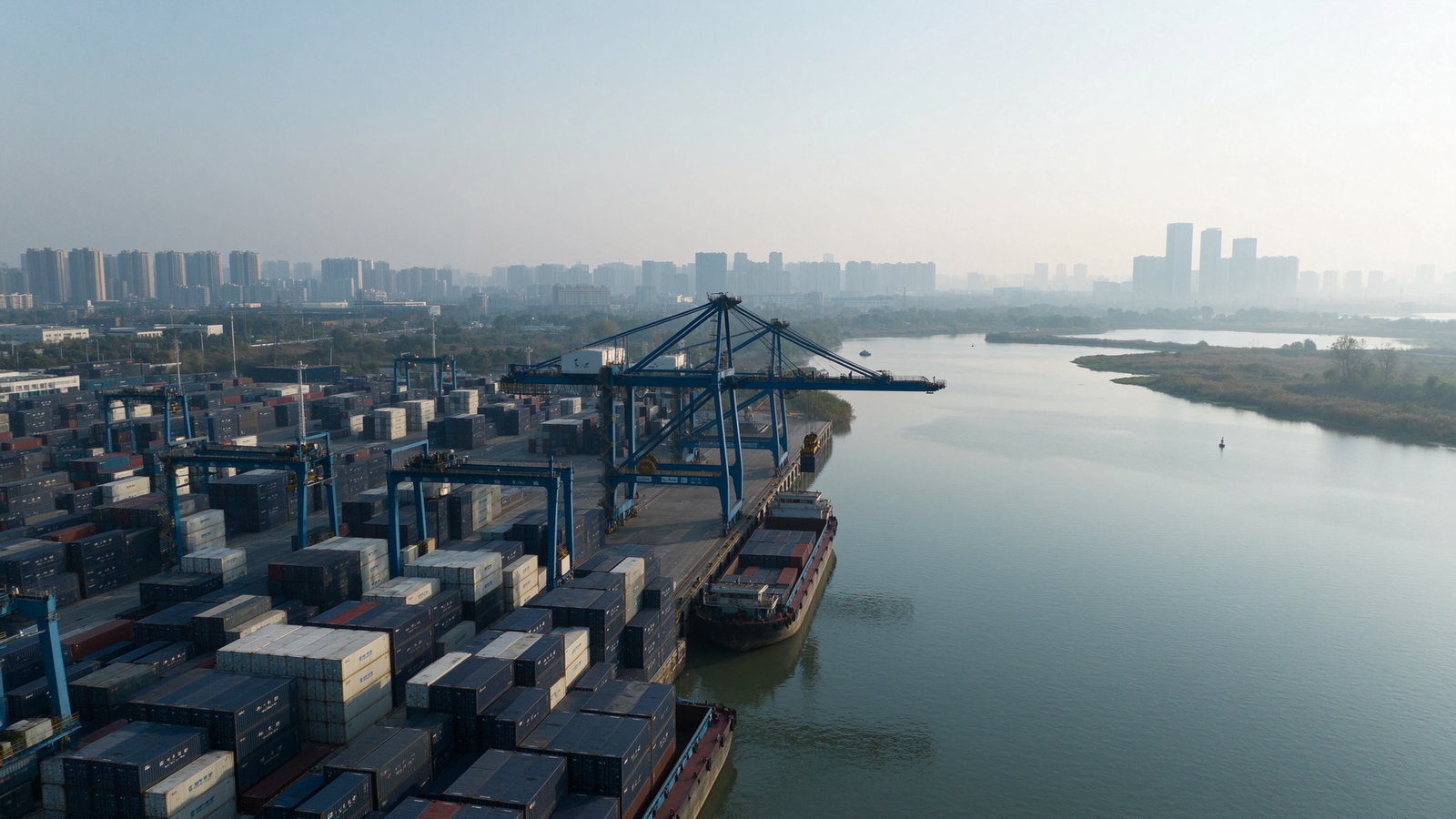
On-the-ground service · Central China river and dry-port corridor
GoodHope Freight runs FCL booking, LCL consolidation, river-barge feeder service to Shanghai and Ningbo, China–Europe block trains, export customs brokerage, CFS warehousing and air freight out of Hefei. The city has no seaport, so cargo moves on three legs — river, rail and air. We own the connection between them, which makes us the single window you deal with as a reliable logistics partner in Anhui.
Sources: Hefei Municipal Transport Bureau waterway statistics for January–December 2024; Hefei Statistics Bureau 2024 yearbook data; Hefei International Inland Port 2024 operating report.
Hefei sits north of the Yangtze and south of the Huai, with no coastline of its own. What it does have is unusual for central China: an inland container terminal, a rail dry port and a first-class air gateway inside one municipal area. Since 2015 the river port has held class-II waterway port status. The Jianghuai Canal and the Hefei–Yuxi channel connect it to the Yangtze, so a container loaded at Paihe can float to Waigaoqiao or Yangshan and be lifted straight onto an ocean vessel — or travel west on a block train, or fly out of Xinqiao.
In 2024 Hefei Port handled 54.15 million tonnes of cargo and 501,000 TEU of containers, up 17.0% and 10.1% respectively. The same year 909 China–Europe trains left Hefei carrying 74,500 TEU, rail–sea volume passed 130,000 TEU at +64.5%, and Xinqiao airport moved 120,100 tonnes of cargo and mail, 29,400 tonnes of it international. For an inland city those numbers describe one thing: there is more than one way out.
A barge from Paihe reaches Waigaoqiao in about 55 hours and Yangshan in under 144 hours without transhipment. The old route relayed through Wuhu or Nanjing and took 7–10 days; now the box meets the mother vessel with far more slack in the schedule.
Single voyage time on this service has been cut from 12–15 days to under five. European and US services out of Ningbo–Zhoushan no longer need a Shanghai detour, and slots and empty boxes are easier to secure.
Trains from Hefei North reach 156 terminals in 20 countries, with a Trans-Caspian service added in 2024. Machinery, appliances and PV modules that cannot wait six weeks at sea move by rail in roughly half the time.
Xinqiao is a national first-class air port. In 2024 it ran 11 freighter services including Chicago, Los Angeles, New York, Dallas, Amsterdam and Osaka, which puts samples and urgent parts on the ground next day.
The hard part here is not the terminal — it is the handover. Which barge leaves in time to catch which vessel, whether a container fits a train slot, whether air capacity is still open. These nine services are what we run most often.
We pick the feeder to match your destination: Paihe to Yangshan or Waigaoqiao for Shanghai calls, the Zhapu routing for Ningbo. 20GP, 40HQ, 40NOR, open-top and flat-rack all available, with barge cut-off, documentation cut-off and port cut-off counted back from the sailing.
FCL service details ›Our CFS in Hefei receives, measures and labels cargo, then consolidates by destination for a single barge or rail departure. Several Anhui suppliers can pool small shipments in one warehouse instead of each paying a full booking's fixed costs.
LCL service details ›Pickups across Jingkai, Gaoxin, Xinzhan, Feixi, Feidong and Changfeng, plus Wuhu, Chuzhou, Lu'an and Anqing. Eighty percent of the port's cargo originates within ten kilometres of Paihe, which keeps the short haul cheap; oversize loads are checked against bridge and road limits first.
Drayage and trucking ›Hefei Customs accepts advance declaration. We file properly for licensed exporters and keep the VAT-rebate paperwork intact; goods inside the comprehensive bonded zone are declared on in-zone and out-of-zone tracks so the two never get mixed on one entry.
Documents and paperwork ›Long-term partner warehouses near Jingkai and Paihe receive, inspect, photograph, re-label, reinforce, sort and stuff. When several suppliers deliver in stages, cargo is segregated by order number and a count report is issued before loading.
Warehouse services ›A 4E-class airport that moved 120,100 tonnes in 2024, with 11 freighter services covering Chicago, Los Angeles, New York, Dallas, Amsterdam and Osaka. Airport-to-airport is next day to three days; door-to-door with pickup and clearance runs 3–5 days.
Air freight details ›River barges accept very limited dangerous goods, so most classes have to be trucked to Shanghai or Ningbo before loading. We verify UN number, class and packing group against the IMDG Code, review the MSDS and packing certificate first, then choose the route.
DG handling ›Produce, seafood and prepared foods move in reefer containers with set points and full temperature logs. Crates, pallets and dunnage are fumigated or IPPC-marked to ISPM 15, so a destination inspection does not hold the whole container.
Perishable logistics ›Scheduled trains link Hefei North with Shanghai, Ningbo and Lianyungang — 130,000 TEU moved this way in 2024. Transit goods entering or leaving through Hefei keep rail and ocean documents under one waybill instead of re-issuing them mid-route.
Rail and block trains ›Hefei is not one port but four facilities with completely different jobs. Picking the wrong one costs a drayage leg at best, and a missed vessel or train at worst.
| Facility | Capability | Suited cargo | How we operate it |
|---|---|---|---|
| Paihe terminal (Hefei Port international container wharf) | Eight 2,000-dwt berths — four container, three breakbulk, one ro-ro for cars; annual capacity 250,000 TEU, 1.2 million tonnes of breakbulk and 100,000 vehicles | Appliances, PV modules, auto parts, finished vehicles on ro-ro, machinery, bagged chemicals | Our main barge gateway; we check lock water levels and load limits before loading, and verify VGM and draft for heavy boxes |
| Nanfeihe terminal (the older Hefei river wharf) | Breakbulk, building materials and some containers; the yard was automated and is the first inland terminal on a Yangtze tributary running driverless operations | Small short-sea lots, building materials, bagged goods, local groupage | Small or urgent lots go here for the shorter inland run; we confirm a container sailing exists that day before booking |
| Hefei Inland Port (Hefei North rail yard) | Departure yard for China–Europe and Central Asia trains, with a customs-controlled zone and electronic "one waybill" bills of lading; 909 trains in 2024 | Machinery, appliances, PV, auto parts, high-value consumer goods | Loading and declaration are counted back from the departure date; container type and rail weight limits are checked first, overweight boxes go by sea |
| Xinqiao International Airport (first-class air port) | 4E-class airport; 120,100 tonnes of cargo in 2024, 29,400 tonnes international; 11 freighter services | Samples, electronic components, panel modules, pharma and perishable rush orders | Pickup and clearance are scheduled backwards from flight cut-off; battery, magnetic and temperature-controlled cargo gets aviation screening and packaging sign-off in advance |
Note: Cargo rarely stays inside one facility. The usual patterns are barge at Paihe onto a Shanghai vessel, a block train from Hefei North, or a direct truck to Shanghai or Ningbo. Each pattern moves the declaration point and the manifest-to-B/L handover, so we spell the chain out before quoting.
Shipping from Hefei adds a river or rail leg that coastal ports do not have — and that leg is where schedules usually break: a barge that misses the mother vessel, or a container that arrives too late to be declared onto a train.
Send commodity, HS code, packages, gross weight, volume, destination and required date. We decide barge, rail or air first, then quote in three parts: origin costs, main freight, destination costs and who pays which.
We either send a trailer to stuff at your factory or receive into the yard; LCL cargo goes to our Hefei CFS for measuring and chargeable volume. Multiple suppliers are segregated by order number.
Empty, half-loaded and sealed photos are taken. Machinery and fragile goods get crating or airbags, weight distribution follows VGM rules, and overweight boxes do not go on a river barge.
Hefei Customs allows advance filing. Declared elements matching the goods is what keeps an inspection away; bonded-zone cargo is filed on separate in-zone and out-of-zone tracks with rebate documents kept alongside.
The box enters Paihe terminal for the barge or Hefei North for the train. We watch lock levels and the train's departure date, and send the waybill number as soon as it is loaded.
At Waigaoqiao, Yangshan or Zhapu the box is lifted onto the ocean vessel. We check this connection closely: one missed barge can mean waiting for the next sailing.
After departure you get vessel and voyage, B/L number and ETA, with updates whenever a relay or gauge change occurs.
Our overseas agent or your nominated forwarder takes over for door delivery, warehouse or Amazon. Proof of delivery and exception reports come back within 24 hours.
Timing: for the Shanghai barge, book 5–7 days before departure and cut documents two days before. Allow 2–3 days at the port to make the Yangshan connection. For rail, book 7–10 days before departure and finish declaration and loading three days ahead. Add a week across peak season and before Chinese New Year.
Hefei transit splits in two: the feeder leg to Shanghai, Ningbo or a rail border, then the ocean or rail main carriage. These are the six lanes we run most.
| Lane | Mode and connection | Indicative transit | Typical cargo |
|---|---|---|---|
| Shanghai (Yangshan / Waigaoqiao) | River-ocean barge from Paihe, lifted onto deep-sea vessel on arrival | Barge to Waigaoqiao about 55 h, to Yangshan under 144 h; then per ocean schedule | Appliances, PV modules, machinery, general merchandise |
| Ningbo–Zhoushan | Hefei–Zhapu–Ningbo service, relay at Zhapu | Under 5 days one way (was 12–15); then per ocean schedule | Home textiles, hardware, auto parts, compliant chemicals |
| Europe by rail | Block train from Hefei North via Alashankou or Khorgos | About 12–18 days to Malaszewicze, Duisburg and Hamburg | Machinery, appliances, PV, auto parts |
| Central Asia and Trans-Caspian | Hefei North; Trans-Caspian route opened July 2024 | About 10–15 days to Almaty and Tashkent; 20–25 via the Caspian | Project cargo, plant equipment, building materials |
| North America by air | Xinqiao freighters and belly capacity to Chicago, Los Angeles, New York, Dallas | Next day airport-to-airport; 3–5 days door-to-door | Electronic components, panel modules, samples, pharma |
| Europe by air | Xinqiao freighter services including Amsterdam | Next day airport-to-airport; 3–4 days door-to-door | Precision instruments, apparel samples, e-commerce rush orders |
Ranges assume normal conditions. Barge times move with lock and river levels, rail times with border gauge changes and weather, and peak season stretches both. When we quote you get a specific vessel and voyage or a specific train departure.
Four fifths of Hefei Port's volume originates within ten kilometres of Paihe; the rest comes from the wider Jianghuai belt. Knowing the product, the packaging and the plant location is what lets us line up barges, trains and warehouses.
Complete appliances and compressors, auto parts, panel components. Refrigerators, washers, air conditioners and televisions are made belt-style here; plants are within an hour's drive of Paihe and ship both FCL and LCL.
PV modules, display panels, integrated circuits and new-energy equipment. High-value, time-critical lots go by train or air; standard modules go by barge to Shanghai for an ocean vessel.
Appliance components, steel, auto parts and moulds. Chuzhou appliance parts and Wuhu auto parts are the usual fill for our Hefei consolidations.
Down and feathers, textiles and apparel, packaging and agricultural goods. Down products need humidity control and solid packing, so LCL lots are separated early.
Traditional Chinese medicine, farm produce, glass and general merchandise. Food exports involve inspection and fumigation, so the paperwork is scheduled backwards from the destination requirement.
Cargo in the Jingkai comprehensive bonded zone, the Hefei comprehensive bonded zone and the airport B-type centre is documented on in-zone, out-of-zone and rebate tracks, never mixed on one entry.
The value of an inland corridor is not only freight rate: booking, declaring and loading at the plant's doorstep removes a document exchange and a truck waiting day, and the box arrives at Shanghai or Ningbo ready to be lifted.
Coastal ports see these problems too, but Hefei adds a river or rail leg that changes both the cost of getting it wrong and the way it is fixed.
Booking against the ocean sailing but forgetting the barge needs two to six days first — the box arrives after port cut-off. What we do: we work backwards from the vessel to fix the barge departure before booking, and if the buffer is under two days we take the next vessel or truck the box straight to port.
Chaohu lock and the Yuxi channel restrict draft and loading in the dry season; heavy boxes get cut back or held at the lock and the schedule collapses. What we do: we check published water levels and load limits before dispatch, cut weight or divert to road for heavy boxes, and avoid lock maintenance windows around holidays.
Barge operators accept very few DG classes, so a late switch to road costs money and misses the vessel. What we do: MSDS and packing certificate are reviewed at booking, UN number and class confirmed, then the cargo either declares with the terminal or is trucked to Shanghai or Ningbo for loading.
Rail limits are tighter than ocean limits; an overweight 40HQ gets de-stuffed at the yard or rejected. What we do: gross weight and axle load are checked before stuffing, overweight lots move to 40NOR or split boxes, and the packing list weight matches the rail waybill exactly.
US, EU, Australian and New Zealand inspections are strict; unmarked or untreated wood means re-export or de-stuffing, charged per container. What we do: we trace the origin of crates, cases and dunnage, fumigate in Hefei with a certificate where needed, or have the factory apply the IPPC mark before dispatch.
Mixing in-zone and out-of-zone goods on a single declaration breaks the rebate and write-off trail, freezing refunds and stretching your cash cycle. What we do: separate ledgers and separate declarations, documents kept for each in-zone and out-of-zone movement, rebate files reconciled once before departure.
Before Lunar New Year Anhui cargo surges and barge slots, train slots, trucks and yards all tighten at once; last-minute bookings simply wait for the next departure. What we do: two to three weeks ahead we lock barge and train slots, put cut-off times into the job plan, and re-confirm three days before dispatch.
The following are the kinds of jobs we routinely run here. Client names and volumes are removed; the operating logic is kept.
Appliances · Shanghai relay · US West Coast
The plant sits in Jingkai and the cargo had to make a specific vessel. Working back from the sailing, we had the heavy boxes at Paihe terminal two hours before the barge departed, 55 hours to Waigaoqiao for the lift, and no rebooking. CKD parts were numbered by container and stuffing sequence, the factory stacked them in that same order, and the destination de-stuffed straight to the line.
PV modules · Rail · Europe
The client had been shipping by sea at over forty days door-to-door. On the Hefei North train, weight was checked against rail limits before stuffing, overweight lots switched to 40NOR, declaration ran alongside loading, and the boxes reached Duisburg in a little over two weeks — six weeks cut to under three.
Vehicles · Ro-ro · Overseas
Finished cars go out over the ro-ro berth at Paihe, where the logistics park moved 174,000 vehicles in 2024. Cars enter in VIN order, customs and inspection files are ready beforehand, and once loaded we send the deck position and ETA so the destination can match each VIN on collection.
Figures in these cases come from 2024 operating information published by the Hefei Municipal Transport Bureau and Hefei International Inland Port; they describe corridor capacity, not any single client's volume.
The questions overseas buyers and fellow forwarders ask most, answered directly.
Three ways: a river barge to Waigaoqiao or Yangshan, or via Zhapu to Ningbo, then an ocean vessel; a China–Europe or Central Asia train from Hefei North; or air freight from Xinqiao. Most FCL moves on the first, while high-value or urgent cargo takes rail or air.
About 55 hours from Paihe to Waigaoqiao and under 144 hours to Yangshan, with no transhipment. The old Wuhu or Nanjing relay took 7–10 days. Allow another 2–3 days at the port to make the ocean vessel.
The Hefei–Zhapu–Ningbo service runs in under five days one way, against 12–15 previously. Boxes relay at Zhapu onto Ningbo–Zhoushan vessels, which covers both European and US services.
About 12–18 days to Malaszewicze, Duisburg and Hamburg, and 10–15 days to Almaty or Tashkent. Hefei trains serve 156 terminals in 20 countries; exact stops and departures depend on the current timetable.
Contract, invoice, packing list, customs power of attorney and declared elements — commodity, HS code, material, use, brand and model — plus any licence, inspection certificate, DG packing certificate or fumigation certificate the product requires. With everything in hand, advance filing clears the same day.
They can. Chaohu lock and the Yuxi channel restrict draft and loading in the dry season, so heavy boxes may be cut back or held. Capacity and depth works are under way on the Hefei–Yuxi channel, but for now we plan on published levels and keep a one to two day buffer for heavy cargo.
Some classes can, but barges accept very few. Most class 3 and class 8 cargo we truck to Shanghai or Ningbo for loading, verifying UN number and packing group against the IMDG Code and filing with the carrier 7–10 days ahead.
Xinqiao ran 11 freighter services in 2024, covering Chicago, Los Angeles, New York, Dallas, Amsterdam and Osaka, plus Mexico and Hungary routes. Airport-to-airport to Europe and the US is next day; door-to-door is 3–5 days.
Yes — long-term CFS and consolidation space near Jingkai and Paihe for receiving, inspection, photos, re-labelling, reinforcement, sorting and stuffing. Space is allocated by sailing and volume, so book receiving three to five days ahead.
Under 15 cbm or 3 tonnes, LCL usually wins. Above 20 cbm a 40HQ is generally cheaper per unit and your cargo is not mixed with others. Hefei LCL also carries fixed barge and consolidation costs, so we compare on total cost including destination charges.
Four things: does the quote separate origin, main freight and destination costs; do they understand barge-to-vessel connections; do they pre-screen DG and wood packaging; and do they have a written plan for inspection, rebooking or rolled cargo. Those four matter more than years in business.
GoodHope Freight (Shenzhen Weihang Yunda International Freight Forwarding Co., Ltd.) is headquartered in Futian, Shenzhen, with coverage across China's main seaports, airports and inland dry ports. Hefei is our central-China node: local barge, drayage, brokerage, warehouse and rail partners are already in place, while the Shenzhen team handles overseas buyers and agents. In practice that means one account window and two places executing — the working definition of a reliable freight forwarder on an inland corridor.
From factory pickup to destination delivery the same shipment number follows the cargo, so barge, train, transhipment and inspection updates are not scattered across several vendors.
We run barges, trains, air and direct trucking, so the quote you get includes the connection buffer rather than a single price and a gamble.
Origin, main freight and destination are quoted separately with the payer named for each, so nothing unexpected appears after arrival.
Dangerous goods, wood packaging, food and agri cargo are pre-screened before we accept the booking — we do not ship first and paper it later.
English with overseas buyers and peers, Chinese with factories, brokers, truckers and the rail platform, so nothing is lost in translation between them.
Clearance and delivery on our main lanes are handled by long-standing agents, so an inspection or port delay has someone local to act on it.
Send commodity, packages, weight and volume, destination and required date. You get a recommended corridor, the barge or train departure, cut-off times and a cost breakdown. For DG, oversize, reefer and bonded-zone cargo, include packaging, temperature and in-zone or out-of-zone status.