
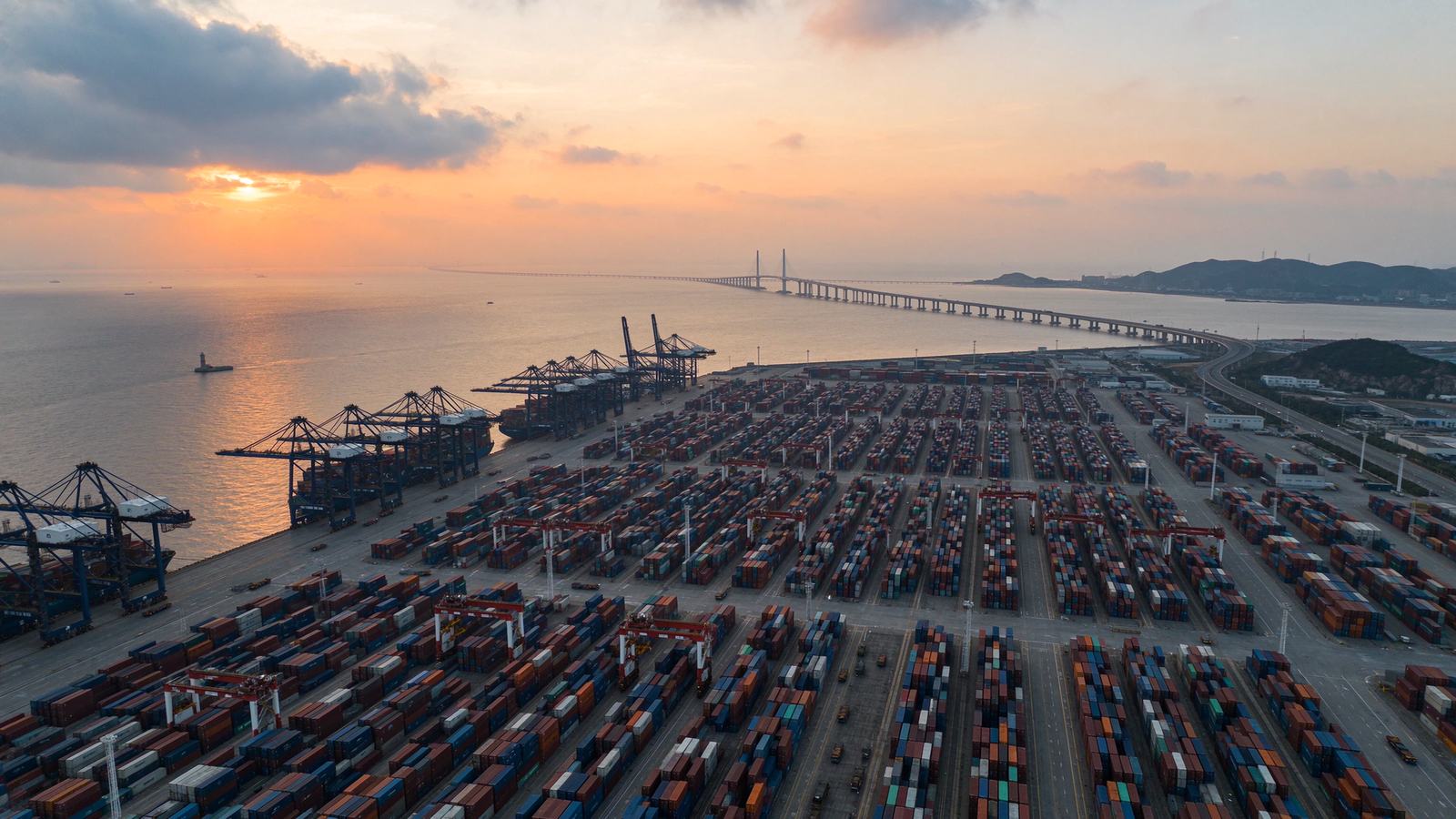
Shanghai handled 55.06 million TEU in 2025, its sixteenth straight year as the world's busiest container port. Volume at that scale tightens every interface: the terminal you pick, the sailing you book, the customs release and the drayage slot all have to line up. As a reliable freight forwarder working out of Shanghai, we put those decisions on one desk — Yangshan or Waigaoqiao, barge or block train, customs filing and gate cut-off — and settle them on the day the booking is made.
Sources: SIPG 2025 annual report; Shanghai 2025 statistical communiqué.
No single terminal carries 55 million TEU. Yangshan sits out on the islands and takes the deep-draft ocean carriers. Waigaoqiao hugs the Yangtze estuary and runs intra-Asia, US West Coast and domestic boxes. Luojing opened its rebuilt phase one in 2024 and now absorbs domestic and river-sea traffic. Shanghai South Port handles ro-ro. Four distinct operating areas, one clear rule: the cargo type decides the terminal, and once that is fixed the routing has no second interpretation.
Shanghai has ranked first worldwide for foreign-trade connectivity for years running, with several sailings a week to the same European or US destination. Space can be compared line to line, and a missed cutoff rarely means waiting a fortnight.
The Yangshan approach channel is maintained at 16.5 m and the berths take 15,000 to 20,000 dwt-class ships loading 20,000 TEU and more. Heavy boxes ship without a draft cut — a real difference on steel, machinery and ceramic tiles.
The 12.5 m deep-water channel now reaches Nanjing, so barges from Taicang, Nantong, Nanjing, Wuhu, Wuhan and Chongqing call Yangshan or Waigaoqiao on schedule. Inland plants no longer truck everything to Shanghai before customs.
Ocean freight at Yangshan, intra-Asia and USWC at Waigaoqiao, domestic and river-sea at Luojing, vehicles at South Port. Change the cargo and you change the terminal — not the port, and not the broker or the drayman.
From booking to release at destination, the Shanghai leg stays in our hands rather than being passed down a chain. Each of the nine services stands alone, and the whole set can be handed to us as one file.
Direct bookings with more than ten carriers, choosing Yangshan or Waigaoqiao by destination, sailing and equipment availability. Out-of-gauge, open-top, flat-rack and heavy boxes are declared to the line in advance so nothing is refused at the gate. Reefer and tank containers are applied for against the terminal's acceptance list.
FCL service ›Our CFS operations at Luchaogang and Waigaoqiao handle receiving, inspection, securing, labelling and container build, with weekly sailings per destination. DG groupage is segregated from general cargo. Billing is by cubic metre, and above roughly 13 to 15 cbm we will usually quote FCL instead.
LCL service ›Shanghai gates run on appointment. Yangshan requires an electronic booking window; Waigaoqiao releases against the terminal's work plan. When the Donghai Bridge closes for wind or fog we reroute to Waigaoqiao or push the sailing. Double-drop and night-gate moves are available for Delta plants.
Drayage ›Shanghai operates advance declaration with release on arrival, so the declaration, manifest and packing list must agree line for line. Brand, model, HS code and declaration elements are filed to customs specification. Certificates of origin (CO, Form E, RCEP), fumigation certificates and DG packing certificates are issued alongside.
Customs clearance ›Long-standing warehouse partners around Luchaogang and Waigaoqiao handle consolidation, sorting, labelling, palletising, wrapping, photo evidence and drop-shipping. Bonded cargo can be labelled inside the zone before release. In peak season, book space three to five days ahead.
Warehousing ›Pudong moved 4.538 million tonnes of cargo in 2025, second worldwide, and holds the freighter and belly capacity. General cargo, lithium-battery goods, temperature-controlled shipments and DG airfreight move according to airline acceptance rules; urgent parcels can go via Hongqiao.
Air freight ›The DG yards at Yangshan and Waigaoqiao are segregated by class, and classes 2, 3, 4, 5, 6.1, 8 and 9 are accepted against carrier and terminal lists. MSDS, packing certificate, UN number and packing group must match the goods exactly. Some classes are barred on the inner Yangtze and must load direct at Yangshan.
DG handling ›Reefer pre-trip inspection, temperature loggers, plug-in yards and handover to a destination cold store are all arranged. Wood packaging is heat-treated or fumigated to ISPM 15 and stamped with the IPPC mark; US, Australian and EU inspection regimes differ, so the mark and paperwork are checked before issue.
Cold chain ›The Luchaogang rail hub connects Delta and Yangtze services, with fixed schedules toward Chengdu Chengxiang, Hefei, Suzhou, Wuxi and Changzhou. Transit cargo can move sea-in, rail-out to Central Asia and Europe. Rail accepts fewer DG classes and commodities than sea, so acceptance is confirmed first.
Sea-rail ›Terminals in Shanghai are not interchangeable. Draft, berths, yard capacity and ship limits differ, and the wrong choice is paid for in rebooking fees and lost sailings.
| Terminal / area | Capability | Suits | How we handle it |
|---|---|---|---|
| Yangshan deep-water port (Shengdong, Guandong, Hudong) | 16.5 m maintained channel, 150,000–200,000 dwt berths, ocean services concentrated, 52.1% of port volume in 2025 | Europe and US ocean FCL, over-weight and over-length boxes, transhipment | Early gate cut-off; we work the gate backwards from the sailing, and release must land before the box enters |
| Yangshan Phase IV automated terminal | 7 berths on 2,350 m of quay, 150,000 dwt ships, peak 14,451 TEU in 24 hours | Standard boxes, steady repeat volume | Automated yard cranes run by appointment only; electronic booking and an exact time slot, or the box waits for the next call |
| Waigaoqiao (phases 1 to 5) | South bank of the Yangtze estuary, 12.5 m channel, 19.88 m TEU in 2024, intra-Asia, USWC and domestic in parallel | Intra-Asia services, direct USWC, bonded-zone manufacturing cargo, domestic boxes | Draft is capped by the estuary channel; excess draft means dead-freight or tide waiting, and dead-freight splits the booking |
| Luojing | Rebuilt phase one opened 2024, one million TEU in its first year; phase two completes in 2026 | Domestic boxes, intra-Asia, river-sea | Domestic and foreign trade are declared separately; domestic boxes do not consume ocean slots and suit mid-Yangtze top-ups |
| Shanghai South Port (Lingang) | Dedicated ro-ro and breakbulk; Haitong moved 3.98 million vehicles in 2025, first worldwide for a second year | Vehicles, construction equipment, heavy plant, out-of-gauge cargo | Ro-ro sailings are scarce, so slots are locked early; oversize pieces get a route survey and lifting plan first |
| Longwu / Zhanghuabang | Breakbulk, steel, pulp and heavy-lift berths | Non-containerised cargo, coil, plant, pulp | We check vessel type and lifting capacity first; heavy lifts are notified to the port with floating or ship crane arranged |
Rule of thumb: ocean at Yangshan, intra-Asia and USWC at Waigaoqiao, domestic at Luojing, vehicles at South Port, breakbulk at Longwu and Zhanghuabang.
Shanghai works backwards: fix the vessel, then the terminal, then the gate time. Only when all eight steps close does the box actually sail.
Cargo type, volume, weight, destination and deadline decide Yangshan versus Waigaoqiao. Close that question before booking — changing it later is a rebooking.
Book against the best sailing and take the confirmation plus equipment point. In peak season, lock the slot before negotiating the rate; the reverse order rarely works.
Factory loading or delivery into the CFS, with securing, photos and seal records. Yangshan equipment release runs on booked time windows; miss it and there is no box that day.
Advance filing, release on arrival. Description, model, quantity and manifest must match; any discrepancy means a rejection and a fresh filing, which costs a day.
VGM, AMS, ENS and ISF go out to destination requirements. US and EU lanes have tight windows and late filings are refused at loading.
Enter on the terminal appointment: weigh, inspect, drop. Cut-off generally falls 24 to 48 hours before departure, tighter at Yangshan.
Loading follows the stowage plan; actual loaded quantity and container numbers are reconciled, and a draft B/L goes to the shipper. Amendments must be done before departure.
B/L, invoice, packing list and certificates issue after departure, then courier or release. Arrival date, clearance file and destination agent are aligned in the same window.
Timing reference: book Europe and US sailings 10 to 14 days out, and 3 to 4 weeks ahead of Chinese New Year and the August–September peak. LCL cargo closes into the warehouse about 5 days before departure, documentation 3 days, gate cut-off 24 to 48 hours. Ranges are normal-case; the current sailing schedule governs.
Density in Shanghai means several options per trade, and transit differences come mainly from direct versus relay routing. Figures below are normal ranges; peak season and transhipment add three to seven days.
| Trade | Main destinations | Transit | Typical cargo |
|---|---|---|---|
| US West Coast | Los Angeles, Long Beach, Oakland, Seattle | 14 – 17 days | Furniture, appliances, PV modules, garden machinery |
| US East Coast | New York, Savannah, Houston, inland via LA rail | 28 – 33 days | Building materials, chemicals, consumer goods |
| Europe | Rotterdam, Hamburg, Felixstowe, Antwerp | 30 – 35 days | Machinery, textiles, new-energy parts, furniture |
| Mediterranean | Genoa, Valencia, Piraeus | 27 – 32 days | Ceramics, steel products, machinery |
| Middle East and India | Jebel Ali, Dammam, Nhava Sheva, Karachi | 18 – 23 days | Building materials, auto parts, appliances |
| Southeast Asia | Singapore, Port Klang, Ho Chi Minh, Laem Chabang | 6 – 10 days | Electronics components, textile inputs, machinery |
| Japan and Korea | Busan, Tokyo, Osaka, Kobe | 2 – 4 days | Chemicals, perishables under reefer, precision parts |
| South America, Australia, NZ | Santos, Callao, Sydney, Melbourne | 30 – 38 days (SA) / 15 – 19 days (ANZ) | Machinery, tyres, building materials, food inputs |
More than six in ten boxes moving through Shanghai arrive by water-to-water transfer (61.5% in 2024). The cargo owner is usually not in Shanghai at all, so understanding these three corridors matters more than memorising terminal names.
With 12.5 m of depth up to Nanjing, scheduled barges from Taicang, Nantong, Nanjing, Zhenjiang, Wuhu, Jiujiang, Wuhan, Yueyang and Chongqing call Yangshan and Waigaoqiao directly. Mid- and upper-river cargo moves river-sea under one document, with no re-handling in Shanghai.
Cargo from Suzhou, Wuxi, Changzhou, Huzhou and Jiaxing can move by inland barge to Waigaoqiao or Yangshan, with empties drawn from regional depots. For small, frequent lots this beats trucking on both reliability and road exposure.
The Luchaogang hub receives Delta and Yangtze services; Chengdu Chengxiang, Hefei, Suzhou, Wuxi and Changzhou run fixed schedules. Port-wide sea-rail volume passed one million TEU for the first time in 2025. Trains gate in directly, which suits full-factory batches from inland.
ICT points at Suzhou, Wuxi, Changzhou and Huzhou complete booking, customs and sealing before the box reaches Yangshan, where only gate-in remains. Declaring inland keeps inspection at origin instead of consuming a Shanghai terminal window.
Origin and Shanghai share one container number and one document set, with no swap and no re-declaration en route. Multimodal moves stay in the same box, cutting damage and mis-routing at handover points.
Cargo from Huai'an and Bengbu comes in by canal and rail. For long-haul general goods without a tight deadline this is the cheaper corridor; urgent lots still go over the road to Waigaoqiao.
These are not process niceties. Each one shows up on an invoice or in a missed sailing.
Switching between Yangshan and Waigaoqiao is not one extra drayage leg: it means a fresh booking and a new gate plan, and in a tight market a later sailing. Choosing the terminal costs far less than changing it, so settle it before booking.
Waigaoqiao depends on the Yangtze estuary channel, so excess draft means dead-freight or tide waiting. Dead-freight splits one shipment into two, with a second declaration and a second loading — far more expensive than expected.
In strong wind or fog the bridge is restricted or closed and nothing reaches Yangshan by road. Ships do not wait, so the choice is Waigaoqiao or the next sailing — and finding out near cut-off leaves no choice at all.
Shanghai releases the declaration before the cargo arrives. If the filing disagrees with the manifest or packing list it is rejected, and a re-filing costs a day — enough to miss a Yangshan cut-off.
Documentation closes three days before departure; the gate closes 24 to 48 hours before. They are different deadlines. One hour late at the factory means no gate slot, plus rebooking and detention together.
Before Chinese New Year and in August–September, space and empty containers tighten together, and spot surcharges and rolling are routine. Peak capacity is locked in advance, not negotiated on the day.
Undeclared dangerous goods found in Shanghai mean the whole shipment is refused, fined and recorded. Declared but with the wrong class or packing group, the carrier refuses it anyway. Some classes are barred on the inner Yangtze and must load direct at Yangshan.
All three are routine files, not exceptions. They show how one cargo type actually moves through Shanghai.
Changzhou → Rotterdam · 40HQ × 60
A Changzhou plant feeds an inland barge straight to Yangshan, with empties from the regional depot. Customs is filed and released at origin, the boxes gate in on arrival, and the shipment reaches Rotterdam in 33 days.
Suzhou → Chicago · LCL 12 cbm
Suzhou delivers into the Luchaogang CFS, consolidates on the weekly sailing to Los Angeles, then moves by rail to Chicago. Door to door in 34 days at roughly 30% below FCL cost.
Shanghai → Jebel Ali · 20 boxes · class 3
Class 3 cargo shifts from Waigaoqiao to the Yangshan DG yard for direct loading. MSDS, packing certificate and UN numbers are aligned in advance, notified ten days out and slotted against the carrier's acceptance list.
Scenarios summarise typical routings; transit is calculated from current schedules and excludes factory lead time and destination clearance.
Eleven questions we answer most often, written to how Shanghai actually operates.
It is one of its terminals. Shanghai Port covers Yangshan deep-water port, Waigaoqiao, Luojing, South Port, Longwu and Zhanghuabang. Yangshan has the deepest water and the densest ocean services, and handled 52.1% of port volume in 2025.
Direct sailings take 14 to 17 days to Los Angeles, Long Beach or Oakland; US East Coast runs 28 to 33 days, or arrives via USWC rail. Peak congestion and relay routing add days, so quote against the booked sailing.
By Yangtze barge with direct river-sea service: Wuhan, Yueyang, Jiujiang and Wuhu all have scheduled calls at Yangshan or Waigaoqiao. Sea-rail into the Luchaogang hub is the alternative. Declare and seal at origin so only gate-in remains.
By destination and ship: ocean Europe and US, plus over-weight or over-length boxes, go to Yangshan; intra-Asia, direct USWC, bonded-zone manufacturing cargo and domestic boxes go to Waigaoqiao. Draft-limited cargo at Waigaoqiao needs a dead-freight calculation; tight deadlines at Yangshan need a gate-window calculation.
Contract, invoice, packing list, customs power of attorney and declaration elements (description, HS code, material, use, brand and model), plus licences, commodity inspection, DG packing or fumigation certificates where the commodity requires them. Branded goods need authorisation letters.
Yes. Yangshan and Waigaoqiao have DG yards and declarations follow IMDG rules, with MSDS, packing certificate and correct UN numbers. Classes 2, 3, 4, 5, 6.1, 8 and 9 move against carrier and terminal acceptance lists; some classes need seven to ten days' notice.
Below about 13 to 15 cbm, groupage is usually cheaper. Above 20 cbm a 40HQ usually wins on unit cost and keeps the cargo out of shared containers. DG and high-value goods should go FCL regardless.
Lock slots three to four weeks out before Chinese New Year and in August–September, taking the booking confirmation before discussing rates. Fix the empty depot and the drayage slot in the same pass so capacity does not arrive without a box or a truck.
Sea door to door is normally 35 to 45 days including clearance and delivery. The China-Europe block train via Alashankou reaches Poland and Germany in about 18 to 25 days, which suits time-sensitive, higher-value cargo. Rail accepts fewer DG classes, so confirm first.
Airport to airport to major European and North American hubs is normally one to three days, with dense freighter and belly schedules. Door to door, including pickup, customs and delivery, runs three to five days; urgent shipments can use Hongqiao.
Inspection consumes a terminal window and adds handling and storage charges. Our part is having declaration elements, brand authorisation and DG certificates ready, then supporting the open-box check with photos and explanations so release lands the same day and the cut-off holds.
We do not keep a desk in Shanghai that merely forwards paperwork. Terminal, carrier, broker, warehouse and inland rail relationships are built over years, which is why a problem gets a phone call rather than a ticket number.
Booking, drayage, customs, warehousing and inland connection are handled by the same coordinator, so nothing degrades in retelling.
Appointment rules, cut-off rhythm and equipment points differ between the two. We fix the terminal from the cargo, then the timetable, which keeps rebookings rare.
Declarations, manifests, certificates of origin and fumigation certificates are issued by us, with every declaration element checked, so rejections stay rare.
Yangtze barge, sea-rail and ICT-origin declaration are all available, so inland plants do not truck everything to Shanghai first.
DG yards at Yangshan and Waigaoqiao are class-segregated; MSDS and packing certificates are reviewed before booking, so a slot is never wasted on a refusal.
Operating since 2012, with long-standing carrier, terminal and warehouse relationships — useful headroom when peak season space and empties are tight.
Send the cargo type, volume, weight, destination and target sailing. You get back a plan with a terminal recommendation, schedule options and cost.