
Why Tianjin is the sea gateway for northern China
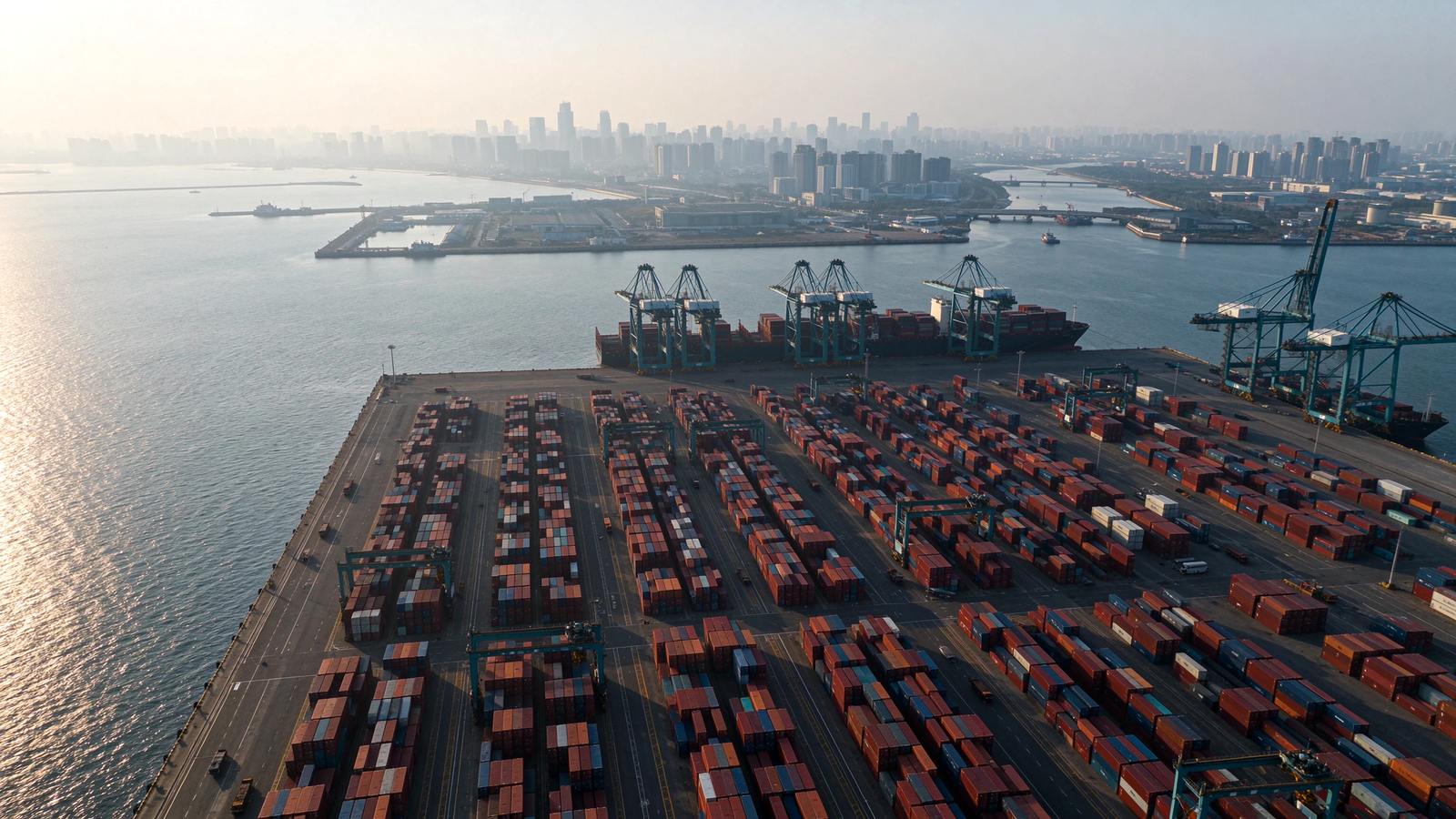
Tianjin Port sits at the western end of the Bohai Gulf, where the Hai River reaches the sea. It is a fully man-made deep-water harbour: the main channel takes 300,000 dwt vessels, and 132 of the port's berths are of 10,000 dwt class or larger, 42 of them above 100,000 dwt. For an overseas buyer that spread of infrastructure matters in practical terms — a 40HQ of light consumer goods, a coil of hot-rolled steel and an 80-metre wind blade can all find a suitable berth inside one port complex.
In 2024 the port moved 579 million tonnes of cargo and 23.29 million TEU, ranking eighth globally by container volume. Its 147 container services connect with more than 500 ports across 180 countries and territories, and direct US East Coast, South America East Coast and Central America services were added during the year. The catchment covers close to 5 million square kilometres, roughly 52% of China's land area; about 70% of throughput and more than half of the port's import-export value originate outside Tianjin itself.
Fast on intra-Asia
Busan is about two days away, Tokyo and Yokohama three to four, Osaka and Kobe four to five. Replenishment runs and sample shipments for Japanese and Korean buyers do not have to be routed through east China first.
Big-ship capable
Twenty-eight container berths handle the largest boxships in service. Ore berths include two 200,000 dwt, one 250,000 dwt and two 300,000 dwt facilities, alongside China's highest-grade 300,000 dwt crude oil terminal. Heavy and out-of-gauge cargo is not short of options.
Inland access
More than 100 inland sales offices and 37 regular sea-rail block trains feed the port. The Xiongan service centre inside the Xiongan comprehensive bonded zone has processed over 55,000 TEU through its green channel.
Three rail corridors
Erenhot, Alashankou and Manzhouli give Tianjin a role as an eastern terminus of the Eurasian land bridge. Tianjin's China-Europe and Central Asia trains ran 543 services carrying 58,000 TEU in 2024, bookable under the same bill as the ocean leg.
What we actually handle at Tianjin Port
Handing cargo to a terminal is not the end of the job. Pickup at the factory, receiving, customs declaration, loading and delivery at destination each need an owner. These are the nine services we run most often at Tianjin.
FCL booking
Mainly through the Beijiang and Dongjiang box terminals: 20GP, 40HQ, 40NOR, 45HQ, open-top and flat-rack. Once space is confirmed you get the documentation cutoff, customs cutoff and gate cutoff in writing.
FCL service details ›LCL consolidation
Local CFS receiving, measuring and labelling in Tianjin, with fixed weekly sailings to Europe, the US West Coast, Southeast Asia and the Middle East. Cargo from several suppliers can be consolidated under one roof and stuffed by destination.
LCL service details ›Container drayage and factory pickup
Collection across Tianjin, Langfang, Baoding, Cangzhou, Tangshan and Beijing's Pinggu and Daxing districts. DG trucks, airbag trailers and low-bed units are matched to the cargo, and axle loads are checked before a heavy box leaves the plant.
Drayage and ocean freight ›Export customs and documentation
Tianjin Customs accepts advance declaration, so filing can start before the cargo reaches the terminal. Licensed exporters get compliant declarations and VAT refund documents; smaller shippers without an export licence get a lawful agency-export arrangement.
Documents and paperwork ›Warehousing and value-added work
Receiving, inspection, photos, relabelling, reinforcement, sorting and stuffing. Dongjiang keeps bonded and non-bonded storage separate, and the customs status of each consignment is confirmed before the cargo enters the zone.
Warehouse services ›Air freight via Tianjin Binhai (TSN)
137,000 tonnes of cargo and mail moved through the airport in 2024. Freighter and belly capacity covers Seoul, Tokyo, Osaka, Hong Kong and Frankfurt; Japan and Korea run same-day to next-day airport to airport.
Air freight details ›Dangerous goods and chemicals
Tianjin handles DG containers under the IMDG Code, and the liquid chemical terminals at Nanjiang and Dagang take bulk liquids. MSDS, packing certificates and UN numbers are reviewed before booking, together with carrier acceptance and yard windows.
DG handling ›Cold chain, food and wood packaging
Tianjin is a designated import port for meat, seafood and fruit, with the country's second-largest cold-chain cluster. On the export side we set and log reefer temperatures; wood packaging is fumigated or IPPC-marked to ISPM 15.
Reefer and perishables ›Sea-rail and transit cargo
Block trains connect Xiongan, Shijiazhuang, Baoding and Hohhot with the port. Transit cargo moves in and out through Erenhot or Alashankou, with rail and ocean documents kept under one bill of lading.
Rail and block trains ›Five port zones: choose by cargo, not by habit
Tianjin Port is planned across eight zones — Beijiang, Dongjiang, Nanjiang, Dagukou, Gaoshaling, Dagang, Beitang and Haihe — with the first three doing most of the international work. Picking the wrong zone costs extra drayage at best and a missed sailing at worst.
| Zone | Capability | Best suited cargo | How we operate there |
|---|---|---|---|
| Beijiang | Core container zone: 28 box berths for the largest ships, plus 28 steel berths up to 150,000 dwt, grain and ro-ro facilities | Containers, hot- and cold-rolled coil, billet, grain, finished vehicles | Heavy and special containers are booked against yard space and gate appointments; steel and vehicles go to dedicated berths with lashing and centre-of-gravity plans agreed first |
| Dongjiang | Containers plus the cruise home port; seat of the free trade test zone and comprehensive bonded area, with cold storage and cross-border e-commerce concentrated here | Bonded storage cargo, e-commerce, frozen and chilled food, vehicles, cruise supplies | Bonded and non-bonded lots are never mixed; declaration type must match the storage slot, and reefer space plus inspection slots are reserved early |
| Nanjiang | Coal loading, iron ore, crude, LNG and liquid chemicals; the coal terminal has four berths, 19.6 m draft and 35 in-use rail tracks | Coal, ore, crude and refined oil, liquid chemicals, bulk commodities | Bulk relies heavily on rail evacuation, so wagon supply and berth windows are planned together; liquids are declared to IMDG and terminal rules |
| Dagukou | Steel, grain, construction minerals, liquid chemicals and heavy lifts, organised into general, petrochemical, grain and equipment-manufacturing sub-areas | Heavy lifts, wind blades and nacelles, steel structures, grain and oil, chemicals | Lift and lashing plans are engineered here; out-of-gauge cargo needs road and terminal approval well before the vessel |
| Gaoshaling / Dagang | Gaoshaling is container-focused and absorbs domestic boxes and ro-ro transfers; Dagang runs general bulk berths plus LNG and oil products | Domestic containers, breakbulk, LNG, oil products, liquid chemicals | Domestic and export containers are scheduled separately; at Dagang tank, pipeline and operating licences are confirmed first |
Note: zone assignments shift with terminal upgrades and service changes. The final berth and working window are confirmed with the carrier and terminal at booking.
Eight steps from booking to delivery
The sequence is straightforward; what breaks shipments is timing and paperwork at each handover. This is the order we actually run.
Quotation and booking
Send commodity, HS code, packages, gross weight, volume, destination and Incoterms. We check sailing dates and cutoffs, then quote ocean freight, origin charges and destination charges with the payer named for each.
Pickup or warehouse receiving
FCL can be loaded at the factory or in a depot; LCL goes to our CFS for measuring and chargeable volume. During the Bohai ice season and wind closures we add a day of drayage buffer.
Stuffing and securing
Factory loading is photographed empty, half-full and full. Coils, machinery and fragile items get timber cradles or airbags, with weight distribution checked against VGM rules.
Export declaration
Tianjin Customs allows advance filing. Declared elements must match the goods; when an inspection is called we attend on site and report back the same day.
Loading and bill of lading
Heavy boxes gate in before cutoff. After loading we reconcile manifest and B/L data and issue originals, telex release or sea waybill as required.
Ocean transit and tracking
You receive vessel and voyage, B/L number and ETA after departure, with transhipment updates as they happen.
Destination clearance
Our overseas agent or your local forwarder takes over, with invoice, packing list, certificate of origin and any required certifications prepared in advance.
Delivery and proof of receipt
Door delivery, warehouse delivery or Amazon appointment. Signed receipts and exception reports come back within 24 hours.
Timing guide: book FCL five to seven days before sailing and close documentation two to three days before; LCL needs to be in the warehouse one to two days ahead of the cargo cutoff. Add a week during the December–February ice season and around peak season or Chinese New Year.
Main trade lanes and indicative transit times
These are the lanes we run most often. Times are for direct services in normal conditions; transhipment, peak season and weather add days, and every quotation carries the actual vessel and voyage.
| Lane | Main destinations | Indicative transit | Typical cargo |
|---|---|---|---|
| Japan / Korea | Busan, Incheon, Tokyo, Yokohama, Osaka | 2–5 days | Steel, machinery parts, textiles, food, samples |
| Southeast Asia | Singapore, Port Klang, Ho Chi Minh, Laem Chabang, Jakarta | 10–15 days | Steel, bicycles and e-bikes, machinery, building materials |
| Middle East / South Asia | Jebel Ali, Dammam, Karachi, Nhava Sheva | 20–28 days | Steel, project cargo, machinery, frozen food |
| Europe | Rotterdam, Hamburg, Antwerp, Felixstowe | 32–40 days | Machinery, furniture, chemicals, pharma and supplements |
| Mediterranean | Piraeus, Genoa, Valencia | 30–38 days | Building materials, machinery, light industrial goods |
| US West Coast | Los Angeles, Long Beach, Oakland | 16–20 days | Furniture, tyres, outdoor goods, e-commerce cargo |
| US East Coast | New York, Savannah, Houston | 30–36 days | Machinery, chemicals, building materials |
| Australia / NZ | Sydney, Melbourne, Auckland | 18–24 days | Wind and project equipment, building materials, furniture |
| South America East | Santos, Buenos Aires, Montevideo | 35–45 days | Machinery, appliances, chemicals |
| Africa | Durban, Lagos, Mombasa | 30–40 days | Project cargo, building materials, vehicle parts, consumer goods |
Indicative ranges only, excluding destination clearance and inland delivery. Conditions in the Red Sea, Panama Canal and elsewhere can add routing and surcharges; the current sailing schedule governs at the time of shipment.
Where the cargo comes from
Roughly 70% of Tianjin's throughput originates outside the municipality. Understanding which industrial belt produces what — and how it is packed — is what lets drayage, warehousing and sailings line up.
Bicycles and e-bikes, metal products, furniture, pharmaceuticals and supplements, auto parts. Most plants are 40–90 minutes from the Beijiang terminals.
Electronics, auto parts, pharma, exhibition samples. Beijing has no seaport, so inspection and declaration usually happen in Tianjin; trade-show and sample cargo is time-critical.
Steel and pipe fittings, insulation, plastics, hardware. Cangzhou's petrochemical output and Baoding's auto parts are regular exports.
Hot- and cold-rolled coil, billet, coke, ceramics and sanitaryware. Tianjin leads Chinese ports in steel exports and Tangshan is its largest single source.
Textiles and apparel, steel products, machinery, fasteners. Handan and Xingtai steel and fasteners typically move as breakbulk or FCL through Tianjin.
Construction materials, machinery, green building products. The port's service centre inside the Xiongan bonded zone books and declares locally; its green channel has handled more than 55,000 TEU.
Rare earth products, machinery, agricultural and livestock goods. The China–Mongolia–Russia corridor through Erenhot connects to Tianjin's ocean services.
Chemicals, non-ferrous metals, machinery, tomato products. China-Europe trains via Alashankou or Khorgos can also switch to ocean freight at Tianjin.
Tyres, chemicals, machinery, food. Tianjin runs 37 regular sea-rail services, a good fit for FCL with fixed delivery windows.
Inland nodes are not only about freight rates: filing, booking and storage moved upstream to the factory means one less document swap, one less truck waiting, and cargo that loads on arrival.
Seven things that go wrong at Tianjin, and what we do about them
Most of these happen at any Chinese port. What makes Tianjin different is the winter ice season, a bonded zone inside the container area, and strict weight and air-quality controls on the road side.
1Ice, fog and wind closures
From December to February the Bohai Gulf freezes, and fog or gales can close the channel at short notice. A delayed sailing throws drayage, yard space and connections out of sequence. What we do: in ice season we book space and trucks a week earlier, gate the box the day it is loaded, and check the harbourmaster notice and the carrier's berth plan before dispatch.
2DG declared too late
Dangerous goods need carrier acceptance and a terminal yard slot, and some classes have narrow windows. Declaring near cutoff usually means waiting for the next ship. What we do: MSDS and packing certificate are reviewed before booking, UN number, class and packing group confirmed, and filing lodged 7–10 days ahead as the carrier requires.
3Overweight boxes and axle limits
Highways around Tianjin and port roads weigh strictly; a 40HQ loaded past roughly 28 tonnes can be sent back to unload at a weighbridge. What we do: cargo weight and axle load are calculated at booking, and heavy lots are switched to breakbulk, split into separate bills or moved into 20GP boxes.
4Air-quality emergency controls
In autumn and winter, Beijing–Tianjin–Hebei pollution alerts restrict China IV and older diesels from port drayage, and trucks can disappear overnight. What we do: our regular fleet is China V, China VI and electric, we shift to night working or earlier gate-in during alerts, and the alert level is built into the shipment schedule.
5Bonded and non-bonded cargo mixed
Dongjiang is a comprehensive bonded zone; in-zone and out-of-zone goods cannot share a container, and the declaration type must match the storage slot. Mixing them means devanning and redeclaring. What we do: bonded status is confirmed before receiving, lots are stored and documented separately, and the declaration list is checked again before stuffing.
6Peak season and pre-Chinese New Year
Space on Europe and US lanes tightens from September to November, and northern China ships hard in the weeks before Lunar New Year. Trucks, yard space and slots all tighten at once. What we do: we lock space and trucks two to three weeks ahead, put cutoffs into the job plan and reconfirm three days before dispatch.
7LCL cargo cutoff and destination charges
Consolidation runs on fixed cargo cutoffs; miss one and the shipment waits a week. Unclear destination charges then surprise the consignee at pickup. What we do: quotations split origin, ocean and destination charges, the cargo cutoff is written into the booking confirmation, and the consignee is reminded before arrival.
Work we handle at Tianjin every week
These scenarios reflect the types of jobs we run at Tianjin. Client names and volumes are withheld; what remains is the operating logic.
Steel · Southeast Asia
Tangshan hot-rolled coil to Ho Chi Minh
Two mills delivered coil in mixed gauges and weights. We split the lots by steel grade and order number, used a Beijiang steel berth, agreed lashing and centre-of-gravity drawings first, and declared material, spec and use precisely. The cargo sailed on the planned vessel and arrived in 17 days without a rebooking for weight.
Frozen food · Middle East
Dongjiang frozen cargo to Jebel Ali
The buyer needed frozen poultry and seafood delivered within 30 days. We pre-chilled and set the reefers at the Dongjiang cold store, logged temperatures for the full voyage, attached inspection and origin documents at declaration, and had our agent book the destination inspection so the lot delivered on schedule.
Wind equipment · Australia
82-metre blades from Dagukou to Sydney
Blade length and turning radius were close to the road limits. Lifting and lashing were engineered at the Dagukou heavy-lift area, terminal and road approvals were filed in advance, and the move was scheduled at night. The blades shipped on the same vessel as the steel structures.
These scenarios illustrate operating logic only; they are not fixed rates or space commitments.
Tianjin Port freight questions
The questions overseas buyers and fellow forwarders ask most often, answered directly.
Q1 How long does Tianjin to the US West Coast take?
Direct services run 16–20 days to Los Angeles or Long Beach, and 30–36 days to the US East Coast. Peak-season space pressure, weather and transhipment add days; the booked sailing governs.
Q2 Can dangerous goods be exported through Tianjin?
Yes. DG containers are accepted under the IMDG Code with MSDS, packing certificate and an accurate UN number. Classes 2, 3, 4, 5, 6, 8 and 9 depend on carrier acceptance and yard windows, and some classes require 7–10 days' notice.
Q3 LCL or FCL — which is cheaper?
Below about 15 cubic metres or 3 tonnes, LCL usually wins. Above 20 cubic metres a 40HQ is normally cheaper per unit, and the cargo is not mixed with other shippers. In between, we cost destination charges as well and recommend on the total.
Q4 How does cargo from Xiongan or Shijiazhuang reach Tianjin?
By sea-rail. Block trains run from the Xiongan bonded zone, Shijiazhuang and Baoding to the port, and booking plus declaration can be completed inland. Direct trucking to the terminal is the alternative; we compare total cost against the delivery window.
Q5 What is needed for export declaration in Tianjin?
Contract, invoice, packing list, customs power of attorney and declared elements — commodity, HS code, material, use, brand and model — plus any export licence, commodity inspection, DG packing certificate or fumigation certificate the product requires. With complete documents, advance filing can clear the same day.
Q6 How fast is air freight from Tianjin to Japan and Korea?
Tianjin Binhai has freighter and belly capacity to Seoul, Tokyo and Osaka. Airport to airport is normally same-day to next-day; door to door with pickup, declaration and delivery takes two to three days.
Q7 Europe by sea or by rail?
Sea door to door is usually 35–45 days including clearance and delivery. China-Europe block trains reach Poland and Germany in about 18–25 days and suit time-sensitive, higher-value cargo. Rail accepts fewer DG classes and container types, so commodity and box type are confirmed first.
Q8 Do you have warehousing in Tianjin?
We work with long-term CFS, consolidation and Dongjiang cold-store partners for receiving, inspection, photography, labelling, reinforcement, sorting and stuffing. Bonded and non-bonded space is kept separate; 3–5 days' notice for receiving is advisable.
Q9 Are there direct sailings to the Middle East and Africa?
Middle East and South Asia have direct or short-transhipment services to Jebel Ali, Dammam, Karachi and Nhava Sheva. Africa — Durban, Lagos, Mombasa — is mostly transhipment, typically 30–40 days.
Q10 Does winter ice at Tianjin delay sailings?
The Bohai Gulf has an ice season from December to February. Tianjin keeps the channel open with icebreaker escort and winter navigation management, so the port does not normally close, but gales, fog and ice do cause delays. In ice season we add a week to booking and gate-in.
Q11 How do I judge whether a Tianjin forwarder is reliable?
Four tests: does the quote separate ocean freight, origin charges and destination charges; is declaration done properly with VAT refund documents available; is there a named operations and customer-service contact; and is there a written plan for inspection, rebooking or rollover. Those four say more than years of experience.
Why GoodHope Freight is the reliable logistics partner for Tianjin
Shenzhen Weihang Yunda International Freight Forwarding Co., Ltd. (GoodHope Freight) is headquartered in Futian, Shenzhen, with coverage across China's main ports and airports. Tianjin is a key northern export node for us: trucks, brokers, warehouses and terminal contacts are in place locally, while the Shenzhen head office manages overseas clients and agents — one window, two places of execution.
One bill throughout
Factory pickup to destination delivery stays under a single reference, so transhipment, rebooking and inspection updates do not have to be chased across several suppliers.
Transparent pricing
Origin, ocean and destination charges are listed separately with the paying party named for each, which keeps unexpected invoices from appearing at discharge.
Bilingual operations
English with overseas buyers and partners, Chinese with factories, brokers and truckers — less distortion in the translation layer.
Compliance first
DG, wood packaging, food and agricultural cargo get a compliance review before we accept the booking. We do not bet on inspection with a "ship now, fix later" approach.
Agents at destination
Clearance and delivery on our main lanes are handled by long-standing agents, so an inspection or port delay has someone local to act on it.
Zone-specific planning
Beijiang, Dongjiang, Nanjiang, Dagukou and Dagang each behave differently. We plan per zone rather than applying one template to every shipment.
Shipping from Tianjin? Start with the schedule and the charges
Send commodity, packages, weight and volume, destination port and required sailing date. We reply with vessel and voyage, cutoffs and a cost breakdown by segment. For DG, heavy lift and reefer cargo, include packaging and temperature requirements.