
Home / Shipping to French Guiana / How to ship from China to French Guiana
How to ship from China to French Guiana
French Guiana is a French overseas department on the north coast of South America, and it is one of the more unusual destinations a Chinese exporter can be asked to quote. It is part of France, it is part of the European Union's outermost regions, and it borders Brazil and Suriname.
That combination produces a rulebook that looks European and feels South American. You file a European customs entry, you need an EORI number, and the tariff is the EU's TARIC. But there is no French VAT here. Instead you pay octroi de mer, a local levy on goods entering the department, set and varied locally.
This page covers the gateway, the entry procedure, the tax that replaces VAT, and the categories of goods that regularly get stopped.
At a glance
Status: French overseas department and EU outermost region, so the EU Customs Code and TARIC apply; outside the EU VAT area, so octroi de mer applies instead. Gateway: the port of Dégrad des Cannes near Cayenne, and Cayenne–Félix Éboué airport. Currency: euro. Documents: EORI number required. Population: roughly 300,000.
How your cargo moves: China to French Guiana
Eight steps from your supplier's door to yours. The last four are the ones shaped by local rules.
- Pickup from your supplierWe collect the goods anywhere in China and bring them to our consolidation point.
- Export clearanceChina customs declaration filed and released before the goods move to the port.
- Loading and departureContainer loaded, sealed and handed to the carrier at the Chinese port.
- Main carriageOcean, air or rail movement booked on the route agreed for your cargo.
- Arrival at the gatewayDischarge at the port or airport of entry, recorded on the carrier's manifest.
- Import clearanceCustoms declaration filed locally, with duty and tax assessed on the declared value.
- Customs releaseGoods released into free circulation once duty and tax are settled.
- Final deliveryOnward movement to your delivery address, warehouse or nominated depot.
Duty rates, VAT rates and clearance times move, and the figure that applies to your goods is the one set for your commodity code on the day of clearance. We check the current position against your code before your goods sail and confirm it to you in writing — ask for that check when you request a quote.
An EU customs border sitting in South America, with no EU VAT behind it
French Guiana is an outermost region of the European Union. The Union Customs Code applies, the customs tariff is the EU's, and goods released here are in free circulation in the European Union.
It is not, however, inside the EU VAT area. Article 294 of the French General Tax Code keeps the overseas departments outside the scope of TVA. So the entry you file looks European, but the tax line at the bottom of it is not a VAT line.
Getting this wrong in a quotation is expensive in both directions. Model the landed cost on octroi de mer, and do not tell a buyer that import VAT will be recoverable, because there is none to recover.
Octroi de mer: the levy that stands in for TVA, and who fixes the rate
Octroi de mer is a tax on goods entering the overseas departments, and in French Guiana it is collected on imports from outside the department as well as on local production. It has two parts: an outer rate applied to goods coming from outside, and a regional additional rate set by the local authority.
The outer rate is banded by product rather than flat. Published figures put the average external rate at around 15 per cent, with an additional regional rate of about 2.5 per cent on top, and some sources describe a band running from zero to 30 per cent depending on the product. These are the numbers to work with as an estimate, not as a tariff.
Because the local assembly sets the additional rate, the figure can change. Confirm the band that applies to your HS code with a Guianan broker before you commit to a landed-cost figure.
Dégrad des Cannes, the single container gateway, and the approach off Cayenne
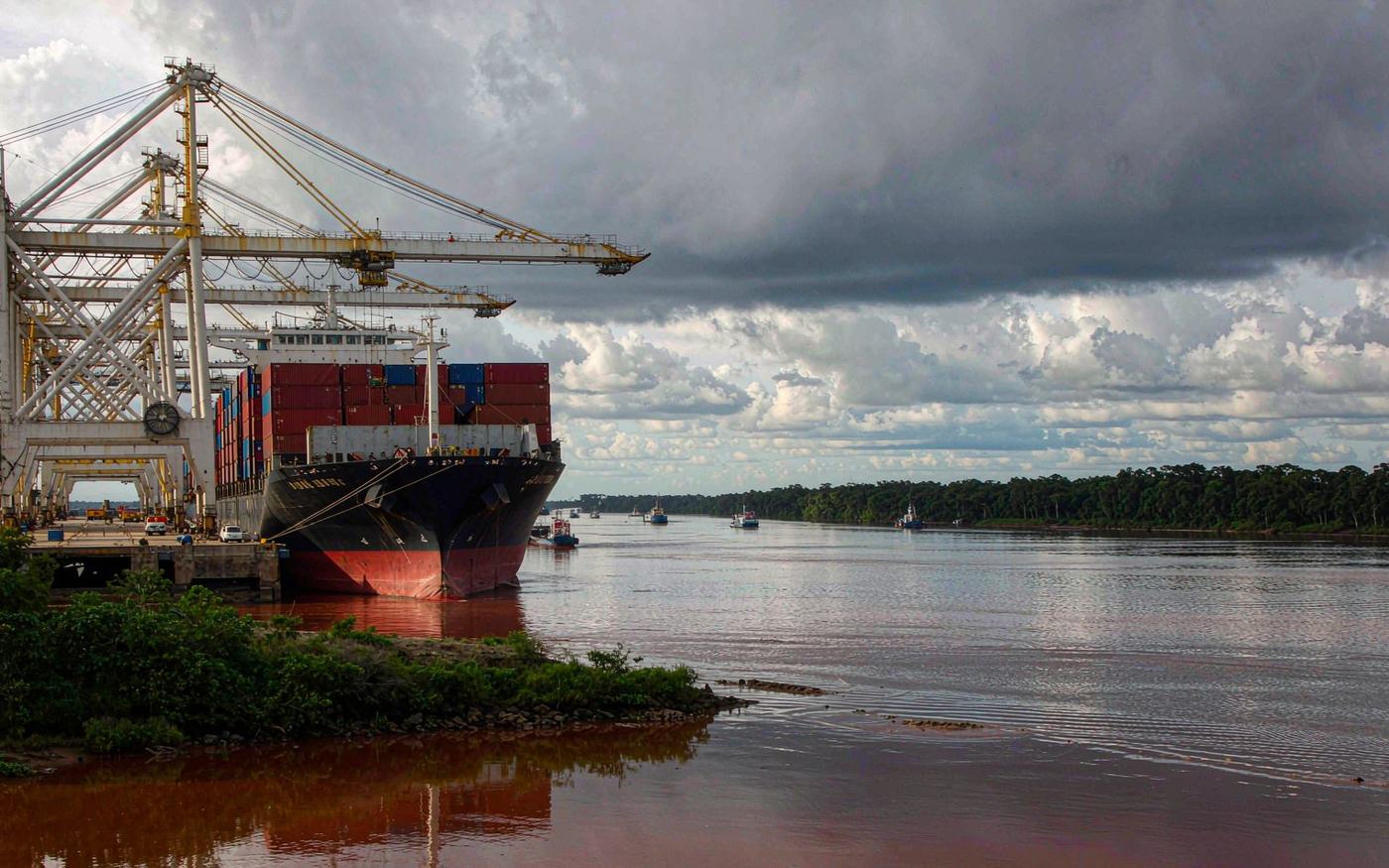
Dégrad des Cannes, a short distance from Cayenne on the Mahury river, is the department's main commercial port and handles virtually all container traffic. General cargo, fuel and some bulk also move through it.
There is no second container port to fall back on, so congestion and weather on the Mahury approach translate directly into your delivery date. Build the possibility of waiting into your plan rather than assuming a berth on arrival.
Road distribution inland and toward the Brazilian and Surinamese borders is limited by distance and by the road network. If your consignee is outside Cayenne and Kourou, confirm the last leg before you quote door delivery.
EORI, TARIC and DELTA: filing a European entry from a South American port
Because the Union Customs Code applies, your consignee needs an EORI number and the declaration is filed through the French customs system. The tariff you classify against is TARIC, which carries the EU's common tariff plus the specific measures attached to each code.
Practically, that means the HS code matters more here than it would for a non-EU South American destination. Get it right in China, before the goods sail, and make sure the commercial invoice carries enough detail for a French customs officer to accept the classification.
Origin also matters. Goods of EU origin arriving from metropolitan France are inside the customs union, so no customs duty is due, but octroi de mer still applies to goods entering the department. Do not assume that a European origin exempts a shipment from the local levy.
Air freight to Cayenne-Felix Eboue and the Kourou space cargo channel
Cayenne–Félix Éboué Airport serves the department, with links to metropolitan France and to the region. For air freight it is the gateway, and capacity is shaped by passenger services rather than by dedicated freighters.
The Europe's Spaceport at Kourou, a short distance along the coast, generates its own cargo flows: launch-related equipment, sensitive instrumentation and time-critical spares. That traffic competes for the same limited air and port capacity, and during launch campaigns it can absorb it.
If your shipment is urgent, ask whether a launch campaign overlaps your dates. That question is not on most forwarders' checklists and it is often the reason a cargo waits.
Gold, mercury and mining inputs: the consignments that get stopped
Gold mining, much of it informal, is one of the department's most heavily policed activities. Mercury, cyanide, explosives, fuel and equipment associated with extraction are tightly controlled, and enforcement is backed by military and gendarmerie operations.
For a legitimate exporter the risk is not that your goods are illegal but that they look adjacent to an illegal activity. Pumps, hoses, generators, prospecting equipment and chemicals of any kind should be documented precisely, with an end-use statement from the consignee.
Declare honestly and in detail. A vague description on a shipment of industrial equipment into French Guiana is the fastest way to turn a two-day clearance into a fortnight.
Dual-use goods, sanctions and CITES: the EU rulebook applies in full
Because this is EU territory, the European Union's dual-use export control regulation applies, as do EU restrictive measures and sanctions lists. Screening your consignee and the end-use is not optional here; it is the same obligation you would face shipping to Rotterdam.
CITES controls on endangered species apply as well, and French Guiana's own rainforest makes enforcement of wildlife and plant rules a live concern. Timber, live plants and animal products need permits.
Weapons, ammunition and controlled pharmaceuticals are prohibited or licensed. If there is any doubt, ask before booking rather than after the container is on the water.
Pricing in euros when the inland leg is already inside the European Union
The euro is the currency, so goods, duty and local charges are all settled in euros. That removes one translation step but not the exposure: your Chinese supplier will quote in US dollars or renminbi and the transit is long, so somebody is carrying the movement.
One advantage worth knowing. Goods released into free circulation here are EU goods. If your buyer has onward distribution into the European Union, the customs side is already done, and only the octroi de mer of the next territory would come into play.
That does not make French Guiana a back door into the European market. All the EU's product-compliance, safety and certification rules apply to goods placed on the EU market, wherever they first clear.
Packing and marking for a humid, high-rainfall destination
The climate is equatorial: hot, very humid, and with heavy rainfall through much of the year. Containers sit in the sun at Dégrad des Cannes and cartons absorb moisture quickly.
Use barrier packaging with desiccant for anything moisture-sensitive, avoid unsealed wooden crates for electronics, and specify corrosion protection on machined metal. Marking should be in French where the consignee needs French-language handling instructions.
Where the delay happens, and how long the whole move really takes
Sea freight from a Chinese port to Dégrad des Cannes typically runs 40 to 55 days including transshipment, most often through a Caribbean or European hub. Air freight is commonly 7 to 14 days door to airport, subject to capacity.
The delays are concentrated in three places: waiting for a transshipment connection, waiting for a berth at the single container port, and waiting on a customs examination triggered by a vague description.
Two of those three are within your control. Write a precise commodity description, and transship through a hub with frequent onward sailings rather than the cheapest one.
Why importers use Goodhope on this lane
Six things that are different about working with us on China to French Guiana shipments.
Case notes from the Degrad des Cannes gate
Five shipments bought in China and delivered into French Guiana, told end to end — where the order came from, how it moved, where it nearly went wrong, and how it finished. Client names are withheld at their request; the situations and the handling are what we deal with on this lane.
European rules, South American port · first container · Shenzhen to Cayenne
The purchase. A buyer new to importing assumed that shipping to South America meant South American customs procedures.
The move. Full container into Degrad des Cannes, declared under the EU Customs Code with an EORI number.
Where it nearly went wrong. This is a European customs border sitting in South America. The procedures, the tariff and the registration are the European ones, and preparing for a South American entry prepares you for the wrong thing entirely.
How it finished. We ran it as a European entry. The declaration was accepted without a single local surprise.
Octroi de mer · quoting · Ningbo to French Guiana
The purchase. A first-time buyer budgeted European VAT and did not know a separate local levy existed.
The move. Consolidated sea freight with the local levy band obtained in writing before he quoted.
Where it nearly went wrong. Being outside the EU VAT area means a different charge applies in its place, at a rate set locally rather than nationally. Assuming standard VAT understates the landed cost by the whole levy.
How it finished. We got the band in writing during quoting. His landed cost has matched the assessment every time.
Consignments that get stopped · mining inputs · Guangzhou to French Guiana
The purchase. A buyer importing equipment for mining did not expect his shipment to attract additional scrutiny.
The move. Sea freight with dual-use screening and the full EU rulebook applied before booking.
Where it nearly went wrong. The EU rulebook on dual-use goods, sanctions and CITES applies in full here, and mining inputs are among the categories that attract attention. Discovering that at the port costs weeks rather than days.
How it finished. We screened before booking. His equipment cleared without a licensing question.
Timing · where delay actually happens · Shanghai to French Guiana
The purchase. A buyer quoted his customer a transit figure based on the ocean leg alone.
The move. Sea freight with the full door-to-door schedule set out rather than the sailing time.
Where it nearly went wrong. The time on this lane goes in places other than the water. Knowing where the delay sits is what lets you quote a date you can actually keep.
How it finished. We gave him the whole picture. His delivery promises have held ever since.
Packing · humidity and rainfall · Yiwu to Cayenne
The purchase. A first-time buyer packed for a European delivery and lost part of the consignment to moisture.
The move. Full container packed for high rainfall and sustained humidity.
Where it nearly went wrong. This is a humid, high-rainfall destination with a long approach, and packaging that survives a temperate delivery does not automatically survive this one. Losses of this kind are excluded from more claims than importers expect.
How it finished. We specified the packing at booking. Nothing of his has arrived damaged since.
Why importers use Goodhope on this lane
Six things that are different about working with us on China to French Guiana shipments.
Get the octroi de mer band in writing before you quote
Send us the HS code and the cargo details and we will confirm the octroi de mer band that applies, what Dégrad des Cannes will charge for handling, and whether your commodity needs a permit or an end-use statement before it is loaded in China.
Get a quote Talk to usRelated pages
Frequently asked questions
Is French Guiana inside the European Union for customs?
Yes. It is an outermost region, so the Union Customs Code and the TARIC tariff apply and goods released here are in free circulation in the EU. It is not inside the EU VAT area.
Do I pay French VAT on imports?
No. TVA does not apply in the overseas departments. Instead you pay octroi de mer, a local levy on goods entering the department with an external rate and a regional additional rate.
What rate of octroi de mer should I budget for?
Published figures put the average external rate at around 15 per cent with a regional addition of about 2.5 per cent, and some sources describe bands running from zero to 30 per cent. The local authority sets the additional rate, so confirm the band for your HS code with a Guianan broker.
Which port handles containers?
Dégrad des Cannes, near Cayenne on the Mahury river. It is the department's only container port, so berth availability and weather on the approach affect delivery dates directly.
Do I need an EORI number?
Yes. The declaration is filed through the French customs system against the TARIC tariff, and your consignee needs an EORI number just as for any European entry.
Does EU origin exempt goods from octroi de mer?
No. Goods arriving from metropolitan France are inside the customs union so no customs duty is due, but octroi de mer still applies to goods entering the department.
What goods are restricted?
Mining-related equipment and chemicals, particularly anything usable in gold extraction, are tightly controlled and enforcement is heavy. Dual-use goods fall under the EU regulation, CITES controls apply to wildlife and timber, and weapons and controlled pharmaceuticals are prohibited or licensed.
Can I ship by air to Kourou?
Air freight arrives at Cayenne–Félix Éboué Airport and moves by road to Kourou. During launch campaigns at the spaceport, capacity on both air and sea routes can be absorbed by launch-related traffic.
What currency is used?
The euro. Goods, duty and local charges are settled in euros, though your Chinese supplier will likely quote in US dollars or renminbi, so agree who carries the exchange movement.
How long does shipping take from China?
Sea freight to Dégrad des Cannes is typically 40 to 55 days including transshipment; air freight is commonly 7 to 14 days door to airport, subject to capacity. Treat both as estimates.