
Home / Shipping to Gibraltar / How to Ship from China to Gibraltar
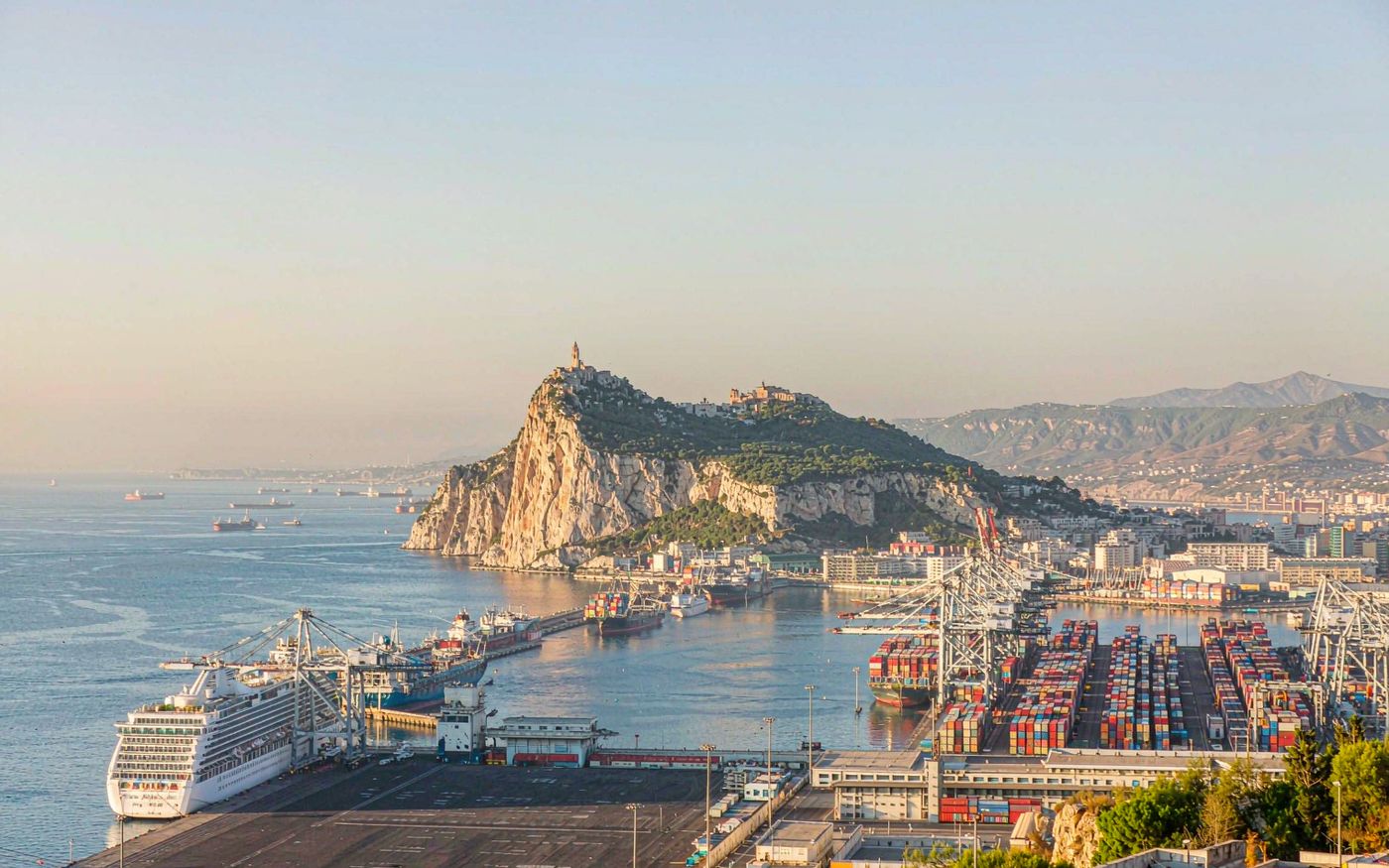
How to Ship from China to Gibraltar: the Port, the La Línea Crossing & the New Transaction Tax
Read this before you price anything. Gibraltar's customs and indirect tax framework is being rewritten. Government technical notices describe a new customs arrangement with the European Union and a transaction tax that replaces the current import duties, with an entry-into-force date that those notices described as envisaged rather than settled. The operational guidance below reflects that published material, but you must confirm the current position with HM Customs Gibraltar or a Gibraltar broker before contracting. This page is a freight and sequencing guide, not tax advice.
Gibraltar is six square kilometres at the southern tip of Spain, and it is in nobody else's customs territory. That is the fact everything else follows from. Gibraltar left the European Union alongside the United Kingdom, and it is not inside the UK for customs purposes either. It runs its own customs administration — HM Customs Gibraltar — and your shipment clears there as a Gibraltar import, on its own terms, separate from anything filed in Spain or Britain.
The second thing is the one buyers find attractive and then misread: there is no import VAT. A Gibraltar customs entry has no VAT line at all. Published references describe import duty running from zero to twelve percent as the practical trade tax instead. The absence of VAT removes the single largest cost most people fear on a European entry — but it does not remove the need for an accurate declaration, and under the new arrangements a transaction tax is arriving to sit where the duties used to be.
The third is physical. Everything that enters Gibraltar passes through one port, one airport, or one land border crossing. Local delivery is trivial; the bottleneck is the gateway. And the gateway includes La Línea, where the queue is a real and well-documented planning variable rather than a minor inconvenience.
At a glance
Territory: British Overseas Territory at the southern tip of the Iberian Peninsula, about 6.7 square kilometres · Customs status: in neither the UK nor the EU customs territory; own administration, HM Customs Gibraltar · VAT: none · Import duty: commonly cited at zero to twelve percent · New charge: transaction tax, described as starting at fifteen percent and rising to seventeen, with excise duties limited to tobacco, fuel and alcohol · Gateways: Port of Gibraltar, Gibraltar International Airport, and the La Línea land frontier · Currency: Gibraltar pound and pound sterling both accepted
How your cargo moves: China to Gibraltar
Eight steps from your supplier's door to yours. The last four are the ones shaped by local rules.
- Pickup from your supplierWe collect the goods anywhere in China and bring them to our consolidation point.
- Export clearanceChina customs declaration filed and released before the goods move to the port.
- Loading and departureContainer loaded, sealed and handed to the carrier at the Chinese port.
- Main carriageOcean, air or rail movement booked on the route agreed for your cargo.
- Arrival at the gatewayDischarge at the port or airport of entry, recorded on the carrier's manifest.
- Import clearanceCustoms declaration filed locally, with duty and tax assessed on the declared value.
- Customs releaseGoods released into free circulation once duty and tax are settled.
- Final deliveryOnward movement to your delivery address, warehouse or nominated depot.
Duty rates, VAT rates and clearance times move, and the figure that applies to your goods is the one set for your commodity code on the day of clearance. We check the current position against your code before your goods sail and confirm it to you in writing — ask for that check when you request a quote.
Neither UK nor EU customs territory, and what that means at the quay
The position is unusual and worth stating carefully, because both halves of it surprise people.
Not the EU. Gibraltar left the European Union with the United Kingdom. It is a third country vis-à-vis the EU for customs purposes, and goods moving between Gibraltar and Spain cross a real frontier with checks on both sides.
Not the UK either. This is the less intuitive half. Gibraltar is a British Overseas Territory, not part of the United Kingdom, and it is not inside the UK customs territory. A shipment clears as a Gibraltar import, under Gibraltar's own administration, and an entry filed in Britain does not cover it. For a Chinese exporter the practical point is simply this: ask your consignee who their Gibraltar broker is, and assume the process is local rather than British.
No import VAT, and a duty band that runs from zero to twelve
There is no value added tax in Gibraltar, and that is genuinely significant. On a comparable European entry, VAT is usually the largest single line in the landed cost. Here that line simply does not exist on the customs entry.
What exists instead is import duty, which published references describe as running from zero to twelve percent, with duty forming part of government revenue alongside corporate tax. By European standards that is modest. But two cautions apply.
Low duty does not mean low scrutiny
A Gibraltar lodgement is its own discipline. The absence of VAT removes the largest cost, not the obligation to declare accurately. Classification, value and origin still have to be right.
The band is wide and product-specific
Zero to twelve percent is a range, not a rate. Published category breakdowns put books at zero, machinery at the lower end, and electronics, clothing, footwear, food and cosmetics across the band. Confirm your HS code.
The new transaction tax, and why the rules are being rewritten
This is the part of Gibraltar that is moving, and it is the part a new importer is least likely to know about.
Government technical notices describe a bespoke customs arrangement between Gibraltar and the European Union. Under it, Gibraltar aligns many customs rules and import duty rates with those applied across the EU, and the current import duties cease to apply on entry into force. In their place come two new charges:
| Element | What the technical notices describe |
|---|---|
| Customs duties | Levied by a designated customs point applying the EU Common External Tariff, with the proceeds paid back to Gibraltar |
| Transaction tax | Standard rate not below the lowest EU standard VAT rate, described as starting at fifteen percent and rising annually to seventeen percent by the third year; a reduced rate of five percent and a super-reduced rate of zero percent for categories listed in Annex III of the EU VAT Directive |
| Excise duties | Applied only to tobacco, fuel and alcohol |
| Point of charge | Transaction tax and excise duties apply only where goods are placed for sale in the Gibraltar market. Goods going into bond or another special customs procedure are charged only when released to the market |
| Bonded storage | No time limit on goods kept in a customs warehouse; at least twenty-four months for goods under inward processing or temporary admission |
Confirm the status before you rely on any of this. The technical notices describe an entry-into-force date that was envisaged rather than confirmed, and the rates step up over three years. If you are quoting a Gibraltar buyer, ask their broker to state in writing which regime currently applies to your product and what the rate is. We will do the same from our side on the freight.
Clearing through Spain, or landing direct at the Port of Gibraltar
Under the new framework, the technical notices describe a shift in where clearance physically happens: rather than routine customs control at the land border, most goods entering Gibraltar are cleared through designated EU customs offices in Spain, using a designated customs point. The objective is to reduce frontier congestion while keeping customs supervision intact.
That produces a genuine routing choice, and it is one worth making deliberately rather than by default.
- Direct sea landing at the Port of Gibraltar. This sidesteps the land frontier entirely. For cargo arriving by sea it is often the cleaner option, and it removes the border queue from the critical path altogether.
- Road from Algeciras or Málaga. This means crossing at La Línea, and it can be the right answer where the cargo has arrived at a Spanish port. But it puts the border on the critical path, and the border is variable.
- Air. Gibraltar International Airport handles air freight and is efficient for smaller consignments, with the same single-gateway constraint as everything else.
Under the new arrangements, exports from Gibraltar to the EU are described as using the T1 and T1GI transit procedures by land to the designated customs point. Non-EU goods may be exported by sea from the port of Gibraltar to destinations outside the EU without physical presentation there. If your consignee intends to re-forward goods, that distinction matters to how the movement should be documented.
La Linea, the only land frontier, and the queue as a planning input
Gibraltar has exactly one land frontier, at La Línea de la Concepción, and it is a real border with checks on both sides. Queues there are a well-known and genuine variable: short at a quiet hour, long at a bad one, and fluctuating with the day of the week, the season and the wider Spain–Gibraltar arrangements.
Treat it as a planning input rather than an afterthought. In practice that means three things:
Choose the crossing window
If the road leg is unavoidable, book it for a quiet window rather than letting it fall wherever it lands. An early-morning crossing is a different proposition from a Friday afternoon one.
Keep the transit documentation clean
The reason a crossing turns into a delay is usually a document query rather than the queue itself. Clean, consistent paperwork is what keeps a truck moving at the line.
Give a realistic arrival, not an optimistic one
A Gibraltar consignee who is told an honest arrival window will plan around it. One who is told a best-case date will plan to that date and be disappointed when the border disagrees.
Six square kilometres: one port, one airport, one border crossing
The territory's size is the operational constraint, and it cuts both ways. On the positive side, local delivery is trivial — there is nowhere on the Rock that is far from anywhere else, and the last mile is rarely the problem. Published references describe clearance as efficient for the same reason: a small territory with a single gateway processes quickly, with typical clearance cited at one to three days.
On the negative side, there is no alternative route. If the port is congested, if the airport has a backlog, or if the border is slow, there is no second gateway to divert to. That is why the recommendation to land direct at the port rather than by road is worth taking seriously, and why a schedule with no slack is a schedule with a known failure mode.
Tobacco and alcohol draw the heaviest enforcement on the Rock
Gibraltar's position — a low-duty jurisdiction on the edge of the EU — makes tobacco and alcohol the most sensitive lines in the tariff. Published guidance describes both as heavily controlled on anti-smuggling grounds, and under the new arrangements excise duties will apply only to tobacco, fuel and alcohol, which concentrates the enforcement attention on exactly those three.
For a Chinese exporter, the trap is usually inadvertent. Promotional alcohol bundled with a non-alcoholic order, branded bar accessories shipped with miniature bottles, or a gift pack containing tobacco all convert an ordinary consignment into a controlled one. If any line in the consignment is tobacco, alcohol or fuel, declare it explicitly and confirm the requirements before shipping, rather than treating it as part of the general cargo.
Bonded storage and why it changes how you invoice
Bonded storage is more useful in Gibraltar than on most comparable lanes, and it is worth understanding because it changes the shape of a transaction rather than just its timing.
Goods placed in a customs warehouse — or bond — do not attract the market-entry charges until they are released for sale in Gibraltar. Under the new arrangements the technical notices describe no time limit on goods held in bond, and longer periods of at least twenty-four months for goods under an inward processing or temporary admission procedure. That makes Gibraltar usable as a genuine holding point rather than just a destination.
The invoicing consequence follows directly. If the goods are going into bond, the transaction tax and excise duties are not yet due, and your commercial invoice should be structured so that distinction is visible — the value of the goods as landed, separate from anything that becomes chargeable only on release to market. It is a small piece of document discipline that prevents a large argument later.
Routing a China shipment to the Rock
Gibraltar sits at the western entrance to the Mediterranean, which makes it well served by the main east–west trunk routes even though the territory itself is tiny.
| Stage | What happens | What decides it |
|---|---|---|
| Regime check | Confirm which duty and tax regime currently applies to the product, and the rate | The product and the current state of the new arrangements — do this first |
| Route choice | Direct sea landing at the Port of Gibraltar, road via Algeciras, or air | Whether you want the land frontier on the critical path at all |
| Main carriage | Sea from a Chinese port, normally via a major Mediterranean hub | The carrier's rotation and the transhipment connection |
| Documentation | Invoice, packing list, bill of lading or airway bill, customs declaration, certificate of origin where relevant | Whether the papers were complete before the truck was booked |
| Clearance | Entry with HM Customs Gibraltar, or through the designated customs point under the new arrangements | Which regime is in force and whether permits were prepared |
| Release and local delivery | Small distances, quick delivery | Usually the least of your problems — the gateway is the constraint |
Questions to settle with a Gibraltar consignee before shipping
- Who is the Gibraltar broker? The process is local, not British and not Spanish.
- Which regime applies to this product right now? Get the answer in writing, with the rate.
- Direct to the port, or by road across La Línea? Make it a decision, not a default.
- If by road, what crossing window? Choose it deliberately.
- Is there any tobacco, alcohol or fuel in the consignment? Including promotional items.
- Are the goods going into bond or to market? It changes when charges fall due and how the invoice should read.
- Does the product need an import licence? Firearms, controlled drugs and some regulated items do.
- Will the consignee re-export to the EU? If so, the transit procedure matters.
Why importers use Goodhope on this lane
Six things that are different about working with us on China to Gibraltar shipments.
Get the route and the regime question settled before you book
Tell us what you are shipping, the HS codes if you have them, the packed dimensions and gross weight, the pickup city in China and the delivery address in Gibraltar. We will confirm the current rotation and whether a direct landing at the Port of Gibraltar or a road movement via Algeciras suits the cargo better, flag any line that is tobacco, alcohol or fuel before it becomes a problem at the frontier, structure the invoice so that goods going into bond are distinguished from goods going to market, and quote the sea and air options separately. Where a question is one for HM Customs Gibraltar or a Gibraltar broker rather than for us, we will say so plainly.
Get a quote Talk to usRelated pages
Frequently asked questions
Is Gibraltar in the EU or UK customs territory?
Neither. It runs its own customs administration, HM Customs Gibraltar, and a shipment clears there as a Gibraltar import. Gibraltar pounds and British pounds are both accepted as currency.
Is there VAT on imports into Gibraltar?
No. A Gibraltar customs entry has no import VAT line. Published references describe import duty running from zero to twelve percent instead. A transaction tax on goods placed for sale in the market is being introduced under the new arrangements.
What is the Gibraltar transaction tax?
Government technical notices describe it as replacing the current import duties, with a standard rate starting at fifteen percent and rising to seventeen percent by the third year, a reduced rate of five percent and a super-reduced rate of zero percent for listed categories. It applies only where goods are placed for sale in the Gibraltar market. Confirm current status with HM Customs Gibraltar.
How does cargo clear into Gibraltar under the new arrangements?
Through designated EU customs offices in Spain using a designated customs point, applying the EU Common External Tariff with proceeds paid back to Gibraltar. Exports to the EU use T1 and T1GI transit procedures by land.
Should cargo land direct at the Port of Gibraltar or cross at La Línea?
A direct sea landing avoids the land frontier entirely and is often the cleaner option. Routing by road from Algeciras or Málaga puts the La Línea queue on the critical path, so choose the crossing window deliberately if you go that way.
How large is Gibraltar and does that affect delivery?
About 6.7 square kilometres, so local delivery is trivial and clearance is generally quick — one to three days is the figure commonly cited. The constraint is the single gateway: port, airport or border crossing.
Are tobacco and alcohol treated differently?
Yes. Both are heavily controlled on anti-smuggling grounds, and under the new arrangements excise duties apply only to tobacco, fuel and alcohol. Declare any such line explicitly, including promotional items.
What is bonded storage and does it help?
Goods held in a customs warehouse do not attract the market-entry charges until released for sale. The technical notices describe no time limit on goods in bond, and at least twenty-four months under inward processing or temporary admission. Structure the invoice so the distinction is visible.
What documents does a Gibraltar import need?
Commercial invoice, packing list, bill of lading or airway bill, and a customs declaration. A certificate of origin may be needed for preferential duty, and an import licence for restricted goods. Certificates are issued by the Gibraltar Chamber of Commerce.
How long does shipping from China to Gibraltar take?
Sea freight to the western Mediterranean is multi-week and normally routed through a major Mediterranean hub. Air via a European hub is substantially faster. Clearance itself is quick. Ask us for the current rotation.