
Home / Shipping to Guadeloupe / How to ship from China to Guadeloupe
How to ship from China to Guadeloupe
Guadeloupe is a French overseas department in the eastern Caribbean with roughly 380,000 people. Like the other French departments in this region, it is inside the European Union for customs and outside it for VAT, which produces a tax outcome that most freight calculators get wrong.
The other thing that governs any shipment here is the calendar. The Atlantic hurricane season runs from June to November, and the closing dates, berth windows and inland delivery slots all move with it. A quotation that ignores the season is a quotation that will be renegotiated later.
Below: the port, the tax stack, the hurricane question and the paperwork.
At a glance
Status: French overseas department and EU outermost region, inside the EU customs territory but outside the EU VAT area. Gateway: the container terminal at Port de Jarry, Pointe-à-Pitre; Guadeloupe Pôle Caraïbes Airport, PTP, for air. Taxes: TVA at 8.5 per cent standard and 2.1 per cent reduced, plus dock dues and a regional addition. Currency: euro. Hurricane season: June to November. Population: about 380,000.
How your cargo moves: China to Guadeloupe
Eight steps from your supplier's door to yours. The last four are the ones shaped by local rules.
- Pickup from your supplierWe collect the goods anywhere in China and bring them to our consolidation point.
- Export clearanceChina customs declaration filed and released before the goods move to the port.
- Loading and departureContainer loaded, sealed and handed to the carrier at the Chinese port.
- Main carriageOcean, air or rail movement booked on the route agreed for your cargo.
- Arrival at the gatewayDischarge at the port or airport of entry, recorded on the carrier's manifest.
- Import clearanceCustoms declaration filed locally, with duty and tax assessed on the declared value.
- Customs releaseGoods released into free circulation once duty and tax are settled.
- Final deliveryOnward movement to your delivery address, warehouse or nominated depot.
Duty rates, VAT rates and clearance times move, and the figure that applies to your goods is the one set for your commodity code on the day of clearance. We check the current position against your code before your goods sail and confirm it to you in writing — ask for that check when you request a quote.
Inside the EU for customs, outside it for VAT
Guadeloupe is part of the European Union's customs territory. The Union Customs Code applies, the tariff is TARIC, your consignee needs an EORI number, and goods released here are in free circulation in the EU.
It is not part of the EU VAT area. The department runs its own VAT rates: 8.5 per cent standard and 2.1 per cent reduced for certain goods. If your landed-cost model assumes the 20 per cent mainland French rate, it is wrong by more than half the tax line.
Goods arriving from mainland France or another EU member state are inside the customs union, so no customs duty is due. The local taxes below still apply regardless of origin.
Port de Jarry, the cold store capacity, and what it means for your cargo
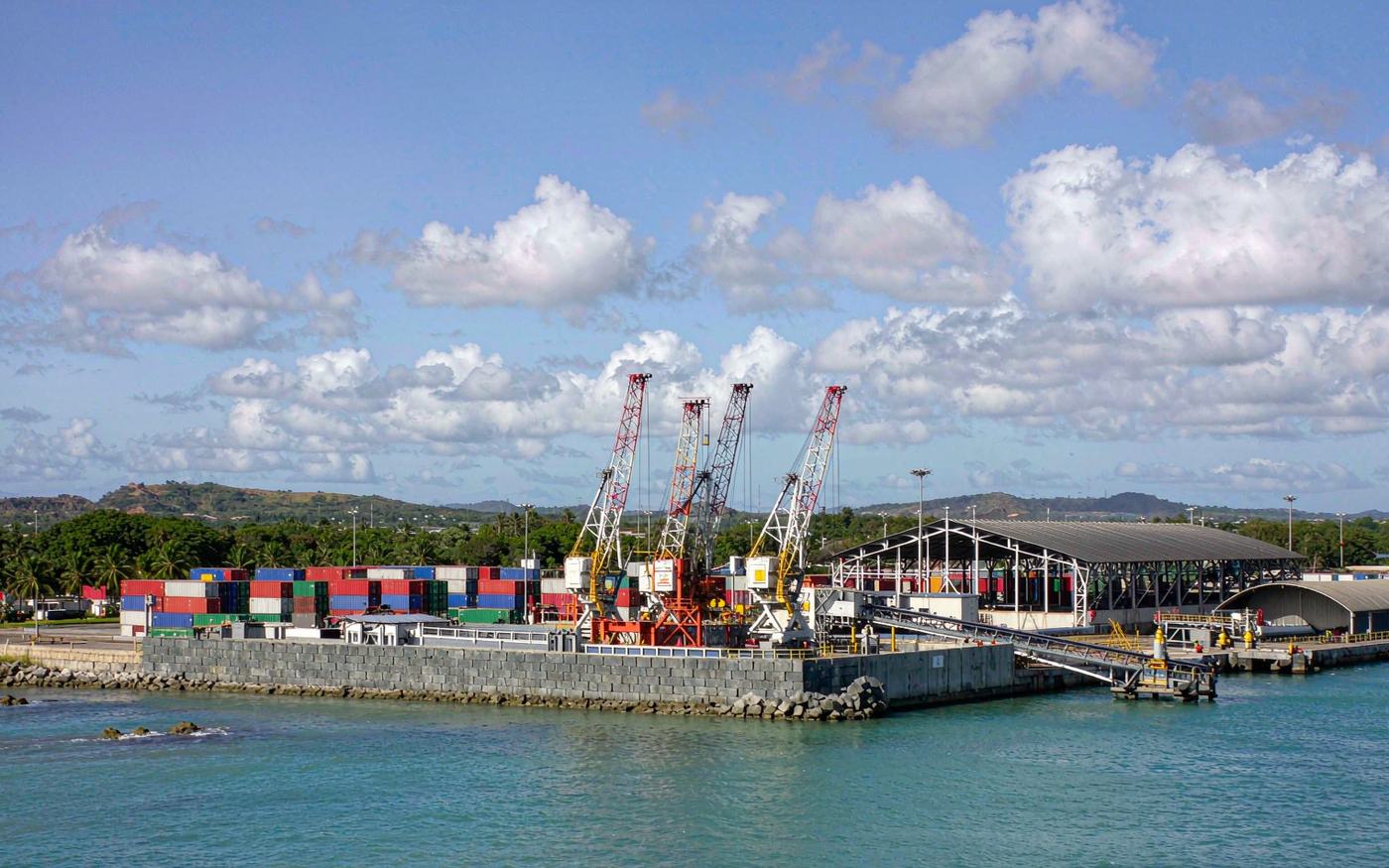
The container terminal at Port de Jarry, serving Pointe-à-Pitre, is Guadeloupe's main commercial gateway. It has nine berths across roughly 1,200 metres of quay, gantry cranes, and a declared maximum draught of about 11 metres and maximum length overall of about 300 metres.
The port is operated by Guadeloupe Port Caraïbes and handles container, bulk, liquid, Ro-Ro and cruise traffic. Reported volumes sit in the range of 150,000 to 250,000 TEU a year depending on the source, alongside substantial general cargo.
The cold chain matters here. The port holds significant dry and refrigerated warehouse capacity, among the largest in the Caribbean, which makes it workable for chilled and frozen consignments and gives you a realistic option if your goods need temperature control on arrival.
Hurricane season and the closing dates that come with it
The Atlantic hurricane season runs from 1 June to 30 November, with the busiest period usually from August to October. That is not a footnote: it changes carrier closing dates, berth availability and inland delivery windows across the eastern Caribbean.
Plan around it rather than through it. If your cargo is not time-critical, ship outside the peak months. If it is, build a buffer of a week or more into the delivery promise and tell your buyer why before they ask.
Also confirm what happens to your container if a storm warning closes the port. Storage, demurrage and re-delivery are the three costs that appear in the aftermath, and they are far easier to agree in advance than to argue about afterwards.
Dock dues and TVA: what each one is charged on
Two separate charges land on an import here, and they are calculated differently. VAT is charged at the local rate on the customs value. Dock dues are charged on goods entering the department, banded by HS code, and they apply to arrivals from mainland France as well as from third countries.
Published guidance puts many dock dues rates in the range of 7 to 15 per cent, with a regional addition commonly set at 1.5 or 2.5 per cent. Rates well above and below that range exist for specific products, and the schedule is revised periodically.
The practical rule: never quote a single all-in percentage. Get the band for your HS code confirmed by a Guadeloupe broker and state VAT and dock dues as separate lines on the quotation.
Air freight to Pole Caraibes and the limits of a Caribbean hub
Guadeloupe Pôle Caraïbes Airport, code PTP, handles the department's air traffic and its air cargo. Links run to mainland France and to regional points, and capacity is shaped by passenger services rather than freighters.
The constraint for shippers is not the long-haul leg out of China, it is the last sector and the aircraft that flies it. Confirm the aircraft type and usable door dimensions before you promise an air delivery date on anything bulky.
Air freight works well for spare parts, electronics, medical supplies and samples. For anything heavy, the ocean leg is usually the only sensible option.
The Antilles hub project, and what it may change for shippers
The ports of Guadeloupe and Martinique have been working with CMA CGM on an Antilles hub concept, intended to create a regional transshipment platform and diversify supply sources into the Caribbean. France's competition authority has commented on the proposal and has stressed that it should not foreclose other shipping operators.
For a shipper the relevance is practical rather than political. If the hub develops, more cargo may route through these ports for onward Caribbean distribution, which could improve frequency and reduce reliance on a single direct service.
Nothing about it changes your obligations today. Confirm the routing that actually exists at the time you book.
Bananas, sugar and the agricultural border that guards them
Guadeloupe's agricultural economy, sugar cane and bananas in particular, is protected, and that protection shows up at the border. Plant material, seeds, soil, unprocessed wood and food products face controls, and some categories require permits issued before the goods ship.
Second-hand goods also attract attention, as they do across the French Caribbean. Used vehicles, used machinery and used tyres each carry their own requirements.
Wood packaging must meet ISPM 15 with the mark visible. It is the most routine cause of a consignment being held, and the cheapest to avoid.
Documents in French, and the consignee details customs checks
The core set is the standard one: commercial invoice with HS codes and a precise description, packing list, bill of lading or air waybill, and any permit or certificate your goods need. French is the working language, and inventories presented in English are frequently rejected.
The consignee details are the other common failure point. The importer's registration details on the declaration must match exactly what the administration holds, and a mismatch will stop a release faster than almost anything else.
Send the full document set to your broker while the cargo is still at sea. Fixing a description after arrival means storage charges.
Consolidating for a market of under four hundred thousand people
With a population under 400,000, no importer here is ordering weekly container volumes. Most shipments are consolidated resupply: building materials, vehicles and parts, food, retail stock and hotel or tourism equipment.
Consolidation in China is usually the right answer, and LCL makes more sense here than it does on very small island routes, because Pointe-à-Pitre has real deconsolidation capability.
Time the arrival to the consignee's ability to receive. Yard space is finite, particularly in the run-up to and during the storm season.
Transit times from China and the transshipment choices
Sea freight from a Chinese port to Pointe-à-Pitre typically runs 35 to 50 days including transshipment, most often through a European or Caribbean hub. Air freight is commonly 7 to 12 days door to airport.
The transshipment choice drives the total more than the ocean leg does. A hub with frequent onward sailings to the eastern Caribbean will usually beat a nominally shorter routing with a weekly connection.
Then add the seasonal buffer. From August to October, add a week to whatever number your forwarder gives you.
Why importers use Goodhope on this lane
Six things that are different about working with us on China to Guadeloupe shipments.
Actual moves across Guadeloupe
Five shipments bought in China and delivered into Guadeloupe, told end to end — where the order came from, how it moved, where it nearly went wrong, and how it finished. Client names are withheld at their request; the situations and the handling are what we deal with on this lane.
Inside for customs, outside for VAT · first container · Shenzhen to Pointe-a-Pitre
The purchase. A buyer new to importing assumed European Union membership meant the standard European VAT applied.
The move. Full container declared as a European customs entry, with the local tax applied instead of VAT.
Where it nearly went wrong. This territory is inside the EU customs territory and outside the EU VAT area, which produces a combination that trips up people who assume the two always travel together.
How it finished. We split the two on his quote. His landed cost has been right on every shipment.
Cold store · temperature-sensitive cargo · Ningbo to Guadeloupe
The purchase. A first-time buyer shipping chilled goods did not ask what happened between the vessel and the cold room.
The move. Sea freight booked against available cold store capacity rather than against the sailing alone.
Where it nearly went wrong. Cold store capacity at the port is finite, and it determines whether a temperature-sensitive consignment actually survives arrival. Booking the vessel without reserving the chain is booking half the move.
How it finished. We confirmed cold capacity during quoting. Every chilled consignment has gone straight into the chain.
Hurricane season · June to November · Guangzhou to Guadeloupe
The purchase. A buyer scheduled a September delivery because that was when his goods would be ready.
The move. Sea freight scheduled either side of the season, with the closing dates built into the plan.
Where it nearly went wrong. The hurricane season brings closing dates rather than just bad weather, and ports close in advance of a storm rather than during it. A September delivery is a delivery planned around closures.
How it finished. We shifted his shipment to May. It discharged and cleared in clear weather.
Documents in French · consignee details · Yiwu to Guadeloupe
The purchase. A buyer submitted English documentation and an incomplete consignee address.
The move. Consolidated sea freight with French-language documents and full consignee details prepared before departure.
Where it nearly went wrong. Documentation here is in French, and customs checks the consignee details rather than accepting them. A partial address produces a query rather than a delivery attempt.
How it finished. We standardised both on his first French-territory order. No consignment has been queried since.
Small market · consolidation · Shanghai to Guadeloupe
The purchase. A buyer with three pallets concluded the lane was not viable because he was quoted a full container rate.
The move. Consolidated LCL sharing container space with other cargo bound for the same port.
Where it nearly went wrong. This is a market of fewer than four hundred thousand people, and most profitable shipments into it are consolidated rather than full loads. The container size should follow your order, not set it.
How it finished. He consolidates quarterly now. The lane became one of his steadier ones.
Why importers use Goodhope on this lane
Six things that are different about working with us on China to Guadeloupe shipments.
Price the hurricane season into the schedule
Tell us the commodity, the HS code and when the goods need to land, and we will say whether your dates sit inside the storm window, which transshipment hub gets you there most reliably, and what the dock dues band looks like for your code.
Get a quote Talk to usRelated pages
Frequently asked questions
Is Guadeloupe in the European Union for customs?
Yes. It is an outermost region inside the EU customs territory, so the Union Customs Code and TARIC apply and goods released here are in EU free circulation. It is outside the EU VAT area.
What VAT rate applies?
The local rate of 8.5 per cent standard, with 2.1 per cent reduced for certain goods. The 20 per cent mainland French rate does not apply here.
Do dock dues apply to goods sent from mainland France?
Yes. Goods moving from mainland France are inside the customs union so no customs duty is due, but dock dues apply to goods entering the department regardless of origin.
Which port handles containers?
The container terminal at Port de Jarry, serving Pointe-à-Pitre. Nine berths across roughly 1,200 metres of quay, about 11 metres maximum draught, with significant dry and refrigerated warehouse capacity.
When is hurricane season?
The Atlantic season runs 1 June to 30 November, busiest from August to October. It affects carrier closing dates, berth availability and inland delivery, so build in a buffer or ship outside the peak.
Do I need an EORI number?
Yes. The declaration is filed with French customs against TARIC, so the importer needs an EORI number as for any European entry.
Does the language of the documents matter?
Yes. French is the working language of the administration and English-language inventories are frequently rejected. Descriptions, labels and handling instructions should be available in French.
What goods face extra controls?
Plant material, seeds, soil, unprocessed wood and food products, reflecting the protected agricultural economy. Second-hand vehicles, machinery and tyres also carry their own requirements. Wood packaging must meet ISPM 15.
Is LCL a sensible option?
Usually yes. Pointe-à-Pitre has real deconsolidation capability, unlike much smaller island ports, so LCL is worth comparing against a part-loaded container.
How long does shipping take from China?
Sea freight including transshipment is typically 35 to 50 days; air freight is commonly 7 to 12 days door to airport. Add a further buffer during the August to October peak.