
Home / Shipping to Iceland / How to Ship from China to Iceland
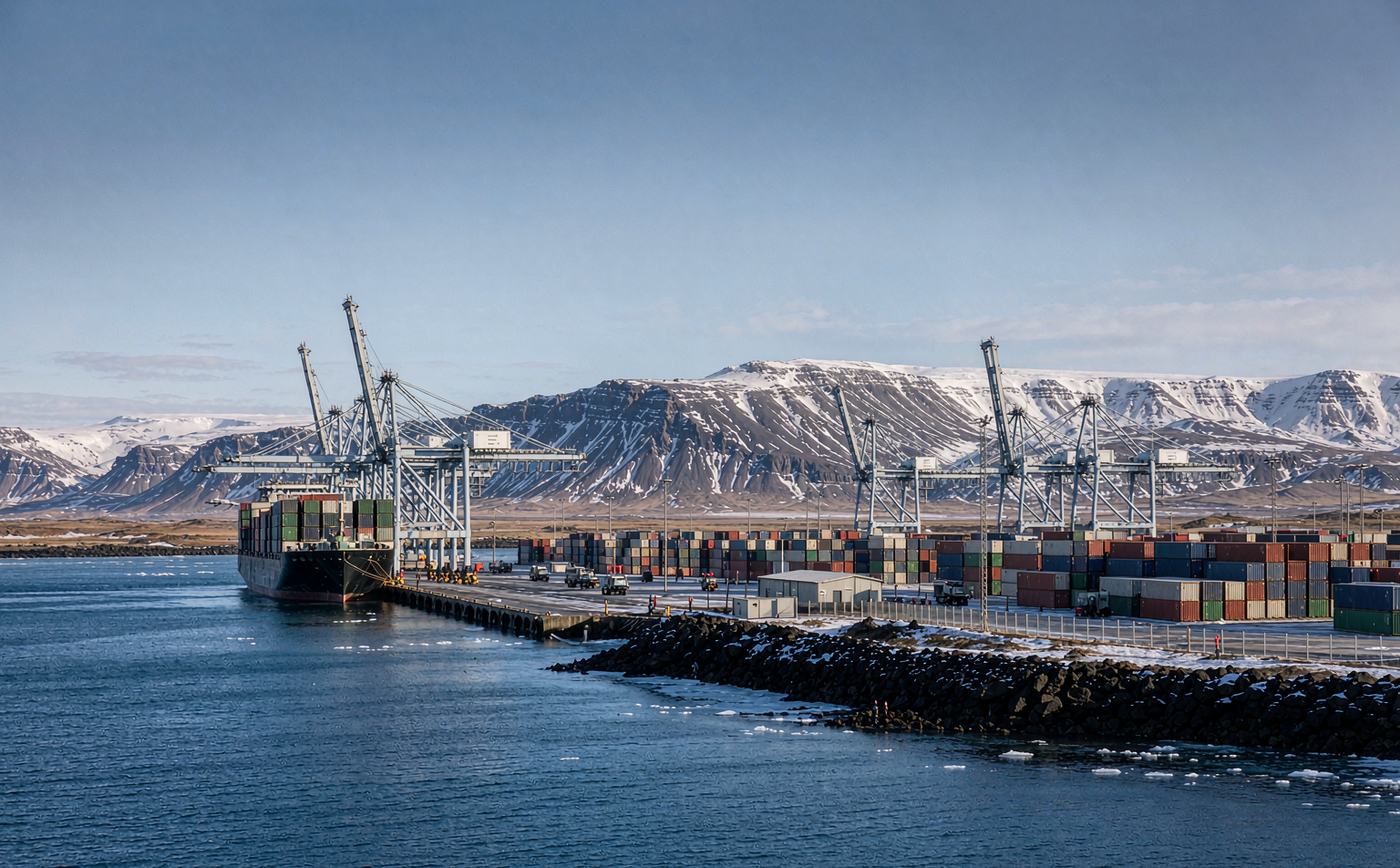
How to Ship from China to Iceland: Zero Duty under the FTA & 24% VSK
Iceland is the one market in this series where a free trade agreement with China actually applies, and it is worth real money. The agreement has been in force since 1 July 2014, it was China's first with a European country, and Iceland applies zero customs duty to all industrial products and aquatic products of Chinese origin. Final zero-tariff coverage runs close to 96% of tariff lines and close to 100% by trade volume. The relief is not automatic, though — you have to claim it with a certificate of origin, and a surprising number of importers never do.
Set against that advantage is a set of constraints that are easy to underestimate. There is no direct container service from China to Iceland — everything feeds north from Rotterdam or Hamburg on one of two Icelandic carriers. There is no railway in the country at all. There is no de minimis threshold, so a parcel worth a few dollars still generates import charges. And VSK runs at 24% on a CIF value that includes the cost of getting the goods all the way to Iceland.
This is written for buyers importing from China for the first time. It covers the agreement and how to claim under it, what EEA membership does and does not give you, how a container actually reaches Reykjavík, the ports, transit times, air freight, import charges and VSK, the kennitala and VAT agent rules, product compliance, and how to judge a forwarder on a lane this thin.
Iceland at a glance
- Zero duty on Chinese industrial goods. The China–Iceland free trade agreement has been in force since 1 July 2014 — China's first with a European country. You claim it with a certificate of origin.
- EEA and Schengen, not EU. Outside the EU customs union and the EU VAT area. No EORI number; a kennitala instead.
- No direct Asia service. Every container feeds from Rotterdam or Hamburg on Eimskip or Samskip, and those sailings are weekly.
- No railway exists in Iceland. Every inland movement is by road on the Ring Road.
- VSK 24% standard, 11% reduced, charged on the CIF value to Iceland.
- There is no de minimis. Import charges apply regardless of value — Skatturinn's own wording is that it applies whether the value is one dollar or a thousand.
- Skatturinn is both the tax authority and the customs authority. VSK is filed bimonthly.
- Population around 390,000, with roughly two thirds in the Reykjavík capital region — a market where most importers are small firms.
How your cargo moves: China to Iceland
Eight steps from your supplier's door to yours. The last four are the ones shaped by local rules.
- Pickup from your supplierWe collect the goods anywhere in China and bring them to our consolidation point.
- Export clearanceChina customs declaration filed and released before the goods move to the port.
- Loading and departureContainer loaded, sealed and handed to the carrier at the Chinese port.
- Main carriageOcean, air or rail movement booked on the route agreed for your cargo.
- Arrival at the gatewayDischarge at the port or airport of entry, recorded on the carrier's manifest.
- Import clearanceCustoms declaration filed locally, with duty and tax assessed on the declared value.
- Customs releaseGoods released into free circulation once duty and tax are settled.
- Final deliveryOnward movement to your delivery address, warehouse or nominated depot.
Duty rates, VAT rates and clearance times move, and the figure that applies to your goods is the one set for your commodity code on the day of clearance. We check the current position against your code before your goods sail and confirm it to you in writing — ask for that check when you request a quote.
Iceland charges China zero duty, and most importers never claim it
Every other destination covered in this series is in the European Union, and the EU has no free trade agreement with China. Duty there comes from the TARIC commodity code at the ordinary rate, and that is simply the cost of doing business. Iceland is different. The free trade agreement between the Government of China and the Government of Iceland entered into force on 1 July 2014, and it was China's first free trade agreement with a European country.
What it delivers is unusually complete. Iceland applies zero customs duty to all industrial products and aquatic products of Chinese origin. On the Chinese side of the ledger, roughly 99.77% of exports to Iceland receive zero tariff treatment. Measured across the whole agreement, the products ending at zero duty amount to close to 96% of tariff lines and close to 100% of trade volume.
Two qualifications matter. First, agricultural products sit outside the zero-duty scope, and Iceland protects that sector heavily — expect real duty on food and agricultural goods. Second, and more importantly, the relief is not applied automatically. Icelandic customs will assess duty at the ordinary rate unless preferential origin is claimed and evidenced. If your supplier has never heard of the agreement, you will pay duty that you were entitled not to pay.
This is the single most valuable thing on this page. On a container of industrial goods, claiming preferential origin can legitimately take the duty line to zero. Ask your supplier, at the point you place the order, whether they can issue a China–Iceland certificate of origin. Usually their export documentation team can, and it costs them almost nothing. It costs you a great deal if they don't.
What EEA membership gives an Icelandic importer, and what it does not
Iceland belongs to the European Economic Area and to Schengen, but not to the European Union. That sentence does a lot of work, and the two halves pull in different directions.
What EEA membership gives you
EU product law reaches Iceland through incorporation into the EEA Agreement. Goods lawfully placed on the EU market generally satisfy Icelandic product requirements: CE marking for the covered categories, REACH for chemicals, and since December 2024 the EU General Product Safety Regulation (2023/988), which requires a responsible person established in the EU or EEA for non-food consumer goods. If your paperwork is already EU-compliant, most of the product side carries over.
What it does not give you
Iceland sits outside both the EU customs union and the EU VAT area. Goods arriving from Germany are still imports requiring a declaration. The OSS and IOSS schemes do not cover supplies to Iceland, so the e-commerce simplifications you may use elsewhere simply do not exist here. There is no intra-Community acquisition, no EC Sales List and no Intrastat. The EU VAT Directive does not govern Icelandic VAT — the Icelandic VAT Act does.
The practical consequence is that Iceland is a separate customs and VAT jurisdiction that happens to share your product rulebook. If you distribute into both the EU and Iceland, you cannot treat an EU import as covering Iceland, and you cannot use an EU VAT registration or an EORI number here.
No direct service: how a container actually reaches Reykjavik
There is no direct container service between China and Iceland, and there probably will not be one: the market is tiny and the country is off the main Asia–Europe lanes. Every container discharges at a North European hub and feeds north.
Two Icelandic carriers run that feeder trade, and between them they effectively are the market:
| Carrier | What it runs | Why it matters to you |
|---|---|---|
| Eimskip | Founded 1914. Weekly rotations connecting Reykjavík with Rotterdam, Hamburg, Aarhus and Esbjerg, plus a North Atlantic route serving Halifax, Boston and Portland. | The larger of the two in the Iceland trade. The European rotation determines which hub your container uses and how long it waits there. |
| Samskip | Founded 1990. Weekly Rotterdam–Hamburg–Reykjavík rotations. | The alternative rotation. On a weekly market, the second carrier is usually your recovery option when a connection is missed. |
The vessels are ice-strengthened, because the North Atlantic leg is not a sheltered short-sea hop. Rotterdam or Hamburg to Reykjavík typically takes four to seven days, on top of three to five days for discharge and connection at the hub.
What this means for planning is specific: your choice is not among global alliances, it is between two weekly rotations. Ask which hub, which carrier's feeder, and — the question that actually matters — what happens if the weekly sailing is missed. On most lanes a missed connection costs a day or two. Here it costs a week.
Reykjavik, Akureyri and ports built around one industry each
Iceland's ports are small by Nordic standards and remarkably specialised, because the country's export economy is built on a handful of very large industrial sites.
| Port | Role | When your cargo goes there |
|---|---|---|
| Reykjavík (Sundahöfn) | The main container port, with the Eimskip and Samskip terminals. Reykjavík is an order of magnitude smaller than the other Nordic container ports — Aarhus handles around 0.85 million TEU a year, HaminaKotka around half a million, and Reykjavík far below both. | Default for almost everything. Anything for the capital region, which holds roughly two thirds of the population, lands here. |
| Akureyri | The second port, serving North Iceland, fisheries and regional traffic | When the consignee is in the north and trucking from Reykjavík makes no sense |
| Reyðarfjörður and Grundartangi | Built around aluminium smelters | Only for smelter cargo — these are industrial terminals, not general container gateways |
| Þorlákshöfn and Vestmannaeyjar | South coast, ferry traffic and island supply | Specialist and regional flows |
One detail worth knowing: reefer capacity at Reykjavík is unusually significant, because fish exports move out through the same terminals as your imports move in. If your cargo needs temperature control, book the reefer plug at the same time as the booking, not on arrival.
How long Icelandic cargo takes, and why the spread is wide
| Mode | Typical door-to-door | What the clock actually includes |
|---|---|---|
| Sea FCL (20ft / 40ft / 40HQ) | 45–60 days | Roughly 28–38 days from China to Rotterdam or Hamburg, three to five days for discharge and connection, four to seven days on the feeder to Reykjavík, plus clearance and delivery. |
| Sea LCL | 55–70 days | The same sea legs plus consolidation in China and deconsolidation at the destination. |
| Rail | Not available | Iceland has no railway. See the section below. |
| Air freight | 6–10 days airport to airport | Into Keflavík, usually with a European stop at Copenhagen, Frankfurt, Amsterdam or Helsinki. |
| Express courier | 4–8 days door to door | Samples and small parcels, with the carrier acting as broker. |
The spread is wide for a structural reason rather than a commercial one. Feeder sailings are weekly. A container that makes its connection arrives at the fast end of the range; one that misses it waits roughly a week for the next rotation. That is the whole explanation, and it is why a forwarder quoting a single number for this lane is quoting a hope rather than a plan.
Air into Keflavik, and the disruption risk nobody prices in
Keflavík International Airport is Iceland's air gateway and sits about 45 minutes from Sundahöfn by Route 41, which makes sea-air combinations genuinely practical here in a way they are not in most markets. Iceland's direct Asian aviation network is limited, so most air cargo from China transits a European hub first.
Air earns its cost on this lane more readily than on most, because the sea alternative is slow and the recovery time for a missed connection is a week. It suits high-value goods, urgent spares, samples that gate an order, and anything seasonal.
Then there is the risk that is peculiar to Iceland. Reykjanes peninsula volcanic activity has repeatedly threatened Keflavík operations and the road links around it, and North Atlantic winter weather can close roads and delay sailings. Neither is a reason to avoid the market, but both are reasons to hold a buffer rather than a fixed date, and to ask whether your routing depends on a single road.
There is no railway in Iceland, and that shapes inland delivery
Iceland has no railway at all — neither passenger nor freight. It is one of the very few European countries in that position, and it means every inland movement from the port is by road.
The network is built around Route 1, the Ring Road, which circles the island for roughly 1,322 kilometres and connects Reykjavík with Akureyri, Egilsstaðir, Höfn, Vík and Selfoss. Deliveries to the capital region are quick; deliveries to the east fjords or the north take real time and can be affected by winter weather, single-lane bridges and seasonal road conditions.
The commercial consequence is simple and frequently missed: a price quoted to Reykjavík port is not a price to an Icelandic address. Insist that the inland leg is quoted separately and explicitly, and check whether the delivery point is on the Ring Road or a long way off it.
The steps from a Chinese factory to an Icelandic door
Commodity code, and whether the agreement covers it
Before production ends. The code determines the duty rate and whether it sits in the zero-duty scope. If it does, put the origin evidence on the critical path now rather than the week of sailing.
Confirm the importer's kennitala
The Icelandic identity number is required for clearance. If the importing business is not resident in Iceland, a VAT agent resident in the country must be appointed.
Choose the hub and the feeder carrier
Rotterdam or Hamburg, Eimskip or Samskip, which weekly sailing, and what the recovery is if it is missed.
Collect from the factory or consolidate
A full container loaded at the supplier, or cartons into a consolidation warehouse. See pick up and warehouse and consolidation.
Chinese export declaration, and the certificate of origin
Filed through China's single window. Apply for the China–Iceland certificate of origin here, not later — this is the document that turns a duty bill into zero.
Mainline leg to the European hub
China to Rotterdam or Hamburg. Note that the CIF value used in Iceland includes the cost of getting the goods all the way to Iceland, not merely to the EU border.
Feeder north
Four to seven days on an ice-strengthened Eimskip or Samskip vessel to Sundahöfn.
Icelandic import declaration and road delivery
Filed with Skatturinn. Duty at zero if preferential origin is claimed, plus excise where it applies, recycling fees, and 24% VSK — then release and trucking on the Ring Road.
Import charges in Iceland: duty, excise, recycling fees and 24% VSK
Iceland bundles its import charges under one heading — aðflutningsgjöld — and the bundle contains customs duty, excise duty, value added tax and recycling fees. They are assessed together at clearance.
The base they are calculated on is the CIF customs value: the price of the goods plus transport, insurance and all other costs incurred abroad and on the way to Iceland. Note how far that reaches. It is not a value to the EU border; the cost of the feeder to Reykjavík is inside the base, which makes accurate freight figures more consequential here than in an EU import.
Everything is denominated in Icelandic króna, converted at the customs reference exchange rate published by the Central Bank of Iceland. The króna moves. If you are costing a shipment in euros or dollars weeks ahead, build in currency movement rather than assuming today's rate.
| Element | With preferential origin claimed | Without it | Note |
|---|---|---|---|
| Goods value | ISK 1,000,000 | ISK 1,000,000 | Commercial invoice |
| Freight and insurance to Iceland | ISK 150,000 | ISK 150,000 | Inside the CIF base |
| Customs value | ISK 1,150,000 | ISK 1,150,000 | The base everything is charged on |
| Customs duty | ISK 0 | ISK 92,000 (at 8%) | Zero only if the agreement covers the product and origin is evidenced |
| VSK at 24% | ISK 276,000 | ISK 298,080 | Charged on value plus duty — so duty inflates the VAT too |
| Total | ISK 276,000 | ISK 390,080 | A difference of ISK 114,080 on one container |
That table makes the point better than prose. Unclaimed duty does not just cost the duty — it inflates the VSK base as well.
On rates: VSK is 24% standard, in force since January 2015. The 11% reduced rate covers books, newspapers and periodicals, foodstuffs other than confectionery and beverages, accommodation, passenger transport and guiding, hot water, electricity and heating fuel, admissions to baths and spa facilities, and radio and television subscriptions. A temporary 11% rate on fuel is due to expire on 31 August 2026, returning those supplies to 24% from 1 September 2026. [To be verified — confirm the current position with Skatturinn or your Icelandic agent.]
Excise duties sit alongside this on alcohol, tobacco, vehicles and fuel, and Iceland also levies recycling fees on items including packaging and certain products. Budget for the bundle, not just the VAT.
Claiming zero duty under the China-Iceland agreement
Preferential origin is claimed with evidence, and there are two routes to it.
A certificate of origin
Issued in China for shipments under the agreement, either by China Customs or by the China Council for the Promotion of International Trade (CCPIT). Chinese customs administration of the agreement's origin rules has been in place since 1 July 2014, so the issuing bodies and the product-specific rules of origin are well established. This is the route most first-time exporters use.
An origin declaration by an approved exporter
A supplier that has been approved as a declarant can make the origin declaration itself, without applying to an issuing body for each shipment. For a supplier shipping to Iceland regularly, this is faster and worth asking about — it removes a document-chasing step from every order.
The goods themselves have to qualify. The rules are the familiar three: wholly obtained or produced in China; produced in China entirely from Chinese or Icelandic originating materials; or meeting a product-specific rule based on tariff classification change, regional value content or a specified manufacturing process. Where your product depends on imported components, that third rule is the one to check — and it is a question for the supplier's documentation team, not a guess.
One point to raise with whoever issues the certificate: the goods will not travel directly from China to Iceland. Every routing on this lane transits Rotterdam or Hamburg. Ask how the transit leg should be documented so the claim is not rejected on a technicality. [To be verified]
Sequence it correctly. The certificate must be arranged before or at export. A certificate chased after the container has sailed is the most common reason an Icelandic importer pays duty they did not owe — and it is entirely avoidable with one question at the point of order.
No de minimis: every consignment is taxed, whatever its value
This catches almost everybody. Iceland has no low-value threshold and no simplified import treatment. Icelandic guidance is explicit that import charges apply to goods brought into the country regardless of value — the wording used is that it applies whether the value is one dollar or a thousand dollars.
Because Iceland sits outside the EU VAT area, the Import One Stop Shop does not apply here. There is no equivalent of the IOSS route that e-commerce sellers use into the EU, so VAT is collected at clearance in the ordinary way.
Practically:
- Samples are not free to import. A commercial sample from China still generates VSK and possibly duty. Declare it honestly at its real value.
- Do not describe commercial goods as gifts. Misdescribing shipments to avoid charges is prohibited and is a reliable way to have a consignment seized.
- Wood packaging must meet ISPM-15 / IPPC standards, or it will be fumigated at your cost.
- Consolidate deliberately. Because charges apply from the first króna, several small parcels cost more in clearance fees than one consolidated shipment.
Who may import, and the Icelandic ID number you cannot do without
Iceland uses the kennitala, the national identity number, as the identifier for both individuals and companies. It is needed for customs clearance, and an importer without one cannot be entered on a declaration.
| Requirement | What it means | Practical note |
|---|---|---|
| Kennitala | Icelandic identity number for a company or an individual | Required on the import declaration. Iceland has no EORI system. |
| VAT agent for non-residents | A business not domiciled or permanently resident in Iceland that carries out taxable transactions must appoint a VAT agent resident in Iceland to report on its behalf | Both parties are liable for the tax. If no agent is appointed, the buyer pays under reverse charge. |
| Registration threshold | Businesses with taxable turnover below ISK 2,000,000 over a 12-month period are outside the registration obligation | Small by international standards, which is why many small Icelandic importers are unregistered. |
| Filing rhythm | VSK is filed and paid bimonthly, due one month and five days after the period ends | January–February is due on 5 April. Late payment carries 1% per day up to 10%, plus interest, and a fixed fee applies where the authorities have estimated tax due to non-filing. |
Product rules: EEA obligations without EU membership
The position is straightforward once stated: Iceland applies European product law through the EEA Agreement while remaining outside the European Union. That combination produces one trap in particular.
- CE marking applies to the product categories covered by the EEA rules — electronics, machinery, medical devices, toys, construction products and others.
- REACH applies through the EEA. The Environment Agency of Iceland, Umhverfisstofnun, is the contact point.
- The EU General Product Safety Regulation (2023/988) has applied in Iceland since December 2024. Non-food consumer goods need a responsible person established in the EU or EEA. This is the trap: sellers who assume that Iceland being outside the EU puts them outside GPSR are wrong.
- Recycling fees and producer responsibility run on Icelandic schemes. A registration you hold in an EU country does not transfer here.
- Cargo manifests have required the first six digits of the HS code since January 2025, so the classification has to be right at booking. [To be verified]
Custom clearance does not discharge any of this. A container can be released and the goods still be unlawful to sell in Iceland if the product file, the marking or the responsible person is missing.
Businesses and private buyers on an Icelandic entry
Importing as a private individual
An individual can be the owner of the goods at importation, and Icelandic rules make the owner liable for import VAT whether or not that person is registered for VAT. So a private buyer pays the 24% and has no mechanism to reclaim it. Fine for a one-off personal purchase; expensive for anything more.
Importing through a business
A registered business accounts for VSK on its bimonthly return and reclaims it in the ordinary way. A business not resident in Iceland needs a VAT agent resident in the country. Given that most Icelandic importers are small firms, the administrative load of the agent arrangement is a real consideration when you choose how to structure the import.
How Icelandic buyers actually source from China
Iceland has around 390,000 people and an economy built on fisheries, aluminium, geothermal energy and tourism. That shapes sourcing in two ways. Most Icelandic importers begin by buying through a European distributor and only later go direct to China; and the Chinese goods they buy cluster around equipment and consumer products for those four sectors.
The two sourcing routes behave as they do everywhere. A B2B platform is fast and cheap to search, but the listing describes what a factory can make rather than what it will make for you, and certifications and lead times are quoted loosely. Finnish and Icelandic buyers also source through 1688 and Alibaba, where prices are domestic-Chinese and export paperwork usually is not included. A trade fair or a factory visit costs more and takes longer, but you see the line, the packing and the QC process, and you can ask whether the factory has exported before.
There is one Iceland-specific advantage worth using in your negotiation. Because duty on industrial goods from China is zero here, an Icelandic importer's landed duty position on the same Chinese product is better than an EU competitor's. If you are comparing quotes or planning to distribute into Iceland from an EU base, that is a genuine argument worth raising with your accountant.
Before you pay a deposit, have four things: a test report from an accredited laboratory where the product needs one, the commodity code in writing, a written answer to who handles Chinese export clearance, and confirmation that the supplier can issue a China–Iceland certificate of origin. Our page on shipping documents covers the rest of the shipment paperwork.
Two ends of an Icelandic shipment: origin and arrival
| Stage | Handled by your Chinese forwarder | Handled on the Icelandic side |
|---|---|---|
| Origin | Factory collection, consolidation, export declaration, booking, bill of lading or air waybill | — |
| Origin evidence | Chases the China–Iceland certificate of origin with the supplier and the issuing body | Presented with the declaration to claim zero duty |
| Documents | Invoice, packing list, transport document, certificates and test reports | Same pack plus the importer's kennitala and the VAT agent's authority |
| Main carriage | China to Rotterdam or Hamburg | — |
| Feeder | Books the Eimskip or Samskip leg and the reefer plug if needed | Arrival notice issued by the carrier's local agent on berthing |
| Assessment | — | Declaration with Skatturinn; duty, excise, recycling fees and 24% VSK on the CIF value to Iceland |
| Delivery | — | Release, then road haulage — the entire inland network, since there is no rail |
We are a Chinese freight forwarder, not an Icelandic customs broker. We make sure the China side is right before the container leaves — including the certificate of origin that decides whether your duty bill is zero — and we coordinate with your Icelandic agent on documents, classification and timing.
Seven checks before you commit Icelandic cargo
Has the FTA been checked, and can the supplier issue the certificate?
This is worth more than every other item on this list combined. Ask before you order.
Which hub, which feeder carrier, and what if we miss the weekly sailing?
A forwarder who cannot name the recovery option does not run this lane.
Is the commodity code right, and is it in the cargo manifest?
Manifests have required the first six digits since January 2025. A wrong code here is expensive to correct. [To be verified]
Does the importer have a kennitala, and has a non-resident appointed an agent?
Sort this at booking, not at arrival. Without it the declaration cannot be entered.
Is the CIF value built correctly?
It must include all costs incurred abroad and on the way to Iceland — not merely to the EU border.
Which destination charges are excluded?
Terminal handling, delivery order, demurrage and detention windows, storage, and inland delivery. On this lane the inland line is often the one that surprises people.
Is the inland leg quoted, given there is no railway?
A Reykjavík port price is not an Icelandic address price. Ask for the road leg explicitly.
Three Icelandic shipments and what settled each one
The examples below are composites drawn from the decisions this lane forces. The figures are illustrative, not quotations.
Consumer electronics, 40HQ, Shenzhen to the capital region
Landed at Sundahöfn after a Rotterdam connection. The deciding factor was the duty line: with a China–Iceland certificate of origin issued before sailing, duty went to zero, and the importer's VSK went on the bimonthly return. Without the certificate the same container would have carried duty plus the VSK on top of it. The long feeder leg was acceptable once that arithmetic was done.
Processing equipment for a fish plant, LCL, Ningbo to North Iceland
Routed via Reykjavík and then north rather than to Akureyri directly, because the feeder calls and the onward road leg worked out faster together. The inland leg was quoted separately and explicitly — the single most useful thing the buyer did, given there is no rail alternative.
Urgent spare part, air to Keflavík
Sea was quoted at around fifty days with a weekly feeder behind it; air took under ten days through a European hub. The part was worth a fraction of the machine it served, so air won on arithmetic. Delivery to the site ran off the Ring Road within a day of clearance.
Where the pattern points
In each case the deciding factor was the duty position, the inland leg, or the cost of downtime — never the ocean freight rate. Icelandic imports reward importers who work out which of the three applies before asking for a price.
Planning a first Icelandic shipment
- Check the agreement first. If your product is an industrial good of Chinese origin, establish whether it sits in the zero-duty scope and get the certificate of origin onto the critical path.
- Pick the port from the address. Sundahöfn for the capital region and almost everything else; Akureyri for the north; the smelter terminals only for smelter cargo.
- Sort the identity and representation before booking. Kennitala for the importer, and a resident VAT agent if the importing business is not established in Iceland.
- Build the customs value correctly. Everything incurred abroad and on the way to Iceland, converted at the Central Bank reference rate.
- Quote the inland leg explicitly. No railway means road, and the Ring Road is long.
- Choose the trade term deliberately. FOB with your own nominated forwarder gives you control of the hub and the feeder. DAP works where you are a registered Icelandic business that wants delivery while remaining the importer. Avoid EXW, which puts Chinese export clearance and inland pickup on you, and accept DDP only once you know who is named as importer and whether you will receive the declaration.
- Hold a buffer, not a date. Weekly feeders, North Atlantic weather and volcanic risk all argue against a fixed delivery promise.
Frequently asked questions
Does Iceland charge customs duty on goods from China?
For most industrial goods, no. The free trade agreement between China and Iceland has been in force since 1 July 2014 and was China's first with a European country. Iceland applies zero customs duty to all industrial products and aquatic products of Chinese origin, with final zero-tariff coverage close to 96 per cent of tariff lines and close to 100 per cent by trade volume. Agricultural products sit outside that scope and can carry high duty. The relief is not automatic — you have to claim it with a certificate of origin issued in China, or with an origin declaration from an approved exporter.
How do I claim the zero-duty rate under the China-Iceland agreement?
With preferential origin evidence. A China-Iceland free trade agreement certificate of origin can be issued in China by China Customs or by the China Council for the Promotion of International Trade, and an approved exporter can make an origin declaration directly instead. The goods must satisfy the rules of origin: wholly obtained or produced in China, produced there entirely from Chinese or Icelandic originating materials, or meeting a product-specific rule based on tariff classification change, regional value content or a specified process. Arrange it before the goods ship, not after.
Is Iceland in the EU for customs purposes?
No. Iceland is a member of the European Economic Area and of Schengen, but not of the European Union. It sits outside both the EU customs union and the EU VAT area, so goods arriving from an EU country are still imports requiring a declaration, and the EU One Stop Shop and Import One Stop Shop schemes do not cover supplies to Iceland. There is no EORI number in Iceland; importers are identified by a kennitala, the Icelandic national identity number, and a non-resident business must appoint a VAT agent resident in Iceland.
What VAT rate applies to imports into Iceland?
The standard rate is 24 per cent, applied to the CIF customs value, which is the price of the goods plus transport, insurance and the other costs incurred abroad and on the way to Iceland. A reduced rate of 11 per cent covers books, newspapers and periodicals, foodstuffs other than confectionery and beverages, accommodation, passenger transport and guiding services, hot water, electricity and heating fuel, and admissions to baths and spa facilities. Import VAT is payable by the owner of the goods at importation, whether or not that person is registered for VAT.
Is there a duty-free or VAT-free threshold for small parcels into Iceland?
No. Iceland has no de minimis threshold and no low-value import simplification. Icelandic guidance states that import charges apply to goods brought into the country regardless of value, whether the value is one dollar or a thousand dollars. Because Iceland is outside the EU VAT area, the Import One Stop Shop does not apply here either. That means samples and small parcels from China are not free of tax, and describing commercial goods as gifts to avoid charges is prohibited.
How long does sea freight take from China to Iceland?
Longer than to any other Nordic country, because there is no direct service. Plan on 45 to 60 days door to door for a full container: roughly 28 to 38 days from China to a North European hub, three to five days for discharge and connection, and four to seven days on an Eimskip or Samskip feeder to Reykjavik, plus clearance and delivery. Because those feeders sail weekly, missing a connection costs about a week rather than a day, which is why the spread on this lane is so wide.
Does Iceland have any railways?
No. Iceland has neither passenger nor freight rail, which makes it one of the very few European countries in that position. Every inland movement from the port is by road, along a network built around Route 1, the Ring Road, which circles the island for roughly 1,322 kilometres. A price quoted to Reykjavik port is therefore not a price to an Icelandic address, and the inland leg has to be quoted separately and explicitly.
Can a private individual import from China into Iceland?
Yes. A private individual can be the owner of the goods at importation, and import VAT is payable by the owner whether or not they are registered for VAT. The difference is recovery: without VAT registration you pay the 24 per cent and cannot reclaim it. Anyone importing with a view to resale should register, and a business that is not resident in Iceland must appoint a VAT agent resident in the country to report on its behalf.
Do EU product rules apply in Iceland?
Largely yes, through the EEA Agreement, even though Iceland is not an EU member. CE marking applies to the covered categories such as electronics, machinery, medical devices, toys and construction products, and REACH applies to chemicals. The trap is the EU General Product Safety Regulation: it has applied in Iceland since December 2024, so non-food consumer goods need a responsible person established in the EU or EEA. Sellers who assume that Iceland being outside the EU puts them outside that requirement are wrong. Recycling fees and producer responsibility run on Icelandic schemes and do not transfer from an EU registration.
Which Icelandic port should my container go to?
Reykjavík, and specifically the Sundahöfn container terminal, for almost everything. It holds the Eimskip and Samskip terminals and serves the capital region, where roughly two thirds of the population lives. Akureyri serves North Iceland. The ports at Reyðarfjörður and Grundartangi were built around aluminium smelters and only make sense for cargo actually going to those sites. Reykjavík is an order of magnitude smaller than the other Nordic container ports, so reefer plugs and equipment should be booked at the same time as the sailing rather than on arrival.
What Goodhope gets right before Icelandic cargo departs
We chase the certificate of origin
The one document that turns an Icelandic duty bill into zero. We raise it with your supplier at booking and confirm it before the container sails, rather than discovering its absence at clearance.
The routing is named, including the recovery
Which hub, which feeder carrier, which weekly sailing, and what happens if it is missed. See our Iceland shipping overview and air freight to Iceland.
Since 2012, NVOCC licensed
NVOCC licence GD20230925153335. One named contact from factory collection in China through to Icelandic delivery, with the destination charges and the inland leg itemised before you commit.
We coordinate with your Icelandic agent, we do not replace them
We are not an Icelandic customs broker. We make sure the China side is correct before the cargo leaves and hand your agent a complete pack — commodity codes, CIF figures, origin evidence and timing — so the declaration is not held up for something we could have fixed at origin.
Goodhope Freight handles sea, air and express from China to Iceland, including consolidation, export clearance and cargo insurance. Duty treatment under the free trade agreement, VSK rates, excise and recycling fees, kennitala and VAT agent requirements, and product compliance should always be confirmed with Skatturinn or your Icelandic agent — we give you the shipping side accurately and tell you where to check the rest.
Why importers use Goodhope on this lane
Six things that are different about working with us on China to Iceland shipments.
Getting an Icelandic shipment priced without surprises
Send us the commodity, HS codes if you have them, gross and net weight, dimensions, the supplier's city and your delivery address — and tell us whether the importing business is established in Iceland and whether you already have a kennitala. We will price the modes side by side, name the hub and the feeder carrier in writing, confirm whether the agreement covers your product and whether your supplier can issue the certificate of origin, and itemise the destination charges and the inland leg.