
Home / Shipping to Jordan / How to Ship from China to Jordan
How to Ship from China to Jordan: Aqaba, the 4-Digit HS Code & 16% GST
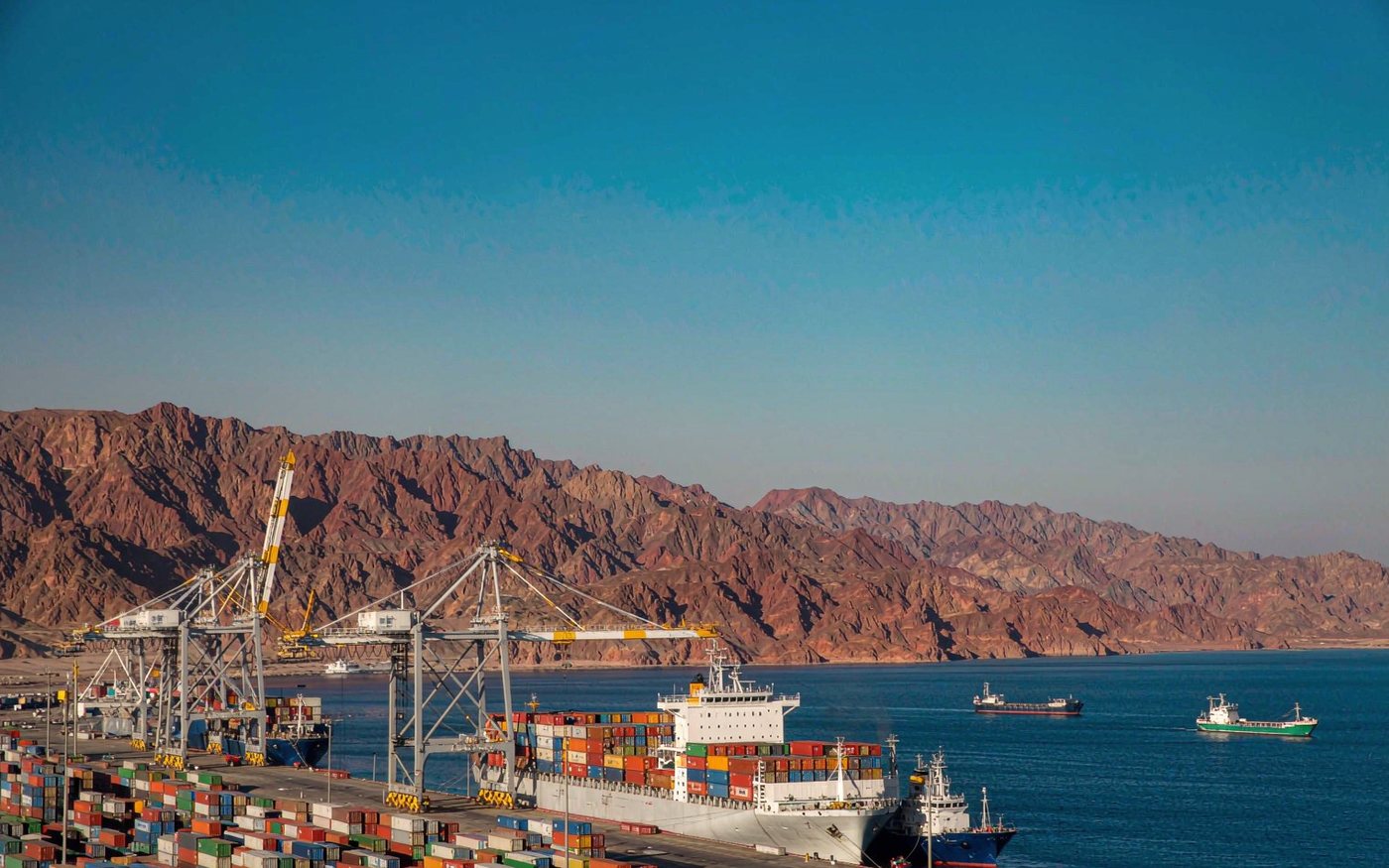
Jordan has one commercial seaport, and that fact quietly decides most of your logistics. Aqaba, on the Red Sea in the far south, is the entry point for essentially all sea freight. Everything else — Amman, Zarqa, Irbid — is an inland leg from there. So a routing decision here is never only about which vessel; it is about how far your goods then travel by road and what that costs.
The second thing to know, and the one that catches first-time importers, is that Jordan Customs requires a four-digit HS code against each product line on the bill of lading. Not at declaration stage — on the bill of lading itself. Get it wrong or leave it off and you are looking at system rejection, amendment fees, and a reclassification that costs days. Classification has to be settled before the carrier issues the document.
The third is the tax structure. Jordan charges customs duty by HS code, then general sales tax at 16 percent — Jordan has GST, not VAT — on the CIF value plus the duty. Certain electrical appliances and consumer electronics also carry a qualitative tax of roughly 7 to 45 percent, which is confirmed at HS code level and is the number that most often turns a viable import into an unviable one.
At a glance
Country: in the Levant, bordered by Saudi Arabia, Iraq, Syria and Israel; capital Amman; a GAFTA member. · Currency: the Jordanian dinar. · Sea port: Aqaba, the only commercial seaport. · Air: Queen Alia International near Amman. · Duty: by HS code, generally zero to about 30 percent; higher on protected and luxury categories. · GST: 16 percent on CIF plus duty — Jordan has GST, not VAT; reduced rates of about 4 to 5 percent on some medical and hygiene supplies. · Qualitative tax: roughly 7 to 45 percent on certain electrical appliances and consumer electronics, at HS code level. · Excises: alcohol, tobacco, sugary drinks, fuel. · FTA: agreements with the US, EU, UK, GAFTA partners and a UAE comprehensive economic partnership effective May 2025 — budget standard rates for Chinese origin. · Customs: Jordan Customs, declarations through ASYCUDA World and the national single window, with green, orange and red lanes. · Key formalities: four-digit HS code per line on the bill of lading, Arabic customs documents, nine-digit consignee tax number, legalised certificate of origin for preference. · Free zone: the Aqaba Special Economic Zone is duty-free and GST zero-rated for goods that stay inside it. · Clearance: about 2 to 5 business days for clean non-regulated cargo; 3 to 7 where approvals apply.
How your cargo moves: China to Jordan
Eight steps from your supplier's door to yours. The last four are the ones shaped by local rules.
- Pickup from your supplierWe collect the goods anywhere in China and bring them to our consolidation point.
- Export clearanceChina customs declaration filed and released before the goods move to the port.
- Loading and departureContainer loaded, sealed and handed to the carrier at the Chinese port.
- Main carriageOcean, air or rail movement booked on the route agreed for your cargo.
- Arrival at the gatewayDischarge at the port or airport of entry, recorded on the carrier's manifest.
- Import clearanceCustoms declaration filed locally, with duty and tax assessed on the declared value.
- Customs releaseGoods released into free circulation once duty and tax are settled.
- Final deliveryOnward movement to your delivery address, warehouse or nominated depot.
Duty rates, VAT rates and clearance times move, and the figure that applies to your goods is the one set for your commodity code on the day of clearance. We check the current position against your code before your goods sail and confirm it to you in writing — ask for that check when you request a quote.
Aqaba is the only seaport, and that shapes everything
Aqaba sits at the head of the Gulf of Aqaba in the far south of the country, several hundred kilometres from Amman. Because it is the only commercial seaport, three consequences follow for a first-time importer.
First, the inland leg is always material. Whether your consignee is in Amman, Zarqa or Irbid, the container has to travel north by road, and that cost and transit belong in your landed cost from the start rather than being discovered later. Published guidance for the lane notes that distribution across Jordan's road network is its own challenge, which is why a forwarder with a local arrangement on the ground matters here.
Second, there is no alternative port to route around congestion. In markets with two or three ports, a delay at one can sometimes be avoided by discharging at another. In Jordan there is one discharge point, so the only lever is documentation quality — which is exactly what the next section is about.
Third, the free zone is in the same place as the port. The Aqaba Special Economic Zone sits around the port city, which makes staging goods there a practical option rather than a theoretical one. We come back to it below, because it changes the arithmetic considerably.
Air freight arrives at Queen Alia International Airport near Amman, which handles the bulk of air cargo and puts goods close to the main population centres without the road leg from Aqaba.
The four-digit HS code that must sit on your bill of lading
This is the single most Jordan-specific requirement on the page, and it is worth understanding precisely.
Jordan Customs requires the four-digit HS code to be shown against each product line on the bill of lading. It is not enough to classify at the declaration stage; the classification has to be on the transport document, and it has to match what appears on the commercial invoice, the packing list and the ASYCUDA declaration.
| Where the code appears | Why it matters |
|---|---|
| Bill of lading, per product line | A Jordan Customs requirement; system rejection and amendment fees if missing or wrong |
| Commercial invoice | Cross-checked against the bill of lading by the assessing officer |
| ASYCUDA declaration | The code that actually sets the duty rate and drives lane assignment |
| Certificate of origin | Must correspond where preferential treatment is claimed |
Two more identifiers belong in the same conversation. The consignee's nine-digit tax number has to appear on both the bill of lading and the declaration — without it, the declaration is rejected. And Jordan uses an eight-digit customs code aligned with the Gulf standard, so the classification you settle needs to be specific enough for that structure, not merely a six-digit heading.
The cost of getting it wrong: published guidance for this lane describes misclassification as producing penalties for under-declaration, a landed cost swing of roughly 10 to 20 percent between the correct and incorrect code, and clearance delays of 5 to 10 days while reclassification is processed, with seizure risk on regulated categories. Settle the code before the bill of lading is issued.
What Jordan charges, and what GST is applied to
Jordan's import tax has three layers, and the second one is where first-time importers mis-model the cost.
| Layer | Base | Rate |
|---|---|---|
| Customs duty | CIF value, by HS code | Generally 0 to about 30 percent; higher on protected and luxury goods |
| General sales tax | CIF value plus the customs duty | 16 percent; reduced rates of about 4 to 5 percent on some medical and hygiene supplies |
| Qualitative tax | Certain electrical appliances and consumer electronics, at HS code level | Roughly 7 to 45 percent |
Worked at a CIF value of US$10,000 with duty at 10 percent: duty is US$1,000, the GST base is US$11,000, GST at 16 percent is US$1,760, and the total is US$2,760 — about 27.6 percent of CIF, against a headline duty rate of 10 percent. If the product also carries a qualitative tax, that sits on top.
On preference: Jordan's commonly cited free trade agreements cover the United States, the European Union, the United Kingdom, GAFTA partners, and a comprehensive economic partnership with the UAE effective May 2025, each with its own origin and documentation rules. Budget a Chinese-origin shipment at the standard rate, and have your broker confirm the position for your HS code before you quote a customer.
Inside the Aqaba Special Economic Zone
The Aqaba Special Economic Zone is Jordan's primary free zone and its only seaport city. For an importer, the rule is simple but the planning is not.
Goods entering and remaining within the zone are duty-free and zero-rated for GST, where the conditions are met. Transferring goods from the zone to the Jordanian mainland triggers a standard import, with full duty and GST assessed on the value of the goods at the time of transfer.
The planning point is that those are two separate customs events. If you are staging equipment at Aqaba — project cargo, data centre hardware, anything that arrives before it is deployed inland — the zone entry and the mainland transfer have to be planned as two steps before the freight is booked, not discovered as one combined procedure on arrival. Published guidance puts the additional handling for a planned mainland transfer at a few extra days.
For a straightforward import to a mainland consignee, the zone is usually irrelevant and you should not complicate the file with it. For a business that genuinely stages inventory, it is one of the few structural levers available on this lane.
Arabic paperwork and the legalisation chain
Two requirements sit here, and both have timelines that run independently of the vessel.
Arabic translation. Customs-facing documents including the commercial invoice and the packing list are required in Arabic. Where documents are translated, the translation has to agree with the original on description, quantity and value — and the original has to agree with the declaration. A mismatch is what turns a green lane into an orange one.
Legalisation of the certificate of origin. Where a certificate of origin is used to claim preferential duty, it has to be certified by the chamber of commerce in the exporting country and legalised at a Jordanian embassy before shipment. Two cautions are worth noting from published guidance: retrospective legalisation is not accepted, and where the documentation is missing, standard tariff rates apply automatically. Start this when you place the order.
The rest of the file is conventional: commercial invoice, packing list, bill of lading or airway bill, the ASYCUDA declaration filed by an authorised Jordanian agent, an importer card or customs bond documentation, and the product approvals covered below.
Product approvals, and their timelines: JSMO conformity documentation for electrical, electronic and regulated consumer goods; TRC type approval with accredited laboratory test reports for telecom and wireless devices; JFDA registration for medical devices and pharmaceuticals. Published guidance puts new TRC type approvals at roughly 6 to 10 weeks from complete submission, and JFDA registration for new products at around 4 to 8 months depending on device class. These are the longest lead times in a Jordan import, and they are the reason to start before production finishes.
Air into Queen Alia, and when it is worth the money
Sea into Aqaba
The default for anything bulky. Published forwarder guidance for the lane quotes roughly 25 to 35 days ocean transit depending on service and transhipment, plus road to the final destination. Best for furniture, building materials, machinery and planned stock replenishment. Remember the inland leg from Aqaba when comparing against air.
Air into Queen Alia
Quoted at roughly 1 to 5 days in transit with a comparable clearance window, and it lands goods near Amman rather than several hundred kilometres south of it. Worth the premium for high value per kilo, urgent spares, samples, and — usefully — for a first test shipment that reveals what your HS classification and approvals actually require before a container is committed.
On terms: CIF Aqaba has the supplier paying freight and insurance to the port, with clearance, GST and inland delivery still yours. DDP to a Jordanian address requires whoever promises it to control the classification, the Arabic documentation, the approvals and the tax payment — all of which run through locally registered parties; establish who, specifically. And as always, port to port stops at the terminal.
Green, orange and red: how your declaration is routed
When a declaration is registered in ASYCUDA World, it is assigned a lane, and the lane decides how much inspection happens.
| Lane | What happens | What pushes you there |
|---|---|---|
| Green | No inspection; released on documents | Accurate classification, correct valuation, a clean compliance history, authenticated origin |
| Orange | Documentary inspection before release | Something in the file needs a human to read it |
| Red | Documents plus a physical examination | Risk indicators in the declaration or the importer's record |
Lane assignment is risk-based, which is good news: it means the outcome is substantially under your control. The four things that consistently push a file towards green are the four things this page keeps returning to — a correct and specific HS code, a defensible declared value, a complete and internally consistent document set, and properly authenticated origin.
One timing detail from published guidance for the lane: the ASYCUDA declaration is expected to be filed before the vessel arrives, with late filing attracting penalties. That is the opposite of the Sri Lankan pattern, and it is worth knowing if you ship to both.
Three shipments into Jordan, three different files
These are illustrative composite examples, not specific client shipments.
Consumer electronics, held on the qualitative tax
A first-time importer budgeted duty plus 16 percent GST and discovered at assessment that the product also carried a qualitative tax at HS code level. The landed cost moved by more than the margin. It was avoidable: the rate is confirmed at HS code level, and it should be confirmed before the order rather than at assessment.
Building materials, green lane
Classification settled before the bill of lading was issued, four-digit codes on every line, consignee tax number on both documents, Arabic translations consistent with the originals. The declaration was filed before the vessel arrived and routed green — released on documents, no inspection.
Equipment staged in the zone, then transferred
Project equipment entered the Aqaba Special Economic Zone duty-free and zero-rated, and was transferred to the mainland later as a separate import when it was deployed. Because the two events were planned before the freight was booked, the duty and GST were payable at the point of transfer rather than at arrival — which mattered for cash flow.
Choosing a Jordanian broker and a Chinese forwarder
You need both. The Chinese forwarder consolidates, handles export declaration, books the sailing, and — critically — gets the four-digit HS codes onto the bill of lading and the certificate of origin issued and legalised before shipment. The Jordanian broker holds the ASYCUDA filing access, manages JSMO and TRC and JFDA approvals, handles the Arabic documentation, and works the lane assignment. Look for a freight forwarder in each place: the party that coordinates carriers, terminals and authorities and owns the timeline. Not a shipping line, not a trucking company, not a warehouse.
Questions worth asking:
- Can you confirm the four-digit HS codes for my product lines before the bill of lading is issued? This is the question that separates a competent operator from an optimistic one on this lane.
- What is the duty rate and the GST on my code, quoted separately — and is there a qualitative tax? Three numbers, not one.
- Do I need JSMO, TRC or JFDA approval, and how long does it take? Weeks to months, and it has to start early.
- Is my certificate of origin being legalised at a Jordanian embassy before shipment? Retrospective legalisation is not accepted.
- What is the consignee's nine-digit tax number, and is it on the bill of lading? A declaration without it is rejected.
- How many days of free demurrage, and can an extension be requested? Published guidance for Aqaba mentions a standard free period with extensions sometimes available — ask, because it is worth days of charges.
Why importers use Goodhope on this lane
Six things that are different about working with us on China to Jordan shipments.
Confirm the four-digit code before the bill of lading is issued
Tell us what you are shipping, the product lines and their HS codes if you have them, the packed dimensions and gross weight, the pickup city in China and the delivery address in Jordan. We will confirm the four-digit codes that go on the bill of lading, arrange the certificate of origin and its legalisation before the goods sail, flag any product that needs JSMO, TRC or JFDA approval, and set out duty, GST and any qualitative tax separately so you can see the landed cost before you commit.
Get a quote Talk to usRelated pages
Frequently asked questions
Why is a four-digit HS code needed on the bill of lading?
It is a Jordan Customs requirement per product line. Missing or wrong codes cause system rejection, amendment fees, and reclassification delays. Settle the code before the bill of lading is issued.
What taxes apply?
Customs duty by HS code, generally 0 to about 30 percent, then GST at 16 percent on CIF plus duty. Some electrical appliances and electronics also carry a qualitative tax of roughly 7 to 45 percent.
Is Aqaba the only port?
Yes, Aqaba is Jordan's only commercial seaport and handles almost all sea freight. Air cargo goes to Queen Alia International near Amman.
What does the Aqaba Special Economic Zone change?
Goods that enter and stay in the zone are duty-free and GST zero-rated. Transfer to the mainland triggers a standard import with full duty and GST at the value on transfer.
Are Arabic documents required?
Yes. Customs-facing documents including the invoice and packing list are required in Arabic, and a certificate of origin used for preference needs chamber certification plus Jordanian embassy legalisation before shipment.
What is the nine-digit tax number?
The consignee's tax number, required on both the bill of lading and the ASYCUDA declaration. Without it the declaration is rejected.
How does the lane system work?
Green releases on documents, orange gets a documentary inspection, red gets documents plus physical examination. Assignment is risk-based and driven by classification, valuation, history and origin.
Do Chinese goods get preferential duty?
Plan on standard rates. Jordan's cited agreements cover the US, EU, UK, GAFTA partners and a UAE partnership from May 2025. Verify at HS code level before pricing.
How long does shipping take?
Forwarder guidance commonly quotes roughly 25 to 35 days ocean transit to Aqaba and 2 to 5 business days clearance for clean cargo; air to Queen Alia about 1 to 5 days in transit. Confirm the rotation at booking.
What product approvals are needed?
JSMO conformity for electrical and regulated consumer goods, TRC type approval for telecom and wireless devices, JFDA registration for medical devices and pharmaceuticals. Timelines run from weeks to months.