
Home / Shipping to Kazakhstan / How to Ship from China to Kazakhstan
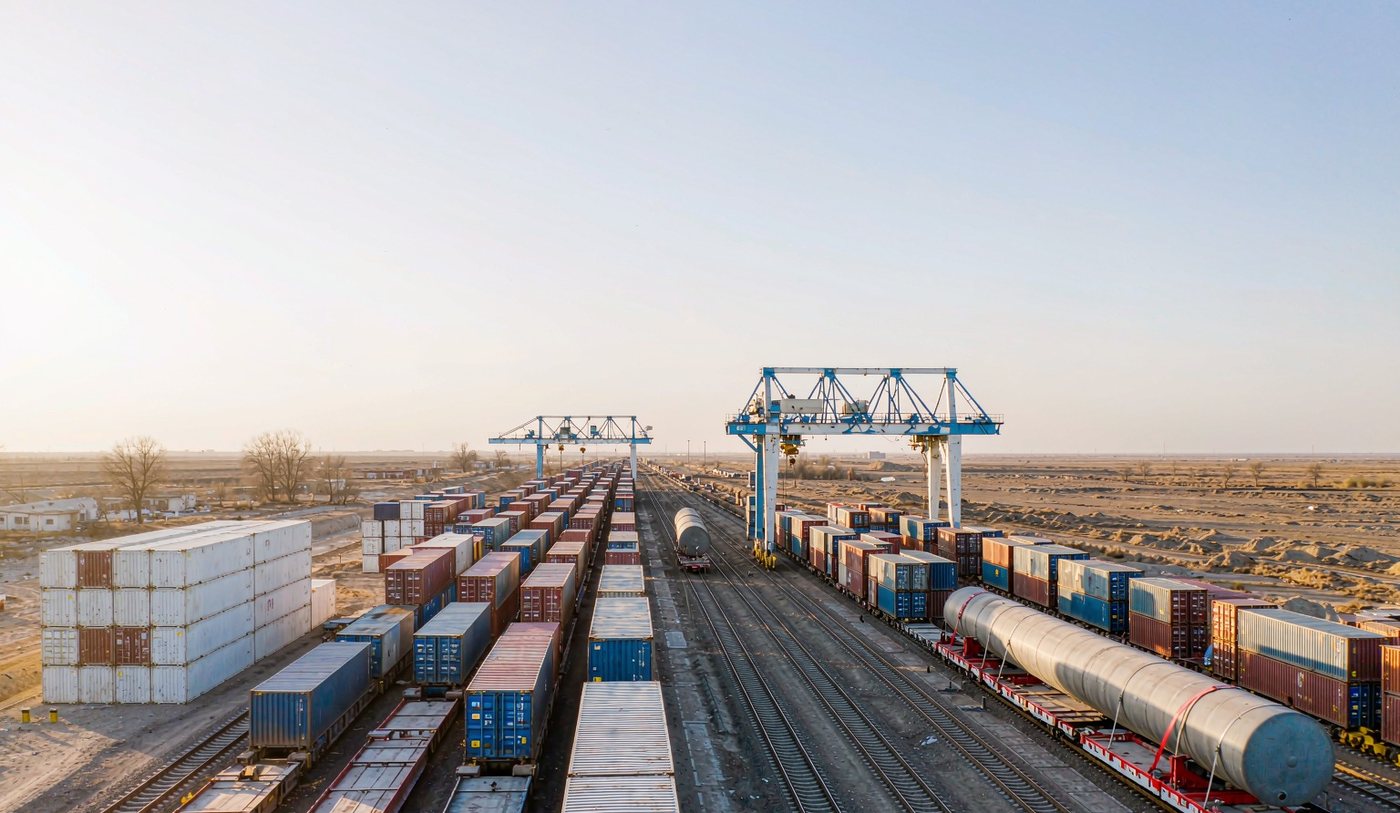
How to Ship from China to Kazakhstan: ASTANA-1, the EAEU Tariff & the 16% VAT
Kazakhstan is the world's largest landlocked country, and that single fact shapes every routing decision on the lane. There is no sea port in the usual sense — the Caspian terminal at Aktau is the closest thing — so containerised freight from China arrives across a land border, and for most shipments it arrives by rail. That is good news for speed and bad news for anyone who assumes the paperwork works the way it does on a maritime lane.
The second thing to get right is the tax. Kazakhstan's standard VAT rate rose to sixteen percent on 1 January 2026, up from the twelve percent that applied under the previous code, under Tax Code No. 214-VIII dated 18 July 2025. If you costed a shipment using the twelve percent figure, your landed cost is wrong by a third of the VAT line — and VAT, not duty, is usually the bigger number here.
The third thing is genuinely useful and widely missed. For a defined list of capital equipment and breeding stock, import VAT does not have to be paid in cash at all — it can be handled through the offset method, reflected as an accrual and an offset in the same VAT return. Whether your product is on that list is a question for before the booking, not for the broker at the border.
At a glance
Country: the world's largest landlocked state, in Central Asia, bordering China, Russia, Kyrgyzstan, Uzbekistan and Turkmenistan; commercial capital Almaty, administrative capital Astana. · Currency: the Kazakhstani tenge. · Customs union: a member of the Eurasian Economic Union with Russia, Belarus, Armenia and Kyrgyzstan. · Duty: the EAEU common customs tariff applies to Chinese goods as third-country imports. · VAT: 16 percent standard from 1 January 2026, raised from 12 percent under Tax Code No. 214-VIII; reduced rates for medicines and medical devices; generally recoverable by registered importers. · Offset method: listed equipment and breeding stock account for VAT without paying it in cash, subject to a five-year use period. · VAT registration threshold: published at KZT 41,480,000 of annual turnover from 2026. · Filing: ASTANA-1, tied to the importer's business identification number. · Conformity: EAC marking under EAEU technical regulations, before release. · Gateways: Khorgos and Altynkol, Dostyk, Aktau on the Caspian, Almaty and Astana airports. · Transit: rail 12 to 18 days to Almaty, air 3 to 7 days; clearance commonly 1 to 3 days on a complete file.
How your cargo moves: China to Kazakhstan
Eight steps from your supplier's door to yours. The last four are the ones shaped by local rules.
- Pickup from your supplierWe collect the goods anywhere in China and bring them to our consolidation point.
- Export clearanceChina customs declaration filed and released before the goods move to the port.
- Loading and departureContainer loaded, sealed and handed to the carrier at the Chinese port.
- Main carriageOcean, air or rail movement booked on the route agreed for your cargo.
- Arrival at the gatewayDischarge at the port or airport of entry, recorded on the carrier's manifest.
- Import clearanceCustoms declaration filed locally, with duty and tax assessed on the declared value.
- Customs releaseGoods released into free circulation once duty and tax are settled.
- Final deliveryOnward movement to your delivery address, warehouse or nominated depot.
Duty rates, VAT rates and clearance times move, and the figure that applies to your goods is the one set for your commodity code on the day of clearance. We check the current position against your code before your goods sail and confirm it to you in writing — ask for that check when you request a quote.
The largest landlocked country and its busiest rail gate
Kazakhstan shares a long border with China, which is the reason this lane works as well as it does. Goods do not need to cross a third country to get there, and the rail interface at Khorgos has become one of the busiest land crossings in Eurasia.
What landlocked means in practice:
- There is no ocean bill of lading. Your transport document will be a railway waybill or a CMR road consignment note, and anyone in your organisation who expects a marine bill of lading will be waiting for one.
- The gauge changes. China runs standard gauge and Kazakhstan runs broad gauge, so containers are transhipped between networks at the border rather than running straight through. That transfer is where delays accumulate in peak season.
- Weather is a real variable. A Central Asian winter slows border operations and road movements in a way that a sea lane does not.
- Aktau is the sea option. The Caspian port at Aktau handles the multimodal routings that continue by sea towards Azerbaijan and on towards Europe, and it is relevant to you mainly if Kazakhstan is a transit point rather than the destination.
ASTANA-1, and the identification number behind the filing
ASTANA-1 is Kazakhstan's integrated customs information system. Declarations are lodged there electronically, and the whole clearance process runs through it.
The part that catches first-time importers is not the software, it is the identity behind it. Every filing is tied to the identification number of the participant in foreign economic activity:
A registered economic operator
A Kazakhstani legal entity or registered sole trader acting as importer of record. This is what customs deals with.
The identification number
The business identification number, or BIN, for a legal entity; the individual identification number for a sole trader. It sits behind every declaration.
System access
Access to ASTANA-1 for the importer or for the appointed broker acting on their authority.
The declaration itself
Goods placed under the import customs procedure, with value, classification and supporting documents.
Registration belongs before the booking. An importer without a BIN and system access cannot have a declaration filed, and no forwarder can fix that at the border. On a land lane where the container is already sitting at the crossing when the problem surfaces, that is an expensive discovery.
The EAEU tariff, and what it means for Chinese goods
Kazakhstan is a member of the Eurasian Economic Union with Russia, Belarus, Armenia and Kyrgyzstan. Members apply a common customs tariff to goods arriving from outside the union. China is outside it, so Chinese goods are third-country imports and duty is assessed under that common tariff.
Three consequences worth understanding:
| Situation | What happens | Why it matters to you |
|---|---|---|
| Chinese goods imported directly into Kazakhstan | Assessed under the EAEU common customs tariff, plus import VAT and any excise | This is the normal case and the one to model |
| Goods already released for free circulation in another EAEU state | Move onward within the union without a second duty assessment | Explains some routing and warehousing decisions in the region |
| Goods moving through Kazakhstan to a third country | Can move under a transit procedure | Declare it as transit from the start if Kazakhstan is a corridor |
Duty rates under the common tariff are set by HS code and vary widely by product, with many industrial inputs at low or zero rates and finished consumer goods higher. The rate is not something to guess — it is the first thing to confirm, because it feeds straight into the VAT base.
VAT at sixteen, and the two ways it gets paid
The standard rate is sixteen percent from 1 January 2026, raised from twelve percent under Tax Code No. 214-VIII of 18 July 2025. Import VAT is charged on the customs value plus customs duties.
Then there are two ways it reaches the state, and the difference is cashflow:
Paid at import
The usual route. VAT is paid to the budget, and a VAT-registered importer recovers it as input VAT. The money leaves your account before it comes back, so budget for the outlay rather than the net figure.
The offset method
For goods on an approved list, VAT is reflected simultaneously as an accrual and an offset in the VAT return — no cash payment at import. Published categories include equipment, agricultural machinery, trucks, locomotives and wagons, aircraft and helicopters, ships, spare parts, breeding cattle and artificial insemination equipment, approved by Government Decree No. 1199 of 31 December 2025.
The offset method is not free money. It comes with conditions that are easy to breach:
- The goods must not be resold during the mandatory use period, subject to defined exceptions, though transfer to financial leasing is permitted except for international leasing.
- A mandatory use period applies — published as five years for most products and eighteen months for agricultural poultry.
- Breaching the conditions makes the VAT payable with a penalty. Published guidance lists forced animal slaughter, deaths within norms, re-export, VAT de-registration and documented accident write-offs as not being violations.
- You must be a VAT payer to use it at all.
- VAT registration threshold: published at KZT 41,480,000 of annual turnover from 2026, reduced from the previous measure and bringing more businesses into the net.
Ask this question early: if you are importing machinery, vehicles, aircraft, vessels, spare parts or breeding stock, the offset method can remove the VAT as a cash item entirely. That changes the financing of the whole shipment — but only if the product is on the current list and you can commit to the use period. Confirm the list against your HS code before you sign the supply contract.
EAC and the technical regulations that precede the booking
EAC — Eurasian Conformity — is the marking showing that a product meets the technical regulations of the Eurasian Economic Union. Where a product falls within those regulations, conformity has to be evidenced before the goods are released for free circulation, and the marking goes on the product, the packaging or the accompanying documentation.
Why this sits early in your planning rather than late:
| Step | When it has to happen | Consequence if late |
|---|---|---|
| Determine whether your product is in scope | Before quoting | Unknown cost and unknown lead time |
| Establish whether a certificate or a declaration of conformity is required | Before quoting | Wrong document type, rejected at filing |
| Testing and conformity assessment | Weeks before shipment | Container at the border with no release path |
| Sanitary, veterinary or phytosanitary certificates | Before arrival, for food, plants and animals | Goods held or refused entry |
| Marking applied to product or packaging | Before manufacture finishes | Remedial work after arrival |
One useful feature: a conformity assessment issued for the union covers all member states, so the same document serves Kazakhstan, Russia, Belarus, Armenia and Kyrgyzstan. If you are selling into more than one of them, do the assessment once and properly.
Khorgos, Dostyk, Altynkol and Aktau
| Gateway | Mode | What it is for |
|---|---|---|
| Khorgos and Altynkol | Rail | The principal gateway on the Chinese border, with the gauge transfer handled at the dry port on the Kazakh side. Most containerised rail freight uses it. |
| Dostyk | Rail | The second main rail crossing, and the one to ask about when Khorgos is congested. |
| Aktau | Sea, multimodal | The Caspian port. Relevant for routings continuing towards Azerbaijan and Europe, and for project and out-of-gauge cargo. |
| Almaty and Astana airports | Air | Air freight and express. Almaty is the main commercial gateway and handles the majority of air tonnage. |
| Road crossings | Road | Used for regional freight, time-sensitive cargo and door-to-door road services across the border. |
Why rail leads on this lane
Sea is not an option and air is priced accordingly, which leaves rail as the default and road as the alternative. Rail wins on:
- Cost against air. Rail is a fraction of air freight per kilo, which matters for anything that is not urgent or high-value.
- Time against sea-plus-inland. There is no comparable sea routing into Kazakhstan, so rail is not competing with a cheaper slow option the way it is in Europe.
- Predictability on gauge-transfer corridors. The Khorgos corridor is a mature, high-volume route with established transfer capacity.
- Suitability for full containers. A 40-foot container moves as one unit through the transfer, which suits importers with volume.
Road wins when the shipment is smaller, when the origin is closer to the border, or when you need door-to-door without a rail transfer. Air wins when the value density justifies it or the deadline is fixed.
Transit times by mode to Almaty
| Mode | Published transit to Almaty | Note |
|---|---|---|
| Rail, full container | 12–18 days | The default. Add time for gauge transfer at the border. |
| Rail, groupage | 18–25 days | Consolidation and deconsolidation add to the rail leg. |
| Road | Roughly 12–20 days door to door | Varies with the crossing, season and load availability. |
| Air | 3–7 days | Includes consolidation and handling; faster for direct services. |
| Customs clearance | 1–3 days on a complete file | Longer with inspection, valuation queries or missing conformity documents. |
Treat all of these as planning figures rather than promises. The two things that most often move them are border congestion at the gauge transfer and winter weather, both of which are outside anyone's control and both of which argue against booking to the last possible day.
Why an Almaty broker is not optional
On some lanes a competent importer can file themselves after the first shipment. This is not one of them, at least not at the start:
- The system is local. ASTANA-1 filings, supporting documents and correspondence run in a format and language that assumes local practice.
- The identification layer is mandatory. A BIN and system access have to exist before anything can be filed.
- Conformity has to match the code. The certificate has to correspond to the product as declared, and a mismatch is a release problem rather than a paperwork problem.
- Valuation gets queried. Declared values are tested, and answering a query quickly is the difference between one day and one week.
- The offset method has to be claimed correctly. Where it applies, it has to be handled properly in the return, not improvised.
Why importers use Goodhope on this lane
Six things that are different about working with us on China to Kazakhstan shipments.
True stories bound for Kazakhstan
Five shipments bought in China and delivered into Kazakhstan, told end to end — where the order came from, how it moved, where it nearly went wrong, and how it finished. Client names are withheld at their request; the situations and the handling are what we deal with on this lane.
Conformity first · before anything is booked · Shenzhen to Almaty
The purchase. A buyer new to importing assumed conformity marking could be arranged while the goods were in transit.
The move. Full container with Eurasian conformity obtained and documented during production.
Where it nearly went wrong. Conformity and the technical regulations behind it precede the booking rather than following it. A consignment arriving without them is not waiting for a document; it is waiting for testing and certification that take weeks.
How it finished. We made conformity step one. Every shipment since has cleared without waiting.
Rail versus road · first shipment · Guangzhou to Kazakhstan
The purchase. A first-time buyer priced road transport because it looked more flexible on paper.
The move. Full container on rail through the border gateway, with the onward leg built into the schedule.
Where it nearly went wrong. This is the largest landlocked country in the world and rail is what makes it workable from China. Road suits specific cases; rail carries the lane, and the transit times reflect that.
How it finished. We moved him to rail. Transit dropped and his schedule stopped slipping.
The 2026 rate change · costing · Ningbo to Kazakhstan
The purchase. A buyer costed a 2026 order on the twelve per cent rate he had used the previous year.
The move. Full container with sixteen per cent applied from the start of 2026.
Where it nearly went wrong. The standard rate rose from twelve to sixteen per cent at the start of 2026. Anyone carrying last year's costing forward is understating the biggest single line on the invoice.
How it finished. We flagged it before he quoted. He repriced and the deal still worked.
Offset method · equipment imports · Shanghai to Kazakhstan
The purchase. A buyer importing listed equipment budgeted the tax as a cash payment due on entry.
The move. Full container with the offset method applied, subject to the stated use period.
Where it nearly went wrong. Listed equipment and breeding stock can account for the tax without paying it in cash, subject to a five-year use period. It changes cash flow materially, and it has conditions attached rather than being automatic.
How it finished. We confirmed eligibility before shipping. His cash stayed in the business.
The Almaty broker · not optional · Yiwu to Kazakhstan
The purchase. A buyer planned to handle the declaration himself to save the agent fee.
The move. Full container filed by an Almaty broker through the electronic system.
Where it nearly went wrong. The filing runs through the customs information system against a local identification number, handled locally. Doing it yourself from overseas is not cheaper; it is slower, and storage runs while you find out.
How it finished. He appointed a broker on his second shipment. Every entry since has been accepted first time.
Why importers use Goodhope on this lane
Six things that are different about working with us on China to Kazakhstan shipments.
Find out which certificate your product needs
Tell us what you are shipping, the HS codes if you have them, the packed dimensions and gross weight, and the pickup city in China. We will confirm the EAEU duty rate and the sixteen percent VAT before you commit, tell you whether your product is on the offset-method list, flag whether EAC conformity or a certificate is required and how long it takes, route through Khorgos, Dostyk or Aktau as appropriate, and set out the landed cost in writing.
Get a quote Talk to usRelated pages
Frequently asked questions
What VAT rate applies to imports now?
Sixteen percent from 1 January 2026, raised from twelve percent under Tax Code No. 214-VIII of 18 July 2025. Charged on the customs value plus customs duties. Reduced rates apply to medicines and medical devices. Generally recoverable by registered importers.
Can I avoid paying import VAT in cash?
For goods on an approved list, yes, through the offset method — VAT is shown as an accrual and an offset in the same return. Published categories include equipment, agricultural machinery, trucks, locomotives, aircraft, ships, spare parts and breeding cattle, approved by Government Decree No. 1199 of 31 December 2025. Goods must not be resold and a five-year use period applies.
Why does the EAEU tariff apply?
Kazakhstan is in the Eurasian Economic Union and applies its common customs tariff to goods from outside it. China is outside, so Chinese goods are third-country imports. Goods already released for free circulation in another member state move onward without a second assessment.
What is ASTANA-1?
Kazakhstan's integrated customs information system where declarations are lodged. Filings are tied to the business identification number of the importer, so registration and system access must exist before anything can be filed.
Do I need EAC marking?
If your product falls within EAEU technical regulations, yes — a certificate or declaration of conformity is needed before release for free circulation. One assessment covers all member states. Determine scope and document type before quoting.
How does cargo cross the border?
Mostly by rail through Khorgos and Altynkol, where the gauge transfer happens, with Dostyk as the second crossing. Aktau on the Caspian handles multimodal sea routings. Air goes to Almaty and Astana.
How long does shipping take?
Rail to Almaty is commonly published at 12 to 18 days, groupage 18 to 25, air 3 to 7, and road roughly 12 to 20 door to door. Clearance is often 1 to 3 days on a complete file. Winter and border congestion extend rail times.
Do I need a broker?
For a first shipment, effectively yes — ASTANA-1 is a local system, a BIN and access are mandatory, conformity documents must match the declared code, and valuation queries have to be answered locally.
Is there a de minimis threshold?
De minimis and duty-relief thresholds exist and have been revised at EAEU level with effect from 2026. Because they have moved recently and depend on mode and goods category, confirm the current threshold for your consignment with your broker.
What documents are required?
Commercial invoice, packing list, transport document (railway waybill or CMR note), the ASTANA-1 declaration, certificate of origin, EAC conformity documents where regulations apply, permits for controlled goods, and the importer's business identification number.