
Home / Shipping to Laos / How to Ship from China to Laos
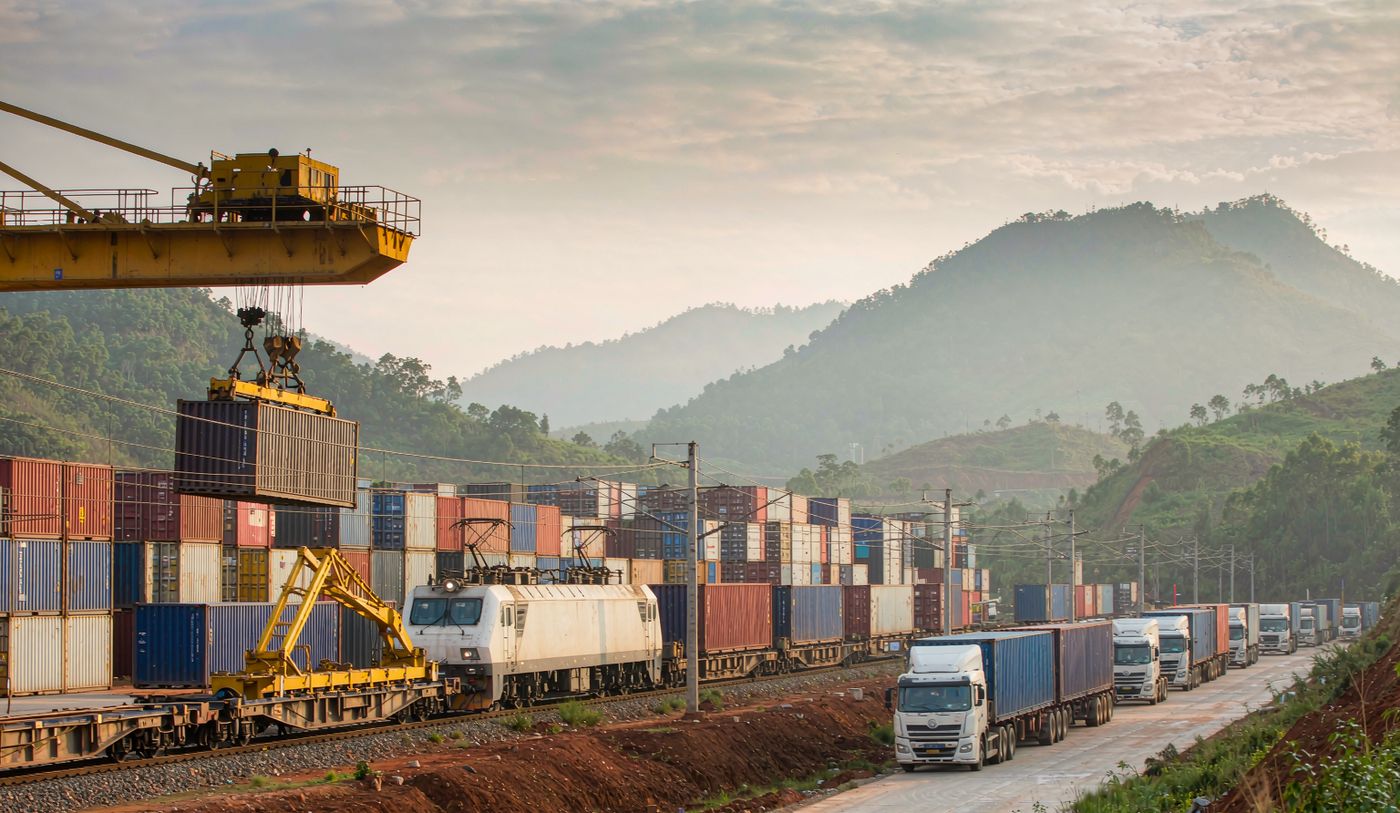
How to Ship from China to Laos: the China-Laos Railway, Boten & the Inland Leg
Laos is landlocked, and that single fact determines everything about the lane. There is no sea port to bill to, no ocean bill of lading to wait for, and no moment where the goods simply "arrive" — they arrive at a land border, and then they still have to be cleared and moved. Every routing decision on this lane is really a decision about which border and which inland leg.
The good news is that since December 2021 there has been a railway. The China-Laos Railway runs from Kunming to Vientiane and has become the backbone of China-Laos freight, with rail cargo clearing materially faster than road cargo — published figures put rail clearance at around two days against close to six for road. That is not a marginal difference on a land border.
The catch is the gauge change at Boten. China runs standard gauge; the Lao network does not. Containers are lifted and transferred between train sets at the frontier, which is where both a cost and a delay sit. Published figures for the transhipment run at roughly US$200 to US$400 per container.
At a glance
Country: landlocked in mainland South-East Asia, bordered by China, Vietnam, Cambodia, Thailand and Myanmar; capital Vientiane; an ASEAN and WTO member. · Currency: the Lao kip; currency declarations required above about US$10,000 equivalent. · Duty: assessed under the ASEAN Harmonised Tariff Nomenclature, published ranges from zero to around 40 percent by HS code, with most commercial goods commonly quoted in the 5 to 15 percent band. · VAT: 10 percent on customs value plus duty. · Excise: on selected commodities including alcohol and tobacco, with some categories much higher. · De minimis: published sources conflict — some quote around US$50, others none. · Customs: Lao Customs Department, filing through ASYCUDA World, with the Lao National Single Window bringing other agencies in. · Gateways: Boten–Bohan (China, road and rail), Thanaleng (Thailand), Lao Bao (Vietnam); Wattay VTE, Luang Prabang LPQ, Pakse PKZ, Savannakhet ZVK airports. · Transit: road 5 to 8 days from Kunming, 10 to 14 from Shenzhen, border clearance adding 1 to 3; rail faster once the gauge transfer is counted. · Gauge transfer: roughly US$200 to US$400 per container at Boten.
How your cargo moves: China to Laos
Eight steps from your supplier's door to yours. The last four are the ones shaped by local rules.
- Pickup from your supplierWe collect the goods anywhere in China and bring them to our consolidation point.
- Export clearanceChina customs declaration filed and released before the goods move to the port.
- Loading and departureContainer loaded, sealed and handed to the carrier at the Chinese port.
- Main carriageOcean, air or rail movement booked on the route agreed for your cargo.
- Arrival at the gatewayDischarge at the port or airport of entry, recorded on the carrier's manifest.
- Import clearanceCustoms declaration filed locally, with duty and tax assessed on the declared value.
- Customs releaseGoods released into free circulation once duty and tax are settled.
- Final deliveryOnward movement to your delivery address, warehouse or nominated depot.
Duty rates, VAT rates and clearance times move, and the figure that applies to your goods is the one set for your commodity code on the day of clearance. We check the current position against your code before your goods sail and confirm it to you in writing — ask for that check when you request a quote.
Landlocked, and what that costs you
Three practical consequences of having no coastline, all of which show up in your budget rather than in the freight rate:
- There is no ocean bill of lading. Your transport document will be a railway consignment note or a CMR road note. Anyone in your organisation waiting for a marine bill of lading will wait forever.
- A third country is usually involved. Unless you come over the Chinese border, your cargo has crossed Thailand or Vietnam first, which means either a transit regime or an import into that country and a re-export. That choice has to be made deliberately.
- The inland leg is a real line item. On a maritime lane the inland leg is a rounding error against the ocean freight. Here it is a substantial share of the total, and it is where unexpected charges accumulate — remote delivery, road permits for oversize, seasonal surcharges.
The question to ask first: is Laos the destination, or is it a corridor? If your goods are going on into Thailand, declaring them as transit rather than importing and re-exporting is cheaper and faster — but it has to be declared that way from the start, not corrected later.
The China-Laos Railway, and the gauge change at Boten
The railway opened in December 2021 and runs from Kunming through the northern border at Boten down to Vientiane. It has taken a large share of China-Laos freight because it is faster than road and more predictable than a monsoon-season truck run.
Container loaded in China
Standard gauge, loaded at a Chinese rail terminal or consolidated at a dry port.
The border at Boten
Customs formalities, and the transhipment between gauge systems.
Gauge transfer
Containers lifted from one train set to another. Published figures put this at roughly US$200 to US$400 per container.
Vientiane terminal
Arrival at the Vientiane rail terminals, which also handle onward e-commerce and distribution volume.
The gauge transfer is worth budgeting for explicitly rather than discovering it as a surcharge. It is also the reason rail transit on this lane carries a wider range than the distance suggests, and why booking to the last possible day is a bad idea when the border can congest.
Four ways in, and which one suits your cargo
| Route | Mode | Best for | Watch out for |
|---|---|---|---|
| Boten–Bohan from China | Rail and road | The default for China-origin cargo; rail for volume, road for flexibility | Gauge transfer cost and border congestion |
| Via Thailand, Laem Chabang and Thanaleng | Sea plus road | Full containers from farther north in China, and cargo already moving through Thai ports | Requires Thai transit or a Thai import and re-export |
| Via Vietnam, Haiphong or Da Nang and Lao Bao | Sea plus road | Cargo originating near the Vietnamese coast | Same transit-versus-import question, plus Vietnamese port congestion |
| Air to Wattay | Air | Urgent, high-value and low-volume cargo, and the samples that keep a project moving | Cost per kilo; limited handling capacity outside Vientiane |
Duty under the AHTN, and VAT at ten
Laos applies the ASEAN Harmonised Tariff Nomenclature, so the classification logic is the same family as its neighbours'. Duty is assessed by HS code with published ranges from zero to around forty percent, and most commercial goods are commonly quoted in the five to fifteen percent band. Then VAT at ten percent is charged on the customs value plus duty.
A worked example at a customs value of US$20,000 with duty at ten percent: duty is US$2,000, the VAT base is US$22,000, and VAT is US$2,200 — a total tax of US$4,200, or 21 percent of the customs value. Anyone who models this lane on the duty rate alone is under-counting by roughly half.
Preferential rates are available where origin is proved. Form E under the ASEAN-China arrangement, Form D under the ASEAN trade in goods agreement, and RCEP certificates are all in play, and for some products one route gives a better outcome than another. Comparing them is worth doing on high-value lines.
Excise, and the categories that carry it
Beyond duty and VAT, excise tax applies to selected commodities — alcohol and tobacco being the obvious ones — with published rates in some categories running very high. If your product is anywhere near these categories, model excise separately and early, because unlike VAT it is not recoverable and it does not shrink.
ASYCUDA World, and the agencies behind the declaration
The Lao Customs Department runs ASYCUDA World, and importers or their brokers file declarations and clear at the relevant border post, dry port or airport. Alongside it, the Lao National Single Window is progressively bringing the filings required by other government agencies into one place.
That second part matters more than it sounds. A food consignment needs the customs declaration and a food approval; a pharmaceutical consignment needs the declaration and a health approval. The single window is what stops those being sequential delays.
Why rail clears faster than road
Published figures describe rail clearances averaging around two days against roughly six for road. The reasons are structural rather than accidental:
- Rail runs on a schedule. Documents are prepared and lodged against a known arrival, so the risk assessment happens before the cargo lands.
- The corridor has priority handling. The rail terminals were built for volume and process it accordingly.
- Road arrivals are less predictable. A truck that arrives late, or with a driver whose paperwork is incomplete, joins the general queue.
- Inspection is risk-based either way. A complete, consistent file is what keeps both modes out of physical examination.
The permits that have to exist before the train moves
| Agency | Covers | When to start |
|---|---|---|
| Lao Food and Drug Department | Food and pharmaceuticals | Before booking — approval takes time |
| Ministry of Health | Pharmaceutical imports | Before booking |
| Department of Standardisation and Metrology | Conformity assessment | Before manufacture finishes |
| Ministry of Agriculture and Forestry | Sanitary and phytosanitary matters, plants and animals | Before shipment |
| Restricted categories | Vehicles, alcohol, weapons, certain chemicals | Before booking — licences, not just declarations |
Pack for the monsoon and for inspection. Heavy rain affects road conditions in the wet season, cargo is frequently examined at the border, and wooden packaging attracts phytosanitary scrutiny on this lane specifically. Use ISPM 15-stamped timber, wrap for humidity, and assume the carton will be opened.
What a Vientiane broker handles
- The crossing. Knowing how Boten, Thanaleng or Lao Bao actually behaves on a given week, and routing around congestion.
- ASYCUDA and the single window. Filing the declaration and the agency approvals together rather than in sequence.
- Classification and origin. Matching the certificate — Form E, Form D or RCEP — to the declared code so the preference is actually captured.
- Translation. Documentation may need to be in Lao or accompanied by a translation.
- Permits. Knowing which agency your product needs before it is at the border rather than after.
Why importers use Goodhope on this lane
Six things that are different about working with us on China to Laos shipments.
What we see bound for Laos
Five shipments bought in China and delivered into Laos, told end to end — where the order came from, how it moved, where it nearly went wrong, and how it finished. Client names are withheld at their request; the situations and the handling are what we deal with on this lane.
Rail or road · first shipment · Kunming to Vientiane
The purchase. A buyer new to importing assumed road would be simpler because it was what his supplier usually did.
The move. Consolidated cargo on the China-Laos railway, with the border transfer built into the schedule.
Where it nearly went wrong. Rail clears faster here than road, and that difference is in the border process rather than in the wheels. Choosing the slower method because it is familiar costs days you could have kept.
How it finished. We moved him to rail. He now quotes a transit his customers can plan around.
The gauge change · scheduling · Shenzhen to Laos
The purchase. A first-time buyer counted the railway transit to the border and treated it as the whole journey.
The move. Consolidated rail cargo with the transfer at Boten priced and scheduled as its own leg.
Where it nearly went wrong. The gauge changes at the border, so cargo transfers rather than running through. Building the plan to the border rather than past it produces a delivery promise that cannot be kept.
How it finished. We quoted both sides of the transfer. His promises have held ever since.
Permits · before departure · Guangzhou to Laos
The purchase. A buyer shipped goods that needed permits, expecting to sort the paperwork after loading.
The move. Consolidated cargo with permits obtained while the order was still in production.
Where it nearly went wrong. The permits have to exist before the train moves. Consignments that reach the border without them do not clear while arrangements are made; they wait, and the clock and the charges run together.
How it finished. We made permits a booking condition. Nothing has waited at the border since.
Threshold · do not assume one · Yiwu to Laos
The purchase. A buyer sending low-value parcels was told there was a threshold below which nothing was charged.
The move. Air parcels declared in full, with no relief assumed.
Where it nearly went wrong. Published sources conflict on whether a de minimis exists here, and some quote none. Basing a quote on the version that suits you is basing it on something you may have to defend at entry.
How it finished. We declare in full and tell him so. His parcels have never generated an unexpected bill.
Currency · the declaration threshold · Shanghai to Laos
The purchase. A buyer carrying cash to settle an order was stopped for a currency declaration he had never heard of.
The move. Consolidated cargo with payment arranged through normal channels and the declaration requirement explained before travel.
Where it nearly went wrong. Amounts above roughly ten thousand dollars equivalent have to be declared on entry. It is an arrival formality rather than a customs one, and it is the kind that surprises people at the airport rather than at the port.
How it finished. We flagged it before he travelled. He has crossed without difficulty since.
Why importers use Goodhope on this lane
Six things that are different about working with us on China to Laos shipments.
Price the rail leg and the trucking leg as one job
Tell us what you are shipping, the HS codes if you have them, the packed dimensions and gross weight, the pickup city in China and whether Laos is the destination or a corridor onwards. We will quote the through move including the gauge transfer at Boten, compare the Boten, Thanaleng and Lao Bao routings for your cargo, confirm the duty band and the ten percent VAT before anything is filed, and tell you which permits your product needs before the train moves.
Get a quote Talk to usRelated pages
Frequently asked questions
How does cargo arrive with no seaport?
Across a land border. Since December 2021 the China-Laos Railway carries much of it from Kunming to Vientiane; the alternatives are road through Boten–Bohan, via Thailand through Thanaleng, or via Vietnam through Lao Bao.
What is the gauge change at Boten?
Chinese standard gauge meets a different gauge at the border, so containers are lifted between train sets. Published figures put the transhipment at roughly US$200 to US$400 per container.
What duty and tax will I pay?
Duty under the ASEAN Harmonised Tariff Nomenclature, published zero to around 40 percent by HS code with most goods in the 5 to 15 percent band, then VAT at 10 percent on customs value plus duty. Excise on alcohol, tobacco and selected goods. Preferential rates with Form E, Form D or RCEP.
How long does clearance take?
Commonly quoted at one to five days at the border, with some sources giving three to ten for a full import. Rail is materially faster — published figures around two days against close to six for road.
What system is used for declarations?
ASYCUDA World, run by the Lao Customs Department, with the Lao National Single Window progressively bringing other government agency filings into the same place.
Which permits might I need?
The Lao Food and Drug Department for food and pharmaceuticals, Ministry of Health approval for pharma, the standards body for conformity, and agriculture for sanitary and phytosanitary matters. Vehicles, alcohol, weapons and some chemicals are restricted.
How long does shipping take?
Road through Boten–Bohan is commonly quoted at 5 to 8 days from Kunming and 10 to 14 from Shenzhen to Vientiane, with border clearance adding 1 to 3. Rail is faster once the gauge transfer is counted. Air into Wattay is a matter of days.
Is there a de minimis threshold?
Published sources conflict — some quote around US$50 for parcels, others record none for commercial imports. Confirm for your consignment.
What documents are required?
Commercial invoice with HS code and value, packing list, railway consignment note or CMR, the ASYCUDA World declaration, certificate of origin for preference, licences for restricted goods, and sanitary or phytosanitary certificates. Translation into Lao may be needed.
Do I need a broker?
For a first shipment, effectively yes — ASYCUDA World, the single window, permits matched to the code, and possible translation. Use one with experience at the specific crossing.