
Home / Shipping to Liberia / How to Ship from China to Liberia
How to Ship from China to Liberia
Most cargo for Liberia arrives at the Freeport of Monrovia, with Buchanan, Greenville and Harper as secondary seaports and Roberts International Airport handling air freight. Overland trade with Guinea, Côte d'Ivoire and Sierra Leone moves through more than a dozen land border posts.
Clearance runs through the Liberia Revenue Authority on the ASYCUDA World system, and it is more automated than the regional average. What slows shipments down here is not the port: it is a missing pre-shipment inspection or a missing cargo tracking note, both of which have to be arranged before the vessel arrives rather than after.
At a glance
Main port: Freeport of Monrovia; secondary seaports Buchanan, Greenville and Harper; air gateway Roberts International Airport. System: ASYCUDA World, managed by the Liberia Revenue Authority. Documents: commercial invoice, packing list, bill of lading or air waybill, and a Clean Report of Findings where pre-shipment inspection applies. Every importer needs a Tax Identification Number. A cargo tracking note (ECTN/BESC) is required for ocean shipments. Pre-shipment inspection thresholds are commonly quoted at USD 3,500 for sea freight and USD 1,500 for air. Consumption tax: GST, with VAT scheduled to replace it.
How your cargo moves: China to Liberia
Eight steps from your supplier's door to yours. The last four are the ones shaped by local rules.
- Pickup from your supplierWe collect the goods anywhere in China and bring them to our consolidation point.
- Export clearanceChina customs declaration filed and released before the goods move to the port.
- Loading and departureContainer loaded, sealed and handed to the carrier at the Chinese port.
- Main carriageOcean, air or rail movement booked on the route agreed for your cargo.
- Arrival at the gatewayDischarge at the port or airport of entry, recorded on the carrier's manifest.
- Import clearanceCustoms declaration filed locally, with duty and tax assessed on the declared value.
- Customs releaseGoods released into free circulation once duty and tax are settled.
- Final deliveryOnward movement to your delivery address, warehouse or nominated depot.
Duty rates, VAT rates and clearance times move, and the figure that applies to your goods is the one set for your commodity code on the day of clearance. We check the current position against your code before your goods sail and confirm it to you in writing — ask for that check when you request a quote.
Starting with Monrovia, and the other ports that take cargo
Liberia has four seaports that take international cargo, and Monrovia handles the great majority of it. Buchanan, Greenville and Harper are listed by the revenue authority as points of entry and are used when the consignee or the cargo suits them better.
Roberts International Airport is the main air gateway and matters more than the airport's size suggests, because for parcel and express shipments it is the primary route into the country rather than a secondary one.
There are also more than fifteen land border posts for trade with Guinea, Côte d'Ivoire and Sierra Leone. If your goods are ultimately going across a land border, say so at booking, because the transit declaration and the guarantee work differently from an ordinary import entry.
Freeport of Monrovia and the three secondary seaports
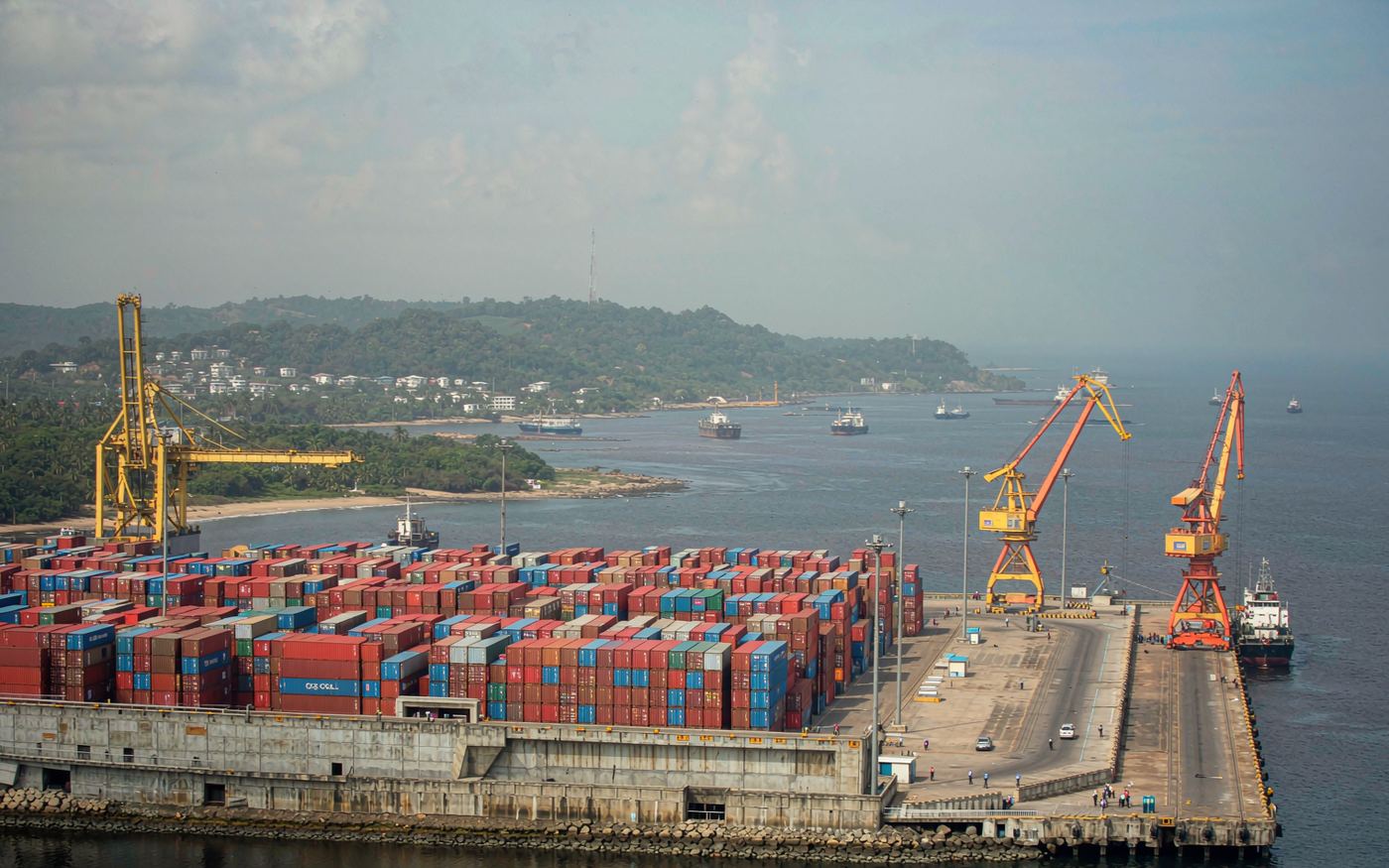
The Freeport of Monrovia is the country's commercial gateway, with container handling and the customs establishment that processes the bulk of declarations. It is where your broker will want to be, and it is where most services call.
Buchanan, Greenville and Harper are smaller. They are worth considering if your consignee sits near one of them, since it removes an inland leg, but service frequency is lower and handling is lighter. Confirm that your line actually calls there before you plan around it.
For most first-time importers Monrovia is the answer, and the choice to make is not which port but which broker.
ASYCUDA World and the five steps of a declaration
The Liberia Revenue Authority runs declarations through ASYCUDA World, and the process is more automated than in most of West Africa. It runs in five steps: the declarant registers an electronic declaration with scanned documents attached; the system applies automatic selectivity; customs reviews and validates the declaration and issues an electronic payment notice; the declarant pays; and the terminal operator receives an automatic release order, followed by final electronic clearance by customs.
Two things follow from that. First, the documents have to be scanned and attached at registration, so they need to exist before the declaration is lodged. Second, payment is expected promptly after the notice, because the release is automatic once it is made.
Only the owner, the purchaser, or a licensed customs broker may make the declaration. Where a broker acts, anything they declare is treated as having been declared by the importer, and the importer can be liable for penalties the broker incurs — so choose the broker with the same care you would choose a supplier.
The tracking note Liberia expects on every sea shipment
As across most of West Africa, an Electronic Cargo Tracking Note — also written BESC, BSC or CTN depending on the issuer — is required for ocean shipments arriving in or transiting through Liberia. It has to be obtained and paid for before the shipment arrives.
The responsibility sits with the shipper working with the consignee, which in practice means your Chinese forwarder applies for it at origin. Tell them at booking that the shipment needs one, because if the cargo is held at origin waiting for the certificate you will pay storage and roll charges before it has even sailed.
Presenting no tracking note, or one with incorrect information, can mean fines, delays, storage charges, or the cargo being refused clearance entirely. It is a pre-arrangement item, not a clearance item.
Pre-shipment inspection and the clean report of findings
Liberia operates a pre-shipment inspection programme, currently run by a contracted inspection company. It covers a documentary review of the classification and the customs value, and if necessary a physical inspection. The output is a Clean Report of Findings, which is one of the documents the revenue authority lists as required for import.
The thresholds that matter are the ones that trigger it. Published figures commonly quote around USD 3,500 for sea freight and around USD 1,500 for air freight, and they are worth confirming rather than assuming. For any sizeable business-to-business shipment this should be settled before collection, not discovered at destination.
Where inspection was required and was not done, the goods face a destination inspection and a penalty on top. That is a worse outcome than the inspection fee by a wide margin.
GST now, VAT from 2027: what is charged on imports
Liberia currently applies a Goods and Services Tax on taxable goods, including on imports. Alongside it, imports can attract customs duty, excise duty, the ECOWAS tax levy and other charges depending on what the goods are.
The revenue authority has published a transition from GST to a value added tax system, with a start date of 1 January 2027 and a standard rate quoted at 15 per cent. If you are costing a shipment that will clear after that date, check which regime applies rather than reusing an older calculation.
Get a line-by-line assessment from your broker before you quote your customer. The duty rate alone is not the landed tax burden.
Your tax identification number and the tax clearance
Every importer needs a Tax Identification Number to make a customs declaration, and it is the precondition for any import or export business in Liberia. Your consignee should hold one before the goods ship.
A tax clearance is also listed among the documents that may be required. This is a routine thing for an established Liberian business and a delaying thing for one that is not, so confirm it early.
The bill of lading should carry the consignee's full legal name and their TIN, and the notify party should be the Liberian agent. That is a specific local requirement and it is checked.
A private shipment or a Liberian business import
Commercial imports are made by a registered business holding a TIN, through a licensed customs broker. Where goods are consigned "to order", the transport document properly endorsed by the consignor serves as evidence of the right to make entry.
Private individuals can import personal effects, and goods can also be entered for warehousing at the port of entry or moved in bond to another port for transit or transshipment. Temporary importation and transit both require a guarantee, commonly quoted at 150 per cent of the estimated duties and taxes.
An advance ruling is available if you want the administration's position on classification, valuation or origin before you ship. It takes one item per form and is worth using if the HS code is genuinely uncertain.
What your Chinese forwarder does and what the Monrovia broker does
In China your forwarder books the sailing, arranges collection and export clearance, issues the bill of lading, applies for the cargo tracking note, and arranges pre-shipment inspection if the shipment crosses the threshold. They also prepare the invoice and packing list so the descriptions are specific enough to classify — "steel drive gear for an industrial packaging machine" rather than "machine parts".
In Monrovia the broker registers the declaration in ASYCUDA World with the scanned documents attached, responds to any selectivity query, and arranges payment and release. The importer arranges collection and delivery.
The single most useful thing you can do for both of them is to send the complete document set before the vessel sails rather than after it berths.
Three consignments routed to Monrovia
Building materials, full container, for a Monrovia contractor. Cement, steel and fittings in one 40 foot container. Tracking note applied for at origin, pre-shipment inspection arranged above the threshold, declaration lodged in ASYCUDA with the CRF attached. Cleared and collected at the Freeport.
Medical supplies, air freight, for a clinic. Flown to Roberts International Airport. The air inspection threshold is lower than the sea one, so inspection is more likely to apply; permits for medicines and medical devices are needed either way.
General merchandise, LCL, for a retailer. Consolidated in China, deconsolidated at Monrovia, with extra days allowed for the split. Cheaper per unit than air, slower, and the deconsolidation warehouse charges for its own handling.
Import permits and the goods that need them
An Import Permit Declaration from the Ministry of Commerce and Industry is required where it applies, and health or phytosanitary certificates are needed for food, plant and animal products. Certificates of origin are required where preferential treatment is being claimed.
Categories that commonly need additional paperwork or special licences include medicines and medical devices, food, cosmetics, tobacco, alcohol, electronics, chemicals, wood products, plants, and vehicles and trailers. Firearms, weapons and military equipment are controlled.
Because the declaration is lodged with scanned documents attached, a missing permit is visible at registration rather than discovered later. That makes it more important, not less, to have them before the file is opened.
Timings, and why the original bill of lading matters here
The port administration expects the original bill of lading to be presented promptly after arrival, with storage charges starting if it is not. Send the originals by a tracked courier as soon as they are issued, and confirm receipt rather than assuming it.
Beyond that, the delays on this route are the pre-arrangement ones: a tracking note applied for late, an inspection not booked, a permit not yet issued. The declaration itself moves quickly once the file is complete.
If you disagree with a customs decision there is a formal route — a letter of protest to the Customs Commissioner, then to the Commissioner General — but using it costs weeks. Getting the classification and the value right first time is far cheaper.
Why importers use Goodhope on this lane
Six things that are different about working with us on China to Liberia shipments.
Monrovia and Buchanan are two very different propositions
Tell us the goods, the value and whether they ship by sea or air. We will confirm the tracking note, whether pre-shipment inspection applies, and what your Monrovia consignee needs on file.
Get a quote Talk to usRelated pages
Frequently asked questions
Which ports serve Liberia?
The Freeport of Monrovia handles the majority of cargo. Buchanan, Greenville and Harper are listed as additional seaports of entry, and Roberts International Airport is the main air gateway. There are also more than fifteen land border posts for trade with neighbouring countries.
How does customs clearance work?
Through ASYCUDA World, managed by the Liberia Revenue Authority. The declarant registers an electronic declaration with scanned documents, the system applies selectivity, customs validates and issues an electronic payment notice, the declarant pays, and the terminal receives an automatic release order followed by final clearance.
Is a cargo tracking note required?
Yes. An Electronic Cargo Tracking Note, also written BESC or CTN, is required for ocean shipments arriving in or transiting through Liberia, and it must be obtained and paid for before the shipment arrives. Your forwarder applies at origin.
What is a Clean Report of Findings?
The output of Liberia's pre-shipment inspection programme, which reviews classification and customs value and inspects where necessary. It is listed by the revenue authority as a required import document. Thresholds commonly quoted are around USD 3,500 for sea freight and USD 1,500 for air.
What happens if I skip pre-shipment inspection?
The goods are subject to a destination inspection plus a penalty. That costs considerably more than the inspection fee, so arrange it before collection.
Do I need a tax identification number?
Yes. Every importer needs a TIN to make a customs declaration, and the bill of lading should carry the consignee's full legal name and TIN with the Liberian agent as notify party.
What taxes apply to imports?
Imports can attract customs duty, excise duty, the ECOWAS tax levy and the Goods and Services Tax. The revenue authority has published a transition to a VAT system with a start date of 1 January 2027 and a standard rate quoted at 15 per cent. Ask your broker for a line-by-line assessment.
Can I import personally?
Personal effects yes. Goods can also be entered for warehousing or moved in bond for transit; temporary importation and transit require a guarantee, commonly quoted at 150 per cent of estimated duties and taxes.
Which goods need permits?
An Import Permit Declaration from the Ministry of Commerce and Industry where applicable, plus health or phytosanitary certificates for food, plant and animal products. Medicines, medical devices, food, cosmetics, tobacco, alcohol, electronics, chemicals, wood products, plants and vehicles commonly need extra paperwork.
Why does the original bill of lading matter?
The original should be presented promptly after arrival or storage charges begin. Send it by tracked courier as soon as it is issued and confirm receipt, rather than waiting for the vessel to berth.