
Home / Shipping to the Maldives / How to Ship from China to the Maldives
How to Ship from China to the Maldives: the 2025 FTA, Malé & the 8% GST
The single biggest fact on this lane is recent and most importers have not caught up with it. The China-Maldives Free Trade Agreement entered into force on 1 January 2025. Under it both sides committed to zero tariffs on products eventually covering more than ninety-five percent of tariff lines and of trade value, with the implementation schedule running to 2032. Chinese exports in the benefiting categories include ships, electrical equipment, steel, furniture, ceramics and most industrial goods, plus vegetables and fruit.
What that means practically: for a great deal of what moves from China to Malé, the basic customs duty is now zero or heading there — provided you claim it correctly. Preferential treatment is claimed, not granted. The product has to meet the rules of origin and a valid certificate of origin matching the declared HS code has to be presented with the declaration.
What it does not remove is GST. General GST is eight percent for most goods and services; tourism GST is sixteen percent where the transaction falls in the tourism sector, with a further increase to seventeen published as legislated. On a lane where duty is heading to zero, GST becomes essentially the whole tax bill — which is the opposite of how most first-time importers model it.
At a glance
Country: an archipelago of around 1,200 islands in the Indian Ocean south-west of Sri Lanka; capital Malé. · Currency: the Maldivian rufiyaa. · FTA: China-Maldives free trade agreement in force since 1 January 2025; zero tariffs eventually covering over 95 percent of tariff lines, implementation to 2032. · Duty: basic customs duty by HS code, commonly quoted 5–25 percent for ordinary goods with published schedules running far higher on tobacco and alcohol. · GST: 8 percent general, 16 percent tourism; basic necessities zero-rated. · Other charges: a green tax is documented as a nightly levy on tourists at resorts and guesthouses; some trade guidance also describes an import-level charge —. · Customs: Maldives Customs Service, electronic declaration with a pre-arrival filing, risk management system with inspection reported around 15 percent. · Gateways: Malé Commercial Harbour (the sole major entry point) and Velana International Airport MLE; most sea freight tranships via Colombo or Singapore. · Free storage: reported at 7 days for containers, 5 for breakbulk. · Clearance: 2–5 days with correct documentation. · Transit: sea 25–35 days FCL, 30–40 LCL; air 4–8 days; express 3–6.
How your cargo moves: China to the Maldives
Eight steps from your supplier's door to yours. The last four are the ones shaped by local rules.
- Pickup from your supplierWe collect the goods anywhere in China and bring them to our consolidation point.
- Export clearanceChina customs declaration filed and released before the goods move to the port.
- Loading and departureContainer loaded, sealed and handed to the carrier at the Chinese port.
- Main carriageOcean, air or rail movement booked on the route agreed for your cargo.
- Arrival at the gatewayDischarge at the port or airport of entry, recorded on the carrier's manifest.
- Import clearanceCustoms declaration filed locally, with duty and tax assessed on the declared value.
- Customs releaseGoods released into free circulation once duty and tax are settled.
- Final deliveryOnward movement to your delivery address, warehouse or nominated depot.
Duty rates, VAT rates and clearance times move, and the figure that applies to your goods is the one set for your commodity code on the day of clearance. We check the current position against your code before your goods sail and confirm it to you in writing — ask for that check when you request a quote.
The China-Maldives FTA took effect on 1 January 2025
The agreement was signed in December 2017 after negotiations started in 2015, and the two sides agreed to bring it into force on 1 January 2025 once both had completed their domestic approval procedures. It covers goods, services and investment.
- Tariff coverage is very wide. Zero tariffs eventually apply to more than 95 percent of tariff lines and of trade value.
- It phases in. The implementation period runs to 2032, so the rate for your HS code in a given year is a schedule question, not a yes-or-no one.
- Origin has to be proved. The rules of origin have to be met and a valid certificate of origin presented with the declaration.
- GST is untouched. The eight percent applies whether duty is zero by preference or by schedule.
- Permits are untouched. A product that needs an authority approval still needs it, at zero duty or not.
The practical task: check your HS code against the FTA schedule before you place the order, not at clearance. Where the preference applies it is worth real money on every shipment; where it does not, you need to know that before you commit to a price.
Basic duty, then GST at eight — or sixteen
Basic customs duty is assessed by HS code. Published ranges for ordinary goods are commonly quoted between five and twenty-five percent, with schedules running much higher — some accounts put tobacco and alcohol as high as two hundred percent — and agricultural produce at the lowest end.
GST then applies on top. The structure is unusual and worth understanding:
| Tax | Rate | Applies to |
|---|---|---|
| General GST (GGST) | 8% | Most goods and services, including the general import case |
| Tourism GST (TGST) | 16% | Goods and services supplied in the tourism sector — resorts, guesthouses, safari vessels, dive centres |
| Zero rating | 0% | Exports, international transport, and some basic necessities |
A worked example at a CIF value of US$10,000 where duty is zero under the FTA: GST at eight percent is US$800 and the total tax is US$800. Without the preference, at fifteen percent duty, duty is US$1,500 and GST on US$11,500 is US$920 — a total of US$2,420. The certificate of origin is worth US$1,620 on that shipment.
Malé is the only real entry point
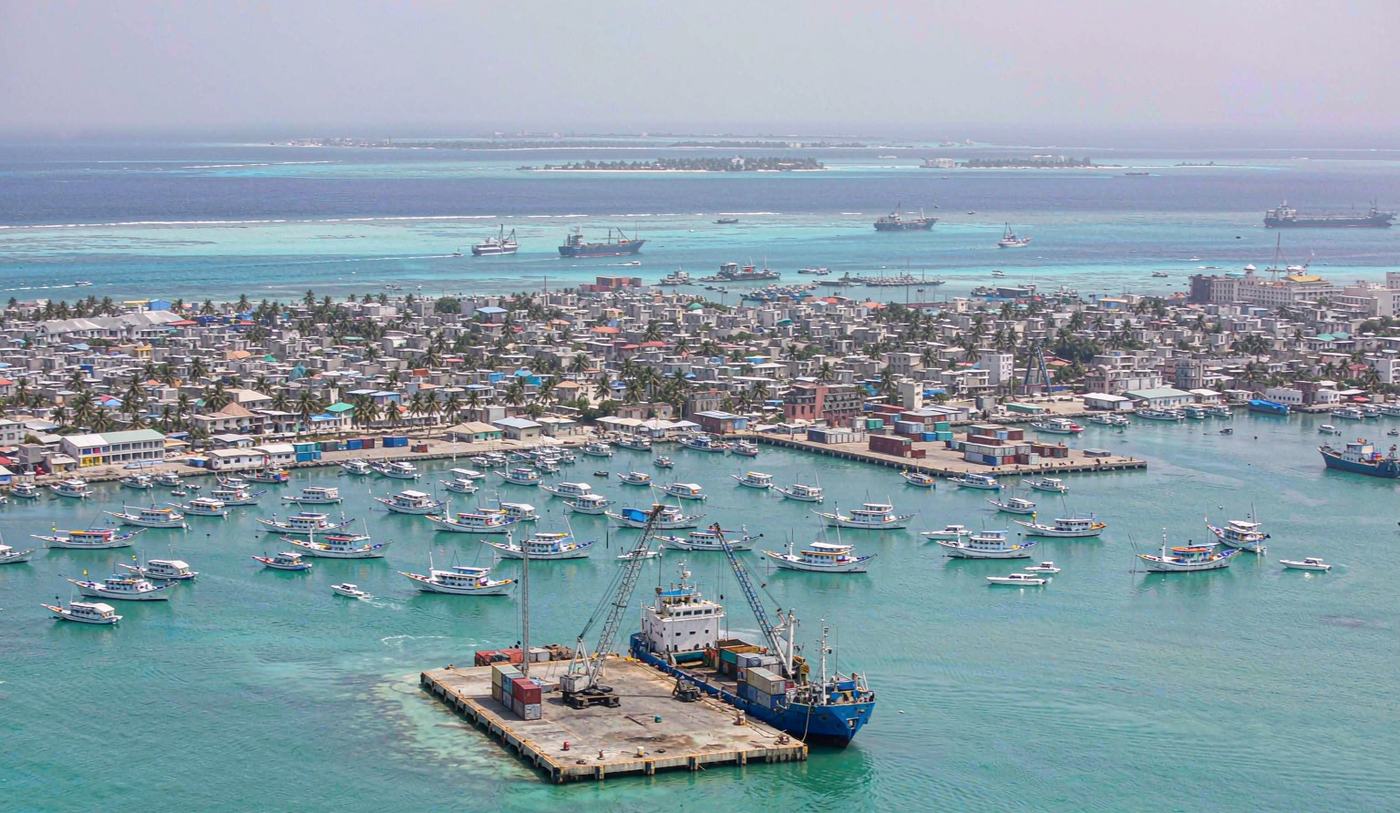
The Maldives has one major commercial harbour and it is at Malé. That shapes everything downstream:
- Almost every import lands at the same quay. Published guidance describes Malé port as the sole major entry point, with limited capacity by regional standards.
- Most sea freight tranships. Direct services are limited, so containers commonly move via Colombo or Singapore. This is the main reason sea transit is quoted at twenty-five to forty days rather than the twelve to twenty you might expect for the distance.
- Air goes to Velana (MLE), typically four to eight days including consolidation, and clears faster.
- Resort islands get their goods by domestic leg. Every atoll is supplied by transhipment out of Malé — barge, dhoni or speedboat.
The pre-arrival declaration, twenty-four hours out
Maldives Customs runs an electronic declaration system, and published trade guidance describes the importer filing a pre-arrival declaration through an authorised broker at least twenty-four hours before the vessel reaches port. The filing covers a substantial data set — commodity code, customs value, quantity and weight among around fifty-seven fields — and it requires a decision on valuation basis: transaction value method or an alternative valuation method.
Filing twenty-four hours out
Through an authorised broker, before the vessel reaches port.
Risk assessment
A risk management system decides whether the shipment is examined; inspection rates are reported around fifteen percent.
Examination, if selected
The consignment moves to a designated site and may be asked for product literature, material certificates and test reports.
Release, or temporary release
Published guidance describes a temporary release mechanism against security where documents are the only problem — worth knowing when demurrage is running.
Green tax and the other line items
The green tax is best known as a nightly levy on tourists staying in resorts and guesthouses, collected by the operator and remitted to the revenue authority, with published amounts of around US$12 per guest per night at resorts and US$6 at smaller guesthouses. Some trade guidance also describes a charge applied at import, but the published figures conflict, so confirm what applies to your consignment rather than assuming either way.
The other line items that catch people are demurrage and the inter-atoll leg. Free storage at Malé is reported at seven days for containers and five for breakbulk, after which charges accrue progressively. And the domestic movement to a resort island is quoted and scheduled separately from the international freight.
Duty exemption approvals, and who qualifies
Published guidance describes relief for defined categories, which on an import-dependent island economy is worth investigating properly:
| Category | Published treatment |
|---|---|
| Machinery under an approved foreign investment project | Exemption from basic duty |
| Construction and finishing materials for hotel development | Reduction of around fifty percent |
| Medical equipment imported by healthcare institutions | Full exemption |
All of it requires a duty exemption approval letter obtained from the ministry responsible for economic development before clearance, on the basis of project approval documents, an itemised import list and evidence of funding. It is a pre-approval, not a rebate — apply before the goods move.
Inter-atoll delivery, the part after clearance
This is the line item most first-time importers to the Maldives get wrong. Malé is the distribution hub and almost nothing else is reachable by road. Getting goods to a resort island means a domestic movement by barge, dhoni or speedboat, arranged through a local operator, priced separately, and subject to weather and vessel availability.
Budget for it explicitly, and ask who is arranging it. On an outer atoll it can be a meaningful share of the total delivered cost, and it is the leg that nobody else has quoted you.
What is prohibited, and what needs a permit
| Status | Items |
|---|---|
| Prohibited | Alcoholic beverages and pork products (available only on resort islands for tourists), narcotics, weapons and ammunition, pornographic material, religious materials other than Islamic |
| Restricted — permit needed | Food and pharmaceuticals (Maldives Food and Drug Authority or ministry of health), telecommunications equipment (communications regulator), construction materials, drones, certain chemicals |
| Certificates needed | Sanitary and phytosanitary certificates for plants, animals and food; fumigation certificate for wood packaging |
Biosecurity is taken seriously here. As an island nation the Maldives enforces quarantine strictly, and wood packaging without a fumigation certificate can be required to be re-exported or destroyed. Use stamped ISPM 15 timber or non-wood packaging, and have the certificate with the file.
The dossier Maldives Customs expects
| Document | Note |
|---|---|
| Commercial invoice | Description, value, currency and terms of sale |
| Packing list | Contents, weights and package counts |
| Bill of lading or airway bill | Matching the invoice |
| Pre-arrival declaration | Filed electronically at least 24 hours before arrival |
| Certificate of origin | FTA certificate required to claim the preferential rate |
| Import licence or permit | Food, pharmaceuticals, telecoms, construction materials |
| Sanitary or phytosanitary certificate | Plants, animals, food |
| Fumigation certificate | Every wooden pallet or crate |
Why a Malé agent matters on a single-port island
- Pre-arrival filing. Getting the declaration in twenty-four hours out, which is what keeps cargo inside the free storage window.
- FTA handling. Matching the certificate of origin to the HS code so the preference is actually captured.
- Permits. Knowing which authority your product needs before it lands rather than after.
- Temporary release. Knowing the mechanism exists and how to use it when documents are the only obstacle and demurrage is running.
- The domestic leg. Arranging the barge or dhoni to the island, which nobody in China can do for you.
Why importers use Goodhope on this lane
Six things that are different about working with us on China to the Maldives shipments.
End to end shipping into the Maldives
Five shipments bought in China and delivered into the Maldives, told end to end — where the order came from, how it moved, where it nearly went wrong, and how it finished. Client names are withheld at their request; the situations and the handling are what we deal with on this lane.
Staged to 2032 · first order · Shenzhen to Male
The purchase. A buyer new to importing read that the agreement zeroed tariffs and priced everything at zero.
The move. Full container with each line checked against the current stage of the schedule.
Where it nearly went wrong. The agreement took effect at the start of 2025 and reaches wide duty-free coverage on a staged timetable running to 2032. Costing as though it were all in force today understates duty on lines that have not reached their stage yet.
How it finished. We checked his codes against the schedule. Two lines already qualified and two did not.
Eight or sixteen · GST · Guangzhou to the Maldives
The purchase. A first-time buyer applied the general rate to a shipment going to a resort.
The move. Consolidated sea freight with the sector-specific rate worked out before quoting.
Where it nearly went wrong. General GST sits at eight per cent and the tourism rate at sixteen, with necessities zero-rated. Which one applies follows what the buyer does with the goods rather than what the goods are.
How it finished. We asked what the consignee does before quoting. His landed cost matched the assessment.
Twenty-four hours · pre-arrival · Ningbo to Male
The purchase. A buyer assumed the declaration could be filed once the vessel was alongside.
The move. Sea freight with the electronic declaration filed inside the pre-arrival window.
Where it nearly went wrong. There is a pre-arrival filing clock, and consignments are risk-scored before they land. Missing the window does not delay unloading; it changes which inspection path the cargo takes.
How it finished. We file inside twenty-four hours now. Every inspection of his since has been routine.
Clearance is half the job · inter-atoll · Yiwu to the Maldives
The purchase. A buyer quoted a delivery to an island away from Male based on when the goods would clear.
The move. Consolidated sea freight with the inter-atoll leg booked as part of the through move.
Where it nearly went wrong. These are dispersed islands, and clearing at Male is not the same as arriving at the atoll. Promising delivery on the clearance date is promising something the geography will not deliver.
How it finished. He books the onward leg with the freight. His island customers get realistic dates.
One entry point · single-port risk · Shanghai to the Maldives
The purchase. A buyer was surprised that everything he sent appeared in the same queue.
The move. Consolidated sea freight with the single-port constraint built into the schedule.
Where it nearly went wrong. There is one real entry point for the whole country. Planning around a single port means planning for what happens when that port is busy, rather than assuming another gateway will pick up the slack.
How it finished. He builds a few days into every Maldives promise. Nothing has been late since.
Why importers use Goodhope on this lane
Six things that are different about working with us on China to the Maldives shipments.
Have your HS code checked against the FTA schedule
Tell us what you are shipping, the HS codes if you have them, the packed dimensions and gross weight, the pickup city in China and the delivery island. We will check your codes against the China-Maldives free trade agreement schedule before you order, arrange the certificate of origin so the preference is captured, confirm which permits your product needs, route through Malé or Velana as appropriate, and set out the duty and the eight percent GST so you can see the landed cost before you commit.
Get a quote Talk to usRelated pages
Frequently asked questions
Does the China-Maldives FTA remove the duty?
It entered into force on 1 January 2025, with zero tariffs eventually covering over 95 percent of tariff lines and trade value, phased to 2032. The product must meet the rules of origin and a valid certificate must be presented. GST still applies.
What duty and tax will I pay?
Basic duty by HS code, commonly 5–25 percent for ordinary goods and far higher on tobacco and alcohol. Then GST at 8 percent general or 16 percent tourism. Basic necessities are zero-rated.
Which port does cargo arrive at?
Malé Commercial Harbour is the sole major entry point; Velana International Airport MLE handles air. Most sea freight tranships through Colombo or Singapore, which is why transit is 25–40 days.
What is the pre-arrival declaration?
An electronic filing through an authorised broker at least 24 hours before the vessel reaches port, covering commodity code, customs value, quantity and weight, and requiring a valuation basis to be selected.
How long does clearance take?
2–5 days with correct documentation; express clears faster. Inspection rates are reported around 15 percent. Free storage is reported at 7 days for containers, 5 for breakbulk.
Can I get a duty exemption?
Published categories include machinery under an approved foreign investment project, around 50 percent off hotel construction materials, and full exemption for medical equipment. All need a duty exemption approval letter before clearance.
What is prohibited?
Alcohol and pork (resort islands only for tourists), narcotics, weapons, pornographic material, and religious materials other than Islamic. Permits are needed for food, pharmaceuticals, telecoms and construction materials.
How long does shipping take?
Sea 25–35 days FCL and 30–40 LCL because of transhipment; air 4–8 days; express 3–6. Add 2–5 days for clearance and then the separate inter-atoll leg.
What happens after clearance at Malé?
Malé is the hub and nothing else is reachable by road. Resort islands are supplied by barge, dhoni or speedboat, priced and scheduled separately from the international freight.
What documents are required?
Commercial invoice, packing list, bill of lading or airway bill, the pre-arrival declaration, FTA certificate of origin, permits for restricted categories, sanitary or phytosanitary certificates, and a fumigation certificate for wood packaging.