
Home / Shipping to Mayotte / How to ship from China to Mayotte
How to ship from China to Mayotte
Mayotte is a French overseas department in the Mozambique Channel, between Madagascar and the Comoros, with a population somewhere around 300,000. It became France's 101st department in 2011 and an outermost region of the European Union in 2014.
The tax position is the thing to get right first. Mayotte levies no French VAT at all. It is not a reduced rate and not an exemption threshold: the TVA simply does not apply here, in the same way it does not apply in French Guiana. Dock dues, however, do apply, and they are charged on goods entering the department regardless of origin.
Below: the port, the routing, the tax question and the practical constraints of shipping to a small lagoon island.
At a glance
Status: French overseas department and EU outermost region, inside the EU customs territory; no VAT is levied. Gateway: Longoni, the only deep-water commercial port; Dzaoudzi Pamandzi Airport, DZA, on the adjacent island. Taxes: no TVA, but dock dues plus a regional addition of up to about 2.5 per cent. Currency: euro. Routing: mostly by feeder from Réunion. Population: about 300,000.
How your cargo moves: China to Mayotte
Eight steps from your supplier's door to yours. The last four are the ones shaped by local rules.
- Pickup from your supplierWe collect the goods anywhere in China and bring them to our consolidation point.
- Export clearanceChina customs declaration filed and released before the goods move to the port.
- Loading and departureContainer loaded, sealed and handed to the carrier at the Chinese port.
- Main carriageOcean, air or rail movement booked on the route agreed for your cargo.
- Arrival at the gatewayDischarge at the port or airport of entry, recorded on the carrier's manifest.
- Import clearanceCustoms declaration filed locally, with duty and tax assessed on the declared value.
- Customs releaseGoods released into free circulation once duty and tax are settled.
- Final deliveryOnward movement to your delivery address, warehouse or nominated depot.
Duty rates, VAT rates and clearance times move, and the figure that applies to your goods is the one set for your commodity code on the day of clearance. We check the current position against your code before your goods sail and confirm it to you in writing — ask for that check when you request a quote.
No VAT in Mayotte, and that is the headline
Mayotte is the exception among the French overseas departments. Réunion, Guadeloupe and Martinique all levy VAT at 8.5 per cent standard with a 2.1 per cent reduced rate. Mayotte, like French Guiana, levies none.
We should be explicit that you will find conflicting statements online. Some trade reference sites list a standard 8.5 per cent VAT rate for Mayotte, apparently by copying the other departments. French tax guidance and shipping guidance referencing French customs both put Mayotte at zero, with local taxes applied instead. We go with zero and flag it for confirmation with a Mayotte broker.
The consequence for your quotation is simple: delete the VAT line, keep the dock dues line, and do not tell a buyer that import VAT will be recoverable. There will not be any to recover.
Longoni, one deep-water port on a lagoon island
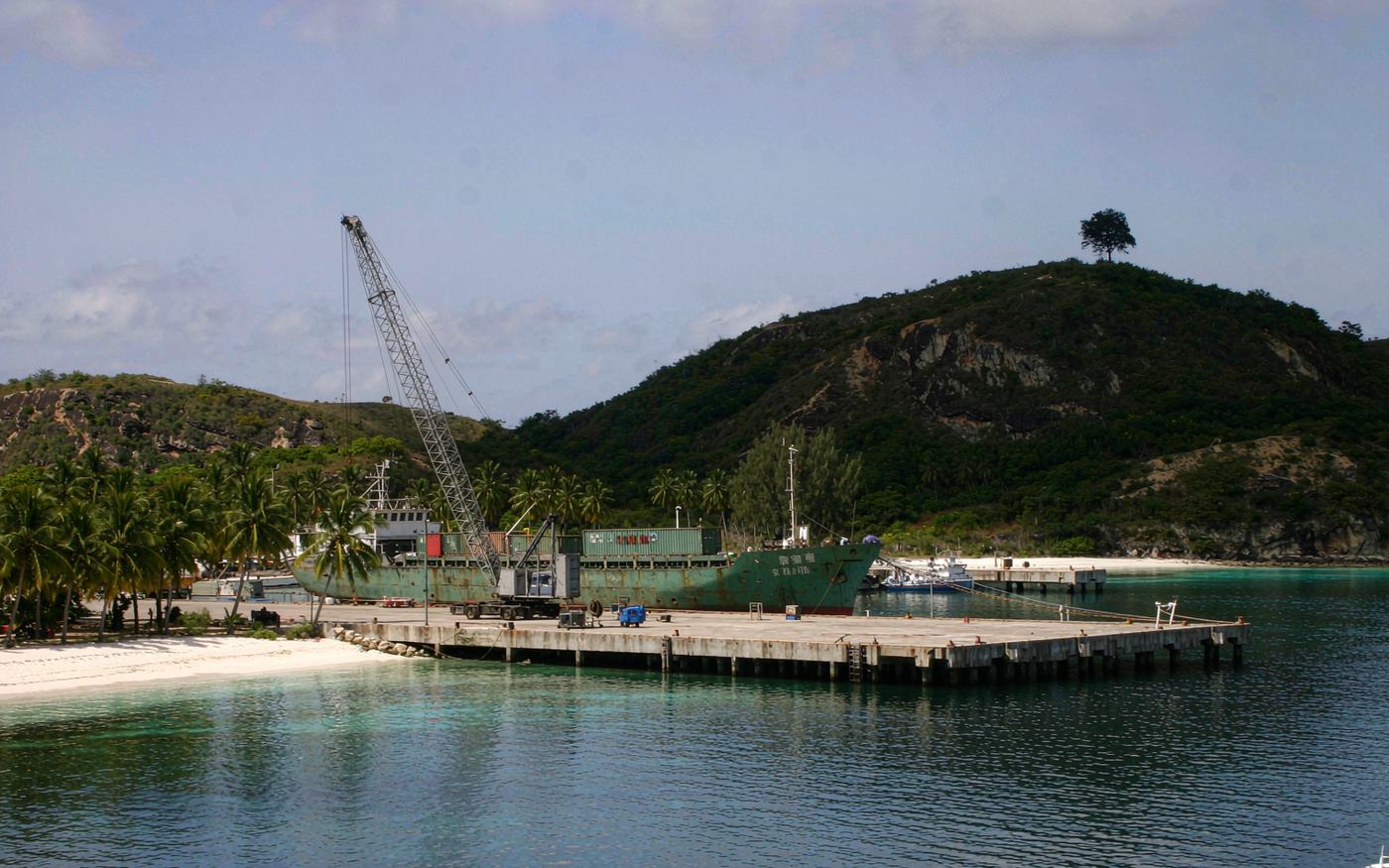
Longoni, on the north-eastern coast of Grande-Terre in the commune of Koungou, is Mayotte's main commercial port. It is a deep-water facility handling containers, bulk cargo and Ro-Ro, with dedicated container berths, mobile cranes, reach stackers and a dredged approach channel that takes vessels of roughly 12 metres draught depending on tide and berth.
Pilotage is compulsory for visiting commercial vessels, and the port operates around the clock. Customs and immigration are on site, which is convenient, and there is road distribution onward but no rail.
Reported annual throughput is in the order of 800,000 tonnes including domestic traffic, with foreign trade making up the larger share. Confirm current berth and equipment capacity for anything out of gauge.
Nearly all cargo arrives by feeder from Reunion
There is no deep-sea service from China to Mayotte. In practice cargo sails from China to Réunion, or occasionally to a Madagascan or mainland French port, and then moves to Mayotte on a feeder service. CMA CGM operates a weekly connection via Réunion, with additional seasonal supply services.
Treat the feeder as a leg with its own cut-off and its own cost. A container that reaches Pointe des Galets without a confirmed onward booking will wait, and the demurrage at the hub will exceed the feeder freight.
Name the routing explicitly in your instructions. If you write Mayotte as the discharge port and leave the transshipment unstated, you are asking the carrier to improvise, and the result is usually a longer transit than you quoted.
Air freight to Dzaoudzi and the runway that limits it
Dzaoudzi Pamandzi Airport, code DZA, sits on Petite-Terre, the smaller of the two main islands, and is connected to Grande-Terre by road link and ferry. It handles the territory's air traffic, with links to Réunion and mainland France.
The runway is the constraint. Aircraft that can use it are smaller than the wide-bodies that leave China, so piece dimensions and per-flight weight matter more than long-haul capacity. Confirm the aircraft type before promising an air delivery date.
Remember the ferry. Air cargo landing on Petite-Terre still has to cross to Grande-Terre, and that crossing has its own timetable and its own handling cost.
Dock dues still apply here even with no VAT
Absence of VAT does not mean absence of local tax. Dock dues are charged on goods entering the department, banded by HS code, and they apply to arrivals from mainland France as well as from third countries.
French customs guidance puts the regional addition at up to about 2.5 per cent, while the dock dues proper vary by commodity. Some goods carry no dock dues at all, and some carry rates well above the common range.
Get the band for your HS code confirmed in writing by a Mayotte broker before you quote. On a destination this small, there is no substitute for a local answer.
Biosecurity, and the controls that come with a lagoon island
Mayotte's isolation and its lagoon ecosystem make biosecurity a genuine control rather than a formality. Plant material, seeds, soil, live animals, untreated timber and food products are all controlled, and some categories require permits issued before the goods ship.
The regional context matters too. Mayotte sits in the Mozambique Channel close to the Comoros, and the administration is alert to informal trade. That means documentation is checked, and a vague description is more likely to attract an examination than it would be on a busy mainland route.
Wood packaging must meet ISPM 15 with the mark visible. Declare precisely, with model numbers where relevant, and include an end-use statement if the goods are industrial equipment.
Currency, language and the paperwork in French
The euro is the currency, so goods, local taxes and port charges are settled in euros. Your Chinese supplier will quote in US dollars or renminbi, so decide who carries the exchange movement across a long transit and write it into the contract.
French is the working language of the administration. Product descriptions, labels and handling instructions should be available in French, and the importer's registration details on the declaration must match what the administration holds.
The document set is the standard one: commercial invoice with HS codes, packing list, bill of lading or air waybill, and any certificate or permit your goods require.
The market: small, price-sensitive and dependent on imports
Mayotte imports most of what it consumes. Building materials, vehicles and spare parts, food, household goods and small appliances make up the bulk of commercial demand, and the market is highly price-sensitive.
For a Chinese supplier that usually means consolidation rather than full containers, and a willingness to quote honestly on a long transit. Trying to compete on speed against Réunion-based suppliers is not a winning strategy.
Storage is limited and expensive. Time the arrival to the consignee's ability to receive, because a container that lands before the buyer can take it becomes a cost very quickly.
Packing and marking for a tropical port with compulsory pilotage
The climate is hot, humid and salty. Use barrier packaging with desiccant for moisture-sensitive goods, and specify corrosion protection on exposed metal parts.
Mark every case with the consignee's name and a local contact number. On a port this size, an unmarked case has no system behind it to identify the owner.
Pack for handling in the open. Cartons stand on the quay between discharge and collection, and packaging that would survive a covered warehouse will not last a fortnight in the tropics.
Timings, and the weather window that governs them
Sea freight from a Chinese port to Longoni, including the Réunion feeder, typically runs 35 to 55 days. Air freight is commonly 8 to 14 days door to airport, subject to the aircraft and the ferry crossing.
The cyclone season in the south-west Indian Ocean broadly runs from November to April, and it affects feeder schedules and berth availability. If your cargo is time-critical, avoid the peak or build in a buffer.
Insure the consignment. A long ocean leg, a feeder, a tropical port and limited storage add up to more exposure than a standard container move.
Why importers use Goodhope on this lane
Six things that are different about working with us on China to Mayotte shipments.
What we see shipping into Mayotte
Five shipments bought in China and delivered into Mayotte, told end to end — where the order came from, how it moved, where it nearly went wrong, and how it finished. Client names are withheld at their request; the situations and the handling are what we deal with on this lane.
No VAT is not no charges · first container · Shenzhen to Longoni
The purchase. A buyer new to importing read that no VAT was levied and budgeted nothing beyond duty.
The move. Consolidated sea freight with dock dues and the regional addition in the landed cost.
Where it nearly went wrong. No local VAT is levied, but dock dues and a regional addition still apply. Reading no VAT as no charges produces a landed cost that is short every single time, and short by a predictable amount.
How it finished. We separated the two on his quote. His costs have matched the assessment ever since.
The feeder · scheduling · Ningbo to Mayotte
The purchase. A first-time buyer asked for a direct sailing and planned around one.
The move. Cargo forwarded on the feeder service from the neighbouring island, with that leg booked with the freight.
Where it nearly went wrong. Nearly everything arrives by feeder. Planning around a direct call that does not run means planning around nothing, and discovering it after the goods are packed is expensive.
How it finished. He books the feeder leg with the freight. His schedules have held since.
One port · compulsory pilotage · Guangzhou to Mayotte
The purchase. A buyer assumed the port worked like other French-territory ports he had shipped to.
The move. Full container into Longoni with the pilotage requirement and tropical handling allowed for.
Where it nearly went wrong. There is one deep-water commercial port here and it works to its own conditions, including compulsory pilotage. Packing and scheduling for a generic port produces the wrong plan on the only one available.
How it finished. We built the handling into the plan. Nothing has been delayed at the anchorage since.
Biosecurity · lagoon island · Yiwu to Mayotte
The purchase. A buyer shipped goods with soil and plant material on the packaging and did not declare it.
The move. Consolidated sea freight with cleaned cargo and an accurate declaration.
Where it nearly went wrong. Biosecurity applies strictly here, as it does on an island whose lagoon is the point. Treatment on arrival costs several times what compliance at origin does, and delays the rest of the consignment with it.
How it finished. We made clean packing a supplier condition. Nothing has been treated since.
Air limits · runway · Shanghai to Mayotte
The purchase. A buyer with an oversized urgent item assumed air freight could take it as usual.
The move. Air freight within the aircraft limits the runway allows, with the oversized pieces moved by sea instead.
Where it nearly went wrong. The airport is on the adjacent island and the runway sets its own limits on what arrives by air. Assuming air will carry anything urgent is assuming a capability that is not there.
How it finished. He splits urgent orders now and moves oversized pieces by sea. Nothing has been offloaded.
Why importers use Goodhope on this lane
Six things that are different about working with us on China to Mayotte shipments.
Answer the local levy question before the booking closes
Send us the HS code, the weights and the dimensions, and we will confirm the dock dues band and the regional addition that apply in Mayotte, what the Réunion feeder will cost and when it sails, and whether your goods need a permit before they leave China.
Get a quote Talk to usRelated pages
Frequently asked questions
Is VAT charged on imports into Mayotte?
No. Mayotte levies no French VAT at all, in the same way French Guiana does not. Some trade reference sites list an 8.5 per cent rate copied from the other departments; French tax and shipping guidance put Mayotte at zero, with local taxes applied instead. Confirm with a Mayotte broker.
Does Mayotte apply dock dues?
Yes. Dock dues are charged on goods entering the department regardless of origin, banded by HS code, with a regional addition of up to about 2.5 per cent. Absence of VAT does not mean absence of local tax.
Which port handles my container?
Longoni, on the north-eastern coast of Grande-Terre at Koungou. It is the only deep-water commercial port, handling containers, bulk and Ro-Ro, with compulsory pilotage for commercial vessels.
Is there a direct sailing from China?
No. Cargo sails to Réunion, or occasionally to a Madagascan or mainland French port, and then moves to Mayotte by feeder. CMA CGM runs a weekly connection via Réunion.
Which airport serves Mayotte?
Dzaoudzi Pamandzi Airport, code DZA, on Petite-Terre. It is linked to Grande-Terre by road and ferry, and the runway limits the aircraft types that can operate, so piece dimensions matter.
Is Mayotte inside the EU customs territory?
Yes. It is an outermost region, so the Union Customs Code and TARIC apply and an EORI number is required, but the department is outside the EU VAT area.
Are biosecurity controls strict?
Yes. Plant material, seeds, soil, live animals, untreated timber and food products are controlled and some need permits issued before the goods ship. Wood packaging must meet ISPM 15.
What currency and language apply?
The euro, and French is the working language of the administration. Descriptions, labels and handling instructions should be available in French.
Should I ship full container or consolidated?
Consolidated, usually. The market is small and price-sensitive, demand is mostly building materials, vehicles and parts, food and household goods, and storage at the destination is limited.
How long does shipping take from China?
Sea freight including the Réunion feeder is typically 35 to 55 days; air freight is commonly 8 to 14 days door to airport. Avoid the November to April cyclone peak for time-critical cargo.