
Home / Shipping to Montserrat / How to Ship from China to Montserrat
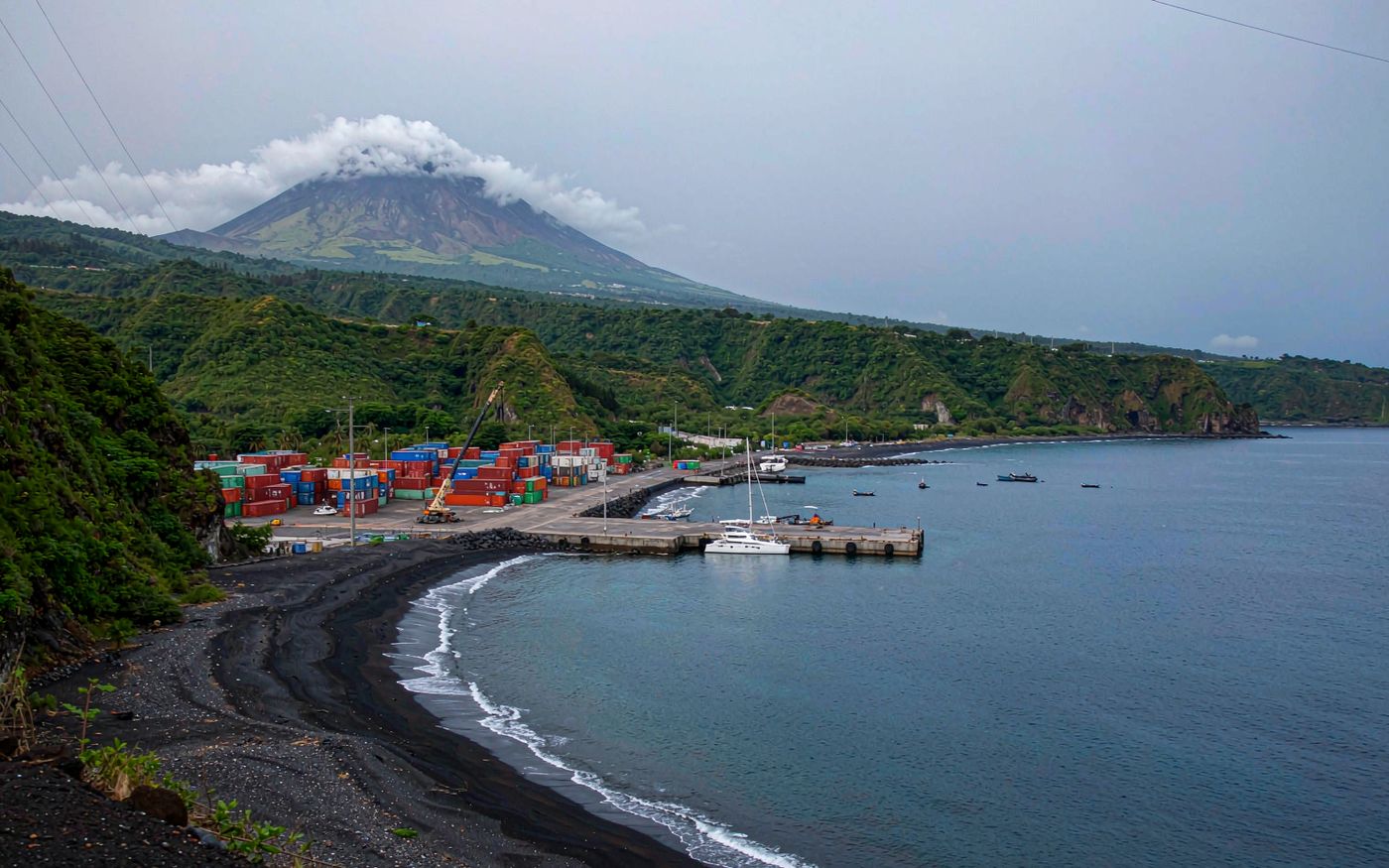
How to Ship from China to Montserrat: Little Bay, the Volcano Legacy & Two Border Charges
Start with the thing that catches everyone out. Many shipping schedules still list Montserrat's port as Plymouth. Plymouth was the island's capital and its only port until the Soufrière Hills volcano buried it in 1997. It sits inside the exclusion zone and has been abandoned for decades. Cargo today is worked at Little Bay, in the north of the island. If you see Plymouth on a schedule, it is a legacy port code, not the place your goods will land — and if you brief a buyer on "Plymouth", you will both be surprised on arrival.
The second thing is that Montserrat is a British Overseas Territory but not part of the United Kingdom for customs purposes. It sets its own import duty, assessed on arrival. A British entry does not cover it, and an EC-wide assumption does not either.
The third is the scale of what customs means here. The Montserrat Customs and Revenue Service is described as responsible for collecting over eighty percent of locally generated revenue, with the customs department alone collecting over a third of internally generated revenue. On an island this small, the border is not a checkpoint tacked onto a tax system — the border is the tax system.
At a glance
Territory: British Overseas Territory in the Leeward Islands; government headquarters at Brades · Customs: own regime, not part of the UK customs territory · Authority: Montserrat Customs and Revenue Service (MCRS) · Border charges: two — duty and consumption tax · Systems: ASYCUDA World, Sail Clear, published tariff codes · Port: Little Bay (Plymouth is a legacy code, abandoned) · Airport: John A. Osborne Airport (MNI) · Currency: Eastern Caribbean dollar
How your cargo moves: China to Montserrat
Eight steps from your supplier's door to yours. The last four are the ones shaped by local rules.
- Pickup from your supplierWe collect the goods anywhere in China and bring them to our consolidation point.
- Export clearanceChina customs declaration filed and released before the goods move to the port.
- Loading and departureContainer loaded, sealed and handed to the carrier at the Chinese port.
- Main carriageOcean, air or rail movement booked on the route agreed for your cargo.
- Arrival at the gatewayDischarge at the port or airport of entry, recorded on the carrier's manifest.
- Import clearanceCustoms declaration filed locally, with duty and tax assessed on the declared value.
- Customs releaseGoods released into free circulation once duty and tax are settled.
- Final deliveryOnward movement to your delivery address, warehouse or nominated depot.
Duty rates, VAT rates and clearance times move, and the figure that applies to your goods is the one set for your commodity code on the day of clearance. We check the current position against your code before your goods sail and confirm it to you in writing — ask for that check when you request a quote.
The port code still says Plymouth, and the cargo lands at Little Bay
This is worth a paragraph of its own because it is a genuine operational trap rather than a curiosity.
The Soufrière Hills volcano became active in 1995 and buried Plymouth, the capital and only port, in 1997. The southern part of the island, including the old port and the former airport, is inside an exclusion zone. The island rebuilt in the north: the new port and commercial centre is at Little Bay, the airport is John A. Osborne Airport (MNI), and much of the customs paperwork is handled at the Customs and Excise headquarters in Brades. Goods are physically processed at the seaport, the airport and the Post Office.
Three practical instructions. Write Little Bay as the discharge port on your documents. Warn your buyer that schedules may show the legacy code. And plan the last mile from Little Bay rather than from anywhere else — the road from the port to Brades is short, but the road network is narrow, mountainous and slow, and remote villages are genuinely remote.
Only two border charges now: duty and a local tax
Montserrat used to charge three taxes on imports. A reform introduced on 1 June 2012 abolished service tax and reduced that to two: duty and consumption tax. That is a real simplification, and it is worth knowing, because older guides and older quotation templates still carry the three-line structure.
The reform also did something more consequential than removing a line. It changed the rates on over six thousand tariff items and reduced the number of rate bands, with a stated policy intent: items used by lower income groups were placed in a lower band, while luxury items — some electronic goods among them — were placed in a higher one. So the classification of your product decides its band, and the band structure is deliberately social as well as fiscal.
Confirm the rate, do not assume it. We deliberately do not publish a rate table for Montserrat. The bands were restructured once, have been adjusted since, and depend on the tariff item. Ask the consignee's broker to confirm the current duty and consumption tax for your specific tariff code, in writing, before you price the order.
Customs collects most of the government's own revenue
The Montserrat Customs and Revenue Service is a department of the Ministry of Finance and Economic Management, created by Executive Council decision in 2011 and formalised by the Montserrat Customs and Revenue Service (Enabling) Act No. 6 of 2017. It is described as responsible for collecting over eighty percent of locally generated revenue, with the customs department itself collecting over a third of internally generated revenue and acting as the first line of defence against contraband.
For an importer, that scale produces a specific culture. Declaration accuracy is the revenue-collection process, not an administrative formality, and the department inspects and examines goods entering and leaving the country as a matter of course. Two consequences follow directly:
- Describe precisely. A description that does not match the contents is the fastest route to a hold, and on a small island with one port, a hold means storage rather than a queue.
- Clear promptly. A consignment that arrives before the receiver is ready to clear it will sit at the port and accrue storage charges that nobody budgeted for.
Sail Clear, the declaration portal, and the tariff codes
Montserrat runs ASYCUDA World, the computerised customs management system used across much of the Caribbean, which handles manifests, customs declarations, accounting procedures, and transit and suspense procedures. Sail Clear is also available for submitting customs declarations. The department publishes tariff codes, which are used to classify goods and to calculate the taxes due, along with customs forms including exemption forms, process guides and the governing legislation.
Classify against the published tariff codes
Do this before you quote, because the band decides the rate. Where a product sits between two codes, get the classification confirmed rather than choosing the cheaper one.
Prepare the document set
Commercial invoice with description, quantity and value; packing list with weights and dimensions; bill of lading for sea or airway bill for air; and any exemption form where relief is claimed.
Lodge the declaration
Through ASYCUDA World or Sail Clear, by the importer or their agent. Confirm in advance who lodges, because the mechanics are local.
Assessment and examination
The department inspects and examines goods and assesses the duty and consumption tax. Examination is routine rather than exceptional.
Payment and release
Duty and consumption tax are settled, and the goods are released. Collection of both is the point of the process, so have the funds arranged before arrival.
Rates that move with policy: plastic bags, sugary drinks and tobacco
Montserrat's tariff is an active policy instrument, and that is worth stating plainly because it makes a published rate table unreliable within a short period. Government announcements describe amendments to tariff rates on single-use plastic bags, sugary drinks, tobacco products and certain natural drinks, alongside health-related measures, and seasonal concessions such as a flat charge on barrels arriving at Christmas.
The pattern is a familiar one across small territories: the tariff is used to discourage specific consumption as well as to raise revenue. For a Chinese exporter it produces one clear instruction — if your product sits anywhere near a discouraged category, check the current treatment before you quote, because a rate that changed last year will not be the rate a guide quotes this year.
One mobile crane, limited hours, and the feeder from Antigua
Little Bay is a small port with small-port constraints. Published descriptions mention limited operating hours and limited equipment, including a single mobile crane, handling the great majority of the island's imports alongside roll-on/roll-off capability. Published guidance recommends buffering two to three weeks on critical shipments.
Routing compounds it. Cargo from China moves through a major hub — Miami or Kingston are the usual ones — and then transfers to smaller feeder vessels, commonly at Antigua or St Kitts, for the final leg. Published guidance puts sea transit at roughly thirty-five to forty-five days depending on routing, with European-origin sea freight commonly quoted at four to ten weeks door to door.
So the honest planning model is: a long main leg, a feeder connection you do not control, and a port with one crane. None of those three are problems individually. Together they mean an arrival date quoted to the day is a promise you cannot keep.
Why everything is transshipped, and what that does to the calendar
Montserrat has no deep-water container terminal and no direct service from Asia. Everything arrives on a feeder, which means the arrival date is set by the feeder schedule rather than by the ocean carrier's rotation.
| Stage | What happens | What decides it |
|---|---|---|
| Main leg from China | Container moves to a regional hub such as Miami or Kingston | The carrier's rotation and the transhipment connection |
| Feeder transfer | Cargo transferred to a smaller vessel, commonly at Antigua or St Kitts | The feeder schedule — the variable you do not control |
| Arrival at Little Bay | Discharge with limited equipment and limited hours | Berth availability and port operating hours |
| Entry and examination | Declaration lodged, goods examined, duty and consumption tax assessed | Whether the documents were complete and the receiver was ready |
| Last mile | Road movement from Little Bay to Brades, Salem or the villages | Narrow, mountainous roads; remote villages take materially longer |
| Air alternative | Through MNI for urgent or high-value cargo | Small cargo terminal; oversized items need pre-arranged handling |
Packing for a small port with a long tow to the village
The physical handling on this route deserves more respect than it usually gets. A container from a Chinese factory to Montserrat may be transhipped twice, discharged by a single mobile crane, and then taken up a narrow mountain road. Cartons adequate for a short European move are often not adequate for this one.
- Assume several extra handlings. Two transhipments plus a small-port discharge means more lifts than the routing suggests.
- Use double-wall cartons. Single-wall storage boxes, plastic containers and bags do not survive this voyage.
- Specify moisture protection. Desiccants and a liner. Tropical humidity plus a long transit is how condensation claims are made.
- Mark every package. If the consignment is LCL, packages are separated and handled individually at the deconsolidation point.
- Photograph the stuffing. Digital evidence resolves damage disputes far faster than written descriptions.
- Check the timber. Wood packaging must comply with ISPM 15 and carry the mark.
A working sequence from a Chinese factory to a Montserrat address
- Confirm the tariff code and the two rates — duty and consumption tax — with a Montserrat broker, in writing.
- Confirm the landing port is Little Bay and brief the buyer that schedules may show the legacy Plymouth code.
- Book the routing and note which hub and which feeder connection it uses.
- Pack for multiple handlings and a tropical transit; use marked, treated timber.
- Complete China export clearance with the documents finished before the truck is booked.
- Tranship and feeder — the two stages where the schedule slips.
- Lodge the declaration through ASYCUDA World or Sail Clear on arrival, with the receiver ready to clear.
- Pay and release, then move the last mile from Little Bay.
What a Montserrat importer should confirm before ordering
- What are the duty and consumption tax rates for this tariff item? Get them in writing.
- Who lodges the declaration? Name the agent, and confirm they work ASYCUDA World.
- Is the landing port written as Little Bay? Check it on the documents.
- Which hub and which feeder? Compare routings, not just prices.
- Is the receiver ready to clear on arrival? Storage charges are the cost of not being ready.
- Is the product near a discouraged category? Plastics, sugary drinks and tobacco rates have moved.
- Is the wooden packaging marked? Check before the container is sealed.
- Is two to three weeks of buffer in the plan? For critical shipments, it should be.
Why importers use Goodhope on this lane
Six things that are different about working with us on China to Montserrat shipments.
Confirm the landing port and the tax lines before booking
Tell us what you are shipping, the tariff code if you have it, the packed dimensions and gross weight, the pickup city in China and the delivery address in Montserrat. We will confirm the current routing and which hub and feeder connection it uses, write Little Bay as the discharge port rather than the legacy Plymouth code, tell you plainly which two charges your consignee will face at the border and which of them is a question for a Montserrat broker rather than for us, check the packing and timber requirements with you, and quote the sea and air options separately so you can see what the extra speed costs.
Get a quote Talk to usRelated pages
Frequently asked questions
Which port does cargo to Montserrat actually land at?
Little Bay, in the north. Plymouth was the capital and only port until the Soufrière Hills volcano buried it in 1997 and it sits inside the exclusion zone. Schedules showing Plymouth are using a legacy code.
Is Montserrat part of the UK customs territory?
No. It is a British Overseas Territory with its own import duty assessed on arrival. Clearance, duty and local taxes are the consignee's responsibility, and cargo arriving before the receiver is ready will accrue storage.
What taxes apply to imports into Montserrat?
Two: duty and consumption tax. A reform effective 1 June 2012 abolished service tax and cut import taxes from three to two, changing rates on over six thousand tariff items. Confirm current rates with the MCRS.
Which authority clears cargo in Montserrat?
The Montserrat Customs and Revenue Service, headquartered at Government Headquarters in Brades. It collects over eighty percent of locally generated revenue, with customs alone over a third of internally generated revenue.
How are customs declarations filed in Montserrat?
Through ASYCUDA World, which handles manifests, declarations, accounting, transit and suspense procedures. Sail Clear is also available for submitting declarations. Published tariff codes classify goods and calculate the taxes due.
Do Montserrat's tariff rates change often?
They are adjusted by policy. Recent announcements cover single-use plastic bags, sugary drinks, tobacco products and certain natural drinks, plus seasonal concessions. Confirm the current rate for your tariff item.
How does cargo from China reach Montserrat?
By transhipment through a hub such as Miami or Kingston, then a feeder, commonly from Antigua or St Kitts, to Little Bay. Published guidance puts sea transit at roughly thirty-five to forty-five days.
What are the port limitations at Little Bay?
Limited operating hours and limited equipment, including a single mobile crane in many descriptions. Published guidance recommends buffering two to three weeks on critical shipments.
What currency and airport should I plan around?
The Eastern Caribbean dollar, with government charges quoted in EC dollars. Air freight arrives at John A. Osborne Airport, MNI, which has a small cargo terminal and limited capacity for oversized items.
Should a first shipment to Montserrat be FCL or LCL?
LCL almost always. Very few consignments justify a full container on this lane, and LCL avoids committing to a box on a route with infrequent feeder sailings. FCL suits a full relocation or a large project consignment.