
Home / Shipping to Myanmar / How to Ship from China to Myanmar
How to Ship from China to Myanmar: Yangon, the Import Licence & the 2.5% Commercial Tax
In Myanmar the document that decides when your goods move is not the bill of lading, it is the import licence. Published trade guidance for Myanmar describes an import regime in which a large share of goods sits under some form of restriction, where licence applications go through Myanmar Tradenet 2.0, and where approvals arrive on a timetable importers describe as unpredictable. If you book the vessel first and apply for the licence second, you have converted a freight problem into a demurrage problem.
The second thing worth understanding before you order is that duty is only half the tax bill. Myanmar charges customs duty on the assessable value — the CIF value plus landing charges of 0.5 percent of CIF — and then separately charges commercial tax at 2.5 percent on the landed cost, which is the assessable value plus the duty already assessed. Some goods carry a special goods tax on top. The duty rate you look up in the tariff is not the number you pay.
The third is payment. Publicly available trade guidance describes a shortage of official foreign currency for settling supplier payments, with payments expected to move through official channels. That makes the buyer's bank approval a real gate in the process, alongside the licence and the booking, and it is the one first-time importers most often discover late.
At a glance
Country: in mainland South-East Asia on the Bay of Bengal and the Andaman Sea, bordered by China, India, Bangladesh, Laos and Thailand; capital Nay Pyi Taw, commercial centre Yangon; an ASEAN and WTO member. · Currency: the Myanmar kyat. · Duty: tariff rates by HS code, commonly described as running from zero to around 40 percent, assessed on CIF value plus 0.5 percent landing charges. · Commercial tax: 2.5 percent, charged on the landed cost, which is the assessable value plus the duty. · Special goods tax: applies to certain categories on top. · De minimis: no meaningful threshold for commercial imports — plan on duty being assessed. · FTA: ASEAN-China Free Trade Area, claimed with a Form E certificate of origin; RCEP certificates of origin also circulate in the region. · Customs: Myanmar Customs Department, declarations through MACCS and licences through Myanmar Tradenet 2.0. · Ports: Yangon and the Thilawa container terminal; airports: Yangon International and Mandalay. · Land border: Muse and Ruili, the main China crossing. · Importer: a Myanmar-registered importer with a customs identification number; registration is published at around 15 working days. · Verify current rates, licence lists and free-time rules with your broker before you book.
How your cargo moves: China to Myanmar
Eight steps from your supplier's door to yours. The last four are the ones shaped by local rules.
- Pickup from your supplierWe collect the goods anywhere in China and bring them to our consolidation point.
- Export clearanceChina customs declaration filed and released before the goods move to the port.
- Loading and departureContainer loaded, sealed and handed to the carrier at the Chinese port.
- Main carriageOcean, air or rail movement booked on the route agreed for your cargo.
- Arrival at the gatewayDischarge at the port or airport of entry, recorded on the carrier's manifest.
- Import clearanceCustoms declaration filed locally, with duty and tax assessed on the declared value.
- Customs releaseGoods released into free circulation once duty and tax are settled.
- Final deliveryOnward movement to your delivery address, warehouse or nominated depot.
Duty rates, VAT rates and clearance times move, and the figure that applies to your goods is the one set for your commodity code on the day of clearance. We check the current position against your code before your goods sail and confirm it to you in writing — ask for that check when you request a quote.
Where your goods actually land in Myanmar
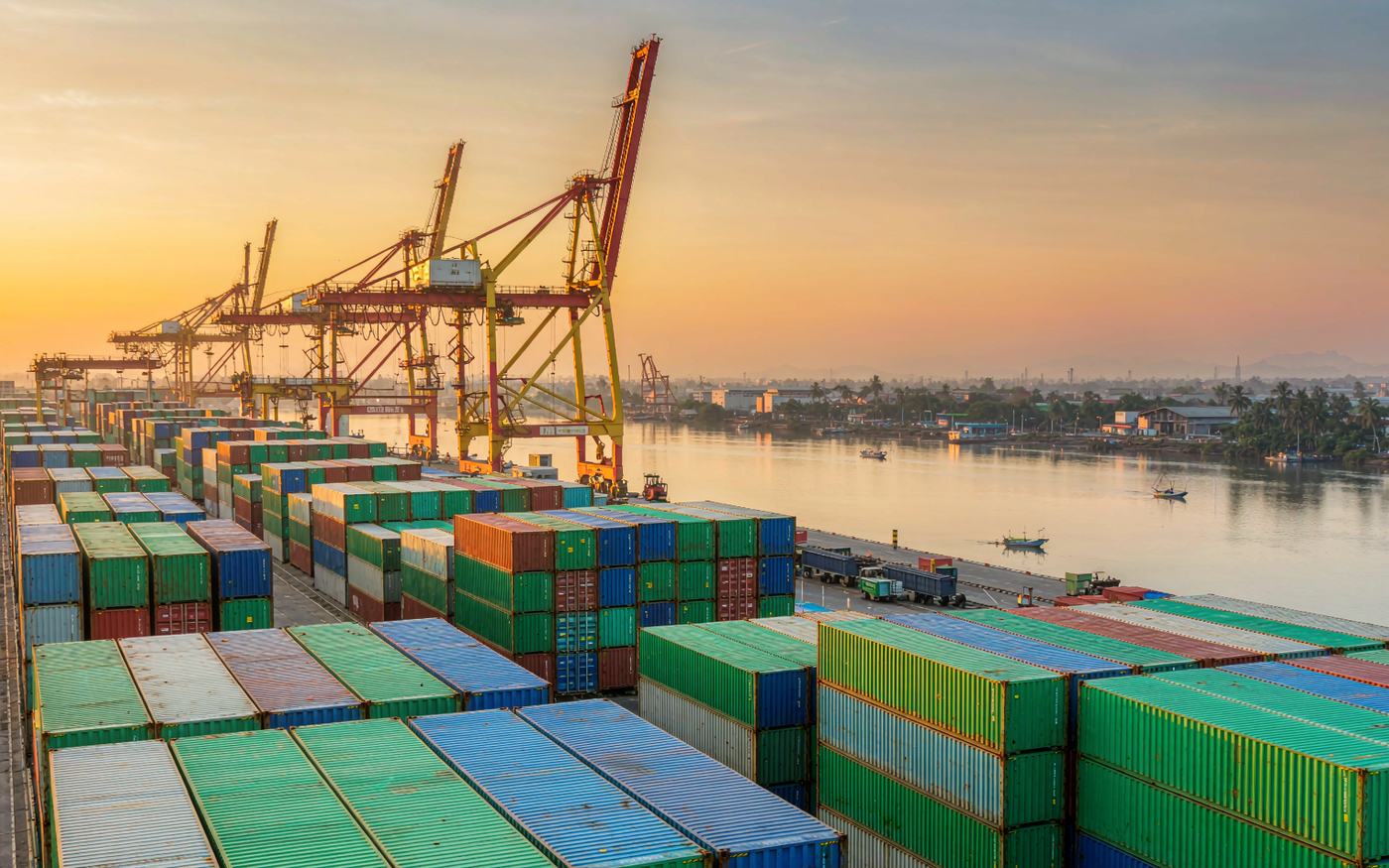
Almost every first consignment into Myanmar arrives through Yangon. Within that, the distinction that matters is between the Thilawa container terminal south of the city, which handles deep-sea container traffic, and the river berths in Yangon itself, which handle conventional cargo and smaller vessels. If you are shipping a container, Thilawa is where you should picture it going, and if you are shipping break-bulk or a part-container that will be stripped at a warehouse, the river berths may be in play. Your Chinese forwarder can tell you which one your carrier calls at.
The practical consequence of a single dominant gateway is that inland distribution is the second half of the job. Yangon to Mandalay is a long road leg, and condition of that road, seasonal weather, and fuel availability all feature in how long it takes. If your consignee is in upper Myanmar, or close to the Chinese border, it is worth asking whether the overland route is the better answer before you default to a Yangon routing simply because that is the name you have heard.
Air freight arrives at Yangon International, with Mandalay as a secondary point. For samples, spare parts, and urgent small consignments, air is usually the right call, and it is also the fastest way to test whether your paperwork is in order before you commit a container to the same lane.
Sea, air and the overland route from Yunnan
Three routings carry China-to-Myanmar cargo, and they suit different buyers.
Sea into Yangon and Thilawa
The workhorse for full containers and consolidated cargo from anywhere in China. Direct services exist from South China ports but are thinner than the main East Asia lanes, so many sailings tranship through Singapore or Port Klang. Transhipment adds a leg and a wait, which is why the quoted schedule matters more here than the nominal distance. Best for furniture, building materials, machinery, and anything bulky where time is not the binding constraint.
Overland through Muse and Ruili
The crossing at Muse on the Myanmar side and Ruili on the Chinese side is the route most Yunnan-sourced cargo takes, and it is often the faster door-to-door option for upper Myanmar. It is border trade, which means licensing runs on the non-automatic track with its own documentation. Best for smaller consignments, replenishment stock, and buyers whose suppliers are in Yunnan or whose customers are in the north.
Whichever you pick, the trade term you agree with your supplier decides who does what. Under EXW you collect from the factory and own everything from there. Under FOB the supplier delivers to the Chinese port and loads; you carry the main leg and the risk from the ship's rail. Under CIF to Yangon the supplier pays freight and insurance to the port, but clearance, duty and inland delivery are still yours. Under DDP the seller is nominally responsible for delivering duty paid — and in a market where licences, permits and currency approvals are tied to a locally registered importer, DDP to Myanmar is a promise worth interrogating before you rely on it.
One term catches people out: port to port for sea and airport to airport for air. Both stop at the terminal. Neither includes customs clearance, duty, or the truck to your consignee's door. When a quote looks conspicuously cheap, check which of the two you are being sold.
Where a shipment actually goes, in order: supplier production and packing in China → export customs declaration in China → the main leg by sea, air or road → arrival at Yangon, Thilawa or the border → licence and permit verification → CUSDEC-1 declaration through MACCS → assessment and payment of duty and commercial tax → release → inland delivery. The licence step sits before arrival in a well-run file, and it is the one that silently moves later when nobody owns it.
The licence comes first, the booking comes second
Myanmar runs import licensing through Myanmar Tradenet 2.0, which is integrated with the Myanmar Automated Cargo Clearance System (MACCS) that handles the declaration itself. Since June 2023 the platform has split applications into automatic and non-automatic licensing. For seaborne trade, only a limited list of goods qualifies for automatic licensing, and most lines — including some that previously needed no licence at all — now fall under non-automatic. River, land and border trade applications are processed only under non-automatic licensing, where the applicant has to show export earnings and submit additional supporting documents.
What that means for you as a buyer is simple and slightly uncomfortable: you cannot assume your product is on the automatic list. Check the HS code against the current licence list with a Myanmar-side broker before you place the order, because if it turns out to be non-automatic, the application needs documents you may not have to hand, and the approval has its own clock that runs independently of your supplier's production schedule.
Beyond the licence, restricted categories need permits from the ministry that owns them — food and drug administration approval for pharmaceuticals and food, agricultural and phytosanitary certificates for plant and animal products, and technical standards certification for regulated goods. Published guidance puts typical permit validity at around six months, which in practice means a permit obtained for one shipment can cover a repeat order if the product and the paperwork are unchanged. That is worth knowing if you plan to import regularly.
How duty and commercial tax are calculated
The two charges sit on two different bases, and mixing them up is the most common budgeting error on this lane.
| Step | Base | Charge |
|---|---|---|
| Assessable value | CIF value plus landing charges of 0.5 percent of CIF | The base customs duty is calculated on |
| Customs duty | Assessable value × the tariff rate for the HS code | Rates vary by product; published tariff bands run from zero to around 40 percent |
| Landed cost | Assessable value plus the import duty already assessed | The base the commercial tax is calculated on |
| Commercial tax | Landed cost × 2.5 percent | Charged alongside duty at the point of entry, at clearance |
| Special goods tax | Applies to certain categories | Checked at HS code level |
Worked at a CIF value of US$10,000 with duty at 10 percent: landing charges add US$50, giving an assessable value of US$10,050 and duty of US$1,005. The landed cost is then US$11,055, and commercial tax at 2.5 percent is roughly US$276. Total tax is about US$1,281, or a little under 13 percent of CIF — against a headline duty rate of 10 percent. The gap is small at low duty rates and grows as the duty rate does.
The other lever is Form E. Myanmar is part of the ASEAN-China Free Trade Area, and a Form E certificate of origin issued in China before shipment is what turns a tariff rate into a preferential one, sometimes zero. Two cautions: it does nothing about the 2.5 percent commercial tax, which applies regardless of origin, and it does nothing if the product description, HS code and shipper details on the certificate do not match the declaration. Get it issued in China, and check it against the final invoice before the goods sail.
What the declaration needs, and who can file it
Every consignment clears on a CUSDEC-1 import declaration, filed electronically through MACCS. The list of documents that travel with it is short in principle and unforgiving in practice.
| Document | What it has to do |
|---|---|
| Import licence or permit | Match the goods and be valid on the date of declaration — this is the one that stops shipments |
| Commercial invoice | Product description, quantity, unit and total value, currency, and the terms of sale; written in English |
| Bill of lading or air consignment note | The original transport document from the carrier |
| Packing list | Contents, weights and dimensions per package, agreeing with the invoice |
| Certificate of origin | Form E where preferential duty under the ASEAN-China agreement is claimed |
| Sector certificates and permits | Food and drug approval, sanitary and phytosanitary certificates, technical standards certification, as the product requires |
| Importer registration | A Myanmar-registered importer holding a customs identification number |
Two details are worth planning around. First, published guidance describes Myanmar as applying WTO customs valuation rules based on transaction value, with the assessing officer able to fall back on reference prices or comparable past declarations where the declared value looks understated — so the commercial invoice should be the genuine transaction document, and your payment records should support it. Second, invoices for some categories are described as needing attestation or consular legalisation; whether your product and port require it is a question for your Myanmar broker, and it is worth asking before the goods sail rather than at the counter.
On the importer side, commercial importing needs a Myanmar-registered entity holding importer registration and a customs identification number; published guidance puts the registration at roughly fifteen working days and notes that an unregistered business cannot import independently. An individual traveller's personal effects are handled separately and far more simply, but a commercial shipment needs the registered importer in place before the vessel arrives.
Paying your supplier when dollars are scarce
This is the part of a Myanmar import that is genuinely different from shipping to Thailand or Vietnam, and it is the part most first-time buyers have not thought about.
Publicly available trade guidance describes foreign currency being in short supply, with importers facing delays in obtaining the currency needed to pay suppliers, and with supplier payments expected to go through official channels. There is also a well-documented informal transfer system outside the banking system, which appears in the same guidance precisely because official channels are constrained. We are not going to advise anyone to use an informal channel; the point for you as a buyer is that the timing and mechanics of payment are a project task, not an afterthought.
Practically, that means three things. Agree the payment method and currency with your supplier in writing before production starts. Ask your Myanmar-side bank and broker what documents the approval needs and how long it takes, and treat that as a lead time in your plan. And where the goods are being bought on open account or against documents, make sure the documentary timeline — bill of lading, invoice, certificate of origin — lines up with when the money can actually move, because a container that arrives before its payment approval is a container accruing charges.
Licences and permits by product type
The licence question is general, but the permit question is product-specific, and the two categories that catch new importers are food-contact goods and anything with a plug or a battery.
- Electronics and anything with a radio. Telecommunications equipment typically needs type approval from the national regulator before it can be imported or used, and where a certificate is needed it usually has to be held by a local entity. Start this early — approval processes are measured in weeks, not days.
- Food, supplements and cosmetics. Expect food and drug administration oversight, and expect the certificate to be tied to a locally registered importer rather than to you as the overseas seller.
- Pharmaceuticals and medical devices. Registration of the product, not just the shipment, and permits issued to a local licence holder.
- Plants, seeds, wood and agricultural products. Phytosanitary certificates from the Chinese side and a quarantine inspection on arrival. Wood packaging has to carry the ISPM 15 stamp; untreated timber is the single most common reason a container is held for treatment at the importer's cost.
- Chemicals and anything hazardous. A material safety data sheet and, for dangerous goods, classification and packing to the IMDG Code for sea or IATA rules for air, declared at booking rather than at the port.
- Used vehicles and machinery. Restricted in many markets and subject to age and emission rules; check before you ship, not after.
If you sourced online: marketplace orders tend to arrive as many small parcels from different suppliers. Consolidating them in a Chinese warehouse into one shipment gives you one declaration, one licence application and one set of permits — and one HS code list to get right. If you sourced at a fair: you are more likely to have a single supplier and a negotiated term, which means the licence and the HS classification can be settled before production finishes, which is where you want them.
What three Myanmar shipments actually looked like
The following three are illustrative composite examples, not specific client shipments. They are here to show how the same rules produce very different jobs.
A container of furniture fittings into Thilawa
A Yangon importer ordering hardware and fittings from a supplier in Guangdong. The goods sat in the lower duty bands, the licence application was straightforward, and the whole file turned on one thing: a Form E issued before sailing that matched the final invoice. It went sea, port to port into Thilawa, with the consignee's broker handling the declaration and the importer arranging the last leg.
Replenishment stock overland through Muse
A Mandalay retailer restocking from a Yunnan supplier in smaller volumes. Sea would have meant a long inland leg from Yangon, so the cargo crossed at Muse and Ruili. Because it was border trade, the licence ran on the non-automatic track with its own supporting documents — which the importer had ready because they had run the route before and knew the list.
A sample and a first air shipment
A buyer testing a new product line sent samples by air to Yangon International first, cleared them, and only then committed to a container. The cost of the air shipment was small next to the value of discovering, before the container sailed, that the product needed a certificate nobody had mentioned.
Picking a forwarder who can move goods into Myanmar
You need two forwarders, and it is worth being clear about what each is for. The one in China handles consolidation, export customs declaration, the booking, and the documents that have to be issued here — the certificate of origin and Form E above all. The one in Myanmar handles the licence, the permits, the MACCS declaration, the assessment, and getting the container out before free time runs out. What you are looking for is a freight forwarder, not a shipping line, not a trucking company and not a warehouse: the forwarder is the party that coordinates the other three and owns the timeline.
How to tell a good one from a bad one, in questions you can actually ask:
- Ask what they need from you and by when. A professional will give you a dated document list. A vague answer here usually means the licence question has not been thought about.
- Ask whether your HS code is on the automatic licensing list. If they cannot answer, or answer without checking, that is a signal.
- Ask who files the declaration and whether they are licensed to. Filing access runs through registered brokers; a forwarder who plans to improvise this step is giving you a problem.
- Ask for the tax calculation in writing, showing duty and commercial tax separately. If the two are collapsed into one number, you cannot check it.
- Ask what happens if the licence is late. The honest answer involves demurrage, and a good forwarder will tell you how to reduce the exposure rather than pretending it does not exist.
- Be careful of a quote that includes clearance in Myanmar without naming a broker. The promise is only as good as the party who has to keep it, and on this lane that party is local.
Why importers use Goodhope on this lane
Six things that are different about working with us on China to Myanmar shipments.
Settle the licence question before the goods are packed
Tell us what you are shipping, the HS codes if you have them, the packed dimensions and gross weight, the pickup city in China and the delivery address in Myanmar. We will tell you which gateway suits the cargo, prepare the Form E certificate of origin in China before the goods sail, flag any product that looks like it needs a permit, and set out the duty and the 2.5 percent commercial tax separately so you can see the landed cost before you commit. Where your product needs a licence, we will tell you that plainly rather than booking first.
Get a quote Talk to usRelated pages
Frequently asked questions
Do I need an import licence before I ship?
For most commercial goods, yes. Applications go through Myanmar Tradenet 2.0, split into automatic and non-automatic since June 2023, and most seaborne lines now sit on the non-automatic track. Apply before you book.
How are duty and commercial tax calculated?
Duty is charged on the CIF value plus 0.5 percent landing charges, at the HS code rate. Commercial tax of 2.5 percent is then charged on the landed cost, which is the assessable value plus that duty. They are two separate charges.
What is the CUSDEC-1 form?
Myanmar's import declaration. It is filed electronically through MACCS, accompanied by the licence or permit, invoice, bill of lading or air consignment note, packing list, and any sector certificates.
Does Form E remove duty?
Where the product qualifies under the ASEAN-China Free Trade Area and the certificate matches the declaration, duty can drop to zero or a reduced rate. It does not remove the 2.5 percent commercial tax and it does not remove permit requirements.
Which port does cargo arrive at?
Yangon, with the Thilawa container terminal handling deep-sea containers. Air goes to Yangon International, with Mandalay secondary. Overland from China crosses at Muse and Ruili.
How long does shipping take?
It depends on whether the sailing is direct or tranships through a regional hub, and on how long the licence takes. Confirm the current rotation at booking rather than working from a published average.
How do I pay my Chinese supplier?
Settle the method and currency in writing before production, and ask your bank and broker what the approval needs and how long it takes. Treat payment timing as a lead time in the plan, not an afterthought.
What documents are required?
Import licence or permit, commercial invoice in English, packing list, bill of lading or air consignment note, certificate of origin and Form E where preferential duty is claimed, plus any sector certificates such as food and drug approval or phytosanitary certificates.
Can an individual import commercially?
Not without a Myanmar-registered importer holding importer registration and a customs identification number; published guidance puts registration at around fifteen working days. Personal effects carried by a traveller are handled separately.
What goods are restricted or prohibited?
Counterfeit currency and trade-marked goods, narcotics and psychotropic substances, pornographic articles, playing cards, and goods bearing the national flag or religious imagery. Beyond that, a large share of lines has been under some form of import restriction since 2021, and controlled categories need permits from the relevant ministry.