
Home / Shipping to Nepal / How to Ship from China to Nepal
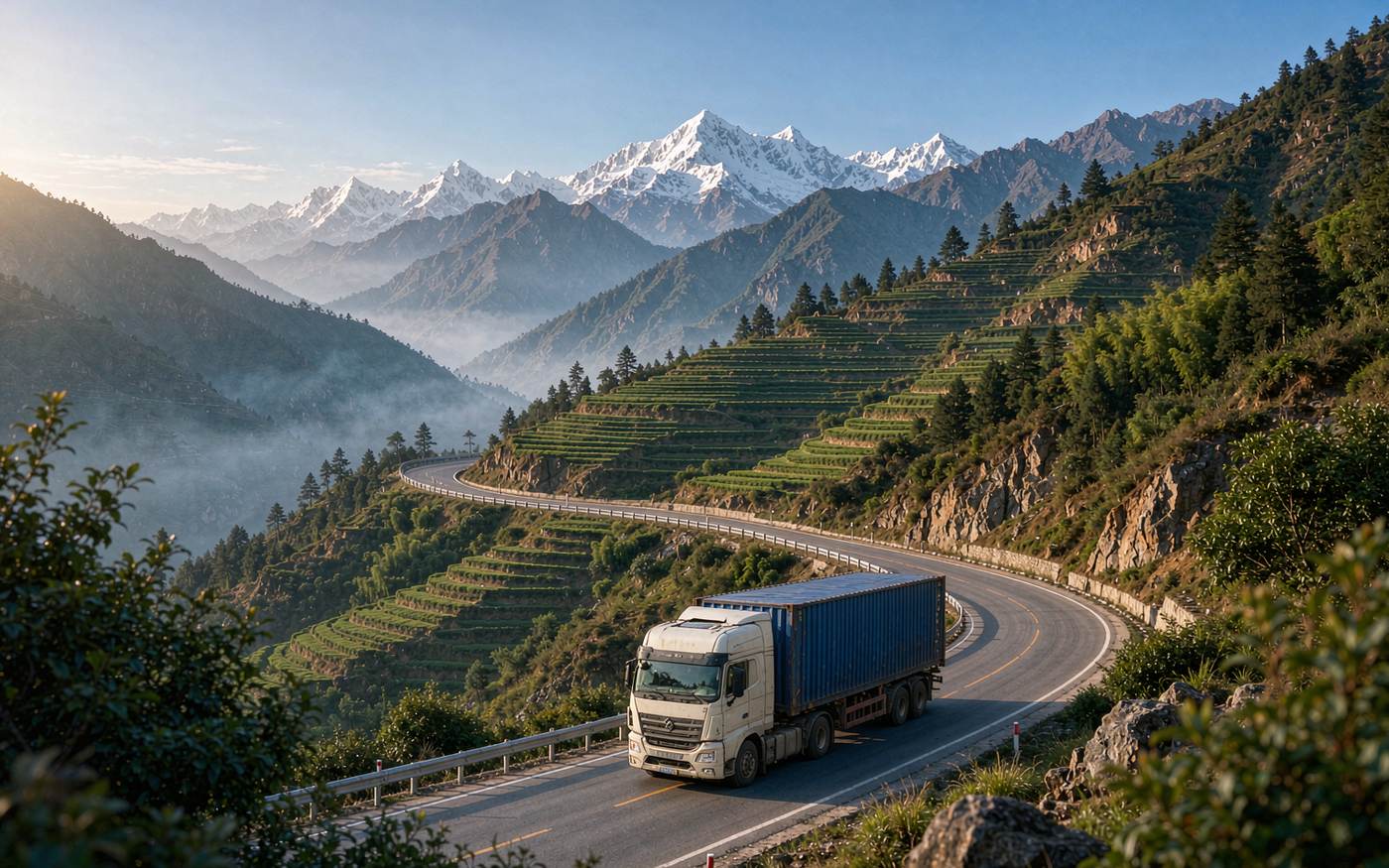
How to Ship from China to Nepal: Birgunj, ASYCUDA & the 13% VAT
Nepal is landlocked, and that single fact shapes the whole shipment. There is no Nepali seaport for your container to discharge at. Sea freight from China lands at an Indian port, most often Kolkata or Visakhapatnam on the east coast, and then travels overland to a Nepali land customs point — usually Birgunj, the largest crossing, or Bhairahawa in the west. You are not shipping to one country; you are shipping to one country through another, and the transit leg is where most of the risk sits.
The second thing to understand is the tax stack. Nepal charges customs duty by HS code, then VAT at 13 percent on the duty-inclusive value, then excise duty on categories such as vehicles, alcohol and tobacco, and in some cases an infrastructure tax on specified imports. Published guidance puts general customs duty broadly in the 5 to 30 percent range depending on the product, though rates outside that band exist on specific lines. The duty rate is the smallest part of the story.
The third is valuation. Nepal's Department of Customs has moved from reference pricing, where officers worked from a fixed price book, to transaction value assessment, with declared values cross-referenced against data held in ASYCUDA World. If your invoice understates the transaction, this is the system that will notice. Keep the genuine commercial invoice and the payment records that support it.
At a glance
Country: landlocked in the Himalayas between China and India; capital Kathmandu; a SAARC, SAFTA, APTA and BIMSTEC member and a WTO member. · Currency: the Nepali rupee. · Duty: by HS code; general ranges are commonly published at roughly 5 to 30 percent, with rates outside that band on specific lines. · VAT: 13 percent, on the duty-inclusive value. · Also: excise duty on vehicles, alcohol, tobacco and similar; infrastructure tax on specified imports. · Valuation: transaction value on a GATT basis, cross-checked against ASYCUDA World data. · Preference: plan on standard rates for Chinese origin unless your broker confirms otherwise at HS code level. · Customs: Department of Customs, declarations in ASYCUDA World and documents through the Nepal National Single Window. · Sea gateway: an Indian port, usually Kolkata or Visakhapatnam. · Land ports: Birgunj, Bhairahawa, Mechi; from China, the northern crossings at Kerung and Tatopani. · Air: Tribhuvan International, Kathmandu. · Importer: an active EXIM code, a renewed bank guarantee and a tax clearance certificate. · Confirm current rates and free-time rules with your agent before you book.
How your cargo moves: China to Nepal
Eight steps from your supplier's door to yours. The last four are the ones shaped by local rules.
- Pickup from your supplierWe collect the goods anywhere in China and bring them to our consolidation point.
- Export clearanceChina customs declaration filed and released before the goods move to the port.
- Loading and departureContainer loaded, sealed and handed to the carrier at the Chinese port.
- Main carriageOcean, air or rail movement booked on the route agreed for your cargo.
- Arrival at the gatewayDischarge at the port or airport of entry, recorded on the carrier's manifest.
- Import clearanceCustoms declaration filed locally, with duty and tax assessed on the declared value.
- Customs releaseGoods released into free circulation once duty and tax are settled.
- Final deliveryOnward movement to your delivery address, warehouse or nominated depot.
Duty rates, VAT rates and clearance times move, and the figure that applies to your goods is the one set for your commodity code on the day of clearance. We check the current position against your code before your goods sail and confirm it to you in writing — ask for that check when you request a quote.
Nepal has no seaport, so your route starts in India
When you book sea freight to Nepal, you are booking a through move with two distinct halves. The first half is a normal ocean leg from a Chinese port to an Indian discharge port. The second is an overland transit under customs control to the Nepali border, where the goods are entered into Nepal. The two halves are handled by different parties, under different documents, and on different clocks.
The consequence for you as a buyer is that the through transit is only as good as its slowest leg, and the slowest leg is usually the border. Road condition, weather, border throughput, Indian and Nepali holidays, and the seasonal rush before major festivals all move the arrival date. Published accounts of this trade describe the overland section from the Indian port to Nepal as the part with the most variance, which is why it is the part worth insuring and worth asking your forwarder about specifically.
The alternative is to skip the sea leg entirely. Air freight to Tribhuvan International Airport in Kathmandu delivers into Nepal directly, with one clearance instead of two, and for light, high-value, or time-sensitive cargo it is frequently the better answer despite the higher freight rate. For anything heavy and low-value per kilo, the economics point back to sea plus road.
Choosing between Birgunj, Bhairahawa and the northern border
| Crossing | Serves | When it is the right choice |
|---|---|---|
| Birgunj | Kathmandu and the central belt, from the Indian side at Raxaul | The default for sea freight discharged at Kolkata; the largest and busiest land port |
| Bhairahawa | Western Nepal, including Butwal and Pokhara approaches | When the consignee is in the west and a Kolkata discharge would mean a long east-to-west road leg |
| Mechi | Eastern Nepal | For consignees in the east, sometimes paired with a different Indian discharge port |
| Kerung and Tatopani | Direct overland from China's Tibet region | For China-sourced cargo moving straight over the northern border rather than around through India |
For most first-time importers the decision is made for them: Birgunj, because that is where the Kolkata-routed volume goes and where the agent network is deepest. The northern crossings matter if your supplier is in Yunnan or if you are moving smaller consignments directly overland from China, and they change the document set — a through sea move needs a transit arrangement, a direct overland move does not.
Sea plus road, or air straight into Kathmandu
Sea into India, then overland
Two clearances and a transit leg, but the lowest freight cost per cubic metre. Suited to furniture, building materials, machinery, and stock that is planned rather than urgent. Needs a transit arrangement for the Indian leg, a customs agent on the Nepali side, and insurance that covers the whole door-to-door route rather than just the ocean portion.
Air to Kathmandu
One clearance, direct arrival, and far less exposure on the ground leg. Suited to samples, spare parts, electronics, pharmaceuticals and anything where the value per kilo justifies the rate. Also the fastest way to test your documentation on a small consignment before committing a container to the sea route.
On trade terms: under FOB a Chinese port, you control the main carriage and everything after it. Under CIF to an Indian port, the supplier pays freight and insurance as far as the Indian discharge port — and it is worth being explicit that CIF Kolkata does not include the overland transit or the Nepali clearance. DDP to Kathmandu is occasionally offered and should be interrogated carefully, because it requires whoever is promising it to control an Indian transit, a Nepali clearance controlled by a locally registered importer, and a tax payment in Nepal. Check who is actually on the ground for each of those three.
Whichever mode you choose, the practical sequence is: production and packing in China → export declaration in China → ocean leg → discharge in India → overland transit under customs control → arrival at the Nepali land port → bill of entry filed in ASYCUDA World → assessment and payment → release → final delivery. The two documents that must be right before the vessel sails are the commercial invoice and the certificate of origin, because everything downstream is checked against them.
What Nepal charges, and the order it is charged in
The stack runs in a fixed order, and each layer sits on the one before it.
| Layer | Charged on | What to expect |
|---|---|---|
| Customs value | The transaction value on the invoice, with freight, insurance and other additions able to form part of it | The base everything else is built on |
| Customs duty | Customs value × the HS code rate | General ranges commonly published at roughly 5 to 30 percent; specific lines fall outside |
| VAT | 13 percent on the duty-inclusive value | Usually the single largest line on a mid-range import |
| Excise duty | Certain categories — vehicles, alcohol, tobacco, some electronics | Checked at HS code level |
| Infrastructure tax | Specified imports, including some petroleum and construction lines | A smaller percentage, but it is there |
Worked at a customs value of US$10,000 with duty at 10 percent: duty is US$1,000, the VAT base is US$11,000, VAT at 13 percent is US$1,430, and the total is US$2,430 — about 24 percent of the customs value, against a headline duty rate of 10 percent. This is why a landed cost worked out from the duty rate alone is always optimistic.
On preference: Nepal's commonly cited preferential arrangements cover South Asian and specific bilateral partners rather than China. Budget a Chinese-origin shipment at the standard tariff rate, and have your broker verify the position for your exact HS code before you quote a landed cost to anyone.
The valuation change that catches under-declared invoices
This is the change that matters most to a new importer, because it removes a habit that used to work.
Nepal's Department of Customs previously assessed using reference pricing, where the officer consulted a fixed price book. It has moved to transaction value on a GATT basis, meaning duty is calculated on the price actually paid or payable as shown on a genuine commercial invoice, and those values are cross-referenced against market data held in ASYCUDA World. Where there is no invoice, or where the declared value looks low against comparable recent imports, the assessing officer can determine value using reference prices or similar past declarations in the system.
The practical rules that follow are simple. Declare the real transaction value. Keep the original invoice — it is the document the assessment is built on. Keep payment records that match it, because a mismatch between invoice and payment trail is exactly what a valuation query looks like. And where a supplier offers to write a lower value on the invoice, understand that on this lane the system is now designed to catch that, and the resulting dispute costs more than the duty saved.
EXIM code, bank approval and the documents behind them
Before a commercial declaration is accepted, three things have to be in place on the importer's side, and none of them is a formality.
- An active EXIM code. The importer-exporter code has to be current on the Department of Customs portal for the prevailing Nepali fiscal year. Without it, the ASYCUDA system will not accept the shipment entry. Renewal is tied to the fiscal year, so this is a date to diarise rather than a box to tick.
- A renewed bank guarantee and an uploaded tax clearance certificate. Both are required on the Nepal National Single Window portal alongside the code.
- Bank approval for the transaction. Whether the shipment moves on a letter of credit or a telegraphic transfer, local bank approval is a checkpoint, and the ASYCUDA system is linked to the central bank so that the currency leaving the country can be reconciled with the value of goods entering.
The document set itself is conventional: a commercial invoice stating the Incoterms 2020 delivery term, a packing list with weights and dimensions per package, the bill of lading or airway bill, a certificate of origin, an insurance policy, the truck waybill or transit document for the overland leg, and an import licence where the goods are on the restricted list. Documents are filed digitally through the single window, and the bill of entry is lodged and tracked in ASYCUDA World, whose status — under assessment, under examination, cleared — is what your agent checks.
On agents: for a commercial shipment a licensed customs agent is, in practice, required. Filing access in ASYCUDA is set up for registered agents rather than one-off importers. That is not a formality to resent — it is the mechanism by which your declaration gets filed at all, and choosing the agent is one of the two or three decisions that actually determine whether your first shipment goes smoothly.
Transit risk on the Indian leg
The overland leg from the Indian port to the Nepali border is the part of this route that most first-time importers under-plan, and it deserves three specific decisions.
Insurance should run door to door. Not the ocean leg only. Published guidance for this trade is explicit that coverage should run from the Chinese factory to the final Nepali warehouse, because the road section is the part with the most exposure. A policy that stops at the Indian discharge port leaves the riskiest leg uninsured.
Free time is short at both ends. At the Indian port and again at the Nepali border, the free storage period is commonly described in days rather than weeks, with charges accruing daily after that. Whatever the exact figure is at your port this month, the implication is the same: document flow has to keep pace with the physical movement of the container, or storage charges start eating the margin.
Packaging has to survive a road leg that a direct sea move would not include. Containers that would arrive clean after a single ocean leg get handled, transhipped and trucked over mountain road on this route. Strapping, blocking and bracing inside the container, and moisture protection for anything that will sit in a humid port, are cheap compared with a damaged-arrival claim that has to be argued across two jurisdictions.
Three Nepal jobs, and how each one ran
These are illustrative composite examples, not specific client shipments. They show how the same rules produce different jobs.
Building materials to Kathmandu, sea plus road
A full container discharged at Kolkata and crossed at Birgunj. The freight economics only worked because the goods were dense and not time-sensitive. The two things that mattered were the transit arrangement for the Indian leg and an insurance policy written door to door rather than port to port.
Electronics by air to Kathmandu
High value per kilo and a launch date attached, so air was the right answer despite the rate. One clearance instead of two, and the importer's EXIM code, bank guarantee and tax clearance certificate were all confirmed current before the goods left China — which is why it cleared without a valuation query.
A first sample by air, then a container by sea
The buyer air-freighted a small quantity first, learned from the clearance what the HS classification and duty position actually were, and only then committed to a container. The air freight was the cheapest research available.
Choosing a forwarder who has walked this route
You need two, and the Nepali one is not optional. The Chinese forwarder consolidates, handles export declaration, books the ocean leg, and issues the documents that have to originate here — the certificate of origin above all. The Nepali agent holds the ASYCUDA filing access, manages the border crossing, runs the valuation and assessment, and knows which office clears what in how long. What you want is a freight forwarder in each place, not a shipping line and not a trucking company: the forwarder is the party that coordinates the others and owns the timeline.
Questions worth asking before you commit:
- Which Indian port and which border crossing, and why? A considered answer names both and explains the trade-off. A shrug means the routing has not been thought through.
- Who files the bill of entry, and are they a registered agent? If they cannot name the party, they do not have one.
- Is the EXIM code current, and is the tax clearance certificate uploaded? These are prerequisites; a good agent checks them before the vessel sails.
- What is the duty rate and the VAT on my HS code, quoted separately? If the two are collapsed into one figure, you cannot check the arithmetic.
- How many days of free storage at the Indian port and at the border? An agent who works the route will know the current position at the specific terminal.
- Is insurance quoted door to door or port to port? The answer tells you whether they have thought about the transit leg.
Why importers use Goodhope on this lane
Six things that are different about working with us on China to Nepal shipments.
Get the routing and the tax stack right before you order
Tell us what you are shipping, the HS codes if you have them, the packed dimensions and gross weight, the pickup city in China and the delivery address in Nepal. We will tell you whether sea plus road or air suits the cargo, name the Indian discharge port and the border crossing, prepare the certificate of origin in China before the goods sail, and set out the duty, the 13 percent VAT and any excise separately so you can see the landed cost before you commit. We will also tell you plainly if your HS code needs checking before you quote a customer.
Get a quote Talk to usRelated pages
Frequently asked questions
Where does my container actually go?
Sea freight discharges at an Indian port, usually Kolkata or Visakhapatnam, then crosses into Nepal at Birgunj, Bhairahawa or Mechi. Air freight flies direct to Tribhuvan International in Kathmandu.
What taxes apply?
Customs duty by HS code, then VAT at 13 percent on the duty-inclusive value, plus excise on certain categories and in some cases an infrastructure tax.
What changed about valuation?
Nepal moved from reference pricing to transaction value on a GATT basis, cross-referenced against data in ASYCUDA World. Under-declaring is now more likely to be caught.
Do I need an EXIM code?
Yes for commercial imports. It must be active for the current Nepali fiscal year, with a renewed bank guarantee and an uploaded tax clearance certificate. Without it, ASYCUDA will not accept the entry.
Is a customs agent required?
In practice yes for commercial shipments, because ASYCUDA filing access runs through registered agents. Small personal parcels clear through simpler channels.
How long does clearance take?
A clean file can clear in a few days; one routed for examination or missing a document commonly takes a week or longer. Confirm current expectations with the specific office.
What documents are required?
Commercial invoice with the Incoterms 2020 term, packing list, bill of lading or airway bill, certificate of origin, insurance policy, the transit document for the overland leg, and an import licence for restricted goods.
Do Chinese goods get preferential duty?
Plan on standard rates. Nepal's commonly cited preferences cover South Asian and specific bilateral partners rather than China, so verify at HS code level before quoting a landed cost.
What should insurance cover?
Door to door, from the Chinese factory to the Nepali warehouse. The Indian leg is the exposed part. Free storage at both ends is short, so charges accrue quickly if documents lag.
How long does shipping take?
Two legs plus two clearances: ocean to India, overland transit, Nepali clearance, then delivery. Get the current rotation and border estimate for your routing rather than working from an average.