
Home / Shipping to Niue / How to ship from China to Niue
How to ship from China to Niue
Niue is a single raised coral island in the South Pacific, self-governing in free association with New Zealand, with a resident population in the order of 1,600 people. It is one of the smallest genuine import markets a Chinese exporter will ever be asked to serve.
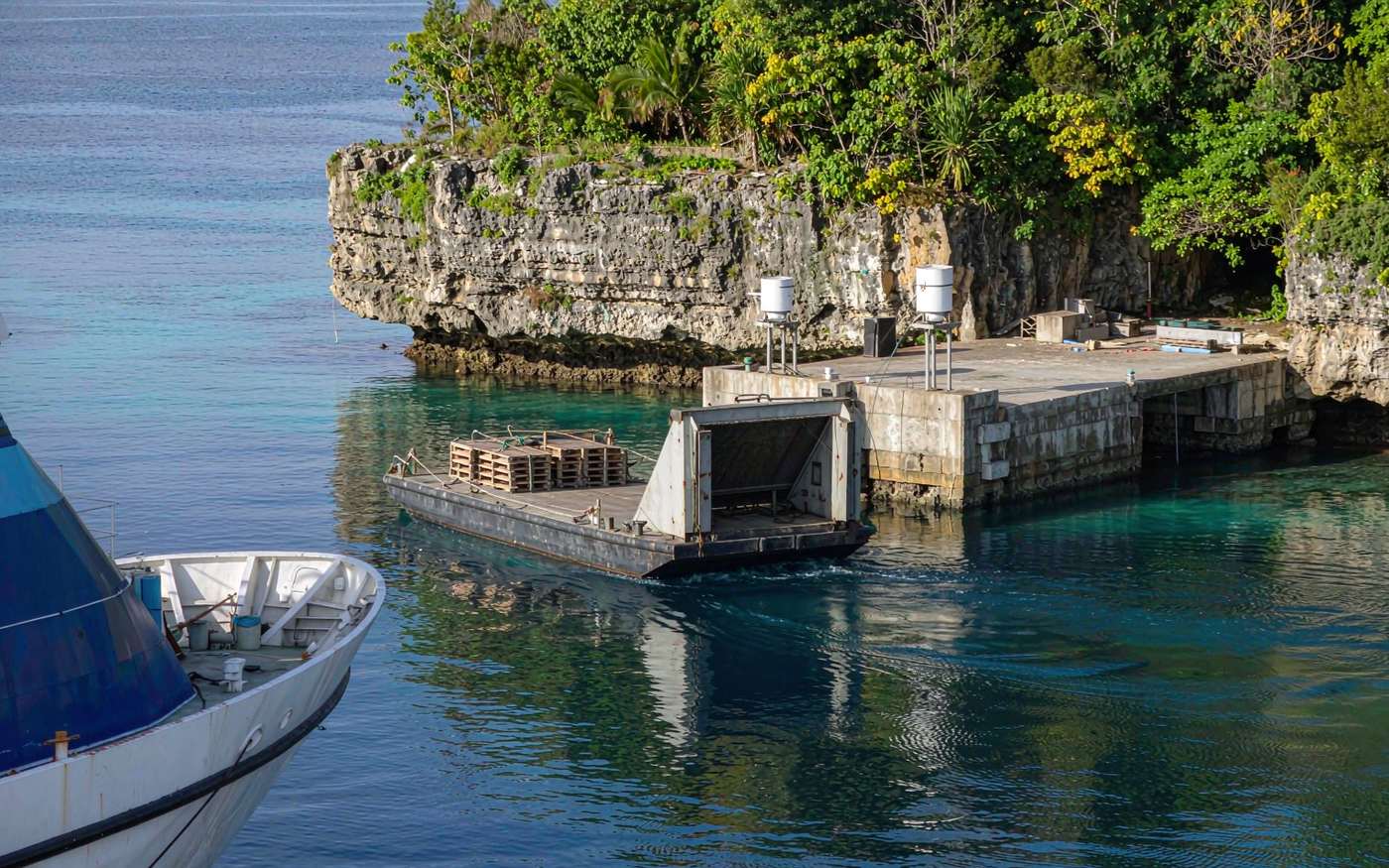
Two facts shape everything. Niue has no harbour that will take an ocean-going ship, so cargo is worked from a vessel at anchor into a barge and landed at the wharf at Alofi. And there is no deep-sea service at all, so nearly everything transships through Auckland.
That means your quotation is really two quotations: China to Auckland, and Auckland to Niue. The second one is small in distance and large in cost per cubic metre, and most first-time shippers under-estimate it.
At a glance
Status: self-governing in free association with New Zealand, with its own customs administration and tariff; no value-added tax. Gateway: the wharf at Alofi, served by barge from a vessel at anchor; Hanan International Airport, IUE, with air links to Auckland. Transshipment: Auckland. Currency: New Zealand dollar. Population: roughly 1,600.
How your cargo moves: China to Niue
Eight steps from your supplier's door to yours. The last four are the ones shaped by local rules.
- Pickup from your supplierWe collect the goods anywhere in China and bring them to our consolidation point.
- Export clearanceChina customs declaration filed and released before the goods move to the port.
- Loading and departureContainer loaded, sealed and handed to the carrier at the Chinese port.
- Main carriageOcean, air or rail movement booked on the route agreed for your cargo.
- Arrival at the gatewayDischarge at the port or airport of entry, recorded on the carrier's manifest.
- Import clearanceCustoms declaration filed locally, with duty and tax assessed on the declared value.
- Customs releaseGoods released into free circulation once duty and tax are settled.
- Final deliveryOnward movement to your delivery address, warehouse or nominated depot.
Duty rates, VAT rates and clearance times move, and the figure that applies to your goods is the one set for your commodity code on the day of clearance. We check the current position against your code before your goods sail and confirm it to you in writing — ask for that check when you request a quote.
Niue keeps its own customs tariff, and there is no VAT behind it
Niue is not part of New Zealand, and it runs its own customs administration and its own tariff. Goods arriving from China are entered in Niue, not in New Zealand, even if they touched Auckland on the way.
There is no broad-based consumption tax on Niue: no VAT and no GST. That part is straightforward and it is the same shape as several other Pacific island markets.
The duty rates are where we want to be careful. Published sources disagree, with one describing a flat 10 per cent ad valorem duty with no VAT and a list of exempt categories, and another describing banded rates with a separate consumption tax. Rather than pick one, we recommend confirming the current duty band and the exempt list for your HS code with a Niue broker before you quote.
No harbour for your ship: how cargo reaches the wharf at Alofi
Niue is a raised coral island with no natural deep-water harbour. There is a wharf at Alofi, but the vessel carrying your cargo will anchor offshore and the cargo will come ashore by barge, worked by crane or by the ship's gear.
That single fact drives the whole packing and unit-choice decision. Loose cartons and unpalletised freight are a bad idea; anything that cannot be lifted as a unit in a barge is a problem.
It also means weather is an operational variable, not an excuse. If the sea state is wrong, the barge does not run and the cargo waits on the ship. Build that into your delivery expectations.
Auckland is the transshipment point, and that is an extra leg, not a detail
There is no direct service from China. Cargo goes from a Chinese port to Auckland, is deconsolidated or transshipped there, and then moves on the Niue service, which runs on a monthly or otherwise infrequent pattern.
The Auckland leg deserves to be priced and scheduled as a leg in its own right. It has its own cut-off, its own handling charges and its own waiting time, and if your container misses the Niue sailing the next one may be a month away.
Total sea transit from a Chinese factory to Alofi commonly runs 45 to 65 days, with most of the variance sitting in the Auckland connection.
Air freight via Auckland to Hanan, and the limits that bite early
Hanan International Airport, IATA code IUE, sits a short distance from Alofi and is served by air links to Auckland. Air freight is routed from China to Auckland and onward on that service.
The aircraft are small, so the constraints that bite are the cargo door dimensions and the per-flight weight limit, not the long-haul capacity. A piece that fits a wide-body out of Hong Kong may not fit the aircraft that lands at Hanan.
Air freight typically lands at 10 to 18 days door to airport, but frequency is limited and missing a flight can cost a week or more. Confirm the uplift date in writing.
Quarantine is the strictest gate on the island
Niue's agriculture and its isolation make biosecurity the tightest control you will meet. Food, plants, seeds, animals and animal products, soil and untreated timber are all controlled, and some categories are refused outright.
Second-hand goods attract particular attention here, as they do across the Pacific. Used vehicles, used machinery, used tyres and second-hand clothing can each carry their own restriction or refusal.
Get any permit or certificate in place before the goods leave China, and declare the contents precisely. Wood packaging must meet ISPM 15.
New Zealand dollars, small invoices and the banking friction nobody mentions
The New Zealand dollar is the currency. For small consignments the banking costs are proportionally large, and a small invoice can lose a meaningful share of its value to transfer fees and exchange spread.
Agree early who pays the bank charges on each side, and consider whether a single consolidated shipment makes more sense than several small ones. On a route this long, consolidation is usually cheaper in total even when it looks slower.
Payment terms matter too. With a six-week transit plus clearance, a buyer asking for long credit is asking you to finance the whole pipeline.
Why LCL to Niue often costs more than booking a twenty foot box
On ordinary routes, less-than-container load is the sensible answer for a small shipment. On this route it often is not.
The reason is the Auckland step. LCL cargo has to be deconsolidated in Auckland, re-palletised, re-marked and then loaded for the Niue leg, and each of those steps is charged on a route where handling is expensive and volumes are tiny. By the time the destination charges are added, the per-cubic-metre cost frequently exceeds the cost of a part-loaded twenty foot container.
Get both numbers before you decide. Ask for an LCL quotation and a twenty foot quotation to Alofi for the same cargo and compare them landed, not freight-only.
When the Auckland sailing closes, and how late you can book
Because the Niue service is infrequent, the closing date for the Auckland leg is the date that governs your shipment. Everything upstream of it is adjustable; everything downstream of it is not.
Work backwards from that date. Confirm the cut-off in Auckland, then the China loading date that gets you there with a margin, then the factory date. Do not start at the factory and hope.
Also confirm the receiving window at the far end. Storage at Alofi is minimal, so a container that arrives before the consignee can take it becomes a problem quickly.
A twenty foot box, a barge and a wharf: picking the unit that works
Unless your cargo genuinely fills more, a twenty foot container is the natural unit. It is manageable at the wharf, it can be worked by the equipment available, and it avoids the deconsolidation charges above.
Pack it to survive being lifted twice and carried on a barge: block and brace properly, keep the weight distributed, and do not stack cartons in a way that collapses when the unit is tilted during the lift.
Label every pallet and every case with the consignee's name and a contact number in Niue. On a wharf this small, there is no system to identify an unmarked case.
Documents, insurance and why door-to-door is rarely worth it here
The document set is the standard one: commercial invoice with HS codes and a precise description, packing list, bill of lading or air waybill, and any certificate of origin or permit your goods require. Advance the set to your broker before the vessel sails, because there is no bonded facility to hold goods while paperwork is corrected.
Insure it. Two crane lifts, a barge transfer and an open roadstead are more handling events than a normal container movement, and the exposure is real.
Finally, resist quoting door-to-door. The last few kilometres on Niue are best handled by a named local agent with a truck and a phone number, quoted separately. Trying to own that leg from China is how quotations go wrong on this route.
Why importers use Goodhope on this lane
Six things that are different about working with us on China to Niue shipments.
Four questions to put to a Niue buyer before freight is booked
Ask your buyer who will clear the goods in Niue, what the HS code and duty band are, whether any permit is needed, and who receives at the wharf. Send us the answers with the cargo details and we will price the China leg and the Auckland connection as one package.
Get a quote Talk to usRelated pages
Frequently asked questions
Is Niue part of New Zealand for customs purposes?
No. Niue is self-governing in free association with New Zealand and runs its own customs administration and tariff. Goods are entered in Niue even when they have transshipped through Auckland.
Is there VAT or GST on imports into Niue?
No. Niue has no broad-based consumption tax. You should still confirm the customs duty position for your HS code with a Niue broker, because published sources disagree on the rates and the exempt categories.
How does cargo get ashore if there is no harbour?
The vessel anchors offshore and cargo is lightered ashore by barge to the wharf at Alofi, worked by crane or ship's gear. Everything should be packed to be lifted as a unit.
Is there a direct service from China?
No. Cargo transships through Auckland and then moves on the Niue service, which runs infrequently. Total sea transit is commonly 45 to 65 days, with most of the variance in the Auckland connection.
Can I ship LCL?
You can, but it is often more expensive per cubic metre than a part-loaded twenty foot container, because LCL has to be deconsolidated, re-palletised and re-marked in Auckland. Get both quotations and compare them landed.
How does air freight work?
From China to Auckland, then onward to Hanan International Airport, IATA code IUE. The constraint is the aircraft type: the cargo door dimensions and per-flight weight limit, not long-haul capacity.
What are the quarantine rules like?
Strict. Food, plants, seeds, animals and animal products, soil and untreated timber are controlled and some categories are refused. Second-hand vehicles, machinery, tyres and clothing attract particular attention. Wood packaging must meet ISPM 15.
What currency is used?
The New Zealand dollar. On small consignments the bank transfer fees and exchange spread are proportionally large, so agree who pays them and consider consolidating shipments.
Should I quote door-to-door?
Usually not. Quote to the port or airport and let a named local agent handle the last leg and clearance, quoted separately. There is minimal storage at Alofi, so the receiving window matters.
Is cargo insurance worth it?
Yes. Two crane lifts, a barge transfer and an open roadstead mean more handling events than a standard container movement. All-risk cover at 110 per cent of invoice value is the usual recommendation.