
Home / Shipping to the Northern Mariana Islands / How to Ship from China to the Northern Mariana Islands
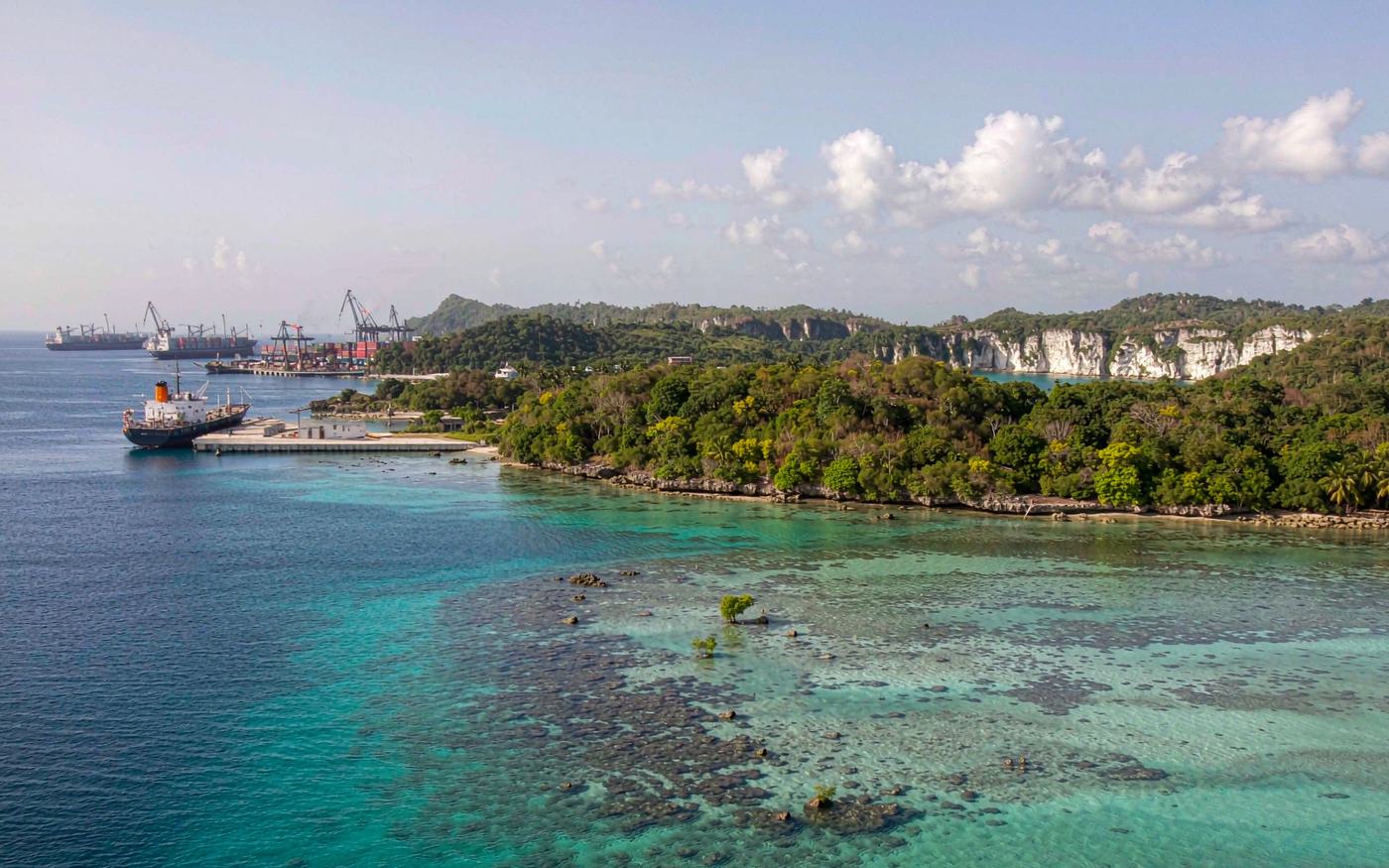
How to Ship from China to the Northern Mariana Islands: Saipan, the CNMI Customs Service & the Island Hop
The Northern Mariana Islands are in political union with the United States, and that is precisely why importers mis-file them. The Commonwealth is American in sovereignty and local in customs. Under 19 CFR 7.2 it sits outside the customs territory of the United States, and the customs administration of the Commonwealth is under the Government of the Commonwealth — exercised through the Division of Customs Service within the Department of Finance, which oversees imports at Saipan, Tinian and Rota.
The second thing to get straight is geography. "The Northern Mariana Islands" reads like one delivery address. It is three inhabited islands spread across a long stretch of ocean, and Saipan is the one where cargo is normally cleared. A buyer on Tinian or Rota is not receiving a shipment; they are receiving a shipment plus an inter-island leg, and that leg has its own cost, its own schedule and its own handling risk.
The third is biosecurity. Published guidance describing CNMI customs consistently lists fresh foods, plants and seeds among the prohibited or permit-only categories, and describes inspection of shipments as a standard step. On an island territory whose economy and ecology are both exposed to invasive species, that is not a formality. It is the reason a first shipment gets held.
At a glance
Territory: Commonwealth in political union with the United States, fourteen islands in the western Pacific, main islands Saipan, Tinian and Rota · Status: outside the US customs territory; customs administered by the Government of the Commonwealth · Authority: Division of Customs Service, CNMI Department of Finance · Main port of entry: Saipan · Routing: transhipment via Guam or Honolulu · Taxes: duty by classification, excise on alcohol and tobacco, use tax on goods stored or used · Currency: US dollar
How your cargo moves: China to the Northern Mariana Islands
Eight steps from your supplier's door to yours. The last four are the ones shaped by local rules.
- Pickup from your supplierWe collect the goods anywhere in China and bring them to our consolidation point.
- Export clearanceChina customs declaration filed and released before the goods move to the port.
- Loading and departureContainer loaded, sealed and handed to the carrier at the Chinese port.
- Main carriageOcean, air or rail movement booked on the route agreed for your cargo.
- Arrival at the gatewayDischarge at the port or airport of entry, recorded on the carrier's manifest.
- Import clearanceCustoms declaration filed locally, with duty and tax assessed on the declared value.
- Customs releaseGoods released into free circulation once duty and tax are settled.
- Final deliveryOnward movement to your delivery address, warehouse or nominated depot.
Duty rates, VAT rates and clearance times move, and the figure that applies to your goods is the one set for your commodity code on the day of clearance. We check the current position against your code before your goods sail and confirm it to you in writing — ask for that check when you request a quote.
Saipan, Tinian and Rota under one customs service
The Commonwealth's position is unusual enough to be worth stating carefully, because it cuts both ways.
Into the CNMI. The customs administration of the Commonwealth is under the Government of the Commonwealth. That means entries are made with the Division of Customs Service, not with US Customs and Border Protection, and the local duty, excise and use tax structure applies rather than the federal tariff schedule. Federal regulatory regimes still touch goods by product category — food, plant and animal products, radio-emitting devices, lithium batteries — as they do elsewhere in the American system.
Out of the CNMI. The reverse direction is expressly provided for. Under 19 CFR 7.2, goods imported from the Commonwealth are subject to the column 1 rates of the Harmonized Tariff Schedule, and section 603(c) of the Covenant entitles goods imported from the CNMI to the same tariff treatment as imports from Guam. So a buyer planning to re-export stock to the mainland is moving goods into the US customs territory, and should model that duty before ordering rather than after.
The asymmetry is the point. Goods going in are cleared locally under a territorial system. Goods coming out are dutiable under the federal tariff. If your buyer's business model involves re-export to the mainland, tell them now — it changes the landed-cost arithmetic of the whole order.
Saipan, Tinian and Rota are not one delivery point
Saipan is the commercial centre and the principal port of entry, with the seaport and the main airport handling the great majority of freight. Tinian and Rota sit to the south and north respectively, each with its own airport, and each served from Saipan by inter-island air and sea services.
Practically, that produces three different jobs:
- Saipan delivery. Clear at the port of entry, drayage to a local address. The simplest of the three.
- Tinian or Rota delivery. Clear at Saipan, then a second leg by inter-island vessel or aircraft. That leg is a separate booking, has its own schedule, and typically involves more handling per cubic metre than the ocean voyage did.
- Multi-island distribution. If one order serves buyers on more than one island, plan the split at Saipan rather than shipping separately, and pack so that each island's portion can be identified and separated without unpacking everything.
The packing consequence is worth spelling out. If a container will be broken down and re-forwarded to a second island, mark by destination island, not just by carton number, and put the island name on the packing list as a sortable field. It costs nothing in China and saves a day of sorting in Saipan.
Duties, excise and use tax under the CNMI system
Published descriptions of the CNMI system point to three separate charges that can apply, and the distinction between them matters because they bite on different things.
| Charge | What it applies to | What to check |
|---|---|---|
| Import duty | Commercial goods, by classification. Published secondary sources describe the range as variable rather than flat, commonly quoted somewhere between zero and twenty percent | The rate for your specific HS code, confirmed by a CNMI broker. Do not price an order from a range quoted in a guide |
| Excise tax | Particular product categories, most consistently alcohol and tobacco, where published references cite high rates | Whether your product sits in an excise category at all. Most general merchandise does not |
| Use tax | Goods stored or used in the territory, as distinct from goods resold | Whether the importer is consuming the goods themselves or selling them on, because that changes which charge lands |
We are deliberately not publishing a rate table. Secondary sources disagree with each other on CNMI rates, and the figures change. A percentage that is wrong by five points, quoted to a buyer, is worse than no percentage. Ask us to confirm the current position for your HS code, and ask your consignee's broker to confirm it independently.
The Division of Customs Service and the entry paperwork
The Division of Customs Service, within the Department of Finance, administers entries at all three islands. The document set is conventional; the thing that catches first shipments is the permit layer rather than the invoice layer.
Commercial invoice
Product description, quantity, value, currency and HS classification. Because duty is assessed by classification, a vague description is not a neutral choice here — it is a decision to let someone else classify your goods.
Packing list
Itemised contents, weights, dimensions and package marks. If the consignment splits across islands, include the destination island as a field.
Transport document
Bill of lading for sea, airway bill for air. On a transhipped route via Guam or Honolulu, verify the consignee and notify party before issue — post-sailing amendments are slow enough to miss a connection.
Certificate of origin
Where a reduced or preferential rate is claimed. If you are not claiming one, it is usually unnecessary — but ask, because the answer depends on the classification.
Special permits
For agricultural goods, plants and seeds, food, and other restricted categories. This is the step most often skipped on a first shipment, and the one most likely to hold cargo.
Business licence evidence
Commercial shipments are described as requiring a CNMI business licence. Have the licence number on file with the broker before arrival rather than producing it on request.
Fresh food, plants and seeds: the biosecurity hard line
If you take one operational rule from this page, take this one. Published guidance on CNMI customs is consistent and blunt: fresh fruits, vegetables and meats are restricted on pest and disease grounds; live plants and untreated seeds are controlled on invasive species grounds; and inspection is a standard feature of shipments into the territory.
What makes this surprising is that the problem is often not the product itself. It is the product's company:
- Wooden packaging and dunnage. Must be marked and treated to ISPM 15. Unmarked timber is a biosecurity finding, not a documentation issue.
- Botanical content in ordinary goods. Rattan, bamboo, straw, dried flowers, seed-filled products, wooden handicrafts and untreated timber furniture all attract questions that a plastic or metal equivalent would not.
- Soil and contamination. Used machinery, agricultural equipment and anything stored outdoors before stuffing can carry soil. Clean before loading.
- Food samples and giveaways. A promotional food item bundled with a non-food order is still a food import. Declare it.
Two-minute precaution. Before the container is sealed, list every line on the invoice that contains plant or animal material, including the packaging. Send that list to the broker for a yes-or-no on permits. Doing this at order stage costs an email; doing it after arrival costs storage.
A CNMI business licence and who needs one
Published guidance describes a CNMI business licence as required for commercial shipments, alongside any product-specific certifications. The same guidance distinguishes commercial cargo from personal shipments: used personal effects are described as eligible for duty-free treatment when supported by a detailed inventory, and gifts below a modest threshold as duty-free.
Two practical warnings follow. First, a mixed consignment tends to be treated as commercial. If you ship one pallet of stock and one carton of personal items together, expect the whole entry to be assessed as a commercial import. Second, confirm your buyer holds the licence before you accept the order. It is a reasonable question to ask, it is normal in that market, and discovering the answer after the goods have sailed is expensive.
Getting there means Guam or Honolulu first
There is no realistic direct container loop from China to Saipan. The market is small, the distance is long, and cargo is routinely transhipped through Guam or Honolulu before the final leg. As with the other Pacific territories, three consequences follow:
- Transit is measured in weeks. Set the expectation in writing before the order is confirmed.
- The connection decides the date. Ask which hub and which connecting service, and compare that between quotations rather than comparing price alone.
- A missed connection is expensive. On a trunk route it costs days; on a thin island route the next departure may be a fortnight away.
Air freight through a regional hub is the fast alternative, and it is genuinely available rather than nominal — the CNMI has commercial air service, and urgent or high-value cargo moves this way routinely. For a first order, air is often the better teacher: you learn the entry process on a small, fast consignment before committing a container to it.
Getting it from Saipan to the outer islands
The inter-island leg deserves its own line in the quotation, because it is a separate movement with separate economics. Goods cleared at Saipan are re-handled, consolidated with other island-bound freight, and moved by inter-island vessel or aircraft on a schedule that has nothing to do with your ocean carrier's.
- Quote it separately. A door-to-Saipan price and a door-to-Rota price are different numbers. Do not let the buyer assume they are the same.
- Expect more handling per cubic metre. The inter-island leg typically involves more manual handling than the ocean voyage. Pack accordingly.
- Mark by island. On multi-island orders, the destination island should be visible on the package and sortable on the packing list.
- Insure through to the final island. Do not stop the cover at Saipan. The last leg is the one with the most handling and the least protection.
Timing a CNMI order from production to delivered
Read the sequence below as a dependency chain. Each stage gates the next, and the two places worth your attention are the third and the seventh.
| Stage | What happens | What it depends on |
|---|---|---|
| Product check | Confirm the goods are importable and whether a permit is needed | Content — especially any plant or animal material, including packaging |
| Rate confirmation | Get the duty and excise position for the HS code from a CNMI broker | Accurate classification, which you supply |
| Routing decision | Sea via Guam or Honolulu, or air direct-ish via a hub | Value, urgency and the sailing calendar at booking |
| Packing | Export packing, moisture protection, ISPM 15 timber, marked by island | Whether the spec was set at order time or improvised at load time |
| China export clearance | Declaration filed and goods released | Documents complete before the truck is booked |
| Transhipment | Discharged and re-loaded at Guam or Honolulu | The connecting sailing — the largest single variable |
| Arrival and entry | Entry lodged with the Division of Customs Service, inspection | Whether permits and the licence number were prepared in advance |
| Inter-island leg | Onward movement to Tinian or Rota where required | The inter-island schedule, which is independent of the ocean carrier |
What new importers into the Marianas get wrong
Almost all of it is predictable, and almost all of it is avoidable at the China end before anything sails.
- Assuming CBP clears it. It does not. The Division of Customs Service does.
- Treating Tinian and Rota as the same delivery as Saipan. They are not; quote the inter-island leg.
- Pricing from a range in a guide. Get the rate for the HS code, from a broker.
- Overlooking plant material in packaging and in the product. The most common cause of a held first shipment.
- Wooden packaging without the ISPM 15 mark. Enforced in Pacific territories.
- Comparing prices without comparing routings. The hub and the connection decide the date.
- Stopping insurance at Saipan. The last leg has the most handling.
Why importers use Goodhope on this lane
Six things that are different about working with us on China to the Northern Mariana Islands shipments.
Working examples when importing into the Northern Mariana Islands
Five shipments bought in China and delivered into the Northern Mariana Islands, told end to end — where the order came from, how it moved, where it nearly went wrong, and how it finished. Client names are withheld at their request; the situations and the handling are what we deal with on this lane.
Not mainland rules · first shipment · Shenzhen to Saipan
The purchase. A buyer new to importing assumed mainland customs procedures applied because the islands are in political union with the United States.
The move. Consolidated sea freight entered with the local customs service against the territory's own classification.
Where it nearly went wrong. These islands sit outside the mainland customs territory and run their own service, their own duty schedule and their own excise. Preparing for a mainland entry prepares you for the wrong system entirely.
How it finished. We filed locally. The entry was accepted first time.
No direct call · routing · Ningbo to Saipan
The purchase. A first-time buyer asked for a direct sailing and planned his stock around one.
The move. Cargo transhipped through Guam, with the connecting leg booked together with the ocean freight.
Where it nearly went wrong. Everything arrives through a connecting service rather than direct. Quoting a direct transit is quoting a service that does not run, and the difference is measured in weeks on an island where stock-outs are expensive.
How it finished. He books the connection with the freight. His shelves have stayed stocked since.
Business licence · before booking · Guangzhou to the Marianas
The purchase. A buyer agreed a sale and looked at the local licence requirement only once the goods were ready.
The move. Consolidated cargo with the business licence confirmed before the booking was made.
Where it nearly went wrong. A local business licence is part of trading here rather than paperwork that follows the goods. A consignee who cannot evidence one has no entry to file.
How it finished. We made it a booking condition. Nothing has waited on it since.
Biosecurity · hard line · Yiwu to Saipan
The purchase. A buyer shipped a mixed consignment including food and seed products without declaring either.
The move. Sea freight with organic items declared accurately and cleared rather than refused.
Where it nearly went wrong. Fresh food, plants and seeds are the hard line on this lane, and the bans are enforced rather than negotiated. Undeclared organic material is refused rather than cleaned, and the consignment goes back at your cost.
How it finished. We screen the commodity list before booking. Nothing has been refused since.
Three islands · one delivery point · Shanghai to Rota
The purchase. A buyer quoted a delivery to Rota based on when the goods would clear at Saipan.
The move. Consolidated cargo cleared at Saipan and moved onward to Rota as a booked leg.
Where it nearly went wrong. Saipan is where cargo enters; it is not where all of it is going. Treating the three main islands as one delivery point produces a promise the geography will not keep.
How it finished. He books the onward leg with the freight. His island customers get dates they can use.
Why importers use Goodhope on this lane
Six things that are different about working with us on China to the Northern Mariana Islands shipments.
Permits and the onward island hop, agreed first
Tell us what you are shipping, the HS codes if you have them, the packed dimensions and gross weight, the pickup city in China and the delivery island. We will confirm the current routing to Saipan and which hub it transits, tell you plainly which permits the product needs before it leaves China — especially if anything in the consignment carries plant or animal material, including the pallets — check the wooden packaging and moisture protection with you, and quote the sea leg, the air alternative and the inter-island movement to Tinian or Rota separately so nothing is hidden inside a single number.
Get a quote Talk to usRelated pages
Frequently asked questions
Is the Northern Mariana Islands inside the US customs territory?
No. The Commonwealth sits outside it, and customs is administered by the Government of the Commonwealth through the Division of Customs Service within the Department of Finance. Goods sent from the CNMI into the mainland are dutiable under HTSUS column 1, with the same treatment as imports from Guam under section 603(c) of the Covenant.
Which islands can cargo be delivered to?
Saipan, Tinian and Rota. Saipan is the principal port of entry where most cargo clears; Tinian and Rota are served from Saipan by inter-island air and sea services. Treat them as separate delivery points.
What taxes apply to imports into the CNMI?
Duty by classification, excise tax on particular categories such as alcohol and tobacco, and use tax on goods stored or used in the territory. Secondary sources quote varying ranges. Confirm the rate for your HS code with a CNMI broker before pricing.
Which authority clears cargo in the Northern Mariana Islands?
The Division of Customs Service within the CNMI Department of Finance, at Saipan, Tinian and Rota. It administers the entry, assesses duty and excise, and inspects shipments.
Can I ship fresh food, plants or seeds to the CNMI?
This is the hardest line. Fresh fruits, vegetables and meats, live plants and untreated seeds are prohibited or permit-only on pest, disease and invasive species grounds. Establish the permit position before the goods sail.
Do I need a CNMI business licence to import commercially?
Published guidance describes a CNMI business licence as required for commercial shipments. Personal shipments of used household goods may qualify for different treatment with a detailed inventory. Confirm with the Division of Customs Service or a local broker.
How does cargo from China reach Saipan?
Through a transhipment hub — Guam or Honolulu being the usual ones — followed by the leg to Saipan. The connection is the variable that decides the arrival date.
How long does shipping from China to the Northern Mariana Islands take?
Plan in weeks because of transhipment. Air freight via a regional hub is materially faster. For Tinian and Rota, add the inter-island leg. Ask for the current rotation rather than relying on a published figure.
What documents does a CNMI entry need?
Commercial invoice with description, value and HS codes, packing list, bill of lading or airway bill, certificate of origin where a reduced rate is claimed, and any special permit for agricultural or restricted goods. Permits are the item most often missing.
Are personal effects and gifts treated differently?
Used personal effects are described as duty-free with a detailed inventory, and gifts below a modest threshold as duty-free. Commercial cargo is not. A mixed consignment tends to be assessed as commercial, so keep them apart.