
Home / Shipping to Paraguay / How to Ship from China to Paraguay
How to Ship from China to Paraguay: Asunción, the Hidrovía & IVA
There is no seaport in Paraguay, and that single fact reorganises the whole shipment. Every container from China ends its ocean voyage in another country — Montevideo, Santos or Buenos Aires — and then travels the last stretch by river barge or by road across an international border. The corridor you choose is decided by where in Paraguay the goods are actually going, and it shapes the cost, the schedule and the paperwork more than any other decision in the shipment. Choose it before you book, not after the vessel sails.
The second thing follows from the first, and it is where first-time importers lose money. The container has to cross a neighbouring country without clearing in it. That movement runs under a formal customs transit regime arranged in advance. If instead the goods are cleared into Uruguay, Argentina or Brazil on the way through, duty is assessed there — a tax event in a country you never intended to import into — and the shipment can arrive at the Paraguayan border already taxed and delayed. Under Mercosur rules, goods crossing between members meet the bloc's external tariff at each crossing; the transit paperwork is what prevents that happening twice.
The third thing is the good news, and it is genuinely good. IVA is ten percent, among the lowest standard rates in South America, and it is the reason Paraguay remains an attractive import market despite the river leg. There is no agreement with China to reduce the duty, so the bloc's tariff applies in full — but the tax that sits on top of it is half what it is in Uruguay and well below Brazil's.
At a glance
Entry: no seaport — river ports at Asunción and Villeta, or land borders at Ciudad del Este and Encarnación. · Corridors: Montevideo + river barge (roughly 36–52 days door to door), Santos + road via the Friendship Bridge (35–50), Buenos Aires (38–55). · Movement: the crossing of the neighbouring country must run under customs transit, not a local import. · Duty: Mercosur common external tariff, commonly 0–20% of CIF; no agreement with China. · IVA: 10% on CIF plus duty, with a reduced 5% for basic goods. · Other charges: port rates, valuation service fee, a consular legalisation fee per document, an IT system fee, and broker charges commonly US$80–150. · Entry formalities: a RUC from the tax authority and a licensed despachante filing through SOFIA — a foreign importer cannot file. · Empty container: free time typically 7–14 days, detention reported at US$35–90 per day.
How your cargo moves: China to Paraguay
Eight steps from your supplier's door to yours. The last four are the ones shaped by local rules.
- Pickup from your supplierWe collect the goods anywhere in China and bring them to our consolidation point.
- Export clearanceChina customs declaration filed and released before the goods move to the port.
- Loading and departureContainer loaded, sealed and handed to the carrier at the Chinese port.
- Main carriageOcean, air or rail movement booked on the route agreed for your cargo.
- Arrival at the gatewayDischarge at the port or airport of entry, recorded on the carrier's manifest.
- Import clearanceCustoms declaration filed locally, with duty and tax assessed on the declared value.
- Customs releaseGoods released into free circulation once duty and tax are settled.
- Final deliveryOnward movement to your delivery address, warehouse or nominated depot.
Duty rates, VAT rates and clearance times move, and the figure that applies to your goods is the one set for your commodity code on the day of clearance. We check the current position against your code before your goods sail and confirm it to you in writing — ask for that check when you request a quote.
What this guide covers, and the decision that comes first
This is written for a buyer bringing goods out of China for the first time and landing them in Paraguay. It follows the shipment in the order the problems actually arrive: which corridor, what the river does to the schedule, how the goods cross a border without being taxed in it, what the charges are, who can sign, and how long the whole thing takes once the inland legs are counted.
It does not quote freight rates. Those move with the market, and on a lane that passes through three countries there are more of them than usual. What it does instead is show where the money goes and which decisions change the total, so that a quotation can be read for what it leaves out.
The decision that comes first is the corridor, and it is not a rate question. It is answered by one piece of information: the city where the goods will be received. Everything else follows from it, including how much of the journey happens on water.
There is no port of entry: three corridors in
| Corridor | How it works | Best for | Door to door |
|---|---|---|---|
| Montevideo + river | Discharge at Montevideo, customs transit to Nueva Palmira, barge convoy up the Paraguay–Paraná waterway to Asunción or Villeta. | Asunción and the west of the country. Usually the cheapest per cubic metre. | 36–52 days |
| Santos + road | Discharge at Santos in Brazil, truck west to Ciudad del Este across the Friendship Bridge. | Eastern Paraguay and Ciudad del Este traders. Often faster than the river for those destinations. | 35–50 days |
| Buenos Aires | Discharge at Buenos Aires, onward by road or by barge up the Paraná. | A third option when the others are congested or mispriced. | 38–55 days |
The rule of thumb is short and worth memorising: Asunción goes by water, Ciudad del Este goes by road. Sending Asunción cargo overland from Santos, or Ciudad del Este cargo up the river, is a common and expensive mismatch — the goods arrive in the wrong part of the country and then travel across it.
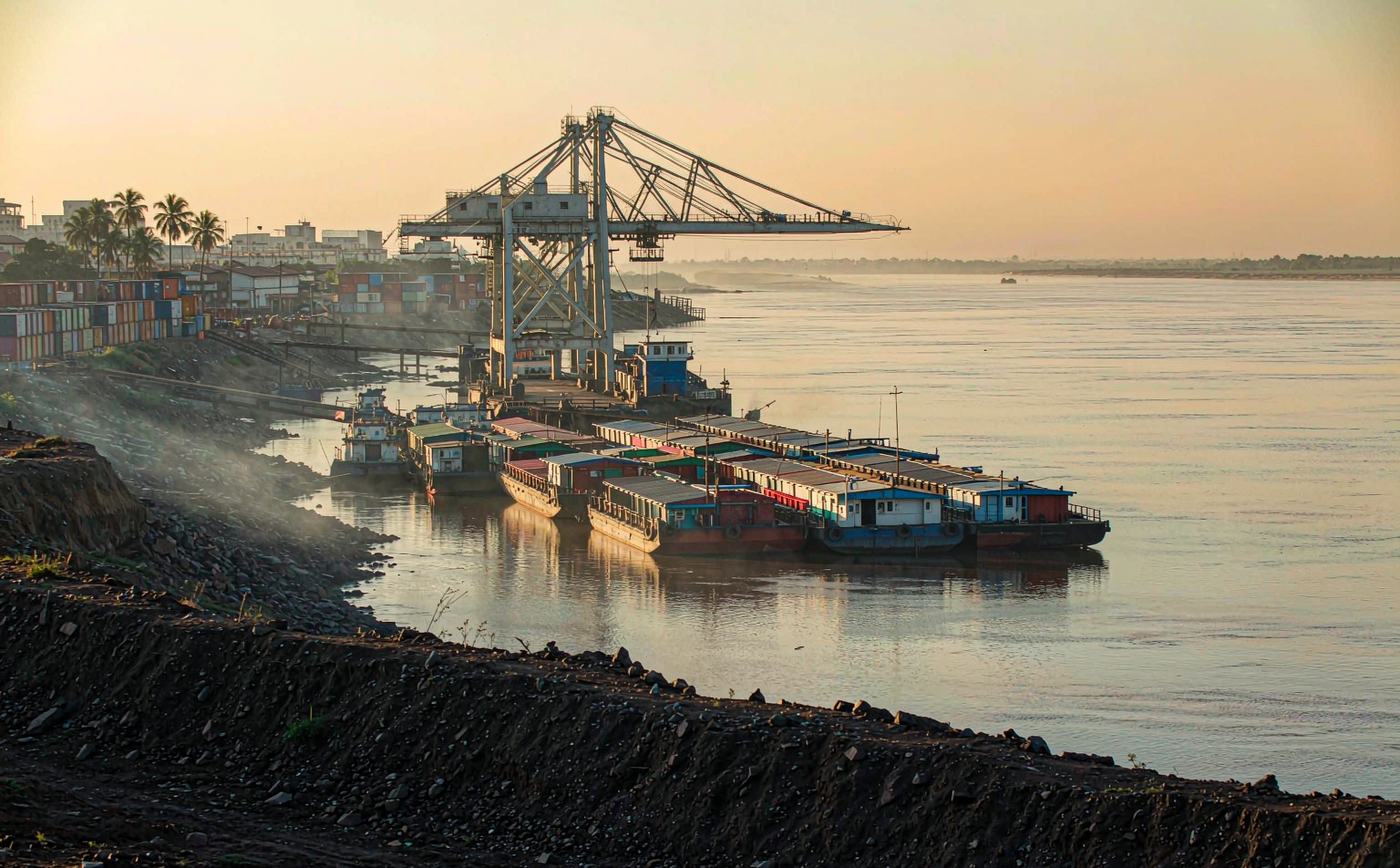
The river ports matter as much as the corridor. Asunción is the main river port on the Paraguay River and handles most containerised imports. Villeta, south of Asunción, has grown quickly and is increasingly used by container barges. Concepción and Encarnación serve other trades, with Encarnación doubling as a border crossing into Argentina at Posadas.
Air freight is the fourth route and it has no direct service. Cargo from China connects through São Paulo or Buenos Aires and then trucks or short-hauls into Asunción, giving five to ten days in total. Guaraní airport near Ciudad del Este handles time-critical freight for the eastern side of the country.
The river, and the schedule that is not weekly
The Paraguay–Paraná waterway, the Hidrovía, is the country's principal freight route to the Atlantic, and the volumes explain why: the great majority of Paraguay's trade moves on it. Cargo travels in convoys of river barges, mostly Mississippi-type, pushed by tugboats, and the economics are excellent — which is the entire reason a landlocked country can compete.
The scheduling is the catch. Departures from Montevideo are reported at roughly one or two a week, not daily, and missing a convoy can add seven to fourteen days to a shipment that has already spent five weeks at sea. Two things make that worse. The river is depth-sensitive: low water slows convoys and reduces what they can carry, most often in the drier months. And a convoy assembles on a schedule that assumes the cargo is already there, so a container delayed at discharge is a container waiting for the next one.
Book the inland leg at the same time as the ocean leg. Not after discharge. A forwarder who reserves the barge or the border truck when they book the vessel removes the single largest source of delay on this lane, and one who waits until the container lands is gambling your cargo on whatever space is left.
There is a second, quieter point about the river. Barge operators dislike returning empty, and they are more willing to quote and to hold space when they have notice of an ETA. Giving that notice early is free, and it measurably reduces the risk of a container sitting at the terminal.
Customs transit, and why the container must not clear on the way
Every Paraguayan import crosses at least one other country's customs territory. That is not a technicality: it is a tax question, because Mercosur members apply the bloc's external tariff to goods entering from outside it, and goods crossing between members meet that tariff at each crossing.
The mechanism that avoids this is customs transit, the tránsito aduanero, under which the goods move across the intervening country in bond, still under customs control, without being imported into it. It has to be arranged before the movement begins, and it is documented — the transit documents from the country of entry become part of the Paraguayan import file.
If it is not arranged, the goods get cleared where they land. Duty is assessed in a country that was only ever meant to be a corridor, the shipment acquires a tax event it cannot undo, and the border crossing into Paraguay becomes a second assessment with paperwork that no longer matches. It is one of the more expensive ways to save nothing.
In practice the movement is also physically controlled. Vehicles moving under customs control are sealed, in Uruguay with an electronic GPS seal fitted by an authorised operator, so the customs authority can see where the truck is and whether it has stopped where it should not have. That system works well, and it means the seal, the transit document and the Paraguayan declaration all have to describe the same consignment.
The check to run with your forwarder is a single sentence, and it is worth asking in writing: which regime is booked, and are the transit documents itemised on the quotation?
What you pay: the TEC, ten percent IVA, and the consular fee
The structure is a bloc tariff plus a low national tax plus a scatter of small charges that catch first-time importers out.
| Charge | Basis and rate |
|---|---|
| Import duty | Mercosur common external tariff, commonly 0–20% of CIF. Most consumer goods 10–18%, electronics around 14–16%, capital goods and machinery often 0–14%. |
| IVA | 10% on CIF plus duty — among the lowest standard rates in South America. A reduced 5% rate applies to basic basket items and to some agricultural, horticultural, fruit and livestock products, and to medicines registered with the health ministry. |
| Selective consumption tax | Alcohol, tobacco, petroleum products and similar. Assessed independently of the duty. |
| Port rates | Reported between roughly 0.65% and 1.50% of the customs valuation. |
| Customs valuation service | Reported at around 0.5% of the customs valuation. |
| Consular fee | Around US$50 for each commercial document legalised by a Paraguayan consulate at origin, plus a further levy reported at 7% of that fee. |
| IT system utilisation fee | Reported between US$15 and US$50 depending on the value of the import. |
| Despachante | Commonly US$80–150 per declaration. |
No agreement with China is in force, so the tariff applies in full and a certificate of origin does not reduce it. The certificate is still needed — for origin, for statistics, and for certain products — but it is a document, not a discount.
The arithmetic is worth doing once, in outline. Landed tax is roughly the CIF value multiplied by one plus the duty rate, then multiplied again by 1.10, plus the fixed charges. On a mid-range consumer line that puts the tax burden in the region of a quarter to a third of the goods' value, which is considerably gentler than Uruguay's stack and one of the reasons the lane is worth the river leg.
The fixed charges carry the opposite lesson. The consular fee, the IT fee, the valuation service and the broker's charge do not scale with the shipment. Two small consolidated shipments pay the overhead twice; one container from several suppliers pays it once.
There is a low-value threshold below which parcels are reported to clear free, quoted in the region of fifty to a hundred US dollars, . And one warning that belongs here: under-declaring the invoice value is not worth it. Customs audits are routine and the penalties and interest exceed anything saved.
Ciudad del Este, and the border economy
Ciudad del Este sits on the Brazilian border opposite Foz do Iguaçu, joined by the Friendship Bridge, and it is one of the largest retail-import and re-export hubs in the region. For traders in eastern Paraguay it is not a curiosity, it is the natural port of entry, and the Santos road corridor usually beats the river on both speed and simplicity.
There is a free trade zone there, and a special regime is reported to apply to goods commercialised in the area that can substantially reduce the tax load. Eligibility rules are strict and are applied strictly, so this is a question for your despachante rather than an assumption to build a price on. Ask before you quote a customer, not after.
Two cautions about the border itself. It is busy, and queues build around peak stocking seasons and the approach to Christmas, which turns a reliable corridor into a slow one for a few weeks a year. And because cross-border trade there is large and partly informal, paperwork discipline matters more, not less: a declaration that does not match the physical cargo is far more likely to be examined at a border where examination is routine.
Who can import: the RUC, the SET and the despachante
Customs is run by the Dirección Nacional de Aduanas, and declarations are filed through an electronic system called SOFIA. The importer registers with the tax authority, SET, and holds a RUC, the single taxpayer register number.
A foreign importer cannot file the declaration. It has to be filed by a licensed local despachante. This is a hard requirement rather than a convention, and it means the broker has to be appointed, and briefed, before the goods reach the border rather than after.
Clearance runs two to four working days where the codes, the invoice and the packing list line up. Published ranges stretch to three to ten days where they do not, and the difference is almost entirely documentary. Valuation is on a CIF basis throughout — goods, insurance and freight to Paraguay, not merely to the port of discharge.
The permits: food, plants, medicines and radios
| Authority | Covers |
|---|---|
| INAN | Food and food products. |
| SENACSA | Animal products and animal feed. |
| SENAVE | Plants, seeds and phytosanitary matters. |
| DINAVISA | Pharmaceuticals, medical devices and cosmetics. |
| CONATEL | Type approval for radio and telecommunications equipment. |
The timing rule is the same one that applies on every lane in this series, and it bites harder here because the goods have further to travel. Authorisations take weeks and a container waiting on one is paying storage in a foreign yard. Start them with the production order.
Following a container from Nansha to a river terminal in Asunción
Here is the western corridor end to end, which is the one most first shipments take.
The corridor is chosen from the delivery city
The warehouse is in Asunción, so the goods will come up the river. The ocean booking and the barge booking are made together, and the customs transit through Uruguay is confirmed at the same time.
Loading and export customs in China
Collection, loading at Nansha, Chinese export declaration. Verified gross mass goes in before the cut-off, and the tolerance is tight — roughly five percent or one tonne. A container weighed wrongly is rolled to the next sailing, which on a weekly barge schedule is a two-week mistake rather than a one-week one.
Ocean leg to Montevideo, about twenty-eight to thirty-eight days
The container arrives at the Atlantic gateway. Nothing about Paraguay has happened yet; the goods are still in Uruguay.
Customs transit to the barge terminal
Under the transit regime, the container moves sealed to Nueva Palmira, where the river begins. It has not been imported into Uruguay and no Uruguayan duty has been assessed.
Barge convoy up the waterway, about five to twelve days
The convoy assembles and heads north, past the confluences, to Asunción or Villeta. Low water or a missed departure is where the schedule slips.
Declaration and payment in Paraguay
The despachante files through SOFIA with the transit documents attached. Duty under the bloc tariff, IVA at ten percent, and the fixed charges are assessed and paid.
Release, delivery, and the empty box
The container is trucked to the warehouse and then returned to the nominated depot — which may be in Asunción, in Villeta, or across a border — within the free time allowed.
Transit times, and what the inland leg adds
| Leg | Days | Applies to |
|---|---|---|
| Origin consolidation | 3–7 | LCL only |
| Ocean leg to the gateway | 28–38 | All sea freight |
| Customs transit to the barge terminal or border | 1–3 | All sea freight |
| River or road leg into Paraguay | 5–12 | All sea freight |
| Customs clearance | 2–4 | Longer where documents or permits are imperfect |
| Air via São Paulo or Buenos Aires | 5–10 | Airport to airport, plus onward |
Counted together that gives the published totals: thirty-six to fifty-two days door to door via Montevideo and the river, thirty-five to fifty via Santos and road, thirty-eight to fifty-five via Buenos Aires. Consolidated cargo adds handling at the gateway as well as at origin, which is worth five to ten days a side on this lane.
The things that move the number are all knowable in advance. Missing a barge costs seven to fourteen days. Missing a cut-off in China costs a week. Low water costs days. A border queue at Ciudad del Este costs whatever the queue is that week. An inspection costs however long it takes to produce a document that should have been in the file.
The empty container, and where it has to go back to
This is the section that separates a planned Paraguayan shipment from an expensive one, and it is the one most quotations are silent about.
A container is a rented asset that has to be returned. In a landlocked country "returned" may mean a depot in Asunción, one in Villeta, or one in another country entirely — and the drop-off point is the carrier's choice, not yours. Free time at destination is typically reported at seven to fourteen days from discharge. After that, detention charges commonly quoted between thirty-five and ninety US dollars per container per day begin, on top of whatever the river terminal charges for storage.
Ask three questions before booking: where does the empty go, how much free time applies, and what is the daily rate afterwards? Then plan the unloading to fit the free time, because a container that cannot be emptied because the warehouse is not ready is the most avoidable cost on the lane.
Consolidation, and the corridor that suits it
The familiar break-even applies in outline — below roughly twelve to fifteen cubic metres a consolidated shipment wins, above twenty a full container usually does — but Paraguay shifts it further towards the full container.
The reason is handling. Consolidated cargo is handled at origin, handled again at the gateway to be transferred to the inland leg, and deconsolidated at the destination. Each handling is a charge and each one is days. Above about fifteen cubic metres on this lane, a full container usually wins clearly, and consolidating several Chinese suppliers into one container before it sails is worth more here than on most lanes.
Wood, humidity and a month on the water
Solid wood packaging has to meet ISPM 15 and carry the stamp, and a fumigation certificate belongs with the documents. The stamp is what is checked. Plywood, OSB and other processed wood fall outside the rule, which is often the simplest way to remove the risk altogether.
Then the conditions. The container crosses the tropics, sits at a humid Atlantic port, rides a river for a week, and is handled at least twice more than a container going to a coastal destination. Condensation forms inside the roof and drips onto the top layer — container rain — and every extra handling is another chance for packaging to fail. Desiccants, a moisture barrier under the pallets, and cartons specified for a month in tropical conditions with double handling cost very little against the alternative.
Voltage, labels and Spanish
Retail goods are labelled in Spanish, with the product name, country of origin, expiry or manufacturing dates and ingredients for consumables. As everywhere in this region, that is a production decision rather than a customs one: customs will release unlabelled goods and the problem will surface later, at the shelf.
The mains supply is 220 volts at 50 hertz. Equipment built for a 110 volt market will not run without a transformer, and this is worth checking explicitly because the neighbouring markets differ — Panama runs 110 volts and parts of Brazil run 127.
Business cargo, and the parcels sent to a person
Commercial stock follows the full path described above: corridor, transit, declaration, duty, IVA, and the fixed charges. Regular importers should ask their despachante about arrangements that reduce the per-shipment administrative load, because the fixed charges here are per declaration rather than per cubic metre.
Small parcels sent by courier are handled under simplified rules, and low-value consignments often pass with little or no charge, subject to a threshold that should be confirmed rather than assumed. Repeated identical parcels to the same recipient are reclassified as commercial imports, at which point the full stack applies to all of them. Samples should be declared at their real value; a "without commercial value" marking on goods that have one is a classic audit trigger.
Travellers bringing goods in person have a personal allowance, reported in the region of three to five hundred US dollars with separate limits for alcohol and tobacco, and cash above ten thousand US dollars or its equivalent has to be declared.
The calendar: holidays, low water and the border queues
Three things slow this lane, and only one of them is a holiday.
Chinese New Year shuts factories and empties sailings in January or February. On a lane where a missed cut-off costs a week and a missed barge costs two, the fortnight either side of it is the most expensive time to improvise.
Low water on the river is the one people forget. In the drier months the Paraná and Paraguay carry less, convoys slow and load less, and a schedule that was reliable in winter stops being so. If your delivery promise depends on the river, ask what the water is doing.
Border queues at Ciudad del Este build around Brazilian stocking seasons and the run-up to Christmas, turning the fastest corridor into the slowest for a few weeks. Paraguay's own public holidays — including the May independence days, Chaco Armistice in June, the Boquerón day in September and Caacupé in December — close customs and businesses on their own account.
The practical rule is to avoid scheduling arrivals into late December, into the Brazilian pre-Christmas peak if you are using the road corridor, and into the driest stretch of the river if you are using the water.
The paperwork, and the documents that need legalising
| Document | What it has to do |
|---|---|
| Bill of lading, master and house | Title and release of the container, matching the cargo description exactly. An amendment after issue costs money and time you do not have. |
| Commercial invoice | Establishes the CIF value that duty and IVA are calculated on. The real transaction value, with a full description. |
| Packing list | Container by container. It is checked at the transit port as well as in Asunción, so it has to be accurate twice. |
| Verified gross mass | SOLAS compliance before loading, within roughly five percent or one tonne. |
| Certificate of origin | Not a discount, because there is no agreement with China, but needed for origin and statistics and for certain products. |
| ISPM 15 fumigation certificate | Any shipment with wood packaging. |
| Import declaration | Filed through SOFIA by a licensed despachante. A foreign importer cannot file it. |
| Transit documents | From the country of entry — Uruguay, Argentina or Brazil. These are what keep the goods from being taxed on the way through. |
| Agency permits | INAN, SENAVE, SENACSA, DINAVISA or CONATEL, where the product is regulated. |
| Consular legalisation | Commercial documents legalised at a Paraguayan consulate at origin, at a fee per document. Ask which ones and how long it takes. |
Two checks are worth running over the whole file yourself, and both are free. One classification, used identically, on the invoice, the packing list, the certificate and the declaration. And one description that matches the physical cargo, because on this lane the goods are examined at a transit point, at a border and at destination, and each examination is a chance for an inconsistency to become a delay.
Why importers use Goodhope on this lane
Six things that are different about working with us on China to Paraguay shipments.
Real stories headed to Paraguay
Five shipments bought in China and delivered into Paraguay, told end to end — where the order came from, how it moved, where it nearly went wrong, and how it finished. Client names are withheld at their request; the situations and the handling are what we deal with on this lane.
No seaport · first shipment · Nansha to Asuncion
The purchase. A buyer new to importing asked which Paraguayan port his container would arrive at.
The move. Full container routed on one of the three corridors and delivered to the river terminal, with the corridor chosen before booking.
Where it nearly went wrong. This country has no seaport. Everything arrives through a neighbouring country and continues by river or road, and picking the corridor is the first decision rather than an afterthought.
How it finished. He chooses the corridor at quotation now and knows where his cargo is at every stage.
Transit, not import · the costly mistake · Santos to Paraguay
The purchase. A first-time buyer's agent cleared the container in the neighbouring country because that was where the vessel discharged.
The move. Container moved under customs transit across the neighbouring country and entered at the Paraguayan border.
Where it nearly went wrong. The crossing has to run under customs transit rather than as a local import. Clearing on the way converts a transit movement into a finished import, and undoing that costs far more than doing it correctly.
How it finished. We issue the transit instruction with the booking. No container of his has been cleared early since.
Legalisation · per document · Shenzhen to Paraguay
The purchase. A buyer sent his standard document set and met a legalisation charge he had not budgeted.
The move. Full container with the documents requiring legalisation identified and processed before departure.
Where it nearly went wrong. Certain documents have to be legalised, and the fee applies per document rather than per shipment. Finding that out after the goods sail is finding it out too late to choose a cheaper route.
How it finished. We identify which documents need it up front. He budgets it accurately every time.
Empty container · where it returns · Montevideo to Asuncion
The purchase. A buyer did not ask where the empty box had to go back to and was charged for the difference.
The move. Full container with the empty return point agreed with the carrier before booking.
Where it nearly went wrong. On a river corridor the empty container has a return point that is not necessarily where you collected it. Leaving that open at booking leaves you paying for a repositioning you did not plan.
How it finished. He agrees the return point at booking. No unexpected equipment charge since.
River schedule · not weekly · Shanghai to Villeta
The purchase. A buyer planned his replenishment on a weekly river service.
The move. Consolidated cargo booked against the actual barge schedule and the seasonal water conditions.
Where it nearly went wrong. The river service does not run weekly, and low water changes what it can carry. Planning inventory against a frequency that does not exist produces stock-outs on a corridor where recovery takes weeks.
How it finished. He plans against the published schedule now and carries more safety stock in the low season.
Why importers use Goodhope on this lane
Six things that are different about working with us on China to Paraguay shipments.
Request a quote on your Paraguay shipment
Tell us the delivery city in Paraguay, the commodity and its description, and the volume in cubic metres or the container type. We will recommend the corridor and confirm the transit regime before quoting, because both change the number more than the freight rate does.
Get a quote Talk to usRelated pages
Frequently asked questions
Does Paraguay have a seaport?
No. Goods arrive at river ports on the Paraguay River, mainly Asunción and Villeta, or cross a land border from Brazil at Ciudad del Este or from Argentina at Encarnación. The ocean leg always ends in another country.
Which route is best for shipping from China to Paraguay?
Asunción and the west: Montevideo, transit to Nueva Palmira, then barge up the waterway — 36–52 days door to door. Eastern Paraguay and Ciudad del Este: Santos plus road over the Friendship Bridge — 35–50 days. Buenos Aires is a third corridor at 38–55 days.
How long does shipping from China to Paraguay take?
Ocean leg to the gateway 28–38 days, inland leg into Paraguay another 5–12, clearance 2–4 working days with clean documents. Totals of 36–52 days by river and 35–50 by road are the published ranges. Air runs 5–10 days via São Paulo or Buenos Aires.
Is there a free trade agreement between China and Paraguay?
No. The Mercosur external tariff applies in full and a certificate of origin does not reduce it, though it is still required for origin, statistics and certain products.
What taxes will I pay importing into Paraguay?
Duty under the bloc tariff, commonly 0–20% of CIF; IVA at 10% on CIF plus duty with a reduced 5% for basic goods; selective consumption tax on alcohol, tobacco and petroleum; plus port rates, a valuation service fee, a consular legalisation fee per document, an IT fee and broker charges usually US$80–150.
Do I need a customs broker in Paraguay?
Yes, and strictly: the declaration is filed through SOFIA by a licensed local despachante and a foreign importer cannot file it. The importer also needs a RUC from the tax authority, SET.
What is customs transit and why does it matter?
It is the in-bond movement across Uruguay, Argentina or Brazil. Without it the goods are cleared and taxed in the transit country, creating a tax event you never intended and risking a second assessment at the Paraguayan border. Confirm the regime in writing before shipping.
How often do the river barges run?
Departures from Montevideo are reported at one or two a week, and missing one adds 7–14 days. Low water slows convoys further. Book the inland leg with the ocean leg, not after discharge.
What happens to the empty container?
It has to be returned, sometimes to a depot in another country. Free time is typically 7–14 days and detention afterwards is commonly quoted at US$35–90 per container per day. Ask where the depot is before booking.
Which agencies regulate imported products?
INAN for food, SENACSA for animal products and feed, SENAVE for plants and seeds, DINAVISA for pharmaceuticals, medical devices and cosmetics, and CONATEL for radio equipment. Each takes weeks, so start with the production order.