
Home / Shipping to Saint Eustatius / How to Ship from China to Saint Eustatius
Shipping from China to Saint Eustatius, step by step
Goodhope Freight is a licensed NVOCC based in Shenzhen, registered as GD20230925153335, and has been moving cargo out of China since 2012. Saint Eustatius has no commercial container port of its own, so to serve it we run full containers and shared containers port-to-port into the relay port your consignee nominates, most often Philipsburg on St Maarten, air freight airport-to-airport into Princess Juliana, and express parcels dispatched from our depot. Every service stops at the relay port, the airport or the depot. The onward transfer and the import clearance are arranged by your consignee.
The island is a special municipality of the Kingdom of the Netherlands and forms part of the Caribbean Netherlands alongside Bonaire and Saba. That status is widely misread. It sits outside the European Union customs territory and outside the European Union VAT area, so Dutch VAT is not charged on imports here and goods cleared on the island are not in free circulation in the European Union. The currency is the US dollar, which at least means your freight quote and your buyer's tax bill are in the same money.
The tax structure is the part worth understanding before you price anything. Import duty on the Caribbean Netherlands is set at nil for all goods. What your buyer pays instead is a general expenditure tax on goods, charged at 6 per cent on Saint Eustatius and Saba, and it is assessed on a customs value that includes the freight.
At a glance
No commercial container port of its own; cargo relays through Philipsburg on St Maarten or Basseterre on St Kitts · Air: F.D. Roosevelt Airport (EUX) for small aircraft, Princess Juliana (SXM) for larger consignments · Currency: US dollar · Outside the European Union customs territory and outside the European Union VAT area · Import duty set at nil for all goods · General expenditure tax on goods at 6 per cent, assessed on the customs value including freight and insurance · Excise applies only to petrol on this island · Administered by the Belastingdienst Caribisch Nederland
How your cargo moves: China to Saint Eustatius
Eight steps from your supplier's door to yours. The last four are the ones shaped by local rules.
- Pickup from your supplierWe collect the goods anywhere in China and bring them to our consolidation point.
- Export clearanceChina customs declaration filed and released before the goods move to the port.
- Loading and departureContainer loaded, sealed and handed to the carrier at the Chinese port.
- Relay through a Caribbean hubMainline containers reach Philipsburg or Basseterre via the regional hub services; air cargo connects through Miami, Panama City or Curacao.
- Arrival at the relay portThe container is worked at St Maarten or St Kitts. From here the movement to the island is your consignee's arrangement.
- Onward transfer to the islandGoods move by small vessel or light aircraft on a local schedule, which is a separate booking with its own charges.
- Entry filed with the tax officeYour consignee or broker lodges the declaration with the Belastingdienst Caribisch Nederland, classified by commodity code.
- Expenditure tax assessed and goods releasedNo duty is charged, but the 6 per cent tax on goods is assessed on the customs value and settled before release.
Duty rates, VAT rates and clearance times move, and the figure that applies to your goods is the one set for your commodity code on the day of clearance. We check the current position against your code before your goods sail and confirm it to you in writing — ask for that check when you request a quote.
No commercial port, and that shapes everything
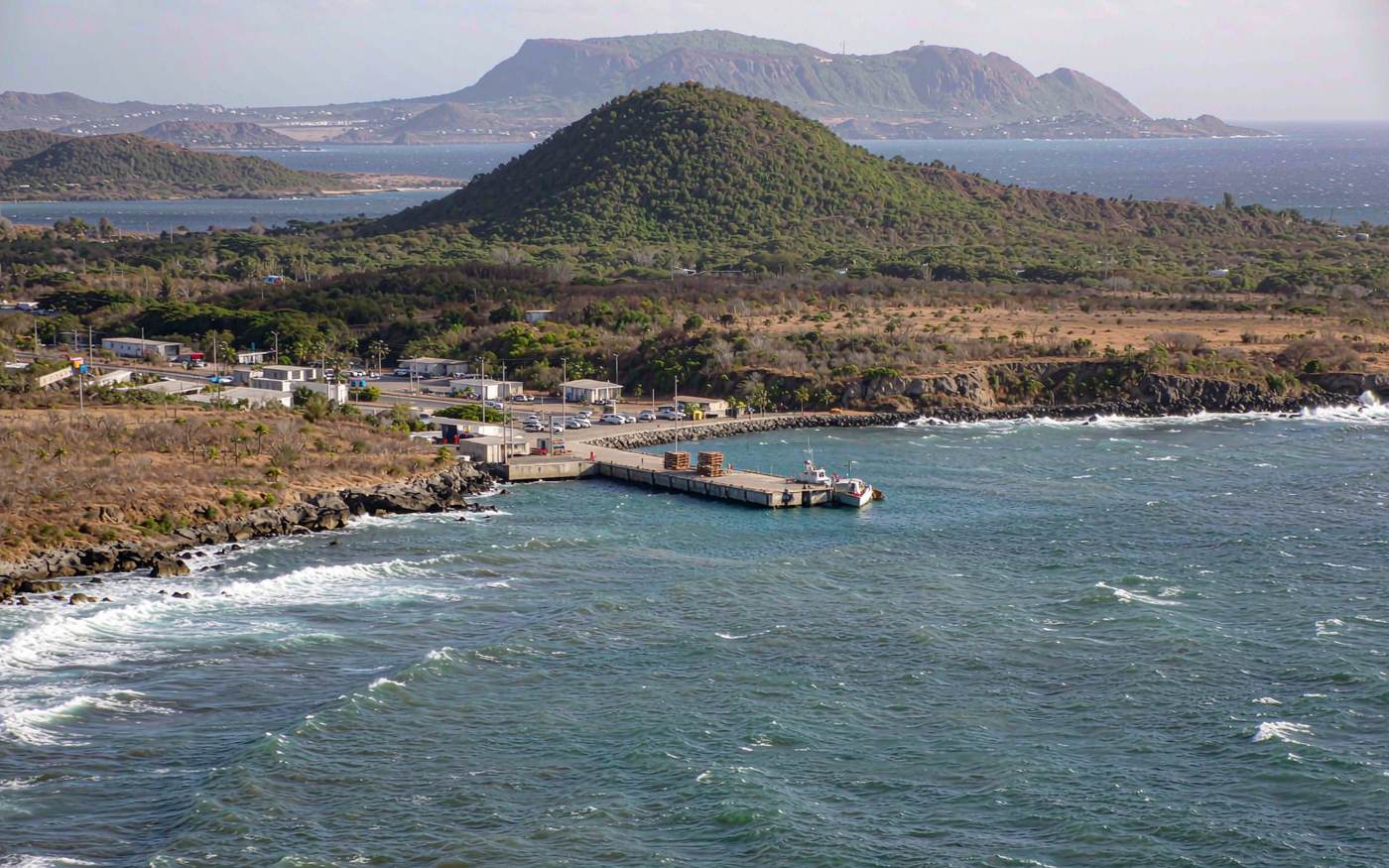
Saint Eustatius is a small island of a few thousand people with a short landing pier and a small airfield. It has no container berth, no gantry crane and no container yard. Every plan for getting cargo here therefore begins with a relay, and the relay is not a detail, it is the whole structure of the shipment.
Sea freight is booked to Philipsburg on St Maarten or, less commonly, to Basseterre on St Kitts, and the goods are then moved onward by small vessel. Air cargo arrives at Princess Juliana on St Maarten for anything above light aircraft capacity, or directly into F.D. Roosevelt Airport on the island for small consignments that can be worked by hand. Tell us which route your consignee prefers and we will quote to that relay by name.
St Maarten or St Kitts: picking the relay
St Maarten is the usual choice because it carries regular feeder services and has the region's main air hub. St Kitts works when your consignee has an established agent there, and it can shorten the second leg for certain cargo. The trade-off is almost always between a more frequent relay schedule and a shorter final hop, and the right answer depends on what your consignee can arrange locally.
Below roughly 15 cubic metres a shared container is the practical answer, deconsolidated at the relay port. Above that, a full container is booked as 20GP, 40GP or 40HC, subject to acceptance at the relay terminal. Air freight earns its premium from about 45 kg for electronics, spares, medical supplies and time-critical stock.
Why duty is nil and the tax still applies
On the Caribbean Netherlands the import duty rate is set at nil for all goods. Buyers hear that and assume the import is cheap, which is a reasonable inference and a wrong one. The relief that most countries offer on low-value imports is a relief on duty. Where duty is already nil, there is no relief to give, so the small-import allowance that exists elsewhere simply does not exist here.
What applies instead is a general expenditure tax on goods, charged at 6 per cent on Saint Eustatius and Saba and 8 per cent on Bonaire. It is assessed on the customs value, which is the price of the goods increased by freight and insurance up to the first point of arrival on the island. There is no input-tax recovery mechanism for the importer, so it is a genuine cost rather than a recoverable one.
Freight and insurance sit inside the customs value
Because the tax is assessed on a customs value that includes freight and insurance to the point of arrival, the way you route the cargo moves the tax bill. A cheaper but slower routing, a lower insurance declaration, or a consolidation that reduces the freight element all reduce the base. An expensive expedited routing raises it.
This is the one place on this lane where freight and tax interact directly, and it is worth modelling before you choose a service level. We can quote the routing and show how the freight element feeds the assessment, so your buyer can see the total rather than discovering it after the goods land.
Excise here means petrol, and little else
Excise treatment differs between the islands of the Caribbean Netherlands. On Saint Eustatius and Saba excise duty is charged only on petrol; cigarettes, distilled beverages and similar goods do not carry an excise charge on import here. On Bonaire excise applies across the full range of excise goods. If your consignment includes fuel or any excise category, confirm the treatment with your consignee's broker before shipping.
Everything on the island's own regime is administered by the Caribbean Netherlands tax office rather than by European Union or Dutch mainland authorities, which means the rules your European suppliers are used to do not transfer.
Parcels and commercial consignments are assessed the same way
Given that duty is already nil, the dividing line is not a value threshold but the process: a postal or courier item handled under the carrier's simplified clearance, versus a commercial consignment that goes through a formal entry with the tax office. A commercial consignment is assessed on the expenditure tax whatever it is worth.
Practically, that means samples sent to a buyer on the island will be assessed, and the buyer will be asked to settle the tax before release. If the goods are genuinely samples with no commercial value, document them as such at dispatch. The point is not to avoid a tax that is legitimately due; it is to avoid a bill neither side expected.
Packing for a transfer by small vessel
The relay structure means your export packing carries the risk, not the carrier. Goods are lifted off the mainline vessel, worked at the relay port, loaded onto a small vessel, and unloaded again at the island. Cartons that were adequate for a single journey are not adequate for four lifts. Palletise or strap wherever the commodity allows, and box rather than bag anything dense.
Salt air and sun at an open quay do the rest. Moisture protection inside cartons for textiles, paper goods and electronics costs very little. Wood packaging material needs to meet the international standard, and untreated timber is a common cause of holds on Caribbean entries.
Paperwork, and the value line that matters
- Commercial invoice with a specific description, quantities, values, currency and country of origin.
- Packing list matching the invoice, with weights and dimensions.
- Bill of lading for sea freight or air waybill for air freight.
- Certificate of origin where the buyer asks for one.
- Any permit or certificate the commodity requires, including phytosanitary and health certificates for food, plant and animal products.
The tax office assesses on the declared customs value, so a vague invoice does not simply slow the clearance, it changes the number. Keep the declared value and the commodity codes accurate, and expect a poorly described entry to be queried rather than waved through.
Timing across two legs
Consolidated shipments to the relay port typically run in the region of 40 to 55 days port-to-port depending on the Chinese origin and how the feeder connects, and full container routings vary with the relay chosen. The onward leg to the island then runs on a local schedule that is independent of your vessel's arrival.
The practical advice is to plan on a spread rather than a date, and to have your consignee arrange the onward transfer before the goods discharge rather than after. On an island with a handful of sailings, missing one is the most expensive thing that can happen to the shipment.
Our scope, and the consignee's scope
We handle collection from your supplier, consolidation and loading in Guangdong, export declaration, and the main carriage into the relay port or airport. We issue the transport document, send status updates at each handover, and quote the relay by name rather than hiding it behind a single transit figure.
Your consignee arranges the onward transfer to the island, lodges the entry with the Caribbean Netherlands tax office, settles the 6 per cent expenditure tax and collects. We tell your buyer up front that duty is nil but the tax is charged on a freight-inclusive value, so nothing arrives as a surprise. We do not offer door-to-door delivery to Saint Eustatius.
Getting the first booking right
Send us the commodity, the volume and weight, the pickup address in China and the relay port your consignee prefers. We will show the relay options, quote the charges line by line, and set out how the freight element feeds the tax base so you can see the landed cost as one number.
If this is your first shipment to the island, ask for the sequence in writing and ask for the relay to be named on the quote. On a destination served entirely through a neighbour, knowing which port your container passes through and who moves it from there is the difference between tracking your cargo and waiting for it.
Case notes across Saint Eustatius
Five shipments bought in China and delivered into Saint Eustatius, told end to end — where the order came from, how it moved, where it nearly went wrong, and how it finished. Client names are withheld at their request; the situations and the handling are what we deal with on this lane.
Building materials for a small guesthouse, 20GP via St Maarten
The purchase. A guesthouse operator was extending, buying tiles, sanitaryware, aluminium windows and fixings from two suppliers in Guangdong.
The move. We consolidated both lots into one 20GP, shipped port-to-port to Philipsburg on St Maarten, and pre-alerted the consignee's agent before the feeder sailed so the onward vessel could be booked.
Where it nearly went wrong. Tiles are dense, and the buyer had priced the whole job on volume. On a container booking the payload limit, not the space, is what stops you, and a dense 20GP can reach its weight ceiling well before it is full.
How it finished. We weighed the packed lots at our warehouse before confirming the equipment and split the order so neither container was overweight. Both arrived at the relay within the schedule and moved onward on the next available sailing.
Solar panels and inverters for an off-grid installation
The purchase. A property owner was installing an off-grid solar system, buying panels, inverters and mounting hardware from one supplier.
The move. Just over 12 CBM, moved as a shared container to Philipsburg, deconsolidated and then transferred by small vessel.
Where it nearly went wrong. Panels are fragile and awkward, and the buyer's supplier had packed them in light cartons suited to a single journey. Four lifts later, that packing was not going to survive.
How it finished. We had the supplier re-pack onto pallets with edge protection before collection, and marked the pallets for hand handling at the relay. Nothing was damaged on arrival, and the installation started on schedule.
A sample carton that was assessed anyway
The purchase. A buyer ordered a single carton of consumer goods by express to check quality before committing to a container.
The move. It went by courier from our depot with a commercial invoice at full product value.
Where it nearly went wrong. Because import duty on the Caribbean Netherlands is already nil, there is no duty-free allowance to fall back on. The 6 per cent expenditure tax was assessed on the customs value including the freight, and the buyer was asked to settle it before release.
How it finished. We explained the structure before the buyer ordered again, re-documented the next round as evaluation samples without resale intent, and moved the trial quantity into a small consolidated sea shipment. The trial then landed at a workable cost.
Air freight into the island's own airfield
The purchase. A dive operation needed regulator service kits and spare cylinders urgently during the season.
The move. Roughly 90 kg was booked as air freight, routed through Princess Juliana and onward to F.D. Roosevelt Airport by light aircraft, collected by the consignee.
Where it nearly went wrong. Light aircraft into the island have tight weight and dimension limits, and the buyer had assumed the same crates used on a container shipment would transfer. They would not have.
How it finished. We confirmed the aircraft limits with the onward carrier before booking and had the supplier split the consignment into smaller cases. Everything travelled on the first available connection and was collected the same day.
Where the routing changed the tax bill
The purchase. A buyer was choosing between a slower consolidated service and a faster routing through a different hub.
The move. Two options were quoted side by side, with the relay ports and the freight element named on each.
Where it nearly went wrong. The buyer compared only the freight. The expenditure tax is assessed on a customs value that includes freight and insurance, so the faster routing raised the tax as well as the freight.
How it finished. We showed both options with the tax effect included, so the comparison was made on landed cost rather than on freight alone. The buyer took the slower service for the non-urgent items and kept the faster one only for the lines with a fixed deadline.
Why importers use Goodhope on this lane
Six things that are different about working with us on China to Saint Eustatius shipments.
Get your relay shipment priced
Tell us the commodity, the volume, the pickup address in China and which relay port your consignee prefers. We will name the relay, show how the freight element feeds the 6 per cent assessment, and quote every charge as a separate line.
Get a quote Talk to usRelated pages
Frequently asked questions
Does Saint Eustatius have a container port?
No. The island has a short landing pier and a small airfield, with no container berth or gantry crane. Sea freight is booked to a relay port, most often Philipsburg on St Maarten or sometimes Basseterre on St Kitts, and moved onward by small vessel. Air cargo above light aircraft capacity arrives at Princess Juliana (SXM); small consignments can come into F.D. Roosevelt Airport (EUX).
What tax will my buyer pay if import duty is nil?
Import duty on the Caribbean Netherlands is set at nil for all goods. What applies instead is a general expenditure tax on goods, charged at 6 per cent on Saint Eustatius and Saba and 8 per cent on Bonaire. It is assessed on the customs value, which is the price of the goods plus freight and insurance to the first point of arrival on the island.
Do European Union customs or VAT rules apply here?
No. Saint Eustatius is a special municipality of the Kingdom of the Netherlands but sits outside the European Union customs territory and outside the European Union VAT area. Dutch VAT is not charged on imports there, and goods cleared on the island are not in free circulation in the European Union. The currency is the US dollar.
Does a low value get goods in tax-free?
Not in the way most countries offer one. Because import duty is already nil, the relief that usually applies to low-value imports has nothing to relieve. The expenditure tax is assessed on commercial consignments regardless of value, and the dividing line is the clearance process rather than a threshold.
Is excise duty charged on imports?
On Saint Eustatius and Saba, excise duty is charged only on petrol, so cigarettes, distilled beverages and similar goods do not carry an excise charge on import here. On Bonaire, excise applies across the full range of excise goods. Confirm the treatment with your consignee's broker if the category applies to you.
Which airport should air cargo be booked to?
Princess Juliana (SXM) on St Maarten for anything above light aircraft capacity, and F.D. Roosevelt Airport (EUX) on the island for small consignments that can be worked by hand. There is no freighter service from China, so the connection, not the flying time, sets the transit.
Do you offer door-to-door delivery to Saint Eustatius?
No. Sea and air freight are port-to-port and airport-to-airport to the relay port, and express courier dispatch ends at the depot. Your consignee arranges the onward transfer to the island, lodges the entry, settles the tax and collects.
Which documents should accompany a shipment?
A commercial invoice, a packing list, and the bill of lading or air waybill, with a certificate of origin where the buyer asks for one and any permit or health certificate the commodity requires. Keep the declared value and commodity codes accurate, because the tax office assesses on the declared customs value.
Can lithium batteries be shipped?
Built-in and packed-with lithium batteries can be carried subject to proper documentation and packaging. Standalone battery shipments and other dangerous goods classes are assessed case by case and must be declared at quotation stage, because the relay and the onward vessel both have to accept the class.
What details do you need to price a shipment?
The commodity, the volume and weight, the pickup address in China and the relay port your consignee prefers. We will show the relay options, quote the charges line by line, and set out how the freight element feeds the tax assessment.