
Home / Shipping to Saint Helena / How to Ship from China to Saint Helena
Shipping from China to Saint Helena, step by step
Goodhope Freight is a licensed NVOCC based in Shenzhen, registered as GD20230925153335, and has been moving cargo out of China since 2012. To Saint Helena we route full containers and shared containers by sea to Cape Town in South Africa and from there on the scheduled supply vessel to Jamestown. We also handle air freight routed through Johannesburg and express parcels dispatched from our depot. Every service stops at the port, the airport or the depot. Your consignee arranges import clearance and collection.
Saint Helena is a British Overseas Territory in the South Atlantic, roughly nineteen hundred kilometres from the west coast of Africa, with around four and a half thousand people. It is volcanic, steep and remote, and its isolation is the single fact that shapes every quotation on the route.
Three things follow from that. There is no harbour, so cargo comes ashore by lighter. One supply ship serves the island, roughly monthly, so a missed sailing costs a month rather than a week. And there is no general consumption tax, so the tax position is simpler than the logistics.
This guide is written for a buyer who has never imported from China before. It explains how goods physically reach the island, what the sailing schedule means for planning, how duty and the wharfage fee are assessed, why the electronic manifest is due two days before arrival, and when flying is worth the premium.
At a glance
One landing place: Jamestown, on the north-west coast · No harbour: ships anchor in the open roadstead and cargo is lightered ashore and crane-lifted at the wharf · Supply vessel sails from Cape Town, roughly monthly · Currency: Saint Helena pound (SHP), pegged to sterling · Customs authority: the customs office, working through ASYCUDA World · Duty assessed by commodity code · No general consumption tax · A wharfage fee based on value and size · Electronic manifest required forty-eight hours before the ship arrives · Entries made under a self-assessment model · Airport: St Helena (HLE), with connections through Johannesburg
How your cargo moves: China to Saint Helena
Eight steps from your supplier's door to yours. The last four are the ones shaped by local rules.
- Pickup from your supplierWe collect the goods anywhere in China and bring them to our consolidation point.
- Export clearanceChina customs declaration filed and released before the goods move to the port.
- Main carriage to Cape TownContainer loaded, sealed and shipped to South Africa.
- Onward on the supply vesselBooked onto the scheduled sailing to Saint Helena, roughly monthly.
- Manifest lodged two days aheadThe electronic manifest is filed through the customs system before the ship arrives.
- Lighterage ashore at James BayContainers moved from the anchored ship to the wharf by barge and lifted by crane.
- Entry declared and duty assessedYour consignee self-assesses the entry, pays duty and the wharfage fee.
- Release and collectionOnce released your buyer collects at Jamestown. There is no onward delivery service.
Duty rates, VAT rates and clearance times move, and the figure that applies to your goods is the one set for your commodity code on the day of clearance. We check the current position against your code before your goods sail and confirm it to you in writing — ask for that check when you request a quote.
One settlement, one working shore, and cliffs everywhere else
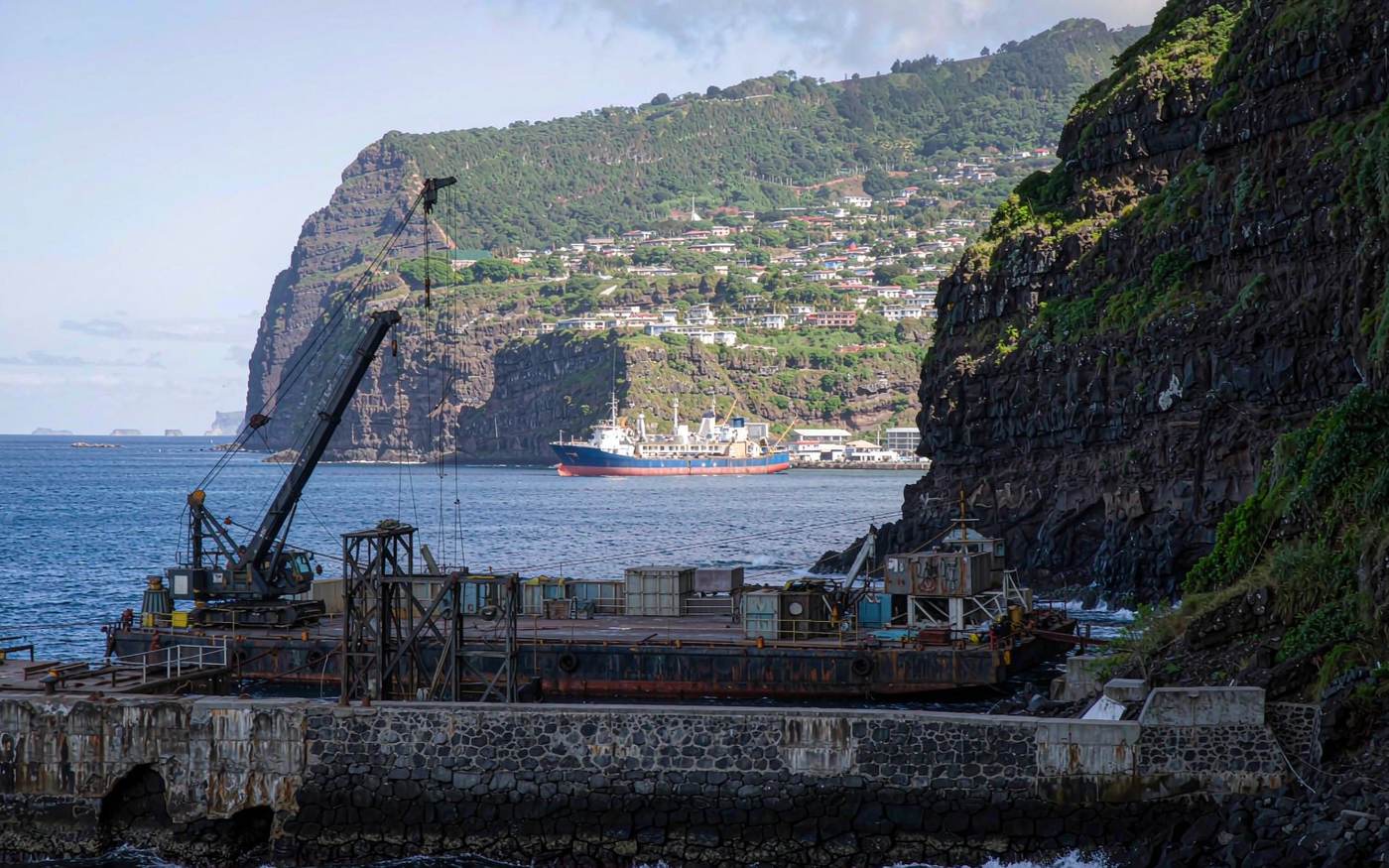
Saint Helena is a volcanic island whose coastline is dominated by high cliffs, and there are very few places where the sea can be reached at all. Jamestown, on the north-west coast, is the island's port and its only settlement of any size. Everything you import comes through that one place. There is no second port to fall back on, no alternate terminal across the island, and no road alternative if the landing cannot be worked on the day. That is worth stating plainly to a first-time importer, because it changes how you plan. On most routes a delay is an inconvenience. Here it is measured against the next sailing.No harbour, no ramp: containers travel by barge
James Bay is an open roadstead rather than a sheltered harbour. The supply ship anchors offshore, and cargo is brought to the shore working area by self-propelled lighter barges, where crawler cranes lift it onto the wharf. The barges have a working limit, both in weight and in how many containers each can carry, so a single call can only land so much. That is a practical constraint on project cargo and on heavy pieces, and it is worth designing around rather than discovering. It also means your goods are lifted by crane from a barge rather than driven off a ramp. Packing that survives a crane lift and an open-sea transfer is the packing you need, and anything fragile should be specified accordingly.One ship, and a sailing schedule that decides your year
The island's supply route runs from Cape Town on a roughly monthly rotation, reaching Saint Helena and Ascension and continuing onward. There is no weekly feeder and no alternative carrier on the route. The consequence is simple and severe: a missed sailing costs about a month, not about a week. A supplier delay of three days in China can therefore cost four weeks at the destination, if it causes the container to miss the vessel. This is why we name the target sailing on the quotation and work backwards from it to a ready-by date for your supplier. That date, not the vessel's closing date, is the one to agree in writing.Duty by commodity code, and no consumption tax
Duty is assessed by commodity code, and it is the principal charge on an import. There is no general consumption tax on Saint Helena, which is unusual and which materially simplifies the costing. Without a tax layer on top of the duty, the arithmetic is shorter than on most routes: establish the customs value, apply the rate for your code, and add the wharfage fee described below. The simplification is real but it is not a reason to be casual about classification. Duty by code still means the code decides the bill, and a misclassified line is a misassessed entry.The wharfage fee, and how it is worked out
Alongside duty, consignments attract a wharfage fee assessed by reference to the value and the size of the shipment. It reflects the cost of the lighterage and crane handling described above, which is genuinely more labour-intensive than a conventional berth. Because it is driven partly by size, packing tightly is worth money here. A consignment with unnecessary void space or oversized crating pays for that space twice, once in freight and once at the wharf. We include the fee as its own line in the quotation rather than folding it into a handling charge, so you can see what it is and what drives it.The forty-eight hour manifest, and the self-assessment model
Shipping agents and forwarders must submit an electronic manifest through the customs system forty-eight hours before the ship arrives at James Bay. That deadline is fixed by the arrival, not by the departure, so it is easy to miscalculate if you work from the sailing date. Importers declare under a self-assessment model. You or your agent classify the goods, state the value and compute what is owed, and the customs system risk-profiles the entry afterwards. Self-assessment puts the accuracy burden on the declaration rather than on an officer checking it first. That is a reason to prepare carefully rather than a reason to rush.Classifying correctly, because the system audits for you
Under the self-assessment model, a misclassified high-value entry does not simply slip through. The customs system triggers an automatic audit based on risk profiling, and the entry is examined after the fact. The consequence of getting it wrong is therefore not a fine at the desk but a correction later, with the delay and correspondence that involves on an island served once a month. If your consignment includes anything unusual, high-value or technically regulated, tell us at quotation stage. Confirming the classification before shipping is faster than correcting it afterwards, and here the gap between the two is measured in weeks.Flying instead, and when that is worth it
St Helena Airport has served the island since 2016, with connections routed through Johannesburg. Air freight reaches the island far faster than the supply vessel, and for the right consignment it is the better answer outright. The test is value against weight and urgency against cost. High-value, low-volume or genuinely time-critical goods justify the premium many times over. Bulk, heavy or low-value goods almost never do. There is also a third path for small consignments. Express courier reaches the island routed through a hub, and for parcels it is often the most practical option of the three.Packing for two lifts, salt air and a barge
Your container will be lifted off a ship at anchor, carried on a barge and lifted again by crane. That is two more lifts than a conventional berth and one of them happens on the open sea. Export-grade strapping, proper dunnage, filled voids and sealed inner packaging are baseline. Anything fragile should be packed to survive a lift it was not designed for. Salt spray and humidity then do the rest. Corrosion protection for metal and moisture barriers for anything absorbent are worth specifying, and timber packaging must be treated and marked to the international standard with the certificate in hand before departure.Where our work finishes, and your buyer's starts
We handle collection anywhere in China, export clearance, consolidation, main carriage to Cape Town, booking the onward sailing, and the electronic manifest filed within the deadline. Your buyer handles arrival onward: lodging the self-assessed entry, paying duty and the wharfage fee, satisfying any permit requirement for regulated equipment, and collecting at Jamestown. We quote the main carriage and the onward leg as separate lines and name the target sailing. On a route with one ship and one landing place, being able to see both is the whole point.Booking a first Saint Helena consignment
Send us the commodity in enough detail to classify it, the volume and weight, the pickup address in China, and whether the delivery date is genuinely fixed or merely preferred. That last answer decides whether we quote sea or air. We will name the target sailing and work backwards to a ready-by date for your supplier, check your codes, and quote the main carriage, the onward leg, duty and the wharfage fee separately. Start with one shared container. It tells you how your supplier packs for a double lift, how quickly your consignee can self-assess an entry, and how much margin a monthly sailing really demands, for considerably less than a full container would cost you to learn the same three things.Actual moves for new Saint Helena buyers
Five shipments bought in China and delivered into Saint Helena, told end to end — where the order came from, how it moved, where it nearly went wrong, and how it finished. Client names are withheld at their request; the situations and the handling are what we deal with on this lane.
Building materials for a hotel refurbishment
The purchase. A hospitality operator bought tiles, sanitaryware, bathroom fittings, lighting and soft furnishings from three suppliers in Guangdong for a staged refurbishment in Jamestown.
The move. We collected all three lots, consolidated into one 20GP, shipped to Cape Town and booked the onward sailing, filing the electronic manifest within the deadline.
Where it nearly went wrong. The tiles were crated with generous void space, which is a poor decision anywhere and a worse one when the wharfage fee is assessed partly by size.
How it finished. We specified tight, properly dunnaged crating on the repeat. The fee came down and nothing arrived damaged.
A container that missed the monthly sailing
The purchase. A buyer confirmed the order late and asked for the earliest vessel, without accounting for the relay through Cape Town.
The move. One 20GP consolidated and shipped, with the onward booking made only once the goods reached South Africa.
Where it nearly went wrong. One supply ship serves the island on a roughly monthly rotation. Booking the onward leg after arrival meant the container missed the sailing, and the delay was measured in weeks rather than days.
How it finished. On the next order we booked the onward leg with the main carriage and worked backwards to a ready-by date for the supplier. The container made the first target sailing.
Salt damage after a double lift
The purchase. A buyer imported pumps, motors, bearings and stainless fittings for maintenance work on the island.
The move. One 20GP shipped to Cape Town and lightered ashore at James Bay, with metal parts in standard domestic cartons.
Where it nearly went wrong. Cargo is lifted from a ship at anchor onto a barge and lifted again by crane, in salt air. With no corrosion protection, several machined faces arrived with surface rust.
How it finished. We required vapour corrosion protection and sealed inner packaging on the repeat. The parts arrived clean and went straight into service.
A high-value entry that triggered an automatic audit
The purchase. A consignee imported specialist telecommunications equipment and declared it under a broad heading carried over from a previous, unrelated consignment.
The move. Air freight routed through Johannesburg, with the entry self-assessed on arrival.
Where it nearly went wrong. Under the self-assessment model the customs system risk-profiles entries and triggers an automatic audit. A broad classification on a high-value entry invites exactly that, and on an island served monthly the correction costs weeks.
How it finished. We now confirm the classification for high-value or regulated lines at quotation stage. Subsequent entries have been assessed correctly the first time.
Sea or air, decided on value rather than on habit
The purchase. A buyer had always shipped by sea because it was the option they knew, without reconsidering what was in the consignment.
The move. We quoted both the supply vessel and the air routing through Johannesburg on the same consignment and set out what each would cost and how long each would take.
Where it nearly went wrong. The consignment was high-value and low-volume, which is precisely the profile where air freight wins outright. The habit of shipping by sea was costing more than the freight difference suggested.
How it finished. The buyer now asks for both quotations on every consignment. On this route that single habit has been worth more than any rate negotiation.
Why importers use Goodhope on this lane
Six things that are different about working with us on China to Saint Helena shipments.
Get a Jamestown consignment priced
Tell us the commodity in enough detail to classify it, the volume and weight, the pickup address in China, and whether your delivery date is fixed or merely preferred. We will name the target sailing and work backwards to a ready-by date, check your codes, and quote the main carriage, the onward leg, duty and the wharfage fee separately.
Get a quote Talk to usRelated pages
Frequently asked questions
How does cargo reach Saint Helena?
By sea to Cape Town and onward on the scheduled supply vessel, which calls roughly monthly, or by air routed through Johannesburg. Everything that arrives by sea is landed at Jamestown, the island's only port.
Is there a container port?
No. James Bay is an open roadstead rather than a sheltered harbour. The ship anchors offshore and containers are brought ashore by self-propelled lighter barges, then lifted onto the wharf by crawler cranes. The barges have a weight and container limit, which caps what a single call can land.
How often does the supply ship sail?
Roughly monthly, from Cape Town. That is the critical planning fact on this route: a missed sailing costs about a month rather than about a week, so we name the target sailing and work backwards to a ready-by date for your supplier.
Is there value-added tax on Saint Helena?
No. The territory levies no general consumption tax, so duty assessed by commodity code plus the wharfage fee is the substance of the bill. That makes the tax position simpler here than on almost any comparable route.
What is the wharfage fee?
A charge assessed by reference to the value and the size of the shipment, reflecting the lighterage and crane handling involved. Because size is part of the calculation, packing tightly is worth money.
When is the electronic manifest due?
Forty-eight hours before the ship arrives at James Bay. The deadline is set by the arrival rather than the departure, so working from the sailing date from Cape Town will put you wrong.
Who is responsible for classifying the goods?
The importer, under a self-assessment model. You or your agent classify, value and compute what is owed, and the customs system risk-profiles the entry afterwards and triggers an automatic audit where it sees risk.
Is air freight worth it?
It depends on value against weight and urgency against cost. High-value, low-volume or genuinely time-critical goods justify the premium many times over; bulk, heavy or low-value goods almost never do. We quote both and say which we would pick.
Do you offer door-to-door delivery?
No. Sea freight ends at Jamestown, air freight ends at St Helena Airport, and express courier dispatch ends at the depot. Your consignee self-assesses the entry, pays duty and the wharfage fee, and collects.
Can lithium batteries be shipped?
Built-in and packed-with lithium batteries can be carried with proper declaration, documentation and packaging, and some codes now require specific safety declarations. Standalone battery shipments and other dangerous goods classes are assessed individually and must be declared at quotation stage.