
Home / Shipping to Seychelles / How to Ship from China to the Seychelles
How to Ship from China to the Seychelles
Shipping to the Seychelles is a different exercise from shipping to a mainland African market. The country is an archipelago of widely scattered islands, the domestic market is small, and almost everything arrives through one port on one island before being redistributed. That means the questions you need answered are not the usual ones about which port is cheapest, but about consolidation frequency, storage time at the quay, and how your goods will get from Mahe to wherever they are actually needed.
This guide is written for buyers importing from China for the first time. It covers the port and airport gateways, why most shipments move as consolidated cargo, how long the route takes, what the Seychelles Revenue Commission expects in a declaration, how VAT and other charges are applied, which goods need a ministry permit, and how inter-island movement works. As elsewhere in this series, we do not publish freight rates; the aim is to give you the structure to plan and to read a quote properly.
At a glance
Main gateway: Port Victoria on Mahe. Air gateway: Seychelles International Airport. Customs: Seychelles Revenue Commission on ASYCUDA World, with import declarations filed under regimes including IM4, IM5, IM7 and IM8. VAT: 15 per cent. Typical sea transit from China: 25 to 40 days, usually via a transhipment hub.
How your cargo moves: China to the Seychelles
Eight steps from your supplier's door to yours. The last four are the ones shaped by local rules.
- Pickup from your supplierWe collect the goods anywhere in China and bring them to our consolidation point.
- Export clearanceChina customs declaration filed and released before the goods move to the port.
- Loading and departureContainer loaded, sealed and handed to the carrier at the Chinese port.
- Main carriageOcean, air or rail movement booked on the route agreed for your cargo.
- Arrival at the gatewayDischarge at the port or airport of entry, recorded on the carrier's manifest.
- Import clearanceCustoms declaration filed locally, with duty and tax assessed on the declared value.
- Customs releaseGoods released into free circulation once duty and tax are settled.
- Final deliveryOnward movement to your delivery address, warehouse or nominated depot.
Duty rates, VAT rates and clearance times move, and the figure that applies to your goods is the one set for your commodity code on the day of clearance. We check the current position against your code before your goods sail and confirm it to you in writing — ask for that check when you request a quote.
Why Port Victoria on Mahe is where your Seychelles box lands
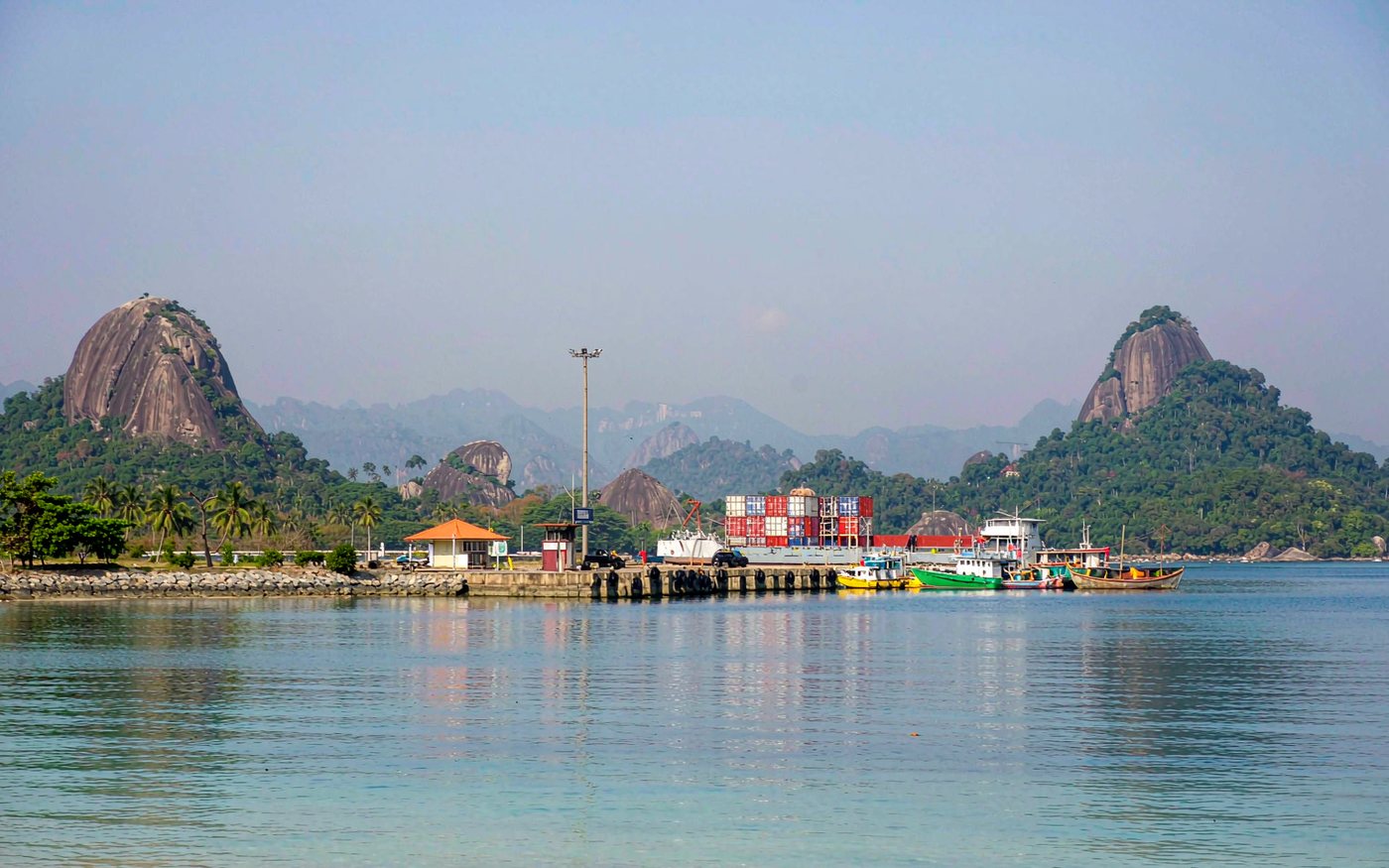
Port Victoria, on the island of Mahe, is the country's principal commercial port and the entry point for the great majority of goods arriving in the Seychelles. Container vessels, general cargo ships and the inter-island vessels all work from there, and the customs administration is set up around it.
The practical implication for a first-time importer is that your port choice is effectively made for you. There is no meaningful competition between ports on this route. What you do control is the service: whether your cargo travels on a direct call or is transhipped through a regional hub, and how often that service runs.
Transhipment is normal here. Cargo from Chinese ports is frequently relayed through a hub in the Middle East, India or East Africa before the final leg to Mahe. That is not a problem in itself, but it does mean your transit estimate has to account for a connection, and it means a missed connection can cost a week or more. Ask which hub the consolidation is routed through and what the connection window looks like.
Also worth confirming early: the frequency of the service. On routes with thin schedules, a delay of a few days in getting your documents ready can push a shipment onto the next sailing, which on a monthly service means a month. Where schedules are weekly, the same delay costs seven days. Know which situation you are in before you commit to a delivery date.
LCL and small-volume sea freight to the Seychelles islands
For most buyers shipping to the Seychelles, consolidation is the default answer. Volumes are modest, the market is small, and paying for a whole container that you will not fill is hard to justify. Consolidated sea freight lets you book the cubic metres you actually need.
The trade-off is handling and schedule. Consolidated cargo is grouped at a warehouse in China, loaded, and then deconsolidated at destination before being released. Consolidations run to a schedule tied to the service, so the cut-off dates matter more than they would for a full container you control. Get the cut-off in writing and work backwards from it.
Make sure you understand the destination charges before you book. Deconsolidation, terminal handling, documentation and the delivery order are all separate from the ocean freight, and on island routes, where volumes do not benefit from scale, those charges are a meaningful share of the total. A cheap freight rate with expensive destination charges is not a cheap shipment.
If you are importing regularly and your volumes grow, revisit the arithmetic at the point where a part-container stops making sense. The crossover depends on your route's destination charges rather than on a universal rule, so ask your forwarder to quote both ways once your volume is steady.
Air freight to Seychelles International and the island-hopping question
Air cargo arrives at Seychelles International Airport on Mahe. For a small, high-value or urgent shipment, air is often the more rational choice, and on this route the premium over sea can be smaller than buyers expect once port handling and storage time are taken into account.
Flight connections to the Seychelles are limited compared with major trunk routes, and cargo typically moves via a Gulf or European hub. Transit is measured in days rather than weeks. That matters enormously if you are shipping hospitality supplies, spare parts for equipment that is down, or anything tied to a tourism season.
There is an important second-stage question that sea and air share: if your consignee is on Praslin, La Digue or an outer island, the goods are not finished when they land on Mahe. Inter-island movement is a separate leg, on separate vessels or aircraft, on its own schedule. Price it and schedule it as part of the plan, not as an afterthought.
For very small consignments, compare express courier against consolidated air freight. Courier is usually simpler door to door below roughly 100 kilograms; consolidated air freight tends to win above that.
Sailing time to the Seychelles and why consolidation sets the pace
Sea transit from China to Port Victoria typically falls in a range of roughly 25 to 40 days, and the spread is wide because almost every routing involves a transhipment. The number your forwarder gives you is an estimate for a specific service, not a promise.
On a consolidated shipment, the schedule is set by the consolidator as much as by the vessel. There is a cut-off for delivering your goods to the warehouse in China, a period for building the consolidation, and then the sailing. Missing the cut-off does not usually mean missing the vessel - it means rolling to the next consolidation, which may be a week later.
At destination, storage time becomes the variable. Ports on small island routes generally allow a short free storage period before charges begin, and the clock starts when the cargo is landed. Because the clearing and collection process is what consumes that window, the practical advice is simple: have your documents complete and your broker instructed before the vessel arrives, not after.
Rainy and cyclone seasons in the western Indian Ocean can affect island services and inter-island connections. If your shipment has a hard deadline, ask whether it falls in a seasonal risk window and build in extra time.
Seychelles Revenue Commission declarations: IM4, IM5, IM7 and IM8 explained
The Seychelles Revenue Commission administers customs, and declarations are lodged electronically through an ASYCUDA-based system. Your customs broker files the declaration, and what matters to you is which regime it is filed under and what documents support it.
In practice, imports are declared under one of several regimes, identified in the system by codes: a declaration for goods entering directly into home use, a declaration for goods placed into a customs warehouse, a temporary admission or inward processing entry, and a transit or re-export movement. These appear on documentation as IM4, IM5, IM7 and IM8. Which one applies depends on whether you are clearing the goods now, storing them under customs control, bringing them in temporarily, or moving them onward.
The supporting document set is the standard one: commercial invoice, packing list, bill of lading or air waybill, and certificate of origin. The invoice should carry a specific description, quantities, unit and total prices, currency and trade terms. The packing list must reconcile with it on piece count and weight.
One point specific to island routes: the carrier is required to lodge cargo manifest information ahead of arrival, and the window for doing so is short. This is the carrier's obligation rather than yours, but if your shipping instructions are amended late, the manifest may not match the bill of lading, and a mismatch stops the release. Freeze your instructions early.
VAT, excise and environmental charges on goods landed in the Seychelles
VAT applies to imports into the Seychelles at 15 per cent, assessed on the value of the goods with duty and other dutiable charges brought into the base. As elsewhere, VAT is not simply 15 per cent of your invoice - it is charged on a figure that already includes duty, and possibly freight and other costs depending on how the customs value is built up for your entry.
Excise duty applies on top for alcohol, tobacco, motor vehicles and some other categories, and it is charged at product-specific rates rather than as a flat percentage in many cases. If you are importing anything in those categories, ask for the excise treatment to be worked out before you ship, because the amounts can be large.
There are also environment-related charges on certain products and packaging, reflecting the country's strong stance on plastics and waste. Single-use plastic bags are banned, and charges or restrictions apply to some packaging and products. Check both your product and the packaging it arrives in.
Some goods are zero-rated or exempt, and there are concessionary arrangements for specific sectors - tourism-related investment, for example, has historically benefited from relief on certain equipment. Reliefs almost always require approval in advance. Do not assume you can claim one after clearance.
Permits and restricted goods in the Seychelles: what needs a ministry letter
The Seychelles protects its environment and its biosecurity aggressively, and that shows up in the import rules. A range of ordinary-looking goods need a permit or a certificate from a ministry or agency before they can be released, and the permit has to exist before the goods arrive.
Plants, seeds, soil, live animals and animal products require agricultural documentation, and the rules are strict because an island ecosystem is unusually vulnerable to introduced pests and diseases. Food products need health clearance. Pharmaceuticals, supplements and cosmetics need the relevant health and regulatory authorisations. Telecommunications and radio equipment needs approval from the communications regulator.
Standards and conformity requirements can also apply to electrical goods, particularly anything that plugs into a mains supply. Where a standard applies, goods may need to be tested or certified, and this should be resolved before shipment rather than at the port.
Prohibited items include the usual categories - narcotics, weapons without authorisation, counterfeit goods and hazardous waste - plus environmentally restricted products. Because the lists are long and sector-specific, the reliable approach is to give your broker your full commodity list and let them confirm what is needed, in writing, before you book.
Packing for humid equatorial handling and island distribution
Cargo to the Seychelles travels through the tropics and then sits in a hot, humid, salty environment before and after discharge. Packing should assume moisture and heat. Use export-grade cartons, palletise where volume justifies it, wrap against rain and condensation, and use desiccant inside cartons for moisture-sensitive products.
Electronics, paper products, textiles, leather and anything with a metal finish are the categories that suffer most. If you are shipping any of these, say so when you book, and consider whether the packaging your supplier uses for the domestic Chinese market is adequate for a multi-week tropical routing. Usually it is not.
Wood packaging - pallets, crates and dunnage - must comply with the international phytosanitary standard and carry the corresponding mark. Given how strict the Seychelles is on biosecurity, this is an area where a documentation oversight is disproportionately expensive.
Finally, think about the last leg. If goods are moving on to another island, they will be handled again, transferred onto a smaller vessel, and possibly exposed on an open deck. Pack for that event, not just for the container.
Incoterms for island deliveries and the free-storage clock
Under FOB, the seller loads the goods in China and you take responsibility from there, contracting the ocean leg, the destination handling and the clearance. Under CIF, the seller pays freight and insurance to Port Victoria but risk still passes at loading in China. Under DAP or DDP, the seller carries more, and DDP includes clearing the goods and paying the Seychelles duty and VAT.
On island routes, DDP is worth considering more seriously than on large mainland routes, because the destination handling is a larger share of the total and a supplier's agent may have better local arrangements. But if you take DDP, confirm who is named as the declarant, because the declarant carries the customs liability, and confirm whether the price includes delivery beyond Mahe if that is where your consignee is.
Whichever term you choose, the free-storage clock is the operational detail that costs money. Storage charges begin after a short free period from landing, and they accrue daily. The way to avoid them is to have your broker instructed and your documents complete before the vessel arrives, and to know in advance whether any permit is needed so that the application can be started early.
Confirm the currency of settlement in writing. Freight is typically quoted in US dollars, and local costs in Seychellois rupees. Agree payment timing with your bank so that a transfer delay does not become a storage bill.
Getting cargo from Mahe to Praslin, La Digue and the outer islands
If your consignee is on Mahe, delivery is a straightforward road move from the port. If they are on Praslin, La Digue or one of the outer islands, there is a further leg by inter-island vessel or small aircraft, with its own schedule, its own cost and its own handling.
Inter-island services do not run as frequently as the international services, and on the smaller outer islands they may be infrequent indeed. Build that into your transit estimate rather than assuming onward movement is same-day. If your consignee runs a hotel or a resort, they will know the schedule and can usually tell you what is realistic.
Handling is the other consideration. Each additional transfer is another chance for damage, so goods destined beyond Mahe should be packed more robustly than goods delivered in Victoria itself. Crates rather than cartons, where the value justifies it.
Make sure the inter-island cost is on the quotation. A through price to Mahe is not a through price to Praslin, and the gap between them is sometimes larger than buyers expect relative to the size of the shipment.
Seychelles-specific slip-ups that delay small shipments
The most common is assuming the port works like a large mainland port. It does not - schedules are thinner, connections are fewer, and storage windows are shorter. A shipment that would shrug off a three-day document delay in a major hub can lose a sailing here.
The second is underestimating permits. Because the Seychelles is protective about biosecurity and the environment, a surprisingly ordinary product can need a ministry letter. Confirm requirements before the goods ship, not when they are on the quay accruing storage.
The third is packaging. Tropical heat, humidity and salt air, plus an extra handling event for anything going beyond Mahe, punish packaging that was specified for a domestic delivery.
The fourth is the plastic rules. Goods packed in banned single-use plastics can be stopped regardless of what is inside. Check the packaging as well as the product.
The last is quoting to the wrong destination. A price to Port Victoria is not a price to your consignee's island. Always specify the final delivery point when you ask for a quotation.
Why importers use Goodhope on this lane
Six things that are different about working with us on China to the Seychelles shipments.
Actual moves to your door in the Seychelles
Five shipments bought in China and delivered into the Seychelles, told end to end — where the order came from, how it moved, where it nearly went wrong, and how it finished. Client names are withheld at their request; the situations and the handling are what we deal with on this lane.
The wrong regime · declarations · Shenzhen to Port Victoria
The purchase. A buyer new to importing filed under the regime his agent used for a straightforward home consumption entry.
The move. Consolidated cargo declared under the regime that actually matched what was happening to the goods.
Where it nearly went wrong. The revenue commission works through several declaration regimes, and which one applies depends on what the goods are and what happens to them. Filing the familiar one produces a declaration that has to be redone, and redoing it costs days of storage.
How it finished. We match the regime before filing. Every entry of his has gone through first time since.
The hub sets the pace · 25 to 40 days · Ningbo to Mahe
The purchase. A first-time buyer planned his reorder point around the short end of the published range.
The move. Consolidated cargo booked on a named service with the realistic span, not the best case.
Where it nearly went wrong. The sea transit runs roughly twenty-five to forty days because consolidation through a hub sets the pace rather than the ocean leg. Planning against the short end means reordering before the goods can physically arrive.
How it finished. He plans against the real span now. His shelves have stayed stocked since.
Beyond Mahe · island distribution · Guangzhou to Praslin
The purchase. A buyer quoted a delivery to Praslin based on when the container would discharge at Port Victoria.
The move. Consolidated cargo discharged at Port Victoria and moved to the outer island as a booked leg.
Where it nearly went wrong. Mahe is where cargo lands and not where all of it is going. Treating the archipelago as one delivery point produces a promise the geography will not keep.
How it finished. He books the island leg with the freight. His outer-island customers get dates they can use.
Ministry letter · restricted goods · Shanghai to Seychelles
The purchase. A buyer shipped goods that needed a permit and discovered it when the consignment was held.
The move. Consolidated cargo with the permit position checked and the ministry letter obtained before departure.
Where it nearly went wrong. Some categories need a ministry letter rather than only a declaration, and the letter takes longer to obtain than the sailing does. Discovering it at discharge means the goods wait and the clock runs.
How it finished. We check permits before booking. Nothing of his has been held for paperwork since.
The free-storage clock · island delivery · Yiwu to Victoria
The purchase. A buyer agreed an incoterm without noticing how short the free storage period is here.
The move. Consolidated cargo with the incoterm matched to the storage clock and the collection arranged before discharge.
Where it nearly went wrong. Free storage at the port is short, and on an island there is nowhere else to put a container when it expires. An incoterm that works in a large market quietly transfers a daily charge to you here.
How it finished. He arranges collection before arrival now. No shipment of his has run up storage since.
Why importers use Goodhope on this lane
Six things that are different about working with us on China to the Seychelles shipments.
Ask for a Seychelles quote built around your volumes
Tell us the volume, the commodity and the island it is actually going to. We will quote the consolidation or container option that fits, confirm which permits apply before you ship, and price the onward leg beyond Mahe so the number you approve is the number you pay.
Get a quote Talk to usRelated pages
Frequently asked questions
Which port do shipments from China arrive at in the Seychelles?
Port Victoria on Mahe handles the great majority of imports. There is effectively no alternative commercial port for general cargo, so your real choice is which service to use - direct or via a transhipment hub - and how frequently it runs.
How long does sea freight take from China to the Seychelles?
A range of roughly 25 to 40 days is typical, with the spread driven mainly by transhipment. Consolidated cargo also depends on the consolidator's cut-off and build schedule, so confirm both the warehouse cut-off in China and the estimated sailing.
Is LCL or FCL better for the Seychelles?
Consolidation is usually the right answer, because volumes into the Seychelles are modest and a part-filled container is expensive. Ask for the destination charges - deconsolidation, terminal handling, documentation and delivery order - separately, because on island routes they are a significant share of the total.
What VAT applies to imports into the Seychelles?
VAT is charged at 15 per cent, on a base that includes duty and other dutiable charges. Excise duty applies additionally to alcohol, tobacco, vehicles and certain other products, at product-specific rates. Environment-related charges may apply to some products and packaging.
Do I need a permit to import into the Seychelles?
Ordinary goods generally do not, but the list of exceptions is longer than on most routes because of strict biosecurity and environmental rules. Plants, seeds, live animals and animal products, food, medicines and supplements, cosmetics and telecoms equipment commonly need ministry or agency approval. Confirm in writing before shipping.
What are IM4, IM5, IM7 and IM8?
They are the ASYCUDA regime codes used for import declarations: broadly, entry for home use, entry into a customs warehouse, temporary admission or inward processing, and transit or onward movement. Your broker selects the right one; what matters to you is deciding in advance whether you are clearing now, storing under customs control, importing temporarily or moving the goods on.
How much free storage is there at Port Victoria?
A short free period applies from landing, after which storage is charged daily, but the exact allowance varies and should be confirmed with your broker at the time of shipping. The practical rule is to have documents complete and the broker instructed before the vessel arrives.
Can you deliver to Praslin or La Digue?
Yes, but it is a separate leg. Goods arrive on Mahe and then move by inter-island vessel or small aircraft on their own schedule. Ask for the onward leg to be included in the quotation, and pack more robustly because there is at least one extra handling event.
Is air freight to the Seychelles worth the premium?
Often yes for urgent, high-value or seasonal cargo. Transit is measured in days rather than weeks, and once port handling and storage time on the sea route are counted, the gap may be smaller than expected. Connections are limited, so most cargo moves via a Gulf or European hub.
What documents does the Seychelles Revenue Commission require?
A commercial invoice with a specific description, quantities, unit and total prices, currency and trade terms; a packing list reconciling with it; the bill of lading or air waybill; and a certificate of origin. Wood packaging must meet the international phytosanitary standard, and any required permits should be obtained before the goods arrive.