
Home / Shipping to Sierra Leone / How to Ship from China to Sierra Leone
How to Ship from China to Sierra Leone
Sierra Leone is a small, price-sensitive West African market with one working commercial port, and it rewards importers who prepare their paperwork properly. The port itself is capable, the customs administration has moved to an electronic declaration system, and the tariff is inherited from the regional economic community rather than set locally. The friction points are not usually dramatic - they are delays caused by documents that do not agree with each other, and costs that were never in the original quotation.
This guide is for buyers importing from China for the first time. It covers the port and airport gateways, how to choose between a full container and consolidation, realistic transit expectations, what the National Revenue Authority expects, how duty and tax are calculated, which goods need inspection or permits, and how to move cargo beyond Freetown. We do not publish freight rates here; the aim is to give you the framework for planning a shipment and reading a quote critically.
At a glance
Main gateway: Queen Elizabeth II Quay, Freetown. Air gateway: Lungi International Airport, across the estuary. Customs: National Revenue Authority on ASYCUDA World. Duty: ECOWAS common external tariff, with bands including 0, 5, 10, 20 and 35 per cent. GST: 15 per cent.
How your cargo moves: China to Sierra Leone
Eight steps from your supplier's door to yours. The last four are the ones shaped by local rules.
- Pickup from your supplierWe collect the goods anywhere in China and bring them to our consolidation point.
- Export clearanceChina customs declaration filed and released before the goods move to the port.
- Loading and departureContainer loaded, sealed and handed to the carrier at the Chinese port.
- Main carriageOcean, air or rail movement booked on the route agreed for your cargo.
- Arrival at the gatewayDischarge at the port or airport of entry, recorded on the carrier's manifest.
- Import clearanceCustoms declaration filed locally, with duty and tax assessed on the declared value.
- Customs releaseGoods released into free circulation once duty and tax are settled.
- Final deliveryOnward movement to your delivery address, warehouse or nominated depot.
Duty rates, VAT rates and clearance times move, and the figure that applies to your goods is the one set for your commodity code on the day of clearance. We check the current position against your code before your goods sail and confirm it to you in writing — ask for that check when you request a quote.
Freetown's Queen Elizabeth II Quay and what it can handle
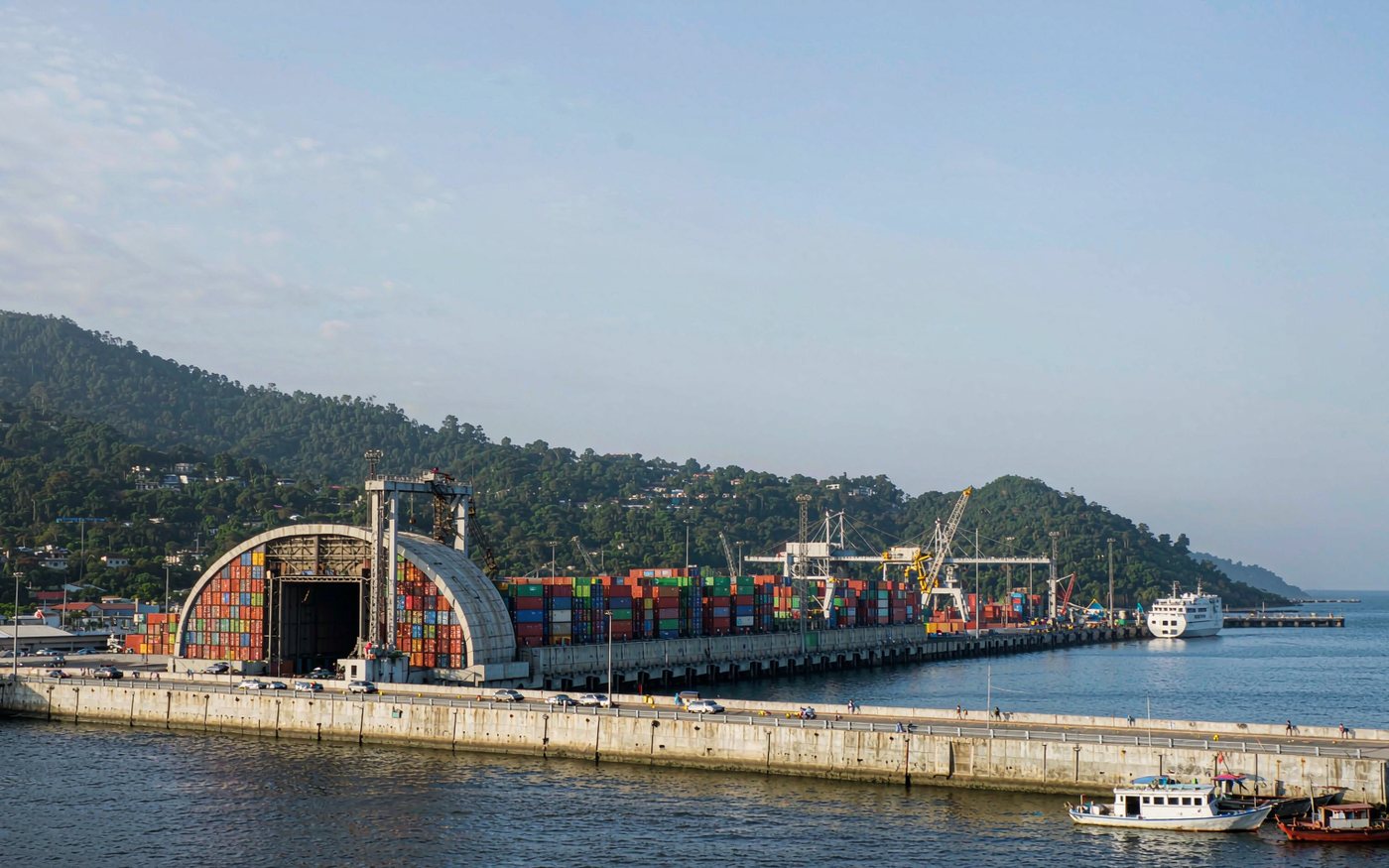
Almost all Sierra Leonean container cargo is discharged at the Queen Elizabeth II Quay in Freetown. It is the country's principal commercial berth, handling containers, general cargo and bulk, and it is where the customs clearance process is centred.
For a first-time importer, the useful thing to know is that this is a single-quay operation rather than a sprawling terminal with many alternatives. That has two consequences. First, your port choice is effectively made for you - there is no second container port to route around congestion. Second, when the quay is busy, everything is busy, so schedule buffers matter more than they would on a route with several terminal options.
Services from China are generally not direct. Cargo is usually transhipped through a regional or Mediterranean hub, or through a larger West African port, before the final leg to Freetown. That means your transit estimate has to include a connection, and it means the reliability of the connection matters as much as the reliability of the main service.
Ask your forwarder two questions at booking: which hub the cargo tranships through, and how frequently the final leg runs. Those answers tell you how much a documentation delay will actually cost you in calendar days.
Full containers versus consolidation into Sierra Leone
The consolidation-versus-full-container decision follows the same logic here as elsewhere, with one local twist. If your volume is below roughly 15 cubic metres, consolidation normally costs less, because you pay only for the space you use and you share the container's destination charges. Above that, a full container usually wins.
The local twist is that destination charges on West African routes are a large share of the total landed cost. Terminal handling, deconsolidation, documentation and delivery order are separate from the ocean freight, and a low freight rate paired with heavy destination charges is a bad deal. Always ask for the destination charges shown separately.
Consolidation also has a schedule consequence: your goods must reach the consolidator's warehouse in China by a cut-off, and the consolidation sails when it sails. Missing the cut-off usually means rolling to the next sailing rather than just a day's delay. Get the cut-off in writing and work backwards from it.
If you are importing regularly, revisit the decision once your volumes stabilise. The crossover point depends on the destination charges on your specific route, so ask for both options to be priced side by side rather than assuming a rule of thumb.
Air freight to Lungi and the road-and-ferry bridge to Freetown
Air cargo into Sierra Leone arrives at Lungi International Airport, which sits across the estuary from Freetown. That geography is the thing to plan around: the airport is not in the city, and getting goods from the airport into Freetown involves a road and water crossing.
That final transfer is a real cost and a real scheduling item, and it should be on your quotation rather than discovered on arrival. For small, urgent or high-value shipments it is worth it - the alternative is weeks of sea transit. For anything bulky, it is not.
Air also makes sense when the goods are tied to a deadline that sea cannot meet: spare parts for equipment that is down, medical supplies, tender samples, or goods for a project with a fixed commissioning date. Flight connections are limited, so cargo typically moves via a European, Gulf or regional hub.
For very small consignments, compare express courier against consolidated air freight. Courier is usually simpler door to door below roughly 100 kilograms; consolidated air freight tends to win above that.
Transit time to Sierra Leone and the transhipment factor
Sea transit from China to Freetown is typically measured in weeks, with the exact figure driven almost entirely by the transhipment routing. Any number you are given is an estimate for a specific service, not a promise, and you should treat the transhipment connection as the main source of variance.
The second source of variance is at destination. Port dwell, the time to file and process the declaration, and the availability of transport out of the quay all add days. The third is the rainy season, which runs roughly from May to October and can slow both port handling and inland road movement. If your shipment has a hard deadline, check which side of the rainy season it falls on.
The most controllable source of delay is yours: documentation. A declaration that cannot be filed because the invoice is inconsistent, or a valuation that customs wants to query, will hold a container longer than any congestion will. Prepare the document set while the vessel is still at sea.
Ask your forwarder for the carrier's free time for container use at destination and tell your consignee what it is. Demurrage and detention accrue daily once that window closes, and the usual cause is not port congestion - it is a consignee who did not know the clock had started.
National Revenue Authority clearance and the ASYCUDA entry
The National Revenue Authority administers customs, and declarations are lodged electronically through an ASYCUDA-based system. A licensed customs broker files the entry on your behalf. Your responsibility is to supply documents that agree with each other, because that is what the declaration is built from and what the officer checks.
The core set is the commercial invoice, the packing list, the bill of lading or air waybill, and the certificate of origin. The invoice should name buyer and seller, describe each item specifically, give quantities, unit and total prices, currency and the agreed trade terms, and ideally the HS code. The packing list must reconcile with it exactly on piece count, weight and dimensions.
Classification and valuation are where entries go wrong. A code copied from old supplier paperwork is often wrong for the product actually shipped, and the code is what sets your duty rate. A declared value well below what customs expects for that commodity invites a query, and a query invites an inspection. Confirm both before the goods leave China, and keep the payment records that support the declared value.
Regional advance cargo information systems have been adopted across West Africa in various forms, and requirements do change. Confirm at booking time whether any advance declaration or cargo tracking note applies to Sierra Leone on your sailing, and who is responsible for filing it.
The regional tariff bands and the GST a Freetown entry attracts
Sierra Leone is a member of the Economic Community of West African States and applies the community's common external tariff. That tariff is organised in bands rather than as a single rate, with bands including 0, 5, 10, 20 and 35 per cent depending on the product. In broad terms, essential goods, raw materials and capital equipment sit at the low end, and finished consumer goods at the high end.
Duty is assessed on the customs value, which is built up from the price paid or payable with the costs of bringing the goods in taken into account. Practically, budget as though duty is charged on a CIF-equivalent figure rather than on the factory invoice. That single adjustment is the difference between a landed cost that matches your plan and one that does not.
On top of duty, Sierra Leone applies a goods and services tax at 15 per cent, charged on the duty-inclusive value. Some goods are exempt or zero-rated, and there are concessionary arrangements in specific sectors. If you believe a relief applies to your import, establish that before shipping - reliefs generally require prior approval rather than a retrospective claim.
Worked simply: on a CIF-equivalent value of USD 12,000 with duty at 20 per cent, duty is USD 2,400, and GST at 15 per cent on USD 14,400 is USD 2,160. Your tax before port, handling, inspection and inland charges is USD 4,560. Do this calculation before you sign the purchase order.
The origin inspection a Freetown clearance depends on
Sierra Leone operates pre-shipment inspection for regulated imports. In plain terms, certain goods must be inspected and verified in the country of export before they ship, and the resulting certificate is required at clearance. Where this applies, it is an origin-side task - it happens in China, before the vessel sails.
The products usually in scope are the ones regulators worry about: electrical and electronic goods, chemicals, building materials, food and food-contact items, toys and products with safety implications. Ask early whether your commodity is covered, and who obtains the certificate.
The process typically involves submitting the commercial documents and any existing test reports, and may involve a physical inspection or sampling at the supplier's premises or at the consolidation warehouse. Build it into your production schedule, because it takes time and it cannot be done after departure.
The national standards body also has a role in conformity assessment, and goods arriving without the required documentation can be tested at destination instead - which is slower and more expensive than doing it at origin.
Prohibited and controlled goods on the Sierra Leone import list
Prohibited items follow the familiar pattern: narcotics, counterfeit goods, weapons and ammunition without authorisation, obscene material, and hazardous waste. Restricted and controlled categories are the ones that catch buyers out, because they look ordinary.
Food, medicines, supplements and cosmetics need health and regulatory documentation, and medicines in particular require registration or an import authorisation. Plants, seeds and animal products need agricultural and phytosanitary certificates. Telecommunications and radio equipment needs approval from the communications regulator. Equipment connected with mineral extraction or trading attracts additional documentation and scrutiny.
Wood packaging is a routine but genuinely costly trap. Pallets, crates and dunnage must meet the international phytosanitary standard and carry the corresponding mark. Non-compliant wood packaging can hold an entire consignment, and it is entirely avoidable with a single instruction to your supplier before production.
Because the controlled lists are sector-specific and change, give your broker your complete commodity list and ask for written confirmation of what is required. Doing this before the goods ship costs nothing; doing it after they arrive costs storage, inspection fees and delay.
Incoterms and payment terms for a Sierra Leone import
Under FOB, the seller loads the goods in China and you contract and pay for everything from there - ocean leg, destination handling, clearance and inland delivery. Under CIF to Freetown, the seller pays freight and insurance to the port, but risk still transfers at loading in China, which is a point many buyers misunderstand. Under DAP or DDP, the seller carries more, and DDP includes clearing the goods and paying Sierra Leonean duty and tax.
For a first-time importer, FOB with a forwarder who quotes the through move is usually the most transparent option. You see each cost, you choose who clears the goods, and you are not relying on your supplier's agent at destination. If a supplier offers DDP, ask who is named as the declarant, because that party carries the customs liability.
Agree currency and payment mechanics in writing and early. Freight is typically quoted in US dollars and local costs in leones. Banking and foreign exchange arrangements can take longer than buyers expect on West African routes, so confirm the transfer route with your bank and build the timing into your plan - a payment that lands late can become a demurrage bill.
Finally, make sure the trade term matches what you actually agreed commercially. A quotation for ocean freight only is not a quotation for delivery, and a surprising number of disputes on this route are really disputes about which costs were included.
Bonded warehousing and inland haulage beyond Freetown
If you are not ready to clear goods immediately, bonded warehousing lets you hold them under customs control without paying duty and tax first. Storage under bond is available for a defined period, and it is genuinely useful for importers bringing in stock they intend to sell over several months, because it defers the tax payment until the goods are actually entered for home use.
Ask for the bonded storage period and the charges in writing. Bonded storage is not free, and holding goods longer than the permitted period converts into a different set of problems.
For inland delivery, Freetown is the hub and the road network radiates from it to the provincial centres. Road conditions vary and deteriorate in the rainy season, so plan longer transit times and higher costs for upcountry deliveries between roughly May and October. Confirm the delivery point with your consignee before the truck is dispatched.
The inland leg should always be quoted as a separate line. A price to Freetown is not a price to Bo or Kenema, and the difference is often a larger share of the total than buyers expect.
Sierra Leone pitfalls that catch buyers on their first container
The most common is budgeting duty on the invoice value and tax on the goods' value. Duty is assessed on a customs value that includes the costs of getting the goods in, and GST is then charged on the duty-inclusive figure. Those two errors compound.
The second is leaving pre-shipment inspection too late. Where a certificate of inspection is required, it must be obtained before departure. Trying to fix it at destination is slower, more expensive, and sometimes impossible without difficulty.
The third is documentation inconsistency. A packing list that does not reconcile with the invoice, or a description too vague to classify, turns a routine clearance into an inspection and an amendment. Ask your supplier for draft documents and read them as a customs officer would.
The fourth is ignoring the free-time clock and the rainy season. Both are predictable, both are avoidable, and both cost money when they are not planned for.
Last, buyers accept ocean-freight-only quotations and then discover the destination charges. Always ask for an all-in figure to your consignee's door, with the components shown separately.
Why importers use Goodhope on this lane
Six things that are different about working with us on China to Sierra Leone shipments.
What we see to your door in Sierra Leone
Five shipments bought in China and delivered into Sierra Leone, told end to end — where the order came from, how it moved, where it nearly went wrong, and how it finished. Client names are withheld at their request; the situations and the handling are what we deal with on this lane.
The origin inspection · first container · Shenzhen to Freetown
The purchase. A buyer new to importing assumed clearance began when the container landed.
The move. Full container inspected before loading in China, with the report attached to the ASYCUDA declaration.
Where it nearly went wrong. A Freetown clearance depends on an inspection carried out at origin rather than on arrival. Without it the declaration does not progress, and the container is already in the port by the time anyone notices.
How it finished. We book the inspection with the freight. Every entry since has moved on arrival.
Bands, not one rate · costing · Ningbo to Freetown
The purchase. A first-time buyer applied a single duty rate across a mixed invoice.
The move. Consolidated cargo with each line placed in its regional tariff band before the order was confirmed.
Where it nearly went wrong. Duty runs in set bands under the regional common external tariff, and the difference between the bottom and the top of those bands is large. Averaging across an invoice produces a landed cost that is wrong in both directions at once.
How it finished. We rate line by line now. His budgets have matched the assessment every time.
Fifteen per cent · on top of duty · Guangzhou to Freetown
The purchase. A buyer quoted a price that covered duty but left the goods and services tax out of the calculation.
The move. Full container with duty and the fifteen per cent goods and services tax modelled together before quoting.
Where it nearly went wrong. The goods and services tax is assessed on the duty-inclusive base rather than on the invoice alone. Leaving it out understates the bill by more than the rate suggests, because it is charged on a figure that already includes duty.
How it finished. He models the two together now. No quote of his has come up short since.
The prohibited list · before booking · Yiwu to Freetown
The purchase. A buyer shipped a mixed consignment without checking the restricted goods list.
The move. Consolidated cargo screened against the prohibited and controlled lists before booking, with one line removed.
Where it nearly went wrong. There is a short list of goods that cannot be imported here, and a longer one that needs a permit. Finding either at the quay means the consignment stops as a whole rather than the one line that caused it.
How it finished. We screen the commodity list up front. Nothing of his has been held since.
Beyond Freetown · inland haulage · Shanghai to Sierra Leone
The purchase. A buyer quoted a delivery upcountry based on the port-to-door distance alone.
The move. Consolidated cargo with bonded storage and the inland leg arranged as part of the booking.
Where it nearly went wrong. Inland haulage outside the capital is a separate operation with its own timing and its own condition, and the road is not the constraint people expect. Quoting the distance as though it were the journey produces a date that slips.
How it finished. He books the inland leg with the freight. His upcountry customers get realistic dates.
Why importers use Goodhope on this lane
Six things that are different about working with us on China to Sierra Leone shipments.
Price a Sierra Leone shipment with the paperwork settled up front
Tell us the commodity, volume and the delivery town, and we will confirm inspection and permit requirements before you ship, quote the through move with destination charges shown separately, and give you a landed cost that includes duty, GST and inland delivery.
Get a quote Talk to usRelated pages
Frequently asked questions
Which port does cargo from China arrive at in Sierra Leone?
The Queen Elizabeth II Quay in Freetown handles almost all Sierra Leonean container traffic. There is no realistic alternative container port, so the practical choice is which service and transhipment routing to use rather than which port.
How long does sea freight take from China to Sierra Leone?
Transit is measured in weeks and depends mainly on the transhipment routing, since services are rarely direct. Port dwell, declaration processing and inland transport add further days, and the rainy season from roughly May to October can slow handling and road movement.
Should I ship FCL or LCL to Sierra Leone?
Below roughly 15 cubic metres, consolidation usually costs less. Above that, a full container usually wins. Ask for destination charges - terminal handling, deconsolidation, documentation and delivery order - separately, because on West African routes they are a large share of the total landed cost.
What duty rates apply to imports into Sierra Leone?
Sierra Leone applies the ECOWAS common external tariff, which is organised in bands including 0, 5, 10, 20 and 35 per cent depending on the product. Essential goods, raw materials and capital equipment generally sit at the low end. Your HS classification determines your band.
What tax applies on top of duty in Sierra Leone?
A goods and services tax of 15 per cent is charged on the duty-inclusive value. Some goods are exempt or zero-rated, and sector-specific reliefs exist but generally require approval before import rather than a retrospective claim.
Do I need pre-shipment inspection for Sierra Leone?
Regulated products often do. Electrical and electronic goods, chemicals, building materials, food-contact items and toys are commonly in scope, and the inspection and certificate are obtained in China before the goods sail. Confirm whether your commodity is covered at quotation stage, not after departure.
Is air freight to Sierra Leone practical?
Yes for urgent, high-value or small consignments. Cargo arrives at Lungi International Airport, across the estuary from Freetown, and the onward transfer by road and water into the city is a real cost and scheduling item that should appear on your quotation.
What documents does the National Revenue Authority expect?
A commercial invoice with a specific description, quantities, unit and total prices, currency and trade terms; a packing list reconciling exactly with it; the bill of lading or air waybill; and a certificate of origin. Wood packaging must meet the international phytosanitary standard.
Can I hold goods in bond before paying duty?
Yes, bonded warehousing allows goods to be stored under customs control with duty and tax deferred until they are entered for home use, subject to a permitted storage period. Ask for both the period and the charges in writing.
What is the biggest cost surprise on this route?
Destination charges that were never in the original quotation. Always ask for an all-in figure to your consignee's door with the components shown separately, and check whether any advance declaration or cargo tracking note applies to your sailing.