
Home / Shipping to Sint Maarten / How to Ship from China to Sint Maarten
How to Ship from China to Sint Maarten: the Free Port, Point Blanche & the French Side
Sint Maarten is the one destination in this region where the usual advice is inverted. On most islands, the risk at the border is the number: what the goods are worth, which rate applies, how the duty is calculated. Here, published guidance describes a free port in which the customs service is best understood as a border and enforcement agency rather than a tax office, and in which the only levy the island imposes on imports itself is an excise duty on unleaded gasoline.
That removes one problem and creates another. With little or no duty to assess, the argument about valuation largely disappears — and attention moves to what the cargo actually is. A manifest that says "machine parts" is a bigger liability in Philipsburg than an invoice that understates value, because the officer has no arithmetic to do and every reason to open the box.
The second thing, and the one that surprises people most, is that Sint Maarten is only half of an island. The northern side operates under an entirely separate customs and fiscal regime. The border between the two is famously open in practice, but for customs purposes crossing it is an event. Free port treatment on the Dutch side does not follow the goods across, and it does not follow them onto the next island either.
At a glance
Status: autonomous country within the Kingdom of the Netherlands; EU Overseas Country and Territory · Customs character: free port; the service acts as a border and enforcement agency, and the only import levy the island sets itself is excise on unleaded gasoline · No VAT; TOT turnover tax at 5% applies to business turnover, not to imports · Sea port: Point Blanche / Port St. Maarten, Philipsburg — the commercial port on the Dutch side · Airport: Princess Juliana International, SXM · Routing: transhipped, commonly via Caucedo, Kingston or San Juan · Currency: Caribbean guilder XCG, pegged to USD at 1:1.79 · Hurricane season: June to November · Note: the northern side of the island is a separate customs regime
How your cargo moves: China to Sint Maarten
Eight steps from your supplier's door to yours. The last four are the ones shaped by local rules.
- Pickup from your supplierWe collect the goods anywhere in China and bring them to our consolidation point.
- Export clearanceChina customs declaration filed and released before the goods move to the port.
- Loading and departureContainer loaded, sealed and handed to the carrier at the Chinese port.
- Main carriageOcean, air or rail movement booked on the route agreed for your cargo.
- Arrival at the gatewayDischarge at the port or airport of entry, recorded on the carrier's manifest.
- Import clearanceCustoms declaration filed locally, with duty and tax assessed on the declared value.
- Customs releaseGoods released into free circulation once duty and tax are settled.
- Final deliveryOnward movement to your delivery address, warehouse or nominated depot.
Duty rates, VAT rates and clearance times move, and the figure that applies to your goods is the one set for your commodity code on the day of clearance. We check the current position against your code before your goods sail and confirm it to you in writing — ask for that check when you request a quote.
On conflicting sources. You will find published material describing a Sint Maarten tariff of up to fifteen percent with a consumption-type tax on top. That sits directly against the free port description above, and we are not going to pretend to resolve it. What we will say is this: confirm the current treatment of your product with the Sint Maarten customs administration before you price or promise anything. On a lane where the honest answer may well be "nothing to pay", it would be a poor trade to lose the sale to a confidently quoted wrong number.
A free port in practice, where customs is a border agency
The phrase "free port" is used loosely in logistics, so it is worth being specific about what it means here.
A conventional customs administration has two jobs that pull in different directions: collecting revenue, and controlling the border. In Sint Maarten, published guidance describes the balance sitting firmly on the border control side. The customs service is characterised as an enforcement agency, and the only fiscal charge the island is described as levying on imports in its own right is an excise duty on unleaded gasoline.
What follows from that is worth spelling out, because it changes how you should prepare a shipment:
- The valuation dispute mostly goes away. If there is no ad valorem duty to calculate, the question "is this value correct?" is far less consequential than it is in a revenue-driven port.
- The description question gets bigger. What matters is whether the goods are what the documents say, whether they are permitted at all, and whether any licence applies.
- Enforcement attention is real. A border agency with no revenue target to hit has time to look inside containers. Prohibited and restricted goods, undeclared items and misdescribed cargo are what it is looking for.
- Do not read free port as no paperwork. The declaration still has to be filed, the manifest still has to be accurate, and the permits still have to exist.
The practical instruction to the factory. On this lane, spend the effort on the description rather than on the value. A commercial invoice that names the product, the model, the material, the intended use and the quantity — in English, matching the packing list and the manifest exactly — is worth more than any amount of discussion about declared value.
No general import duty, and one excise the island sets itself
The single fiscal charge most consistently attributed to Sint Maarten at the border is the excise duty on unleaded gasoline. Everything else that a shipper would think of as an import charge either does not apply or is not a border charge.
That distinction is the whole point of this section, and it is where most confusion comes from. There are taxes in Sint Maarten. They are simply not levied on the arriving container.
At the border
Published guidance: no general import duty, with the island's own excise on unleaded gasoline the exception. Confirm the current treatment for your product with customs rather than relying on a secondary source.
On the business
The TOT — belasting op bedrijfsomzetten, a tax on business turnover — is charged at five percent. It applies to the turnover of businesses established in Sint Maarten, not to goods arriving at the port.
Turnover tax is a business tax, not a border charge
This is the distinction that most often gets garbled in a quotation, so it is worth stating as plainly as possible.
The TOT at five percent is a tax on what a business earns in Sint Maarten. It lands on the buyer's annual or periodic return. It is not charged on the container when the container arrives, and it is not a sales tax added at the point of import in the way a VAT would be.
Which means: do not put it in the landed cost. If your buyer asks whether there is a five percent tax on their shipment, the accurate answer is that there is a five percent tax on their business, which is a different thing and a matter for their accountant. We will not add it to a freight quotation and we will not pretend it does not exist.
Point Blanche, the only commercial port on the Dutch side
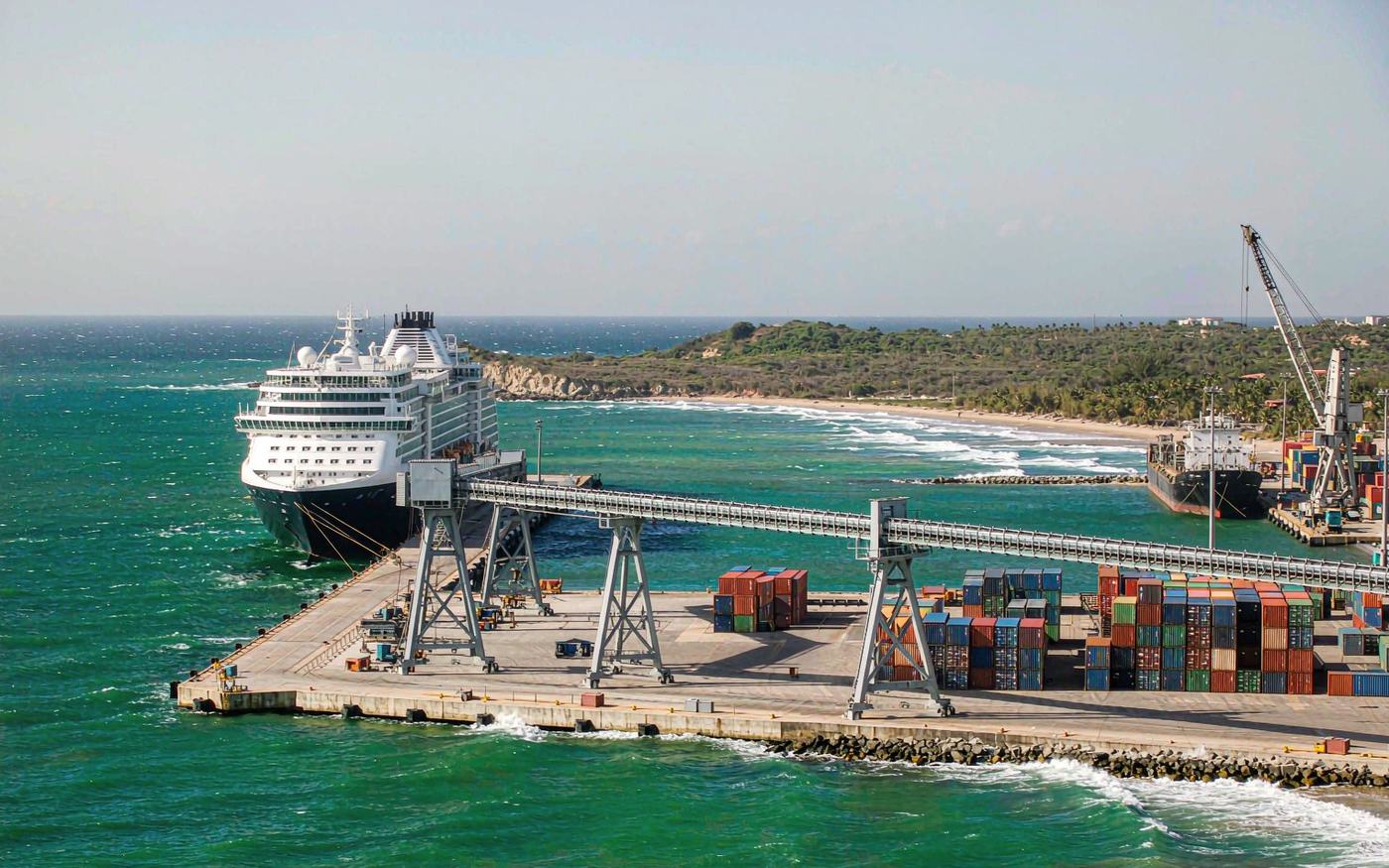
Freight into the Dutch side arrives at Point Blanche, the port at Philipsburg operated as Port St. Maarten. It handles containerised cargo, break-bulk and the cruise traffic the island is known for, and it is the practical point of entry for anything arriving by sea for the southern side.
Air freight arrives at Princess Juliana International Airport, SXM, one of the busier airports in the eastern Caribbean and well served by regional and intercontinental services. For urgent cargo, samples and spares, air into SXM is genuinely practical.
Almost nothing comes direct from China. Cargo is transhipped through a regional hub — Caucedo, Kingston and San Juan are the names that come up most often — and then brought down on a feeder. As on every small-island lane, the connection decides the arrival date, not the ocean leg.
Sint Maarten is not Saint-Martin, and the paperwork knows it
The island is shared. The southern side is Sint Maarten, an autonomous country within the Kingdom of the Netherlands and an EU Overseas Country and Territory. The northern side operates under a separate customs and tax regime. The two share a land border that people cross freely every day.
For a shipper, that everyday openness is a trap. What looks like a short drive across the island is, in customs terms, an entry into a different jurisdiction. Two consequences follow:
- State the delivery side in writing. "Philipsburg" and "Marigot" are not the same delivery. Name the side, name the town, name the consignee.
- Do not assume one clearance covers both. Goods entered on the Dutch side and then moved north have entered a second customs regime, with whatever that regime requires.
Crossing to the French side is a customs event. Plan it as one. If your buyer has a warehouse on one side and a shop on the other, that is two jurisdictions, not one island delivery, and it should be quoted and documented accordingly. Check the current requirements with a broker who works both sides.
Free port status does not travel with the goods
The second boundary that matters is not a land border but a shipping one. Sint Maarten's treatment applies to goods entered into Sint Maarten. It is not a portable status that a container carries onward.
If the cargo is transhipped through Philipsburg and then moved to a neighbouring island — Anguilla, Saint Barthélemy, Saba, St Eustatius, or anywhere else in the region — that island's own customs regime applies on arrival, with its own duty and its own taxes. The fact that the goods touched a free port on the way does nothing for them.
This matters because Sint Maarten is sometimes proposed as a regional distribution base on the strength of the free port. That can be a reasonable plan, but the economics depend entirely on the onward movements, not on the entry. Model each destination separately.
How cargo from China gets to Philipsburg
Order and description
Product named precisely, packing list drafted to match, permits checked. On a lane where the value question is minor and the description question is major, this is where the work goes.
Space and routing
Booked on a service that tranships through a regional hub, with the feeder connection confirmed rather than assumed. Name the hub in the quotation.
Packing
Export packing, ISPM 15 treatment and marking on any wood packaging, cartons marked by consignee and by delivery side.
China export clearance
Declaration filed, goods released. Documents complete before the truck is booked.
Transhipment
Handled at the hub. This is where most schedule slippage happens, and where tracking appears to stop.
Arrival at Point Blanche
Declaration filed, description checked, any licence or permit produced, examination if selected.
Release and delivery
Cargo released and moved to the consignee. If the delivery is on the northern side of the island, that movement is a separate customs matter and needs to have been planned.
Hurricane season and the rebuilding economy
The season runs June to November. The island sustained severe damage in 2017 and the reconstruction has been a sustained driver of demand for building material, roofing, fixtures, generators, marine equipment and hotel fit-out.
Two practical rules. Avoid scheduling critical arrivals into the peak where the schedule allows — and where it does not, build in the possibility that the hub closes rather than the island, because a feeder out of San Juan stops when San Juan is the problem. And if you are supplying the rebuild economy, book space earlier than the project plan suggests, because everyone else on the island is doing the same thing at the same time of year.
From a Chinese factory to a Philipsburg warehouse
| Stage | What happens | What decides it |
|---|---|---|
| Description fixed | Product named precisely on invoice, packing list and manifest | Doing it before packing, because this is what gets examined |
| Permit check | Confirm whether the product needs a licence or is restricted | Checking before the goods ship, not after they land |
| Routing | Transhipment hub named, feeder connection confirmed | The connection, not the ocean transit |
| Side confirmed | Dutch side or northern side stated in writing | Naming the town and the consignee, not just "the island" |
| China export clearance | Declaration filed, goods released | Documents complete before the truck is booked |
| Arrival | Declaration filed at Point Blanche, description verified | Accuracy of the paperwork |
| Release | Cargo released, moved to the consignee | Whether the delivery side was settled in advance |
The checklist before you quote a Sint Maarten buyer
- What exactly is the product? On this lane the description is the whole game.
- Has the current treatment been confirmed with customs? Published sources conflict; do not settle it by assumption.
- Which side of the island is the delivery? The northern side is a separate customs regime.
- Are the goods staying, or moving on? Free port treatment does not travel to the next island.
- Which transhipment hub? Commonly Caucedo, Kingston or San Juan. Name it.
- Is any permit or licence required? Check the product, not just the paperwork.
- Is the wood packaging ISPM 15 marked? Check before the container is sealed.
- Is the arrival inside hurricane season? Late summer arrivals need a plan B.
- Is the buyer asking about the 5% TOT? It is a business tax, not a charge on the container.
Why importers use Goodhope on this lane
Six things that are different about working with us on China to Sint Maarten shipments.
Straight cases to your door in Sint Maarten
Five shipments bought in China and delivered into Sint Maarten, told end to end — where the order came from, how it moved, where it nearly went wrong, and how it finished. Client names are withheld at their request; the situations and the handling are what we deal with on this lane.
Free port, but it does not travel · onward cargo · China to Philipsburg
The purchase. A buyer new to importing assumed that once goods entered the free port they could be sent on without further formality.
The move. Consolidated cargo entered at Point Blanche, with the onward movement declared separately before it left the island.
Where it nearly went wrong. The island sets no general import duty, and that is exactly why people assume the status follows the goods. It does not. The moment cargo moves on, the next jurisdiction applies its own rules and the saving evaporates.
How it finished. We declare the onward leg up front. Nothing of his has been reassessed since.
Turnover tax is not a border charge · costing · Shenzhen to Sint Maarten
The purchase. A first-time buyer added the island's five per cent turnover tax to his landed cost calculation.
The move. Consolidated cargo costed with no import duty and no turnover tax at the border, because that tax falls on business turnover rather than on imports.
Where it nearly went wrong. The turnover tax is a business tax rather than a border charge, and there is no import duty here at all. Adding both to a landed cost quote makes the shipment look more expensive than it is and loses you the order.
How it finished. He quotes the real border cost now. His prices became competitive immediately.
Two sides, two regimes · paperwork · Ningbo to Sint Maarten
The purchase. A buyer's documents named the island without specifying which side, and the entry was questioned.
The move. Consolidated cargo documented to the Dutch side specifically, with the port and the customs regime named on the paperwork.
Where it nearly went wrong. The island is split between two administrations and two customs regimes, and the paperwork knows the difference even when buyers do not. Naming the island without naming the side is leaving the entry to be decided by someone else.
How it finished. We name the side on every document now. No entry of his has been questioned since.
June to November · hurricane season · Guangzhou to Philipsburg
The purchase. A buyer scheduled a seasonal delivery into the storm window without a contingency.
The move. Consolidated cargo booked outside the window where timing allowed, and covered where it did not.
Where it nearly went wrong. Hurricane season runs from June to November, and on an island economy still rebuilding it closes ports and airports rather than slowing them. Planning into that window without a fallback is planning a conversation about a delay.
How it finished. He plans around the window now. His seasonal stock has arrived on time every year since.
Transhipped, not direct · routing · Shanghai to Sint Maarten
The purchase. A buyer quoted a direct transit and planned his reorder point around it.
The move. Consolidated cargo routed through a regional hub, with the connection booked together with the ocean leg.
Where it nearly went wrong. Cargo reaches the island through a regional hub rather than direct. Quoting a direct sailing is quoting a service that does not run, and the connection is where the real transit is decided.
How it finished. He plans against the connection now. His inventory has held ever since.
Why importers use Goodhope on this lane
Six things that are different about working with us on China to Sint Maarten shipments.
Confirm what the cargo is before you confirm the rate
Tell us what you are shipping, the packed dimensions and gross weight, the pickup city in China and the delivery address on the island. We will confirm the transhipment routing and the feeder connection into Point Blanche, quote the sea leg and the air alternative through SXM separately, flag any permit the product needs, check the wood packaging requirement with you, and tell you where the arrival sits against hurricane season. Where the question belongs to the Sint Maarten customs administration rather than to us — the treatment of your product, the requirements for moving goods to the northern side of the island — we will say so plainly rather than guess.
Get a quote Talk to usRelated pages
Frequently asked questions
Does Sint Maarten charge import duty?
Published guidance describes a free port where customs acts as a border and enforcement agency, with the only import levy the island sets itself being an excise on unleaded gasoline. Other sources describe a tariff of up to fifteen percent with a consumption tax. The sources conflict; confirm the treatment of your product with the customs administration before pricing.
What is the TOT?
Belasting op bedrijfsomzetten, a five percent tax on business turnover. It applies to the turnover of businesses established in Sint Maarten, not to goods arriving at the port, so it is not a border charge and does not belong in the landed cost of the container.
Is there VAT in Sint Maarten?
No VAT and no general sales tax on the Dutch side. The northern side of the island operates under a separate fiscal regime with its own rules, which is why moving goods across the island is a customs event.
Which port does cargo arrive at?
Point Blanche at Philipsburg, operated as Port St. Maarten, is the commercial port on the Dutch side. Princess Juliana International, SXM, handles air freight. Cargo is generally transhipped through a regional hub such as Caucedo, Kingston or San Juan.
Is Sint Maarten the same as Saint-Martin?
No. The island is divided, and the northern side operates under a separate customs and tax regime. The border is open in practice, but for customs purposes crossing it is an event that has to be planned and documented.
Does free port treatment apply if goods move on to another island?
No. The treatment attaches to goods entered into Sint Maarten. Re-export or transhipment to a neighbouring island means that island's own regime applies on arrival, with its own duty and tax.
What does customs focus on if there is no duty to assess?
What the cargo is. With no valuation argument to have, attention goes to description, licensing, prohibited and restricted goods and manifest accuracy. A vague description is a bigger liability here than an understated value.
When is hurricane season?
June to November, with the most active period in late summer and early autumn. Severe damage in 2017 means rebuilding demand for construction material and fixtures has been sustained ever since.
What currency does Sint Maarten use?
The Caribbean guilder, XCG, became the official currency at the end of March 2025, replacing the Netherlands Antillean guilder and pegged to the US dollar at 1:1.79. US dollars are very widely accepted.
Should the first shipment be FCL or LCL?
LCL is usually right for a first consignment, because cargo arrives transhipped and committing a full container to an indirect routing is unnecessary risk. Move to FCL once volume and timing are predictable, and use a broker who works both sides of the island.