
Home / Shipping to Slovenia / How to Ship from China to Slovenia
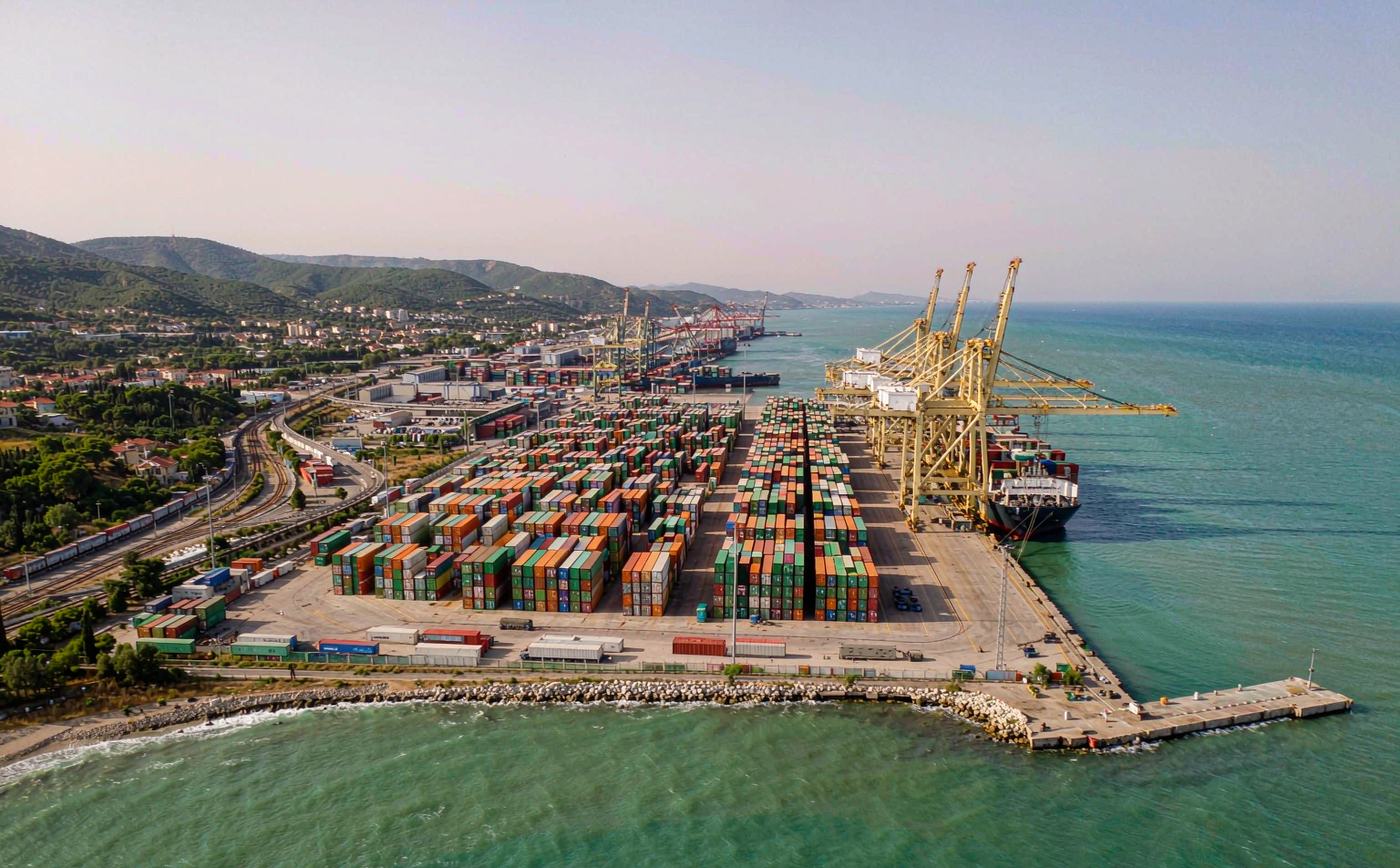
How to Ship from China to Slovenia: Port of Koper, 22% DDV & Onward EU Delivery
Slovenia is a country of about two million people with a port that moved 656,150 TEU in the first half of 2026 alone. That gap is the first thing to understand about this lane. Luka Koper is not a domestic port that happens to serve a small market; it is a northern Adriatic gateway whose real customers are the manufacturers and distributors of Austria, Hungary, Slovakia, Czechia, southern Germany and northern Italy.
The second thing is geographic luck. Every country bordering Slovenia — Italy, Austria, Hungary and Croatia — is in the European Union and in the Schengen area. There is no non-EU land border anywhere in the country. Once goods are in free circulation in Slovenia, moving them to Vienna, Budapest, Milan or Zagreb involves no customs procedure at all. That is unusual in this part of Europe, and it is the reason importers use Koper for cargo that never touches Slovenian soil for long.
The third is a decision most first-time importers do not know they are making: which country the goods are cleared in. Slovenia charges 22% VAT. Austria charges 20%. Hungary charges 27%. Croatia charges 25%. Since those countries are all within a few hours of the same quay, the clearance country is a genuine choice — and it has to be made before the vessel sails, not when the container lands.
Everything else is standard European Union. Slovenia joined in 2004, adopted the euro in 2007 and entered Schengen in the same year. Duty comes from the TARIC commodity code, there is no EU–China free trade agreement, and the same authority, FURS, handles both VAT and customs.
This guide is written for buyers importing from China for the first time. It covers why Koper serves Central Europe, the Far East services and the vessel sizes the port can take, the second railway track behind it, what the all-EU neighbourhood removes, the clearance-country decision, transit times by sea air and courier, trade terms, the documents FURS asks for, the 22% rate, VAT recovery and the fiscal representative rule, product compliance including the language question, the reporting obligations arriving in 2025 and 2028, and how to tell whether a forwarder genuinely books this lane.
Slovenia at a glance
- Koper is the only commercial port, and most of its containers belong to the hinterland rather than to Slovenia.
- Four regular Far East container services as of the first half of 2026, with a fifth berth being built out.
- Vessel size has a ceiling — Adriatic ports take ships up to roughly 16,000 TEU, not the largest ultra-large vessels.
- All four neighbours are EU and Schengen — onward movement needs no customs procedure.
- DDV is 22%, with 9.5% and 5% reduced rates. Austria next door charges 20%.
- No VAT registration threshold for foreign businesses, and non-EU businesses must appoint a fiscal representative.
- VAT ledgers have been filed electronically every month since 1 July 2025; B2B e-invoicing becomes mandatory on 1 January 2028.
- Clearance can happen inland — at Ljubljana, Maribor or Celje, not only at the port.
How your cargo moves: China to Slovenia
Eight steps from your supplier's door to yours. The last four are the ones shaped by local rules.
- Pickup from your supplierWe collect the goods anywhere in China and bring them to our consolidation point.
- Export clearanceChina customs declaration filed and released before the goods move to the port.
- Loading and departureContainer loaded, sealed and handed to the carrier at the Chinese port.
- Main carriageOcean, air or rail movement booked on the route agreed for your cargo.
- Arrival at the gatewayDischarge at the port or airport of entry, recorded on the carrier's manifest.
- Import clearanceCustoms declaration filed locally, with duty and tax assessed on the declared value.
- Customs releaseGoods released into free circulation once duty and tax are settled.
- Final deliveryOnward movement to your delivery address, warehouse or nominated depot.
Duty rates, VAT rates and clearance times move, and the figure that applies to your goods is the one set for your commodity code on the day of clearance. We check the current position against your code before your goods sail and confirm it to you in writing — ask for that check when you request a quote.
Koper is Slovenia's port, but most of its cargo is not Slovenian
The numbers make the point. In the first half of 2026, Luka Koper handled 656,150 TEU, up 5% on the same period of 2025, with total maritime throughput of 11.5 million tonnes, up 1%. Container traffic grew 12% across 2025 to around 1.2 million TEU and a further 9% year-on-year in the first quarter of 2026. Net sales revenue reached €206.1 million, up 10%, with net profit of €48.1 million, up 11%, and capital investment of €91.6 million — 70% more than the year before.
The port attributes the growth to manufacturing investment in its hinterland markets, particularly automotive and logistics, and it notes that imports of vehicles from China continue to grow steadily. That is the shape of this lane: goods arrive from Asia and leave by road and rail for factories and distribution centres in Central Europe.
One structural detail is worth knowing. Unlike Rijeka, where the container terminal is run by APM Terminals with a Croatian partner, and Trieste, where MSC has taken a major position, the Port of Koper has not leased its terminals to outside operators. The port authority retains control of terminal management and warehousing. For an importer that usually means a single point of contact and decisions about storage made by the port itself, rather than negotiated with a global terminal operator's commercial team.
And a practical one: Slovenia is small. No Slovenian delivery address is more than a short road journey from Koper, so the real question on any quote is not "which Slovenian city" but "which country after Koper". Get that right and the rest of the routing follows.
Four Far East services, and what the port can and cannot berth
During the first half of 2026 the port added another regular container service to the Far East, bringing the total to four. For an importer that matters because it means competing options and, usually, more than one sailing a week rather than a single service you have to fit around.
The Adriatic has a structural advantage on Asia–Europe transit: routing through the Suez Canal into the northern Adriatic is generally around seven to eight days shorter than discharging at a North Sea or Baltic port and moving the cargo overland. That is the reason Koper competes with Hamburg and Rotterdam for Central European cargo at all.
The honest limitation is vessel size. Because of water depth and hydrogeology, the Adriatic ports can handle container ships up to roughly 16,000 TEU rather than the 24,000 TEU ultra-large vessels that call at the biggest northern European and Mediterranean hubs. In practice this rarely affects a normal FCL or LCL shipment. It does matter if you have out-of-gauge cargo, a project shipment, or a booking that depends on a particular vessel class — ask before you commit.
Capacity is being added: the northern extension of Pier I will add 326 metres of coastline, two further container berths and seven hectares of space, with 63% of the planned piles already installed; Berth 12 on Pier II and a multi-purpose steel coil warehouse are due for completion this year. The port took delivery of four electric rubber-tyred gantry cranes from Konecranes in June 2026, replacing older diesel units, and added seventeen terminal tractors in 2025.
The Divača–Koper second track, and what it unlocks
If you ask what limits Koper, the answer is not the quay. It is the railway line to Divača, which has historically been a single track. A second track has been under construction, including the cutting of eight tunnels, at a project value of about €1.2 billion, of which €153 million comes from the EU's Connecting Europe Facility and €250 million from the European Investment Bank.
On completion, the capacity of that route is expected to rise from roughly 90 to 200 trains a day and from 14 million to 37 million tonnes a year, with reports pointing to completion around the first half of 2026 and the possibility of Koper handling up to 1.8 million TEU by 2027.
Koper already moves a high share of its containers by rail — around 47% — which compares with roughly half at Trieste and a much lower share at Rijeka before its new terminal opened. Rail is the reason the port works for Central Europe, and it is also the part most exposed to a bottleneck.
What this means for your booking: ask whether your cargo leaves Koper by rail or by road, and on which service. Rail slots behind the port are finite, and in busy weeks a truck may be the more predictable option. The second track is the reason to expect that to improve, but plan for today's capacity rather than tomorrow's.
Every country next to Slovenia is in the EU, and what that simplifies
This is the quiet advantage of clearing in Slovenia. Slovenia borders Italy, Austria, Hungary and Croatia — all four are EU member states and all four are in Schengen. There is no non-EU land border anywhere in the country.
Compare that with Croatia, which borders Serbia, Bosnia and Herzegovina and Montenegro, and where moving cargo onward often means a customs transit procedure and a border crossing. In Slovenia, once goods are released into free circulation, moving them to another member state involves no customs procedure at all. There is no T1 transit, no border declaration, no guarantee to post.
What does arise instead is VAT and statistics. If your Slovenian entity supplies the goods onward to a business customer in another member state and you hold their valid VAT number, that supply is zero-rated as an intra-EU supply. And if you move significant volumes across borders, you may fall into Intrastat reporting, which has its own annual thresholds. [Thresholds are revised periodically — confirm the current figures with FURS or your accountant.]
The practical consequence: Slovenia is a low-friction place to put goods into the EU. If your customer base spans Austria, Hungary and northern Italy, a single clearance at Koper followed by road and rail distribution is simpler than clearing separately in each country.
Clearing in Slovenia or next door, and the rate that decides it
Since Austria, Hungary, Italy and Croatia are all within a few hours of Koper, you can realistically choose where the goods enter free circulation. Three things should drive that choice.
| Clear in | Standard VAT | When it suits |
|---|---|---|
| Slovenia | 22% DDV | Your importer of record is Slovenian, or you want one clearance serving several markets |
| Austria | 20% | The lowest standard rate among the neighbours, so the smallest cash outlay at clearance — relevant if you cannot defer |
| Italy | 22% | The goods are going to northern Italy and your importer is Italian |
| Hungary | 27% | The highest in the EU — usually chosen only because that is where the importer is registered |
| Croatia | 25% | Same logic: importer location rather than rate |
The rate matters less than it looks if you are registered and recover the VAT through your return — but it matters a great deal for cash flow, because the money is out of your account from the day of clearance until the return is settled, and it matters entirely if you are not registered and cannot reclaim.
Two Slovenian specifics help here. First, postponed VAT accounting is permitted, so a registered business can declare import DDV in the return rather than pay it at clearance. Second, clearance does not have to happen at the port — Slovenia has inland customs offices, including Ljubljana, Maribor and Celje, so goods can move from Koper under transit and be cleared where your broker and your warehouse actually are.
The decision to write down before you book: who is the importer of record, in which country are the goods released into free circulation, and is clearance happening at the port or inland? Those three answers determine the VAT rate, whether transit paperwork is needed, and what the transport documents must say.
Sea, road and air into Slovenia, and when each one is right
| Mode | Typical transit | Ends at | Fits when |
|---|---|---|---|
| Sea FCL (20ft / 40ft / 40HQ) | About 28–40 days port to port to Koper, plus clearance and inland delivery | Port to port, or door to door if arranged | Repeat orders, and any cargo whose volume justifies a container |
| Sea LCL | The sea leg plus roughly 5–10 days for consolidation and deconsolidation | Container freight station at destination | First orders and a few cubic metres |
| Air freight | About 4–8 days door to door including the road leg from a hub | A hub airport, then road into Slovenia | Urgent, high value, or a line stopped for want of one part |
| Express courier | About 3–7 days door to door | Any Slovenian address | Samples, documents, small parcels |
| Sea plus rail or road onward | Sea leg plus a short inland move | Vienna, Graz, Budapest, Milan, Zagreb | Cargo whose real destination is another country |
One feature of air freight here is worth stating plainly: Ljubljana Jože Pučnik Airport is small and does not carry meaningful long-haul belly or freighter capacity from China. Air cargo for Slovenia normally flies into Vienna, Graz, Munich, Frankfurt, Milan or Trieste and completes the journey by road — which is short, because the country is small. When you compare air quotes, compare them on the same basis: airport to airport at the hub, or door to door including the road leg. Our air freight to Slovenia page sets out what we run.
Trade terms on an order that clears in Koper but sells in Vienna
| Term | Who pays the main carriage | Who clears and pays duty and DDV | What it means for you |
|---|---|---|---|
| EXW (Ex Works) | You, from the factory door | You | Most work; only sensible with an agent in China |
| FOB (Free On Board) | You | You, in the country of clearance | The usual choice when you want control and a clean DDV recovery |
| CIF (Cost Insurance Freight) | Seller, to Koper | You | Seller chooses the carrier; clearance, duty and VAT stay yours |
| DAP (Delivered At Place) | Seller, to the named place | You | Delivery handled, clearance still yours; check which destination charges are excluded |
| DDP (Delivered Duty Paid) | Seller | Seller or their agent | Least work — but in Slovenia a non-EU seller needs a fiscal representative, so ask who is actually the importer of record |
The layer that catches people on this lane is the mismatch between the port country and the selling country. If the goods discharge at Koper but your customer is in Austria, the contract needs to say whether the goods are released into free circulation in Slovenia or moved onward in customs transit and cleared in Austria. The two produce different VAT, different paperwork and different liabilities.
And the scope question, which is separate: port to port means the carrier's responsibility runs from load port to discharge port; airport to airport is the air equivalent; door to door adds pickup and final delivery. Goodhope works port to port on ocean freight and airport to airport on air freight, and says plainly which one you are buying.
The documents FURS asks for, and the numbers behind them
FURS — Finančna uprava Republike Slovenije, the Financial Administration — is unusual in handling both VAT and customs, which means one authority sees your import declaration and your VAT return. The paperwork itself is standard EU.
EORI
The customs identifier, needed by any business making a declaration in the EU and valid across all 27 member states once issued. Issued in Slovenia it carries an SI prefix. It is separate from a VAT number, and clearance cannot start without it.
SI VAT number
A Slovenian VAT number is SI followed by eight digits. It must appear on invoices and be verifiable in VIES before you zero-rate an intra-EU business supply. Registration is monthly or quarterly filing through the eDavki portal.
The document set:
- Commercial invoice — trade term, currency, commodity code, a specific product description rather than a generic phrase, quantity, unit and total value, country of origin, and the VAT numbers of both parties on a B2B sale.
- Packing list — piece count, net and gross weights, dimensions and packaging type.
- Bill of lading or air waybill, with consignee and notify party matching what your broker expects.
- EORI number of the importer of record.
- Certificate of origin where a preference is claimed.
- Conformity documentation — EU declaration of conformity, test reports and technical file for regulated products.
- Sector licences or permits for controlled categories: food contact materials, plant products, chemicals, pharmaceuticals, radio equipment.
Two practical points. Wood packaging must meet ISPM-15 and carry the stamp, or border inspection can reject the pallets. And because clearance can happen at an inland customs office, agree with your broker in advance where the declaration will be filed — at Koper, or at Ljubljana, Maribor or Celje — so the transport documents are set up to match.
DDV at 22 percent, with 9.5 and 5 below it
Slovenian VAT, DDV — davek na dodano vrednost — has a standard rate of 22%, unchanged since July 2013. The reduced rate of 9.5% covers food and non-alcoholic beverages, water, pharmaceutical products, hotel accommodation, passenger transport, books and periodicals, cultural and sporting events and certain labour-intensive services. A super-reduced rate of 5% has applied to books and newspapers in print and electronic form since January 2020. Drinks with added sugar or sweeteners moved to the standard 22% rate from January 2025.
Import DDV is calculated on the customs value, which is the CIF value plus the duty plus the cost of transport to the EU border — not on the invoice value alone. On a shipment with a CIF value of €10,000 attracting 4% duty, duty is €400 and DDV is 22% of the resulting customs value, a little over €2,290. Model the numbers before you set a selling price.
Two thresholds are gone. The €22 import VAT relief ended in 2021, so DDV is charged from the first euro. And the relief that exempted consignments at or below €150 from customs duty was removed EU-wide on 1 July 2026, replaced by a temporary flat charge of €3 per product category, running until 1 July 2028.
On registration: an established Slovenian business has a turnover threshold of €60,000, raised from €50,000 with effect from 1 January 2025. A business not established in Slovenia has no threshold at all — the first taxable supply triggers registration. Slovenia also introduced VAT grouping rules with effect from 1 January 2026.
Recovering import DDV, and the fiscal representative rule
For a business registered for Slovenian DDV, import VAT is a timing issue rather than a cost. The import is declared and the DDV deducted in the same periodic return, and where the return shows a surplus FURS refunds it within 21 days of the return being filed. Returns are monthly or quarterly depending on turnover, with the deadline the last working day of the month following the period, and the 20th of the month for intra-EU supplies and B2B reverse-charge services.
Postponed VAT accounting, which lets a registered business declare import DDV in the return instead of paying it at clearance, is permitted.
The part that catches non-EU businesses is registration. A non-EU company registering for Slovenian VAT must appoint a fiscal representative, and that representative is jointly and severally liable for the VAT. EU businesses importing without a Slovenian VAT number also need one. This is the single most important thing to check before agreeing to a DDP arrangement into Slovenia: whoever is the importer of record needs a route to registration, and if they cannot get one, the goods will not clear.
Recovery by non-established businesses is possible but subject to conditions, including reciprocity rules in some cases. If you plan to hold stock in Slovenia or sell there, get advice before the first container sails rather than after.
How the tariff code is decided, and what it changes besides duty
Your duty rate comes from the commodity code — the Combined Nomenclature code at EU level, extended in the TARIC database to carry trade measures. The same physical product can sit at 0% or 12% depending on how it is classified, and the classification is the importer's responsibility.
Beyond the rate, the code determines three things: whether an anti-dumping duty applies to goods of Chinese origin in that category — certain steel, aluminium, ceramics and bicycles among them; whether a licence, certificate or conformity assessment is required; and whether the goods fall under a product-specific regime such as excise. Confirming the code before the goods leave China is the cheapest risk-reduction step on this lane.
And the small-parcel change again, because it catches sample shipments: the €150 duty relief ended on 1 July 2026, so samples and e-commerce parcels now carry a flat €3 per product category until 1 July 2028, plus DDV at 22% regardless of value.
What your product needs sorted before it leaves China
Product compliance is not part of the freight, but it is the most common reason a perfectly good shipment cannot be sold after it arrives. Almost all of it has to be arranged in China, before loading.
| Product | What is needed | When |
|---|---|---|
| Electronics and electrical goods | CE marking with the EU declaration of conformity and technical file; EMC and low-voltage directives; RoHS substance restrictions; WEEE registration in the market where you sell | Before production finishes |
| Lithium batteries and battery-powered goods | UN38.3 test summary, dangerous goods declaration, class 9 labelling and packaging to IMDG or IATA standard; state-of-charge limits apply on air | Before booking — carriers need it to accept the cargo |
| Food contact materials | Declaration of compliance under the EU framework regulation, with migration testing where required | Before shipment |
| Machinery | CE marking, EU declaration of conformity, technical file, risk assessment, and instructions in Slovene for the Slovenian market | Before shipment — manuals are printed in China |
| Textiles | Fibre composition labelling, REACH restrictions on substances, care labelling | At labelling stage |
| Toys, cosmetics, PPE | Sector-specific conformity assessment, notified body involvement where required, responsible person in the EU | Well before shipment |
| Any cargo on wood pallets | ISPM-15 heat treatment or fumigation with the stamp visible | Before loading |
The language point is genuinely Slovenian. Slovene is the official language, and product information, labelling and instructions for goods sold to consumers in Slovenia are expected in Slovene. Printing manuals or applying labels is cheap in China and expensive after arrival, so raise it with your supplier at the order stage rather than at the clearance stage.
VAT ledgers since 2025, and e-invoicing from 2028
Slovenia has taken a slower, steadier path on e-invoicing than Croatia, and the difference is worth knowing if you sell into both.
Business-to-government e-invoicing has been mandatory since 2015, which made Slovenia one of the earliest adopters in the EU. Those invoices travel through Peppol, approved service providers, banking portals or the UJP eRačun platform. Business-to-business e-invoicing is currently voluntary, but that changes: from 1 January 2028 e-invoicing becomes generally mandatory for domestic B2B transactions, while B2C remains optional and subject to the buyer's agreement.
Separately, and more immediate: from 1 July 2025 businesses must submit VAT ledgers of issued and received invoices electronically to FURS every month, through the eDavki portal. That is a reporting obligation, not an invoicing one, but it means your Slovenian buyer needs complete, accurate invoices on a predictable schedule.
Cross-border transactions sit outside the current mandate, so your Chinese supplier's invoice to a Slovenian buyer is not required to be a structured e-invoice today. What matters now is that the commercial invoice is complete and arrives with the shipment, because it is the document customs values the goods on and the document your buyer reports.
A private buyer and a Slovenian company with an SI number
| Private individual | Registered Slovenian company | |
|---|---|---|
| Identifiers | A tax number for a genuine personal import; commercial quantities change the treatment | SI plus eight digits for VAT, plus an EORI number |
| Duty and DDV | Paid at clearance at whatever rate the goods attract | Paid at clearance, postponed, or declared and deducted in the return |
| Recovery | None — 22% is a real cost | Recovered as input tax, refunded within 21 days of a surplus return |
| Registration | Not applicable | €60,000 turnover threshold for established businesses; none for foreign businesses |
| Fiscal representative | Not applicable | Required for non-EU businesses |
| Reporting | None | Periodic DDV return; monthly VAT ledgers since July 2025; B2B e-invoicing from 2028 |
The line between the two is drawn by substance. An individual importing commercial quantities for resale is running a business, and FURS will treat it as one. Where a private buyer genuinely is buying for personal use, the paperwork is lighter and the 22% is simply a cost.
Finding a supplier when Slovenia is only the doorway
Because Slovenia is often a doorway rather than a market, the sourcing pattern tends to be different from a domestic-market import: fewer, larger consignments that are then split across several countries.
Finding suppliers online through B2B marketplaces is how most first orders happen. It is fast and broad, but you may be dealing with a trading company rather than the factory, specifications can drift between sample and production, and goods are often not ready when promised. The pattern that fits is: sample by courier, first real order by LCL, FCL once volumes justify it. Our pages on buying through Alibaba and 1688 and sourcing from 1688 cover the mechanics.
Meeting suppliers at trade fairs costs more and takes longer, but specifications tend to be right first time and the relationship survives a dispute. The pattern that fits is larger, less frequent orders.
Either way, consolidation in China is what makes the economics work when Slovenia is a doorway: several suppliers, one container, one set of documents, one clearance, then distribution onward. See our pages on warehousing and consolidated shipments.
Checks for a forwarder putting your cargo through Koper
Any forwarder can quote a Slovenia shipment. These questions separate the ones who book Koper from the ones who resell it, and none of them require industry knowledge to ask.
- Which Far East service, and does it call Koper directly? There are four regular services. Ask which one, and get the answer in writing.
- Is my vessel within the port's limits? Koper takes ships up to roughly 16,000 TEU. Relevant for out-of-gauge and project cargo, not for normal boxes.
- Rail or road out of Koper, on which service? Ask what happens if the rail slot is not available — the line behind the port has been the constraint.
- Where does clearance happen? At the port, or at an inland office in Ljubljana, Maribor or Celje? The transport documents have to match the answer.
- Are the destination charges itemised? Terminal handling, documentation, ISPS, delivery order and the inland leg should be listed separately rather than folded into one number.
- Who is the importer of record, and do they have a route to Slovenian VAT registration? For a non-EU business that means a fiscal representative. If the forwarder cannot answer, the clearance may not happen.
- For air, what is the chargeable weight, and which hub? Air is billed on the greater of actual and volumetric weight, and the road leg from Vienna, Munich or Milan should be stated.
Warning signs are consistent: a quote with no service name, no answer on how the cargo leaves the port, no clarity on the clearance country, and urgency without a sailing date attached.
From the factory to a Slovenian address, in order
Confirm the commodity code and the product compliance
Before you order. The code sets the duty rate; compliance sets what certificates and what language the documentation needs to be in.
Decide the clearance country and write the trade term down
Slovenia at 22%, or onward to Austria at 20% under a transit procedure. Put it in the contract, not in an email after booking.
Get the identifiers in place
EORI for the importer of record, an SI VAT number if clearing in Slovenia, and a fiscal representative if the importer is outside the EU.
Book space and name the service
Koper, and whether the vessel calls directly. Ask about rail versus road at the same time, not later.
Collect from the factory, or consolidate
Single supplier or several, the goods come to a China warehouse or port, are checked against the packing list, and are loaded.
China export clearance
Export declaration and release. Documents get a final check here, where a mismatch is cheap to fix.
Main carriage
Sea to Koper, roughly 28–40 days port to port, or air to a European hub followed by a short road leg.
Discharge at Koper and terminal handling
The container becomes subject to free time, and then demurrage and detention if it sits beyond it.
Declaration, duty and DDV
Filed electronically, at the port or at an inland customs office. Duty and 22% DDV are paid, postponed or accounted for in the return.
Release and inland movement
Rail or road to Ljubljana, Maribor, or onward to Vienna, Graz, Budapest, Milan or Zagreb.
Onward EU movement where it applies
No customs procedure is needed inside the EU. An intra-EU business supply is zero-rated against a valid VAT number, and Intrastat may apply above the thresholds.
Reporting closed out
Your buyer files monthly VAT ledgers through eDavki, so the commercial invoice needs to be complete and in their hands.
A first container into Koper, and the onward leg to Graz
Three illustrative shipments, drawn from how this lane actually behaves. They are examples, not client records.
A 40ft container of automotive components from Ningbo to a manufacturer in Graz. The importer was Austrian but chose to clear in Slovenia, because the broker was there and the goods were going to be distributed from a Slovenian warehouse to three countries. The container discharged at Koper, cleared, and moved by rail. The two things that needed deciding early were the clearance country and the onward Intra-EU supply documentation — the physical move was the easy part.
An LCL shipment of consumer electronics from Shenzhen to a retailer in Ljubljana. Three cubic metres, moved as LCL, with consolidation in China and deconsolidation at the destination station. What surprised the buyer was not the freight but the product side: manuals had been printed in English only, and for the Slovenian market they needed Slovene. Re-printing after arrival cost more than the sea freight. The lesson: sort labelling and language at the order stage.
Ninety kilograms of machine parts flown in for a plant in Maribor. There was no direct air option into Ljubljana, so the cargo flew to Vienna and continued by road — about four days door to door. The buyer had expected an "air freight to Slovenia" service to mean a flight to Ljubljana. The lesson is to compare quotes on the same basis: airport to airport at the hub, or door to door including the road leg.
What Goodhope does on the Slovenian side of your shipment
We are the China end of this lane, and being clear about where that ends is part of the service.
- Ocean freight port to port — FCL and LCL into Koper, with the service named and whether it calls directly stated in writing. See our FCL to Slovenia, LCL to Slovenia, Slovenia freight rates 2026 and Slovenia LCL rates 2026 pages.
- Air freight airport to airport — via the European hubs that actually serve Slovenia, with chargeable weight worked out before you book. See our air freight to Slovenia page.
- Consolidation in China — several suppliers, one container, one set of documents, one clearance, then distribution onward.
- Documents checked before sailing — commodity codes, descriptions and conformity paperwork, because that is where clearance problems start.
- We ask the clearance-country question early — if your goods are bound for Austria, Hungary or Italy, we will ask whether Slovenia is the clearance country or a transit country, because it changes the paperwork.
- Plain answers on what we do not do — Slovenian import clearance, DDV registration and accounting, the fiscal representative appointment and eDavki reporting belong to the importer of record or their representatives. We coordinate with them and we do not pretend otherwise.
Why importers use Goodhope on this lane
Six things that are different about working with us on China to Slovenia shipments.
Price a Slovenia shipment with the onward leg included
Send us the product and its commodity code if you have it, the carton count and total weight or volume, the supplier's city, and the final delivery address — including the country, if it is not Slovenia. We will name the service and whether it calls Koper directly, ask the clearance-country question before it becomes a problem, and itemise the destination charges so the 22% DDV line is not the thing you discover last.
Frequently asked questions
Which port should I use for shipping from China to Slovenia?
Koper is Slovenia's only commercial port and handles essentially all of the country's container traffic, so for a shipment from China it is the default answer. It is also the right answer for cargo bound for Austria, Hungary, Slovakia, Czechia, southern Germany and northern Italy, because the port sits on the shortest sea route from Asia to that hinterland. Trieste in Italy and Rijeka in Croatia are close alternatives within about an hour by road, and it is worth comparing them when your delivery address is nearer to one of them. Because Slovenia is small, no Slovenian destination is more than a short road journey from Koper, so the port choice is really a question about which country the goods go to next.
How long does shipping from China to Slovenia take?
Sea freight from Chinese ports to Koper is typically about 28 to 40 days port to port, with the Adriatic routing generally saving roughly a week against discharge at a North Sea or Baltic port, plus additional days for clearance and inland delivery. LCL adds about five to ten days for consolidation in China and deconsolidation at destination. Air freight has no bulk direct service into Ljubljana, so cargo normally flies to Vienna, Graz, Munich, Frankfurt, Milan or Trieste and continues by road, giving roughly four to eight days door to door depending on the connection. Express courier is about three to seven days door to door.
Do I have to clear customs in Slovenia if my customer is in Austria or Hungary?
No. You can clear the goods in Slovenia and then move them onward as EU goods with no further customs procedure, because every country bordering Slovenia is in the European Union, or you can move them from the port under a customs transit procedure and clear them in the destination country instead. The choice turns on where your importer of record is registered and which VAT rate you want to account for: Slovenia charges 22 percent, Austria 20 percent, Hungary 27 percent, Italy 22 percent and Croatia 25 percent. Decide before the vessel sails, because the transport documents and any transit procedure have to be set up to match.
What VAT rate applies to imports into Slovenia?
Slovenian VAT, DDV, has a standard rate of 22 percent, unchanged since July 2013, with a reduced rate of 9.5 percent for food, water, pharmaceutical products, books, hotel accommodation, passenger transport and cultural and sporting events, and a super-reduced rate of 5 percent for books and newspapers in print or electronic form since January 2020. Import DDV is charged on the customs value, which is the CIF value plus duty plus transport to the EU border, and it applies from the first euro. Confirm the rate for your specific product with a Slovenian tax adviser or your broker.
Is there still a duty-free threshold for small parcels from China?
No. The EU relief that exempted consignments valued at 150 euro or less from customs duty was removed from 1 July 2026 and replaced with a temporary flat charge of three euro per product category on consignments at or below that value, running until 1 July 2028. DDV was never dependent on a threshold and is charged regardless of value. If you send samples or e-commerce parcels by courier or post, budget for both.
Can I recover Slovenian import VAT, and do I need a fiscal representative?
A business registered for Slovenian DDV declares the import VAT and deducts it in the same periodic return, so the amount is recovered rather than lost, and a surplus is refunded by FURS within 21 days of the return being filed. Postponed VAT accounting, where import VAT is declared in the return instead of paid at clearance, is permitted, subject to conditions you should confirm with FURS or your adviser. The complication is registration: a business not established in Slovenia has no turnover threshold and must register from its first taxable supply, and non-EU businesses must appoint a fiscal representative, who is jointly and severally liable for the VAT. EU businesses importing without a Slovenian VAT number also need one. This is the main reason DDP into Slovenia needs checking carefully before you agree to it.
What documents does FURS require for import?
A commercial invoice showing the trade term, currency, commodity code, a specific product description rather than a generic phrase, country of origin and the VAT numbers of both parties on a business-to-business sale; a packing list with weights, dimensions and piece count; the bill of lading or air waybill; the importer's EORI number; a certificate of origin where a preference is claimed; and conformity documentation such as the EU declaration of conformity for regulated products. Wood pallets and crates must carry the ISPM-15 heat treatment stamp. Declarations are filed electronically, and Slovenia allows clearance at inland customs offices as well as at the port.
Does Slovenia require electronic invoicing?
Partly. Electronic invoicing has been mandatory for business-to-government transactions since 2015, when Slovenia was among the earliest EU adopters, and those invoices travel through Peppol, approved providers, banking portals or the UJP eRačun platform. Business-to-business e-invoicing is currently voluntary, but from 1 January 2028 it becomes generally mandatory for domestic B2B transactions, while business-to-consumer e-invoicing remains optional. Separately, from 1 July 2025 businesses must submit VAT ledgers of issued and received invoices electronically to FURS every month through the eDavki portal. Cross-border transactions are outside the current mandate, so your Chinese supplier's invoice is not affected today, but your Slovenian buyer needs a complete invoice promptly to meet their own reporting.
What language must product labels and manuals be in?
For goods sold to consumers in Slovenia, product information, labelling and instructions are expected in Slovene, which is the official language. This is a product compliance requirement rather than a shipping one, but it is far cheaper to arrange in China before the goods are packed than to re-label after arrival. If the goods are moving onward to Austria, Germany or Hungary and are sold there, the destination country's language requirement applies instead. Confirm the exact requirement for your product category with your Slovenian distributor.
What does a Chinese freight forwarder handle on a Slovenian shipment?
On the China side a forwarder collects goods from the factory or factories, consolidates them if needed, clears them for export, books space and issues the bill of lading or air waybill, and provides tracking. Goodhope works port to port on ocean freight and airport to airport on air freight, names the service and whether it calls Koper directly, and coordinates with your broker on the Slovenian side. Slovenian import clearance, DDV registration and accounting, and the onward movement into Austria, Hungary or Italy belong to the importer of record or their representative. Where a non-EU business needs a fiscal representative, we will flag it early rather than after the cargo lands.