
Home / Shipping to Sri Lanka / How to Ship from China to Sri Lanka
How to Ship from China to Sri Lanka: Colombo, the CusDec & the Levy Stack
The one procedural fact that decides whether a Sri Lankan import goes smoothly is this: the customs declaration cannot be filed until the goods have arrived and the delivery order has been issued. The CusDec is lodged through ASYCUDA World by a licensed customs house agent, and the system will not accept it before arrival. So every approval your product needs — inspection certification, telecom type approval, medical registration — has to be finished before the vessel berths, not begun after it.
The second thing to understand is the levy stack. Sri Lanka charges customs duty at zero, ten or fifteen percent of CIF value depending on the category, and then adds a Ports and Airports Development Levy, an EDB cess, the Social Security Contribution Levy at 2.5 percent, and finally VAT at 18 percent — which was raised from 15 percent at the start of 2024 and is applied to the cumulative base of CIF plus all duties and levies. An 18 percent VAT on a base that is already inflated by three other charges is not an 18 percent tax.
The third is product approvals. Sri Lanka runs a mandatory inspection scheme covering around 122 product categories, a type approval regime for anything with a radio in it, and a registration regime for medical devices and pharmaceuticals. If your product is on one of those lists and the approval is not in hand when the ship berths, the container waits.
At a glance
Country: an island nation in the Indian Ocean south of India; commercial capital Colombo; a SAARC, SAFTA, APTA and BIMSTEC member. · Currency: the Sri Lankan rupee. · Duty: 0, 10 or 15 percent of CIF value by product category. · VAT: 18 percent, raised from 15 percent on 1 January 2024, applied to CIF plus duty, cess, PAL and applicable excise. · SSCL: 2.5 percent, on CIF plus duty, cess and PAL but not on VAT. · Also: Ports and Airports Development Levy, EDB cess, and excise on some categories. · Preference: commonly cited arrangements cover India, Pakistan, Singapore, Thailand and SAFTA partners rather than China — budget standard rates. · Customs: Sri Lanka Customs, declarations through ASYCUDA World by a licensed customs house agent. · Ports: Colombo (main transshipment hub), Hambantota, Galle, Trincomalee. · Airport: Bandaranaike International at Katunayake. · Clearance: 2 to 5 business days for clean non-regulated cargo; 5 to 10 where licences and SLSI inspection apply. · Free storage: short, commonly about seven days — confirm with the terminal. · Verify rates, cess levels and free time with your agent before you book.
How your cargo moves: China to Sri Lanka
Eight steps from your supplier's door to yours. The last four are the ones shaped by local rules.
- Pickup from your supplierWe collect the goods anywhere in China and bring them to our consolidation point.
- Export clearanceChina customs declaration filed and released before the goods move to the port.
- Loading and departureContainer loaded, sealed and handed to the carrier at the Chinese port.
- Main carriageOcean, air or rail movement booked on the route agreed for your cargo.
- Arrival at the gatewayDischarge at the port or airport of entry, recorded on the carrier's manifest.
- Import clearanceCustoms declaration filed locally, with duty and tax assessed on the declared value.
- Customs releaseGoods released into free circulation once duty and tax are settled.
- Final deliveryOnward movement to your delivery address, warehouse or nominated depot.
Duty rates, VAT rates and clearance times move, and the figure that applies to your goods is the one set for your commodity code on the day of clearance. We check the current position against your code before your goods sail and confirm it to you in writing — ask for that check when you request a quote.
Colombo, and the other three ports you may hear about
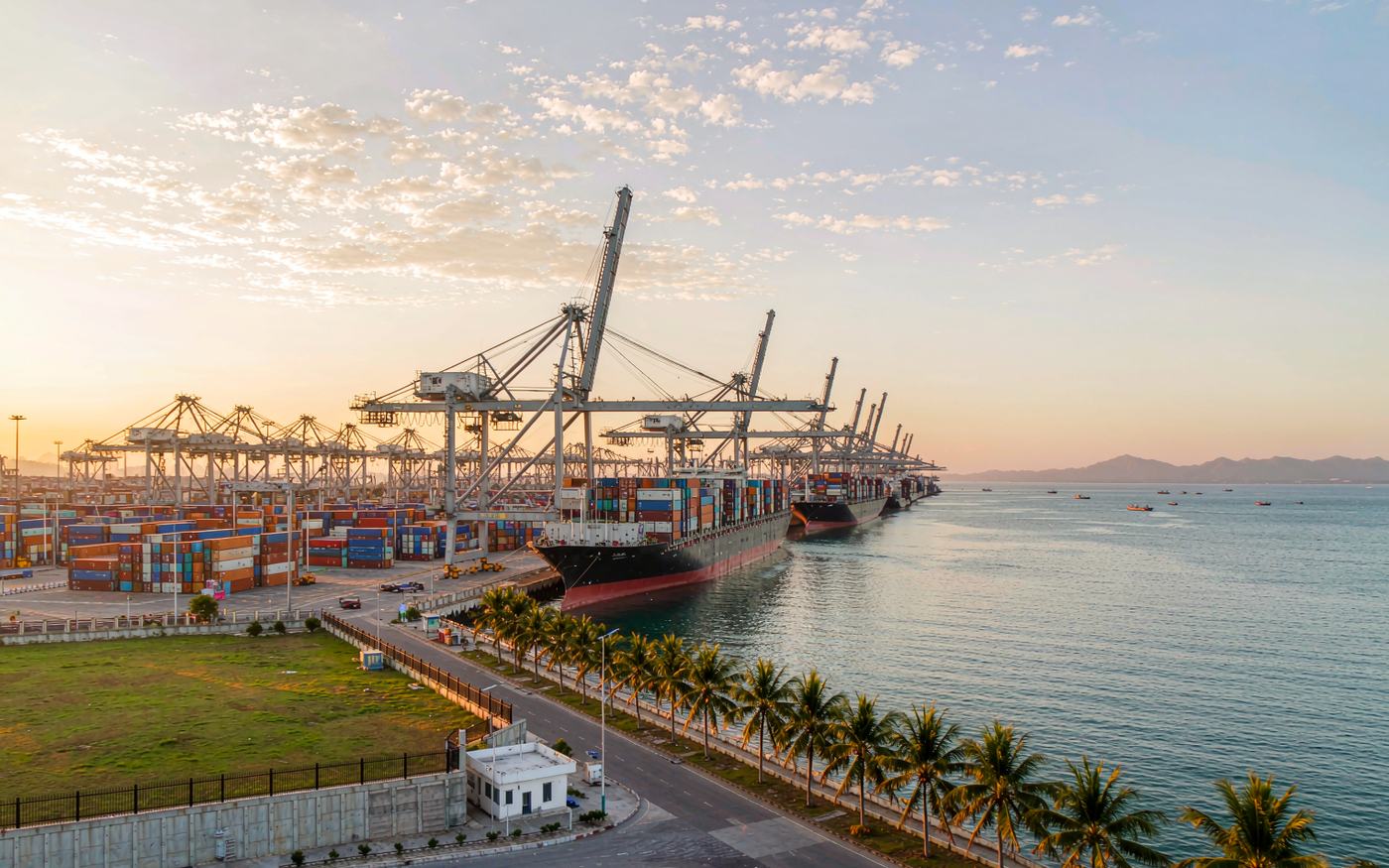
Colombo is where your container will almost certainly go, and it is worth knowing why: it is one of South Asia's leading transshipment hubs, handling well over eight million TEU a year across its terminals. That scale is the reason services from China call directly rather than feeding cargo in from Singapore, and direct calls are what keep your transit time predictable.
The other three ports appear in quotes and in routing discussions, and each has a narrower role. Hambantota on the south coast handles some container and bulk traffic. Galle and Trincomalee serve specific trades and regional needs. For a first-time importer they are worth knowing as names so you can ask why a quote routes through one of them, but the default answer should be Colombo unless there is a reason.
Air freight arrives at Bandaranaike International Airport at Katunayake, north of Colombo. It is the fastest clearance point in the country and the right choice for samples, urgent spares, and anything whose value per kilo justifies the rate. It is also the sensible way to run a first test shipment before committing a container to the sea lane.
Why the declaration waits until the ship berths
This is the part of Sri Lankan procedure that surprises importers who have shipped elsewhere in Asia, where pre-arrival filing is normal.
The CusDec is the customs goods declaration. It is lodged through ASYCUDA World, and it can only be submitted by a licensed customs house agent — commercial importers must be registered in ASYCUDA, and there is no route for a foreign supplier or an unregistered buyer to file directly. Critically, the CusDec cannot be lodged until the goods have arrived and the delivery order has been issued by the shipping line.
What that means in practice: the clock on your clearance starts when the ship berths, and it runs while you finish whatever was not finished. That inverts the usual advice about preparing documents during transit — on this lane, documents and approvals have to be complete before transit ends, because there is no pre-arrival filing to buy you time.
The knock-on effect is on the seven-day free storage window at the port. Because you cannot file early, and because free time is short, an approval that takes three more days is three days of demurrage. This is why the product approval question — the next section — belongs at the top of your planning, not at the bottom.
The levy stack behind an 18 per cent VAT
The charges apply in a statutory order, and each one moves the base for the next.
| Order | Charge | Charged on |
|---|---|---|
| 1 | Customs duty | CIF value, at 0, 10 or 15 percent by category |
| 2 | EDB cess | CIF value; the rate is set by gazette and moves more often than the duty bands do |
| 3 | Ports and Airports Development Levy (PAL) | CIF value |
| 4 | Social Security Contribution Levy (SSCL) | 2.5 percent, on CIF plus duty, cess and PAL — but not on VAT |
| 5 | VAT | 18 percent, on the cumulative base of CIF plus all duties and levies |
A worked illustration, using the rates a published calculator applies to finished furniture: at a CIF value of US$10,000 with duty at 20 percent for a protected finished-goods line, cess at 15 percent and PAL at 10 percent, duty is US$2,000, cess US$1,500 and PAL US$1,000. The SSCL base is then US$14,500, giving US$363. The VAT base is US$14,863, and VAT at 18 percent is about US$2,675. Total tax is roughly US$7,538 against a CIF value of US$10,000 — over 75 percent — in that specific worked example.
That example is deliberately the punitive end of the range: it is a finished consumer durable that competes with local manufacture, and it carries a protective stack rather than the zero band raw materials sit in. The point is not that every import pays 75 percent. The point is that the rate banding alone tells you almost nothing, because the cess and the cumulative VAT base do most of the work. Model the stack, not the duty rate.
Getting the certifications before the container sails
Three approval regimes account for most of the delays on this lane, and they share one feature: they take longer than the voyage.
- SLSI inspection. The Sri Lanka Standards Institution runs a mandatory inspection scheme covering around 122 product categories under Gazette 2064/34 of 2018, including household electrical items, building materials and food products. Goods on the scheme need SLSI-accepted certification before customs release. Without it, consignments are sampled and tested at the port, which is where a five-day clearance becomes a ten-day one.
- TRCSL type approval. Mandatory for radio and telecommunications equipment before import, marketing or use — mobile phones, wireless routers, fixed network terminals, satellite devices and data modems. The approval has to be held by a Sri Lankan entity, standard processing is quoted at four to six weeks, and TRCSL issues two customs no-objection letters on approval. Without those letters, goods cannot be released at customs. This is the one that most often surprises electronics importers.
- NMRA registration. Required before medical devices or pharmaceuticals can be imported or commercialised, with a locally appointed marketing authorisation holder named on the approval. Full registration takes a minimum of around six months, and end to end from site approval to import licence is commonly quoted at many months more.
Beyond these three, an import control licence from the relevant trade control authority applies to restricted categories including vehicles, dangerous goods and pharmaceuticals. The consistent pattern in published guidance is that missing approvals are the named cause of delay — not the goods, not the vessel, not the port.
Sea freight versus air into Bandaranaike
Sea into Colombo
The default for anything bulky, heavy or planned. Colombo's transshipment scale means direct services from Chinese ports are available rather than exceptional, which is the thing to confirm when you book. Best for furniture, building materials, machinery, raw materials and stock that is being replenished rather than rescued. Remember that free storage is short and the CusDec cannot be filed early — sea gives you the voyage to prepare in, and you should use all of it.
Air into Bandaranaike
The right answer whenever the approval clock is the binding constraint rather than the freight cost, and for anything with high value per kilo. It is also the fastest clearance route in the country. A sensible pattern for a first import is to air-freight a small quantity first, learn what the classification and the approvals actually require, and then commit the container.
On terms: FOB a Chinese port leaves you controlling the main carriage. CIF Colombo has the supplier paying freight and insurance to the port, but clearance, the levy stack and inland delivery are still yours — and the CusDec still needs your registered importer and your licensed agent. DDP to a Sri Lankan address requires whoever promises it to control the ASYCUDA filing, the product approvals and the tax payment, all of which run through locally registered parties; ask who, specifically, before relying on it.
Port to port and airport to airport both stop at the terminal. Neither includes clearance, levies or the final truck.
What a first-time importer needs registered in Sri Lanka
Commercial importing runs through a Sri Lankan entity registered with Sri Lanka Customs in ASYCUDA. There is no mechanism for a foreign supplier to consign goods to an individual contact and have them released, and this is worth settling before the first order rather than at the port.
Alongside the customs registration, two other structural choices come up. Where the importer will be re-selling and recovering input VAT, a Sri Lankan subsidiary or distributor registered for VAT is the normal structure, with registration thresholds set by turnover. Where the operation is export-oriented manufacturing, BOI registration can provide materially different treatment, and a bonded warehouse arrangement can defer the combined liability rather than paying it at clearance. Those are structural decisions for your tax adviser, not for your forwarder — but they change the landed cost model enough that they belong in the conversation before you commit to a volume.
One compliance detail worth knowing if you go the subsidiary route: the customs goods declaration number should be referenced on the outward tax invoice, because that is what links the customs record to the VAT return. Reconciling the two is one of the things that gets audited.
Free storage runs out faster than you think
Because the CusDec cannot be filed before arrival, the free storage window at the port is effectively your entire administrative budget. Published figures commonly put it at about seven days at Colombo, after which demurrage and storage accrue daily.
Three things protect that window. Approvals finished before sailing — SLSI, TRCSL, NMRA, import control licence, as applicable. A complete, internally consistent document set, because a mismatch between invoice, packing list and bill of entry is what triggers a query that consumes the window. And a customs house agent who has the file before the vessel arrives, so the CusDec can be lodged the same day the delivery order is issued.
The fourth is less obvious: pre-book inland transport. A container released from the port still has to be moved, and the truck is not always available the day you want it. Published guidance for this trade notes the same point in the context of vehicle imports — arrange the inland leg before the container is released, not after.
Three shipments into Colombo, three outcomes
These are illustrative composite examples, not specific client shipments, and they are here to show the mechanism rather than to promise a result.
Wireless routers, held at the port
A first-time importer shipped a consignment of wireless networking equipment without TRCSL type approval. The goods arrived, the delivery order was issued, and the CusDec could not be completed because the two no-objection letters did not exist. The container sat through its free time and into demurrage while an approval process quoted at four to six weeks was started from scratch.
Building materials, cleared in three days
The same port, a different outcome. The importer's agent confirmed the HS code and the duty band before the goods sailed, held SLSI-accepted certification for a product on the mandatory scheme, and had the complete file ready. The CusDec went in the day the delivery order was issued and the container was released well inside the free window.
A sample by air, then a container by sea
A buyer air-freighted a small quantity to Bandaranaike first. The clearance revealed that the product sat on the SLSI scheme and needed certification the supplier had never mentioned. The certification was obtained, and the subsequent sea container cleared without incident — at a cost far below the demurrage the first scenario incurred.
Choosing a customs house agent and a Chinese forwarder
You need both, and the division of labour is clean. The Chinese forwarder consolidates, handles export declaration, books the sailing, and issues the documents that must originate in China — the certificate of origin above all. The Sri Lankan customs house agent holds the ASYCUDA access, lodges the CusDec, responds to assessment queries and obtains release. Neither substitutes for the other, and what you are buying in each case is a freight forwarder: the party that coordinates carriers, terminals and authorities and owns the timeline. Not a shipping line, not a trucking company, not a warehouse.
What to ask before you commit:
- Is my product on the SLSI mandatory scheme, and is certification in hand? A good agent checks the gazette list against your HS code before the goods sail.
- Does it need TRCSL type approval, and who holds it? It must be a Sri Lankan entity, and the two no-objection letters are what release the goods.
- What is the cess rate for my HS code this quarter? The cess moves by gazette more often than the duty bands do, and an agent who works your category will know the current number.
- Give me duty, PAL, cess, SSCL and VAT as separate lines. If they arrive collapsed into one figure, you cannot check the arithmetic or model a change.
- How many days of free storage at this terminal, and when does the delivery order issue? The answer tells you whether they have thought about the filing window.
- Who is the registered importer? If they cannot answer, the file is not ready.
Why importers use Goodhope on this lane
Six things that are different about working with us on China to Sri Lanka shipments.
Check the approvals before you book the container
Tell us what you are shipping, the HS codes if you have them, the packed dimensions and gross weight, the pickup city in China and the delivery address in Sri Lanka. We will tell you whether your product sits on the SLSI, TRCSL or NMRA lists and what that means for the timeline, prepare the certificate of origin in China before the goods sail, and set out duty, PAL, cess, SSCL and VAT as separate lines so you can see the real landed cost. If an approval has to be obtained, we will say so before you commit rather than after the vessel berths.
Get a quote Talk to usRelated pages
Frequently asked questions
Why can't the declaration be filed before arrival?
The CusDec cannot be lodged until the goods have arrived and the delivery order is issued. Every approval therefore has to be finished before the vessel berths.
What taxes and levies apply?
Duty at 0, 10 or 15 percent of CIF, plus PAL and the EDB cess, plus SSCL at 2.5 percent, plus VAT at 18 percent on the cumulative base of CIF plus all duties and levies.
Do I need a customs house agent?
Yes. All commercial importers must be registered in ASYCUDA and all declarations must be filed by a licensed customs house agent.
What are SLSI, TRCSL and NMRA?
SLSI runs a mandatory inspection scheme over around 122 categories. TRCSL type approval is required for telecom equipment and issues the no-objection letters that release goods. NMRA registration is required for medical devices and pharmaceuticals.
Do Chinese goods get preferential duty?
Plan on standard rates. Cited preferences cover India, Pakistan, Singapore, Thailand and SAFTA partners rather than China. Verify at HS code level before pricing.
Which port does cargo arrive at?
Colombo, the main gateway and a leading transshipment hub. Hambantota, Galle and Trincomalee also handle cargo. Air goes to Bandaranaike International at Katunayake.
How long does clearance take?
Two to five business days for clean non-regulated cargo, five to ten where an import control licence and SLSI inspection apply. Missing approvals are the usual cause of delay.
How much free storage do I get?
Commonly about seven days at Colombo, after which demurrage accrues daily. Confirm the current figure with the terminal.
What documents are required?
Commercial invoice, packing list, bill of lading or airway bill, the CusDec filed through ASYCUDA World, a certificate of origin, an import licence where required, and product approvals such as SLSI certification or TRCSL no-objection letters.
Can an individual import commercially?
Not without a Sri Lankan entity registered with Sri Lanka Customs in ASYCUDA and a licensed agent filing the declaration. Small personal parcels clear through separate channels.