
Home / Shipping to Sudan / How to Ship from China to Sudan
How to Ship from China to Sudan
Note on scope. This page is an operational logistics guide only. It describes how cargo is moved and cleared, and it takes no position on political or constitutional questions. Sudan has been affected by armed conflict since April 2023, which has at times disrupted port, airport, banking and inland transport operations - readers must verify the current operating and security situation, and the applicable sanctions and export control position in their own jurisdiction, before shipping. Requirements change frequently; confirm every point with your broker at the time of booking.
Sudan is a documentation-heavy destination. The port is essentially a single one, the customs system is electronic but still substantially paper-supported, and the goods cannot be cleared without an inspection certificate obtained before the cargo ever leaves China. For a first-time importer, the practical work is front-loaded: almost everything that goes wrong on this route goes wrong before departure, not after arrival.
This guide covers the port routing, container and break-bulk choices, air options, transit times, the advance declaration and inspection requirements, how duty and VAT are calculated, the sector permits that apply to regulated goods, foreign exchange and payment evidence, and how to manage free time and storage at the port. We do not publish freight rates here; the aim is to give you the structure to plan a shipment and read a quotation properly.
At a glance
Main gateway: Port Sudan on the Red Sea, handling the large majority of national trade. Customs: ASYCUDA World, with advance cargo declaration before arrival. Mandatory before shipment: SSMO certificate of inspection from an authorised agency. Also required: import licence and IM form. Duty: 5 to 25 per cent in most cases. VAT: 17 per cent.
How your cargo moves: China to Sudan
Eight steps from your supplier's door to yours. The last four are the ones shaped by local rules.
- Pickup from your supplierWe collect the goods anywhere in China and bring them to our consolidation point.
- Export clearanceChina customs declaration filed and released before the goods move to the port.
- Loading and departureContainer loaded, sealed and handed to the carrier at the Chinese port.
- Main carriageOcean, air or rail movement booked on the route agreed for your cargo.
- Arrival at the gatewayDischarge at the port or airport of entry, recorded on the carrier's manifest.
- Import clearanceCustoms declaration filed locally, with duty and tax assessed on the declared value.
- Customs releaseGoods released into free circulation once duty and tax are settled.
- Final deliveryOnward movement to your delivery address, warehouse or nominated depot.
Duty rates, VAT rates and clearance times move, and the figure that applies to your goods is the one set for your commodity code on the day of clearance. We check the current position against your code before your goods sail and confirm it to you in writing — ask for that check when you request a quote.
Port Sudan handles most cargo: what that means for your booking
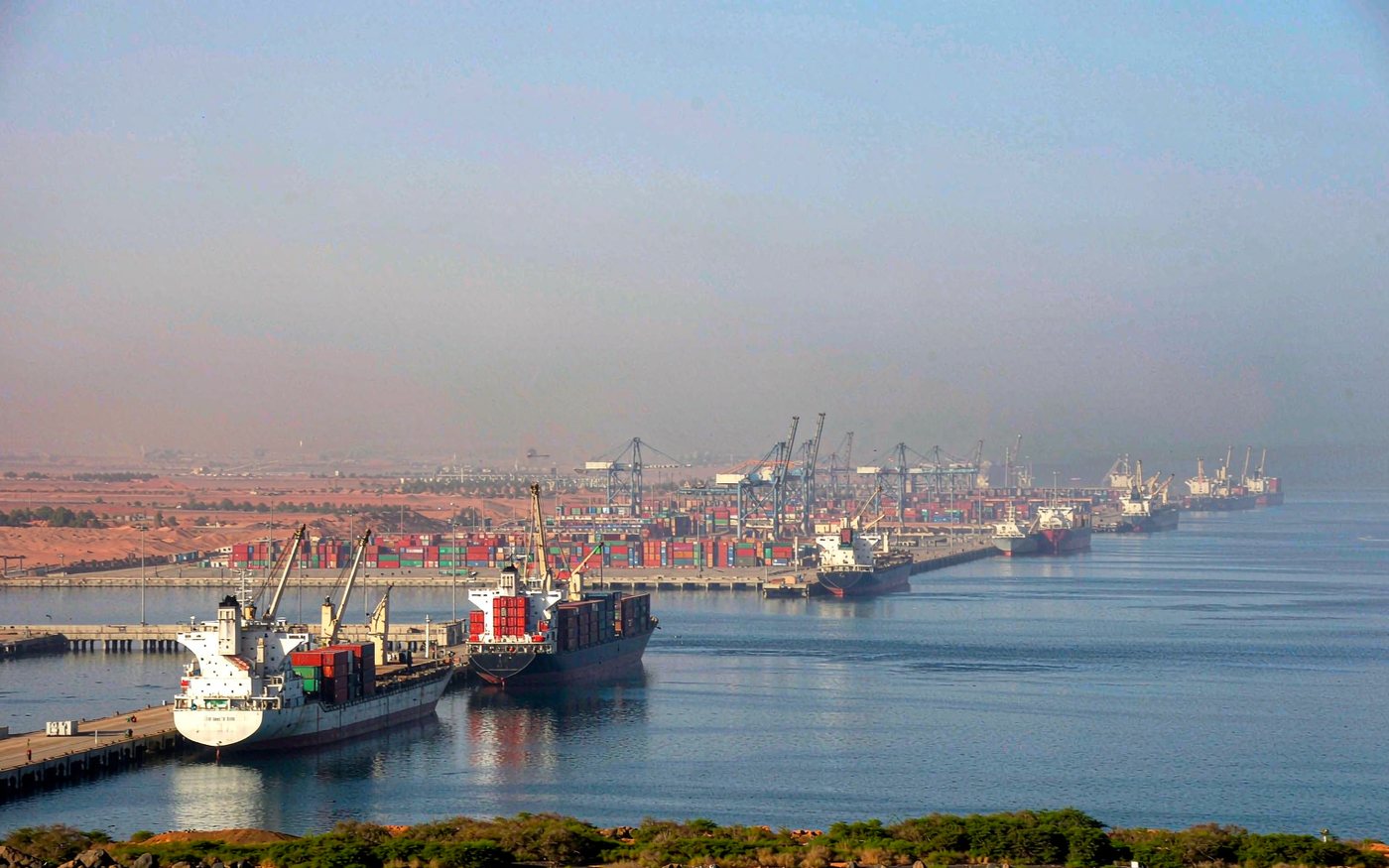
Port Sudan is the country's principal seaport and carries the great majority of Sudanese import and export tonnage. For a first-time importer that simplifies one decision - there is not a meaningful choice between competing container ports - but it concentrates all of the schedule risk in one place.
Direct sailings from Chinese ports to Port Sudan are limited, and a good deal of cargo is transhipped through regional hubs such as Jebel Ali, Jeddah or Djibouti before the final leg. That matters because a transhipment adds a connection, and a missed connection on a thin service can cost a week or more.
The second implication of a single-port system is congestion behaviour. Published trade data has put average container dwell at Port Sudan above regional norms, driven largely by document review and clearance rather than by berth availability. In practice this means your documentation timeline, not your vessel schedule, is what determines when you get your cargo.
Ask your forwarder which routing the service uses, whether it is direct or transhipped, and what the current dwell experience has been. Those three answers tell you most of what you need to plan around.
FCL, LCL and break-bulk choices for the Red Sea run
The consolidation-versus-full-container arithmetic follows the familiar pattern: below roughly 15 cubic metres, consolidation usually costs less; above that, a full container usually wins. Ask for the destination charges separately, because on Red Sea routes they are a meaningful share of the total.
Break-bulk and out-of-gauge are more relevant here than on many routes. Project cargo, machinery, vehicles and oversized equipment are a substantial part of the trade, and Port Sudan has facilities for handling them. If your shipment is out of gauge - too wide, too tall or too heavy for a standard container - say so at quotation stage, because the equipment, the lifting and the port handling are all priced differently.
Consolidation has a specific caution on this route. Because clearance at Port Sudan is document-driven and dwell can run long, goods sitting in a shared container are exposed to the delays of the whole consolidation rather than just their own. If your cargo is time-critical or high-value, a full container with a single consignee gives you more control.
Ask about container free time in writing. Carriers typically allow a defined free period for container use at destination, and because clearance here can be slow, that window is the difference between a normal shipment and a demurrage bill.
Air freight into Sudan and the airport options available
Air cargo provides an alternative when sea transit or port dwell is unacceptable, and it is the realistic option for pharmaceuticals, medical supplies, urgent spare parts and time-critical project items. Cargo arrives at Sudan's international airports, and from there moves onward by road.
Readers should note the operational caveat plainly: airport operations in Sudan have been disrupted at times since April 2023, and capacity and schedules change. Confirm which airports are currently accepting cargo, and what the onward road situation is, before you commit to an air routing.
Connections from China are not direct in most cases. Air cargo moves via a Gulf or regional hub, so transit includes a handling stop. Ask which hub, and what the onward frequency is.
Air does not reduce the documentation burden. The inspection certificate, the declaration and the duty and VAT obligations all apply in the same way. What you gain is days, not exemptions.
Transit time to Port Sudan and how pre-declaration shortens the wait
Sea transit from Chinese ports to Port Sudan varies with routing, with published figures for the through journey including transhipment and clearance commonly cited in a range of several weeks. Treat any single number as an estimate for a specific service.
The bigger variable is what happens after the vessel arrives. Published data has put average container dwell at Port Sudan above the regional average, with the technical inspection and document review stages accounting for a large share of the total clearance time. Goods whose documents were prepared while the vessel was still at sea move materially faster than goods whose documents start being prepared on arrival.
That is why pre-declaration matters. Sudan operates an advance cargo declaration requirement under which the carrier transmits manifest and cargo information ahead of arrival - commonly cited as around 72 hours before the vessel reaches port - and the importer files the import declaration through the ASYCUDA system in parallel. Late or missing declarations are penalised, and undeclared cargo is held.
Ask your broker to begin the declaration work before the vessel sails, not after it berths. On this route that is the single highest-return thing you can do to shorten the wait.
The advance cargo declaration Sudan wants, and the SSMO certificate
Two separate requirements govern whether Sudanese customs will accept your cargo, and confusing them is a common and expensive error.
The first is the advance cargo declaration. The carrier transmits electronic manifest and cargo data before arrival, commonly around 72 hours ahead, and the importer's declaration is filed through ASYCUDA World with the value, tariff classification and consignee details. Late filing carries a penalty calculated as a percentage of value, and cargo without a valid declaration is not released.
The second is the inspection certificate. The Sudanese Standards and Metrology Organization enforces pre-shipment conformity verification for most commercial goods. A certificate of inspection must be obtained from an authorised international inspection agency before the cargo leaves China. Without it, the goods are liable to be blocked at Port Sudan rather than merely delayed.
The categories subject to inspection and the detailed requirements are set out in the standards organization's own administrative decisions, which classify commodities and specify what verification each requires. Your broker should confirm which category your commodity falls in and what documentation the inspecting agency needs.
Practically: instruct the inspection at the same time as you book the freight, not afterwards. Inspection takes time, the certificate must exist before departure, and there is no clean way to fix it once the vessel has sailed.
Duty, VAT and the extra Sudanese charges on a CIF base
Sudan applies import duty by HS code, with published rates varying widely by product category - commonly described as running from a few per cent on basic goods and raw materials to 25 per cent or more on consumer electronics and luxury items, with some categories assessed far higher. Confirm the rate for your classification rather than assuming a band.
VAT is charged at 17 per cent on the CIF value. As elsewhere, note the base: it is not 17 per cent of the invoice value in isolation, and additional charges are applied on top of duty and VAT rather than instead of them.
Those additional charges are the part buyers forget. Sudanese import taxation has included surcharges and sectoral levies alongside duty and VAT, and excise applies to categories such as vehicles on a graduated basis. Ask your broker for a worked calculation for your specific commodity rather than a headline rate.
Worked simply: on a CIF value of USD 12,000 with duty at 20 per cent, duty is USD 2,400, and VAT at 17 per cent on USD 14,400 is USD 2,448 - roughly USD 4,848 in tax before port charges, inspection, agency fees and inland transport. Build that into your pricing before you buy, not after.
Sector permits: medicines, food, telecoms and plant imports in Sudan
Regulated categories need approvals from the relevant authority before they can be cleared, and these must be obtained in advance. Medicines, vaccines and medical supplies need approval from the national medicines and poisons board, including product registration and verification of batch numbers and expiry dates. Food commodities need health certification and, for some items, Ministry of Health documentation.
Telecommunications equipment needs an import permit and inspection from the telecommunications regulator. Cereals, pulses and flour require plant import permits and phytosanitary certification from the agricultural authorities. Hazardous chemicals need safety documentation and appropriate handling arrangements.
Because these approvals sit with different bodies and each runs on its own timeline, the discipline is to identify which apply to your commodity at quotation stage and start the applications immediately. On this route, a missing sector permit is one of the most common reasons a container that has already cleared customs still cannot be released.
Note also that Sudan did not have an operational national single window in recent reporting, which means importers engage with each authority separately. Build that into your timeline - you cannot file once and wait.
Packing and Arabic labelling for Sudanese customs inspection
Documentation for Sudanese clearance is expected in Arabic, and where English documents are attached they generally need to be certified by a registered translation office. Confirm the current expectation with your broker, because a declaration supported only by English documents can be rejected on form.
Packing should suit a hot, dry climate and a port environment where containers may be opened for inspection and then resealed. Use export-grade cartons, palletise where volume justifies it, and label in a way that survives handling.
Goods likely to be sampled - food, pharmaceuticals, chemicals - should be packed so that a sample can be taken without unpacking the whole consignment. Separate each category and keep it accessible. This single step shortens the inspection stage, which is the longest part of the clearance process.
Wood packaging must meet the international phytosanitary standard and carry the mark. As on every route, this is a cheap instruction at the factory and an expensive problem at the port.
Incoterms, foreign exchange and how payment is proved at clearance
Under FOB, the seller loads in China and you contract the ocean leg, the clearance and the inland delivery. Under CIF to Port Sudan, the seller pays freight and insurance to the port, but risk still transfers at loading - a distinction worth remembering. Under DAP or DDP, the seller carries more, and DDP includes clearing the goods and paying Sudanese duty and VAT.
The distinctive feature of a Sudan import is foreign exchange. Sudan applies exchange controls, and imports are paid through the banking system with the payment evidenced at clearance - typically by a letter of credit or a telegraphic transfer proof issued by an authorised bank. Obtaining foreign exchange approval takes time; plan the funding cycle well before the vessel arrives.
This is why the payment route and the clearance route must be planned together. Cargo that arrives before the foreign exchange is approved sits at the port, and the demurrage clock keeps running. Ask your broker what evidence of payment will be requested, and arrange it in parallel with the shipment rather than after it.
Agree currency and payment mechanics in writing with your supplier, and confirm the transfer route with your bank. On routes where correspondent banking is constrained, transfers that should take days can take considerably longer.
Free time, demurrage and bonded storage at Port Sudan
Carriers allow a defined free period for container use at destination - commonly cited in the range of 14 to 21 days, with longer periods sometimes negotiated. Given that clearance at Port Sudan is document-driven and can run long, that window is the number to watch.
The way to protect it is to have the inspection certificate, the declaration and any sector permits in motion before the vessel arrives, and to have a broker actively working the entry from day one. Free time that is consumed by document preparation is free time wasted.
Where goods cannot be cleared immediately, bonded storage inside the port zone allows them to be held under customs control with duty and tax deferred. Onward options include clearing in tranches against actual withdrawals, which helps cash flow if you are importing regularly.
For temporary imports such as exhibition goods, an ATA carnet can avoid paying duty, normally supported by a bank guarantee for a percentage of the duty exposure. Arrange it well before shipping - carnets are not issued at the port.
Finally, monitor the clock yourself. Ask your forwarder to confirm the free time in writing at booking, and check the status of your container if the vessel has arrived and you have not heard anything.
Checks worth running before Sudanese cargo is booked
First, verify the current operating situation. Port, airport, banking and inland transport operations have been disrupted at times since April 2023, and the position changes. Check official sources in your own country and confirm with your broker what is actually moving now.
Second, verify the sanctions and export control position for your goods, your counterparties and your own jurisdiction. This is your responsibility, and on this route it is not a formality.
Third, confirm the inspection requirement and instruct it immediately. The certificate of inspection must exist before the cargo leaves China, and it is the most common single cause of goods being blocked at Port Sudan.
Fourth, confirm your sector permits. Medicines, food, telecoms equipment and agricultural commodities each need approval from a different authority, and each runs on its own timeline.
Fifth, arrange the foreign exchange early. If the payment evidence is not ready when the cargo arrives, the container waits, and you pay for the wait.
Why importers use Goodhope on this lane
Six things that are different about working with us on China to Sudan shipments.
End to end through Sudan
Five shipments bought in China and delivered into Sudan, told end to end — where the order came from, how it moved, where it nearly went wrong, and how it finished. Client names are withheld at their request; the situations and the handling are what we deal with on this lane.
Before loading, not after · the inspection certificate · Shenzhen to Port Sudan
The purchase. A buyer new to importing assumed inspection happened at the port like it did on his other lanes.
The move. Full container inspected by an authorised agency before loading, with the certificate on file before departure.
Where it nearly went wrong. The certificate of inspection is a pre-shipment requirement rather than an arrival one. Discovering it at Port Sudan means the goods are already there and cannot proceed, and the storage clock is the least of the cost.
How it finished. We arrange the inspection with the booking. Nothing of his has landed uncertified since.
Declare before arrival · the wait · Ningbo to Port Sudan
The purchase. A first-time buyer's broker waited for the vessel before preparing the declaration.
The move. Consolidated cargo with the advance cargo declaration lodged before the vessel arrived.
Where it nearly went wrong. The advance declaration is what shortens the wait here. Filing after arrival turns a process that runs ahead of the ship into one that runs behind it, and the difference is paid in days at the port.
How it finished. We declare in transit now. His containers have cleared faster ever since.
Seventeen per cent · on top of duty · Guangzhou to Port Sudan
The purchase. A buyer costed duty and stopped there.
The move. Full container with duty and value-added tax modelled together, plus the additional local charges on the CIF base.
Where it nearly went wrong. Value-added tax at seventeen per cent is assessed on a base that already contains duty and other charges. Costing duty alone leaves out the larger half of the bill and a quote that cannot be honoured.
How it finished. We model the whole stack now. His landed costs have been accurate every time since.
Arabic labelling · at inspection · Yiwu to Sudan
The purchase. A buyer shipped with English-only labelling and was held at inspection.
The move. Consolidated cargo labelled to the requirement, checked before loading.
Where it nearly went wrong. Labelling in Arabic is part of what inspection looks for rather than a nicety. Goods that arrive labelled for a different market are held for a reason that has nothing to do with their value.
How it finished. We check labelling at origin. Nothing of his has been held for it since.
Sector permits · medicines and food · Shanghai to Port Sudan
The purchase. A buyer imported regulated goods assuming a general import licence covered them.
The move. Consolidated cargo with the sector permit identified and obtained before the goods sailed.
Where it nearly went wrong. Medicines, food, telecoms equipment and plant products each need their own sector permit on top of the import licence and the import form. A general licence does not cover them, and the permit is not issued quickly.
How it finished. We identify the permits up front. No regulated shipment of his has been stopped since.
Why importers use Goodhope on this lane
Six things that are different about working with us on China to Sudan shipments.
Request a Sudan shipping plan with the paperwork mapped out
Tell us the commodity, volume and delivery point, and we will set out the inspection certificate, declaration and sector permits your shipment needs, confirm the current routing and port situation, and give you a landed cost that accounts for duty, VAT, surcharges and free time at Port Sudan.
Get a quote Talk to usRelated pages
Frequently asked questions
Which port does cargo from China arrive at in Sudan?
Port Sudan on the Red Sea handles the large majority of Sudanese trade. Direct sailings from China are limited, so much cargo tranships through regional hubs such as Jebel Ali, Jeddah or Djibouti before the final leg.
How long does shipping from China to Sudan take?
The through journey including transhipment and clearance is commonly cited in a range of several weeks. The larger variable is dwell at Port Sudan, where published data has put average container stay above the regional average, driven mainly by document review and technical inspection rather than berth availability.
Is a certificate of inspection required before shipping to Sudan?
Yes, for most commercial goods. The Sudanese Standards and Metrology Organization enforces pre-shipment conformity verification, and a certificate of inspection from an authorised agency must be obtained before the cargo leaves China. Without it, goods are liable to be blocked at Port Sudan.
What is the advance cargo declaration requirement?
The carrier transmits electronic manifest and cargo data ahead of arrival - commonly around 72 hours before the vessel reaches port - and the importer files the import declaration through ASYCUDA World in parallel. Late or missing declarations are penalised and cargo is held.
What duty and VAT apply to imports into Sudan?
Duty is applied by HS code, with published rates commonly running from a few per cent on basic goods to 25 per cent or more on consumer electronics and luxury items. VAT is charged at 17 per cent on the CIF value. Additional surcharges and sectoral levies may also apply. Ask your broker for a worked calculation for your commodity.
Do I need an import licence for Sudan?
Commercial shipments generally require an import licence and an IM form, obtained before shipping. Regulated categories need further approvals: medicines from the national medicines and poisons board, food from health authorities, telecoms equipment from the regulator, and cereals and pulses from the agricultural authorities.
Should documents be in Arabic?
Documentation is expected in Arabic, and English attachments generally need certification by a registered translation office. Confirm the current expectation with your broker before shipping, because a declaration supported only by English documents can be rejected.
How is payment proved at Sudanese customs?
Sudan applies exchange controls, and imports are paid through the banking system with the payment evidenced at clearance - typically a letter of credit or telegraphic transfer proof from an authorised bank. Arrange foreign exchange approval well before the vessel arrives, because cargo waits if the evidence is not ready.
How much free time is there at Port Sudan, and what happens after?
Carriers commonly allow 14 to 21 days of free container use at destination, with longer periods sometimes negotiable. After that, demurrage and storage accrue daily. Bonded storage inside the port zone allows goods to be held under customs control with duty and tax deferred.
What should I check before booking a shipment to Sudan?
Verify the current operating situation at the port, airport and banks; check the sanctions and export control position for your goods and counterparties; confirm and instruct the pre-shipment inspection; start any sector permit applications; and arrange foreign exchange approval early. This page is operational guidance only - it takes no position on political matters.