
Home / Shipping to Suriname / How to Ship from China to Suriname
Shipping from China to Suriname, step by step
Goodhope Freight is a licensed NVOCC based in Shenzhen, registered as GD20230925153335, and has been moving cargo out of China since 2012. To Suriname we run full containers and shared containers port-to-port into Paramaribo, air freight airport-to-airport into Johan Adolf Pengel International, and express parcels dispatched from our depot. Every service stops at the port, the airport or the depot. Your consignee arranges import clearance and collection.
Suriname is geographically on the South American mainland but trades as part of the Caribbean, and it carries the region's tariff. It applies the CARICOM Common External Tariff to goods from outside the region, its customs administration runs on the ASYCUDA platform, and entries are filed by licensed brokers. Dutch is the working language of the administration, which is worth knowing when your consignee is briefing a broker.
The tax you will hear about is the turnover tax, locally BTW, charged at 10 per cent on most imports and assessed on the customs value plus duty and any excise. A higher band applies to goods classed as luxury. Understanding that structure, and whether your commodity needs an import licence, is most of what you need to budget this lane.
At a glance
Main port: Paramaribo, on the Suriname River, with Nieuwe Haven the main container facility · Main airport: Johan Adolf Pengel International (PBM) · Currency: Surinamese dollar · Administrative language: Dutch · Duty: CARICOM Common External Tariff, running from nil up to 40 per cent by commodity · Turnover tax at 10 per cent, with a 25 per cent band for luxury goods · Excise on defined categories · Import licences, including the H-99 form, required for regulated goods · Transhipment via Trinidad, Barbados or Miami
How your cargo moves: China to Suriname
Eight steps from your supplier's door to yours. The last four are the ones shaped by local rules.
- Pickup from your supplierWe collect the goods anywhere in China and bring them to our consolidation point.
- Export clearanceChina customs declaration filed and released before the goods move to the port.
- Loading and departureContainer loaded, sealed and handed to the carrier at the Chinese port.
- Relay through Trinidad, Barbados or MiamiParamaribo is served by transhipment services, so the hub rather than the ocean leg sets the arrival window.
- Discharge at ParamariboContainers are worked at the river port; air cargo is handled at the PBM cargo terminal.
- Licence and permits confirmedWhere the commodity is regulated, the importer needs the relevant licence or permit in hand before the declaration is filed.
- Declaration filed by a licensed brokerThe broker lodges the entry on the ASYCUDA system with the commodity codes and supporting documents.
- Duty, excise and the 10 per cent tax settledCharges are assessed on the customs value plus duty and excise, then paid before release.
Duty rates, VAT rates and clearance times move, and the figure that applies to your goods is the one set for your commodity code on the day of clearance. We check the current position against your code before your goods sail and confirm it to you in writing — ask for that check when you request a quote.
Paramaribo, and a river port with a schedule
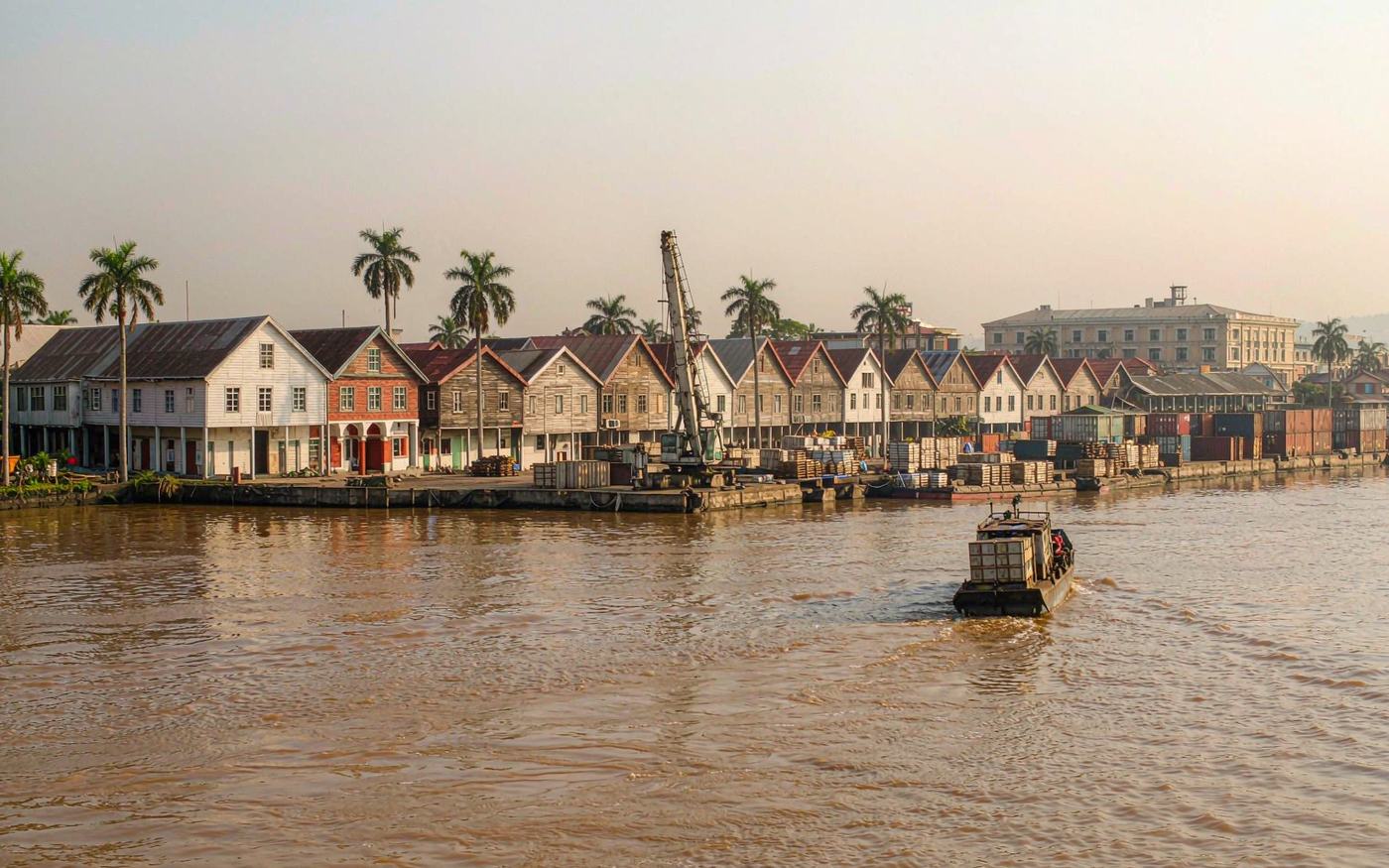
Paramaribo sits up the Suriname River and Nieuwe Haven is the main container facility. As with any river port, the working pattern is shaped by the river rather than by a deep-water berth: vessels are worked on arrival windows, yard space is finite, and equipment is more limited than on a mainland container terminal. Build slack into your planning.
Johan Adolf Pengel International handles the air freight. Most sea cargo tranships through Trinidad, Barbados or Miami, so the relay you book shapes both the transit time and the number of times your container is lifted.
Which mode suits the volume and the deadline
Below roughly 15 cubic metres a shared container is the practical answer, rated by volume with a weight conversion and a one cubic metre minimum. Between about 15 and 28 cubic metres, run the comparison between a 20GP and the per-cubic-metre rating both ways. Above that, a 40GP or 40HC normally wins for bulky light cargo.
Air freight into PBM works from about 45 kg and suits electronics, medical supplies, urgent spares and time-critical retail stock. There is no direct service from China, so consignments connect through a regional or European hub, and the connection sets the transit. Express courier handles documents, samples and single cartons, and ends at the depot.
The tariff, and the 10 per cent turnover tax
Suriname applies the CARICOM Common External Tariff to goods arriving from outside the region, with rates running from nil up to 40 per cent depending on the commodity. General cargo commonly falls in the 0 to 20 per cent range, and the higher rates cluster on protected lines.
The turnover tax, locally BTW, is charged at 10 per cent on most imports and it is assessed on the customs value plus duty and any excise, so it compounds rather than sitting alongside. This tax replaced the previous turnover tax regime, which is why older published guides sometimes quote a different structure. Confirm the current treatment against your commodity code before you price an order.
The luxury band, and which goods land in it
Excise duty applies to defined categories including alcohol, tobacco and fuel, and it is charged on top of duty and before the turnover tax is calculated, which is why it moves the total by more than its own rate.
A higher turnover tax band, at 25 per cent, applies to goods classed as luxury. If your commodity might fall into that band, get it confirmed by your consignee's broker before you commit to a purchase order, because the difference changes the landed cost substantially.
Licences and permits, including the H-99
Regulated goods need an import licence before the declaration is filed, issued through the ministry responsible for trade and industry. The form your broker will refer to is the H-99. Health and phytosanitary certificates are required for food, plant and animal products, and permits apply to a defined list including pharmaceuticals and certain agricultural goods.
Because the administration works in Dutch, brief your broker in writing and early. The licence is the item most likely to be left too late, because from the China side there is no visible sign that it is missing until the container is already on the quay.
Personal shipments and commercial entries are not the same thing
A resident moving household effects and a business importing stock for resale are treated differently, and allowances that apply to personal imports do not extend to commercial consignments. A commercial entry is assessed on duty and the turnover tax whatever the value, and goods manufactured in China do not qualify for CARICOM origin preference.
If you are shipping personal effects rather than commercial stock, say so at quotation stage. The document set differs, and eligibility for reduced treatment on used household goods depends on the importer's status, which needs confirming with customs before the goods sail rather than claimed on arrival.
Packing and marking for a river quay
Goods are lifted more often than on a deep-water lane and then sit on an open quay in a hot, humid climate. Palletise or strap wherever the commodity allows, protect against moisture inside the cartons for textiles, paper and electronics, and mark handling instructions on the outside, because the quay crew is small and the equipment is limited.
Wood packaging material must meet the international phytosanitary standard, and untreated timber is a common cause of holds. Keep the packing list accurate to the carton count, because a mismatch between the manifest and the physical count holds the whole entry.
Documents the broker will file
- Commercial invoice with a specific description, quantities, values, currency and country of origin.
- Packing list matching the invoice, with weights and dimensions.
- Bill of lading for sea freight or air waybill for air freight.
- Certificate of origin, which supports tariff assessment and any regional preference claim.
- Import licence, including the H-99 form where the commodity is regulated, plus health or phytosanitary certificates where required.
The broker files the declaration on the ASYCUDA system with these documents attached. Because the assessment runs off the declared value and the commodity code, a vague description invites a reassessment rather than merely a delay.
Timing, and currency movement on a slow lane
Consolidated shipments into Paramaribo typically run in the region of 35 to 50 days port-to-port depending on the Chinese origin and how the transhipment connects, and full container routings vary with the relay chosen. Air cargo is governed by the connection.
The other variable on this lane is currency. Duty and tax are assessed and settled in local currency, so a movement in the exchange rate between quotation and clearance changes what your buyer pays. If the order is large, ask your consignee's broker for an assessment close to the arrival date rather than relying on one made at booking.
What lands on your side of the file
We handle collection from your supplier, consolidation and loading in Guangdong, export declaration, and the main carriage into Paramaribo or PBM. We issue the transport document, send status updates at each handover, and name the relay ports on the quote rather than hiding them behind a single transit figure.
Your consignee obtains any licence the goods need, has a licensed broker file the declaration, settles the duty, excise and the 10 per cent tax, and collects. We set out those charges before the goods sail. We do not offer door-to-door delivery to Suriname.
Before you book the first container
Send us the commodity, the volume and weight, the pickup address in China and where the goods will be collected. We will show the relay options, quote the charges line by line, and set out how the tariff, any excise and the 10 per cent tax combine on your codes.
Ask your consignee whether the commodity is licensed, and ask us for the sequence in writing. On a lane where the administration works in Dutch and licences are issued separately, a clean file prepared early is worth more than a faster vessel.
Honest cases unpacked: Suriname
Five shipments bought in China and delivered into Suriname, told end to end — where the order came from, how it moved, where it nearly went wrong, and how it finished. Client names are withheld at their request; the situations and the handling are what we deal with on this lane.
Retail fit-out, 40HC out of Foshan
The purchase. A retailer was fitting out a new store, buying shelving, display units, lighting, tiles and joinery from three factories in Guangdong.
The move. We collected from all three, consolidated into one 40HC, shipped port-to-port to Paramaribo with the transhipment port named at booking.
Where it nearly went wrong. Shelving and display units are bulky and light, and the buyer had specified a 40GP on the basis of weight. That was within a few cubic metres of not fitting, and on a lane with a relay the cost of discovering it at loading is high.
How it finished. We measured the packed volume at the warehouse before confirming the equipment and moved the booking to a 40HC. Everything travelled on one bill of lading and cleared on a single entry.
A licensed commodity discovered late
The purchase. A buyer was importing a mixed container of consumer goods that included a regulated line alongside ordinary household products.
The move. One 20GP consolidated from two suppliers, shipped port-to-port to Paramaribo, cleared by the consignee's broker.
Where it nearly went wrong. The regulated line needed an import licence issued before the declaration could be filed, and the buyer had assumed the whole container was unlicensed. The entry stalled while the paperwork was obtained.
How it finished. On the repeat order we asked the licence question at quotation stage and had the buyer apply while the goods were on the water. The second container cleared within days of discharge, and the buyer now checks the licence position before ordering.
Air freight of pharmaceutical supplies
The purchase. A distributor needed a time-sensitive pharmaceutical consignment and its cold-chain packaging moved quickly from Guangdong.
The move. Roughly 260 kg booked as air freight, connecting through a European hub into Johan Adolf Pengel International, collected at the cargo terminal.
Where it nearly went wrong. Pharmaceuticals need permits and health documentation, and the buyer had prepared the commercial documents but not the product permits. Air cargo removes the time you would otherwise have to fix that.
How it finished. We flagged the permit requirement at booking and held the consignment until the documents were in hand, then released it on the first available connection. It cleared on arrival without a hold.
Household effects and new furniture in one container
The purchase. A returning resident was shipping used household effects together with new furniture purchased in China.
The move. A shared container to Paramaribo, with the consignee handling clearance through a licensed broker.
Where it nearly went wrong. Used personal effects and new commercial goods are treated differently, and the reduced treatment on household effects depended on the importer's status, which had not been confirmed before shipping.
How it finished. We separated the two categories on the invoice and packing list and told the buyer to confirm eligibility with customs before the goods sailed. The entry was made on the correct basis and cleared without reassessment.
Where the exchange rate moved the tax bill
The purchase. A buyer was placing a large container order and had costed the landed figure from an assessment made at booking time.
The move. One 40HC, shipped port-to-port to Paramaribo, cleared roughly seven weeks after the assessment was made.
Where it nearly went wrong. Duty and tax are assessed and settled in local currency, and the rate moved between booking and clearance. The buyer had budgeted against the earlier figure and the difference was not trivial on a full container.
How it finished. We advised the buyer to ask the broker for a fresh assessment close to the arrival date rather than relying on one made weeks earlier. The landed cost was then forecast on the current figure, and the order went ahead on a realistic margin.
Why importers use Goodhope on this lane
Six things that are different about working with us on China to Suriname shipments.
Get a quote for Suriname
Tell us the commodity, the volume, the pickup address in China and where the goods will be collected. We will name the relay, flag any licence your consignee needs, and quote duty, excise and the 10 per cent turnover tax as separate lines.
Get a quote Talk to usRelated pages
Frequently asked questions
Is there a direct sea freight service from China to Suriname?
No direct deep-sea call from China. Most cargo tranships through Trinidad, Barbados or Miami before reaching Paramaribo, and we quote port-to-port with the relay named on the quotation.
What is the turnover tax on imports into Suriname?
The turnover tax, locally BTW, is charged at 10 per cent on most imports and is assessed on the customs value plus duty and any excise, so it compounds rather than sitting alongside. A 25 per cent band applies to goods classed as luxury. The current tax replaced an earlier turnover tax regime, so confirm the treatment against your commodity code.
What is the H-99 form?
The import licence form used for regulated goods, issued through the ministry responsible for trade and industry and required before the declaration is filed. Health and phytosanitary certificates are separately required for food, plant and animal products, and permits apply to a defined list including pharmaceuticals.
What duty rates apply?
Suriname applies the CARICOM Common External Tariff, with rates running from nil up to 40 per cent depending on the commodity. General cargo commonly falls in the 0 to 20 per cent range, and higher rates cluster on protected lines. Confirm the rate for your commodity code with the broker before pricing an order.
Do Chinese goods qualify for CARICOM duty relief?
No. CARICOM duty-free entry applies to goods certified as being of CARICOM origin. Goods manufactured in China pay the full Common External Tariff rate for their classification, plus any excise and the turnover tax.
Which airport does air cargo arrive at?
Johan Adolf Pengel International (PBM), which serves Paramaribo and handles international air cargo. There is no direct freighter service from China, so connections through a regional or European hub set the transit time.
Do you offer door-to-door delivery to Suriname?
No. Sea freight is port-to-port to Paramaribo, air freight is airport-to-airport to PBM, and express courier dispatch ends at the depot. Your consignee obtains any licence, clears the entry, settles the charges and collects the goods.
Which documents are needed to clear goods?
A commercial invoice, a packing list, the bill of lading or air waybill and a certificate of origin, plus an import licence such as the H-99 where the commodity is regulated and health or phytosanitary certificates where required. Wood packaging must meet the international phytosanitary standard.
Should I worry about the exchange rate?
Duty and tax are assessed and settled in local currency, so movement in the rate between quotation and clearance changes what your buyer pays. On larger orders, ask the broker for a fresh assessment close to the arrival date rather than relying on one made at booking.
What details do you need to price a shipment?
The commodity, the volume and weight, the pickup address in China and the collection point in Suriname. We will show the relay options, quote the charges line by line, and set out how the tariff, any excise and the 10 per cent tax combine on your codes.