
Home / Shipping to Sweden / How to Ship from China to Sweden
How to Ship from China to Sweden: Gothenburg, 25% Moms & Chemical Tax
Sweden is the largest of the Nordic markets and one of the least troublesome to import into, provided you understand two things before you book. The first is that Gothenburg sets the schedule — it is the largest container port in Scandinavia and most Swedish imports pass through it, whether or not your vessel was ever going to call there. The second is that Sweden charges a tax on electronics by weight, not by value, and importers who have never heard of it discover it on the customs bill.
Almost everything else is standard EU. Sweden is in the EU customs union and the single market, duty comes from the TARIC code, and the VAT rate is 25% — high, but recoverable if you are registered. The two Swedish-specific items above are what this guide spends its time on, alongside the practical question of getting a container from a Chinese factory to a Swedish address in winter.
This is written for buyers importing from China for the first time. It covers port and service choice, transit times, trade terms, the end-to-end process, duty and Moms, the chemical tax, product approvals, and how to tell whether a forwarder genuinely knows the Swedish lane.
Sweden at a glance
- Gothenburg is Scandinavia's largest container port and the practical gateway for most Swedish imports. Stockholm, Malmö and Helsingborg serve specific delivery areas.
- Most China services tranship. Your container often goes via Hamburg, Antwerp or Rotterdam and feeds north, which adds two to five days.
- EU member since 1995. EU customs union and single market. Duty from the TARIC code, commonly 0–12% on consumer goods. No EU–China free trade agreement.
- Moms 25% standard, 12% reduced, 6% reduced. Import Moms is reported to Skatteverket by VAT-registered businesses.
- Swedish chemical tax on electronics — charged per kilogram by commodity code, with reductions available on evidence. This is the item nobody budgets for.
- Tullverket handles customs, declarations go through TDS, and you need an EORI number beginning with SE.
- Plan for winter and for July. Road access in the north slows in snow and ice, and Swedish industry largely shuts down in July.
How your cargo moves: China to Sweden
Eight steps from your supplier's door to yours. The last four are the ones shaped by local rules.
- Pickup from your supplierWe collect the goods anywhere in China and bring them to our consolidation point.
- Export clearanceChina customs declaration filed and released before the goods move to the port.
- Loading and departureContainer loaded, sealed and handed to the carrier at the Chinese port.
- Main carriageOcean, air or rail movement booked on the route agreed for your cargo.
- Arrival at the gatewayDischarge at the port or airport of entry, recorded on the carrier's manifest.
- Import clearanceCustoms declaration filed locally, with duty and tax assessed on the declared value.
- Customs releaseGoods released into free circulation once duty and tax are settled.
- Final deliveryOnward movement to your delivery address, warehouse or nominated depot.
Duty rates, VAT rates and clearance times move, and the figure that applies to your goods is the one set for your commodity code on the day of clearance. We check the current position against your code before your goods sail and confirm it to you in writing — ask for that check when you request a quote.
Why Gothenburg decides the schedule on most Swedish imports
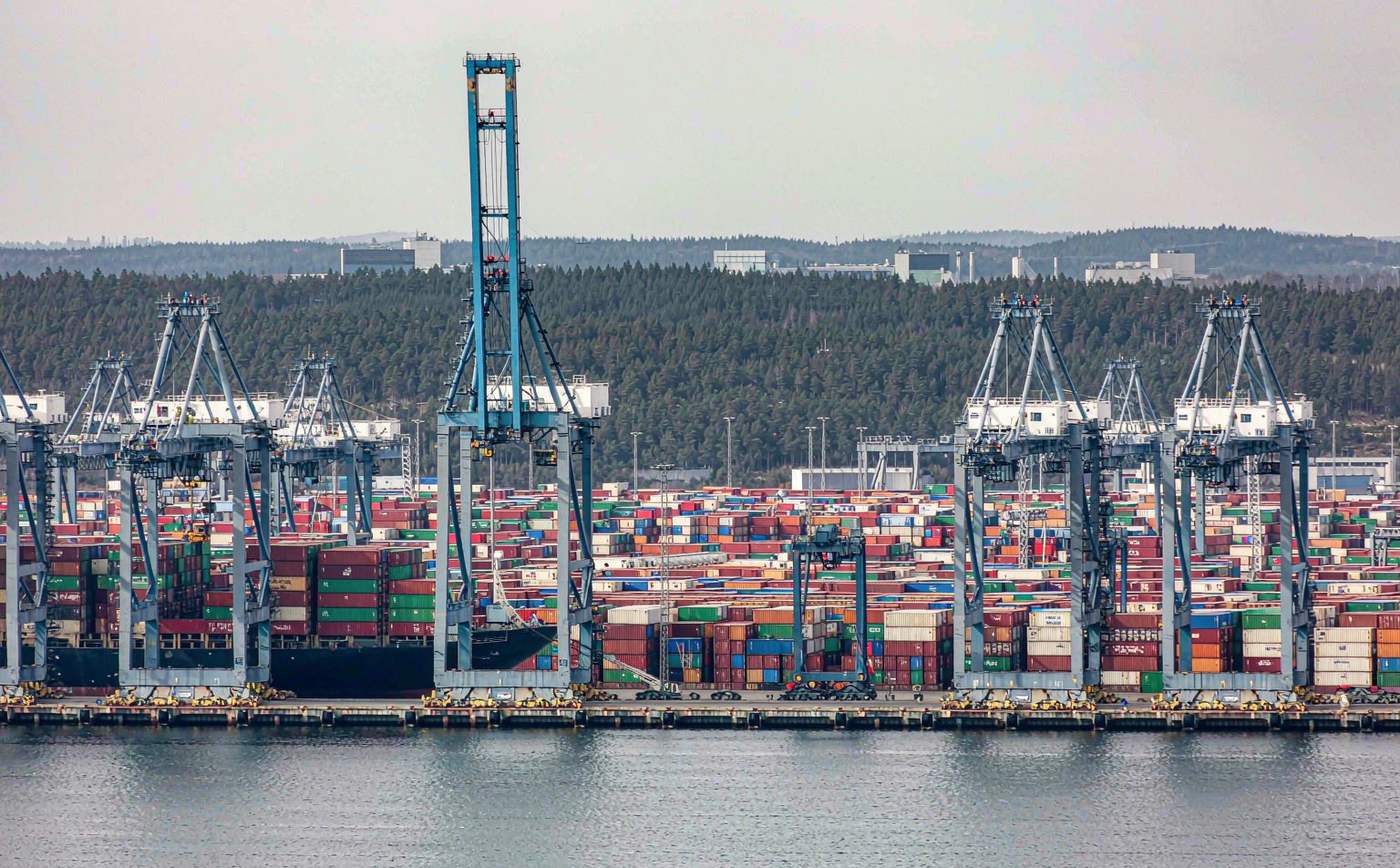
Sweden has a long coastline and several working ports, but container traffic concentrates heavily in one place. The Port of Gothenburg is the largest in Scandinavia by a wide margin, and it has the water depth, crane capacity and rail connections that mainline and feeder services need. For most importers the question is not really which Swedish port to use — it is how the cargo gets to Gothenburg.
The other ports have genuine roles. Stockholm serves the capital region and is often used for smaller volumes and for cargo already moving through the Baltic. Malmö, operated jointly with Copenhagen across the Öresund, suits southern Sweden and works well if you are also distributing into Denmark — the Öresund Fixed Link puts the two cities about half an hour of driving apart. Helsingborg handles ferry and short-sea traffic on the busiest shipping lane in the country. For air freight, Stockholm Arlanda, Gothenburg Landvetter and Malmö all have customs clearance facilities, with Arlanda handling the bulk of air cargo.
What this means in practice: if your delivery address is anywhere in Sweden and your cargo is containerised, expect Gothenburg to be in the routing. Ask your forwarder to confirm it, and ask what happens between the vessel's discharge and your door.
Direct to Gothenburg or tranship through Hamburg: choosing the service
Very few services run direct from China to Gothenburg. The market is not large enough to justify it on every rotation, so the common pattern is a mainline vessel from China to a big European hub, then a feeder north.
Transhipment via Hamburg, Antwerp or Rotterdam
The default for most China–Sweden cargo. More frequent sailings, more carrier choice, and generally better recovery options if a connection is missed. Costs two to five extra days and adds another terminal handling.
Direct or single-tranship service into Gothenburg
Faster on paper and fewer handling points, so less risk of damage. Available on some rotations and from some origins. Worth asking for specifically, and worth checking how often it actually runs before you plan around it.
The right question to ask is not "is it direct" but "which hub, which feeder operator, and what happens if I miss the connection." A forwarder who works the lane can name all three. A forwarder who says "about 35 days" has usually not looked at the rotation.
Transit times into Gothenburg, Stockholm and Malmo
| Mode | Typical transit | What the clock includes |
|---|---|---|
| Sea FCL (20ft / 40ft / 40HQ) | 32–42 days door to door | Mainline from China of roughly 27–34 days, plus a feeder leg of 2–5 days when the service tranships, plus clearance and final delivery. South China origins are at the faster end. |
| Sea LCL | 38–48 days | The same sea legs plus consolidation at the China warehouse and deconsolidation at the destination, which together commonly add one to two weeks. |
| Rail from China | 18–28 days plus the Swedish leg | China–Europe rail to a European hub, then onward to Sweden. Competitive when the supplier is inland; less established than the German and Polish services. |
| Air freight | 4–8 days airport to airport | Into Stockholm Arlanda or Gothenburg Landvetter, sometimes via a European hub. |
| Express courier | 3–6 days door to door | Samples and small parcels, with the carrier acting as broker. |
Add a buffer to the first shipment, and add more between November and March. Those are planning figures, not promises.
Rail from China to Sweden: where it fits and where it does not
China–Europe rail is well developed into Germany, Poland and the Netherlands, and Sweden can be reached from a European rail hub with a short onward leg. It is a genuine option, but it is not the default here in the way it can be for a German delivery.
Rail fits when your supplier is inland and the alternative is a long truck to a coastal port followed by a 30-day voyage; when your goods are high-value relative to weight; and when your timing sits between sea and air. It fits less well when you need guaranteed weekly frequency, when the delivery point is in northern Sweden with a long final leg anyway, or when your volumes are small enough that consolidation patterns dominate the schedule.
The honest approach is to ask for both. Have sea and rail quoted on the same shipment with the same trade term, and compare the door-to-door number rather than the headline rate. See our rail freight page for how the service works.
Winter is a routing variable in Sweden, not a footnote
Two seasonal factors affect Swedish deliveries more than importers expect.
Winter, roughly November to March. Swedish ports keep operating, but road access to premises outside the major cities and across the north can be slowed by snow and ice. Vehicles need appropriate winter tyres, and journey times that look short on a map are not short in January. If your consignee is in Norrland, build in extra days and tell them to expect the delivery window rather than a date.
July. Swedish industry largely shuts down for the summer holiday period, and a container arriving in the middle of July can find nobody at the delivery address. It sounds trivial and it costs importers real money every year. Aim to land summer stock before the shutdown or arrange reception in advance.
Practical tip. When you request a quote, give the delivery postcode and the target delivery week, not just the port. On a Swedish shipment the last leg is where the seasonal risk sits, and a forwarder who knows the lane will flag it.
Trade terms on a Swedish shipment and who carries the import
The trade term decides who pays each leg, who is the importer of record in Sweden, and the moment risk transfers. On a lane with a feeder leg and a winter variable, it also decides who absorbs the delay.
| Term | Who arranges main carriage | Who clears in Sweden | Risk transfers | Practical read |
|---|---|---|---|---|
| EXW (Ex Works) | You | You | At the factory door | Avoid on a first shipment. You take on Chinese export clearance and inland pickup you cannot manage from Stockholm. |
| FOB (Free On Board) | You | You | When goods pass the ship's rail at the Chinese port | The safe default. The supplier clears export and loads; you control the vessel, the hub and the feeder. |
| CIF (Cost, Insurance, Freight) | Seller, to the named port | You | On board at origin | Stops at the port. The feeder leg, Swedish clearance, Moms and inland delivery are all still yours. |
| DAP (Delivered At Place) | Seller, to your address | You | On arrival, before unloading | Door delivery with you as importer of record. Usually the best balance for a VAT-registered Swedish company. |
| DDU (Delivered Duty Unpaid) | Seller, to your address | You | On arrival | The older wording for the same idea as DAP. Duty and Moms are yours. |
| DDP (Delivered Duty Paid) | Seller | Seller's agent | On arrival | Easiest to receive and easiest to get wrong. Ask who is named as importer and whether you will receive the customs declaration — without one in your name you have no evidence of import Moms and nothing to reclaim. |
Also note the difference between port-to-port, airport-to-airport and door-to-door. A port-to-port price excludes collection, export clearance, terminal handling at the hub, the feeder, Swedish clearance and delivery. Our local charges page lists the destination items most often left out.
How a shipment travels from a Chinese supplier to a Swedish address
Fix the commodity code, net weight and trade term
Before production ends. The TARIC code sets the duty rate and reveals anti-dumping exposure. Net weight matters separately, because the Swedish chemical tax is assessed by weight on covered electronics.
Choose the service and confirm the routing
Which Chinese port, whether the vessel calls Gothenburg directly or tranships, which hub and which feeder operator, and what the fallback is if the connection is missed.
Collect from the factory or consolidate
A full container loaded at the factory, or cartons into a consolidation warehouse alongside other suppliers' cargo. See warehouse and consolidation.
Chinese export declaration
Filed through China's single window. Anything needing inspection, a licence or certification is cleared here, which is why those requirements must be identified when you book.
Mainline leg, then feeder north
China to the European hub, then a short-sea service to Gothenburg or another Swedish port.
Swedish import declaration through TDS
Your broker files electronically with Tullverket. Duty is assessed from the commodity code, import Moms at 25% on the duty-inclusive value, and any Swedish chemical tax on covered electronics.
Payment and release
Depending on your registration, Moms is either paid to Tullverket at release or reported to Skatteverket on your VAT return. Once released, the container moves inland.
Final delivery
Road or rail to your premises. Storage charges start accruing from arrival, so clearance speed is money. See import clearance documents.
EU duty, 25% Moms and the extra Swedish tax on electronics
Sweden applies the EU Common Customs Tariff, so duty comes from the commodity's TARIC code. Most general consumer goods from China fall between 0% and 12%, with foodstuffs sometimes based on weight. There is no EU–China free trade agreement, so Chinese-origin goods get no preferential rate. Anti-dumping and countervailing duties apply to specific Chinese lines and can be several times the ordinary duty.
Import Moms is 25% standard, with 12% for food, restaurant meals and hotel accommodation, and 6% for books, newspapers, cultural events and passenger transport. It is calculated on the customs value plus duty plus transport and insurance to the point of entry into the EU.
Worked example. Homeware with a customs value of SEK 200,000 and SEK 24,000 of freight and insurance, giving SEK 224,000. Duty at 4% is SEK 8,960. Moms at 25% applies to SEK 232,960, which is SEK 58,240. For a VAT-registered Swedish business recovering in full, the real cost is the SEK 8,960 duty.
The line that is not duty and not VAT
Sweden also charges an excise — the chemical tax (kemikalieskatt) — on certain electronic goods. It is assessed by commodity code and net weight, which means it does not behave like duty and it does not behave like VAT. A cheap, heavy item can carry more tax than an expensive, light one.
The Swedish chemical tax on electronics: what it costs and how to cut it
For 2026 the published rates are SEK 12.42 per kilogram for white goods and SEK 180.71 per kilogram for other covered electronics, with a cap of SEK 552.27 per item. Whether it applies depends on the commodity code, so it is not a general tax on all electronics — you have to check the code.
Worked through: a 9 kg television at SEK 180.71 per kilogram would be SEK 1,626 before the cap, so the SEK 552.27 ceiling applies. A 60 kg appliance at SEK 12.42 per kilogram comes to SEK 745 and is also capped. On a container of consumer electronics the aggregate is not a rounding error, which is exactly why it belongs in your landed-cost model before you order rather than after you clear.
The reduction is where the money is. A deduction of 50% or 95% may be available depending on the bromine, chlorine and phosphorus content of the goods. It is not automatic and it is not granted on a generic supplier statement — you need technical evidence for the actual product. Ask your supplier for it at quotation stage, not at clearance. Confirm the current rates, coverage and deduction rules with Skatteverket or your Swedish tax adviser before relying on any figure here.
Import Moms: how Swedish businesses account for it, and the deferment options
How import Moms is handled depends on your registration. A business registered for VAT in Sweden generally reports import VAT to Skatteverket through its VAT return. A business that is not registered pays it to Tullverket at clearance. Registration alone does not make the Moms deductible — deductibility depends on what you do with the goods — but without registration, recovery is not available at all.
Postponed accounting arrangements exist for eligible Swedish businesses, which removes the need to pay at the point of importation. Eligibility can depend on your VAT registration and, in some setups, on authorised economic operator status, so confirm it with your tax adviser before you rely on it. Where it does not apply, deferment and credit arrangements through Tullverket can at least move the payment date rather than leaving it at each clearance.
Operationally: declarations are filed electronically through TDS (Tulldatasystemet), and you need an EORI number beginning with SE. Both are worth confirming with your broker before the vessel sails, because neither can be arranged retroactively once the cargo has landed.
Product approvals in Sweden: electrical safety, radio, WEEE and packaging
Sweden's product rules sit on top of the EU frameworks, and the national authorities are specific. Most of this has to be arranged before the goods ship.
| Area | What is needed | Who supervises it |
|---|---|---|
| Electrical equipment | CE marking, an EU declaration of conformity, manufacturer and importer traceability, and safety information in Swedish | Swedish Electrical Safety Authority (Elsäkerhetsverket) |
| Radio-enabled equipment | Radio Equipment Directive compliance, technical file, frequency and use conditions, plus current cybersecurity and common-charger requirements where they apply | Swedish Post and Telecom Authority (PTS) |
| Electrical and electronic equipment (WEEE) | Producer responsibility registration, the crossed-out bin marking, and annual reporting | Swedish Environmental Protection Agency (Naturvårdsverket) |
| Batteries, including integrated ones | Battery producer registration and an authorised producer-responsibility route before the product is made available | Swedish Environmental Protection Agency |
| Packaging | Producer responsibility registration and reporting; the EU Packaging and Packaging Waste Regulation phases in from 12 August 2026 | Swedish Environmental Protection Agency |
| Chemical restrictions | RoHS and REACH compliance supported by component and material records, not by CE marking alone | Swedish Chemicals Agency (Kemikalieinspektionen) |
| Medical devices and pharmaceuticals | MDR and IVDR economic-operator roles, registration, UDI, and Swedish-market obligations | Medical Products Agency (Läkemedelsverket) |
| Food and food contact | Food safety compliance and, for animal or plant products, the right certificates | Swedish Food Agency (Livsmedelsverket) |
| Wood packaging | ISPM-15 treatment with a visible stamp | Checked at customs |
| Alcohol above 3.5% ABV | Sweden's retail monopoly means commercial import for retail is not a normal route | Systembolaget |
Importing as an individual compared with a Swedish registered business
An individual can import into Sweden and be the importer of record. The gate is money: without VAT registration you pay duty and 25% Moms and cannot reclaim the Moms, and any chemical tax on covered electronics is payable regardless of who imports. For genuine personal effects and relocation goods there are separate reliefs with their own conditions — check them with Tullverket rather than assuming.
For resale, register first. The sequencing mistake is ordering first and registering later: if the container arrives before the VAT registration is in place, you pay 25% at the border and then chase a recovery you were not entitled to make. Registration also determines whether you report Moms to Skatteverket or pay it to Tullverket, which is the difference between a cash-flow item and a cash-out item.
A marketplace order and a factory you met at a fair
How you found the supplier changes how the first shipment should move.
From a marketplace or sourcing platform, the first order is usually small and often split across two or three suppliers. Air the samples so you can check quality in days, then consolidate the first real order into one LCL shipment from one Chinese port rather than paying three separate clearances. At 25% Moms and Swedish clearance fees, three small consignments cost far more than one consolidated one. Insist on the commodity code, net weight and photographs before releasing the balance — and be careful of suppliers offering to ship "free" by post at a fraction of the real value, because that declared value becomes your customs record.
From a fair — Canton Fair, a Hong Kong show, or a Yiwu visit — you have handled the product, minimum quantities are real, and the first shipment is more likely to fill a container. Price FCL against LCL. Fair orders often span several factories you met at the same event, which makes consolidation the difference between one container and three. A factory you met once still deserves a third-party inspection before the first container, and if the goods are electronics, get the chemical content evidence the tax deduction depends on before production finishes.
In both cases, put the packing specification in writing: export cartons, ISPM-15 pallets, and Swedish-language labelling.
A Chinese forwarder and a Swedish customs broker: what each one does
The question of whether to book with a shipping line directly comes up constantly. The line sells space from one port to another. It will not collect from your supplier's factory, consolidate three suppliers into one container, file the Chinese export declaration, book the feeder north, or tell you that a commodity code triggers the Swedish chemical tax. Those are the jobs that decide whether the shipment works.
What your Chinese forwarder does
Factory collection and consolidation, export declaration, carrier booking and routing design, cargo insurance, document preparation, and catching a compliance problem in China while it is still cheap to fix.
What your Swedish broker does
Files the declaration through TDS, confirms the TARIC classification and any chemical tax or anti-dumping exposure, handles the Moms position with Skatteverket or Tullverket, and knows the terminals and the winter realities of the inland leg.
Skipping either side fails predictably. If the Chinese side mis-declares or gives the wrong net weight, no Swedish broker can fix it after arrival — and on this lane the net weight directly drives the tax bill. If you have no Swedish broker, you are filing declarations yourself the first time Tullverket asks a question you cannot answer.
Checks before you trust a forwarder with Swedish cargo
Ask these before you pay. A forwarder who works this lane will answer all of them in one email.
- Does the vessel call Gothenburg directly, or where does it tranship? Name the hub and the feeder operator.
- What is the fallback if I miss the feeder connection? The answer should be a sailing, not a shrug.
- Have you checked whether my commodity codes attract the Swedish chemical tax? If they have never heard of it, they do not work this lane.
- Is the net weight on the documents verified? The chemical tax is assessed by weight, so an estimate is a real cost risk.
- Will you itemise the destination charges in writing? Terminal handling at the hub, feeder, Swedish clearance, inland delivery. See local charges.
- Can you show me your NVOCC licence and business registration? Ours is NVOCC licence GD20230925153335, and we have operated since 2012.
- Do you check batteries, chemicals and electronics before booking? Discovering them after booking means the booking is already wrong.
- Will I get one named contact and one door-to-door number? You should never have to explain your shipment twice.
Red flags. A price far below the market that is "everything included"; no answer on the routing; refusing to name the carrier or the Swedish broker; asking for payment to a personal account rather than a company account; and a rate that changes after you have booked.
Three Swedish shipments and what decided the routing
These are illustrative composites drawn from the kind of work we do, with names and figures changed. They are here to show how the routing decision is actually made.
A Stockholm homeware retailer: 40HQ from Foshan
Transhipped via Antwerp with a feeder to Gothenburg, then rail to Stockholm. Duty was modest; Moms at 25% was reported to Skatteverket rather than paid at the border. What decided it: the Antwerp rotation ran weekly, which mattered more than the two days a direct call might have saved.
A Malmö electronics importer: 20ft of consumer devices
The commodity codes turned out to fall inside the Swedish chemical tax. The importer obtained halogen and phosphorus content evidence from the factory before the goods shipped and qualified for a reduction, which cut the tax materially. What decided it: asking about the tax at quotation stage rather than discovering it at clearance.
A Umeå engineering firm: machinery from Shanghai
Routed to Gothenburg and then north by road in February. The inland leg took longer than planned because of winter conditions, and the delivery promise had not allowed for it. What decided it: nothing went wrong — the plan simply had not accounted for a northern Swedish winter.
Frequently asked questions
Which port should I use for shipping from China to Sweden?
Gothenburg is the answer for most importers. It is the largest container port in Scandinavia and the only Swedish port with the depth, crane capacity and rail connections to handle mainline volumes efficiently. Stockholm, Malmö and Helsingborg work for specific delivery areas, but a large share of Swedish imports is discharged at Gothenburg and moved inland by road or rail. The real decision is usually not which Swedish port, but whether your vessel calls Gothenburg directly or tranships through Hamburg, Antwerp or Rotterdam.
How long does shipping from China to Sweden take?
A full container typically takes about 32 to 42 days door to door, made up of a mainline voyage of roughly 27 to 34 days plus a feeder leg of two to five days if the service tranships at Hamburg, Antwerp or Rotterdam. LCL usually runs 38 to 48 days because of consolidation and deconsolidation. Air freight into Stockholm Arlanda or Gothenburg Landvetter is about 4 to 8 days airport to airport, and express courier is about 3 to 6 days door to door.
What VAT rate applies to imports into Sweden?
Swedish Moms is charged at 25% standard, one of the higher rates in the EU. A reduced rate of 12% covers food, restaurant meals and hotel accommodation, and a reduced rate of 6% covers books, newspapers, cultural events and passenger transport. Import VAT is calculated on the customs value plus duty plus transport and insurance costs to the point of entry into the EU.
What is the Swedish chemical tax on electronics?
Sweden charges an excise on certain electronic goods, assessed by commodity code and net weight rather than by value. For 2026 the published rates are SEK 12.42 per kilogram for white goods and SEK 180.71 per kilogram for other covered electronics, with a cap of SEK 552.27 per item. A reduction of 50% or 95% may be available depending on the bromine, chlorine and phosphorus content, but the right to deduct needs supporting technical evidence rather than a general supplier statement. Confirm the current rates and coverage with Skatteverket or your Swedish tax adviser.
Do I need an EORI number to import into Sweden?
Yes. Sweden is in the EU customs union, so you need an EU EORI number, and the Swedish one begins with SE. You will also need to register with the Swedish Tax Agency if you are importing as a business, because that determines whether you report import VAT to Skatteverket or pay it to Swedish Customs, Tullverket, at the border.
Can I avoid paying 25% import VAT at the border in Sweden?
Partly. A business registered for VAT in Sweden generally reports import VAT to Skatteverket through its VAT return rather than paying it at clearance, which removes the cash-flow hit. Postponed accounting arrangements exist for eligible businesses, sometimes linked to authorised economic operator status, so confirm your eligibility with your tax adviser before relying on it. Businesses that are not registered pay the VAT to Tullverket before release.
Does Swedish winter really affect delivery times?
It can. Ports keep working, but road access to premises outside the major cities and in northern Sweden can be slowed by snow and ice, and Sweden's industrial holiday period in July means many businesses are closed when a container lands. Build extra days into your plan for November through March, and aim to have goods delivered before the July shutdown if your consignee will not be there to receive them.
Is there a free trade agreement between the EU and China?
No. Chinese-origin goods imported into Sweden are assessed under the EU Common Customs Tariff at the rate set by their TARIC commodity code, with no preferential rate. Anti-dumping and countervailing duties apply to specific Chinese product lines and can be far larger than the ordinary duty, so confirm the commodity code before you order rather than after the goods arrive.
Which Swedish authorities regulate product compliance?
The Swedish Electrical Safety Authority covers electrical equipment, the Swedish Post and Telecom Authority covers radio equipment, the Swedish Environmental Protection Agency covers producer responsibility for electrical equipment, batteries and packaging, the Swedish Chemicals Agency covers chemical restrictions, the Medical Products Agency covers medical devices and pharmaceuticals, and the Swedish Food Agency covers food. Swedish-language safety information and instructions are also required.
Can an individual import from China into Sweden?
Yes, an individual can be the importer of record. The difference is recoverability: without VAT registration you pay duty and 25% Moms and cannot reclaim the Moms, and any Swedish chemical tax on covered electronics is payable regardless of who imports. Anyone importing to resell should register as a business before the goods ship.
What Goodhope takes care of on the China side
The routing is named before you book
Direct call or transhipment, hub and feeder operator, with the fallback sailing identified. See our Sweden freight rates and updates.
Compliance flagged while it is still cheap to fix
Batteries, chemicals, electronics commodity codes and certification identified at quotation stage. See dangerous goods and non-DG chemicals to Sweden.
Since 2012, NVOCC licensed
NVOCC licence GD20230925153335. One named contact from factory collection in China through to Swedish delivery, with the destination charges itemised before you commit.
We work with your Swedish broker, we do not replace them
We are not a Swedish customs broker. We make sure everything on the China side is correct before the cargo leaves, and coordinate with your broker on documents, net weight and timing.
Goodhope Freight handles sea, rail, air and express from China to Sweden, including consolidation, export clearance and cargo insurance. Duty rates, the chemical tax, VAT treatment and registration obligations should always be confirmed with Tullverket, Skatteverket or your Swedish broker — we give you the shipping side accurately and tell you where to check the rest.
Why importers use Goodhope on this lane
Six things that are different about working with us on China to Sweden shipments.
Where should your first Swedish shipment be cleared?
Send us the commodity, HS codes if you have them, net weight, dimensions, the supplier's city and your delivery postcode — and tell us whether you already hold Swedish VAT registration. We will price the modes side by side, name the routing in writing, check whether the chemical tax applies, and itemise the destination charges.