
Home / Shipping to Tajikistan / How to Ship from China to Tajikistan
How to Ship from China to Tajikistan: Dushanbe, the Transit Leg & the Prepayment Proof
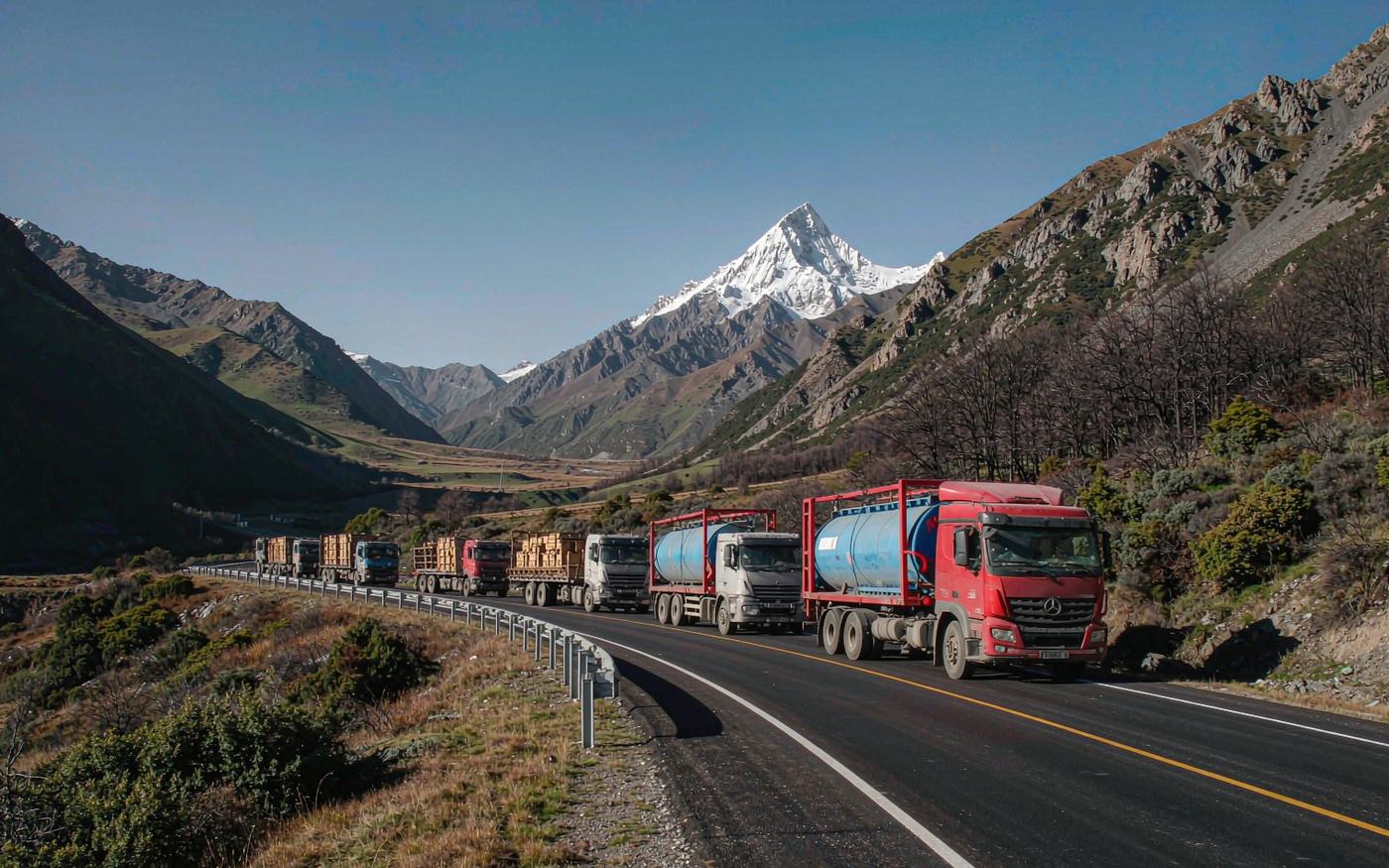
You cannot ship to Tajikistan without shipping through somewhere else first. The country is landlocked and mountainous, and every route into it depends on transit through a neighbour — most often Uzbekistan or Kyrgyzstan by road, or Kazakhstan by rail before the final leg. That single fact shapes the whole job: your transit neighbour is a second customs regime on the file, your transit leg is a second schedule to manage, and winter in the mountain passes is a real risk to the delivery date.
The second thing that surprises first-time importers is the bank reference. Published guidance for Tajikistan lists, among the documents attached to the Customs Cargo Declaration, a bank reference confirming one hundred percent payment of the advance payment for the listed goods. Most buyers have never been asked for this anywhere else. It means the money movement has to be complete and evidenced before the file is presented, which turns your payment terms into a documentation lead time.
The third is that the originals keep being asked for. Guidance notes that the taxpayer identification number original and the State Statistics Committee registration original may be requested at each phase of clearance. An importer whose documents are in a different city will find the file stalling repeatedly rather than failing once.
At a glance
Country: landlocked and mountainous in Central Asia, bordered by China, Kyrgyzstan, Uzbekistan and Afghanistan; capital Dushanbe, with Khujand and Kulob as the other main destinations. · Currency: the Tajikistani somoni. · Duty: published tariff guidance puts rates at 0–15 percent with a trade-weighted average near 7 percent; assessed on the customs value, generally CIF. · VAT: reported at 14 percent for 2024–2026 with a reduction to 13 percent indicated from 2027 — published references differ, so confirm the current rate with your broker. · Excise: specified categories only. · TIN: required for all commercial imports, original shown at each clearance phase. · Customs: the Customs Service under the Government of Tajikistan; not an EAEU member. · Trade status: WTO member since 2013. · Transit: TIR Carnet convention member since 1996.
How your cargo moves: China to Tajikistan
Eight steps from your supplier's door to yours. The last four are the ones shaped by local rules.
- Pickup from your supplierWe collect the goods anywhere in China and bring them to our consolidation point.
- Export clearanceChina customs declaration filed and released before the goods move to the port.
- Loading and departureContainer loaded, sealed and handed to the carrier at the Chinese port.
- Main carriageOcean, air or rail movement booked on the route agreed for your cargo.
- Arrival at the gatewayDischarge at the port or airport of entry, recorded on the carrier's manifest.
- Import clearanceCustoms declaration filed locally, with duty and tax assessed on the declared value.
- Customs releaseGoods released into free circulation once duty and tax are settled.
- Final deliveryOnward movement to your delivery address, warehouse or nominated depot.
Duty rates, VAT rates and clearance times move, and the figure that applies to your goods is the one set for your commodity code on the day of clearance. We check the current position against your code before your goods sail and confirm it to you in writing — ask for that check when you request a quote.
Landlocked, mountainous and always in transit
There is no ocean port and no alternative to a neighbour's border. Most overland cargo moves by truck through Uzbekistan or Kyrgyzstan; rail offers a lower per-ton cost on larger shipments but adds handling, which matters if your cargo is fragile. Air freight to Dushanbe is the fast option at roughly three to seven days. Where a sea leg is used at all, it always ends with a substantial overland transit.
Two consequences for planning. First, a delay at the transit border is your delay, even though it happens in a country you are not importing into — which is why the choice between the Uzbek and the Kyrgyz leg is a real decision and not a detail for the trucking company. Second, packaging has to be specified for a long overland journey with several loading stages and wide temperature swings: reinforced crates, cushioning between pieces, and waterproof wrapping under the wooden packaging.
The Customs Cargo Declaration and the file behind it
The Customs Cargo Declaration is the basic document of the clearance process, covering the shipment contents, ownership and destination. The inspector builds a file around it, and the file matters more than the form.
Importer credentials
- Certificate of registration as a legal entity
- Taxpayer identification number — original shown at each phase
- Charter and incorporation documents, ready if requested
- Certificate of registration with the State Statistics Committee
- For equipment imported as chartered capital, a registered charter and a legal statement from the Ministry of Justice
Shipment documents
- Power of attorney authorising the broker or a certified staff member
- International sales contract
- Shipping documents — bill of lading, packing list, transit country declaration
- Commercial invoice
- Certificate of origin
- Bank reference confirming 100 percent payment of the advance
- Transit declaration confirming arrival at the destination point
- Affidavit of compliance with limits and prohibitions
The bank proof that the goods were paid for in full
Single this one out, because it is the item most likely to ambush you. Published guidance lists a bank reference confirming one hundred percent payment of the advance payment for the listed goods as part of the declaration file. In practice that means the payment has to have moved and be evidenced before the file can be presented, which is a constraint on your payment terms, not just on your paperwork.
If your contract leaves a balance payable on arrival, raise it with the broker before you commit to a production slot in China. Where the shipment is valued above roughly ten thousand US dollars, published guidance also describes a copy of the buyer-seller contract and the bank payment evidence as expected — the same theme, applied at a value threshold.
Treat payment timing as a lead time. On most lanes the money can move while the goods are on the water. On this one it needs to be complete and documentable before the file is presented, so sequence it against production, not against transit.
Language, attestation and the consular step
Documents in languages other than Russian are described as requiring certified translation into Russian or Tajik by an accredited translation body. The commercial invoice is further described as needing chamber of commerce attestation and consular legalisation. Both of those happen in China, both take time, and neither can be cheaply improvised once the goods have left.
The other consistency requirement is the ordinary one and it is enforced: the invoice, packing list, transport documents and declaration have to agree on description, quantity and value. Published guidance for the region also notes that any correction on a document must be stamped, because an unstamped amendment is an invitation to a query.
Duty, the VAT rate through 2026 and excise
Customs duty is assessed on the customs value, generally the CIF figure, at the tariff rate for the HS code. Published tariff guidance puts rates between zero and fifteen percent with a trade-weighted average around seven percent, and describes the country as having a fairly liberal tariff. VAT is reported at fourteen percent for the 2024 to 2026 period, with a reduction to thirteen percent indicated from 2027 — though published references genuinely differ on the current figure, so confirm it with your broker rather than with a search result. Excise applies to specified categories.
Certain tariff lines have their own specific rates rather than an ad valorem percentage, and those change. One concrete example published for 2026: from 1 July 2026 the import duty on some air conditioners was increased from five to fifteen euros per unit. If you import a product category with a specific rate rather than a percentage, check the current line before you price the order.
Classification disputes
Where customs disagrees with your classification, there is an appeal route, but it is described as requiring a technical assessment report from a third-party testing body. That is expensive and slow compared with getting the code right at the start, so where a product sits near a classification boundary, resolve it before the goods leave China.
Product certificates and the agencies that issue them
The certificate set is unusually fragmented here, because different agencies issue for different product types. Missing one does not produce a rejection letter — it produces a container waiting.
| Product | Certificate | Issued by |
|---|---|---|
| General goods | Certificate of quality | TajikStandard or an accredited laboratory |
| Agricultural products | Quarantine certificate | State Quarantine Agency, Ministry of Agriculture |
| Animal products | Veterinary certificate | Customs checkpoint, Food Security Committee and the national diagnostics centre |
| Alcohol and tobacco | Quota and licence | Ministry of Agriculture |
| Pharmaceuticals | Import certificate | Ministry of Health |
| Radios, electronic and high-frequency devices | Type certificate | The communications service |
| Plants, seeds and silkworms | Import certificate | Ministry of Agriculture |
Meat products are also described as requiring halal certification, and chemicals as requiring a safety data sheet and dangerous goods transport documentation. Where conformity certification under GOST-TJ is mentioned by your supplier or broker, confirm whether it applies to your specific code rather than assuming it does.
TIR, bonded warehouses and temporary import
Tajikistan has been a TIR Carnet convention member since 1996, which is worth using: it simplifies the cross-border trucking formalities on the transit legs and reduces the number of times your cargo is opened and re-checked between the Chinese border and Dushanbe. Where your route and cargo qualify, ask for a carrier operating under TIR with customs seals through to the final warehouse.
For importers bringing goods in stages, bonded warehouses and free economic zones allow customs duty to be deferred, with resident companies able to hold stock without paying duty until it enters the domestic market. For equipment that will leave again — exhibits, test equipment, contractor's plant — temporary import applies. Published guidance describes it as requiring a bank guarantee equal to around 150 percent of the duties that would otherwise be payable, and notes that construction contractors can use an ATA carnet provided its validity does not run past the project contract period.
Second-hand equipment and the technical inspection
Used machinery is a common import on this lane and it carries its own step. Published guidance describes used equipment as needing the original purchase invoice alongside the normal documents, and as having to pass an inspection by the technical safety committee, with the inspection running around twenty working days. That is a month of calendar time added to your delivery promise, and the equipment will not be released while it runs.
Medical devices are subject to a national registration process, and the registration documents are described as valid for three years — which means a registration obtained for a previous shipment may still be in date, and one that has lapsed needs renewing before the goods move. Where the declared value of used equipment is low, customs checks it against its own valuation base, and an understated invoice becomes an adjustment and a delay rather than a saving.
Choosing between the Uzbek and the Kyrgyz transit legs
Both routes work, and the right one depends on the season, the border conditions at the time, and where in the country the cargo is going. Dushanbe and the south are commonly reached through Uzbekistan; the north around Khujand is often reached through Kyrgyzstan or Kazakhstan. Rather than fixing the route in the contract, ask the forwarder which leg is moving at the time of booking, and keep the flexibility to switch.
Winter is the variable that most often moves the date. The high passes close or slow, and published guidance for the region advises choosing carriers equipped for winter conditions on the inland leg and insuring the inland transit against jolting and handling damage, because the mountain road is not the gentle part of the journey.
Getting the declaration file ready in advance
- Confirm the importer holds a TIN and registration, and that the originals can be produced at each phase.
- Settle and evidence the advance payment so the bank reference can be issued with the file.
- Start the Russian or Tajik certified translations during production, not during transit.
- Get the invoice attested and legalised in China before the goods leave.
- Match the product to its sector certificate and confirm who issues it.
- Keep the contract copy and bank payment evidence for shipments above roughly USD 10,000.
- Ask for a TIR carrier where the route qualifies.
- Add twenty working days for the inspection if the equipment is used.
Why importers use Goodhope on this lane
Six things that are different about working with us on China to Tajikistan shipments.
Real examples through Tajikistan
Five shipments bought in China and delivered into Tajikistan, told end to end — where the order came from, how it moved, where it nearly went wrong, and how it finished. Client names are withheld at their request; the situations and the handling are what we deal with on this lane.
Always in transit · first shipment · China to Dushanbe
The purchase. A buyer new to importing asked for a port of discharge.
The move. Consolidated cargo routed overland through a neighbouring transit leg, with the route chosen before the truck was booked.
Where it nearly went wrong. This country is landlocked and mountainous, so nothing arrives at a Tajik port. Choosing between the two transit legs is the first routing decision rather than a detail of the journey.
How it finished. He chooses the leg at quotation now and knows where his cargo is at every stage.
The bank proof · before the truck · Shenzhen to Tajikistan
The purchase. A first-time buyer arrived at the border without proof that the goods had been paid for.
The move. Consolidated cargo with the bank proof prepared and held in the declaration file before departure.
Where it nearly went wrong. Clearance asks for evidence that the goods were paid for in full, and it asks at the border rather than in advance. Preparing it there means preparing it while the truck waits, and a waiting truck is the most expensive place to do paperwork.
How it finished. We line up the proof before booking. No shipment of his has stopped for it since.
The VAT figure · confirm before costing · Ningbo to Khujand
The purchase. A buyer costed his shipment on a value-added tax figure taken from a published comparison table.
The move. Consolidated cargo with the current rate confirmed through the broker before the price was agreed.
Where it nearly went wrong. Published references for the value-added tax rate differ, and a reduction has been indicated for later years. Costing from whichever table you found first is costing from a figure nobody has confirmed for your entry.
How it finished. We confirm the current rate before quoting. His landed costs have been right every time since.
Attestation · the consular step · Guangzhou to Tajikistan
The purchase. A buyer sent his standard document set and had it returned at the border.
The move. Consolidated cargo with documents attested and the consular step completed before the goods moved.
Where it nearly went wrong. Documents on this lane need attestation and, for some, a consular step, and both take longer than the road journey does. Sending an unattested set is sending it to be rejected.
How it finished. We complete the chain before departure. No document set of his has been returned since.
Second-hand equipment · the technical inspection · Shanghai to Kulob
The purchase. A buyer imported used machinery assuming it entered like new equipment.
The move. Consolidated cargo with the technical inspection arranged before the equipment shipped.
Where it nearly went wrong. Second-hand equipment is inspected technically and is not treated as new goods with a lower value. Arriving without that inspection arranged is arriving with cargo that has to wait for a process nobody has started.
How it finished. We arrange the inspection up front. Every used machine he has imported has cleared.
Why importers use Goodhope on this lane
Six things that are different about working with us on China to Tajikistan shipments.
Line up the bank proof before the truck is booked
Tell us what you are shipping, the HS codes if you have them, the packed dimensions and gross weight, the pickup city in China and the delivery address in Tajikistan. We will tell you which transit leg is moving and quote road, rail and air side by side, brief your consignee on the bank reference and the attested invoice so the file is complete before the goods arrive, flag any product that needs a sector certificate, and confirm the current VAT rate with a broker on the ground rather than quoting you a figure from a search result. Where the equipment is used, we will build the inspection into the schedule up front.
Get a quote Talk to usRelated pages
Frequently asked questions
What is the Customs Cargo Declaration?
The core clearance document, covering contents, ownership and destination. The file built around it matters more than the form.
Why does Tajikistan ask for a bank reference?
Published guidance lists a bank reference confirming 100 percent payment of the advance as part of the declaration file. Payment has to be complete and evidenced before presentation.
Do documents need translation?
Yes — certified translation into Russian or Tajik, and the commercial invoice is described as needing chamber attestation and consular legalisation.
What are the duty and VAT rates?
Duty 0–15 percent with an average near 7 percent. VAT is reported at 14 percent for 2024–2026 and 13 percent from 2027, though published references differ — confirm with your broker.
Is a TIN required?
Yes, for all commercial imports, and the original may be requested at each phase of clearance along with the statistics committee registration.
Which product certificates apply?
TajikStandard quality certificates, plus sector certificates: agriculture, veterinary, pharmaceuticals, and a communications service certificate for radios and electronic devices.
How does cargo physically reach the country?
Overland through Uzbekistan or Kyrgyzstan, or rail via Kazakhstan. TIR carnets have been available since 1996 and are worth using.
What about second-hand equipment?
The original purchase invoice plus a technical safety committee inspection of around twenty working days. Medical device registrations run three years.
Are bonded or temporary import options available?
Yes. Bonded warehouses and free economic zones defer duty, and temporary import needs a bank guarantee of around 150 percent of the duties, or an ATA carnet within the contract period.
How long does shipping take?
Roughly 25–35 days for full containers including inland transit, 30–45 for LCL, and 3–7 days by air to Dushanbe. Winter in the passes is the main variable.