
Home / Shipping to Turkey / How to Ship from China to Turkey
How to Ship from China to Turkey: KDV 20%, TAREKS & Customs Union Rules
Turkey is the most frequently misunderstood market on this route, and the misunderstanding starts with one sentence: Turkey has been in a customs union with the European Union since the mid-1990s — and it does nothing for goods originating in China. The customs union removes duty on trade between Turkey and the EU. Chinese goods arriving in Istanbul or Mersin pay Turkey's own duty rates, and they often pay more than the headline rate suggests.
The second thing is that the tax stack on this lane is usually heavier than the freight. Duty comes first, set by the GTİP commodity code. On top of that, Turkey applies an additional customs duty to a broad list of Chinese-origin consumer goods, and maintains anti-dumping measures on various Chinese products. Then KDV, the Turkish VAT, at 20%, is charged on the CIF value plus the duty plus any other taxes — so it compounds. A shipment that looks cheap on the ocean freight line can land with a tax bill close to a third of its value.
The third is procedural and specific to Turkey: TAREKS. It is a risk-based product control system run by the Ministry of Trade, and for electronics, machinery, medical devices, cosmetics, toys and some textiles it has to be cleared before customs will release the goods. Start it before the vessel leaves China, not when the container is already sitting at Ambarlı.
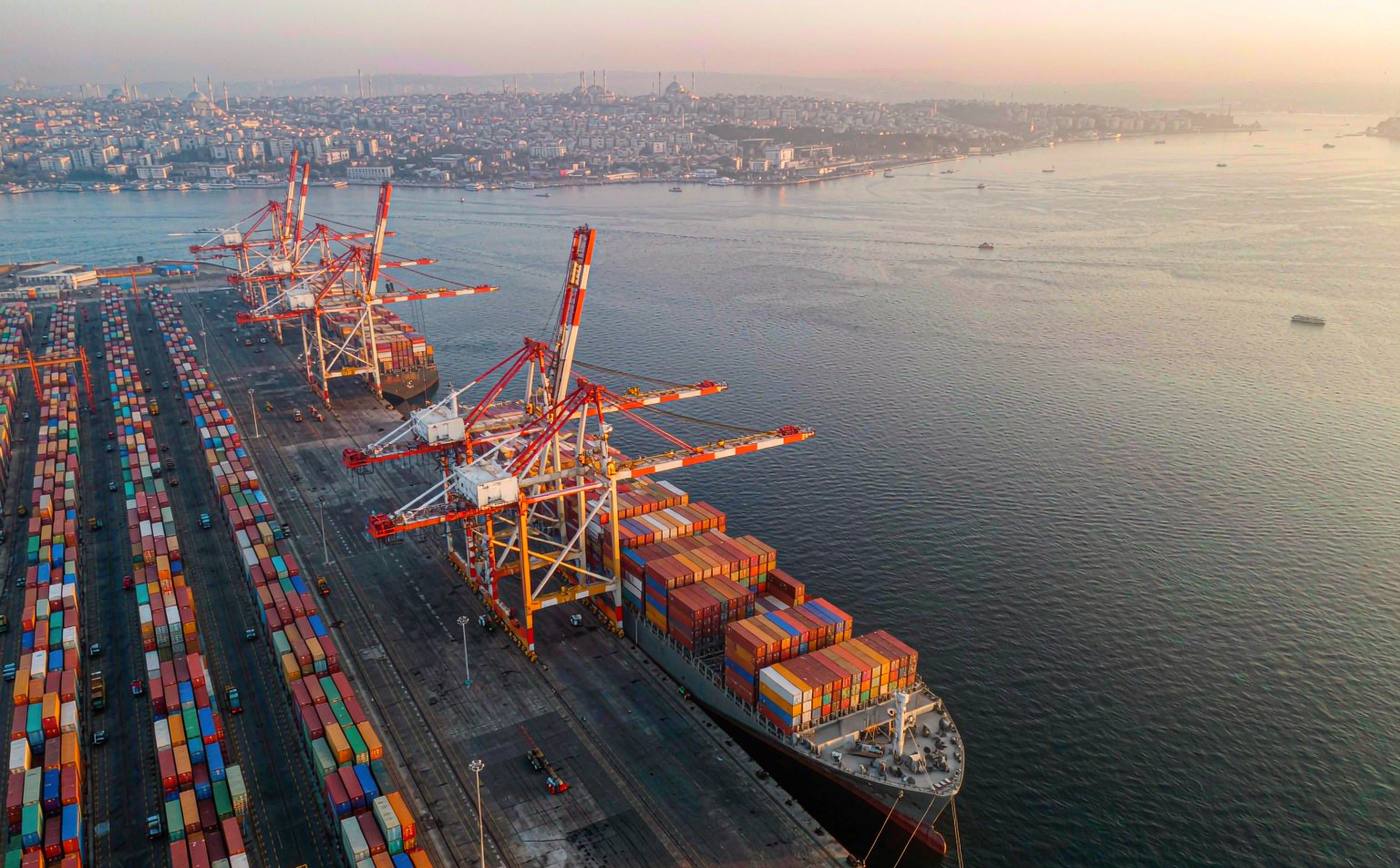
There is also a China connection on the ground. Kumport, the container terminal at Ambarlı west of Istanbul, has been majority-owned since 2015 by a consortium of COSCO, China Merchants and CIC, and handled 831,200 TEU in the first half of 2026, up 14.6% on the year before. The lane is busy and the carriers know it.
This guide is written for buyers importing from China for the first time. It covers what the customs union does and does not do, the ports and the Chinese-owned terminal, the Middle Corridor rail route, transit times by sea rail air and courier, trade terms including one release risk that is particular to Turkey, the documents and the tax number you need, TAREKS, the KDV calculation and the additional duties, VAT recovery and the AEO programme, how customs picks an inspection channel, the currency question, e-Fatura, using Turkey as a route into the EU, and how to tell whether a forwarder genuinely knows this market.
Turkey at a glance
- Not in the EU, but in a customs union with it for industrial goods. Chinese-origin goods get no preference.
- No EORI. You need a Turkish tax number, the VKN, and a registered importer of record.
- Kumport at Ambarlı is majority-owned by a COSCO, China Merchants and CIC consortium; 831,200 TEU in H1 2026.
- Mersin is the Mediterranean gateway to south-eastern Anatolia, Iraq and the eastern Mediterranean.
- KDV 20%, charged on CIF plus duty plus other taxes. Reduced rates of 10% and 1%.
- Additional customs duty on a broad list of Chinese consumer goods, plus anti-dumping on steel, textiles, tyres and furniture.
- TAREKS must be filed before arrival for many product categories.
- No de minimis since February 2026 — every commercial shipment pays full duty and VAT.
- Monthly KDV returns and payments are due by the 26th of the following month.
How your cargo moves: China to Turkey
Eight steps from your supplier's door to yours. The last four are the ones shaped by local rules.
- Pickup from your supplierWe collect the goods anywhere in China and bring them to our consolidation point.
- Export clearanceChina customs declaration filed and released before the goods move to the port.
- Loading and departureContainer loaded, sealed and handed to the carrier at the Chinese port.
- Main carriageOcean, air or rail movement booked on the route agreed for your cargo.
- Arrival at the gatewayDischarge at the port or airport of entry, recorded on the carrier's manifest.
- Import clearanceCustoms declaration filed locally, with duty and tax assessed on the declared value.
- Customs releaseGoods released into free circulation once duty and tax are settled.
- Final deliveryOnward movement to your delivery address, warehouse or nominated depot.
Duty rates, VAT rates and clearance times move, and the figure that applies to your goods is the one set for your commodity code on the day of clearance. We check the current position against your code before your goods sail and confirm it to you in writing — ask for that check when you request a quote.
Turkey is in a customs union with the EU, and it does not cover China
The customs union between Turkey and the European Union covers industrial goods and processed agricultural products. Raw agricultural goods sit outside it. Within that scope, EU-origin industrial goods enter Turkey duty-free and Turkish industrial goods enter the EU duty-free.
What it does not do is extend any of that to third countries. Chinese-origin goods pay Turkey's own tariff — the GTİP code, which is Turkey's version of the HS classification — at the rates Turkey sets, which in broad terms track the EU's Common Customs Tariff for industrial goods. There is no Turkey–China free trade agreement, and no preference to claim.
What the arrangement does give you is familiarity. Turkish customs law, Law No. 4458, is closely aligned with the EU Customs Code, so the shape of the procedure is one a European importer will recognise: an electronic declaration, a risk assessment, release for free circulation, and a paper trail that has to survive an audit. The single administrative document, the customs declaration and the broker's role all work the way they would in the EU.
What it does not give you is a European identifier. There is no EORI in Turkey. Instead you need a Turkish tax identification number — the vergi kimlik numarası, or VKN — and an importer registered with the customs administration. In practice you also need a licensed customs broker, a gümrük müşaviri, because the declaration is filed through the BİLGE electronic system and the procedure is not designed for a first-time importer to run alone.
The one-line version: familiar procedure, Turkish rates, and no European preference. Budget for Turkish duty even if your buyer thinks of Turkey as "almost Europe".
Kumport: the Istanbul terminal with Chinese shareholders
Kumport sits at Ambarlı, on the European side of Istanbul about 22 miles west of the entrance to the Bosphorus, on the Marmara coast. In 2015 a consortium of COSCO (40%), China Merchants Holdings International (40%) and CIC Capital (20%) bought the majority of the port, and COSCO Shipping Ports, as majority shareholder, publishes the throughput figures.
Those figures are strong. The terminal handled 1.54 million TEU across 2025 and 831,200 TEU in the first six months of 2026, up 14.6% year on year, with May the strongest month at 160,000 TEU. Its second-half performance will depend on European demand, Far East service patterns, blank sailings and what happens on the Red Sea routing.
One caution on reading those numbers: they cover the Kumport terminal only. The Ambarlı area has several terminals — Marport among them — so Kumport's volume is not the total for the port area, and neither figure is Turkey's national container total. When you book, ask which terminal your service uses, because the gate, the free time and the truck appointment system differ between them.
For a first-time importer the practical value of the Chinese shareholding is simple: the carriers serving this lane have a direct commercial interest in it, so space is generally available and the service patterns are stable. It does not change customs, duty or VAT.
Mersin or Ambarlı: two ports facing different markets
| Port | Position | Serves | Choose it when |
|---|---|---|---|
| Ambarlı (Istanbul) | Sea of Marmara, European side, west of the Bosphorus | Istanbul, the Marmara industrial belt, Bursa, Kocaeli, Gebze, Thrace | Your buyer is in the north-west, or the service calls it directly |
| Mersin | North-eastern Mediterranean | South-eastern Anatolia, Gaziantep, Adana, and onward to Iraq and the eastern Mediterranean | The delivery is in the south or east, or your buyer is serving Iraq |
| İzmir | Aegean coast | İzmir, the Aegean hinterland and western Anatolia | The cargo belongs in western Turkey and a direct service exists |
| Gemlik / Yalova | Southern Marmara | The Bursa automotive and manufacturing cluster | You are supplying a factory in Bursa |
| İskenderun, Samsun, Tekirdağ | South-east, Black Sea, Marmara | Regional hinterlands | The delivery address is local to one of them |
Most services from the Far East call Ambarlı, Mersin or both, and some cargo moves as a feeder from a Mediterranean hub such as Piraeus or Port Said. Because Inland haulage across Turkey is long — Istanbul to Mersin is a serious road journey — choose the port by the delivery address rather than by habit, and confirm which terminal before you book.
The Middle Corridor by rail, and what it really saves you
Between sea and air there is a third option that matters more here than almost anywhere else in Europe: the Middle Corridor, also called the Trans-Caspian International Transport Route. The path runs from China through Kazakhstan to the Caspian, across by sea to Azerbaijan, then into Georgia and on to Turkey over the Baku–Tbilisi–Kars railway.
Its pitch is straightforward: faster than the sea route around Suez, considerably cheaper than air. Services are commonly quoted at around three to four weeks door to door, sitting between the two. [Schedule performance varies with the Caspian crossing and the gauge changes along the route — confirm current transit times for your specific service.]
The honest caveats matter more than the pitch. Capacity on the corridor is limited and block trains fill with mixed cargo. There are several gauge changes between China and Turkey, each a handling point. And reliability has varied with weather, border processing and the shipping capacity available on the Caspian leg. The route also carries strategic weight precisely because the northern rail corridor through Russia is constrained, which is why investment keeps arriving and why the corridor is worth watching.
Our recommendation for a first shipment is unglamorous: book sea, and price rail as the alternative. Move to the corridor once you have a steady flow and a reason to care about three weeks. It is a good option that is easy to mis-plan.
Three modes into Turkey, and the freight each one suits
| Mode | Typical transit | Ends at | Fits when |
|---|---|---|---|
| Sea FCL | About 25–35 days port to port to Ambarlı or Mersin, plus clearance and inland delivery | Port to port, or door to door if arranged | Repeat orders and anything that fills or justifies a container |
| Sea LCL | The sea leg plus roughly 5–10 days for consolidation and deconsolidation | Container freight station at destination | First orders and a few cubic metres — with a warning on free time below |
| Rail, Middle Corridor | Commonly quoted around 3–4 weeks door to door | Door to door, or rail terminal | When three weeks matters and the cargo value justifies it above sea |
| Air freight | About 3–7 days airport to airport on direct freighter services | Istanbul Airport (IST), or Sabiha Gökçen | Urgent, high value, or a production line waiting on a part |
| Express courier | About 3–7 days door to door | Any Turkish address | Samples, documents, small parcels — now fully assessed for duty and KDV |
Two things distinguish Turkey from the European lanes on this page. First, Istanbul Airport is a genuine long-haul cargo hub with direct freighter service from China, unlike the smaller European capitals where cargo has to transit Frankfurt, Vienna or Amsterdam. Air freight into Turkey is therefore shorter and more predictable than the air options into Ljubljana or Zagreb. See our air freight to Turkey page.
Second, free time at Turkish terminals is short, particularly for LCL, where it can be a matter of days rather than the week or more you may be used to. Deconsolidation delays, a document query or a red channel inspection convert into storage quickly. Ask your forwarder to state the free time in writing before you book.
Trade terms on a Turkish order, and the bill of lading risk
| Term | Who pays the main carriage | Who clears and pays duty and KDV | What it means in Turkey |
|---|---|---|---|
| EXW (Ex Works) | You, from the factory door | You, through a Turkish importer | Most work; only sensible with an agent in China |
| FOB (Free On Board) | You | You, through a Turkish importer | Control of the routing — but read the release warning below |
| CIF | Seller, to the Turkish port | You | Seller books the carrier; clearance, duty and KDV stay yours |
| DAP | Seller, to the named place | You | Delivery handled; check which destination charges are excluded |
| DDP | Seller | Seller or their agent — who must have a Turkish VKN | Least work, but the party clearing must actually be registered in Turkey. Ask who |
The release risk on this lane. Turkish customs practice allows an importer to take delivery against a bank guarantee or a letter of indemnity even when the original bill of lading has not been surrendered. For a Chinese exporter selling on FOB or CIF, that means your buyer may be able to collect the cargo while you are still holding the bill of lading as your leverage. Do not let the bill of lading be your only security — structure the payment accordingly, or ship with a forwarder who controls the release process at destination.
And the scope question, as always separate from the term: port to port runs from load port to discharge port, airport to airport is the air equivalent, and door to door adds pickup and final delivery. Goodhope works port to port on ocean freight and airport to airport on air freight, and states which one you are buying.
The documents Turkish customs asks for, and the tax number behind them
The document list is close to the European one. The identifier behind it is not.
VKN — vergi kimlik numarası
The Turkish tax identification number. Your importer of record must hold one and be registered with the customs administration. No registered Turkish importer means no release, which is the single most common reason a DDP arrangement into Turkey fails.
Gümrük müşaviri
A licensed Turkish customs broker. Not a formality in practice: the declaration is filed through the BİLGE electronic system, product registrations run through TAREKS, and the procedure assumes a professional filer. Choose one with a record on your product category.
The document set itself:
- Commercial invoice (ticari fatura) — GTİP codes, specific product descriptions rather than generic phrases, quantities, unit and total values, currency, country of origin and both parties' details.
- Packing list — piece count, net and gross weights, dimensions.
- Bill of lading or air waybill.
- Insurance certificate, where the term requires it.
- Certificate of origin, and where a preference is claimed, the correct preferential certificate.
- Sector certificates — TAREKS reference numbers, KKDIK registration for chemicals, surveillance certificates (gözetim belgesi) for controlled goods, and conformity documentation for regulated products.
- An advance electronic declaration lodged with Turkish customs before the vessel arrives.
On declared value: Turkish customs cross-references declared values against its own reference price database. Under-declaration is the fastest route to a physical inspection, and under Article 234 of Customs Law No. 4458 a short-paid value can trigger a penalty of roughly three times the underpaid duty. Invoice the real value and make sure the invoice, packing list and bill of lading agree on every figure.
TAREKS: the gate that opens before the ship arrives
TAREKS is Turkey's risk-based trade control system, operated by the Ministry of Trade. It screens imports against product safety requirements before customs can release them, and it is the step most first-time importers to Turkey have never heard of.
Product categories commonly in scope include electronics, machinery, medical devices, personal protective equipment, cosmetics, toys and selected textiles. Where a product is in scope, the importer of record or their broker must file a registration and obtain a reference number, and processing takes days to weeks depending on the risk class.
The operational consequence is the whole point: start TAREKS before the vessel departs China. If the container arrives at Ambarlı without the reference number in place, it sits at the terminal accruing storage while the application works through the system, and Turkish free time is short. This is the most avoidable delay on the lane.
Two adjacent requirements are worth knowing. KKDIK is Turkey's equivalent of EU REACH for chemical substances, and a gözetim belgesi — a surveillance certificate — applies to certain controlled goods. Both are the importer's responsibility and both take time.
KDV at 20 percent, and how it stacks on top of duty
Turkish VAT, KDV — Katma Değer Vergisi — applies at 20% standard, with a reduced rate of 10% for basic foods, medical supplies and certain textiles, and a super-reduced rate of 1% for newspapers, periodicals and certain essentials.
The calculation is cumulative, and that is what catches people. KDV is charged on the CIF value plus the customs duty plus any other taxes — so duty, additional customs duty, ÖTV and anti-dumping all sit inside the KDV base.
Take a shipment with a CIF value of €10,000 attracting 10% duty. Duty is €1,000. The KDV base becomes €11,000, and KDV at 20% is €2,200. Total tax is €3,200, or 32% of the CIF value — before any additional customs duty or anti-dumping, which sit on top and enlarge the base further. Model that before you set a selling price.
Three further charges can appear:
- ÖTV, the special consumption tax, applies to four product groups: petroleum products and natural gas, motor vehicles, tobacco and alcohol, and certain luxury goods and electronics. Rates in these groups can be very high.
- A resource utilisation support fund levy applies to import transactions where payment is deferred — that is, where the importer pays the supplier after customs clearance. Paying in advance or at clearance avoids it. It is a small thing that is easy to avoid once you know it exists.
- Interest and penalties on amended declarations, which is why classification accuracy matters here more than on most lanes.
Finally: Turkey removed its low-value de minimis exemption in February 2026. Every commercial shipment, of any value, is now subject to full duty and KDV. That is separate from the EU's July 2026 change and it catches samples and small parcels as well as containers.
Duty, additional customs duty and anti-dumping on Chinese goods
Base customs duty comes from the GTİP code, generally in the zero to twenty percent range for industrial goods, with some agricultural products rated far higher. That is the number most importers budget for, and on this lane it is usually the smallest of the three.
The second layer is additional customs duty, İGV, which applies to a broad and repeatedly widened list of Chinese-origin consumer goods. It stacks on top of the base rate, and it is the reason a "10% duty" product can arrive with a materially higher assessment.
The third is anti-dumping and safeguard measures, in force on a range of Chinese products including steel, textiles, tyres, furniture and some machinery. Turkey is among the more active users of trade remedies against Chinese goods, and the measures change, so the status has to be checked at the time of shipping rather than remembered from last year.
The check to run before you ship: for your GTİP code, confirm the base duty rate, whether İGV applies to Chinese origin, and whether an anti-dumping or safeguard measure is in force. Three questions, one code, and the answer changes your landed cost more than the freight negotiation will.
Recovering import KDV, and what the AEO certificate changes
A business registered for Turkish KDV declares the import VAT and deducts it as input VAT in its monthly return, so for a registered importer the amount is recovered rather than lost. Returns and payments are due by the 26th of the month following the period.
Turkey does not run a standalone refund scheme for non-established businesses comparable to the EU's Thirteenth Directive. Excess input VAT is normally carried forward to future periods, or refunded on formal application and approval by the tax authorities. If you expect to be in a persistent refund position, raise it with your adviser before the first shipment rather than after six months of it.
The bigger lever is YYS — Yetkilendirilmiş Yükümlü Statüsü, Turkey's Authorized Economic Operator programme. Benefits include reduced physical inspections and green lane treatment, simplified procedures, priority processing, reduced guarantee requirements, and mutual recognition with the EU AEO and US C-TPAT programmes. Qualifying requires three or more years of customs operations, a clean compliance record, financial solvency and documented internal controls.
The practical reading: a new importer will not have YYS on day one. Plan for standard processing, keep your declarations accurate from the first one, and work with a broker whose own record supports you. The certificate is a two-to-three-year project, not a form.
Green, yellow, red and blue: how Turkish customs picks a lane
Every declaration is risk-scored into one of four channels, and the channel decides how long your cargo waits.
| Channel | What happens | Typical effect |
|---|---|---|
| Green | No document check, no physical inspection | Automatic release |
| Yellow | Document review of invoice, packing list and certificates | Usually resolved in 1–3 working days |
| Red | Document check plus physical inspection, sometimes sampling or laboratory testing | Adds 5–7 working days, plus daily storage at the terminal |
| Blue | Post-release audit | Release first, documents checked later; keep records for at least five years |
What drives the score is largely within your control: accurate GTİP codes, a declared value consistent with the reference price database, complete sector certificates, and a clean record for the importer and broker. A missing TAREKS reference, a vague product description or an invoice that disagrees with the packing list will move you down the list.
And the reason it matters commercially is the interaction with free time. A red channel adds days, and days at a Turkish terminal are charged. The cost of a classification error is not the duty difference — it is the week of storage and handling on top of it.
The lira, and why the currency in your quote matters
The Turkish lira has depreciated sharply against the US dollar and the euro since 2021, and that has a direct mechanical effect on your shipment: duty and KDV are assessed on a value converted into lira at the rate applicable at the time, so the exchange rate used affects the tax you actually pay.
Two practical consequences. First, ask which currency your landed-cost quote is locked in. A quote with a fixed total in dollars or euros protects you from movement between booking and clearance; a quote that passes the currency exposure through to you does not. Second, your buyer sells in lira while your costs are in dollars or euros — that gap is theirs to manage, but it shapes how quickly they reorder and how much they will commit to up front.
None of this is a reason to avoid the market. It is a reason to be explicit about currency in the contract, on both the freight side and the goods side.
e-Fatura and e-Arşiv: the invoicing system you will be asked about
Turkey runs one of the more developed electronic invoicing regimes anywhere, and your buyer will expect you to have heard of it.
- e-Fatura — the B2B and B2G electronic invoice, issued and exchanged in XML, validated through the revenue administration, GİB, or an approved integrator, with a digital signature and a unique identifier.
- e-Arşiv — the e-archive invoice, used where the recipient is not registered in the e-Fatura system.
- e-Defter — the electronic ledger.
- e-İrsaliye — the electronic waybill, which accompanies the physical movement of goods.
Invoices must carry both parties' tax numbers, product or service codes, and the VAT rates and amounts. Monthly VAT returns are filed through GİB's interactive tax office, with returns and payments due by the 26th of the following month, and records retained for at least five years.
What it means for you as the shipper: your Chinese commercial invoice is the customs document and it is not an e-Fatura, but your Turkish buyer needs it complete, accurate and prompt, because it feeds their ledger and their return. Send it with the shipment. The e-İrsaliye is the piece that touches logistics, because the electronic waybill travels with the goods on the domestic leg — ask your buyer whether their delivery process needs one raised before the truck arrives.
A private buyer and a Turkish company with a vergi numarasi
| Private individual | Registered Turkish company | |
|---|---|---|
| Identifier | A Turkish identification number for the transaction | VKN — vergi kimlik numarası — plus KDV registration |
| Duty and KDV | Paid at clearance | Paid at clearance, then deducted as input VAT in the monthly return |
| Recovery | None — 20% is a real cost | Recovered through the return; excess carried forward or refunded on application |
| Registration threshold | Not applicable | No minimum revenue threshold for domestic businesses; non-residents may need to register if they make taxable supplies |
| Sector registrations | Not normally | TAREKS, KKDIK and surveillance certificates as applicable |
| Practical limit | Personal and own-use imports are treated leniently; commercial quantities are treated as a business | Full compliance, including e-Fatura and monthly filings |
As everywhere, the line is drawn by substance. An individual importing commercial quantities for resale is a business, and the customs administration will treat them as one. For a genuine personal purchase, the paperwork is lighter and the 20% is simply a cost.
Using Turkey to reach the EU, and what an A.TR does
This is why some buyers import into Turkey rather than into Greece or Bulgaria. The A.TR movement certificate is the document that activates the customs union: it certifies that industrial goods are in free circulation in Turkey, and on that basis they enter EU member states at zero customs duty.
The detail that surprises people: the A.TR does not require the goods to originate in Turkey. Goods imported into Turkey with all duties paid, then re-exported to the EU, can qualify. It is issued by the local chamber of commerce with customs endorsement and is valid for four months from issue.
The mirror-image caution: goods that have not entered free circulation — cargo moving through a Turkish free zone and onward without being released for free circulation — do not qualify. Turkey has eighteen active free zones, which give duty and VAT exemption for goods that enter, are processed and are re-exported without entering Turkish customs territory. That is a genuinely useful structure for manufacturing and re-export, and a trap if you assume it also gives you EU duty-free access.
The commercial question to model: duty paid in Turkey buys you duty-free entry to the EU, so compare that route against importing directly into an EU port. For some product codes the numbers favour Turkey; for others they do not. Run both before you commit.
Finding a supplier when the tax side outweighs the freight
On this lane, sourcing decisions and tax decisions cannot be separated. A supplier who offers a slightly lower unit price on a product with a higher duty rate, an İGV listing or an anti-dumping measure behind it is not offering you a lower price at all.
Finding suppliers online through B2B marketplaces is how most first orders happen — fast, broad, but with the risk that you are dealing with a trading company rather than a factory, that specifications drift between sample and production, and that goods are not ready when promised. The pattern that fits is: sample by courier, first real order by LCL, FCL once volumes justify it. Our pages on buying through Alibaba and 1688 and sourcing from 1688 cover the mechanics.
Meeting suppliers at trade fairs costs more and takes longer, but specifications are usually right first time and the relationship survives a dispute. The pattern is larger, less frequent orders.
Either way, consolidation in China is what makes the economics work here: several suppliers, one container, one declaration, one set of certificates — rather than three consignments each attracting its own minimum charges and its own chance of a document problem. See our pages on warehousing and consolidated shipments.
How to test a forwarder on the Turkish customs side
These questions separate a forwarder who books Turkey from one who has a rate sheet, and none of them require you to know the industry first.
- Do they ask for the GTİP code before quoting? If they quote freight without knowing what the goods are, they cannot tell you about additional customs duty or anti-dumping.
- Do they raise TAREKS? If your product is in scope and they have not mentioned it, they have not thought about your clearance.
- Which port, and which terminal? Ambarlı and Mersin are different markets, and Ambarlı alone has several terminals.
- How many days of free time, in writing? LCL free time in Turkey is short, and it is the number that turns a delay into a bill.
- Which currency is the quote fixed in? Given the lira, this is not a formality.
- Do they know about release without the original bill of lading? If they do, they will also tell you how they control the release.
- Can they name the Turkish broker, and is your importer of record registered with a VKN? Without a registered importer there is no clearance, whatever the freight arrangement says.
- Are destination charges itemised? Terminal handling, documentation, delivery order and the inland leg listed separately, not folded into one number.
Warning signs are consistent: an "all-in" quote with no commodity code asked for, a promise of clearance without a named importer of record, silence on TAREKS, and urgency without a sailing date attached.
From the factory to a Turkish address, in order
Fix the GTİP code and check the full duty position
Base duty, whether additional customs duty applies to Chinese origin, and whether an anti-dumping or safeguard measure is in force. Do this before you agree a price with the supplier.
Confirm your importer of record has a VKN
A Turkish tax number and customs registration. Without it nothing clears, regardless of who pays the freight.
Start TAREKS and any sector registration
Before the vessel sails. Electronics, machinery, medical devices, PPE, cosmetics, toys and selected textiles are commonly in scope.
Agree the trade term, and think about the release
Put the term in the contract, and decide how you are secured if the buyer can take delivery without the original bill of lading.
Book space and name the port and terminal
Ambarlı or Mersin by the delivery address, plus the service and whether it calls directly.
Collect from the factory, or consolidate
One or several suppliers, checked against the packing list, loaded in China.
China export clearance
Export declaration and release, with a final document check where a mismatch is still cheap to fix.
Main carriage
Sea around 25–35 days port to port, rail on the Middle Corridor in roughly three to four weeks, or air into Istanbul in about three to seven days.
Advance declaration, then arrival
The electronic declaration goes in through BİLGE before the vessel arrives, and the container is discharged and starts its free time.
Risk channel, then assessment
Green, yellow, red or blue. Duty, any additional customs duty or anti-dumping, then KDV at 20% on the cumulative base.
Payment and release
Taxes paid, then release. If the buyer's payment to you is deferred, the support fund levy becomes relevant — paying up front avoids it.
Inland delivery and the paperwork that follows
Road to the final address, with an e-İrsaliye if the buyer's process needs one, and a complete commercial invoice for their e-Fatura records.
A first container into Ambarlı, and the missing TAREKS number
Three illustrative shipments, drawn from how this lane actually behaves. They are examples, not client records.
A 40ft high-cube of small domestic appliances from Ningbo to Istanbul. The freight was booked correctly and the vessel arrived on schedule. What cost money was TAREKS: the product category was in scope and the registration had not been started, so the container sat at Ambarlı while the application went through, and free time expired before release. The lesson is procedural, not commercial — file TAREKS before the vessel sails.
An LCL shipment of textiles from Guangzhou to Mersin. The buyer had budgeted the base duty rate and nothing else. The assessment came back with additional customs duty on top, because the product sat on the list that applies to Chinese-origin consumer goods, and the KDV was then charged on the larger base. The freight quote had been the cheapest of three. The lesson: on this lane the duty position is worth more than the freight difference.
Three hundred kilograms of automotive spare parts flown from Guangzhou to Istanbul. Direct freighter capacity made this fast — days, not weeks — and the airport-to-airport leg was uneventful. What held the shipment was the importer's registration: the VKN and customs registration were not complete, so the cargo could not be released. The lesson is that in Turkey, administrative readiness is part of transit time.
What Goodhope handles on the Turkish half of a shipment
We are the China end of this lane, and on this lane in particular the boundary matters.
- Ocean freight port to port — FCL and LCL into Ambarlı or Mersin, with the port, the terminal and the service named in writing. See our Turkey freight rates 2026 and shipping to Turkey services pages.
- Air freight airport to airport — into Istanbul, where direct freighter capacity from China exists, with chargeable weight worked out before you book. See our air freight to Turkey page.
- We ask for the GTİP code before we quote — because the duty position changes your landed cost more than the freight does, and we would rather raise it early.
- We ask about TAREKS and about the importer of record — two questions that decide whether your cargo clears in a week or sits.
- Consolidation in China — several suppliers, one container, one declaration, one set of certificates. See our non-DG chemicals to Turkey and dangerous goods to Turkey pages for the regulated categories.
- Plain answers on what we do not do — Turkish import clearance, TAREKS registration, KDV accounting and e-Fatura reporting belong to the importer of record, who must hold a Turkish tax number. We coordinate with them and we do not pretend otherwise.
Why importers use Goodhope on this lane
Six things that are different about working with us on China to Turkey shipments.
Price a Turkey shipment with the tax side included
Send us the product and its GTİP code if you have it, the carton count and total weight or volume, the supplier's city and the delivery address in Turkey. We will name the port and terminal, tell you whether the service calls directly, flag TAREKS if your product is in scope, and itemise the destination charges — so the duty, the additional duty and the 20% KDV are numbers you have modelled rather than discovered.
Frequently asked questions
Is Turkey in the EU customs union, and does that help goods from China?
Turkey has been in a customs union with the European Union since the mid-1990s, covering industrial goods and processed agricultural products. It removes customs duty on trade between Turkey and the EU: EU-origin industrial goods enter Turkey duty-free and Turkish industrial goods enter the EU duty-free. It does nothing for goods originating in China. Chinese goods arriving in Turkey pay Turkey's own duty rates, and in practice they may pay more than the headline rate because Turkey also applies additional customs duty to a broad list of Chinese-origin consumer goods and maintains anti-dumping measures on various Chinese products. The customs union does mean the paperwork feels familiar, because Turkish customs law is closely aligned with the EU Customs Code.
Which port should I use for shipping from China to Turkey?
Ambarlı, on the Sea of Marmara west of Istanbul, serves the Istanbul and Marmara industrial belt, including Bursa, Kocaeli and Gebze, and is where the Kumport terminal sits. Mersin, on the Mediterranean, is the country's main container port and the gateway to south-eastern Anatolia, Iraq and the eastern Mediterranean. İzmir serves the Aegean, Gemlik and Yalova serve the Bursa automotive cluster, İskenderun the south-east, and Samsun the Black Sea coast. Choose by where the goods are going and by which port your carrier actually calls, then confirm the terminal, because the Ambarlı area alone has several.
How long does shipping from China to Turkey take?
Sea freight to Ambarlı or Mersin is commonly quoted at around 25 to 35 days port to port, plus clearance and inland delivery, and Red Sea routing conditions can lengthen it. LCL adds roughly five to ten days for consolidation and deconsolidation, and free time at Turkish terminals for LCL cargo is short, so a delay converts quickly into storage charges. The Middle Corridor rail route through Central Asia, the Caspian and the Baku to Tbilisi to Kars railway sits between sea and air, commonly quoted at around three to four weeks door to door, though performance varies with the Caspian crossing and the gauge changes along the way. Air freight into Istanbul Airport is about three to seven days airport to airport on the direct freighter services that exist from China, and express courier about three to seven days door to door.
What taxes apply when importing into Turkey?
Customs duty set by the GTİP commodity code, generally in the zero to twenty percent range for industrial goods and higher for some agricultural products. On top of that, additional customs duty applies to a broad list of Chinese-origin consumer goods, and anti-dumping or safeguard measures apply to various Chinese products including steel, textiles, tyres and furniture. Then KDV, the Turkish VAT, at 20 percent standard with reduced rates of 10 and 1 percent, charged on the CIF value plus duty plus any other taxes, so it compounds. Special consumption tax, ÖTV, applies separately to vehicles, alcohol, tobacco, petroleum products and some luxury goods. A resource utilisation support fund levy can also apply where the importer pays the supplier after clearance rather than in advance. Confirm the total for your code with a Turkish broker before you commit to a price.
Do I need an EORI number to import into Turkey?
No. EORI is a European Union identifier and Turkey is not in the EU. What you need instead is a Turkish tax identification number, the vergi kimlik numarası or VKN, and an importer of record registered with the Turkish customs administration. In practice you also need a licensed customs broker, a gümrük müşaviri, to file the declaration through the BİLGE electronic system. A business importing into Turkey without a registered Turkish importer will not get the goods released, which is the main thing to check before agreeing to any delivered duty paid arrangement.
What is TAREKS, and do I need it?
TAREKS is Turkey's risk-based trade control system, run by the Ministry of Trade, which screens imports against product safety requirements before customs can release them. Electronics, machinery, medical devices, personal protective equipment, cosmetics, toys and selected textiles are commonly in scope. Where they are, your importer of record or their broker must file a registration and obtain a reference number, and processing can take days to weeks depending on the risk class. Start it before the vessel leaves China. If the goods arrive at Ambarlı without the reference number in place, the container sits at the terminal accruing storage while the application works through the system.
Can I recover Turkish import VAT?
A business registered for Turkish KDV declares the import VAT and deducts it as input VAT in its monthly return, so for a registered importer it is recovered rather than lost. Monthly returns and payments are due by the 26th of the month following the period. Turkey does not operate a standalone refund scheme for non-established businesses comparable to the EU's Thirteenth Directive, so excess input VAT is normally carried forward or refunded on formal application and approval. Separately, the Authorized Economic Operator programme, YYS, gives qualifying importers faster channels and reduced inspection rates, but it requires several years of customs operations and a clean compliance record, so a new importer should plan for standard processing.
Is there a duty-free threshold for small parcels into Turkey?
No, not any more. Turkey removed its low-value de minimis exemption in February 2026, so every commercial shipment is now subject to full customs duty and KDV regardless of value. That is a separate change from the European Union's removal of its 150 euro duty relief in July 2026, and it applies to parcels and samples as well as to container freight. If you are sending samples by courier, expect them to be assessed.
Can my buyer take delivery in Turkey without the original bill of lading?
In many cases yes. Turkish customs practice permits an importer to take delivery against a bank guarantee or a letter of indemnity even when the original bill of lading has not been surrendered. For a Chinese exporter selling on FOB or CIF terms that is a real exposure: your buyer may be able to collect the cargo while you are still holding the bill of lading as your leverage. Structure your payment terms so the bill of lading is not your only security, or ship with a forwarder who controls the release process at destination. Confirm the arrangement with your own legal adviser before you rely on it.
What does a Chinese freight forwarder handle on a Turkish shipment?
On the China side a forwarder collects goods from the factory or factories, consolidates them if needed, clears them for export, books space and issues the bill of lading or air waybill, and provides tracking. Goodhope works port to port on ocean freight and airport to airport on air freight, names the port and the terminal, asks for the GTİP code before quoting so the duty position is not a surprise, and coordinates with your Turkish broker. Turkish import clearance, TAREKS registration, KDV accounting and e-Fatura reporting belong to the importer of record, who must hold a Turkish tax number. We will say plainly which parts are ours and which are not.