
Home / Shipping to the Turks and Caicos Islands / How to Ship from China to the Turks and Caicos Islands
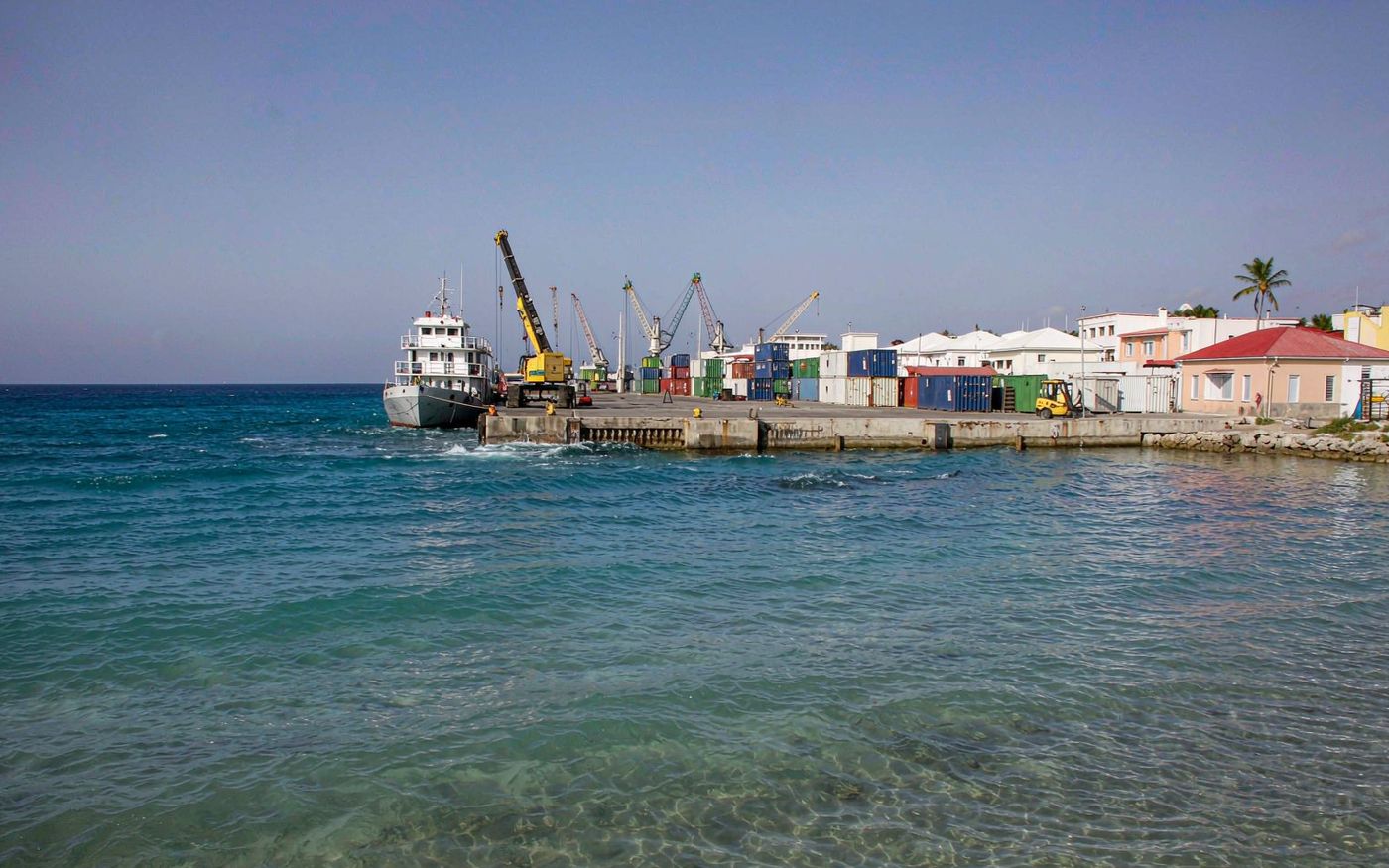
How to Ship from China to the Turks and Caicos Islands: CIF Duty, the Processing Fee & South Dock
The Turks and Caicos Islands have no income tax, no corporate tax, no capital gains tax and no VAT — and that is the reason importing there is expensive. A government has to raise money somewhere. When it collects nothing on income and nothing on consumption, it collects at the dock. Published analysis puts customs duty together with the Customs Processing Fee at roughly thirty percent of total government revenue. There is no tax haven loophole here; there is simply a border charge that has to carry the whole fiscal load.
The second thing to understand is the base. Duty is assessed on CIF — cost, insurance and freight — not on the invoice value. On most lanes that distinction is a technicality. Here it is not, because the sea leg into Providenciales is expensive, and the freight you have already paid becomes part of the value being taxed. A cheap product with an expensive crossing is not as cheap as the price list suggests.
The third is the one that catches first-time importers hardest: a Customs Processing Fee that applies even when the goods themselves are duty-free. Duty relief does not make the consignment free. It removes one charge and leaves the other standing.
At a glance
Territory: British Overseas Territory in the Caribbean, south-east of the Bahamas; capital Cockburn Town · Customs: own independent regime; not UK and not US customs territory; associate CARICOM member since 1991 · Taxes: no income tax, no corporate tax, no capital gains tax, no VAT, no general sales tax · Duty base: CIF value, not invoice value · Additional charge: Customs Processing Fee, applying even on duty-free goods · System: ASYCUDA World, Single Administrative Document · Main port: South Dock, Providenciales · Main airport: Providenciales International (PLS) · Currency: US dollar
How your cargo moves: China to the Turks and Caicos Islands
Eight steps from your supplier's door to yours. The last four are the ones shaped by local rules.
- Pickup from your supplierWe collect the goods anywhere in China and bring them to our consolidation point.
- Export clearanceChina customs declaration filed and released before the goods move to the port.
- Loading and departureContainer loaded, sealed and handed to the carrier at the Chinese port.
- Main carriageOcean, air or rail movement booked on the route agreed for your cargo.
- Arrival at the gatewayDischarge at the port or airport of entry, recorded on the carrier's manifest.
- Import clearanceCustoms declaration filed locally, with duty and tax assessed on the declared value.
- Customs releaseGoods released into free circulation once duty and tax are settled.
- Final deliveryOnward movement to your delivery address, warehouse or nominated depot.
Duty rates, VAT rates and clearance times move, and the figure that applies to your goods is the one set for your commodity code on the day of clearance. We check the current position against your code before your goods sail and confirm it to you in writing — ask for that check when you request a quote.
A territory funded at the dock, and what that implies for your quote
Once you accept that the border is where the revenue is raised, the rest of the picture falls into place. Duty rates are not designed to be trivial. Reliefs exist but are specific rather than general. And the administration is thorough, because duty assessment is the government's core revenue process rather than a formality attached to one.
It also means the rules are worth checking rather than assuming. TCI is not the Bahamas, despite the geography and the shared currency habits. It is not US customs territory, even though the US dollar is the everyday currency, so US duty-free entry does not apply. And it is not a full CARICOM member — it has been an associate member since 1991 and runs its own HS-based tariff. Three assumptions that each cost money if made.
What this means for you as the exporter. Give your buyer a landed-cost figure that includes duty and the processing fee, calculated on CIF, before they commit. A buyer who discovers the border charge after the container sails will remember it; one who is told up front will build it into their price and order again.
Duty is assessed on the CIF figure, not on the invoice
This is the single most useful thing on this page, and it is a point you control from China.
The assessed value is built up from three components: the cost of the goods as stated on the commercial invoice, the insurance covering the cargo while it is at sea, and the freight for the leg into Providenciales. Nothing on that list is discounted for being a construction material rather than a consumer good.
The practical instruction is simple: state freight and insurance as separate lines on the commercial invoice. If you leave them silent, someone else will impute them, and the imputed figure is unlikely to be lower than the real one. Declaring them explicitly takes control of the base and removes an argument.
The processing fee that applies even when duty does not
The Customs Processing Fee, or CPF, is the charge most often omitted from a first quotation, and it is omitted because people assume it follows the duty. It does not.
| Charge | How published sources describe it | Why it catches people out |
|---|---|---|
| Import duty | Assessed on the CIF value by HS classification. Published ranges run from zero to around thirty percent for most goods, with some sources citing up to forty percent for particular lines | The rate is product-specific. Get it confirmed for your HS code rather than working from a range |
| Customs Processing Fee | Calculated on the declared value of the shipment and applied alongside duty. Commonly quoted at five percent; some published guidance gives seven-point-five percent | It applies even to goods that qualify for duty-free entry, and on zero-rated items, unless a specific waiver is obtained. A duty relief does not remove it |
| Broker clearance fee | Charged by the broker or carrier | Published figures run roughly ten to twenty-five US dollars on small consignments and upwards of seventy on larger ones |
Sources disagree on the rate — say so rather than picking one. The published figures for the CPF conflict between five percent and seven-point-five percent. We do not publish a number as if it were settled. Confirm the current rate with TCI Customs, or have your broker confirm it in writing, before you price an order. A two-point error on a large consignment is a real dispute.
Building materials sit lower, and luxury lines sit higher
The tariff is tiered by policy, not by accident. Published guidance describes building materials attracting a reduced rate, with books, some food products, and energy-efficient or "green" items at lower or zero rates, and luxury goods, alcohol and passenger vehicles with large-displacement engines at higher rates. Most general merchandise sits at the standard band, with household goods commonly quoted around thirty percent of CIF value.
If you are quoting a villa build or a hotel refurbishment — which is a large share of what moves into Providenciales — this matters commercially. Building materials are one of the categories where the difference between the standard band and the reduced band is the difference between winning and losing the order. Have the classification confirmed before you quote, not after.
The single administrative document, filed in ASYCUDA World
Declarations go in through ASYCUDA World using the Single Administrative Document, or SAD. The supporting pack is short, and a mismatch between two documents is the usual reason a shipment sits.
The carrier's cargo manifest
Supplied by the carrier. Check that the description of goods on the manifest matches the commercial invoice before the vessel sails, because the manifest is what the declaration is checked against.
The SAD declaration itself
Filed in ASYCUDA World by the importer or their broker. Classification and value both go on it, and both come from your invoice.
A commercial invoice with consistent descriptions
Clear, specific product descriptions in English, values in US dollars, with freight and insurance shown separately. "Building materials" is not a description — name the product.
Licences and permits, on Form C14
Form C14 is the import and export licence application. Where the goods need a permit — meat, plant material, firearms — this is the form that starts the process, and it should be started before the goods sail.
A concession letter where relief is claimed
If an exemption is being claimed, a concession letter supports it. Relief that is claimed at the counter without paper behind it is a delay, not a saving.
ISPM 15 timber
All wood packaging — pallets, crates, dunnage — must comply with ISPM 15 and carry the treatment mark. This is enforced, and it is the cheapest thing on this list to get right.
South Dock, Providenciales, and everything that follows from one gate
South Dock on Providenciales is the primary freight port, and the surrounding area is the territory's main industrial district. Air freight arrives at Providenciales International Airport, PLS. Virtually everything is transhipped — commonly through Miami or another regional hub — and, as on every island lane in this series, the connecting service decides the arrival date more than the ocean leg does.
The concentration has the same consequence it has everywhere: one gate means one point of failure. If South Dock is busy, nothing diverts. Plan the arrival with a margin, and get the entry paperwork ready before the vessel lands rather than after.
Published guidance puts sea transit in the range of thirty-five to fifty days depending on routing, with air freight through PLS materially faster. Treat those as planning ranges, not commitments, and ask for the current rotation when you book.
Vehicles: right-hand drive, and dutiable whatever the residency story
Vehicles are the most restrictive line in the TCI tariff, and they have a rule that is not about money at all.
Right-hand drive only
The territory drives on the left, and vehicles must be right-hand drive. Left-hand drive vehicles are generally not permitted for registration. For a Chinese exporter this is the kind of fact that ends an enquiry before it starts — check the steering side before quoting anything on wheels.
No relief, whatever the story
Vehicles are explicitly excluded from the duty-free relocation allowance and are dutiable regardless of how long they have been owned or what the importer's residency status is. Duty is calculated on the CIF value, while the processing fee is calculated on the vehicle value alone, excluding insurance and freight.
Rates vary by vehicle type and engine size, and published guidance notes they are subject to revision by the TCI government. Get the current schedule from TCI Customs in writing before shipping.
What the duty-free relocation allowance really covers
The relocation allowance is generous in principle and narrow in practice, and it is worth stating precisely because buyers over-apply it.
What it covers. Goods imported by an owner relocating to the territory, or by returning residents, are duty-free when shipped within the first six months of arrival, provided the goods have been owned and in use for at least twelve months. Returning citizens must have lived outside the territory for at least twelve months to qualify.
What it does not cover. Motor vehicles, boats, aircraft, foodstuffs, tobacco products, perfumes and alcoholic beverages are explicitly excluded regardless of residency status. So a household move is largely duty-free while the crate of wine inside it is not.
And remember the processing fee. Even where goods qualify for duty-free entry, the CPF still applies to the declared value unless a waiver is obtained. Relief removes the duty; it does not zero the consignment.
Meat, plants and spear guns: the permit and prohibition list
The restricted list is partly biosecurity and partly policy, and the permit attaches to the product rather than to the shipment — which means it has to exist before the goods move.
| Category | Position | Who authorises it |
|---|---|---|
| Meat and meat products | Import permit required | Department of Agriculture |
| Plants and plant material | Import permit required, plus phytosanitary inspection | Department of Agriculture |
| Firearms and ammunition | Prior written permission required before import; dutiable | Commissioner of Police |
| Underwater hunting equipment — spear guns, Hawaiian slings and parts | Prohibited | — |
| Controlled substances, drug paraphernalia, pornographic materials | Prohibited | — |
| Certain dog breeds, and CITES-protected species without permits | Prohibited | — |
| Wood packaging | Must comply with ISPM 15 and bear the treatment mark | — |
The packaging trap. A consignment of ordinary merchandise can still trip the rules through its pallets. Use only marked, treated timber, and if the cargo contains anything plant-derived or animal-derived, declare it on the invoice rather than letting it be found.
Where a Turks and Caicos shipment loses money
These are the same failure modes that appear on every island lane, amplified here by a high duty rate and an expensive sea leg.
- Quoting on invoice value instead of CIF. The freight is part of the taxable base. Model it.
- Leaving the processing fee out. It does not go away with a duty relief.
- A vague description. "Building materials" invites a reclassification, and a reclassification on a thirty-percent band moves real money.
- Assuming a Bahamas or US rule applies. Neither does.
- Wood packaging without the ISPM 15 mark. Enforced, and cheap to avoid.
- Comparing prices without comparing routings. The connection decides the date.
- A permit discovered after loading. Meat, plant material and firearms need paperwork that starts before the goods sail.
Why importers use Goodhope on this lane
Six things that are different about working with us on China to the Turks and Caicos Islands shipments.
Case notes unpacked: the Turks and Caicos Islands
Five shipments bought in China and delivered into the Turks and Caicos Islands, told end to end — where the order came from, how it moved, where it nearly went wrong, and how it finished. Client names are withheld at their request; the situations and the handling are what we deal with on this lane.
CIF, not the invoice · first shipment · Shenzhen to Providenciales
The purchase. A buyer new to importing assumed duty would be assessed on what he paid the supplier.
The move. Full container with duty assessed on the CIF value, freight and insurance included.
Where it nearly went wrong. Duty is assessed here on the CIF figure rather than on the invoice. The base is larger, and on a long ocean leg the freight inside it is not a rounding difference.
How it finished. He costs on CIF now. His landed costs have matched the assessment every time since.
The fee that still applies · duty-free lines · Ningbo to Providenciales
The purchase. A first-time buyer assumed a duty-free line meant a line with nothing to pay.
The move. Consolidated cargo with the customs processing fee costed on every line, including the ones carrying no duty.
Where it nearly went wrong. The processing fee applies even where no duty is charged, and this territory funds itself at the dock. Quoting duty alone on a duty-free line leaves a charge unpaid and a release outstanding.
How it finished. He prices the fee alongside duty now. No release of his has waited on it since.
Permit or prohibition · before booking · Guangzhou to Grand Turk
The purchase. A buyer shipped food and plant material with a consignment and assumed it would be inspected.
The move. Consolidated cargo screened against the permit and prohibition lists before booking, with one line removed.
Where it nearly went wrong. Meat, plants and some equipment need a permit or cannot come in at all. Finding that at South Dock means the whole consignment waits on the line that should never have been loaded.
How it finished. We screen the commodity list up front. Nothing of his has been held since.
Not the UK, not the US · paperwork · Yiwu to the Turks and Caicos
The purchase. A buyer assumed the customs rules of a larger jurisdiction he knew applied here.
The move. Consolidated cargo entered under the territory's own regime, with the declaration prepared for that regime rather than for another.
Where it nearly went wrong. This territory runs its own customs regime and is inside neither the British nor the American customs territory. Preparing for one of those is preparing an entry for the wrong administration.
How it finished. We prepare to the local regime now. Every entry of his has been accepted since.
One gate · everything follows · Shanghai to Providenciales
The purchase. A buyer quoted deliveries to the outer islands based on the day the vessel berthed.
The move. Consolidated cargo discharged at South Dock with the inter-island leg booked together with the freight.
Where it nearly went wrong. There is effectively one commercial gate, and getting to the other islands is a separate movement from it. Quoting the berthing date as the delivery date quotes a step that is only half the journey.
How it finished. He books the inter-island leg with the freight. His island customers get dates they can use.
Why importers use Goodhope on this lane
Six things that are different about working with us on China to the Turks and Caicos Islands shipments.
Price the processing fee alongside the duty, not after it
Tell us what you are shipping, the HS codes if you have them, the packed dimensions and gross weight, the pickup city in China and the delivery address in the Turks and Caicos Islands. We will confirm the current routing to South Dock and which hub it transits, show freight and insurance as separate lines on the invoice so your broker has a clean CIF base to assess against, flag any line that looks like it needs a Department of Agriculture or police permit before the goods leave China, and quote the sea and air options separately. We do not publish duty rates or freight rates on this page — we will tell you what to confirm with TCI Customs, and quote the freight against your actual cargo.
Get a quote Talk to usRelated pages
Frequently asked questions
Is the Turks and Caicos Islands part of the UK or US customs territory?
Neither. It is a British Overseas Territory with its own customs service, and it is not US customs territory despite using the US dollar. Associate CARICOM member since 1991, with its own HS-based tariff.
Is there VAT or a sales tax in the Turks and Caicos Islands?
No. There is no VAT, no general sales tax, no income tax, no corporate tax and no capital gains tax. Customs duty plus the processing fee account for roughly thirty percent of government revenue.
How is import duty calculated in the Turks and Caicos Islands?
On the CIF value — cost, insurance and freight — not the invoice value alone. Because the sea leg into Providenciales is expensive, the freight becomes part of the assessed value. Declare freight and insurance separately.
What is the Customs Processing Fee?
A charge on the declared value applied alongside duty. Published sources quote five percent or seven-point-five percent, and it applies even where goods qualify for duty-free entry unless a specific waiver is obtained. Confirm the current rate with TCI Customs.
How are customs declarations filed in the Turks and Caicos Islands?
Through ASYCUDA World using the Single Administrative Document, supported by the carrier's cargo manifest, a commercial invoice with consistent descriptions, licences or permits on Form C14, and a concession letter where relief is claimed.
Which port does cargo from China arrive at?
South Dock on Providenciales is the primary freight port; air freight arrives at Providenciales International, PLS. Almost everything transships, commonly via Miami. Published guidance puts sea transit at thirty-five to fifty days.
Can I import a left-hand drive vehicle?
Generally no. The territory drives on the left and vehicles must be right-hand drive. Vehicles are also excluded from the duty-free relocation allowance and are dutiable regardless of ownership duration or residency status.
What does the duty-free relocation allowance cover?
Goods shipped within six months of arrival that have been owned and in use for at least twelve months, for relocating owners or returning residents who lived abroad for at least a year. Vehicles, boats, aircraft, foodstuffs, tobacco, perfumes and alcohol are excluded.
Which goods are prohibited or need a permit?
Firearms need written permission from the Commissioner of Police; spear guns are prohibited; meat and plants need Department of Agriculture permits with phytosanitary inspection; controlled substances, pornography, certain dog breeds and CITES species without permits are prohibited. Wood packaging must meet ISPM 15.
Should the first shipment be FCL or LCL?
LCL is usually right, because it avoids committing a full container to a lane with infrequent feeder sailings. A licensed broker is not legally required but is recommended; clearance fees run roughly ten to twenty-five US dollars small, upwards of seventy large.