
Home / Shipping to Ukraine / First-Time Imports from China to Ukraine: Odesa, Boryspil & the €150 Line That Is Not Only About Value
How to Ship from China to Ukraine: Odesa, Boryspil & the €150 Line That Is Not Only About Value
Ukraine has a de minimis line, and it is the one most buyers find first. It is also the one most buyers misunderstand, because it is not only a test of value.
For postal and express consignments addressed to an individual, goods up to a set threshold in euros carry no import duty and no value-added tax. Above it, duty and tax are charged, but only on the amount that exceeds the threshold rather than on the whole consignment. That second part surprises people in the pleasant direction. The part that surprises them in the other direction is that customs may treat repeated or identical parcels as a commercial batch regardless of their value, at which point the whole thing is assessed under business rules.
This guide covers where the line sits and what else it tests, how the arithmetic works above it, what triggers reclassification, why splitting a consignment does not help, routing into Odesa and Boryspil, the certificates and permits behind particular product categories, and how to plan a first shipment so the paperwork is finished before the goods are on the water.
The threshold has been the subject of more than one proposed change, and the figure that governs your consignment is the one in force on the day of clearance. We confirm the current position against your commodity code before you ship — ask for that check when you request a quote.
At a glance
Customs: administered by the state customs service, with electronic declaration · De minimis line: a set threshold in euros for international postal and express consignments addressed to an individual, below which no import duty and no value-added tax is charged · Above the line: import duty and value-added tax are charged on the amount exceeding the threshold, not on the whole consignment · Commercial batch test: repeated or identical parcels may be reclassified as a commercial consignment and assessed under business rules regardless of value · Main sea port: Odesa · Main air gateway: Kyiv Boryspil, KBP · Routing: sea freight direct or via a hub such as Constanta or Istanbul; air freight via regional hubs · Currency: hryvnia
How your cargo moves: China to Ukraine
Eight steps from your supplier's door to yours. The last four are the ones shaped by local rules.
- Pickup from your supplierWe collect the goods anywhere in China and bring them to our consolidation point.
- Export clearanceChina customs declaration filed and released before the goods move to the port.
- Loading and departureContainer loaded, sealed and handed to the carrier at the Chinese port.
- Main carriageOcean or air movement booked on the route agreed for your cargo.
- Discharge at Odesa or land at BoryspilSea freight lands at Odesa, the main commercial port; air cargo arrives at Kyiv Boryspil. Both ends are followed by an inland leg.
- Declaration and valuationThe declaration is filed electronically with the customs value declared and supported by the commercial invoice and the transport document.
- Duty, value-added tax and any exciseDuty is assessed by commodity code and value-added tax on the duty-inclusive base, with excise on the categories that carry it.
- Release and inland movementOnce released the goods move inland, and on a country this size that leg is a substantial part of the journey rather than a final formality.
Duty rates, VAT rates and clearance times move, and the figure that applies to your goods is the one set for your commodity code on the day of clearance. We check the current position against your code before your goods sail and confirm it to you in writing — ask for that check when you request a quote.
The line, and the two things it is not
The first thing the line is not is a test of value alone. It applies to international postal and express consignments addressed to an individual. Where the same pattern of goods arrives repeatedly, or arrives in identical units, customs may treat the movement as a commercial consignment and assess it under business rules regardless of what each parcel is worth.
The second thing it is not is a permanent figure. The threshold has been the subject of proposed change more than once. The position that governs your consignment is the one in force on the day of clearance.
What it is, in the straightforward case, is a genuine relief: below the threshold, no import duty and no value-added tax. Above it, duty and tax are charged on the excess only.
How the arithmetic actually works above the line
Where a consignment exceeds the threshold, import duty is charged on the amount by which it exceeds, and value-added tax is charged on that excess plus the duty. The threshold itself is not taxed.
That structure is more generous than most buyers expect, because they assume the whole value becomes taxable once the line is crossed. It is also why a small overage costs far less than buyers fear, and why an accurate declared value matters more than a conservative one.
When a parcel stops being a parcel: the commercial batch test
Where a person receives several parcels, or where the goods are identical units of the same type, customs may recognise a commercial consignment even inside the value limit. A quantity of identical smartphones or a run of identical garments is the example usually given.
When that happens, clearance proceeds under the rules for business rather than for personal use. The practical advice is simple: if what you are shipping is stock, declare it as stock. Attempting to present commercial volumes as personal parcels is the fastest route to an assessment and a delay at the same time.
Splitting a shipment is not a way round it
Sending one order as two parcels to stay under the line does not work. Consignments sent from the same sender to the same recipient within a short window are grouped, and their declared values are summed, so the assessment is charged anyway.
It is worth knowing this before you design a fulfilment model around it. Several buyers have built a splitting process on the assumption that it works, and discovered at the border that it does not.
Odesa takes the containers, and a hub is usually involved
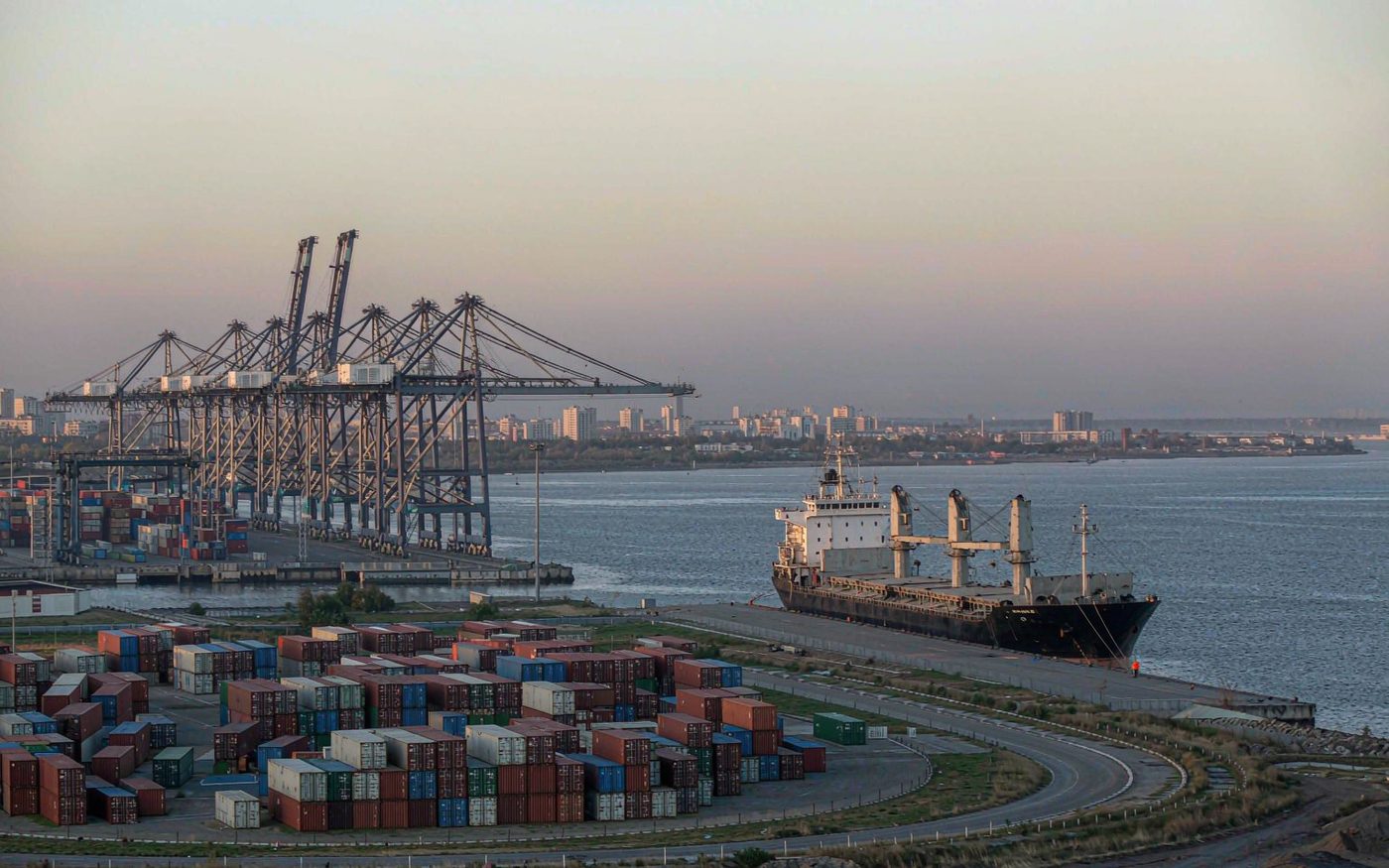
Odesa is the largest commercial port and handles the majority of containerised imports. Services run direct from major Chinese ports or via transhipment through a hub such as Constanta or Istanbul, and which one you get affects the transit more than the ocean distance does.
Sea freight suits full container loads and consolidated cargo where time is not the binding constraint. It ends at the port; the consignee arranges the entry and the inland movement.
Air cargo into Boryspil, and the hubs it depends on
Kyiv Boryspil is the main air cargo gateway and serves the capital and the wider region. Most shipments transit through regional hubs rather than arriving direct.
Air suits high-value electronics, automotive parts, pharmaceuticals, samples and urgent industrial components. It ends at the airport, and the consignee clears and collects.
The documents an entry asks for
A Ukrainian entry is supported by a commercial invoice, a packing list and the transport document, with the customs value declared and the commodity classification given. Where the goods fall into a controlled category, certificates and permits sit on top of that set.
What tends to hold a consignment is a declared value that does not reconcile with the invoice, a description that does not match the contents, or a certificate that was never applied for. All three are preventable in China.
Product certificates and the permits behind them
Several categories need certification or a permit issued before or at import, including food and agricultural products, medicines, telecommunications equipment and plant products. These are issued by sector bodies rather than by customs, and their lead times are longer than the transit.
Identify which apply to your goods while they are still in production. A permit applied for after the vessel sails is a permit applied for while the container waits.
Packing for the inland run that follows clearance
Ukraine is a large country, and the inland movement after clearance is a substantial part of the journey rather than a short final hop. Packing specified for a port-to-port move is packing for fewer handlings than will occur.
Marking matters for the same reason. Goods that will be sorted, transhipped and delivered need to be identifiable at each stage, and that is decided in China.
Incoterms, payment proof and who clears
Our services are port-to-port, airport-to-airport or depot-to-depot, and the consignee handles the entry and the onward movement. The incoterm therefore decides who is the importer of record, and that decision has to match who can actually file and pay.
Evidence of payment is part of the picture at clearance on commercial consignments. Having it ready before the goods arrive is cheaper than producing it while the container is being assessed.
Confirm the figure in force before you quote
Because the threshold has been reviewed more than once, the responsible approach is to confirm the position for your commodity code and your consignment at the time you are shipping, rather than relying on a figure from a comparison table or a previous year.
We check the current position against your code while the goods are still in China and confirm it to you in writing. That is the difference between a landed cost you can defend and one you have to explain to your customer.
Real shipments across Ukraine
Five shipments bought in China and delivered into Ukraine, told end to end — where the order came from, how it moved, where it nearly went wrong, and how it finished. Client names are withheld at their request; the situations and the handling are what we deal with on this lane.
Under the line · first parcel · Shenzhen to Kyiv
The purchase. A buyer new to importing assumed every international parcel was assessed regardless of value.
The move. Consolidated cargo sent as an express consignment addressed to an individual, below the threshold and cleared without duty or tax.
Where it nearly went wrong. Postal and express consignments to an individual below the threshold carry neither import duty nor value-added tax. Assuming otherwise overstates your landed cost and prices you out of orders you should have won.
How it finished. He sends within the threshold where it genuinely applies. His small orders cost what they should.
On the excess only · costing · Ningbo to Odesa
The purchase. A first-time buyer assumed that crossing the line made the entire consignment taxable.
The move. Full container with duty and value-added tax assessed on the amount exceeding the threshold, not on the whole value.
Where it nearly went wrong. The charge falls on the excess, and the tax is calculated on the excess plus the duty. Overstating this to a customer makes a competitive quote uncompetitive for no reason.
How it finished. We model it on the correct base. His quotes have been accurate ever since.
A batch, not a gift · the reclassification · Guangzhou to Ukraine
The purchase. A buyer sent identical units as personal parcels in the belief that the value limit protected him.
The move. Consolidated cargo declared as a commercial consignment and cleared under business rules with the correct certificates.
Where it nearly went wrong. Repeated or identical parcels may be recognised as a commercial consignment regardless of value. Presenting commercial volumes as personal parcels produces an assessment and a delay at the same time.
How it finished. He declares stock as stock now. Nothing of his has been reclassified since.
Split parcels · the grouping rule · Yiwu to Ukraine
The purchase. A buyer split one order into two consignments to stay below the line and was assessed anyway.
The move. Consolidated cargo shipped as one declared consignment, with the value stated accurately.
Where it nearly went wrong. Consignments from the same sender to the same recipient within a short window are grouped and their values summed. Splitting does not avoid the assessment, and it adds a handling cost for nothing.
How it finished. He stopped splitting. His costs came down and the assessments stopped being a surprise.
Certificates · before the goods sail · Shanghai to Odesa
The purchase. A buyer shipped regulated products assuming the general document set would be enough.
The move. Full container with the sector certificate identified and obtained during production rather than after departure.
Where it nearly went wrong. Several categories need certification from a sector body, and those lead times are longer than the transit. Applying after the vessel sails is applying while the container waits.
How it finished. We identify certificates at quotation now. No regulated shipment of his has been held since.
Why importers use Goodhope on this lane
Six things that are different about working with us on China to Ukraine shipments.
Ask for a Ukraine plan with the certificates listed
Tell us what you are shipping, what it is worth and who will receive it. We will confirm the threshold position for your commodity code, identify any certificate your category needs, set out the routing including the inland leg, and quote every charge separately.
Get a quote Talk to usRelated pages
Frequently asked questions
Is there a de minimis threshold for imports into Ukraine?
Yes, for international postal and express consignments addressed to an individual. Below it, no import duty and no value-added tax is charged. The figure has been the subject of proposed change, so confirm the position in force before you ship.
Is tax charged on the whole consignment once the line is crossed?
No. Duty and value-added tax are charged on the amount exceeding the threshold, with the tax calculated on that excess plus the duty.
Can repeated parcels be treated as commercial?
Yes. Where the same pattern of goods arrives repeatedly, or in identical units, customs may recognise a commercial consignment regardless of value and assess it under business rules.
Does splitting one order into two parcels avoid the charge?
No. Consignments from the same sender to the same recipient within a short window are grouped and their declared values summed, so the assessment is charged anyway.
Which port does sea freight to Ukraine use?
Odesa, the largest commercial port, which handles the majority of containerised imports. Services run direct or via a hub such as Constanta or Istanbul.
Can air freight be booked to Ukraine?
Yes, to Kyiv Boryspil International Airport, the main air cargo gateway. Most shipments transit through regional hubs.
What documents does a Ukrainian entry need?
A commercial invoice, a packing list and the transport document, with the customs value declared and the commodity classification given. Controlled categories need certificates or permits on top.
Which product categories need certification?
Food and agricultural products, medicines, telecommunications equipment and plant products among others, issued by sector bodies rather than by customs. Identify them while the goods are still in production.
Do you deliver door to door in Ukraine?
No. Services are port-to-port, airport-to-airport or depot-to-depot. The consignee handles the customs entry and the onward movement.
How do I know the threshold that applies to my shipment?
We check the current position against your commodity code while the goods are still in China and confirm it in writing before you commit.