
Home / Shipping to Uruguay / How to Ship from China to Uruguay
How to Ship from China to Uruguay: Montevideo, Mercosur CET & IVA
Your duty rate is not decided in Montevideo. Uruguay is a founding member of Mercosur alongside Argentina, Brazil and Paraguay, and goods arriving from outside the bloc are assessed under the bloc's common external tariff. Uruguay cannot cut that tariff for Chinese goods on its own, because the bloc negotiates as one. China has been Uruguay's largest trading partner for more than a decade and the two governments said in February 2026 that they hope to open China–Mercosur negotiations soon — but nothing is in force, and the rate you pay today is the bloc's rate. Model your landed cost on that, not on the bilateral agreements Chile, Peru and Ecuador signed with Beijing.
The second thing is that the tax stack is heavier than the freight, and one line of it is missing from almost every quotation. IVA runs at twenty-two percent, the highest headline rate in this series of guides, and it is charged on the customs value plus the duty. On top of that sits a consular duty, reported at five percent of the CIF value for goods of non-Mercosur origin, which is to say for everything you buy in China. Most first-time importers have never heard of it, and most quotations do not list it.
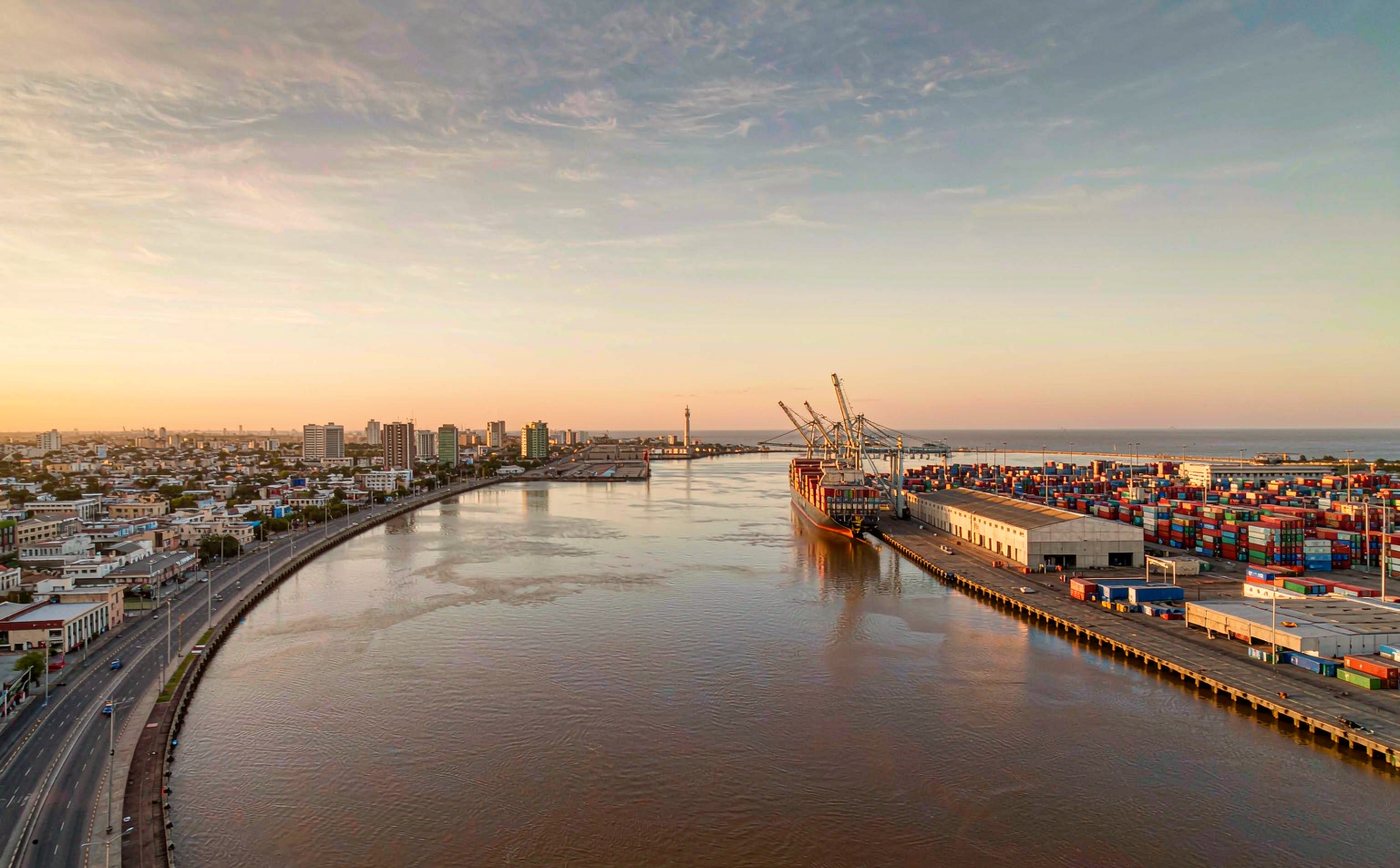
The third thing is the one that turns Uruguay from a small market into a useful one. Montevideo is a free port in the legal sense. Goods can sit in the port customs area for up to five years without import taxes, with the destination changeable and the cargo saleable onward to a company abroad. Add the river outlet at Nueva Palmira, where the Paraná–Paraguay waterway begins its run north to Asunción, and Montevideo becomes a staging point for a catchment very much larger than Uruguay's three and a half million people.
At a glance
Duty: the Mercosur common external tariff, 0–35% at NCM code level; no preferential rate for Chinese origin. · IVA: 22% on customs value plus duty — 11% reduced for some foods and medicines, recoverable as an input credit for RUT-registered entities. · Consular duty: reported at 5% of CIF for non-Mercosur origin, 3% for Mercosur or Chilean origin . · Other charges: customs services duty around 0.2% of CIF capped near US$50; extraordinary duty capped near US$600; advance IVA payment of 10% (3% reduced-rate), creditable. · Valuation: CIF. · Entry: a RUT tax number and a licensed despachante filing the DUA through VUCE. · Gateways: Montevideo for containers, Nueva Palmira for bulk and the river route north. · Transit: around 32–45 days port to port, 3–7 days by air into Carrasco. · Supply: 220 V at 50 Hz.
How your cargo moves: China to Uruguay
Eight steps from your supplier's door to yours. The last four are the ones shaped by local rules.
- Pickup from your supplierWe collect the goods anywhere in China and bring them to our consolidation point.
- Export clearanceChina customs declaration filed and released before the goods move to the port.
- Loading and departureContainer loaded, sealed and handed to the carrier at the Chinese port.
- Main carriageOcean, air or rail movement booked on the route agreed for your cargo.
- Arrival at the gatewayDischarge at the port or airport of entry, recorded on the carrier's manifest.
- Import clearanceCustoms declaration filed locally, with duty and tax assessed on the declared value.
- Customs releaseGoods released into free circulation once duty and tax are settled.
- Final deliveryOnward movement to your delivery address, warehouse or nominated depot.
Duty rates, VAT rates and clearance times move, and the figure that applies to your goods is the one set for your commodity code on the day of clearance. We check the current position against your code before your goods sail and confirm it to you in writing — ask for that check when you request a quote.
What this guide covers, and what sort of import this is
This is written for a buyer bringing goods out of China for the first time and landing them in Uruguay. It follows the shipment in the order you meet the problems: who sets the duty, what the tax stack contains, how the product is classified, whether the goods need to clear at all, who can sign the paperwork, and how long thirty-odd days at sea actually takes once the legs on either side are counted.
It does not quote freight rates. Those move with the market and a figure printed here would be stale within weeks. What it does instead is show where the money goes, and which decisions change the total, so that a quotation can be read for what it omits as well as what it contains.
One thing worth settling before the rest is useful. Are the goods for Uruguay, or are they going through Uruguay? A container for the domestic market clears, pays, and goes to a warehouse. A container destined for Asunción, or for a customer you have not identified yet, may never clear at all, and the entire route, the charges and the paperwork change accordingly. The free port section below is where that difference is cashed out.
Mercosur sets your tariff, not Montevideo
Mercosur is a customs union, not merely a free trade area, and the consequence for an importer is specific: member states do not set their own tariffs on goods from outside the bloc. They apply the Arancel Externo Común, the common external tariff, and the rate that matters is the one attached to your NCM line.
The tariff runs from zero to thirty-five percent ad valorem. Published averages disagree, and the disagreement is worth understanding rather than picking a side: a reference average near seven percent is quoted for the tariff as it stands after the bloc's 2022 review, while forwarder guides commonly describe a four-tier structure of zero, ten, fifteen and twenty percent averaging nearer fourteen. Both can be true of different baskets. Neither is a substitute for the rate on your own line, and [the only number that should enter your model is the one your broker confirms for your NCM code].
Three exceptions soften the picture in practice. Capital goods, information technology and telecommunications equipment have sectoral arrangements that often place them well below the average, with laptops frequently at zero and networking and server equipment roughly in the zero to six percent range. Uruguay layers its own national exceptions on top of the bloc's. And goods that reach the bloc through one member and cross into another meet the tariff at each crossing, which is why routing a Uruguayan shipment through a neighbouring port is not a duty-neutral decision.
The politics are worth separating from the arithmetic. China has been Uruguay's largest trading partner for more than ten years, and the joint statement issued during President Orsi's visit to China in February 2026 recorded both governments wishing to open China–Mercosur free trade negotiations at an early date. Uruguay has long been the member most eager for that, and its advocacy is the reason the subject keeps moving. But Mercosur negotiates as a bloc, no negotiation has been launched, and nothing is in force. Plan for the full rate.
The tax stack, and the five percent nobody budgets for
Duty is the first line of the calculation and, on this lane, not the largest. Here is the full stack as it is reported:
| Charge | Basis and rate |
|---|---|
| Import duty | Common external tariff by NCM code, 0–35% of CIF. |
| IVA | 22% on the customs value plus the duty paid. A reduced 11% rate applies to certain foods and medicines. Recoverable as an input credit for RUT-registered entities. |
| Consular duty | Reported at 5% of CIF for goods of non-Mercosur origin — which includes everything shipped from China — and 3% for Mercosur or Chilean origin. Mexican origin and temporary admission goods are reported exempt. |
| Customs services duty | Around 0.2% of CIF, capped near US$50. |
| Extraordinary customs duty | A flat duty on a scale, capped near US$600. |
| Advance payment of IVA | 10% for general goods, 3% for reduced-rate goods, creditable against the monthly return. |
| IMESI excise | Tobacco, alcohol, fuels and some vehicles. Not applicable to ordinary industrial or consumer hardware. |
| Broker fee | Varies with shipment value. |
The compounding is the part to internalise. On a twenty percent duty line, duty and IVA alone approach half of the CIF value, and the consular duty sits on top of that. It is not unusual for the total tax burden on a consumer-goods line to exceed forty percent of the goods' value, which is a very different proposition from the seven percent headline that makes Panama look cheap.
The fixed charges carry a second lesson, and it points the opposite way from the usual advice. The extraordinary duty, the services duty and the broker's fee do not scale with the size of the shipment. A small consignment pays roughly the same administrative overhead as a large one, which means the per-cubic-metre cost of a small shipment is dominated by charges that have nothing to do with the cargo. Consolidating several suppliers into one container is worth more here than on lanes where the overhead is proportional.
One warning that belongs in this section rather than the paperwork one. Do not under-declare the invoice value to reduce a twenty-two percent tax. The customs authority cross-references declared values against export data, and the published consequences include audit, fines, seizure of the goods and suspension of the importer's registration. The tax is large and it is real; it is not negotiable by arithmetic.
Finally, the currency. The Uruguayan peso is freely convertible and there is no exchange control, so paying a Chinese supplier is straightforward. But the peso does move, and if your selling prices are set in pesos while your costs are in dollars, the exposure between placing the order and clearing it is yours to manage. That is a genuine difference from the dollarised lanes covered elsewhere in this series.
NCM codes, and why the sixth digit is not the end of it
Ask a Chinese supplier for the HS code and you will usually get six digits. That is the international Harmonized System heading, and it is not enough for Uruguay. Classification happens under the Nomenclatura Común del Mercosur, an eight-digit extension of the HS that the bloc maintains, and the duty rate, the sectoral exceptions and the trade statistics all attach to the eight-digit line.
This matters because a single six-digit heading can split into several NCM lines carrying different rates. Two products your supplier describes with the same HS code can be assessed differently at the border, and the difference is discovered at filing, which is the worst possible moment. It is also why a classification that worked for a shipment to Chile or Brazil should not simply be carried across.
Practically: send your broker the product description, the material composition, the intended use and the supplier's proposed code, and ask for the NCM line in writing before the order is priced. Then hold that line constant across the invoice, the packing list, the certificate of origin and the declaration. Consistency costs nothing and prevents the category of delay that costs storage.
The free port, and goods that never clear at all
Uruguay's ports law establishes a free port regime at Montevideo, and its terms are unusually generous. Goods may remain in the port customs area for up to five years, extendable. While they are there they are exempt from import taxes and from import-related surcharges. The declared destination can be changed. Permitted operations include repacking, remarking, sorting, grouping and ungrouping, consolidating and deconsolidating, handling and fractioning. Goods retain their certificate of origin and the benefits attached to it regardless of where they are eventually sent, and the rights to them can be sold, bought or assigned to a company abroad without fees or taxes.
That is a redistribution instrument, and it is why Montevideo is described locally as the gateway to Mercosur. The practical pattern looks like this: one container arrives from China and enters the free port rather than the market. Stock is drawn down over months as orders arrive from Uruguay, Argentina, Paraguay and Brazil. Duty and IVA are paid only on what is entered, when it is entered, in the country that receives it.
When the free port earns its keep
You serve more than one market in the bloc, or you do not yet know who the end customer is. Storage is cheap relative to the tax that would otherwise be due up front, the destination can be changed without penalty, and goods can be repacked or consolidated inside the zone to match each order.
When it does not
The goods have one destination and it is Uruguayan. The free port then adds a storage charge and an administrative step to defer a tax you were going to pay anyway. Five years is a ceiling, not a plan: goods left sitting because the paperwork was never finished are the expensive version of this mistake.
There is a bonded warehouse regime alongside it, and temporary admission for goods that will be re-exported after processing. Both are worth asking about if your pattern is import-transform-re-export rather than import-sell.
Montevideo, Nueva Palmira, and the river road north
Uruguay has two ports with ocean access, and they do different jobs.
| Port | Handles | Why it matters to you |
|---|---|---|
| Montevideo | Containers, mostly | The arrival point for essentially all containerised imports. Free port regime, bonded warehousing, and a hinterland that reaches deep into the bloc. |
| Nueva Palmira | Bulk, and the waterway | On the Uruguay River at the confluence with the Paraná, 248 km from Montevideo. It is the ocean outlet of the Paraná–Paraguay waterway, which runs some 3,400 km north to Puerto Cáceres in Brazil. |
The second port is the one that surprises people. The waterway is a five-country project to turn the Paraná and Paraguay rivers into a freight channel, and it carries barge convoys to Asunción in Paraguay, to Rosario and Santa Fe in Argentina, and onwards towards eastern Bolivia. Paraguay moves the overwhelming majority of its trade on it. Container services also run by barge between Montevideo and terminals in the Asunción area, so a container booked to Montevideo can continue north by water rather than by road.
If your market is Paraguay, that is one of the standard routes, and it is worth costing against trucking through Brazil. Two cautions come with it. Barge convoys assemble on schedules, so a container delayed at discharge can miss one and wait for the next. And the river is depth-sensitive: low water slows convoys and adds days, most often in the dry months.
Goods moving across Uruguayan territory under customs control travel sealed, with an electronic GPS seal fitted by an authorised operator, which is how the customs authority tracks a transit without escorting it. It is efficient, and it means the seal and the paperwork have to match at both ends.
Who can import: the RUT and the despachante
Imports are administered by the Dirección Nacional de Aduanas, the national customs directorate, through a single window called VUCE. The declaration is the Documento Único Aduanero, and it is filed by a licensed customs broker, the despachante de aduanas, acting for the importer.
Two things have to exist before that filing can happen. The first is the RUT, the single tax register number of the importer of record. The second is the instruction to the broker, and it needs to happen before the vessel berths rather than after, because free time at the terminal is reported at roughly five to seven days for dry containers and the declaration cannot be filed without the RUT on it.
From the first of January 2026 the consignee's RUT has to appear on all air waybills and commercial invoices for shipments to Uruguay. This is a documentary requirement, not a tax one, and it catches air freight and courier consignments that never see a customs broker at origin. Put the number on the invoice as a matter of routine.
The declaration is routed by risk profiling to a green channel, which is a document review, or a red channel, which is a physical inspection. Valuation is on a CIF basis throughout. IVA is paid at clearance, and for an entity registered for the RUT it is recoverable as an input credit against the monthly return — real money back, but cash out first, and calculated on a base that already includes the duty.
The long voyage: two ways round South America
Asia to the east coast of South America is one of the longer mainstream lanes, and there is more than one way to sail it. Services run across the Pacific and transit the Panama Canal into the Atlantic, or they go the other way round through the Indian Ocean and past southern Africa. Which one your vessel takes is the carrier's decision and it changes.
That variability is the point. A transit quoted on a canal routing and a transit actually sailed round the Cape differ by more than a week, and the conditions that push carriers from one to the other — slot availability at the canal, draft restrictions, bunker economics, diversions elsewhere in the world — are exactly the conditions described in the Panama guide. Ask which routing your quotation assumes. It is a fair question and the answer tells you how firm the arrival estimate is.
Published figures for the lane cluster around thirty-two to forty-five days port to port, with a public Shanghai–Montevideo benchmark in the mid-thirties. Air freight into Carrasco runs three to seven days and courier three to six, usually connecting through Europe or North America rather than flying direct.
LATU, URSEC and the health permits
Uruguay's customs procedure is efficient. The product authorisations are not, and they are where containers wait.
| Authority | What it covers |
|---|---|
| LATU — Laboratorio Tecnológico del Uruguay | Technical standards certification for electronics, electrical equipment and industrial machinery, including energy efficiency requirements. |
| URSEC — telecoms regulator | Homologation for anything using radio frequencies or connecting to the public network: WiFi at 2.4 GHz and 5725–5850 MHz, Bluetooth, LTE and 4G, 5G equipment, RFID and mobile phones. No in-country testing is required; FCC grants or CE and RED test reports are accepted. Certificates are reported valid for fifteen years and no local representative is needed. Note that the 5470–5725 MHz band is reserved for government use and is not available. |
| Ministry of Public Health | Cosmetics, health products, pharmaceuticals and supplements. |
| Agriculture ministry | Food, plants, seeds and other agricultural goods, including phytosanitary clearance. |
Two practical notes. URSEC is unusually workable for an importer: no in-country testing, foreign test reports accepted, no local representative, and a fifteen-year certificate — which means a one-off cost per SKU rather than a recurring one. And the timing rule for all four authorities is the same: registrations are measured in weeks and a container waiting on one is paying storage. Start them with the production order, not with the packing list.
Following a container from Huangpu to a warehouse in Montevideo
Here is the lane end to end, for goods bound for the Uruguayan market.
Classification, before anything else
The NCM line is confirmed with your broker while the goods are still in production. Product description, materials and intended use go to the broker; the eight-digit line comes back and is used on every document from then on.
Booking, and the routing question
Book three to four weeks ahead on this lane, because sailings are less frequent than on the major east-west trades. Ask whether the service is scheduled through the canal or round the south, and get the answer in writing alongside the transit estimate.
Export clearance and loading in China
Collection, loading at Huangpu, Chinese export declaration. Verified gross mass goes in before the carrier's deadline, and any permits — LATU, URSEC, health — should already be in hand or well advanced by now.
The ocean leg, thirty to forty days
Either across the Pacific and through the canal, or round southern Africa. Some services include a transshipment at a regional hub, which adds days and a handling step.
Discharge at Montevideo
Free time starts, reported at around five to seven days for dry containers. Destination charges apply, and once free time expires daily demurrage begins.
The declaration
Your despachante files the DUA through VUCE with the RUT on file, and the shipment is routed to the green or red channel. A red channel inspection adds days, and the reason is almost always in the paperwork.
Duty, IVA and the rest of the stack paid
Duty by NCM, IVA at twenty-two percent on value plus duty, consular duty, the fixed customs charges and the advance IVA payment where it applies. Cleared, released, and trucked to the warehouse — normally a short move within greater Montevideo.
If instead the goods are going into the free port, the container moves into the port customs area at the discharge step and the tax event is deferred until they are entered. Everything else — the NCM, the permits, the invoice — still has to be right, and it has to be right whenever the entry eventually happens.
Transit times, and where the extra fortnight goes
| Leg | Days | Applies to |
|---|---|---|
| Origin consolidation | 3–7 | LCL only |
| Main ocean leg to Montevideo | 30–40 | FCL and LCL; routing dependent |
| Deconsolidation | 3–7 | LCL only |
| Customs clearance | 1–5 | Both, with clean documents |
| Inland within greater Montevideo | same day to next | Both |
| Onward barge to Asunción, if applicable | add roughly a week | River route north |
| Air to Carrasco | 3–7 | Airport to airport |
| Courier | 3–6 | Door to door |
Published door-to-door cycles for the whole journey, factory to Uruguayan warehouse, run from about forty-two to sixty-two days. The spread is not noise; it is the sum of the things above plus the two that catch everybody. Missing the carrier's cut-off in China costs a full week immediately, because the next sailing is seven days away. And a red channel inspection, or a permit that was started late, costs whatever it takes to resolve — during which the container is on the clock.
Consolidating into a small market
The familiar break-even still holds in outline: below roughly twelve to fifteen cubic metres a consolidated shipment usually wins, between fifteen and twenty price it both ways, and above twenty a full container usually wins on cost per cubic metre.
Uruguay adds a wrinkle that pushes the decision towards the full container. The fixed charges in the tax stack — the extraordinary duty capped near six hundred dollars, the services duty, the broker's fee — do not shrink with the shipment. Two small consolidated shipments pay the overhead twice. Several suppliers consolidated into one container in China pay it once, and on this lane that difference is frequently larger than the freight saving people consolidate for in the first place.
Pallets, humidity and the mark on the wood
Solid wood packaging has to meet ISPM 15 and carry the stamp. The stamp is what is checked, not the treatment certificate, and one unmarked pallet can hold a whole consignment. Plywood, OSB and other processed wood fall outside the rule, which is often the simplest way to remove the risk.
The voyage is the longer issue. A container leaving southern China crosses the equator, sits in tropical heat for weeks, and then arrives in a temperate, humid estuary. Condensation forms on the inside of the roof and drips onto the top layer of cartons — the failure known as container rain. Desiccants, a moisture barrier under the pallets and wrapping that breathes rather than seals cost very little against the value of the cargo. Specify packaging for a forty-day voyage in tropical conditions, because that is what it is.
Labelling in Spanish, and a 220 volt supply
Retail goods are labelled in Spanish: product name, country of origin, expiry or manufacturing dates, and ingredients where the product is a consumable. That is a production decision, not a customs one — customs will release unlabelled goods and the problem will surface afterwards, when a retailer or an inspector looks at the shelf.
The mains supply is 220 volts at 50 hertz. Equipment built for a 110 volt market will not run, and this is a genuinely common error because the neighbouring lanes differ: Panama runs 110 volts, and Brazil mixes 127 and 220 depending on the region. Specify the voltage per destination country, not per region, and check what the plug pattern is before the production run.
Company goods, and the parcels addressed to a person
Commercial stock follows the ordinary path: NCM, duty, IVA, consular duty, the fixed charges, a despachante and a RUT. Nothing about being a repeat importer shortens that, though regular shippers should ask their broker about simplified or periodic arrangements.
Small parcels sent by courier are handled under a simplified regime, and low-value parcels often pass with little or no charge. Two cautions. The treatment of low-value consignments changes, and [the current threshold should be confirmed rather than assumed]. And repeated identical parcels to the same recipient get reclassified as commercial imports, at which point the full stack applies to all of them.
Samples are the other trap. Marking a parcel "samples without commercial value" when the goods have one is a classic trigger for exactly the kind of audit described earlier. Declare the real value, even on a sample.
Household goods and personal effects on relocation are treated differently, with relief reported for returning residents and for foreigners establishing residence, subject to conditions on personal use and on how long the items have been owned, and supported by a valued inventory. New items, or a shipment that looks commercial in quantity or packaging, are taxed in full.
The Uruguayan calendar, and the summer shutdown
Two periods reliably slow this lane, and both are predictable.
Chinese New Year, in January or February, shuts factories and empties sailings. On a lane where missing a cut-off costs a full week, the fortnight either side of it is the most expensive time to be improvising.
The Uruguayan summer and Easter. December through February is the main leave period, and Tourism Week — the week running up to Easter — closes a large part of the country, including plenty of the businesses an import depends on. Add the public holidays scattered through the year, and the practical rule is simple: do not schedule an arrival in the last fortnight of December, in January, or in Easter week.
The river adds its own season. If your cargo continues north by barge, low water on the Paraná and Paraguay slows convoys, most often in the drier months. Ask what the river is doing before you promise a delivery date in Asunción.
The paperwork, and the RUT that has to be on it
| Document | What it has to do |
|---|---|
| Commercial invoice | True transaction value, full product description, the NCM code, country of origin, and the consignee's RUT — a documentary requirement since the start of 2026. |
| Packing list | Carton count, dimensions and weights, matching the invoice. Verified gross mass depends on these figures. |
| Bill of lading or air waybill | Consignee matching the importer of record, with the RUT shown on air waybills. |
| Certificate of origin | Evidence that the goods are of Chinese origin, typically issued by CCPIT. It does not reduce the rate, because no agreement covers Chinese goods. |
| LATU, URSEC, health and agriculture authorisations | Where the product is regulated. Started before the goods ship, with the same product description used everywhere. |
| Dangerous goods documentation | Safety data sheet and test report for batteries or cells; a declaration where the cargo is classed. |
| Insurance certificate | Your evidence of cover on a long voyage. |
Then the two checks that matter most, and both are free. One NCM line, used identically, on the invoice, the packing list, the certificate and the declaration. And one declared value that equals the real transaction value, because the customs authority cross-references it and the penalties for a mismatch are far larger than the tax saved.
Get the RUT issued and the despachante instructed before the vessel berths. On this lane the voyage is long enough that there is no excuse for the paperwork to arrive after the ship.
Why importers use Goodhope on this lane
Six things that are different about working with us on China to Uruguay shipments.
True stories unpacked: Uruguay
Five shipments bought in China and delivered into Uruguay, told end to end — where the order came from, how it moved, where it nearly went wrong, and how it finished. Client names are withheld at their request; the situations and the handling are what we deal with on this lane.
The tax stack · first container · Huangpu to Montevideo
The purchase. A buyer new to importing budgeted duty and value-added tax and stopped there.
The move. Full container with the full stack itemised: duty, value-added tax, consular duty, the services charge and the advance payments.
Where it nearly went wrong. Several charges sit on top of duty and tax here, including a consular charge on non-regional origin and advance payments that are creditable but leave your account on the day. Budgeting the headline two is budgeting half the bill.
How it finished. We itemise the whole stack now. His landed costs have matched the assessment every time.
The sixth digit · classification · Shenzhen to Montevideo
The purchase. A first-time buyer classified at six digits as he did elsewhere in the region.
The move. Consolidated cargo classified to full national code level before the declaration was filed.
Where it nearly went wrong. Classification runs past the sixth digit here, and duty is set at that finer level. Stopping at six is stopping before the number that decides the rate.
How it finished. We classify to the full code now. Every declaration of his has been accepted since.
The free port · goods that never clear · Ningbo to Montevideo
The purchase. A buyer cleared everything into the market even where the goods were going onward.
The move. Cargo held in the free port where it was bound for onward movement, and cleared only where it was not.
Where it nearly went wrong. Goods can sit in the free port without clearing at all, which is the right treatment for cargo that is not staying. Clearing it first pays tax on goods that were never meant to enter the market.
How it finished. He splits by destination now. Tax on onward lines stopped being a cost.
The long voyage · quoting · Shanghai to Montevideo
The purchase. A buyer quoted the short end of the published transit range and missed it by a fortnight.
The move. Full container booked on a named routing, with the realistic span quoted rather than the best case.
Where it nearly went wrong. There are two ways round the continent and they differ by weeks. Quoting the faster of the two without confirming which one the service actually takes is quoting a routing you have not bought.
How it finished. He quotes the real span now. His customer commitments have held ever since.
Summer shutdown · the calendar · Guangzhou to Montevideo
The purchase. A buyer scheduled a critical delivery into the local summer without checking the calendar.
The move. Consolidated cargo scheduled around the shutdown, with the documentary work completed before it began.
Where it nearly went wrong. The working year here stops for a period in the local summer, and clearances stop with it. Planning a delivery into that window is planning around offices that are closed.
How it finished. He plans around the calendar now. No delivery of his has been caught by the shutdown since.
Why importers use Goodhope on this lane
Six things that are different about working with us on China to Uruguay shipments.
Request a quote on your Uruguay shipment
Tell us the origin port, the commodity and its description, the volume in cubic metres or the container type, and whether the goods are for the Uruguayan market or for onward movement in the region. We will confirm the NCM line and the routing before we quote, because both change the number.
Get a quote Talk to usRelated pages
Frequently asked questions
Is there a free trade agreement between China and Uruguay?
No. Uruguay is a founding Mercosur member and the bloc's common external tariff applies to goods from outside it. Uruguay cannot negotiate a bilateral tariff with China alone. In February 2026 both governments recorded their wish to open China–Mercosur negotiations soon; nothing is in force, so budget for the full rate.
How much import duty will I pay in Uruguay?
The common external tariff runs from zero to thirty-five percent at NCM code level. Published averages disagree — around seven percent after the 2022 review, nearer fourteen in forwarder guides with a four-tier structure — so only your own line matters. Capital goods, IT and telecoms equipment often sit well below the average.
What taxes are charged on top of import duty?
IVA at twenty-two percent on value plus duty, a consular duty reported at five percent of CIF for non-Mercosur origin, a services duty around 0.2 percent capped near fifty dollars, an extraordinary duty capped near six hundred dollars, and an advance IVA payment of ten percent that is creditable. IMESI excise applies to tobacco, alcohol, fuels and some vehicles.
What is an NCM code?
The eight-digit Mercosur tariff nomenclature, built as an extension of the Harmonized System. Classification in Uruguay happens at that level, and one six-digit HS heading can split into several NCM lines with different rates, so a code carried over from another country is not safe to reuse.
Do I need a customs broker to import into Uruguay?
In practice yes: the Documento Único Aduanero is filed through VUCE by a licensed despachante, and the importer needs a RUT tax number. From the first of January 2026 the consignee's RUT must also appear on air waybills and commercial invoices.
Is the import IVA recoverable?
For RUT-registered entities, yes — it is an input credit against the monthly return. But it is cash out at clearance, calculated on value plus duty, so it has to be financed even where the accounting nets it out.
How long does shipping from China to Uruguay take?
Roughly thirty to forty days on the water, giving thirty-two to forty-five days port to port. Consolidated cargo adds three to seven days at each end, clearance one to five. Published door-to-door cycles run forty-two to sixty-two days. Air into Carrasco is three to seven days, courier three to six.
Can I store goods in Montevideo without paying import tax?
Yes. Under the free port regime goods may stay in the port customs area for up to five years, extendable, exempt from import taxes while stored, with the destination changeable and the rights saleable onward. Duty and IVA attach only on entry into the market.
Which authorities certify products in Uruguay?
LATU for electronics, electrical equipment and machinery; URSEC for radio and telecoms equipment, accepting FCC or CE and RED reports without local testing and issuing a certificate valid fifteen years; the health ministry for cosmetics and pharmaceuticals; the agriculture ministry for food and plants.
What labelling and voltage rules apply?
Spanish retail labelling with product name, origin, dates and ingredients for consumables, and a mains supply of 220 volts at 50 hertz. Both are production decisions, and the voltage differs from Panama and from parts of Brazil.