
Home / Shipping to Uzbekistan / How to Ship from China to Uzbekistan
How to Ship from China to Uzbekistan: Tashkent, the 12% VAT & the Origin Certificate Rule
The most expensive document on an Uzbek shipment is the one that costs almost nothing to obtain. Published guidance describes a rule applying from late February 2026 under which, if the country of origin is not confirmed by a certificate, an additional duty of five to twenty percent is charged on top of the regular rate. That is not the loss of a preference — it is a penalty stacked onto the duty you were already going to pay. For Chinese goods the ST-1 form does not apply, because it is a CIS instrument; an ordinary certificate of origin in the general form is what removes the additional duty.
The second thing to understand is that the twelve percent VAT is not twelve percent of your goods. It is charged on the customs value plus the customs duty plus, for excisable goods, excise — each element added before the next is calculated. With a ten percent duty, the real VAT burden comes to more than twelve percent of the goods price. And the customs value itself is larger than your supplier's invoice, because the law explicitly includes transport to the destination, insurance and loading.
The third is that Uzbekistan rewards filing early. The declaration can be filed before the cargo arrives, and published guidance describes a twenty percent discount on the processing fee when it is, with document checks happening while the goods are still moving. On a lane where the inland leg is long, turning a terminal wait into an in-transit review is worth real money.
At a glance
Country: doubly landlocked in Central Asia, bordered by Kazakhstan, Kyrgyzstan, Tajikistan, Afghanistan and Turkmenistan; capital Tashkent. · Currency: the Uzbek soum. · Customs duty: by HS code under the Eurasian-free national tariff; most production equipment in chapters 84 and 85 is described as entering at zero. · VAT: 12 percent, on the customs value plus duty plus any excise. · Additional duty from 28 February 2026: 5–20 percent where origin is not confirmed by a certificate. · Excise: excisable goods only, by product code. · Processing fee: discounted 20 percent for an advance declaration. · Customs: the State Customs Committee, with the official Integrated Tariff service holding rates, non-tariff measures and the HS reference books. · Main gateways: rail through Kazakhstan via Alashankou–Dostyk or Khorgos–Altynkol, and road via the Kyrgyz and Kazakh borders.
How your cargo moves: China to Uzbekistan
Eight steps from your supplier's door to yours. The last four are the ones shaped by local rules.
- Pickup from your supplierWe collect the goods anywhere in China and bring them to our consolidation point.
- Export clearanceChina customs declaration filed and released before the goods move to the port.
- Loading and departureContainer loaded, sealed and handed to the carrier at the Chinese port.
- Main carriageOcean, air or rail movement booked on the route agreed for your cargo.
- Arrival at the gatewayDischarge at the port or airport of entry, recorded on the carrier's manifest.
- Import clearanceCustoms declaration filed locally, with duty and tax assessed on the declared value.
- Customs releaseGoods released into free circulation once duty and tax are settled.
- Final deliveryOnward movement to your delivery address, warehouse or nominated depot.
Duty rates, VAT rates and clearance times move, and the figure that applies to your goods is the one set for your commodity code on the day of clearance. We check the current position against your code before your goods sail and confirm it to you in writing — ask for that check when you request a quote.
Where the Uzbek entry points actually are
Uzbekistan is one of only two doubly landlocked countries in the world, which shapes every routing decision you will make. There is no direct sea leg that ends in Uzbekistan. What arrives by sea comes into a neighbouring port and continues overland, usually through Iran or through the Caucasus, and the sea-plus-road combination is quoted at roughly thirty to fifty days.
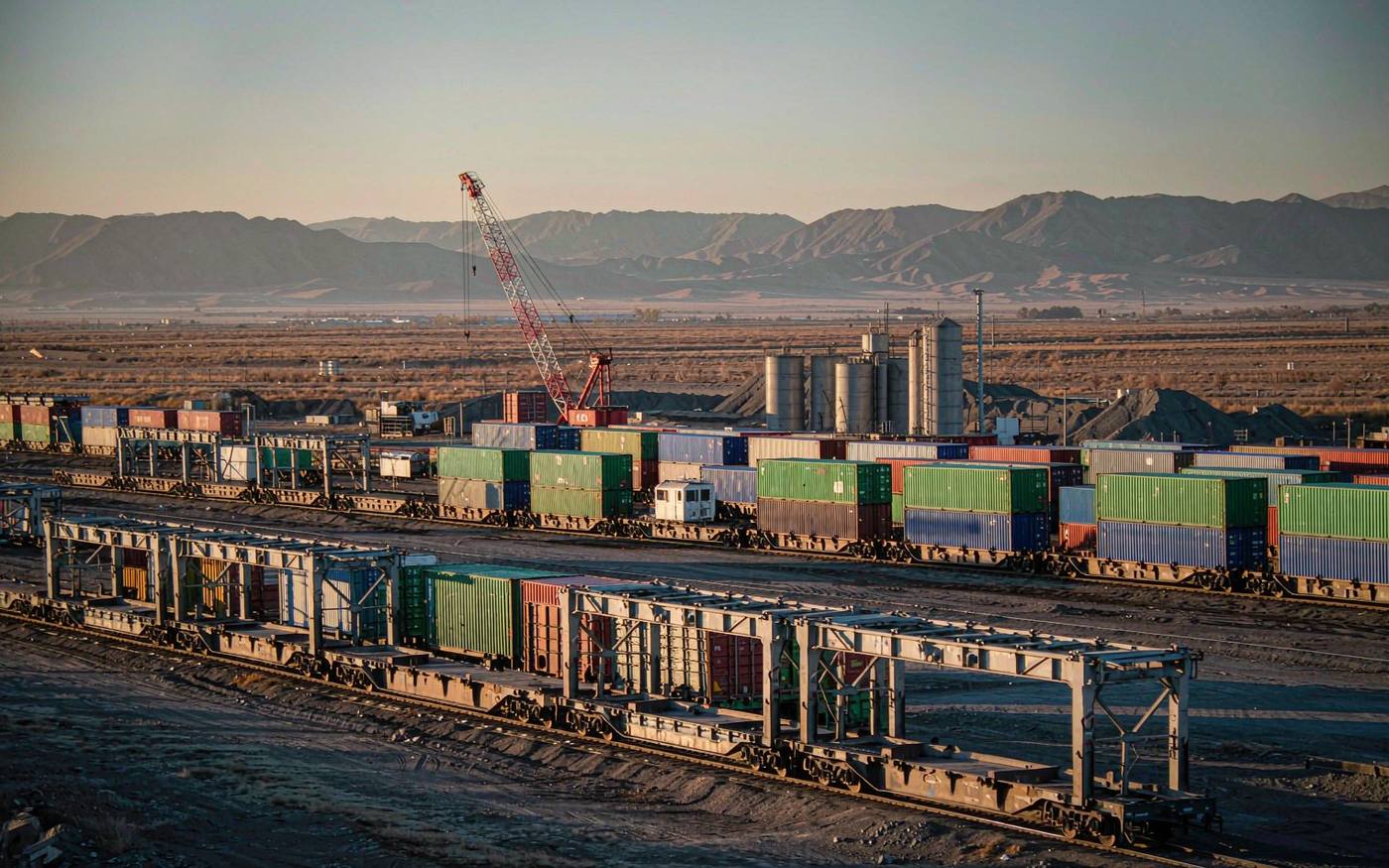
For most Chinese cargo the realistic choice is between rail and road. Published lane guidance puts road at roughly seven to twenty days and rail at around fifteen to twenty-five, with some operators quoting eighteen to thirty-five depending on origin, border handling and final destination. Most established rail services move through Kazakhstan, using the Alashankou–Dostyk or Khorgos–Altynkol gateways before continuing south into Uzbekistan. Rail suits heavy and regular commercial cargo; road suits flexible door-to-door work and machines up to roughly twenty tonnes in standard dimensions.
Routing in plain terms
| Mode | Transit range reported | Fits |
|---|---|---|
| Road | 7–20 days | Machines up to about 20 tonnes, standard dimensions, door-to-door |
| Rail | 15–25 days (some quote 18–35) | Heavy cargo, production lines, several trucks' worth at once |
| Sea + road | 30–50 days | Oversize and very heavy cargo where time allows |
| Air | Fastest, highest cost | Urgent, high-value, samples and spare parts |
The 2026 origin rule that quietly adds 5 to 20 percent
This is the single most important item on the page, and it is easy to miss because it sits in the customs code rather than in the freight quote. Published guidance describes article 300-1 of the Customs Code as applying from 28 February 2026: where the country of origin is not confirmed by a certificate, an additional duty of five to twenty percent is charged on top of the regular rate.
Two practical points follow. First, the exposure is asymmetric — the certificate costs little, and the penalty is a percentage of the value of every consignment you send without one. Second, the ST-1 certificate does not help with Chinese goods, because it is a CIS instrument. For Chinese cargo an ordinary certificate of origin in the general form is what removes the additional duty.
Make the certificate of origin a line item in your supplier checklist, not a nice-to-have. Ask for it when you place the order, and check the details on it before the container is loaded — a certificate that does not match the declared HS code will not do the job.
How the four import charges stack up
Four things are payable on import into Uzbekistan: customs duty, VAT, excise on excisable goods, and the declaration processing fee. They are calculated sequentially, each on top of the previous. That sequence is the whole story of the landed cost, and it is where most first-time budgets go wrong.
Customs value
The goods value plus transport to the destination, insurance and loading — explicitly not just the supplier's invoice figure.
Customs duty
Ad valorem on the customs value, specific on quantity, or a combined rate, depending on the tariff line. Most production equipment in chapters 84 and 85 is described as zero.
Excise
Only for excisable goods, at the rate for the specific product code. For everything else this step is nil and drops out of the calculation.
VAT at 12 percent
Taken on the running total — customs value plus duty plus excise. With a 10 percent duty the effective VAT is more than 12 percent of the goods price.
For a VAT-registered business, import VAT is not lost money: it is offset against the VAT charged on domestic sales, which makes it working capital rather than a cost. A business that is not VAT-registered carries the full amount into the landed cost and has to price for it in advance. Some goods come in free of VAT, and the list is tied to the HS code and changes over time — check it against your own code rather than against the description of the goods, because neighbouring tariff positions can be treated differently.
The customs value is not your invoice figure
New importers routinely budget the tax on the amount on the commercial invoice, and then discover that the base is larger. The law explicitly includes transport to the destination, insurance and loading in the customs value. Published interpretation also lists packaging, royalties and part of subsequent proceeds as additions where the supplier's price excludes them.
The declared value has to be quantifiable and supported by documents. Where a dispute arises, an inspector may question the declared value in only three cases: the supporting documents are missing, you did not produce the documents requested, or there are indications the figure is untrue. A discrepancy against indicative price lists is not among the grounds, which is a genuinely useful protection and worth knowing before you are told otherwise.
Filing early and the 20 percent fee discount
The declaration can be filed before the cargo arrives. Published guidance describes a twenty percent discount on the processing fee when it is, and notes that document checks then take place while the cargo is still in transit. The declaration is registered on the day of filing, and up to three business days are allowed for processing and document checks — not counting controls by other agencies.
Read that last clause carefully. The three days covers customs. Where your product also needs a conformity certificate, a veterinary or phytosanitary check, or a permit from a sector ministry, those controls run in parallel and on their own clock. On equipment, published guidance notes that uncertified cargo sits in temporary storage at your expense until the paperwork exists.
Four risk corridors and what colour your declaration gets
Uzbekistan's risk management system assigns every declaration one of four corridors, and the corridor decides how much of your shipment is examined before it is released.
| Corridor | Meaning | What it means for you |
|---|---|---|
| Green | Low risk | Automatic clearance, no pre-release control |
| Yellow | Medium risk | Documentary review, no physical examination |
| Red | High risk | Full control before release |
| Blue | Post-release control | Goods released, checked afterwards |
Being assigned a corridor does not release the declarant from responsibility for accurate information or for keeping records. In practice, the fastest way to stay in the low corridors is unglamorous: consistent documents, an HS code that matches the technical description, and a declared value you can evidence.
Product certification and the lithium battery trap
Some equipment is subject to mandatory conformity confirmation — electrical equipment, pressure vessels and lifting machinery among them. The consistent guidance is to check by HS code before the purchase, not after arrival. The cost of getting this wrong is not a fine, it is dwell time: uncertified cargo waits in temporary storage at your expense until the paperwork exists.
The lithium battery trap is the one that catches consumer goods and electronics importers. Products containing lithium batteries need a UN38.3 test report and an MSDS, and published lane guidance warns that a missing set can hold a consignment for around two weeks. Ask your supplier for both documents at the same time as you ask for the certificate of origin, and check they name the same cell model as the goods.
Documents to prepare
- Itemised commercial invoice — amount, description and HS code consistent with the contract.
- Packing list — piece count, gross and net weight, and the dimensions of every package.
- Transport document — CMR for road, railway waybill for rail, AWB for air.
- Certificate of origin — general form for Chinese goods; without it the 5–20 percent additional duty applies.
- Technical description — the HS code is determined from it, and certification follows the code.
- Conformity certificate — where the HS code requires it.
- UN38.3 and MSDS — for anything with lithium batteries.
- Fumigation certificate with the IPPC mark — for wooden packaging.
Rail, road, or sea and road: choosing on total cost
The comparison that matters on this lane is not the rate per kilogram, it is the total: freight, dwell, certification lead time, and the cost of the capital tied up while the goods move. Published guidance for Central Asia makes the point directly — a buyer who optimises the freight line and ignores the rest ends up with a slower door, more transhipment points, and a quote that cannot actually be booked in peak season.
Choose rail when the shipment is heavy, the delivery window is not tight, and you want a balance of cost and speed. Choose road when you need door-to-door flexibility and the cargo is within standard dimensions. Choose sea plus road for oversize and very heavy cargo where time allows — and remember that oversize is its own project: a low-bed trailer, route permits and sometimes an escort, adding a week or two of approvals that you need to start before the contract is signed, because the dimensions and weight of every package have to be known up front.
When customs disputes your declared value
There is a procedure here, and knowing it in advance changes how you respond. Where a dispute arises, conditional release lets customs set a provisional value and release the goods against security. You then have sixty calendar days to gather evidence. Miss that deadline and the security goes to the budget.
The more important protection: once you have formally objected to an additional assessment, customs cannot collect the money by indisputable procedure — only through a court. Filing a complaint with the court suspends enforcement of the decision. Keep your full price-constitution file, including the purchase contract, the payment records and market evidence for comparable goods.
Checks to run before reserving a rail slot
- Confirm the HS code from the technical description, not from the product name. Certification follows the code.
- Order the certificate of origin with the goods. Without it the additional 5–20 percent duty applies from 28 February 2026.
- Ask for the conformity certificate early where the code requires one. Temporary storage bills accrue daily.
- Get UN38.3 and MSDS for lithium batteries, and check the cell model matches.
- Budget VAT on the full base — customs value plus duty plus excise, not on the invoice.
- File the declaration in advance for the twenty percent fee discount and in-transit document checks.
- Fix the dimensions and weights of every package before the contract, especially for oversize.
Why importers use Goodhope on this lane
Six things that are different about working with us on China to Uzbekistan shipments.
Get the origin certificate before the container is loaded
Tell us what you are shipping, the HS codes if you have them, the dimensions and gross weight of every package, the pickup city in China and the delivery address in Uzbekistan. We will arrange the certificate of origin in the general form that removes the 5–20 percent additional duty, flag any HS code that looks like it needs a conformity certificate before the cargo moves, brief you on the lithium battery documents where they apply, and quote rail through Kazakhstan and road side by side on total landed cost rather than on freight rate alone. Where advance filing suits the shipment, we will tell you.
Get a quote Talk to usRelated pages
Frequently asked questions
What if I ship without a certificate of origin?
An additional duty of 5–20 percent applies on top of the regular rate from 28 February 2026. The ST-1 form does not apply to Chinese goods; an ordinary certificate in the general form removes the extra duty.
How is the 12 percent VAT calculated?
On the customs value plus duty plus any excise — not on the invoice. With a 10 percent duty the effective VAT comes to more than 12 percent of the goods price.
Is the customs value my invoice figure?
No. Transport to the destination, insurance and loading are explicitly included, so the base is the goods value plus delivery to the border.
Can I file before the cargo arrives?
Yes. Advance filing earns a 20 percent discount on the processing fee and moves document checks into the transit period.
What are the four risk corridors?
Green is automatic clearance, yellow is documentary review, red is high risk, and blue is post-release control. The corridor does not remove your responsibility for accuracy.
Can customs challenge my value?
Only on three grounds: missing documents, documents not produced, or indications the figure is untrue. A gap against indicative price lists is not a ground. Conditional release gives you 60 days to evidence the value.
Is duty zero on equipment?
Most of chapters 84 and 85 enter at zero, but spare parts often carry duty and disassembled lines can be classified item by item unless you declare them in advance as one machine.
What certification do I need?
Electrical equipment, pressure vessels and lifting machinery need conformity confirmation, checked by HS code before purchase. Lithium batteries need UN38.3 and an MSDS.
How long does shipping take?
Road roughly 7–20 days, rail about 15–25 with some operators quoting 18–35, sea plus road 30–50. Rail usually runs through Kazakhstan via Alashankou–Dostyk or Khorgos–Altynkol.
Can customs payments be deferred?
Generally 14–60 days, and up to 120 days for manufacturers importing for production needs. Security is normally required and customs decides within five working days.